

Author’s note: This article compares Qwen4-Max and GPT-6 Astra on benchmark scores, context specifications, and input/output pricing, and then explains which one is the better deal by task type.
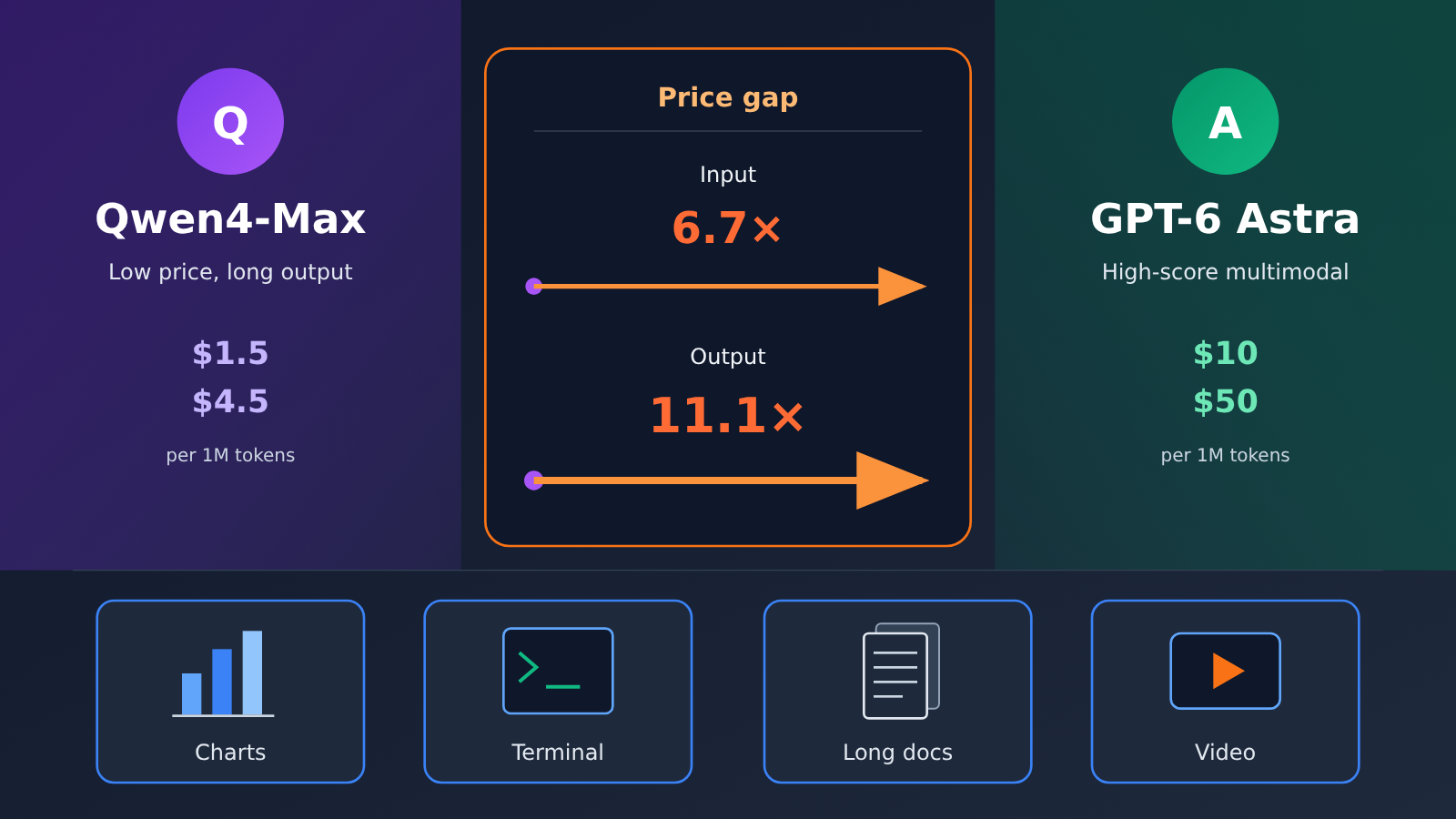
Bottom line first: GPT-6 Astra’s input price is about 6.7× that of Qwen4-Max, and its output price is about 11.1×. What that premium buys you is very concrete: mainly higher scores on three types of tasks—chart understanding, terminal and code-repo operations, and video understanding. On office-oriented Agent tasks and some professional benchmarks, Qwen4-Max actually leads.
This is not an article about who crushes whom across the board. Each model has clear strengths and clear weaknesses. This article compares only these two models. There are four kinds of sources for the facts: Qwen’s official self-reported head-to-head comparisons, OpenAI’s original documentation, a public arena leaderboard snapshot (2026-11-14), and APIYI platform pricing.
Core value: After reading this, you’ll have a model-selection table organized by task and budget, you’ll know where the extra money for Astra goes, and you’ll also know how the whole-request surcharge is calculated once Astra’s input exceeds 272K.
Qwen4-Max vs GPT-6 Astra: The Core Differences
Let’s start by putting the specs and pricing in a single table. The spec and pricing figures come from QwenCloud’s price list and OpenAI’s documentation, with data retrieved on 2026-11-16; all prices are per 1M tokens.
| Dimension | Qwen4-Max | GPT-6 Astra | Edge |
|---|---|---|---|
| Architecture / positioning | 2.4T backbone / 71B active + 328B N-gram Embedding, native vision | OpenAI’s most capable general-purpose model in its current lineup | Different purposes |
| Context window | 1M | 1,050,000 | Basically on par |
| Max input | 991K (983K in thinking mode) | 922K | Qwen4-Max |
| Max output | 393K (max chain-of-thought 262K) | 128K | Qwen4-Max |
| Reasoning tiers | Thinking mode | reasoning.effort: low / medium / high / xhigh / max |
Astra offers finer control |
| Input price | $1.5 | $10 (2x when input exceeds 272K) | Qwen4-Max |
| Output price | $4.5 | $50 (1.5x when input exceeds 272K) | Qwen4-Max |
| Knowledge cutoff | Not given in the reference materials | 2026-04-30 | — |
Context Window Differences Between Qwen4-Max and GPT-6 Astra
Both models nominally sit in the 1M range — the difference lies in how that budget is split between input and output. Qwen4-Max can emit up to 393K tokens in a single pass, a ceiling that comes in handy for long report generation, large-scale code rewrites, and batch structured extraction. Astra caps output at 128K, which is plenty for everyday work, though very long generations will need to be split up.
On max input, Qwen4-Max’s 991K also edges out Astra’s 922K. What’s actually more worth watching when you’re choosing between them is Astra’s pricing threshold: once input passes 272K, the unit price for the entire request goes up. We’ll run those numbers separately in the cost section below.
Qwen4-Max vs GPT-6 Astra: A Benchmark-by-Benchmark Look
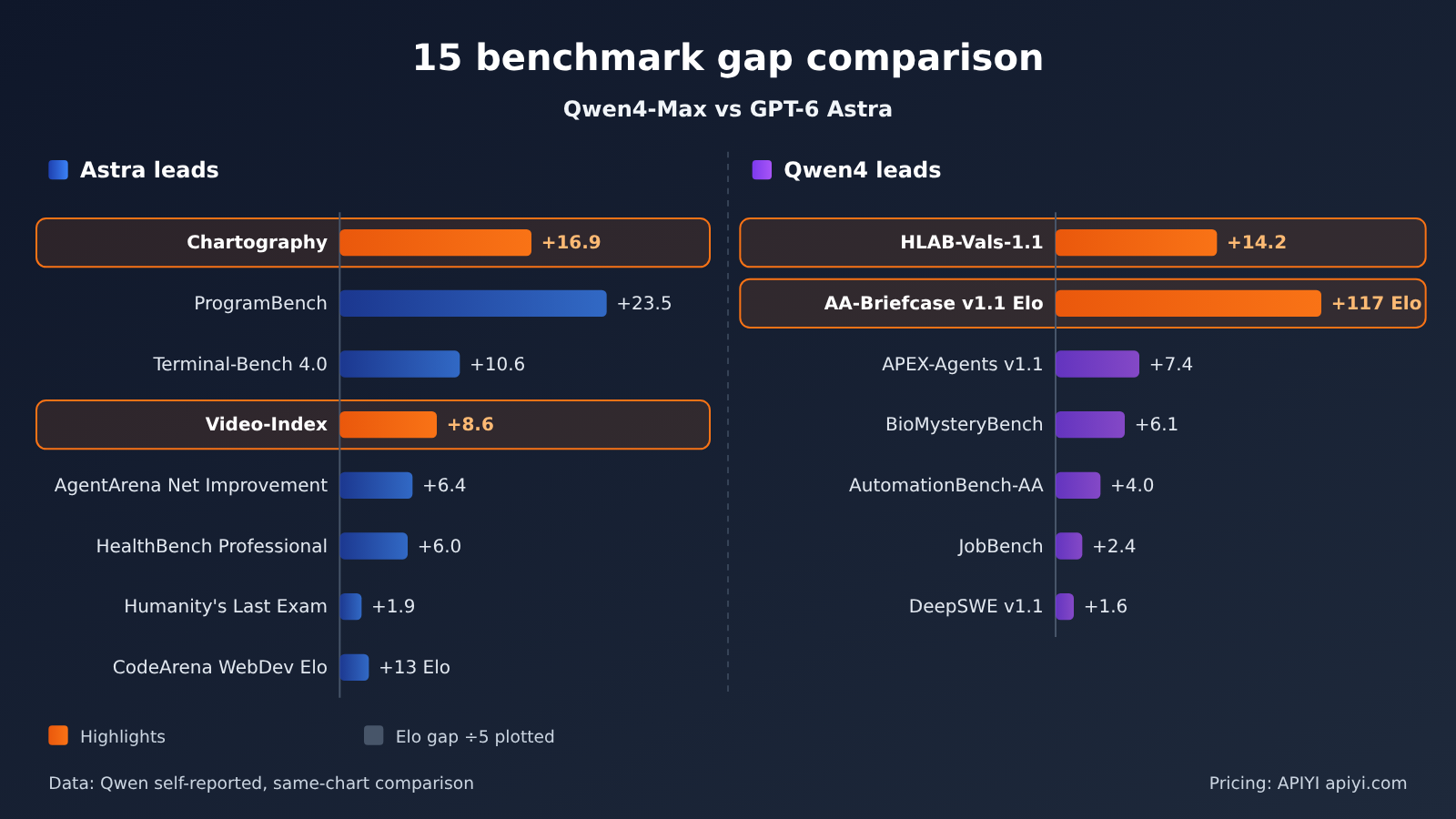
All scores below come from Qwen’s own self-reported, same-chart comparison. When a head-to-head like this is published by one of the parties involved, you’ll want to read it with a grain of salt. That said, the handful of areas where Astra clearly leads are things Qwen itself put on the table, so those numbers are relatively more trustworthy.
| Benchmark | Qwen4-Max | GPT-6 Astra | Gap | Leader |
|---|---|---|---|---|
| Chartography | 54.2 | 71.1 | 16.9 | Astra |
| ProgramBench | 31.5 | 55.0 | 23.5 | Astra |
| Terminal-Bench 4.0 | 48.5 | 59.1 | 10.6 | Astra |
| Video-Index | 68.1 | 76.7 | 8.6 | Astra |
| AgentArena Net Improvement | 7.5 | 13.9 | 6.4 | Astra |
| HealthBench Professional | 60.0 | 66.0 | 6.0 | Astra |
| Humanity’s Last Exam | 51.7 | 53.6 | 1.9 | Astra |
| CodeArena WebDev Elo | 1750 | 1763 | 13 | Astra |
| HLAB-Vals-1.1 | 21.3 | 7.1 | 14.2 | Qwen4 |
| AA-Briefcase v1.1 Elo | 1686 | 1569 | 117 | Qwen4 |
| APEX-Agents v1.1 | 72.1 | 64.7 | 7.4 | Qwen4 |
| BioMysteryBench | 85.0 | 78.9 | 6.1 | Qwen4 |
| AutomationBench-AA | 72.5 | 68.5 | 4.0 | Qwen4 |
| JobBench | 68.5 | 66.1 | 2.4 | Qwen4 |
| DeepSWE v1.1 | 75.7 | 74.1 | 1.6 | Qwen4 |
GPT-6 Astra’s Real Strengths: Charts, Terminal, and Video
The biggest gap is in chart understanding. On Chartography, Astra scores 71.1 vs Qwen4-Max’s 54.2, a 16.9-point difference. If your business needs to read financial charts, dashboard screenshots, or scientific charts, this gap will show up directly in extraction accuracy, and it’s hard to make up for with prompts.
Terminal and code repositories are the second area. Terminal-Bench 4.0 shows a 10.6-point gap, and ProgramBench a 23.5-point gap. These two measure multi-step command execution and end-to-end program construction, which are exactly the most demanding parts for coding agents. On DeepSWE, Qwen4-Max edges out Astra by 1.6 points, which shows it isn’t weak at fixing a single issue. But once the task becomes “build a project through a long chain of steps in the terminal,” Astra is more stable.
Video understanding is another area you can’t skip. On Video-Index, Astra scores 76.7 vs 68.1, an 8.6-point lead. Although Qwen4-Max has native vision support, it still lags behind in video understanding. Teams that need video content moderation, clip retrieval, or instructional video summarization should put this near the top of their selection checklist.
Qwen4-Max’s Real Strengths: Office Agents and Professional Benchmarks
HLAB-Vals-1.1 is the clearest lead for Qwen4-Max: 21.3 vs 7.1, an absolute gap of 14.2 points and nearly 3x in relative terms. Qwen4-Max leads by 117 Elo points on AA-Briefcase v1.1 (1686 vs 1569). These benchmarks lean toward business documents and office-workflow agent tasks, and in the Elo system, a 117-point gap is quite significant.
Qwen4-Max also leads on APEX-Agents (+7.4), AutomationBench-AA (+4.0), and JobBench (+2.4). Taken together, the conclusion is clear: in process automation and office-agent scenarios, Qwen4-Max isn’t just cheaper—it also scores higher.
Code Arena Public Leaderboard Snapshot (2026-11-14)
Third-party leaderboards can serve as a cross-reference. The public leaderboard snapshot for arena.ai Code Arena WebDev shows GPT-6 Astra (Max) ranked 5th with 1,763 points, 8,685 votes, and a per-task cost of $9.43. Qwen4-Max (xHigh) ranked 6th with 1,750 points, marked Preliminary, 1,814 votes, and a per-task cost of $4.18.
A 13-point Elo gap in the WebDev setting puts them in the same tier, yet their per-task costs differ by more than double. Keep in mind that Qwen4-Max still has relatively few votes, so its ranking may keep fluctuating—it’s worth watching.
Qwen4-Max vs. GPT-6 Astra: Input and Output Pricing Comparison
The pricing table covers two sets of numbers: official list prices and APIYI’s current prices. Official prices come from QwenCloud and the original OpenAI documentation; data was retrieved on 2026-11-16; all units are per 1M tokens.
| Billing item | Qwen4-Max (QwenCloud) | GPT-6 Astra (OpenAI docs, as published) | Multiple |
|---|---|---|---|
| Input | $1.5 | $10 | 6.7× |
| Output | $4.5 | $50 | 11.1× |
| Cache read | $0.075 | $1 | 13.3× |
| Cache write | 5 min $1.875 / 1 hr $3 | $12.5 | 4.2–6.7× |
| Input over 272K | No tiers listed in the reference material | Entire request input and cache ×2, output ×1.5 | — |
The double-billing trap when GPT-6 Astra input exceeds 272K
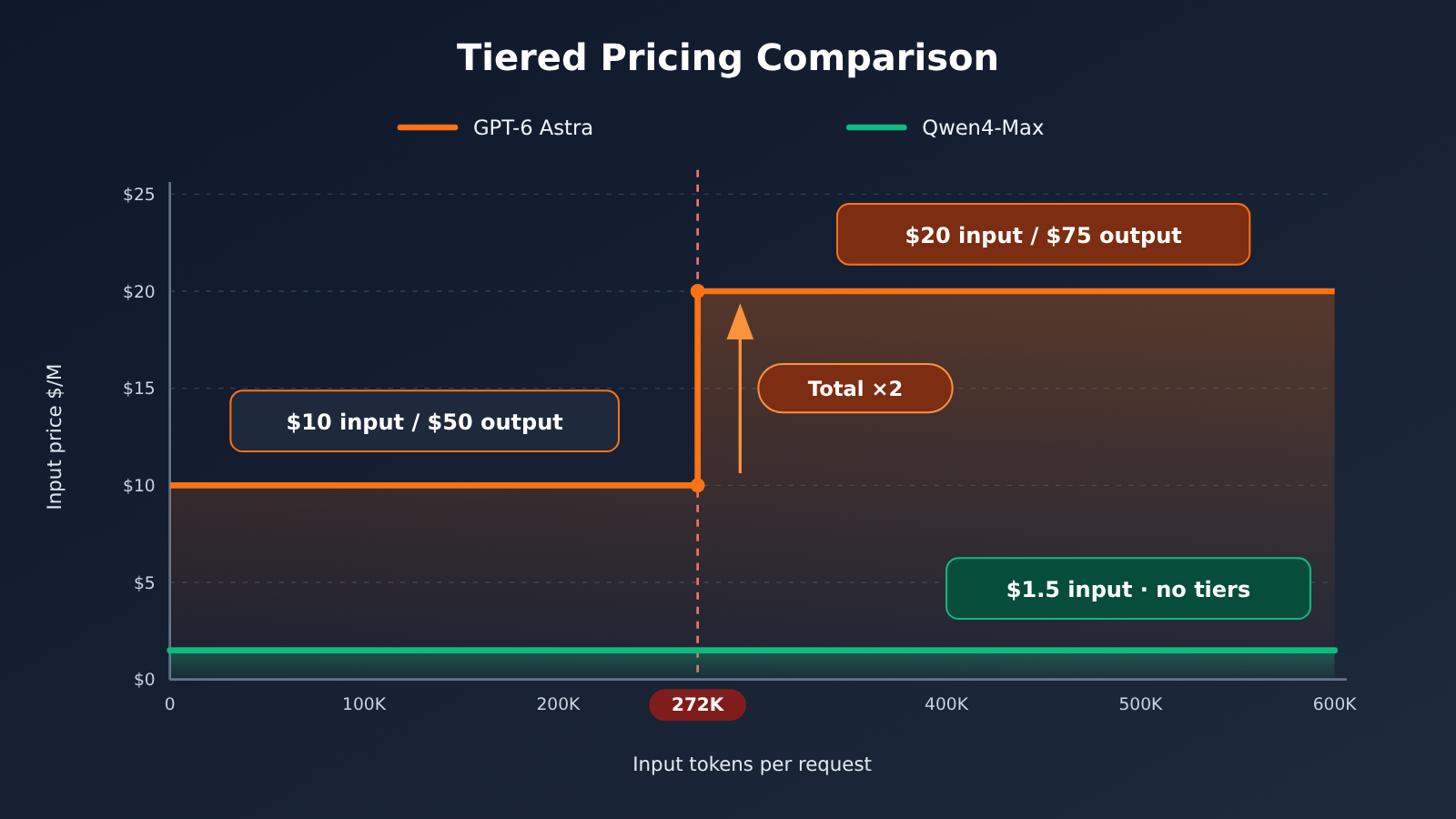
OpenAI’s docs state the rule clearly: when a single request’s input exceeds 272K, input and cache are billed at 2× for the entire request, and output is billed at 1.5×. It isn’t just the portion above 272K that gets marked up—the whole request does. When teams estimate costs for long-document RAG or full-repo context, this is an easy rule to miss.
Let’s run the numbers on a few typical requests. These use official standard prices and ignore caching for now.
| Scenario | Qwen4-Max | GPT-6 Astra | Difference |
|---|---|---|---|
| Single request, 270K input + 20K output | ~$0.50 | ~$3.70 | ~7.4× |
| Single request, 400K input + 20K output | ~$0.69 | ~$9.50 (272K rule triggered) | ~13.8× |
| Monthly 100M input + 10M output (all requests under 272K) | ~$195 | ~$1,500 | ~7.7× |
| Same as above, but all requests are long-context above 272K | ~$195 (estimated at standard rates) | ~$2,750 | ~14× |
The second row is the clearest example. Input goes from 270K to 400K—less than a 50% increase in tokens—but Astra’s per-request cost jumps from $3.70 to $9.50. So when you’re designing long-context workflows for Astra, it’s best to keep each request’s input under 272K. You can trim retrieval results or summarize chunks first, then pass the result to Astra for the final reasoning step.
APIYI current pricing and model availability
APIYI’s current prices (as of 2026-11-16) are below. For final confirmation, refer to the platform’s model list.
gpt-6-astra: Input $10, output $50, cache read $1; input in the 272,001–1,050,000 token range costs $20, matching the official tiers.qwen3.8-max: Input $1.65, output $4.95, cache read $0.20625.qwen4-max: not yet listed—we’ll get this model up as soon as possible. Once it’s live, check the model list on apiyi.com for the model ID and pricing.
💰 Cost tip: Before
qwen4-maxis listed, you can useqwen3.8-maxto get your Qwen-family prompts and tool-calling flows working. Once the new model is live, just switch themodelparameter. Both series use the same key on APIYI (apiyi.com), and billing is in one place, so you can easily compare real spend on both sides.
Choosing Qwen4-Max vs. GPT-6 Astra by Task
Putting benchmarks and pricing side by side makes it easier to recommend models by task type.
| Task Type | Recommendation | Basis | Available Platforms |
|---|---|---|---|
| Chart / screenshot understanding | GPT-6 Astra | Chartography leads by 16.9 points | APIYI apiyi.com, OpenAI official |
| Terminal operations and full codebase builds | GPT-6 Astra | Terminal-Bench +10.6, ProgramBench +23.5 | APIYI, OpenAI official |
| Video understanding | GPT-6 Astra | Video-Index leads by 8.6 points | APIYI, OpenAI official |
| Single-issue fixes / WebDev | Qwen4-Max (cost-effective) | Slight win on DeepSWE, only 13 Elo behind on WebDev, per-task cost about half | QwenCloud; APIYI coming soon |
| Office and workflow automation agents | Qwen4-Max | AA-Briefcase +117, APEX +7.4, HLAB-Vals +14.2 | QwenCloud; APIYI coming soon |
| Long-context batch processing (>272K) | Qwen4-Max | No Astra-style whole-request surcharge, max output 393K | QwenCloud; APIYI coming soon |
| Medical professional Q&A | GPT-6 Astra | HealthBench Professional leads by 6.0 | APIYI, OpenAI official |
When GPT-6 Astra Is the Better Choice
- Multimodal quality inspection: Charts, dashboard screenshots, and video clips need highly accurate interpretation, and the cost of an error far exceeds the token cost.
- Autonomous coding agents: You need to execute commands over long chains in a sandbox terminal and build complete programs. The gap on ProgramBench directly affects task success rate.
- Low-frequency, high-value requests: Call volume isn’t high, but every result influences decisions. In this case, the 11x output price accounts for only a limited share of the total budget.
When Qwen4-Max Is the Better Choice
- High-throughput text tasks: High daily volumes of document processing, summarization, and extraction. The 11.1x output price gap directly determines the monthly bill.
- Office-type agents: Form routing, business document processing, and automated workflows. Qwen4-Max actually scores higher on these tasks.
- Very long input and very long output: Hundreds-of-K-token contracts, full codebase reviews, and reports that need to generate hundreds of thousands of tokens in a single pass.
Decision Recommendations for Qwen4-Max vs. GPT-6 Astra
For teams already using Astra but on a tight budget, the safer approach is hybrid routing rather than a wholesale switch. Keep chart, terminal, and video requests on Astra, move the remaining text and office-Agent requests to the Qwen family, and cap Astra’s long-context requests at under 272K. This preserves the capabilities Astra genuinely leads in while cutting the portion of spend with the widest price gap.
Before switching models, check these three things:
- Verify model IDs: Confirm whether
gpt-6-astraandqwen3.8-maxare available in the model list on APIYI apiyi.com, and keep an eye on the listing status ofqwen4-max— don’t fill in model IDs from memory. - Compare pricing: Check the per-unit prices for input, output, and cache reads, along with Astra’s $20 input tier above 272,001 tokens. Run your monthly bill against the actual token distribution in your own logs.
- Check the protocol: Both models can be called through the OpenAI-compatible interface at
https://api.apiyi.com/v1— just setbase_urlto that address when initializing your SDK. Astra supports both the/v1/responsesand/v1/chat/completionsendpoints. If you need to tune the reasoning level withreasoning.effort, it’s best to validate parameter behavior on the Responses endpoint first.
💡 Selection tip: Send the same batch of business samples to both
gpt-6-astraand the Qwen models, and record accuracy and per-item cost — that’s more reliable than looking at leaderboards. With APIYI apiyi.com, you can switch themodelparameter using a single key to run the comparison, and new users get free test credits to try a small sample first.
FAQ
Q1: What are Qwen4-Max and GPT-6 Astra designed for?
Qwen4-Max launched on 2026-11-16 with a 2.4T backbone / 71B activated architecture, plus native vision and a 1M context. GPT-6 Astra is OpenAI’s strongest general-purpose model currently in service, with a 1,050,000-token context window and five reasoning tiers ranging from low to max.
Q2: Astra costs so much more — are the extra points worth it?
It depends on the task. On chart understanding (+16.9), ProgramBench (+23.5), Terminal-Bench (+10.6), and video understanding (+8.6), Astra’s advantage is real, and the premium is worth paying for those tasks. On office agents, HLAB-Vals, and AA-Briefcase, Qwen4-Max scores higher at a lower price, so paying extra for Astra doesn’t make sense.
Q3: Are these benchmark scores trustworthy?
All 15 benchmarks are Qwen’s own self-reported, same-chart comparisons — first-party data, so read them with some margin for error. The public arena leaderboard snapshot (2026-11-14) works as a third-party cross-reference, and the gap between the two on WebDev is likewise only 13 Elo. That said, Qwen4-Max is still marked Preliminary on the leaderboard and has relatively few votes.
Q4: How does Astra’s pricing work above 272K input?
Once a single request’s input exceeds 272K, the entire request’s input and cache are billed at 2x, and output at 1.5x — the surcharge applies to the whole request, not just the portion over the threshold. For example, 400K input plus 20K output costs about $9.50, roughly 2.5x what 270K input with the same output would cost.
Q5: Can I call Qwen4-Max through APIYI right now?
`qwen4-max` isn’t listed yet — we’ll get it up as soon as we can. Until then, you can use `qwen3.8-max` ($1.65 / $4.95 / cache read $0.20625) to validate Qwen-family workflows. `gpt-6-astra` is already available, with the unified endpoint at `https://api.apiyi.com/v1`; check apiyi.com’s model list for the exact model IDs.
Q6: What are Qwen4-Max’s clear weak spots?
Chart understanding, video understanding, long-chain terminal operations, and ProgramBench all lag noticeably behind Astra, and HealthBench Professional is 6 points lower too. If your business centers on these scenarios, switching to Qwen4-Max purely to save money may end up trading a lower success rate for the savings.
Qwen4-Max vs GPT-6 Astra: Key Takeaways
- Price gap: Astra’s input price is 6.7× that of Qwen4-Max, its output price is 11.1×, and cached reads are 13.3×.
- Astra’s real advantages: Chartography 71.1 vs 54.2, Video-Index 76.7 vs 68.1, and it also leads in terminal and codebase building.
- Qwen4’s real advantages: HLAB-Vals 21.3 vs 7.1, AA-Briefcase 1686 vs 1569, and it’s stronger overall at office agents.
- Long-context trap: When Astra input exceeds 272K, the entire request is surcharged: input ×2, output ×1.5.
- Output limit: Qwen4-Max maxes out at 393K output, while Astra is 128K.
- How to get started: On APIYI, use the same API key to compare
gpt-6-astrawith Qwen-series models;qwen4-maxis currently being listed.
Summary
Comparing Qwen4-Max and GPT-6 Astra, there are three key conclusions:
- Astra’s premium maps to three real capabilities: chart understanding, terminal and codebase building, and video understanding—tasks that are worth paying for.
- Qwen4-Max isn’t just cheaper: it scores higher on office agents and several professional benchmarks, and it has a larger output limit.
- Long context needs its own cost math: Astra’s 272K threshold makes per-request costs jump. Using retrieval trimming to keep input below the threshold is the most direct way to save money.
For most teams, task-based mixed routing is more cost-effective than switching everything over. We recommend running an A/B comparison on APIYI apiyi.com with real business samples, then deciding the allocation ratio for each type of request.
📚 References
- OpenAI Model Documentation – GPT-6 Astra: specifications, context, and reasoning tiers
- Link:
developers.openai.com/api/docs/models/gpt-6-astra -
Notes: original source for context length, max input/output, and the
reasoning.efforttiers -
OpenAI Pricing Page: standard pricing and rules for usage above 272K
- Link:
developers.openai.com/api/docs/pricing -
Notes: unit prices for input, output, and cache read/write, plus the whole-invoice markup rule for long context
-
arena.ai Code Arena WebDev leaderboard: third-party public leaderboard (snapshot date 2026-11-14)
- Link:
arena.ai - Notes: cross-reference for Elo ranking, vote counts, and per-task cost
Author: APIYI Technical Team
Technical exchange: Feel free to reach us via the APIYI website homepage; more materials are available at the docs.apiyi.com documentation center


