

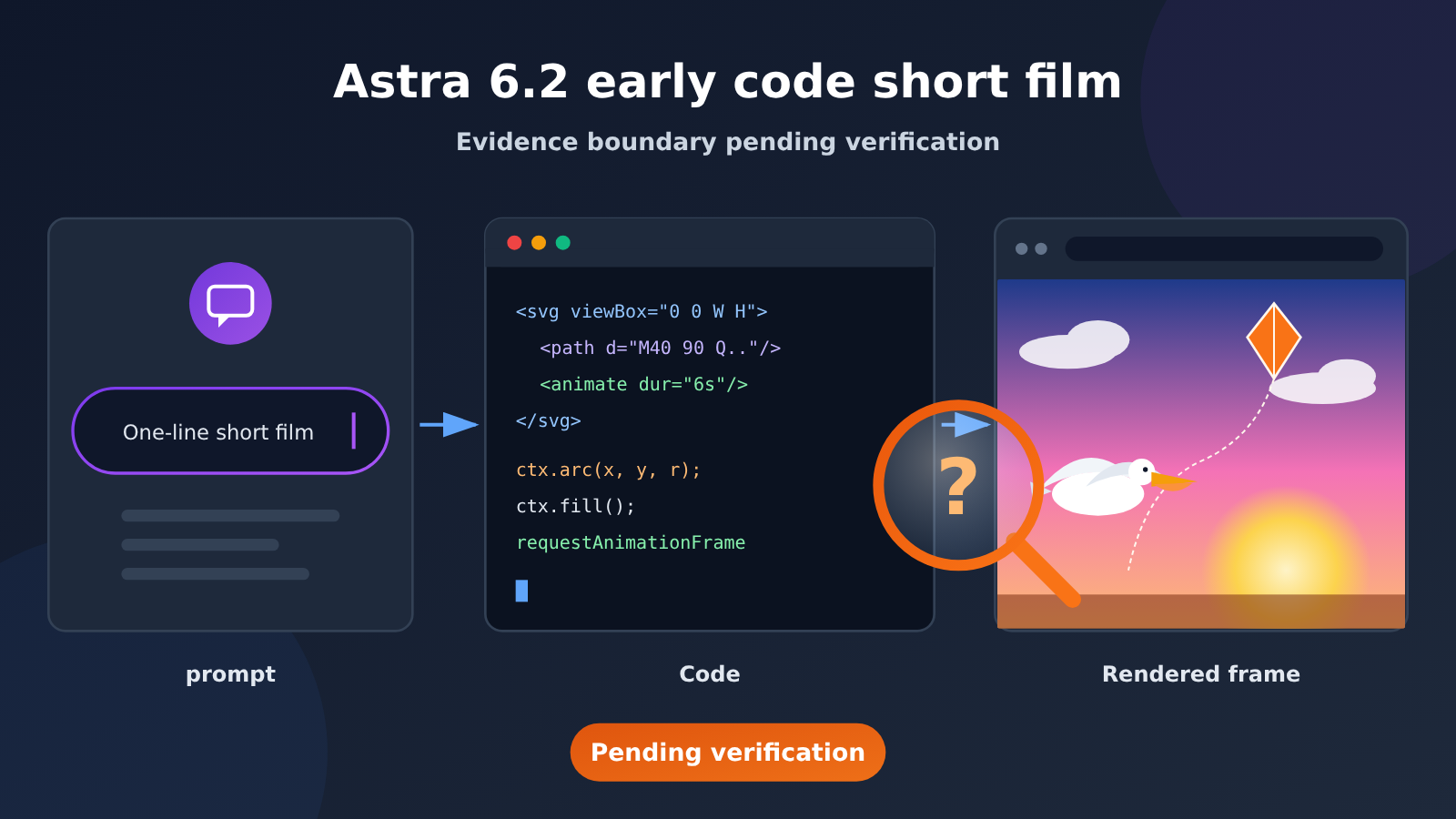
The short answer: there isn’t enough evidence yet to show that Astra 6.2 can reliably turn a single prompt into a complete animated short, and we can’t conclude that its aesthetics have improved in any dependable way. Among the community samples, you can spot some localized changes—more delicate lighting and atmosphere, richer environmental detail, and technical illustrations with zoomed-in regions and bilingual labels. But these samples have clear weaknesses, such as crowded, overlapping labels and a questionable joint structure in the pelican’s legs. More importantly, the model identities are entirely self-reported by the authors, and the comparisons aren’t rigorously controlled experiments. As of 2026-11-16, no 6.2 entry appears in any public model catalog or API changelog.
What you’ll learn from this article
- Which Astra 6.2 samples are circulating in the community, what each one does and doesn’t demonstrate.
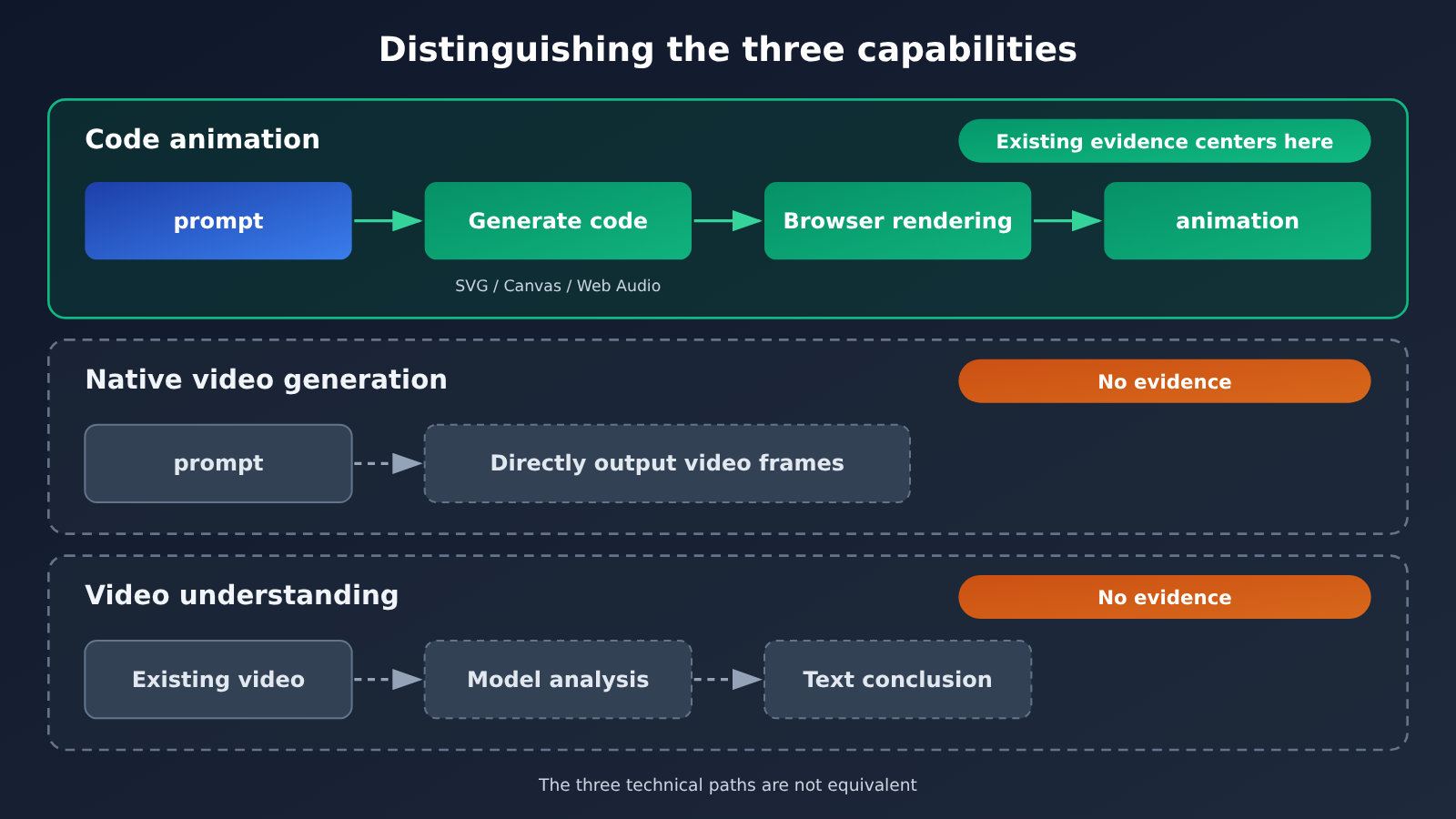
- The difference between “code-driven animation,” “native video generation,” and “video understanding”—and which category the current evidence falls into.
- What conditions those seemingly “improved” details would need to meet before they count as convincing.
- Which variables you should check if you want to rigorously compare AI’s ability to generate a complete short film.
Index: Before the main text, a concept table explains the key terms and gives a quick overview of what this news means for different audiences. The “Objective facts” section organizes official-channel search results and four types of community samples by date, for readers who want to verify the original information. The “Analysis and judgment” section discusses where progress might be showing up, where the evidence gaps are, and provides a comparison checklist you can apply directly—useful for evaluators and developers.
Astra 6.2 Code-Short Concepts to Know
| Concept | Brief explanation |
|---|---|
| Code animation | The model generates program code (such as SVG, Canvas, or JavaScript), and the browser then executes it to render an animation; the visual quality depends on how well the code is written |
| Native video generation | The model outputs video frames or a video file directly, without going through the “write code, then render” step |
| Video understanding | The model reads and analyzes existing video content; this is an input-side capability and has nothing to do with generation |
| Single-file SVG animation | Graphics, styles, and animation logic are all written into a single SVG file, which the community often uses to quickly test a model’s drawing and coding ability |
| Canvas | The browser’s bitmap drawing interface, which you can use to draw complex scenes frame by frame in code |
| Web Audio | The browser’s audio interface, which you can use to synthesize sound effects and music in code without relying on external audio files |
| Gray-scale testing | A new version is released only to some accounts or users, and outsiders often have a hard time verifying it |
| xhigh | A settings tier labeled in community posts when making comparisons; the author says both sides used the same tier — for the exact meaning, refer to the author’s original post |
| Exploded view | A technical illustration that spreads mechanical parts out along the assembly direction; it really puts structural understanding and layout ability to the test |
| Controlled variable experiment | Change only one factor (such as the model version) while keeping everything else the same, so that any difference can be attributed to that factor |
Astra 6.2 Early Output: Impact at a Glance
- Everyday users: When you see a “one-sentence short film” demo, you need to know it’s most likely code animation—and usually cherry-picked. At this stage, don’t expect any prompt to produce a complete short film.
- Developers: Generating interactive, modifiable animation through code is a direction worth watching, since the output is editable source code rather than a black-box video. But the model’s identity hasn’t been confirmed, so it’s not advisable to adjust your technology choices based on rumors.
- Content creators: Improvements in localized details like lighting and atmosphere are worth referencing. Narrative, transitions, audio-visual synchronization, and rework costs are what determine whether this can actually be used—and right now there’s almost no reliable evidence on those fronts.
- Evaluators and researchers: The existing samples expose common flaws in community comparisons, including self-reported identity, differing toolchains, differing operators, and single frames standing in for full films. They’re well suited as a counter-example for designing rigorous evaluations.
Astra 6.2: The Objective Facts—Official Channels and Community Samples
No Astra 6.2 Entry on Official Channels Yet
When I searched on 2026-11-16, I couldn’t find any 6.2-related entries in the public model catalog (developers.openai.com/api/docs/models) or the API changelog (developers.openai.com/api/docs/changelog). That doesn’t rule out private testing or limited gray-release testing, but it does mean the model’s identity and performance haven’t been independently confirmed. Every “6.2” label below comes from community authors’ own accounts.
2026-11-06: Two-Account Comparison Across Five Sets of Prompts
A community author said he used two accounts, opened new sessions, kept the same xhigh settings on both sides, and compared five subjects using full prompts: a pelican animation, a mechanical peacock, a dragon city in the clouds, a watch-movement exploded view, and the Chinese zodiac. Among them, the movement image labeled 6.2 had zoomed-in details, bilingual labels, and material shading, giving it a richer information hierarchy than the control group. However, some labels were crowded and overlapping, which hurt readability. Some people in the discussion thread also questioned the overall aesthetics and pointed out structural issues with the pelican’s leg joints.
It’s worth noting that the model’s identity is based on the author’s own account, not official confirmation. “Two accounts + identical settings” doesn’t equal a strict controlled experiment either; details such as the number of generations and whether results were cherry-picked can’t be verified. Source: linux.do/t/topic/3132699
2026-11-10: Single-File SVG Pelican Animation Comparison
Another community author used a single-file SVG pelican animation to compare Astra 6.2 — which claims to still be in grayscale rollout — against Fable. In the author’s view, version 6.2 handles the morning light and environmental detail better. The comments, however, once again flagged problems with the leg structure, and some argued the differences come down more to differing art styles than to one being clearly better than the other. Source: linux.do/t/topic/3151490
Public Repository: The Kite That Pulled the Sky
The README and source code of the public repository The Kite That Pulled the Sky show that this short film draws its visuals with Canvas and synthesizes its soundtrack with Web Audio, including characters, clouds, the kite, camera movement, and timeline controls. It demonstrates that “producing a short film with camera work and a soundtrack purely in code” is technically feasible. But the repository itself can’t prove that it was generated by 6.2, nor that there’s any gap between the old and new models. Source: github.com/PankajKumardev/The-Kite-That-Pulled-the-Sky
Pixel City Comparison: Different Toolchains, Different Operators
There’s also a pixel city comparison. The supposed old and new versions were generated through Codex and Devin, respectively, and the operators weren’t the same person. With both the toolchain and the operator changing at once, you can’t pin the differences in the results on the model version. On top of that, the original X video couldn’t be read in full, so there’s no way to judge the quality of the whole animation. Source: postharness.com/article/006672
Astra 6.2 Community Samples at a Glance
| Sample | Date | Observed highlights | Issues noted | Strength of evidence |
|---|---|---|---|---|
| Five-topic dual-account comparison | 2026-11-06 | Zoomed-in details of the movement image, bilingual labels, material shading | Crowded and overlapping labels; pelican leg joints and aesthetics questioned | Weak: self-reported identity, not a controlled experiment |
| SVG pelican vs. Fable | 2026-11-10 | Morning light and environmental details were better | Leg structure issues; could just be a style difference | Weak: self-reported identity (grayscale) |
| Kite short film repo | Not specified | Canvas visuals + Web Audio soundtrack + camera control | Can’t prove it was generated by 6.2 | Only demonstrates feasibility |
| Pixel city comparison | Not specified | Couldn’t be fully evaluated | Mixed Codex and Devin comparison, different operators | Very weak: multiple confounded variables |
Analyzing Astra 6.2’s Code Demos
Likely Improvements Center on “Local Details,” Not “Complete Works”
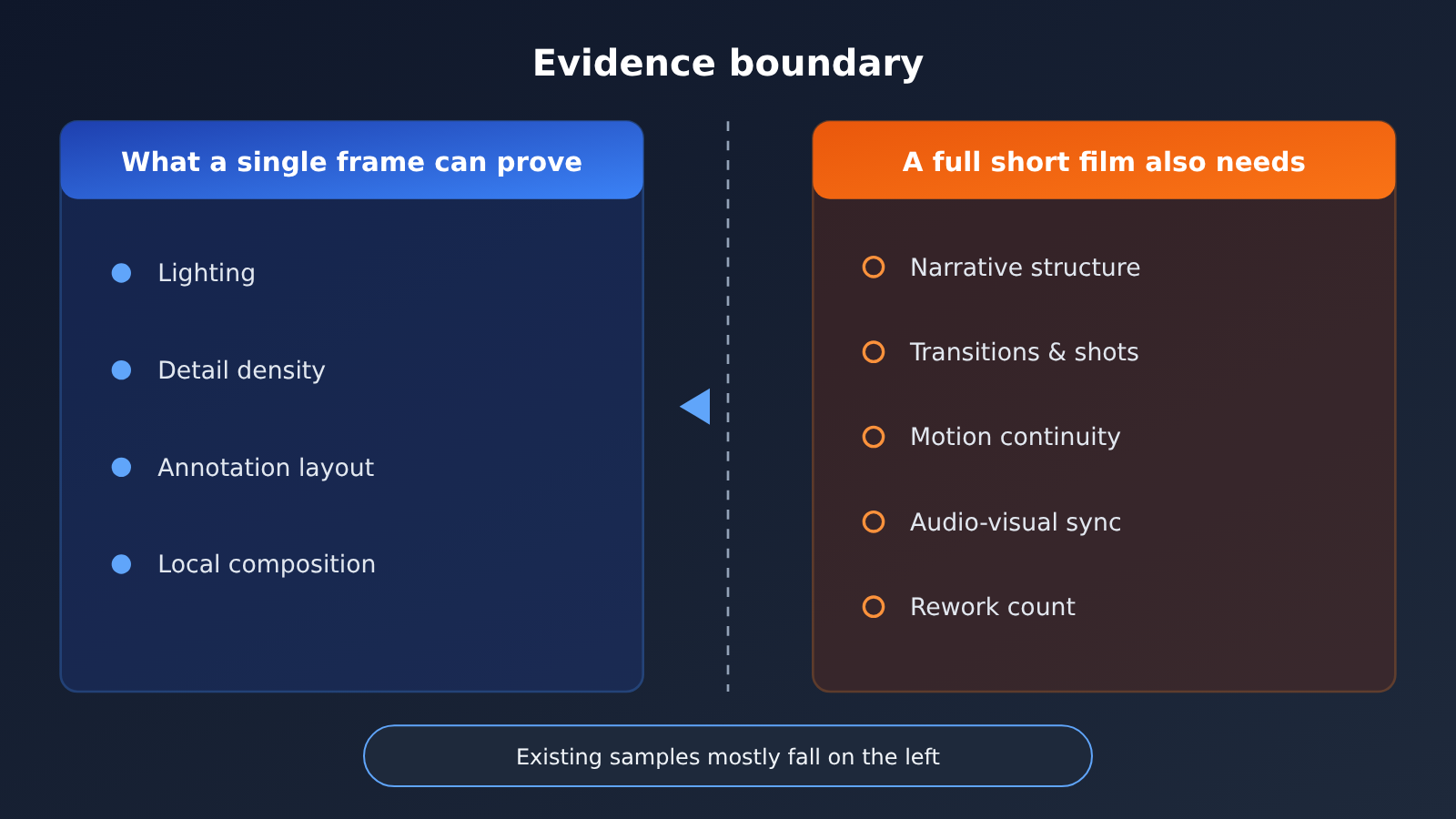
If we take the labels on these samples at face value for now, the changes mainly appear in three areas: lighting atmosphere (morning light), the density of environmental detail, and how information is organized in technical illustrations (inset magnifications and bilingual annotations). All of these concern the richness of a single frame, suggesting that when the model writes drawing code, it tends to add more layers and details. But the more details there are, the more likely layout conflicts become—overlapping labels in the movement diagram are one example. More detail and a better image are not the same thing.
The repeatedly noted issue with the pelican’s leg joints is also worth attention. Structural accuracy tests the model’s understanding of an object’s form, not the amount of code. If the new version gains points on lighting but still loses them on structure, it’s hard to claim an overall improvement in aesthetics. Some comments attribute the differences to art style, which itself shows that aesthetic judgment is subjective; a few images alone can’t settle the question.
What the existing evidence supports is at most “code animation”—not the other two capabilities
All the samples fall under “the model writes the program, the browser handles rendering” code animation. They can’t be used to show that Astra 6.2 has native video generation or video understanding—those three follow completely different technical paths. When you see a claim about “making a short film from a single prompt,” the first thing to sort out is which of the three it actually means.
Even if we only look at code animation, a single screenshot or a few seconds of footage doesn’t stand in for a complete short film. A short film needs a story with a beginning, middle, and end; transitions and shot choreography; motion continuity; narration or music synced to the visuals; and on top of all that, the rework cost of repeated revisions. The kite repo shows that code can cover these stages, but it’s precisely the thing that can’t be tied back to 6.2.
How to rigorously compare AI’s ability to generate a short film from a single prompt
To judge whether Astra 6.2—or any new model—has genuinely improved, you need at minimum to control the variables below and look at the results across several dimensions.
| Check item | Requirement | Status of existing samples |
|---|---|---|
| Prompt | Old and new models use the exact same complete prompt, word for word | The 11-06 sample claims to use the full prompt; the rest are unknown |
| Toolchain | Same client, same runtime environment | The pixel city comparison mixes Codex and Devin |
| Model identity | A verifiable model identifier or official record | All are self-reported by the author |
| Number of attempts | Disclose how many generations per side, and whether results were cherry-picked | None disclosed |
| Human intervention | Record whether code was manually edited or extra instructions were added | None disclosed |
| Operator | Same person or same process doing the work | The pixel city comparison used different operators |
| Observation dimension | What to focus on |
|---|---|
| Narrative | Whether there’s a complete arc, rather than a looping animation |
| Aesthetics | Composition, color, and consistent style—don’t let subjective preference drive the conclusion |
| Motion | Whether character structure is sound and movement is coherent |
| Sound and image | Whether the score and sound effects match the shot rhythm |
| Rework volume | How many rounds of revision it takes to go from a single prompt to a usable final product |
How Different Groups Can Respond
For developers, the more pragmatic move is to build the evaluation framework first: a fixed prompt set, a fixed toolchain, and a record of how many attempts each run took — then run comparisons once the model’s identity is confirmed. The advantage of code-based animation is that the output is editable and version-controllable. Even if the model’s first draft isn’t perfect, you can fix it at the source level, and that trait has more engineering value than “getting a finished clip in one shot.”
Content creators can keep an eye on trends in lighting and detail, but they shouldn’t get their hopes up about narrative and sound-image sync just yet. Evaluators, meanwhile, should treat “self-reported identity, mixed variables, and a single frame standing in for the whole film” as problems to actively rule out — not as grounds for arguing about art style in the comments section.
Signals Worth Watching
The judgments below are predictions and await verification. If a 6.2 entry shows up in the official model catalog or changelog, the identity question around community samples will be settled, and the table above can be re-checked accordingly. If someone publishes a full short-film comparison using the same prompt and toolchain across multiple attempts, along with their rework process, that would be more convincing than any screenshot we have now. Until then, “progress” is at best an impression that still needs testing.
The ancients warned us long ago: “What you get from paper always feels shallow; to truly know a thing, you must act on it.” (Lu You, Reading with My Son on a Winter Night) A handful of screenshots and a few self-accounts ultimately need reproducible comparisons before they can prove anything.


