

Author’s note: A breakdown of Qwen4-Max, No. 6 on the Code Arena WebDev leaderboard — the top-six lineup, the gaps among Chinese models, the score gap to the front-runners, and how to correctly read vote counts and per-task cost.
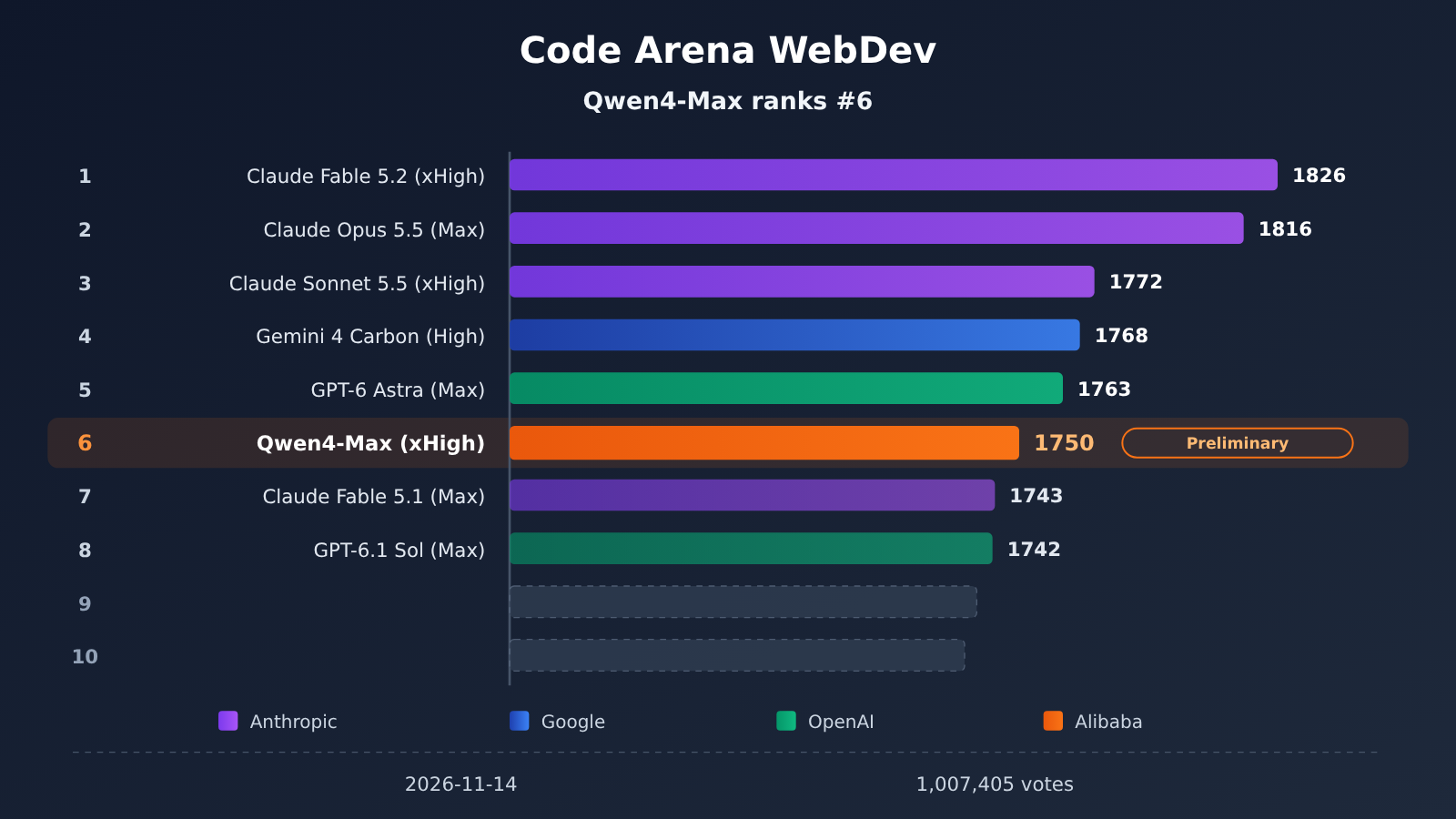
Let’s start with the conclusion: on arena.ai’s Code Arena WebDev leaderboard (Overall category, page dated 2026-11-14), Qwen4-Max (xHigh) ranks 6th with 1,750 points. This is the first time a Chinese model has cracked the top six of this leaderboard — and it’s the only non-US-lab model in the top six.
This isn’t a puff piece dressing up 6th place as 1st. Qwen4-Max carries a Preliminary tag on the leaderboard, with only 1,814 votes, so its rank will still move. In Alibaba’s own official chart, it still trails Opus 5.5 and GPT-6 Astra by a clear margin on Terminal-Bench and ProgramBench.
The core value: once you’ve read this, you’ll have a set of leaderboard metadata you can open and verify yourself, and you’ll understand how the No. 6 spot for Qwen4-Max should — and shouldn’t — be used.
Qwen4-Max Code Arena WebDev: The 6 Key Facts About Its No. 6 Spot
Before we argue about rank, let’s put the leaderboard’s metadata on the table. Any claim about “what place it’s in” should be checked first against the date, the vote count, and the number of competing models — otherwise it’s hard to tell whether the rank actually holds up.
| Item | Data (public on the same leaderboard) | How to read it |
|---|---|---|
| Leaderboard & category | arena.ai Code Arena WebDev, Overall | Only reflects blind-test preference for web development |
| Page date | 2026-11-14 | Rank keeps shifting as votes come in |
| Total votes / models | 1,007,405 votes / 159 models | Large sample size, but per-model vote counts vary widely |
| Qwen4-Max rank & score | No. 6, 1750 points | The only non-US-lab model in the top six |
| Qwen4-Max votes & flag | 1,814 votes, Preliminary | Still in the preliminary evaluation stage |
| Per-task cost P50 | $4.18 | Median as reported on the leaderboard, not the model’s unit price |
What the Qwen4-Max Leaderboard Numbers Actually Mean
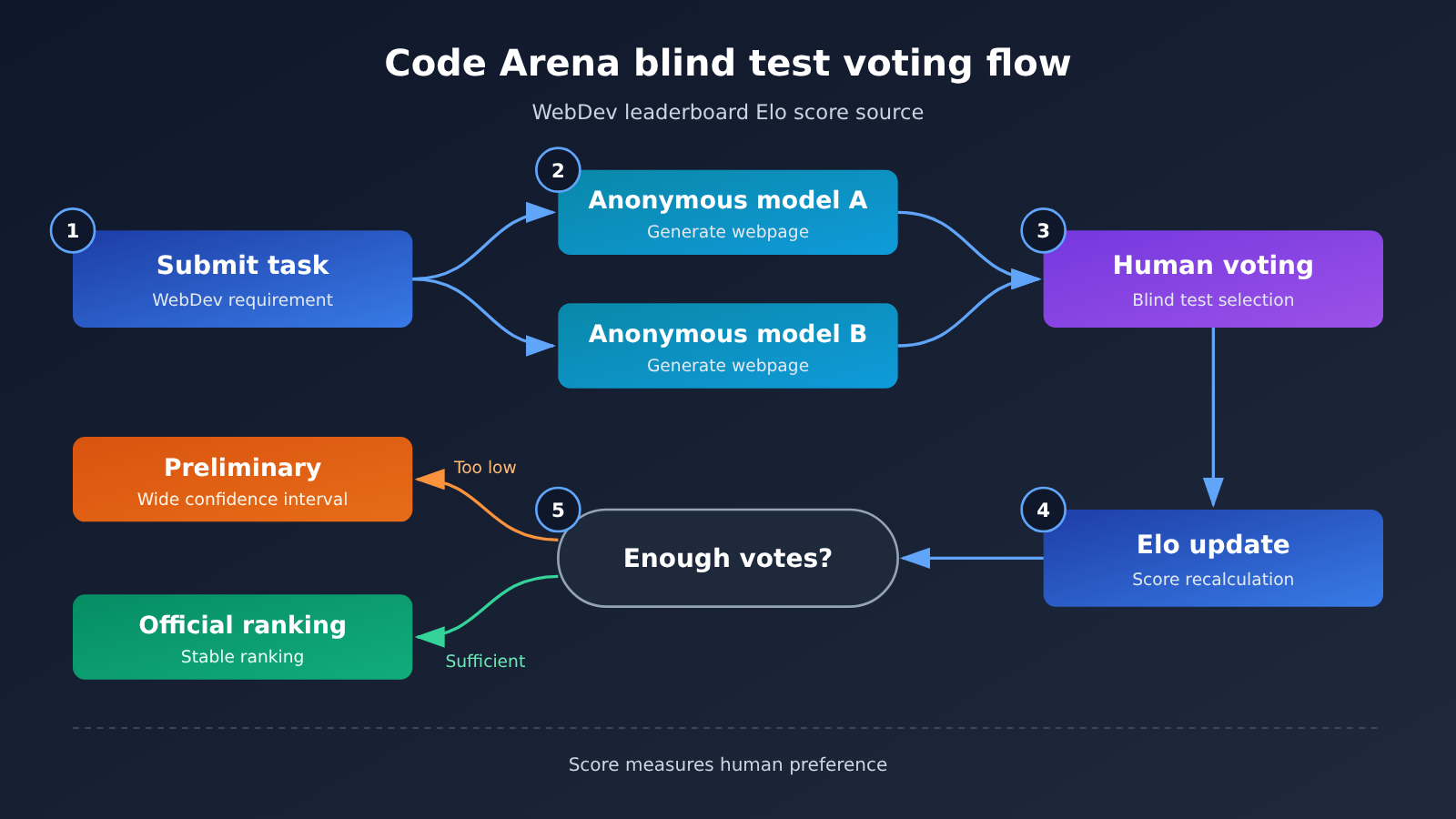
Code Arena’s Elo scores come from blind human voting: a user submits the same web development task, sees the output of two anonymous models, then votes for whichever is better. The score reflects “whose webpage humans think is better” — it measures preference, not some overall productivity score.
You also need to understand what the Preliminary flag means. It tells you the model hasn’t been in enough head-to-head battles yet, so its confidence interval is wide. Gemini 4 Carbon (High), ranked No. 4 on the same board, carries the same flag — so it wouldn’t be surprising if positions 4 through 6 swap around in the next few weeks.
Who Are the Top Six on Code Arena WebDev: Qwen4-Max’s Competitive Field
Listing the full top ten makes it easier to see exactly where Qwen4-Max sits. The top five are completely occupied by three U.S. labs, and Anthropic alone holds three of those seats.
| Rank | Model | Score | Lab | Notes |
|---|---|---|---|---|
| 1 | Claude Fable 5.2 (xHigh) | 1826 | Anthropic | Top spot |
| 2 | Claude Opus 5.5 (Max) | 1816 | Anthropic | P50 per-task cost $8.99 |
| 3 | Claude Sonnet 5.5 (xHigh) | 1772 | Anthropic | — |
| 4 | Gemini 4 Carbon (High) | 1768 | Preliminary | |
| 5 | GPT-6 Astra (Max) | 1763 | OpenAI | P50 per-task cost $9.43 |
| 6 | Qwen4-Max (xHigh) | 1750 | Alibaba | Preliminary, 1,814 votes |
| 7 | Claude Fable 5.1 (Max) | 1743 | Anthropic | — |
| 8 | GPT-6.1 Sol (Max) | 1742 | OpenAI | — |
| 9 | Muse Wonder Full (Max) | 1724 | — | — |
| 10 | Claude Sonnet 5.5 (High) | 1716 | Anthropic | — |
What the Top-Five Landscape Means for Qwen4-Max
In the top six, Anthropic holds three seats (Fable 5.2, Opus 5.5, and Sonnet 5.5), while Google and OpenAI each hold one, and Alibaba holds one. In other words, Qwen4-Max squeezed a spot between the flagships of three leading labs—it didn’t just pick up a rank on a loosely contested leaderboard.
Another detail worth noting is how tight ranks 6 through 8 are: 1750, 1743, and 1742, all within less than 10 points of each other. Qwen4-Max’s lead over Claude Fable 5.1 and GPT-6.1 Sol is smaller than the 13-point gap between it and GPT-6 Astra. How stable that ranking really is will become clearer once more votes come in.
Qwen4-Max’s Position Among Domestic Models
If you look only at the domestic camp, Qwen4-Max’s lead is fairly obvious. It’s the only domestic model to make the top ten, and the runner-up doesn’t show up until No. 13.
| Domestic Rank | Model | Score | Leaderboard Rank | Gap to Qwen4-Max |
|---|---|---|---|---|
| 1 | Qwen4-Max (xHigh) | 1750 | No. 6 | — |
| 2 | Kimi K3.1 Pro (Max) | 1686 | No. 13 | −64 |
| 3 | Qwen3.8-Max (0902) | 1676 | No. 16 | −74 |
| 4 | Qwen3.8-Max | 1670 | No. 18 | −80 |
| 5 | Ernie 5.5 Flash Preview | 1668 | No. 18 | −82 |
| 6 | DeepSeek-V4.1-Flash-20261017 (Max) | 1661 | No. 19 | −89 |
| 7 | Kimi K3 (Max) | 1658 | No. 20 | −92 |
| 8 | MiMo-V2.6-Flash | 1639 | No. 26 | −111 |
| 9 | Hy4 preview | 1632 | No. 27 | −118 |
| 10 | GLM-5.3 (Max) | 1622 | No. 31 | −128 |
| 11 | DeepSeek-V4.1-Flash-20260910 | 1621 | No. 33 | −129 |
What the Domestic Gap Means on Two Levels
The first level is the generational jump. Qwen4-Max scores 74 points higher than its own previous generation, Qwen3.8-Max (0902), and its rank jumps from No. 16 to No. 6. On the same leaderboard and with the same voting mechanism, that’s a pretty substantial improvement.
The second level is the distance to the domestic runner-up. Qwen4-Max leads Kimi K3.1 Pro by 64 points, which is close to the 66 points by which it trails Opus 5.5. In other words, Qwen4-Max currently sits in the middle between the domestic camp and the global leaders: it has pulled away from its domestic rivals, but it still has some distance to go before it reaches the top.
One caveat: domestic models ranked No. 2 through No. 7 are clustered between 1686 and 1658, with very small score gaps. Using this leaderboard to rank these models in order doesn’t mean much.
How Big Is the Gap Between Qwen4-Max and the Global Top Models?
Score Gaps on Code Arena WebDev
Listing the score gaps between Qwen4-Max and the top models, then roughly estimating the “head-to-head win rate” with the standard Elo formula (400-point scale), helps clarify what those gaps actually mean. Arena’s specific statistical method may differ from standard Elo, so the win rates below are only for intuitive reference:
- vs. No. 5 GPT-6 Astra: 1750 vs. 1763, a 13-point gap; rough estimated head-to-head win rate of about 48%, basically evenly matched.
- vs. No. 2 Opus 5.5: a 66-point gap; rough estimated head-to-head win rate of about 41%.
- vs. No. 1 Fable 5.2: a 76-point gap; rough estimated head-to-head win rate of about 39%.
- vs. Kimi K3.1 Pro, the second-ranked domestic model: leads by 64 points; rough estimated head-to-head win rate of about 59%.
The score range across the entire leaderboard is 1,071 to 1,826. On this scale, Qwen4-Max’s 76-point gap from the top spot isn’t huge, but it still shows that in web development preference, Anthropic’s top model remains more favored by evaluators.
Other Benchmarks in the Same Chart: High Elo Doesn’t Mean Strong Terminal Task Performance
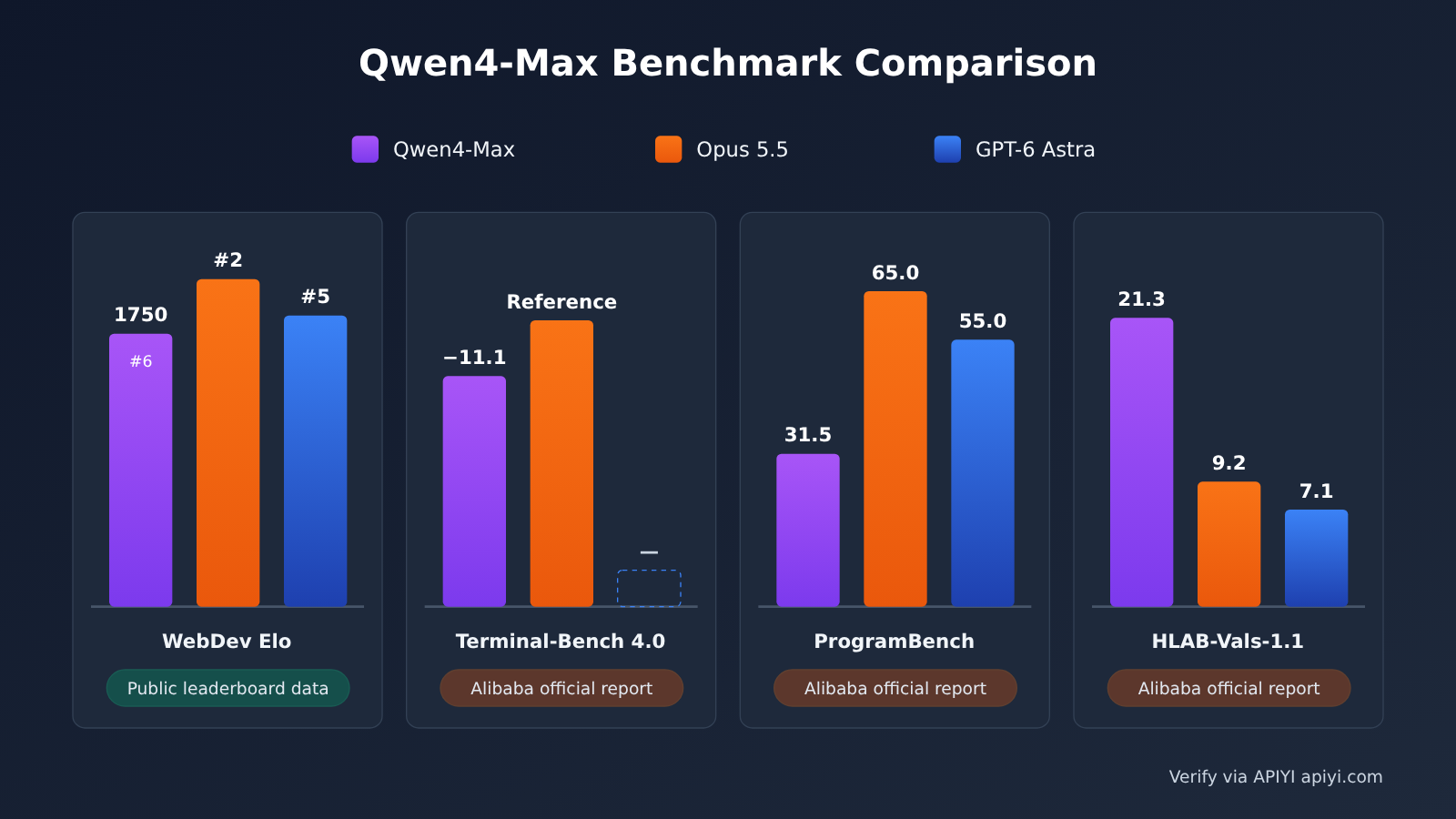
When Alibaba released Qwen4-Max, it used a multi-benchmark chart. The following data are all officially self-reported by Alibaba; they are not Arena leaderboard data, nor are they third-party reproductions.
| Benchmark (official self-reported) | Qwen4-Max | Opus 5.5 | GPT-6 Astra | Other |
|---|---|---|---|---|
| Terminal-Bench 4.0 | 48.5 | 59.6 | 59.1 | Kimi 67.2 |
| ProgramBench | 31.5 | 65.0 | 55.0 | — |
| JobBench | 68.5 | 75.4 | — | — |
| HLAB-Vals-1.1 | 21.3 | 9.2 | 7.1 | — |
| AA-Briefcase v1.1 Elo | 1686 | 1801 | 1569 | — |
This table makes one key point: Qwen4-Max scores very high in blind web development tests, but there’s still a clear gap in terminal-operation and engineering-coding benchmarks. On Terminal-Bench 4.0, it scores 11.1 points lower than Opus 5.5, and the Kimi model in the chart scores even higher at 67.2; on ProgramBench, its 31.5 is less than half of Opus 5.5’s score.
It also has clear leads in some areas. On HLAB-Vals-1.1, Qwen4-Max scores 21.3, far above Opus 5.5’s 9.2 and GPT-6 Astra’s 7.1; on AA-Briefcase, it also beats GPT-6 Astra. So a more accurate description is that Qwen4-Max’s capability distribution differs from the top models, rather than being “close across the board.”
How to Read Qwen4-Max’s Votes and Cost
Votes: What Does 1,814 Votes Mean?
Whether a ranking holds up depends heavily on the vote count. Qwen4-Max’s 1,814 votes account for less than 0.2% of roughly 1 million total votes, and that’s also much lower than several other Chinese models on the same leaderboard.
| Model | Rank | Votes | Per-task cost P50 | Status |
|---|---|---|---|---|
| Qwen4-Max (xHigh) | 6th | 1,814 | $4.18 | Preliminary |
| Kimi K3.1 Pro (Max) | 13th | 5,215 | $0.89 | — |
| Qwen3.8-Max (0902) | 16th | 23,030 | $1.91 | — |
| Claude Opus 5.5 (Max) | 2nd | Public data from the same leaderboard | $8.99 | — |
| GPT-6 Astra (Max) | 5th | Public data from the same leaderboard | $9.43 | — |
Qwen3.8-Max has about 12.7 times as many votes as Qwen4-Max, so its score is closer to a “stable value.” Qwen4-Max’s 1,750 points currently look more like an early reading, and they may be revised up or down later. When citing this rank, it’s best to include all three qualifiers: “Preliminary,” “1,814 votes,” and “2026-11-14.”
Per-task Cost P50: Not the Model’s Unit Price
The per-task cost P50 on the leaderboard refers to the median cost of a single task on that leaderboard’s tasks. It’s heavily influenced by model output length and reasoning effort level (such as xHigh or Max), so it can’t be used to compare models as a price per million tokens.
By that measure, Qwen4-Max’s $4.18 is about 46% of Opus 5.5 ($8.99) and 44% of GPT-6 Astra ($9.43), but about 4.7x Kimi K3.1 Pro ($0.89) and 2.2x the previous-generation Qwen3.8-Max ($1.91). If your use case is sensitive to per-task cost, Kimi K3.1 Pro scored 1686 at about one-fifth the cost, which is also worth factoring into your evaluation.
Qwen4-Max Official Pricing vs. APIYI Current Pricing
Below are prices per 1M tokens, with data as of 2026-11-16:
- Qwen4-Max official pricing: input $1.5, output $4.5, cache read $0.075.
- Qwen flagship
qwen3.8-maxavailable on APIYI: input $1.65, output $4.95, cache read $0.20625.
To be clear, APIYI doesn’t yet offer qwen4-max; we’ll make it available as soon as possible. They’re different models, so the prices above can’t be compared directly. For the models actually available and their prices, please refer to the model list on APIYI’s platform at apiyi.com.
Three Steps to Recheck the Leaderboard, Compare Pricing, and Switch Endpoints
After reading a leaderboard, developers usually do three things: verify the rankings, check the pricing, and try the model in their own project. Here’s the order I’d suggest:
- Recheck the leaderboard: open the Code Arena WebDev page on arena.ai and confirm whether the date, vote count, or Preliminary label has changed.
- Compare pricing: check the currently available Qwen models and live pricing in the model list on APIYI (apiyi.com), and confirm whether
qwen4-maxhas been listed. - Switch endpoints: in your existing OpenAI-compatible SDK, change base_url to
https://api.apiyi.com/v1, set the model ID toqwen3.8-maxfor now, and switch toqwen4-maxlater once the new model is listed so you can compare them.
🚀 Quick-start tip: If you want to test how the Qwen series stacks up against Claude, GPT, and Gemini on your own WebDev tasks, you can use APIYI (apiyi.com) to call multiple models through one API key. New users get free trial credits, which makes it a good way to run a batch of small samples before deciding which model to pick.
Qwen4-Max Pros and Cons
Qwen4-Max Advantages
- Leads domestic models in web development preference score: 1,750 points, 64 points above the second-highest domestic model and 74 points above the previous generation.
- The gap to some of the leaders is now quite small: just 13 points behind No. 5, GPT-6 Astra, and essentially tied with No. 7 and No. 8.
- Lower per-task cost than top-tier flagships: P50 is $4.18, less than half of Opus 5.5 and GPT-6 Astra.
- Unique advantages on some benchmarks: its officially self-reported HLAB-Vals-1.1 score clearly leads Opus 5.5 and GPT-6 Astra.
Qwen4-Max Limitations
- The ranking isn’t stable yet: it has a Preliminary label and 1,814 votes, so you’ll need to note those caveats when citing it.
- Falls behind on terminal and engineering-programming benchmarks: it scores clearly lower than Opus 5.5 and GPT-6 Astra on Terminal-Bench 4.0 and ProgramBench, so you’ll need to evaluate it separately for Agent or command-line automation work.
- Higher per-task cost than some domestic models: it’s noticeably more expensive than Kimi K3.1 Pro and Qwen3.8-Max, so it may not be a good deal in cost-sensitive scenarios.
When you shouldn’t rely only on the Code Arena WebDev leaderboard
If your main use case is terminal operations, long-horizon code edits, or multi-step Agent tasks, looking only at WebDev Elo will overestimate Qwen4-Max’s real performance. In that case, benchmarks like Terminal-Bench are closer to what you need. Likewise, if budget is a hard constraint, you should look at per-task cost alongside scores instead of chasing rank alone. This leaderboard is best suited to answering one question: “In the eyes of human reviewers, who builds better webpages?”
FAQ
Q1: Is Qwen4-Max’s No. 6 spot on the Code Arena WebDev leaderboard a real ranking?
Yes — it’s the actual position shown on the leaderboard page (2026-11-14, Overall category, 1,750 points). But it carries a Preliminary flag and has only 1,814 votes, so the ranking could still shift. When citing it, it’s worth noting these conditions.
Q2: How far behind GPT-6 Astra and Opus 5.5 is Qwen4-Max?
On Code Arena WebDev, Qwen4-Max sits 13 points below GPT-6 Astra, 66 points below Opus 5.5, and 76 points below the leader, Fable 5.2. But on Alibaba’s self-reported Terminal-Bench 4.0 and ProgramBench, the gap between it and those two models is noticeably wider.
Q3: How far ahead is Qwen4-Max among domestic models?
It’s the only domestic model in the top ten, 64 points ahead of the next-best domestic model, Kimi K3.1 Pro (#13, 1,686 points), and 74 points ahead of its own predecessor, Qwen3.8-Max (0902).
Q4: What scenarios is Qwen4-Max best suited for?
Judging by this leaderboard’s criteria, it’s better suited to WebDev tasks like web front-end generation, landing pages, and interactive prototypes. For terminal automation, large-scale engineering-grade code changes, and similar scenarios, we’d recommend consulting terminal-focused benchmarks and running your own sample validations.
Q5: How can I call Qwen series models via API for comparison testing?
You can sign up at APIYI apiyi.com and get an API key, then set base_url to `https://api.apiyi.com/v1` in an OpenAI-compatible SDK and use `qwen3.8-max` as the model ID. `qwen4-max` isn’t listed yet — we’ll be adding it as soon as we can, and once it’s live you just change the model ID to switch the comparison.
Q6: Is the $4.18 per-task cost the price of Qwen4-Max?
No. $4.18 is the median per-task cost (P50) reported on the leaderboard, and it’s affected by output length and reasoning tier. For actual model pricing, look at the per-1M-token input, output, and cached-read prices; you can check live pricing in the model list at APIYI apiyi.com.
Qwen4-Max Code Arena WebDev: Key Takeaways
- Ranking: #6 on the 2026-11-14 leaderboard with 1,750 points — the first time a Chinese model has made the top six.
- The field: The top five slots are split between Anthropic (three), Google (one), and OpenAI (one).
- Stability: The Preliminary tag plus 1,814 votes means the ranking can still shift.
- Domestic gap: It leads Kimi K3.1 Pro by 64 points and the previous generation by 74 points.
- Capability boundaries: On Terminal-Bench and ProgramBench, the officially self-reported numbers still trail the leaders.
- Cost metric: The P50 figure of $4.18 is the median per task, not the per-model unit price.
- Getting started: You can build your comparison workflow on APIYI with
qwen3.8-maxfirst, then switch over once the new model is listed.
Summary
Qwen4-Max’s performance on the Code Arena WebDev leaderboard comes down to three points:
- First time in the top six: 1,750 points, the only non-US-lab model in the top six, and just 13 points behind #5.
- The ranking is still an early read: Preliminary status, 1,814 votes — cite the date and vote count whenever you reference it.
- Elo doesn’t mean strong across the board: On the officially self-reported terminal and engineering-coding benchmarks, it still trails Opus 5.5 and GPT-6 Astra.
If you’re doing model selection, treat this leaderboard as one reference dimension for “web development preference,” then combine it with your own task samples and cost budget before deciding. We recommend using APIYI apiyi.com to put candidate models on the same batch of tasks through a unified interface, and letting your own data drive the conclusion.
📚 References
- arena.ai Code Arena WebDev Leaderboard: the source for this article’s ranking, scores, vote counts, and per-task cost
- Link:
arena.ai -
Note: The page is dated 2026-11-14, Overall category—you can check the latest ranking and the Preliminary flag yourself
-
Alibaba Qwen4-Max official launch chart: the source for benchmark scores such as Terminal-Bench 4.0 and ProgramBench
- Link: Refer to Qwen’s official release channels
- Note: All related figures in this article are self-reported by the official source, not independently reproduced by a third party
Author: APIYI Technical Team
Technical discussion: Feel free to reach us through the APIYI website homepage. For model listings and integration instructions, visit the docs.apiyi.com documentation center


