

Author’s note: both are 2.4T-class flagships, but Qwen4-Max cuts the list price by 25%, roughly triples the output ceiling, and uses 20–30% fewer tokens for the same task. This article breaks down the architecture, the official self-reported benchmarks, and the list prices of both generations, then gives you a migration checklist for moving off qwen3.8-max.
On 2026-11-16, Alibaba released Qwen4-Max. Bottom line first: compared with Qwen3.8-Max, the new generation cuts input and output list prices by 25% each, raises max output from 128K to 393K — roughly 3x, and in the official Work360 evaluation it uses 20–30% fewer tokens per task. For teams already running qwen3.8-max in production, this upgrade is worth a serious evaluation — but you don’t need to tear everything down and start over.
This isn’t a “new generation crushes everything” puff piece. Every benchmark below is labeled as officially self-reported; third-party leaderboards are labeled as public leaderboard snapshots (2026-11-14). Two numbers that are easy to oversell — the 62% per-task cost reduction and the #6 Arena ranking — get their own separate breakdown.
The main takeaway: by the end, you’ll be able to judge three things — how much of the savings is actually real, which benchmarks moved meaningfully and which barely budged, and what you need to change during migration besides the model ID. One more thing: if you call through APIYI apiyi.com, as of 2026-11-16 11:00 the platform hasn’t listed qwen4-max yet, so you can keep using qwen3.8-max for now. We’ll get the new model listed as soon as we can.
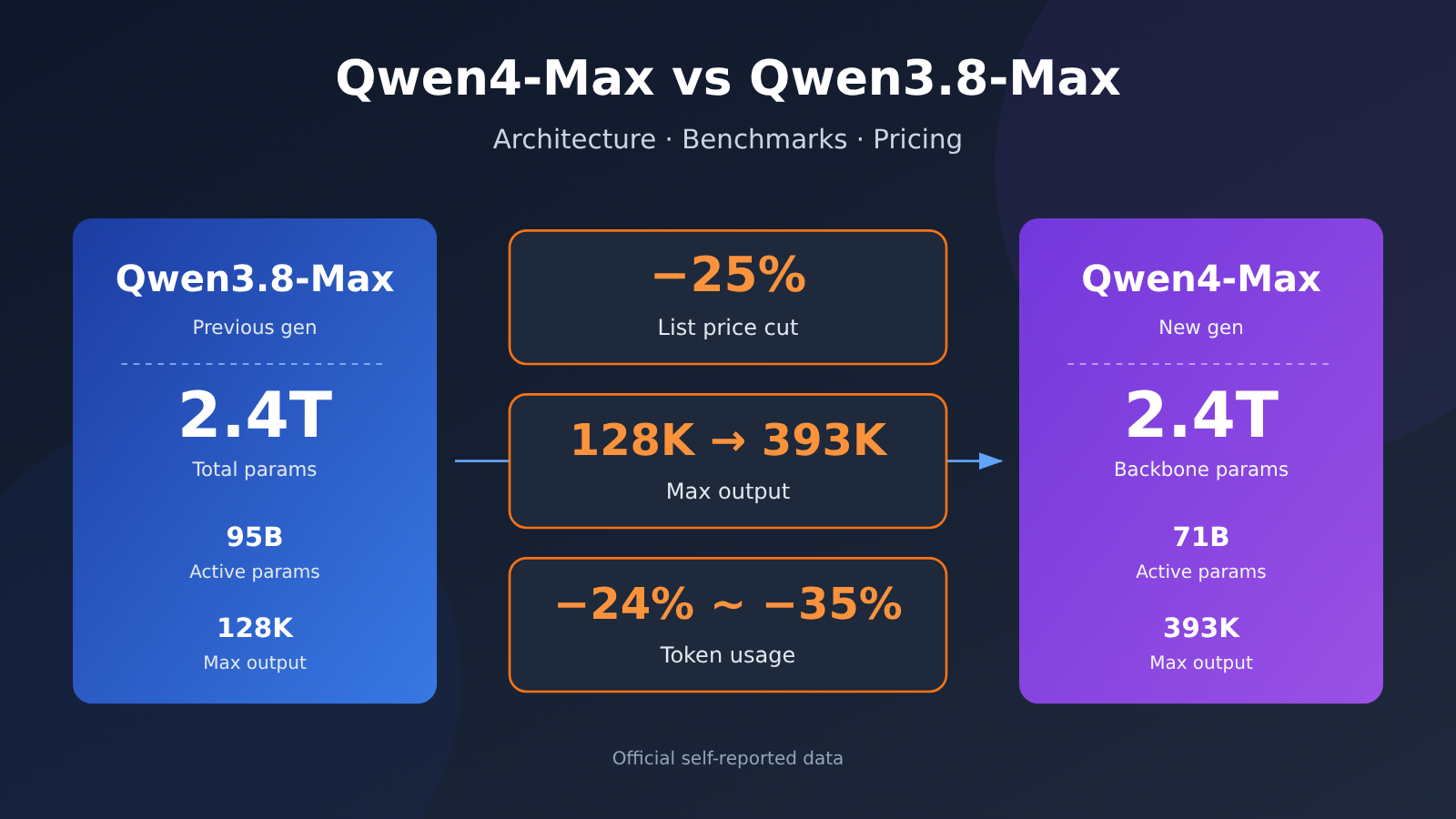
Qwen4-Max vs Qwen3.8-Max: Key Differences at a Glance
Both generations sit in the same overall scale bracket, but Qwen4-Max has adjusted active parameters, the output ceiling, and the default reasoning level. The table below lines up the spec-level differences first; pricing gets its own section in the cost chapter later.
| Dimension | Qwen3.8-Max | Qwen4-Max | Change |
|---|---|---|---|
| Parameter scale | 2.4T total parameters | 2.4T backbone + 328B N-gram embedding | Same backbone level, new embedding table |
| Active per pass | 95B | 71B | About 25% fewer |
| Context | 1M | 1M (max input 991K, thinking mode 983K) | Input ceiling slightly tightened |
| Max output | 128K | 393K | About 3x |
| Max chain-of-thought | Not listed separately by official sources | 262K | New explicit cap |
| Default reasoning_effort | xhigh | high | Default level lowered one notch |
| Vision capability | Supports image input | Native vision | Vision becomes a native capability |
| Open weights | Qwen3.8-2.4T-A95B | Not mentioned in the materials | — |
This table reveals the thinking behind the upgrade: the overall scale stays the same, per-pass compute is cheaper, and output room is larger. Dropping active parameters from 95B to 71B is the underlying precondition for lowering the list price; pushing max output to 393K directly changes what’s feasible for tasks like long reports and large code generation.
One thing to watch: the default reasoning_effort changes from xhigh to high. If your code doesn’t explicitly set this parameter, the actual reasoning level will change after you switch model IDs—something we’ll emphasize again in the migration checklist.
Qwen4-Max Architecture Changes: How the Three Changes Affect You
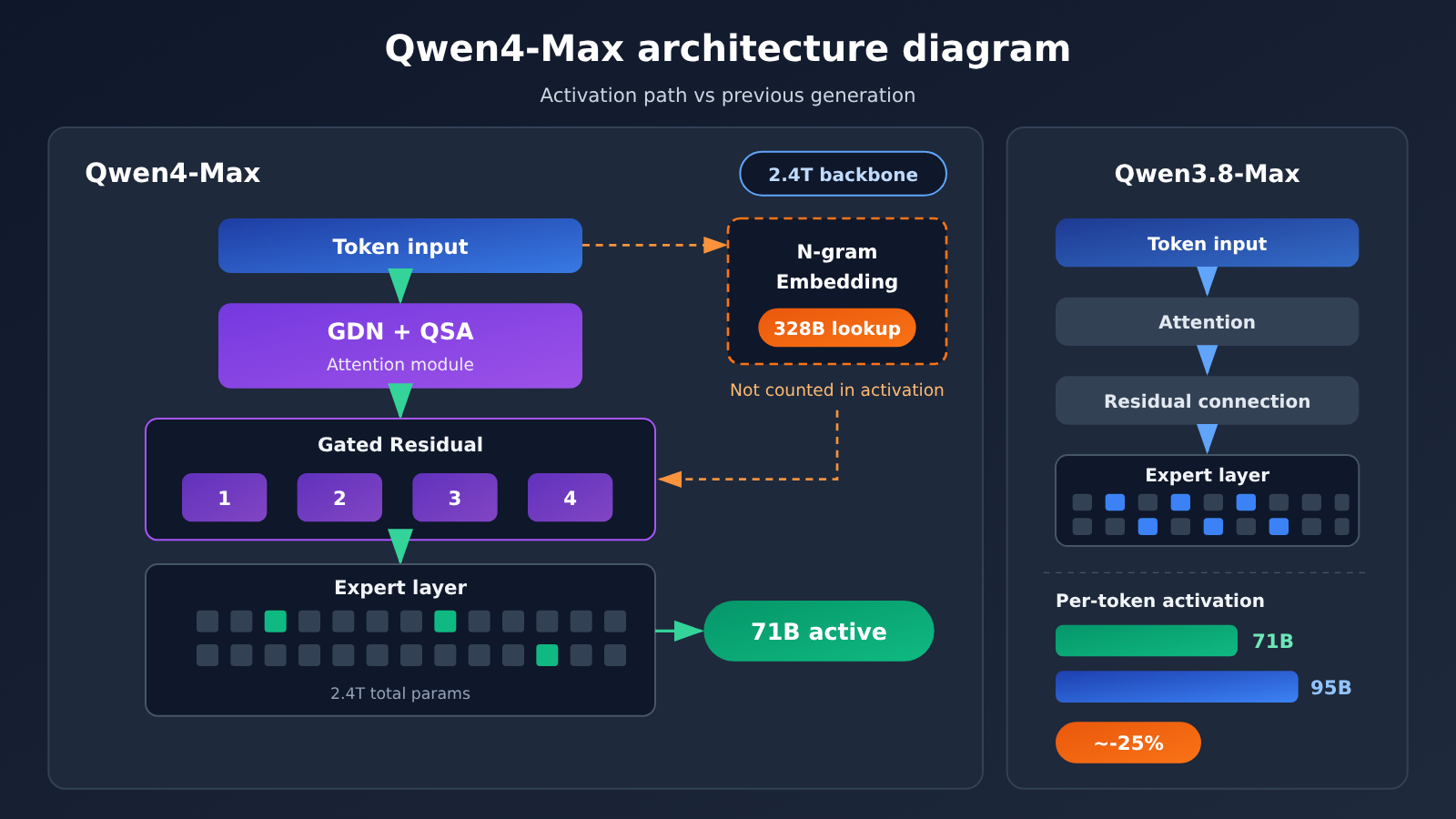
The official blog boils Qwen4-Max’s architecture changes down to three items: GDN + QSA, the four-branch Gated Residual, and N-gram Embedding. If you’re using the API, there’s no need to understand the implementation layer by layer — but you do need to know what each of these three changes affects.
GDN + QSA: Changes at the Attention Level
This is a structural adjustment to attention. The official blog introduces it alongside the 1M context window and 393K max output, and our read is that it mainly serves computational efficiency in long-sequence scenarios. For callers, the directly observable result is this: with the same 1M context window, Qwen4-Max can produce longer output while the unit price actually drops.
The Four-Branch Gated Residual
Residual connections have been expanded into four branches with gating. Changes like this typically affect training stability and how information flows between different capabilities, and they ultimately show up in model behavior. The practical impact: even if your prompt stays exactly the same, Qwen4-Max’s output style and reasoning-step length may differ from the previous generation. That means prompts you fine-tuned for Qwen3.8-Max need regression testing.
N-gram Embedding: 328B Parameters Don’t Equal Compute
Qwen4-Max’s parameter notation reads “2.4T backbone / 71B activated + 328B N-gram Embedding.” Under the usual design, this kind of embedding is table-lookup parameters and isn’t counted toward the backbone activation compute per token, so you can’t just add 328B onto the activation count for comparison. What actually relates to inference cost is 71B versus 95B — in other words, roughly 25% less activation per step.
At the pretraining level, the official numbers show Qwen4-Max-Base has the lowest BPB (bits per byte — lower is better) across all four internal eval categories: knowledge, code, Q&A, and STEM. That’s about 5–13% lower than Qwen3.8-Max-Base. These are official internal evals, but they at least show the base model itself has improved — meaning the benchmark gains that follow aren’t coming solely from post-training.
Qwen4-Max Benchmark Comparison: Which Scores Jumped and Which Barely Moved
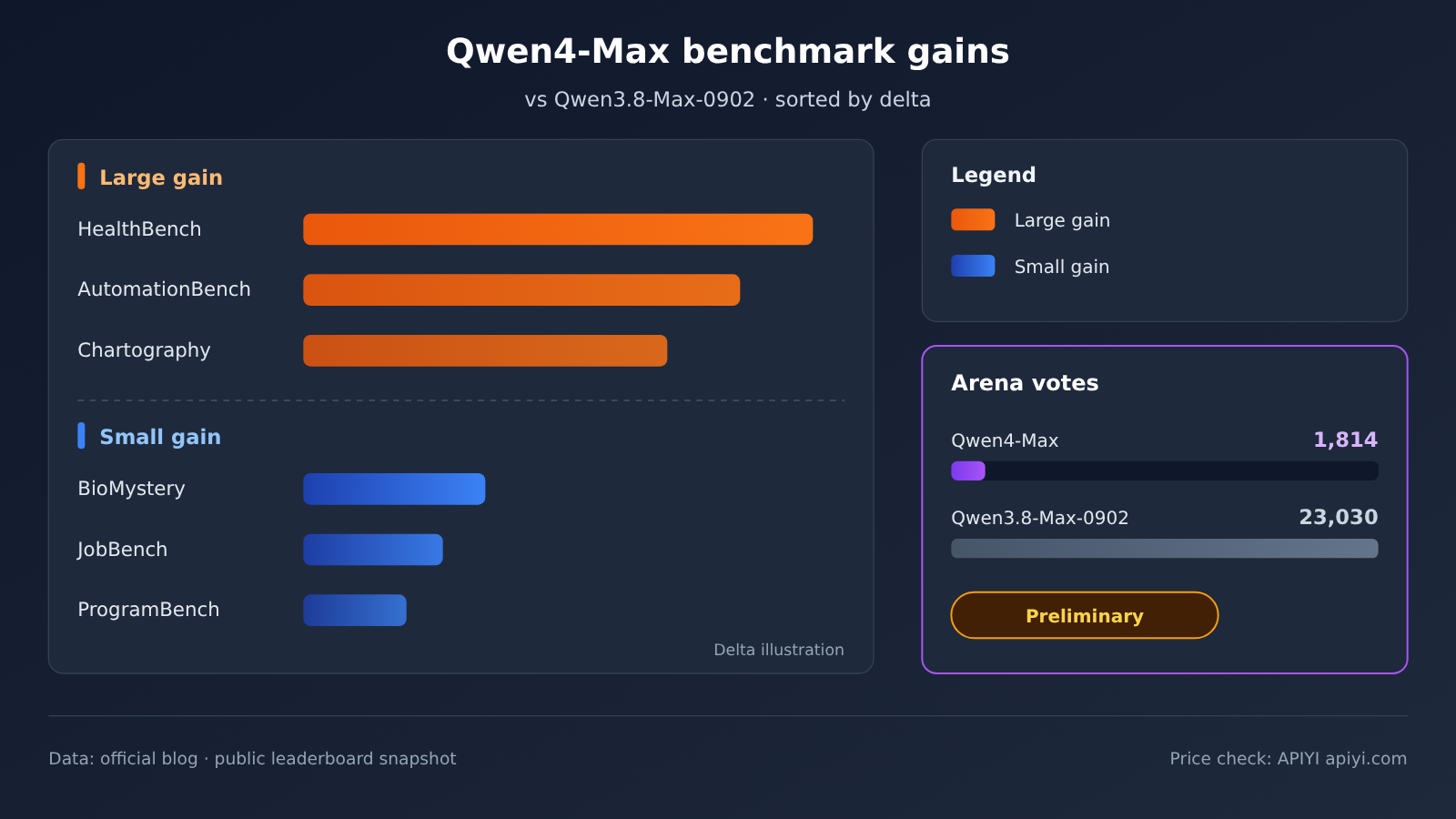
All the data below comes from the same comparison chart released by Alibaba. It’s officially self-reported, and the comparison is against Qwen3.8-Max-0902 (the September refresh). We’ve sorted the results by improvement from largest to smallest, so you can see right away where the upgrade gains are concentrated.
| Benchmark (officially self-reported) | Qwen3.8-Max-0902 | Qwen4-Max | Delta | Improvement |
|---|---|---|---|---|
| AA-Briefcase | 1605 | 1686 | +81 | Notable |
| CodeArena | 1676 | 1750 | +74 | Notable |
| HealthBench | 39.6 | 60.0 | +20.4 | Very notable |
| AutomationBench | 56.2 | 72.5 | +16.3 | Very notable |
| Chartography | 42.0 | 54.2 | +12.2 | Notable |
| Terminal-Bench | 38.9 | 48.5 | +9.6 | Notable |
| APEX-Agents | 63.3 | 72.1 | +8.8 | Notable |
| HLE | 43.9 | 51.7 | +7.8 | Notable |
| DeepSWE | 69.3 | 75.7 | +6.4 | Moderate |
| HLAB-Vals | 15.4 | 21.3 | +5.9 | Moderate |
| Video-Index | 63.2 | 68.1 | +4.9 | Moderate |
| ProgramBench | 28.0 | 31.5 | +3.5 | Small |
| JobBench | 65.3 | 68.5 | +3.2 | Small |
| BioMystery | 84.1 | 85.0 | +0.9 | Barely moved |
The biggest gains are concentrated in agent and tool-use tasks: AutomationBench +16.3, Terminal-Bench +9.6, APEX-Agents +8.8. If your business runs on multi-turn tool calls, terminal operations, or automated workflows, that’s where the upgrade pays off most. HealthBench climbed from 39.6 to 60.0, and Chartography gained 12.2, which shows medical Q&A and chart understanding are also key focus areas for this generation.
At the other end, BioMystery gained just 0.9, while JobBench and ProgramBench each moved a little over 3 points. The marginal benefit of upgrading for these task types is limited. If your main scenarios happen to be close to these, benchmark scores alone aren’t enough to support an upgrade decision — you should look at cost instead. The officially reported Work360 is 52.69 vs 47.74, a gain of 4.95, which also lands in the moderate range.
On safety, the official figures show the function-level dual pass rate on Last Secure Code Bench rising from 22.0% to 31.8%, and simultaneous safety across all three granularities from 8% to 14.7%. The absolute numbers are still low — generated code still needs security review — but the relative improvement is clear.
Third-Party Arena Leaderboard: Preliminary Ranking with 1,814 Votes
The official CodeArena score of 1750 also shows up on the third-party arena.ai Code Arena WebDev leaderboard. Here’s a public leaderboard snapshot, 2026-11-14:
- Qwen4-Max (xHigh): 1750 points, No. 6, marked Preliminary, 1,814 votes, $4.18/task
- Qwen3.8-Max (0902): 1676 points, No. 16, 23,030 votes, $1.91/task
- Qwen3.8-Max: 1670 points, No. 18
The second thing that’s easy to overstate here is this: Qwen4-Max has only 1,814 votes, while the previous-generation 0902 version has 23,030 votes—about a 12x difference. The Preliminary label means the ranking is still converging, and the No. 6 spot may still change. When citing it now, it’s best to write “preliminary No. 6.”
Another detail in the snapshot is worth noting: Qwen4-Max competed at the xHigh setting, with a per-task cost of $4.18, higher than Qwen3.8-Max 0902’s $1.91. This doesn’t contradict the official claim of “lower per-task cost,” because the tested settings and task types are different, but it’s a reminder: at the highest reasoning setting, Qwen4-Max isn’t necessarily cheaper.
Qwen4-Max Pricing and Cost: How Much of the Savings Is Real?
When it comes down to it, an upgrade means switching models, and before you make that call you need to compare prices. The table below lists the official list prices for both generations alongside the current price of qwen3.8-max sold on APIYI. All figures are per 1M tokens, with data as of 2026-11-16.
| Billing item (per 1M tokens) | Qwen3.8-Max official (Singapore region) | Qwen4-Max official | Qwen4-Max official (CNY) | APIYI qwen3.8-max current price |
|---|---|---|---|---|
| Input | $2 | $1.5 | ¥10 | $1.65 |
| Output | $6 | $4.5 | ¥30 | $4.95 |
| Cache read | $0.25 | $0.075 | ¥0.5 | $0.20625 |
| Cache write (5 minutes) | Not listed in the official blog | $1.875 | ¥12.5 | Not listed separately in the docs |
| Cache write (1 hour) | Not listed in the official blog | $3 | ¥20 | Not listed separately in the docs |
Input and output each drop 25%, and cache reads fall from $0.25 to $0.075—roughly a 70% reduction, the biggest single item in this price adjustment. On the other hand, Qwen4-Max explicitly breaks out two cache-write tiers, 5 minutes and 1 hour, so applications that repeatedly reuse long prefixes will need to work this write cost into their budgets.
Token Savings: 20–30% on Work360, 40–50% on Terminal-Bench
The official token savings numbers come in two sets. On Work360, the Xhigh tier saves 24% and the High tier saves 35% — that’s where the “20–30% savings” figure comes from. On Terminal-Bench 4.0 it’s even more dramatic: 48% and 49% respectively.
The savings on terminal-style tasks are noticeably bigger, which may have something to do with fewer tool rounds in those tasks. When you’re budgeting, 20–30% is the safer estimate for general office work; 40–50% only applies to terminal-style scenarios similar to Terminal-Bench.
The 11-Point Gap Between 62% and 51%
This is the first place where things tend to get overstated. Officially, per-task cost drops from $4.43 to $1.67 — about a 62% drop in dollar terms. The Chinese-language version says ¥26.58 down to ¥11.16, roughly a 58% drop, so the two framings already disagree.
Run the numbers using the official figures themselves: 35% fewer tokens and 25% lower unit price. Multiply the two and you only get about a 51% reduction — 0.65 × 0.75 ≈ 0.49. The remaining ~11 points aren’t explained by the official documentation. Our guess is that they come from cache-hit gains driven by the steep cut to cache-read pricing (about −70%), plus fewer tool-call rounds — but that’s our inference, not an official explanation.
Here’s the safe approach: treat 51% as the reference ceiling “at the same cache hit rate,” and consider 62% reachable only in scenarios with high cache hit rates and many tool rounds. For your own business, the most reliable basis is to run a per-task cost comparison on real traffic.
APIYI Current Pricing and Listing Status
APIYI currently sells qwen3.8-max at $1.65 input, $4.95 output, and $0.20625 cache read — about 17.5% below Alibaba Cloud’s documented $2 / $6. The same price applies to qwen3.8-max-0902, while the open-weight version qwen3.8-2.4t-a95b comes in at $1.72 / $5.16 / $0.215.
When we re-checked at 11:00 on 2026-11-16, qwen4-max wasn’t anywhere in APIYI’s model docs or price list (284 models in total), so it isn’t listed yet. We’ll get this model up as soon as we can — the model name and pricing will follow the model list on the APIYI apiyi.com platform. Honestly, Qwen4-Max’s official list price is already lower than what we’re charging for qwen3.8-max today, so once it’s live it’s worth going back over the numbers.
Migrating from Qwen3.8-Max to Qwen4-Max: A Checklist
A lot of people assume an upgrade is just a model ID change. In practice, the default parameters, context boundaries, and cache billing have all changed too. The checklist below is ordered by priority—things that will cause problems if you don’t change them come first.
| Item | Qwen3.8-Max today | After migrating to Qwen4-Max | Recommended action |
|---|---|---|---|
| Model ID | qwen3.8-max / qwen3.8-max-0902 |
Follow the platform’s model list | Switch after it’s available; start with a canary rollout |
reasoning_effort default |
xhigh | high | Set the tier explicitly so behavior doesn’t quietly change |
max_tokens limit |
128K | 393K | Check downstream truncation, storage, and timeout settings |
| Max input | 1M | 991K (983K in thinking mode) | Very long inputs close to 1M need to be trimmed |
| Cache billing | Cache read $0.25 | Cache read $0.075, plus separate 5-minute / 1-hour write prices | Reassess cache prefix and TTL strategy |
| Vision input | Image input | Native vision | Re-run regression tests for image-related use cases |
| Prompt and output format | Tuned for the previous generation | Architecture has changed, so behavior may differ | Run regression tests with a fixed eval set |
| Cost monitoring | Per token | Token count and unit price both drop | Track per-task cost instead of unit price |
The easiest item to overlook on this list is reasoning_effort. Qwen3.8-Max defaults to xhigh, while Qwen4-Max defaults to high. If your code doesn’t set it explicitly, switching could save tokens—or it could underperform on complex reasoning tasks. The official token-savings data covers both Xhigh and High, so I’d test both tiers separately and then decide which one to use in production.
The second item is output length. A 393K limit means a single response can be much longer than before. If your logging system, database fields, or gateway timeouts were designed around 128K outputs, you’ll need to loosen them ahead of time. The maximum input has tightened from 1M to 991K (983K in thinking mode). For most workloads that never get close to the limit, the impact is minor—but scenarios that stuff documents right up to the cap will start throwing errors.
Calling through APIYI today
If you’re currently integrating through APIYI, the base_url is https://api.apiyi.com/v1, you’re using the OpenAI-compatible protocol, and you can keep running in production by setting the model field to qwen3.8-max. If you need to lock in the behavior of the September refresh, you can switch to qwen3.8-max-0902 at the same price.
Once qwen4-max is available on the platform, the protocol won’t change, so at the code level the migration only requires updating the model field, then filling in reasoning_effort and max_tokens according to the checklist above. I’d recommend routing 5%–10% of traffic through a canary first, comparing per-task cost and business metrics, and then rolling it out fully.
🚀 Migration tip: For projects currently using APIYI (apiyi.com), keep using
qwen3.8-maxand get your eval set and canary switch ready. Onceqwen4-maxis available, swap the ID. That way, you won’t end up with a business gap while waiting for the new model.
Qwen4-Max vs Qwen3.8-Max: Scenario Recommendations
Scenarios where you should evaluate upgrading to Qwen4-Max first
- Multi-turn tool calling and automation: AutomationBench, Terminal-Bench, and APEX-Agents all show clear gains, and the token savings are biggest on terminal-style tasks.
- Extremely long output tasks: When you need a single response over 128K for a report, code, or document, only Qwen4-Max’s 393K can deliver it.
- Medical Q&A and chart understanding: HealthBench is up 20.4 and Chartography up 12.2 — the most notable improvements in this generation.
- Code safety requirements: The safe dual-pass rate rises from 22.0% to 31.8%, but you still need a review process alongside it.
- Apps with high cache reuse: Cached-read pricing drops roughly 70%, so scenarios with long system prompts and fixed knowledge-base prefixes benefit the most.
Scenarios where you should stay on Qwen3.8-Max
- Already stable in production with deeply tuned prompts: Qwen3.8-Max is still a dependable production model, and there’s no reason to upgrade just for the sake of upgrading.
- Your main workloads resemble BioMystery or JobBench: Gains in these areas are limited, and migration costs may outweigh the benefits.
- You need open weights for self-hosting: Qwen3.8-2.4T-A95B has open weights, and the materials don’t mention an open-weight release for Qwen4-Max.
- You call through APIYI and need something available right now: While
qwen4-maxisn’t listed yet,qwen3.8-maxis the ready option.
| Your situation | Recommendation |
|---|---|
| Agent- and tool-calling-heavy, focused on cost reduction | Evaluate Qwen4-Max first, and measure actual cost at the High tier |
| Need single outputs over 128K | Qwen4-Max is the only option |
| Stable in production, mostly general Q&A | Keep Qwen3.8-Max and run regression evals in idle time |
| Need open weights for self-hosting | Keep using Qwen3.8-2.4T-A95B |
| Currently integrated through APIYI | Keep using qwen3.8-max, then roll over gradually once it’s listed |
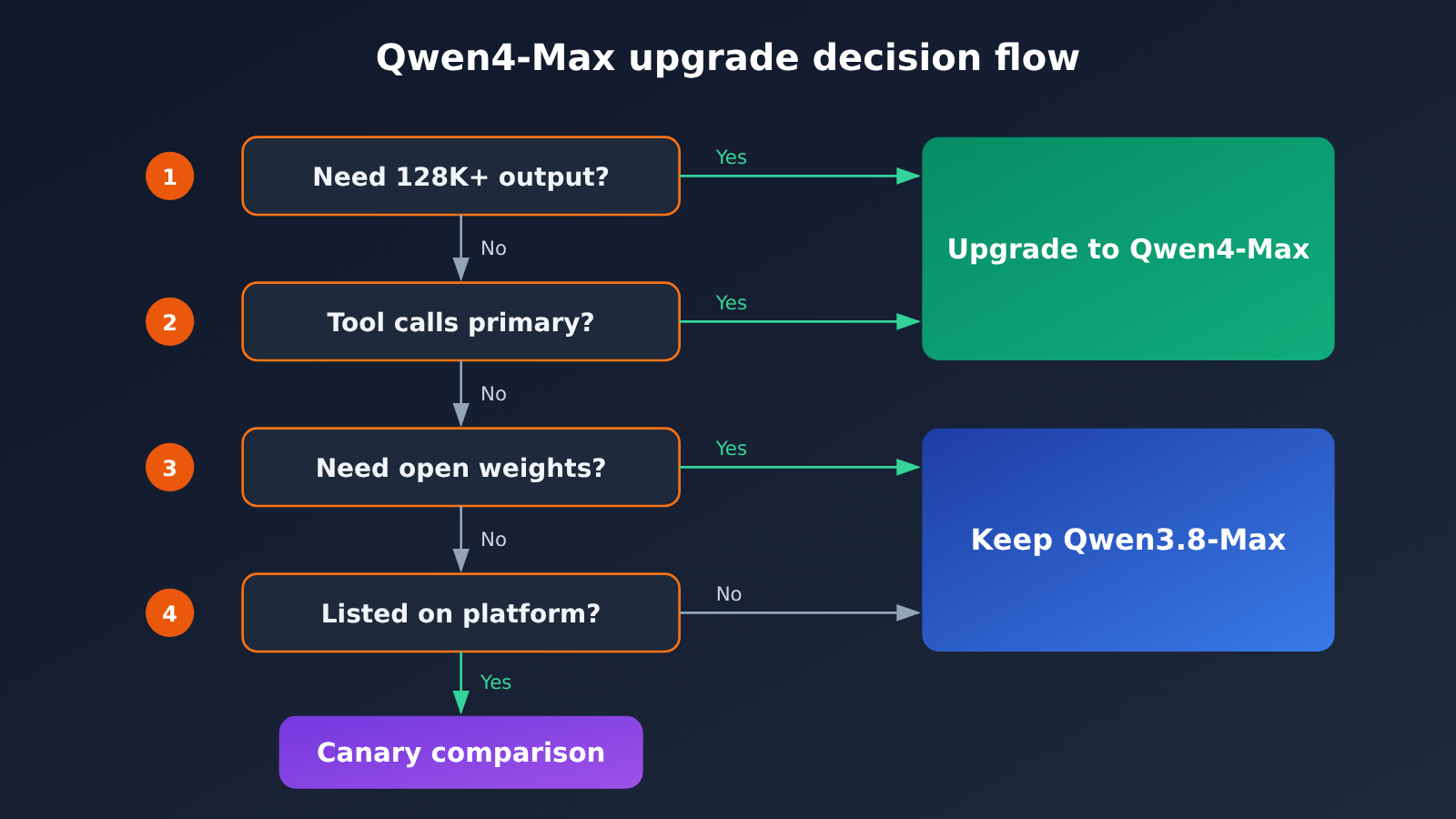
Qwen4-Max vs Qwen3.8-Max: Decision Guide
If it comes down to one sentence: agents, long outputs, and cache-heavy workloads are worth upgrading; general stable workloads can wait. Of the three upgrade benefits, the 25% lower unit price is certain, the 20–30% token savings is official data from specific benchmarks, and the 62% per-task reduction only gets close if your own caching and tool-turn conditions line up.
💡 Recommendation: Before deciding, run a set of your own real tasks on each model and compare per-task cost and output quality, instead of just looking at benchmark tables. Through APIYI apiyi.com, you can use the same API key to run a baseline on
qwen3.8-maxfirst; onceqwen4-maxis listed, compare them directly in the same codebase.
FAQ
Q1: What’s the relationship between Qwen4-Max and Qwen3.8-Max?
Both are 2.4T-class flagships from Qwen. Qwen3.8-Max was released on 2026-08-03, and 0902 is the September refresh. Qwen4-Max was released on 2026-11-16 with a new architecture: active parameters per pass dropped from 95B to 71B, the output limit was raised to 393K, and the list price was cut by 25%.
Q2: If tokens are saved by 20–30%, will the bill drop by 20–30%?
More than that—and not necessarily. The unit price itself is down 25%, and when you stack token reduction on top, the same-task cost could theoretically drop by about 51%. But the token-saving figures come from the official Work360 benchmark; how much your workload saves needs real testing. If you use the xhigh setting, as the Arena snapshot shows, per-task cost could actually be higher.
Q3: Qwen4-Max is No. 6 on Arena—is that ranking reliable?
It’s only a preliminary result. In the public leaderboard snapshot (2026-11-14), Qwen4-Max had only 1,814 votes marked Preliminary, while the previous generation 0902 had 23,030 votes—about a 12x difference. Its score of 1750 matches the official self-reported figure, but the ranking will shift as votes accumulate.
Q4: Can I call qwen4-max through APIYI now?
As of 2026-11-16 11:00, no. `qwen4-max` isn’t listed yet, and we’ll list it as soon as possible. Currently available are `qwen3.8-max`, `qwen3.8-max-0902`, and the open-weight version `qwen3.8-2.4t-a95b`. For the latest models and pricing, refer to the model list on APIYI apiyi.com; new users can use the free trial quota to run a baseline first.
Q5: Is changing only the model ID enough for migration?
No. At minimum, you also need to explicitly set reasoning_effort (the default changes from xhigh to high), relax max_tokens and downstream storage limits as needed, check ultra-long inputs close to 1M, and re-evaluate cache write costs. At the protocol level, if you’re using the OpenAI-compatible endpoint `https://api.apiyi.com/v1`, you only need to change the model field in your code.
Q6: Is Qwen3.8-Max still worth using?
Yes. It’s still a 2.4T-class flagship with a 1M context window, 128K output, thinking and non-thinking modes, and an open-weight version. Qwen4-Max shows only small gains on benchmarks like BioMystery and JobBench; for those workloads, a stable Qwen3.8-Max can absolutely continue to handle production traffic.
Qwen4-Max vs Qwen3.8-Max Key Takeaways
- Same scale, fewer active parameters: The 2.4T backbone is unchanged, while active parameters per pass drop from 95B to 71B — about 25% fewer.
- Unit price down 25%: Input $2→$1.5, output $6→$4.5; cache reads drop about 70%, and cache writes are now billed.
- Output roughly triples: Max output 128K→393K; max input tightens to 991K.
- Gains are concentrated in agents: AutomationBench, Terminal-Bench, and HealthBench improve noticeably; BioMystery barely moves.
- Two points not to overstate: Only about 51 points of the 62% cost reduction can be derived from the stated changes; the Arena #6 spot is based on just 1,814 votes and is Preliminary.
- Migration is more than swapping IDs: Watch the
reasoning_effortdefault, themax_tokenslimit, and the caching strategy. - APIYI status:
qwen4-maxisn’t listed yet; keep usingqwen3.8-maxand switch over gradually after it’s available.
Summary
Core conclusions from Qwen4-Max vs Qwen3.8-Max:
- Cost: The 25% unit price cut is a sure gain. The 20–30% token savings need to be measured against your own workload, and about 11 points of the 62% reduction remain unexplained.
- Capability: Agent, tool-calling, healthcare, and chart-related directions improve noticeably; some benchmarks are nearly flat; all scores are vendor-reported.
- Migration: The protocol is unchanged, but the default reasoning effort level, output limit, and cache billing have all changed, so check each item against the checklist.
Qwen3.8-Max is still a reliable production model. An upgrade should be a data-backed, staged rollout decision — not a full cutover just because a new version exists. We recommend first using qwen3.8-max through APIYI at apiyi.com to establish a cost and quality baseline, then comparing directly under the same API once qwen4-max becomes available.
📚 References
- Qwen3.8 Official Blog: Qwen3.8-Max release notes, including parameters, context window, and official pricing
- Link:
qwen.ai/blog?id=qwen3.8 -
Note: Source for the previous generation’s specs and Singapore-region pricing
-
Hugging Face – Qwen3.8-2.4T-A95B: The open-weights version of Qwen3.8
- Link:
huggingface.co/Qwen/Qwen3.8-2.4T-A95B -
Note: Model card and weight downloads if you need to self-deploy
-
Qwen Official Blog: The Qwen4-Max release post with a same-chart benchmark comparison
- Link:
qwen.ai/blog -
Note: Source for architecture changes, official self-reported benchmarks, and token and per-task cost data
-
arena.ai Code Arena WebDev: A third-party head-to-head model leaderboard
- Link:
arena.ai - Note: This article cites the 2026-11-14 snapshot; rankings shift as votes come in
Author: APIYI Technical Team
Technical Contact: Feel free to reach us through the APIYI homepage. Model names and pricing are available in the docs.apiyi.com documentation center.


