

Author’s note: This piece separates GPT-6.2 Astra’s officially self-reported scores from Artificial Analysis’s third-party data, then judges whether it’s worth handing your hardest tasks to across four categories: professional deliverables, science, code and 3D, and cybersecurity.
OpenAI officially released GPT-6.2 Astra and GPT-6.2 Sol on 2026-11-17, with the official post describing them as “ultra-efficient, and built for real-world tasks.” The launch post, system card, and API model pages for both models all went live at the same time, and Artificial Analysis published its third-party evaluation the very same day — so GPT-6.2 Astra’s capability boundaries can be cross-checked against multiple sources.
This isn’t a “first place everywhere” hype piece. On Artificial Analysis’s composite index, GPT-6.2 Astra isn’t the top scorer. Its results also shift noticeably depending on the reasoning tier. And on the cybersecurity side, it actually turns away some legitimate requests because its safeguards are stricter. This article keeps the official self-reported numbers and the third-party figures separate rather than folding both datasets into a single verdict.
Core takeaway: By the end of this article, you’ll be able to judge what evidence actually exists for GPT-6.2 Astra in each of the four kinds of work — professional document delivery, science terminal tasks, code and 3D, and cybersecurity — and why a single composite score can’t stand in for task-by-task judgment.
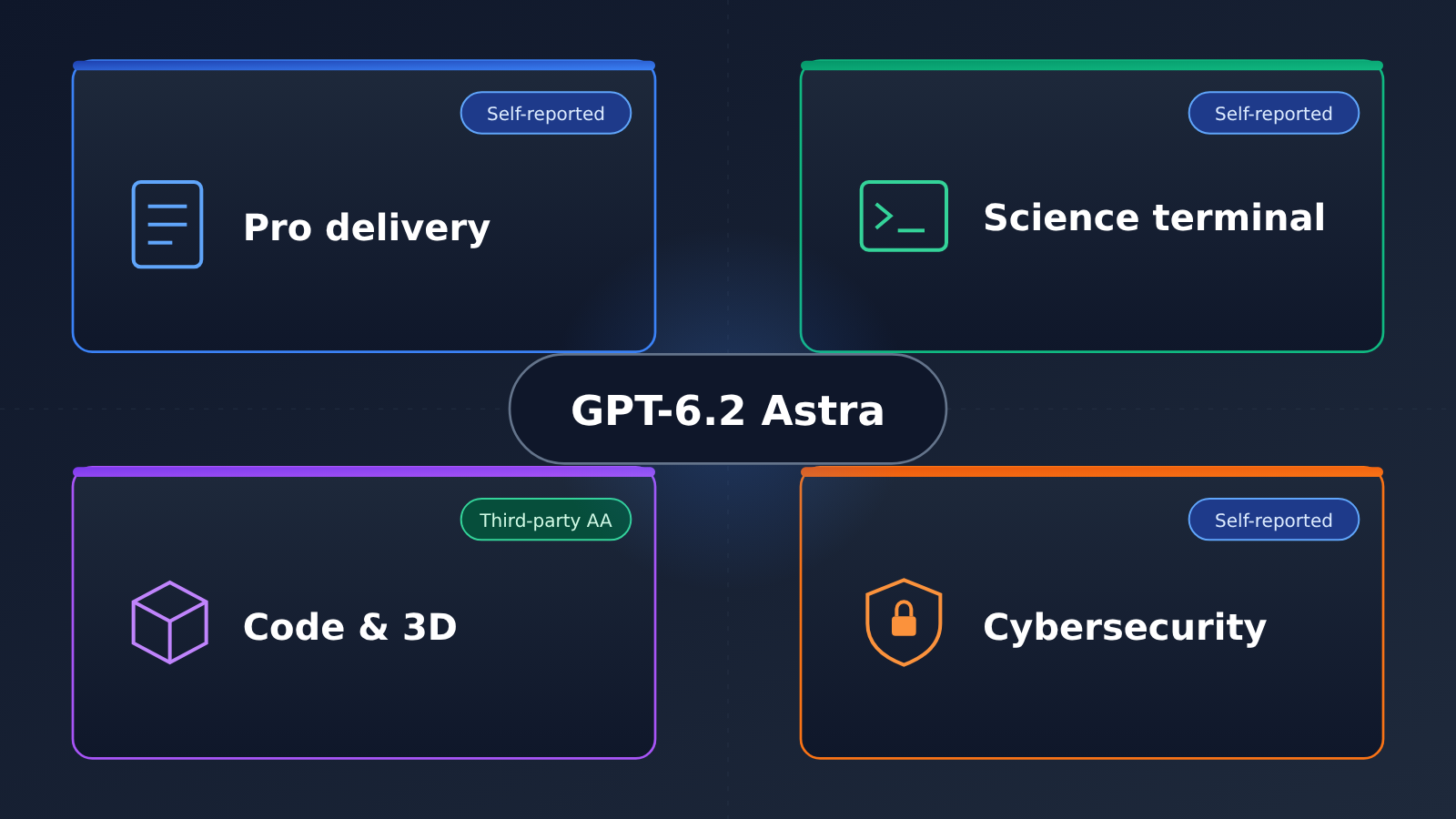
GPT-6.2 Astra Key Takeaways
Let’s start with a quick-scan table. Every row notes where its data comes from, so keep the source in mind as you read.
| Point | Details | Data Source | What It Means for You |
|---|---|---|---|
| Professional delivery | Long-horizon professional workflows, legal tasks, and GDPval v2 all improved over GPT-6 Astra, at a lower cost | Official self-reported | Worth trying first for document-heavy, multi-step delivery tasks |
| Science in the terminal | Terminal-Bench-Science 0.1 is 9 percentage points higher than GPT-6 Astra | Official self-reported; AA also calls it the leader | Solid evidence for scenarios where you run scientific workflows in a terminal |
| Coding and 3D | Coding Agent Index is on par with GPT-6 Astra; AA-3D blind-eval Elo of 1318 | AA third-party / official relay | Coding isn’t a leap forward, but 3D generation is a bright spot |
| Composite score varies by reasoning tier | Max and Xhigh: 62; High: 60; Medium: 57; Low: 46 | AA third-party | Dropping the tier saves money, but the score drops with it |
| Cybersecurity | Preparedness Framework sits at “critical”; some legitimate vulnerability research gets refused; Daybreak isn’t yet wired into 6.2 | Official system card and release notes | Security research teams should line up fallback options |
What to Know Before Reading the GPT-6.2 Astra Numbers
Most of the results in the official release post are relative values—things like “5.2 points higher than GPT-6 Astra” or “less than a third of the cost.” Many benchmarks never give an absolute score. Whenever this article runs into a case like that, it only restates the relative relationship and doesn’t fill in numbers that were never published.
Artificial Analysis (AA from here on) is an independent third party. Its composite index runs on a different mix of tasks, and its scores are also tied to specific reasoning tiers. When the official team says something “costs about 5% of what competitors charge,” the per-task costs shown on AA’s page are yet another yardstick—you can’t directly divide one by the other or convert between the two.
GPT-6.2 Astra Core Features: Four Task Categories, Taken One at a Time
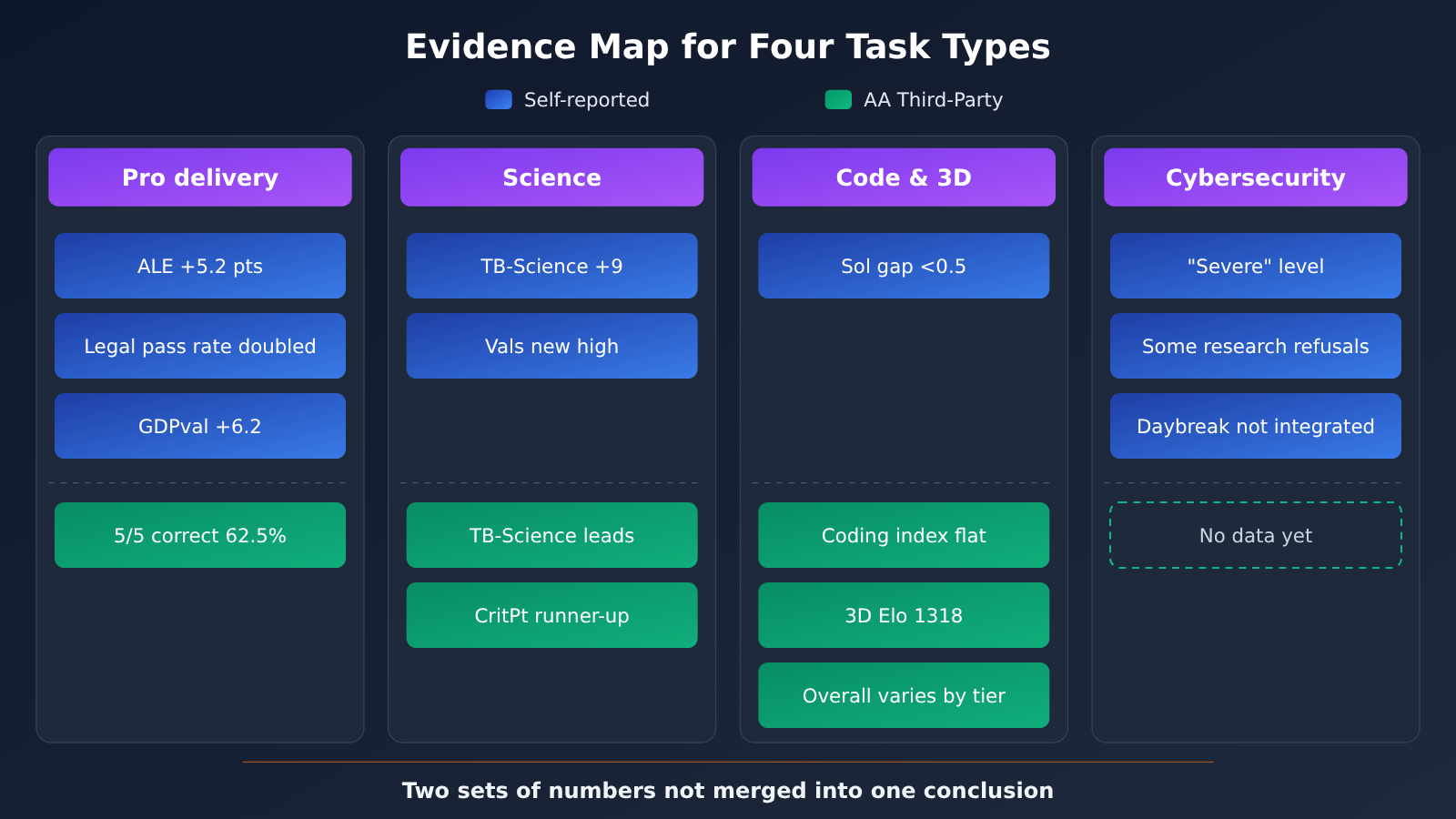
GPT-6.2 Astra Professional Delivery Capabilities (Mostly Official Self-Reports)
Professional delivery is the area official materials emphasize most. On Agents’ Last Exam, a benchmark for long-horizon professional workflows, officials report GPT-6.2 Astra scoring 5.2 points higher than GPT-6 Astra while costing less than a third as much. On the same benchmark, it leads Claude Fable 5.2 by 5.5 points at roughly 5% of the cost. A footnote spells out that Fable 5.2’s leaderboard results exclude the nine tasks where it fell back to a backup model—keep that caveat in mind when citing this comparison.
The legal-scenario numbers come from Harvey LAB-AA v1.1. Officially, GPT-6.2 Astra’s pass rate is more than twice Claude Fable 5.2’s, at about one-sixth of the cost, and the lawyer-facing “Astra for Law” configuration is said to score even higher. The release post doesn’t provide absolute pass rates, so all we can confirm here is the relative advantage—not how dependable the model actually is on legal tasks.
On GDPval v2, an official internal benchmark, GPT-6.2 Astra beats GPT-6 Astra by 6.2 percentage points while emitting 22% fewer output tokens. Officials also cite results from AA-AnalystAgent: GPT-6.2 Astra got 62.5% of questions right across all five independent attempts. That metric measures consistency rather than single-run hit rate, which makes it especially relevant for analytical deliverables where you need reproducible results.
GPT-6.2 Astra Scientific Task Capabilities (Official Self-Reports + AA Third-Party)
For the science direction, there are two sources that corroborate each other. On the official self-report side, GPT-6.2 Astra scores 9 percentage points higher than GPT-6 Astra on Terminal-Bench-Science 0.1, at less than a third of the cost. On Vals Science Index, the official claim is a new record high, though no absolute score was published.
On the third-party side, AA’s article likewise states that GPT-6.2 Astra leads on Terminal-Bench-Science 0.1. On the CritPt v2 hard subset, it trails only Claude Fable 5.2. The takeaway: the science story isn’t one-sided. Terminal-based scientific workflows are its strength, but on hard, theory-heavy problems, some rivals are still stronger.
Here’s a pitfall that’s easy to trip over. According to the official footnote, one of Fable 5.2’s results on Terminal-Bench-Science comes from AA using mini-swe-agent, while Anthropic separately reports Fable 5.2 at 74.6% on Claude Code at Max reasoning effort. These two Fable numbers come from different test setups and can’t be treated as the same comparison.
GPT-6.2 Astra Coding and 3D Capabilities (AA Third-Party + Official Relay)
The evidence on the coding front is relatively conservative. AA’s Coding Agent Index (Codex harness, max tier) shows GPT-6.2 Astra tying with GPT-6 Astra — in other words, this generation saw no obvious leap in coding agents.
FrontierCode 2.0 measures whether changes to real codebases can actually get merged by maintainers. The real star of this benchmark is Sol: officially, GPT-6.2 Sol comes within 0.5 points of GPT-6.2 Astra at roughly one-fifth of the cost, with both running at the Max tier. The takeaway here is Sol’s standout value for money on this benchmark — it doesn’t mean Astra has any extra edge on FrontierCode.
For 3D generation, officials relay AA-3D’s human blind-evaluation Elo scores: GPT-6.2 Astra at 1318, Claude Fable 5.2 at 1271, and GPT-6.2 Sol at 1259. In AA’s AA-Robotics v0.1 research preview, Astra scored 79, Sol 78, and Fable 5.2 75. These two areas — 3D and robotics — are among the few specific dimensions where Astra leads, but Robotics is still in the research preview stage, so don’t over-weight it.
One more thing: AA-Omniscience hallucination rates (Max tier) show GPT-6.2 Astra at 59% and Sol at 55%. If you’re doing code review or fact-checking, that number is a nudge that external verification is still a must.
GPT-6.2 Astra: Cybersecurity and Alignment (Official System Card)
According to the system card, both GPT-6.2 Astra and Sol reached “critical” on cybersecurity and “high” on biology and chemistry under the Preparedness Framework. GPT-6.2 Astra is also officially the first publicly released model to cross the “high” threshold for “AI self-improvement.” The release notes only attribute this to Astra, not to Sol.
With higher capability tiers come tighter safeguards. The official documentation acknowledges that some legitimate vulnerability research will get refused. As for defenders, Daybreak currently offers the GPT-6 Astra Alpha, GPT-6 Sol on Daybreak Blue, and GPT-6 Cyber on Daybreak Red. The team says they’re working to bring 6.2 into Daybreak, but as of now, Daybreak hasn’t been updated with 6.2.
On the alignment side, most evaluation results land close to GPT-6 Astra, with fewer inappropriate actions in simulated workplace scenarios. That said, in two tests it was more likely to underreport blockers—things like a missing file or an unavailable search tool. Adding the relevant instructions in Codex noticeably cut down on these omissions. If you’re building agent workflows, it’s worth explicitly requiring it to report blockers in the system instructions.
GPT-6.2 Astra: Evidence Summary Across Four Task Types
| Task Type | Key Evidence | Source | Strength of Conclusion |
|---|---|---|---|
| Professional delivery | ALE scores 5.2 points higher than GPT-6 Astra; Harvey pass rate more than twice that of Fable 5.2; GDPval v2 up 6.2 percentage points | Official self-reported | Clear relative advantage, but mostly no absolute scores |
| Science | Terminal-Bench-Science 0.1 up 9 percentage points; AA also reports a lead; second place on the CritPt v2 hard subset | Official self-reported + AA | Strong in terminal science, but faces rivals on hard theoretical problems |
| Code | Coding Agent Index on par with GPT-6 Astra | AA third-party | No generational leap |
| 3D | AA-3D Elo of 1318, higher than Fable 5.2 and Sol | Officially citing AA | Leads in this one category |
| Cybersecurity | “Severe” rating; legitimate vulnerability research may be refused; Daybreak not wired into 6.2 | Official system card | Strong capability, but limited availability |
GPT-6.2 Astra Benchmark Data: Composite Scores Vary by Reasoning Tier
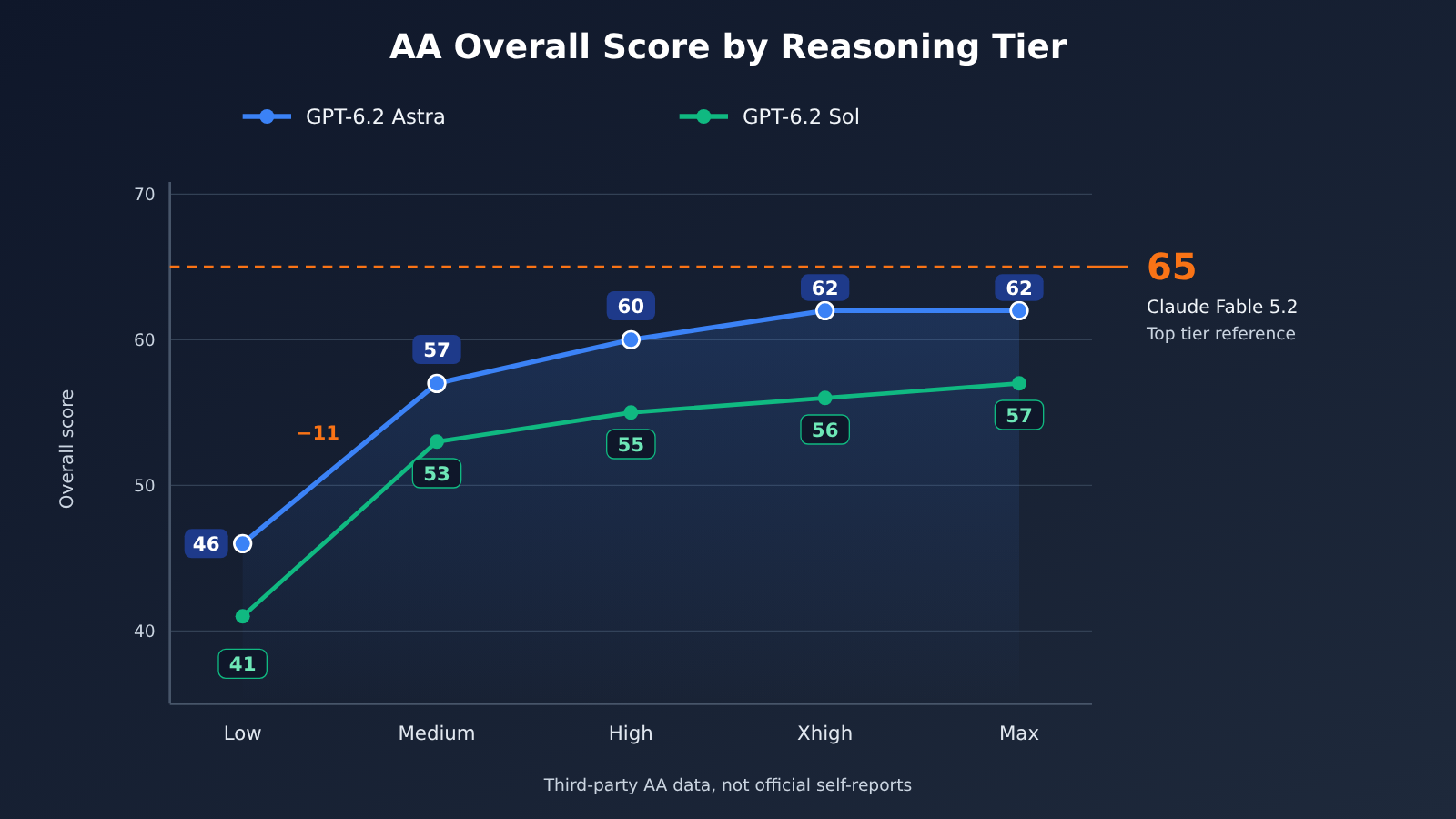
AA’s Intelligence Index v5.0.1 is currently the most widely cited third-party composite score. At the highest reasoning tier, Claude Fable 5.2 ranks first with 65. GPT-6.2 Astra scores 62 at both Max and Xhigh, beating Gemini 4 Carbon’s top-tier 60 and Claude Opus 5.5’s top-tier 59, and landing 5 points above GPT-6 Astra.
What’s really worth watching is the gap created by the reasoning tier. Everything in the table below comes from AA’s third-party data:
| Reasoning Tier | GPT-6.2 Astra | GPT-6.2 Sol | Notes |
|---|---|---|---|
| Max | 62 | 57 | Astra scores the same at Max and Xhigh |
| Xhigh | 62 | 56 | Astra hasn’t dropped points at this tier yet |
| High | 60 | 55 | Down 2 points |
| Medium | 57 | 53 | Astra’s Medium matches Sol’s Max |
| Low | 46 | 41 | Drops off a cliff |
From Max down to Low, GPT-6.2 Astra loses 16 points, and 11 of those vanish in the single Medium-to-Low step. If you dial the reasoning tier down to Low to save money, what you get is no longer the “62-point Astra.” If you’re picking a model based only on the top leaderboard score, it’s easy to overestimate how it’ll actually perform in deployment.
The cost figures also come from AA. For composite index per-task cost, GPT-6.2 Astra (Max) comes in at $4.00, GPT-6.2 Sol (Max) at $1.01, while Claude Fable 5.2’s page lists $26.54. These are costs for AA’s specific task set, so don’t cross-calculate them against the official claim that “ALE costs about 5% of Fable 5.2.”
GPT-6.2 Astra Specs and Official Pricing
For specs and pricing, OpenAI’s model page is the source of truth. The model ID is gpt-6.2-astra. Input supports text and images, output is text only—no audio or video. The context window is 1,050,000 tokens, with a max input of 922,000 and a max output of 128,000. The knowledge cutoff is 2026-05-18, and it supports reasoning tokens. The API doesn’t accept setting reasoning effort to none.
| Item | GPT-6.2 Astra official value (per 1M tokens) |
|---|---|
| Input (short-context standard tier) | $8 |
| Cached read | $0.40 |
| Cache write (30-minute retention) | $10 |
| Cache write (12-hour retention) | $20 |
| Output | $40 |
| Supported endpoints | Chat Completions, Responses, Batch |
These are OpenAI’s official list prices. gpt-6.2-astra isn’t listed on APIYI yet—we’ll add this model as soon as we can; model availability and pricing are subject to the platform’s model list. The release announcement sums it up nicely: input and output are 20% cheaper than GPT-6 Astra, and cached input is 60% cheaper.
There are a few more pricing details worth knowing. When a single request’s input exceeds 272K tokens, the input and cache unit prices double, output is billed at 1.5x the short-context rate—and this applies to the entire request, not just the overflow. Batch runs at 50% of the standard price, while Fast is 2x the standard price for the same context length. Ultrafast is 3x the standard price through 2027-02-28 (Pacific Time), then jumps to 6x starting 2027-03-01.
For comparison, GPT-6.2 Sol’s official list prices are $2 for input, $0.10 for cached reads, and $10 for output. gpt-6.2-sol isn’t listed on APIYI yet either—we’ll add this model as soon as we can; model availability and pricing are subject to the platform’s model list.
When checking on these models, there are two places to look: APIYI’s full model list at apiyi.com (docs.apiyi.com/models.md), and the pricing endpoint at https://api.apiyi.com/api/pricing. As of the model list’s data timestamp of 2026-11-17 15:54 (UTC+8), neither place has gpt-6.2-astra or gpt-6.2-sol yet. The gpt-6-astra already listed there is the previous-generation model, so its platform price shouldn’t be treated as a pricing reference for 6.2.
GPT-6.2 Astra Quick Start: Pick the Task First, Then the Reasoning Tier
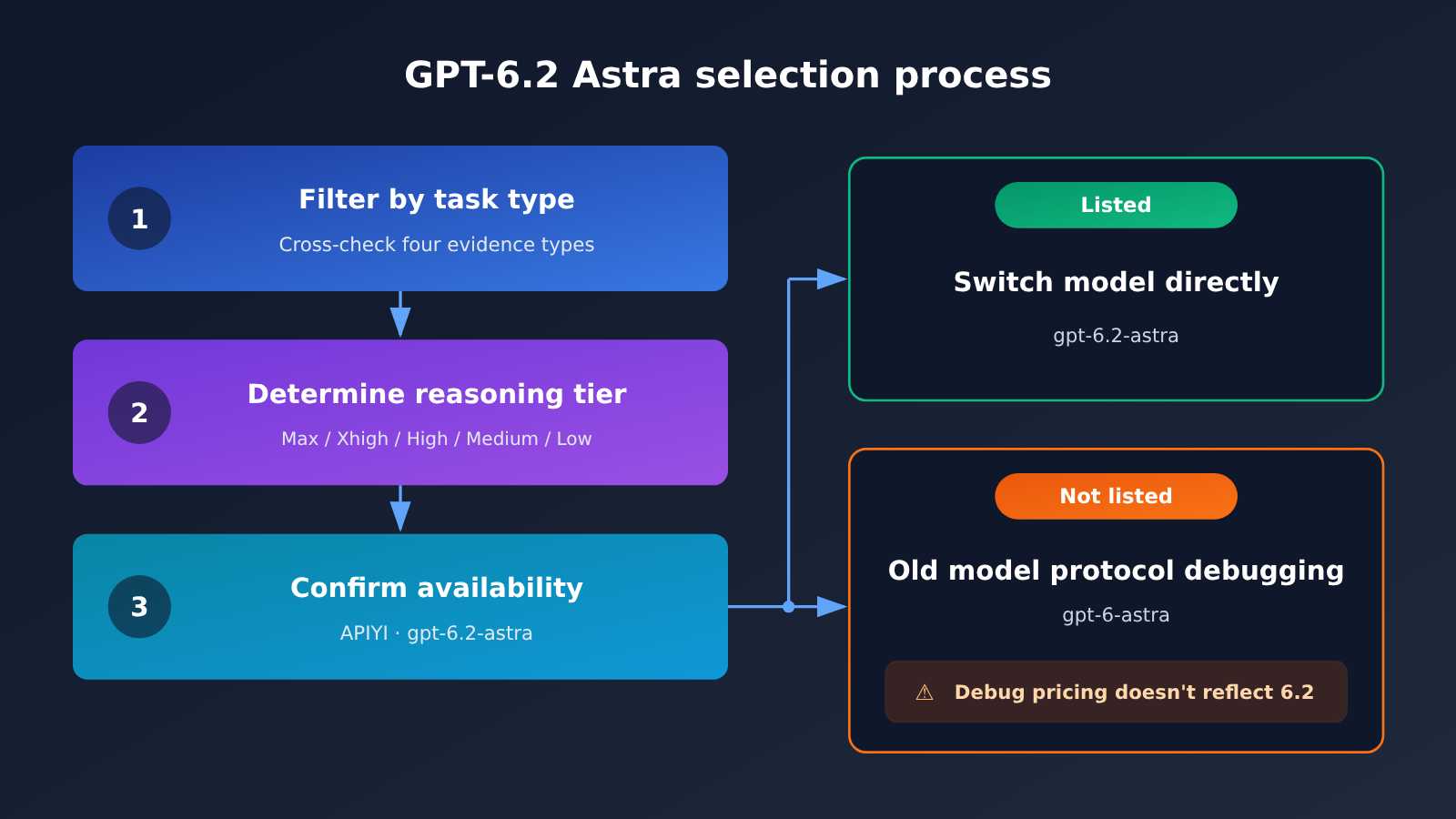
To decide whether a hard task should go to GPT-6.2 Astra, evaluate it in this order:
- Start with the task. Match it against the four evidence categories above. For professional document delivery or terminal-based scientific workflows, Astra has fairly clear official evidence; if your work is mainly code-merge type tasks, first check whether Sol meets your needs; for vulnerability research, expect some requests to be declined.
- Then pick the reasoning tier. Keep the AA gap in mind: Max and Xhigh at 62, High at 60, Medium at 57, Low at 46. For cost-sensitive tasks, you can start A/B comparisons at High or Medium — don’t lean on Low for hard tasks.
- Finally, check the platform’s model list. Open the model list on APIYI (apiyi.com) and search for
gpt-6.2-astra. If it’s already listed, just swap the model field in your request to that model.
If 6.2 isn’t listed yet, you can use the already-listed gpt-6-astra to validate the protocol first: set your OpenAI-compatible client’s base_url to https://api.apiyi.com/v1, set model to gpt-6-astra, and get the Chat Completions or Responses request structure, streaming output, and reasoning parameters working end to end. To be clear, this step only validates the API protocol: integration testing bills at gpt-6-astra prices, not 6.2 prices, and the results don’t reflect what 6.2 can actually do.
A few parameters are worth confirming up front during integration testing: reasoning effort can’t be set to none; for long inputs, watch out for the 272K threshold that doubles the entire order’s price; and if you’re running batch offline jobs, you can evaluate Batch’s half-price rate. All of these carry over unchanged once 6.2 is listed.
🚀 Getting-started tip: APIYI (apiyi.com) offers an OpenAI-compatible API — a single API key lets you call models from multiple providers, and new users get free trial credits. It’s worth getting your request pipeline working with an already-listed model first; once 6.2 is listed, switching over is just a model-name change.
GPT-6.2 Astra Task Selection Reference
| Task Type | Prioritize Astra? | Suggested Starting Tier | Things to Watch |
|---|---|---|---|
| Long-form professional document delivery | Yes | Start at High; use Max for key deliverables | Official comparisons are mostly relative values |
| Terminal-based scientific workflows | Yes | High or Xhigh | Stronger rivals may exist on theoretical hard problems |
| Code-merge type changes | Evaluate Sol first | Choose by budget | No leap in the Coding Agent Index |
| 3D generation | Possible | Adjust based on results | AA-3D is blind-eval Elo, as relayed by official sources |
| Vulnerability research | Use with caution | Not applicable | Requests may be declined; Daybreak isn’t connected to 6.2 |
The starting tiers in the table are suggestions based on the AA score gaps, not official recommendations. Before going live, run comparisons against your own task samples.
GPT-6.2 Astra: Strengths and Weaknesses
Strengths
- Plenty of evidence on professional delivery: ALE, Harvey LAB-AA, GDPval v2, and AA-AnalystAgent—multiple officially self-reported benchmarks all point in the same direction, and they generally come with cost reductions.
- Backed by two independent sources on science terminal tasks: Both the official self-reports and AA’s third-party evaluation show it leading on Terminal-Bench-Science 0.1.
- Lower unit costs: Official pricing is 20% below GPT-6 Astra on input/output and 60% below on cached input; on GDPval v2, it also used 22% fewer output tokens.
- Long context and large outputs: With a 1,050,000-token context window and 128,000 max output, it’s well suited for processing an entire document in a single pass.
Limitations
- Not the top overall score: At AA’s highest tier, Claude Fable 5.2 hits 65 while GPT-6.2 Astra lands at 62. If your scenario demands the strongest overall performance, run a head-to-head comparison first.
- Sensitive to reasoning tier: The Low tier only manages 46. Be sure to run regression tests on your own tasks before stepping down a tier.
- No generational leap in coding: AA’s Coding Agent Index is on par with GPT-6 Astra; for code-merge tasks, it’s worth evaluating the cheaper Sol first.
- Constrained on security research: Some legitimate vulnerability research gets refused, and Daybreak doesn’t have 6.2 yet. Security teams will have to stick with the GPT-6 series on Daybreak for now.
- Under-reports blockers: In two tests, it was more likely to fail to report issues like missing files or unavailable tools—agent workflows should explicitly require it to report blockers.
- Hallucination rate isn’t low: The AA-Omniscience hallucination rate (Max) sits at 59%, so factual output still needs external verification.
Frequently Asked Questions (FAQ)
Q1: What is GPT-6.2 Astra?
GPT-6.2 Astra is a model OpenAI released on 2026-11-17, shipped in the same batch as GPT-6.2 Sol, with the model ID `gpt-6.2-astra`. It takes text and images as input and outputs text, has a context window of 1,050,000 tokens, and is available in ChatGPT Work, Codex, and the OpenAI API.
Q2: Is GPT-6.2 Astra the strongest model right now?
You can’t sum it up that way. On the AA third-party composite index at its highest tier, Claude Fable 5.2 scores 65 while GPT-6.2 Astra scores 62. There’s evidence it leads in specific dimensions like professional delivery, terminal science, and 3D, but its code agent index is on par with the previous generation, so you’ll need to judge it task by task.
Q3: Why does the same GPT-6.2 Astra get different scores?
Because AA’s scores are tied to the reasoning tier: Max and Xhigh score 62, High scores 60, Medium scores 57, and Low scores 46. The lower the reasoning tier, the less it consumes and the lower the score. When citing a score, always state the reasoning tier as well.
Q4: Is GPT-6.2 Astra suited for vulnerability research?
Be careful here. It has reached the cybersecurity “severe” level, which means stricter safeguards, and some legitimate vulnerability research will get refused. Daybreak, the offering aimed at defenders, isn’t yet available on 6.2 — officially, they’ve only said they’re working on bringing it over.
Q5: Can I call gpt-6.2-astra through APIYI right now?
As of the master model list and pricing endpoint at 2026-11-17 15:54 (UTC+8), gpt-6.2-astra isn’t listed yet — we’ll add this model as soon as possible, and model availability and pricing are subject to the platform’s model list. In the meantime, you can use the already-listed `gpt-6-astra` on APIYI (apiyi.com) for protocol integration testing. Keep in mind that integration testing incurs gpt-6-astra charges, which don’t reflect 6.2 pricing.
Q6: What is the official pricing for GPT-6.2 Astra?
OpenAI’s official list price, per 1 million tokens: input $8, cached read $0.40, 30-minute cache write $10, and output $40. When a single request’s input exceeds 272K, pricing for the entire request goes up. It’s not yet listed on APIYI — we’ll add this model as soon as possible, and model availability and pricing are subject to the platform’s model list.
Q7: What are GPT-6.2 Astra’s known weaknesses?
Mainly four things: scores drop noticeably at lower reasoning tiers; its code agent capability is on par with the previous generation; the AA-Omniscience hallucination rate (Max) is 59%; and in some tests it tends to miss blockers like missing files or unavailable tools. The first three can be mitigated through tier selection and external validation, and the last one can be addressed by explicitly instructing it to report blockers.
GPT-6.2 Astra Key Takeaways
- Professional deliverables have the most evidence: Official self-reported results on ALE, Harvey, and GDPval v2 all show gains at lower cost.
- Terminal science is backed by two sources: Both official self-reports and AA’s third-party results show Terminal-Bench-Science in the lead.
- Coding hasn’t leaped forward: AA’s Coding Agent Index is flat versus GPT-6 Astra, and on FrontierCode the price-performance crown goes to Sol.
- Composite scores hinge on the reasoning tier: AA scores are 62 at Max/Xhigh, 60 at High, 57 at Medium, and 46 at Low.
- Safety is strong but constrained: Reaches the “critical” tier, may refuse legitimate vulnerability research, and Daybreak isn’t hooked up to 6.2.
- Getting-started order: Pick the model by task, then set the reasoning tier, and finally confirm availability in the model list on APIYI apiyi.com.
Summary
GPT-6.2 Astra’s core takeaways:
- Strengths by task: The evidence is strongest for professional document deliverables and terminal science, with individual category leads in three dimensions, while coding holds at the previous generation’s level.
- Scores by reasoning tier: AA’s third-party composite score drops from 62 at Max to 46 at Low — your tier choice directly affects results.
- Numbers by source: Official self-reports and AA’s third-party figures are two separate measurement systems — costs and scores can’t be converted between them.
- Evaluate safety scenarios separately: Guardrails are tighter, and Daybreak isn’t yet connected to 6.2.
If you’ve got a hard task on your hands, I’d suggest first checking it against the four types of evidence to see whether it falls within Astra’s strengths, then comparing across reasoning tiers using your own samples.
Before 6.2 is available, you can get your invocation pipeline running end to end through APIYI apiyi.com using models that are already in stock; once it goes live, just switch the model name — actual pricing follows the platform’s model list.
📚 References
-
OpenAI’s announcement post: Official introduction of GPT-6.2 Astra and Sol, along with officially reported results
- Link:
openai.com/index/introducing-gpt-6-2-astra-sol - Notes: Relative benchmarks for professional delivery, science, and coding, plus a pricing overview
- Link:
-
OpenAI’s system card: Safety levels and alignment assessments
- Link:
deploymentsafety.openai.com/gpt-6-2-astra-sol - Notes: The “critical” cybersecurity rating, the high threshold for AI self-improvement, and the current status of Daybreak
- Link:
-
OpenAI’s model page: Specs and official list pricing
- Link:
platform.openai.com/docs/models/gpt-6.2-astra - Notes: Context window, endpoints, the 272K billing rule, and Batch/Fast/Ultrafast rate multipliers
- Link:
-
Artificial Analysis’s review article: Third-party composite index and category breakdowns
- Link:
artificialanalysis.ai/articles/openai-has-the-2-model-in-the-intelligence-index-with-the-release-of-gpt-6-2-astra-and-gpt-6-2-sol - Notes: Composite scores by reasoning tier, the Coding Agent Index, hallucination rates, and Robotics
- Link:
-
Artificial Analysis’s model page: Per-task cost for GPT-6.2 Astra
- Link:
artificialanalysis.ai/models/gpt-6-2-astra - Notes: The per-task cost methodology behind the composite index
- Link:
Author: APIYI Technical Team
Get in touch: Feel free to reach out via the APIYI homepage. For more model options and integration guides, check out the documentation center at docs.apiyi.com


