

Author’s note: MAI Cyber 2 Flash is a security model Microsoft released on 2026-11-17. It only ships inside Microsoft’s own security products and has no general-purpose API. This article covers what the official figures actually measure, the automatic replacement happening in mid-December, and what developers who want to plug it into their code review pipeline should do right now.
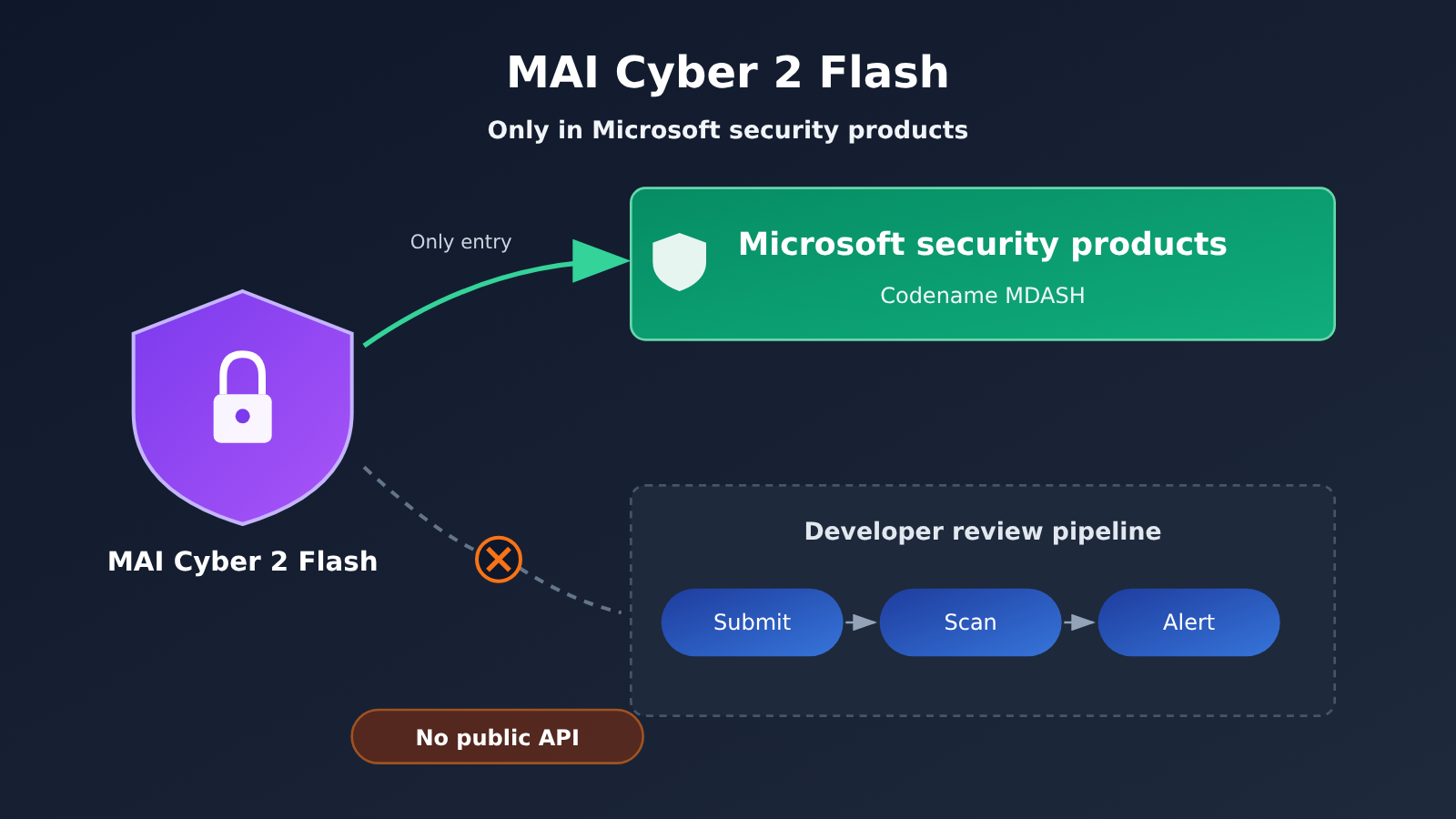
A post has been making the rounds these past couple of days claiming Microsoft shipped “Cyber 2.” A lot of developers working on code review and security alerting had the same first reaction: can I hook it straight into my own pipeline the way I’d call any normal model? Let’s put the answer up front: Not today. MAI Cyber 2 Flash only goes into Microsoft’s own security products — it is not a public model you can just order up and call.
This isn’t a rumor passed along secondhand. Microsoft issued an official press release on 2026-11-17, and the name on it is MAI Cyber 2 Flash, with the product entry points and replacement timeline spelled out clearly. This article pulls together what can be verified: what it’s called, which products it lands in, when it takes effect, how to read the scores and the “under 2%” figure in the press release, and how you should plan your own review pipeline in the meantime.
The bottom line: in a few minutes you’ll see exactly how far you can actually use MAI Cyber 2 Flash — so you don’t sit around wiring up an endpoint for a model you’ll never be able to call.
MAI Cyber 2 Flash: Key Facts at a Glance
Let’s start with the facts that matter most, in one table. Everything here comes from Microsoft’s 2026-11-17 press release and the Ignite Book of News, checked on 2026-11-18.
| Item | Details |
|---|---|
| Official name | MAI Cyber 2 Flash (per Microsoft’s press release) |
| Released by | Microsoft MAI |
| Release date | 2026-11-17 (press release) |
| Availability | Ships only inside Microsoft security products, including the one codenamed MDASH |
| Rollout | Starting mid-December, existing models in eligible customers’ MAI profiles get replaced automatically |
| Context length | One million tokens, which Microsoft says is four times that of MAI Cyber 1.1 Flash |
| Can you call it yourself? | No — there’s no general-purpose API endpoint for developers |
In one sentence: it’s a “built-in engine” inside Microsoft’s security products, not an option you pick from a model list. You get to it by using Microsoft’s security products, not by grabbing an API key and firing off a request.
Why the MAI Cyber 2 Flash name is so easy to mix up
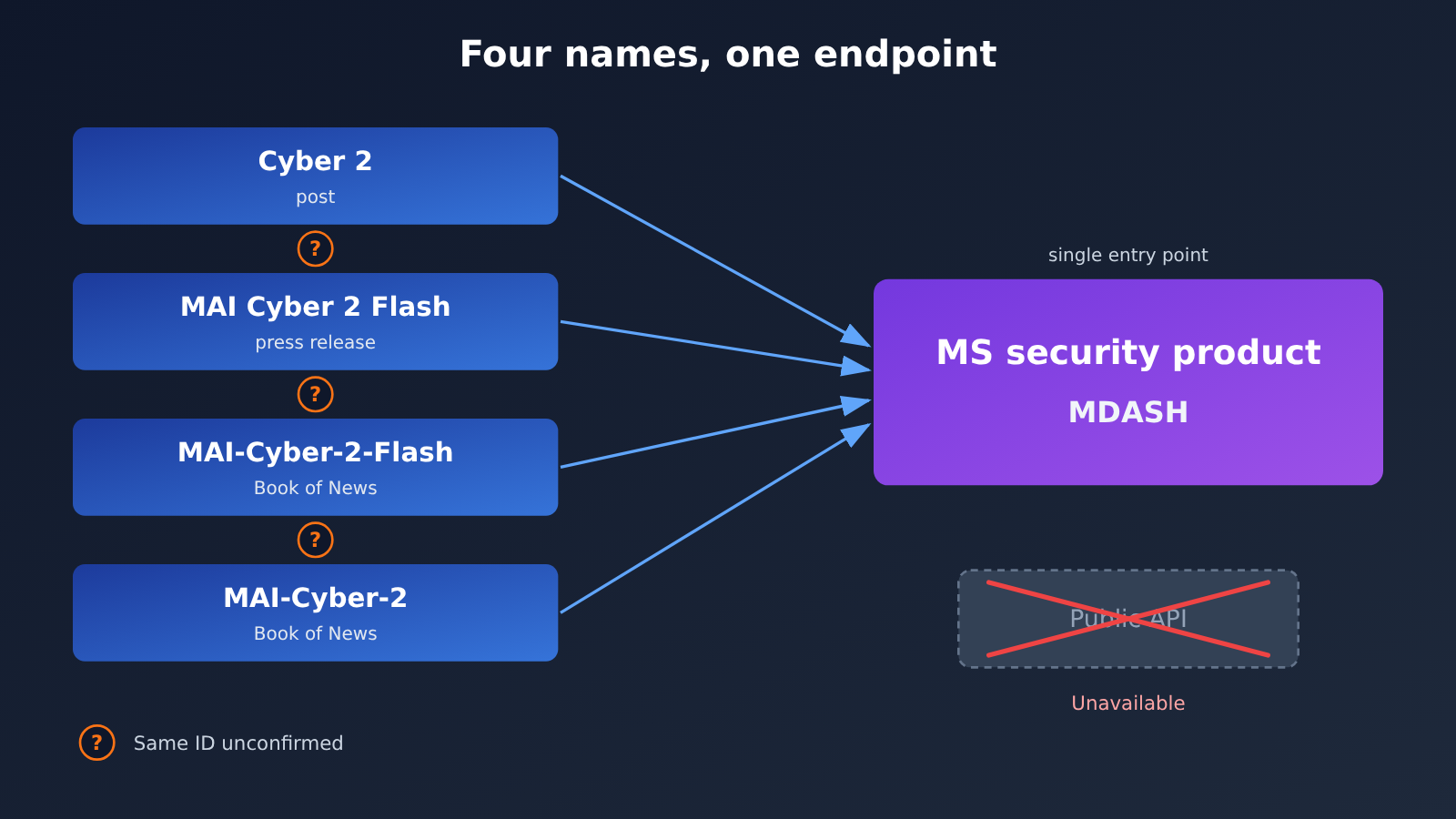
The naming this time around is a bit messy, and it deserves its own explanation. The most widely shared post just said “Cyber 2” — no Flash, no model ID of any kind. Microsoft’s press release calls it MAI Cyber 2 Flash. Then the Ignite Book of News uses both spellings inside the same official guide: one passage says MAI-Cyber-2-Flash is only in preview within the codenamed MDASH, while another says MDASH will use MAI-Cyber-2 once evaluation is complete.
| Source | How it’s written | Notes |
|---|---|---|
| Social media post | Cyber 2 | Just the hook — no Flash, no model ID |
| Microsoft press release (2026-11-17) | MAI Cyber 2 Flash | The reference used in this article |
| Book of News, one passage | MAI-Cyber-2-Flash |
States it’s only previewed inside MDASH |
| Book of News, another passage | MAI-Cyber-2 |
States MDASH uses it once evaluation is complete |
Whether those two spellings point to the same model ID isn’t something the available public information can settle, so this article won’t merge them. For developers, though, it doesn’t change the conclusion either way: whatever you call it, you can’t hook it up as a public API today — its entry point is Microsoft’s security products, not a model picker.
How to Read MAI Cyber 2 Flash’s Official Numbers
The press release serves up a handful of eye-catching figures. All of them are Microsoft’s own self-reported numbers, and each comes with explicit test conditions — so you need to read them along with those conditions. The marketing page also carries another set of percentages measured on a different basis that don’t line up with the press release footnotes; I’m not using those here.
MAI Cyber 2 Flash benchmark results (vendor-reported)
| Benchmark | MAI Cyber 2 Flash | Comparison model | Conditions |
|---|---|---|---|
| CyberGym-E2E task success rate | 92.3% | GPT-6 Astra 91.5% | Inference budget is half of Astra’s; 813 questions after removing overlapping items |
| WebExploitBench | 40.4% | GPT-5.6 Cyber 38.4% | Same inference budget |
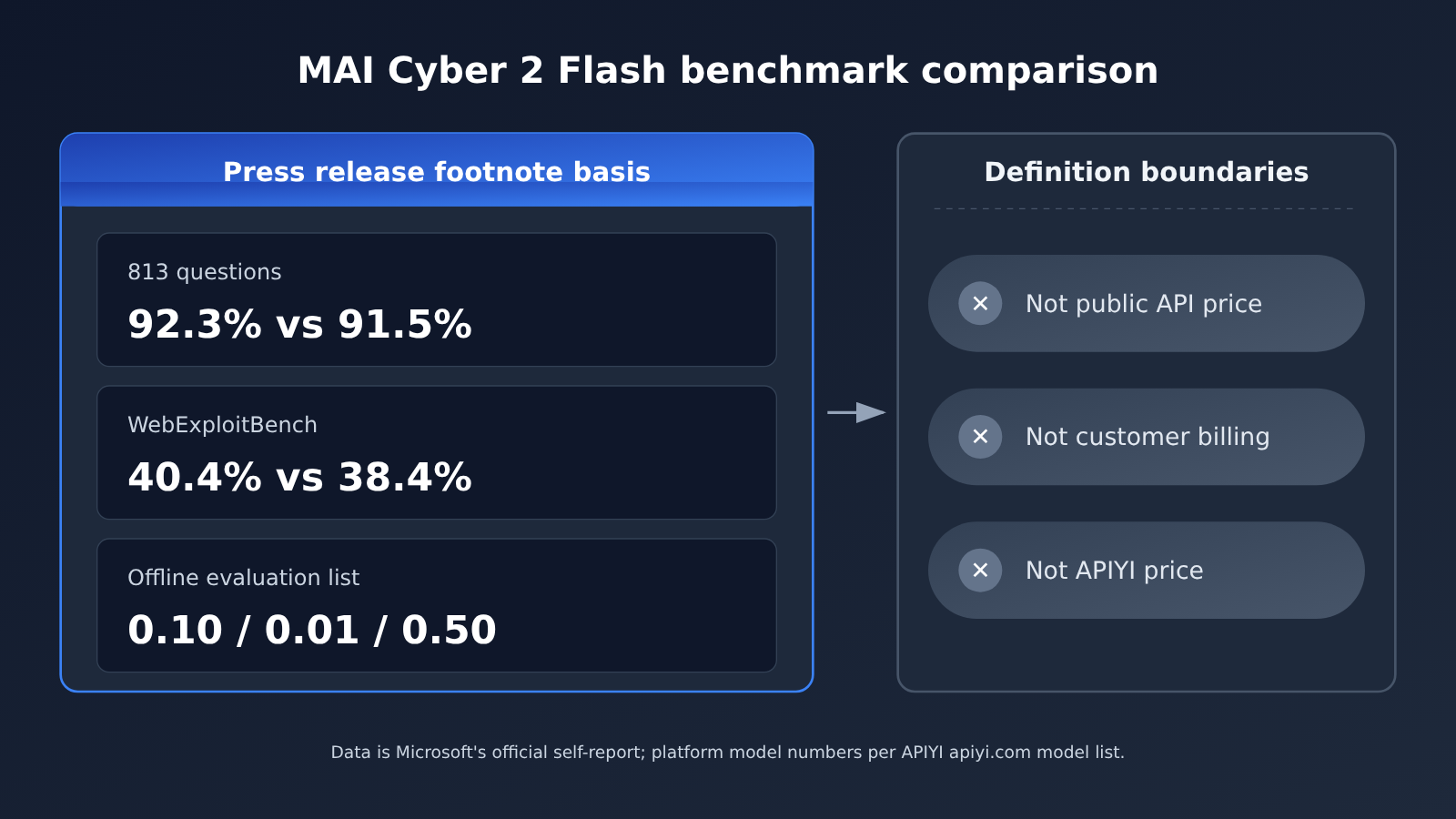
There’s an important footnote attached to the CyberGym-E2E numbers, about benchmark hygiene. The original question bank had 905 questions, 92 of which overlapped with open-source projects and vulnerability reports that had been used in the training data. Microsoft says the reference answers weren’t used for training, but it still pulled those 92 questions out of every model’s score — the 92.3% and 91.5% are results on the remaining 813 questions. The gap between the two is 0.8 percentage points, and that’s with MAI Cyber 2 Flash running on only half the inference budget.
Separately, Microsoft states in the press release that it did not compare against GPT-6 Cyber. The reason given: GPT-6 Cyber is currently available only to a subset of customers, and its tool-enabled benchmarks are still being hardened with additional safety measures, so that comparison will come later. Which means this scorecard doesn’t directly support the claim that “it beats every comparable security model out there” — it only answers the question of how it stacks up against specific comparison models at a specific budget.
What exactly does MAI Cyber 2 Flash’s “under 2%” mean?
The press release also claims that MAI Cyber 2 Flash costs less than 2% of GPT-6 Astra per task. That number is easy to misread as “its API price is only 2% of the others'”, but that’s not what it says.
Microsoft’s method is: total all input, cached input, and output tokens, then apply a list-unit price to get an offline evaluation cost. Microsoft itself states that this is not a customer’s actual bill.
| Model | Input (USD/million tokens) | Cached input | Output | Source note |
|---|---|---|---|---|
| MAI Cyber 2 Flash | 0.10 | 0.01 | 0.50 | List price used for the offline evaluation in the press release |
| GPT-6 Astra (Azure OpenAI Global) | 10 | 1 | 50 | List price used for the offline evaluation in the press release |
Three things need to be made clear about this table:
- It’s not a publicly orderable API price: MAI Cyber 2 Flash doesn’t have a general-purpose API at all; these unit prices are just the calculation basis Microsoft used for its offline evaluation.
- It’s not a customer bill: Microsoft explicitly says actual billing is calculated separately, and how usage through security products is billed is governed by Microsoft’s product terms.
- It’s not APIYI’s price: Neither the model list nor the pricing page on APIYI apiyi.com as of 2026-11-18 includes this model.
💡 Platform note: As of 2026-11-18, this model isn’t listed on APIYI apiyi.com yet — we’ll get it up as soon as we can. Model names and prices are subject to the platform’s model list.
There’s also another set of numbers that gets cited often, this time from a customer. Insight Enterprises says MAI Cyber models use about 20% fewer tokens than the GPT Profile in their evaluation, and the footnote specifies the comparison was against GPT 5.4, GPT 5.3 Codex, and GPT 5.4 Mini. This is a customer’s own account — not a Microsoft leaderboard, and not an APIYI test result — so treat it as a case study when you reference it.
MAI Cyber 2 Flash: Impact Analysis
For developers who want to plug it into a code review workflow
This is the part I most want to make clear. If your plan is to hook a new security model into PR reviews, CI checks, or alert triage scripts, MAI Cyber 2 Flash can’t help you at this point in time. There’s no public endpoint, and no model ID you can hardcode — you won’t find it in any model list.
Even by mid-December, the only changes will happen inside Microsoft’s security products: for eligible customers, existing models in their MAI profile will be swapped out automatically. It’s an engine upgrade internal to the product — you don’t need to change anything in your own code, and equally, you can’t change code to get it early.
So the advice is straightforward: don’t hold up your own review pipeline waiting for this model. Ship your current solution when it’s ready, and if it ever shows up in a public API, run a comparative test then. No rush.
How to Confirm Whether You Can Actually Connect to MAI Cyber 2 Flash
Check the model name before you integrate — that’s a habit you should have for any model integration. The steps below are only for confirming availability; they don’t involve any security testing:
- Check the model list on the platform you’re using: Take APIYI as an example. Look at the model docs at docs.apiyi.com and the pricing page at APIYI apiyi.com, and search for variations like MAI Cyber 2, MAI-Cyber-2, MAI Cyber 2 Flash,
MAI-Cyber-2-Flash, and so on. As of the 2026-11-18 check, none of them turned up. - Call the model list endpoint once: If your code already points base_url to
https://api.apiyi.com/v1, you can pull the currently available models through the OpenAI-compatible model list endpoint. If you can’t find the matching ID, that means it’s not connectable yet. - Look at the switches in Microsoft security products: If your organization already uses Microsoft security products (including the codename MDASH), the place to watch is the MAI configuration file inside the product, plus the product notifications Microsoft sends to admins — not any model selector. For the specific interface and eligibility requirements, refer to Microsoft’s official product documentation.
- Don’t try with a guessed ID: “Cyber 2” in the post isn’t a model ID, and the two spellings in Book of News haven’t been confirmed to map to the same endpoint. Piecing together an ID by guesswork will only get you an error.
MAI Cyber 2 Flash vs. Available Alternatives
Putting the different scenarios side by side makes it easier to figure out which category you fall into.
| Your situation | Can you use MAI Cyber 2 Flash? | What you can do now | Available platforms |
|---|---|---|---|
| Self-built code review / CI scripts | No, there’s no public API | Use general-purpose Large Language Models already on the market to build the workflow first | APIYI apiyi.com and others, subject to the model list |
| Alert triage and log summarization scripts | No | Same as above; keep the design model-swappable | APIYI apiyi.com and others |
| Already using Microsoft security products (including MDASH) | Eligible users get automatic replacement starting mid-December | Keep an eye on MAI configuration files and official notices | Microsoft security products |
| Just want to see the scorecard | Doesn’t involve invocation | Read the test conditions alongside the press release | Microsoft press release |
🎯 Integration tip: When building a review workflow, make the “model name” a configuration item instead of hardcoding it. Through OpenAI-compatible interfaces like APIYI apiyi.com, a single API key lets you switch between OpenAI, Claude, Gemini, and other models already on the market. When new models launch down the road, you’ll only need to change one line of config to compare them.
Impact on the security model race
Judging by how it’s being shipped, Microsoft is delivering this model as a component of its security products rather than as a standalone API for sale. The upside of that approach is that the vendor can bundle permission controls and usage constraints right into the product — for a sensitive area like cybersecurity, that’s far more controllable than just opening up an endpoint. The trade-off is that developers can’t treat it as a general-purpose building block and combine it however they like.
Two other signals in the press release are worth noting. First, the one-million-token context window, which the company says is four times that of MAI Cyber 1.1 Flash — meaning that inside the product you can process a larger codebase or a longer incident log in a single pass. Second, the company is pitching “comparable results at equal or lower budget” as its headline selling point, which tells you competition in the security space has moved from raw benchmark scores to cost per unit of work. That said, all of this is based on vendor-reported data; the real picture will only become clear after customers have run it in production for a while.
Summary: can you wire up MAI Cyber 2 Flash yourself today?
Coming back to the question we started with, here are the key takeaways:
- The official name is MAI Cyber 2 Flash: the “Cyber 2” in the post, and
MAI-Cyber-2andMAI-Cyber-2-Flashin the Book of News, have all appeared — it isn’t confirmed that they refer to the same model ID. - It only ships inside Microsoft security products: including the MDASH codename. The entry point is the product itself, not a model selector, and there’s no public API.
- Automatic swap in mid-December: for eligible customers, the existing model in their MAI configuration will be replaced automatically — you can’t wire it in early through your own code, and you don’t need to.
- The scores are vendor-reported: 92.3% vs. 91.5% on 813 questions, and 40.4% vs. 38.4% on WebExploitBench — both measured under conditions like a fixed inference budget.
- “Under 2%” is an offline-evaluation figure: the rate-card numbers used — 0.10 / 0.01 / 0.50 — aren’t publicly orderable API prices, aren’t customer bills, and aren’t APIYI’s prices either.
- Don’t sit idle with your own pipeline: get your review workflow running on models that are already available, and keep the model configuration swappable.
If you’re building a code review or alerting pipeline, our suggestion is to first check the available models in the model list on APIYI apiyi.com and get the flow working through the OpenAI-compatible interface. If MAI Cyber 2 Flash ever becomes available, we’ll sync it to the platform’s model list, and you can run the swap-and-compare at that point.
📚 References
-
Microsoft press release: Introducing MAI Cyber 2 Flash — published 2026-11-17; the model name, product scope, benchmark data, and official published-rate wording in this article all follow this source
- Link:
microsoft.ai/news/introducing-mai-cyber-2-flash - Note: includes the explanation for excluding 813 questions, the WebExploitBench comparison, and the offline evaluation cost footnote
- Link:
-
Microsoft Ignite 2026 Book of News — Microsoft’s official event guide
- Link:
news.microsoft.com/events/ignite/2026/book-of-news/ - Note: both
MAI-Cyber-2-FlashandMAI-Cyber-2spellings appear in it
- Link:
-
testingcatalog post — the spark for this discussion
- Link:
x.com/testingcatalog/status/2122759893174178173 - Note: it only says “Cyber 2” and doesn’t provide a model ID, so it isn’t used as a factual basis
- Link:
-
APIYI model docs and pricing page — used to check whether the model is listed
- Link:
docs.apiyi.com/models.md - Note: as of the 2026-11-18 check, no spelling of the MAI Cyber 2 series was included
- Link:
Author: APIYI Technical Team
Technical contact: Want to confirm whether a particular model can be invoked? Reach out to us on the APIYI apiyi.com homepage — more integration details are available in the docs.apiyi.com documentation center


