
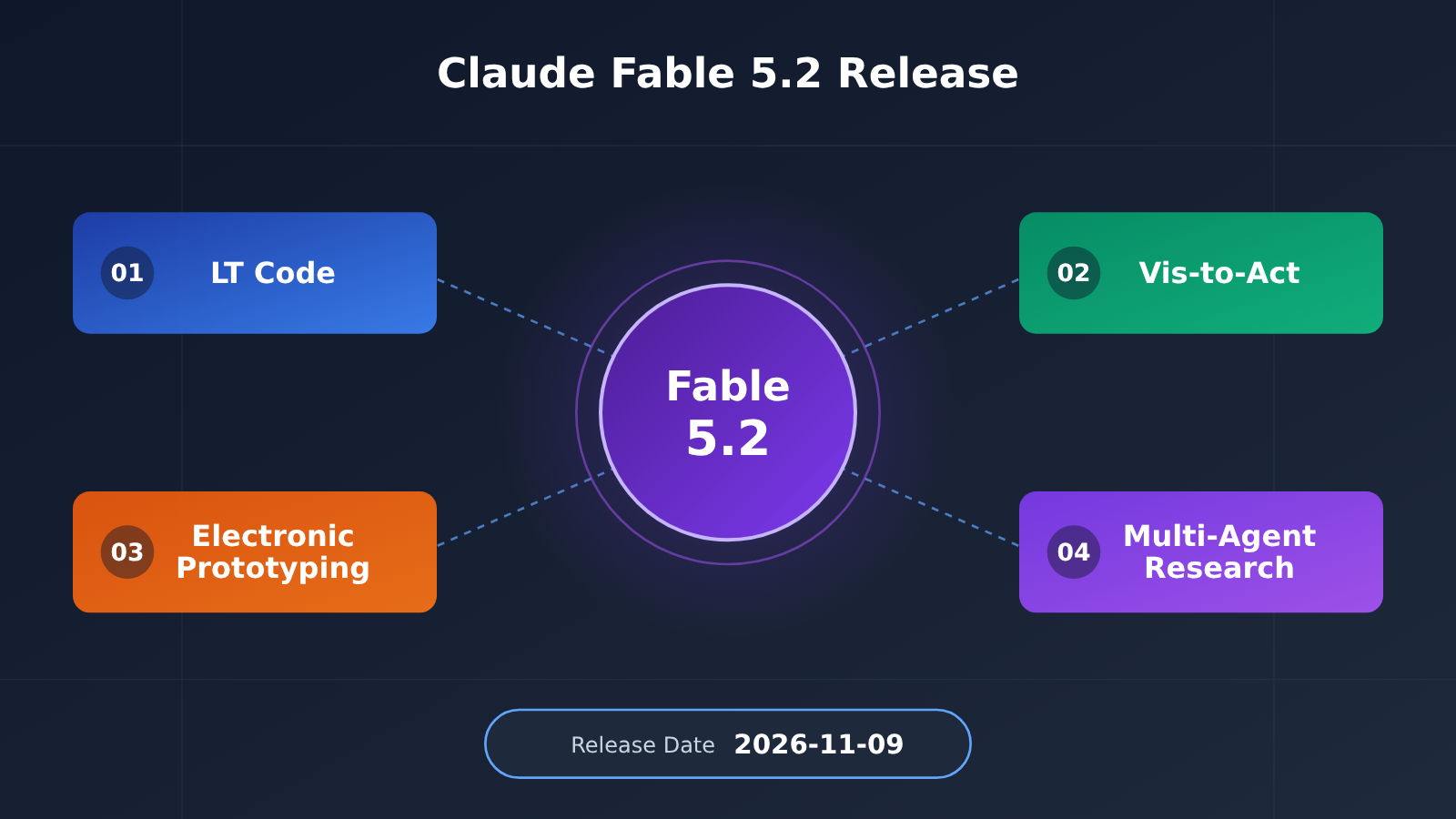
Anthropic officially released Claude Fable 5.2 on November 9, 2026. The official capability tables and third-party rankings both show that it’s noticeably stronger than 5.1 on difficult tasks and long-running collaboration. Its standard API pricing is also 20% lower than 5.1.
Key takeaway: This article follows a “conclusions first, evidence next, limitations last” approach to help you figure out where Claude Fable 5.2 excels, just how capable it is, and whether your tasks are worth switching for now.
Key Terms to Know Before Reading the Claude Fable 5.2 Review
A few evaluation terms come up repeatedly below. Misunderstanding them can lead you to mistake a vendor demo for independent validation, or read a partial score as a pass rate.
- Agent: A model system that can call tools and carry out tasks over multiple steps.
- Intelligence Index: Artificial Analysis (AA)’s overall capability index. It’s a composite score, not an accuracy rate.
- OSWorld partial: A scoring method for desktop-use evaluations that gives credit for partial completion. It isn’t the same as a strict pass rate for the entire task.
- RoboDojo Sim: A control evaluation in a simulated robotics environment. It doesn’t represent the success rate of real-world robots.
- PCB: A printed circuit board, used to hold and connect electronic components.
- Lean / formal proof: Lean is a language and tool that lets computers check proofs. A formal proof expresses a mathematical argument as rigorous steps that a machine can verify one by one.
- Multi-agent collaboration: Multiple model instances divide up tasks, communicate with one another, and combine their results.
How Capable Is Claude Fable 5.2? The Verdict First, Then the Release Context
In a nutshell: Claude Fable 5.2 shows significant improvements on difficult programming, long-horizon tasks, and vision-to-action evaluations, but it’s not accurate to call it “the best at everything.” It still trails other models on some automated evaluations and preference scores.
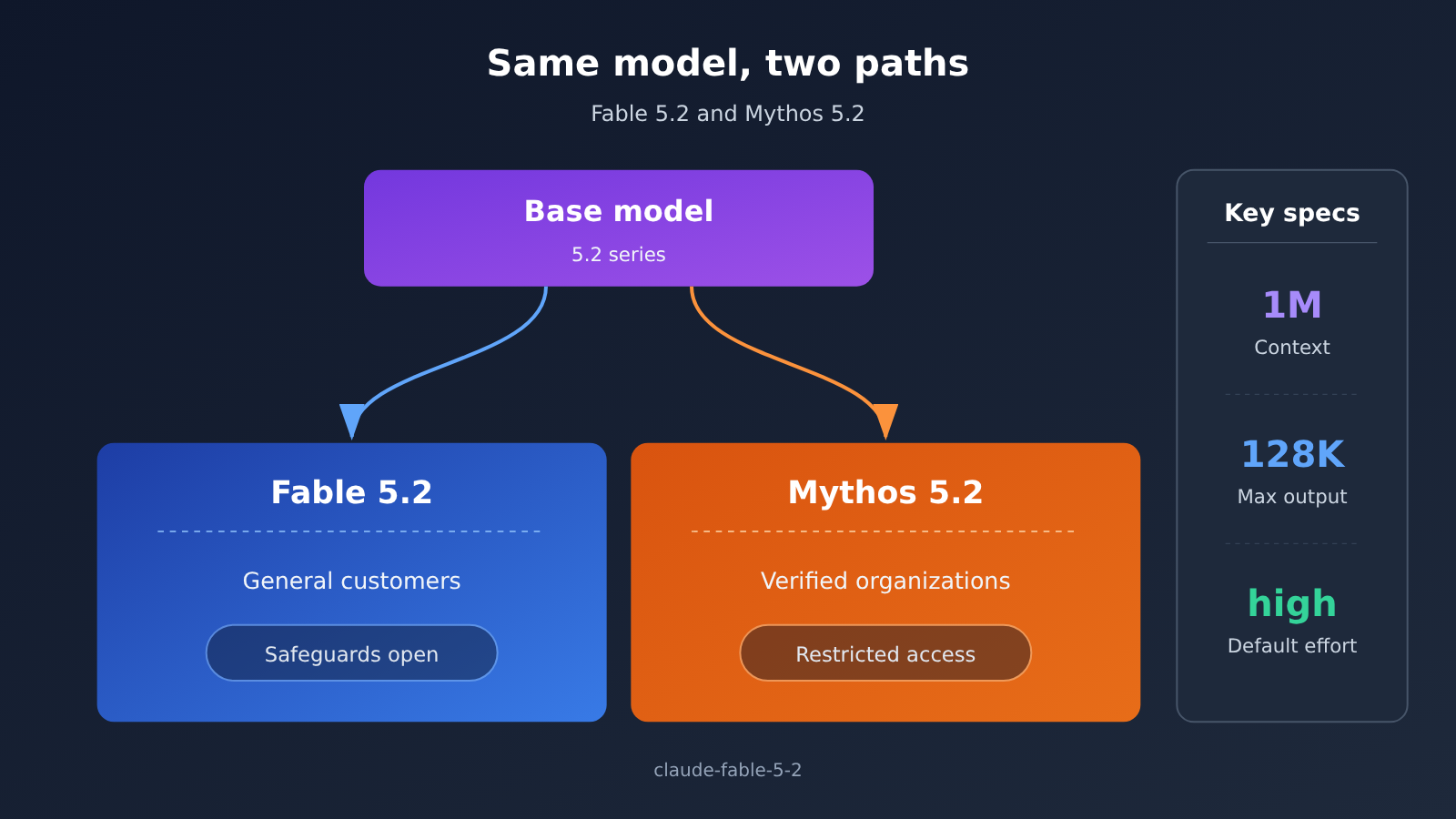
First, some context about the release. Anthropic says Fable and Mythos use the same underlying model. Fable’s cybersecurity and biosafety safeguards allow it to be made available to general customers, while Mythos is limited to verified organizations. So Mythos-specific capabilities or scores shouldn’t be attributed directly to the standard Fable model.
Claude Fable 5.2 at a Glance
| Item | Details | Source |
|---|---|---|
| Release date | November 9, 2026 | Official announcement |
| API model ID | claude-fable-5-2 |
Official model documentation |
| Context window / maximum output | 1M tokens / 128K tokens | Official model documentation |
| Input and output modalities | Text and image input, text output | Official model documentation |
| Thinking mode | Adaptive thinking is always on; default API effort is high | Official model documentation |
| Knowledge cutoff | June 2026 (doesn’t mean it has real-time web access) | Official model documentation |
| Standard pricing | $8 per million input tokens and $40 per million output tokens, 20% lower than 5.1 | Official pricing page |
| Speed claim | Output generation is “up to 30% faster” than 5.1 | Vendor’s stated maximum |
Two points are easy to misread. First, “up to 30% faster” is the vendor’s upper-bound claim for output speed; it doesn’t mean every task takes 30% less time. Second, Fable 5.2’s standard price is still twice that of Opus 5.5 ($4/$20).
Anthropic also explicitly recommends using Opus 5.5 for most everyday coding and knowledge work, and upgrading to Fable for more complex tasks.
Evidence of Claude Fable 5.2’s Gains in Coding and Long-Horizon Tasks
Coding is the main focus of this release. Let’s start with the vendor’s published results, then look at third-party data from two different environments.
Official Benchmark Results: Fable 5.2 vs. 5.1 and Opus 5.5
| Benchmark (vendor-reported) | Fable 5.2 | Fable 5.1 | Opus 5.5 | Notes |
|---|---|---|---|---|
| FrontierCode 2.0 | 49.1% | 32.4% | — | Different effort settings |
| FrontierSWE v2 | 69.9% | 56.3% | 62.3% | Long-horizon software engineering tasks |
| AutomationBench | 51.4% | 31.4% | 42.5% | Automation tasks |
| OSWorld 2.1 offline subset, partial | 89.3% | 83.5% | 87.2% | Partial-score methodology |
| RoboDojo Sim | 64.9% | 27.6% | 39.4% | Simulated robot control |
The table shows that Fable 5.2 scores 13.6 percentage points higher than 5.1 on FrontierSWE v2, and also outperforms Opus 5.5. The gain on FrontierCode 2.0 is larger, but the two models were tested at different effort settings, so some of that improvement may come from the reasoning level.
Third-Party Results: Claude Fable 5.2 on AA and Cursor
| Evaluation environment | Configuration | Score | Cost per task (USD) |
|---|---|---|---|
| Artificial Analysis | Fable 5.2 medium | 56 | 3.80 |
| Artificial Analysis | Fable 5.2 high | 62 | 9.08 |
| Artificial Analysis | Fable 5.2 xhigh | 62 | 14.83 |
| Artificial Analysis | Fable 5.2 max | 65 | 26.54 |
| Artificial Analysis | Opus 5.5 max | 59 | 10.04 |
| CursorBench 4.0 | Fable 5.2 High | 56.9% | 9.70 |
| CursorBench 4.0 | Fable 5.2 Max | 60.0% | 32.79 |
| CursorBench 4.0 | Opus 5.5 High | 56.0% | 3.97 |
AA is an independent evaluator. On its Intelligence Index, Fable 5.2 max scores 65, above Opus 5.5 max at 59—a result that aligns with the direction of the official benchmark results.
Cursor’s results come from its own tasks and tool environment. Fable 5.2 Max reaches 60.0%, while the High configurations of Fable 5.2 and Opus 5.5 are just 0.9 percentage points apart.
Both sets of third-party results show that a higher performance ceiling usually comes with a higher cost per task. On AA, the score increases by 3 points from high to max, while the cost per task rises to about 2.92 times as much.
🎯 Technical recommendation: Leaderboards can help narrow down your options, but you’ll need to test the models on your own tasks to reach a final conclusion. Consider using APIYI apiyi.com to compare Opus, Fable, and other models through the same OpenAI-compatible interface, with identical prompts and acceptance criteria. Then track quality and cost for each tier.
Where Claude Fable 5.2 Stands on Vision and Engineering
From understanding screens to controlling actions
The two most notable vision benchmarks are OSWorld 2.1 and RoboDojo Sim. On the offline subset of OSWorld 2.1, the partial score rose from 83.5% to 89.3%. Opus 5.5 has already reached 87.2%, though, so the gap isn’t that large.
RoboDojo Sim showed a bigger change, climbing from 27.6% to 64.9%. This suggests a marked improvement in the model’s ability to turn visual understanding into continuous control actions.
Fable 5.2 takes part in electronic prototyping
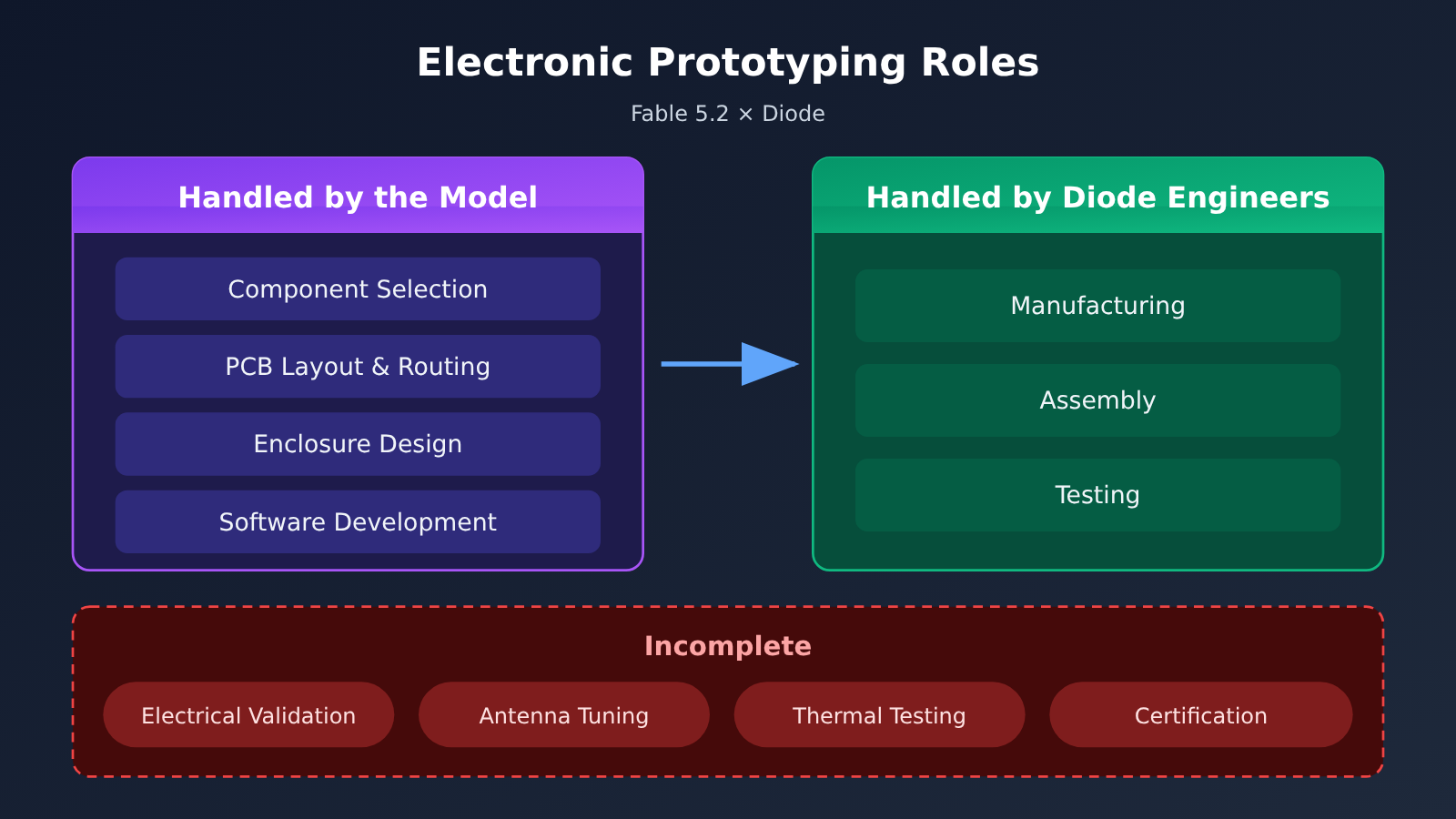
Anthropic and Diode worked together to create three electronic device prototypes: a voice assistant, a USB speakerphone, and a virtual pet. The model contributed to component selection, PCB layout and routing, enclosure design, and software development. Diode’s engineers handled the actual manufacturing, assembly, and testing. The two companies have a commercial relationship, which is worth keeping in mind when reading this case study.
The limits of this case are clear. All three devices are prototypes; none has completed electrical validation, antenna tuning, thermal testing, or certification, and none was designed to meet production requirements. The model wasn’t connected to factory equipment or test instruments. So the accurate conclusion is that “the model can make substantial contributions to electronic prototyping,” not that “the model independently built a product ready for mass production.”
The same research document includes two other design-related results. First, on PCB Gym, an internal benchmark run by Diode, Fable 5.2 scored 69%. The comparison group was Fable 5 (25%), not 5.1. Second, on the public benchmark BenchCAD 2.1, which tests the reconstruction of 3D parts, assemblies, and circuit boards from engineering drawings and rendered images, the company reports a score of 83.5% for Fable 5.2. The benchmark itself is public, but this score hasn’t yet been independently replicated.
Why Claude Fable 5.2’s Research and Multi-Agent Case Studies Are Attracting Attention
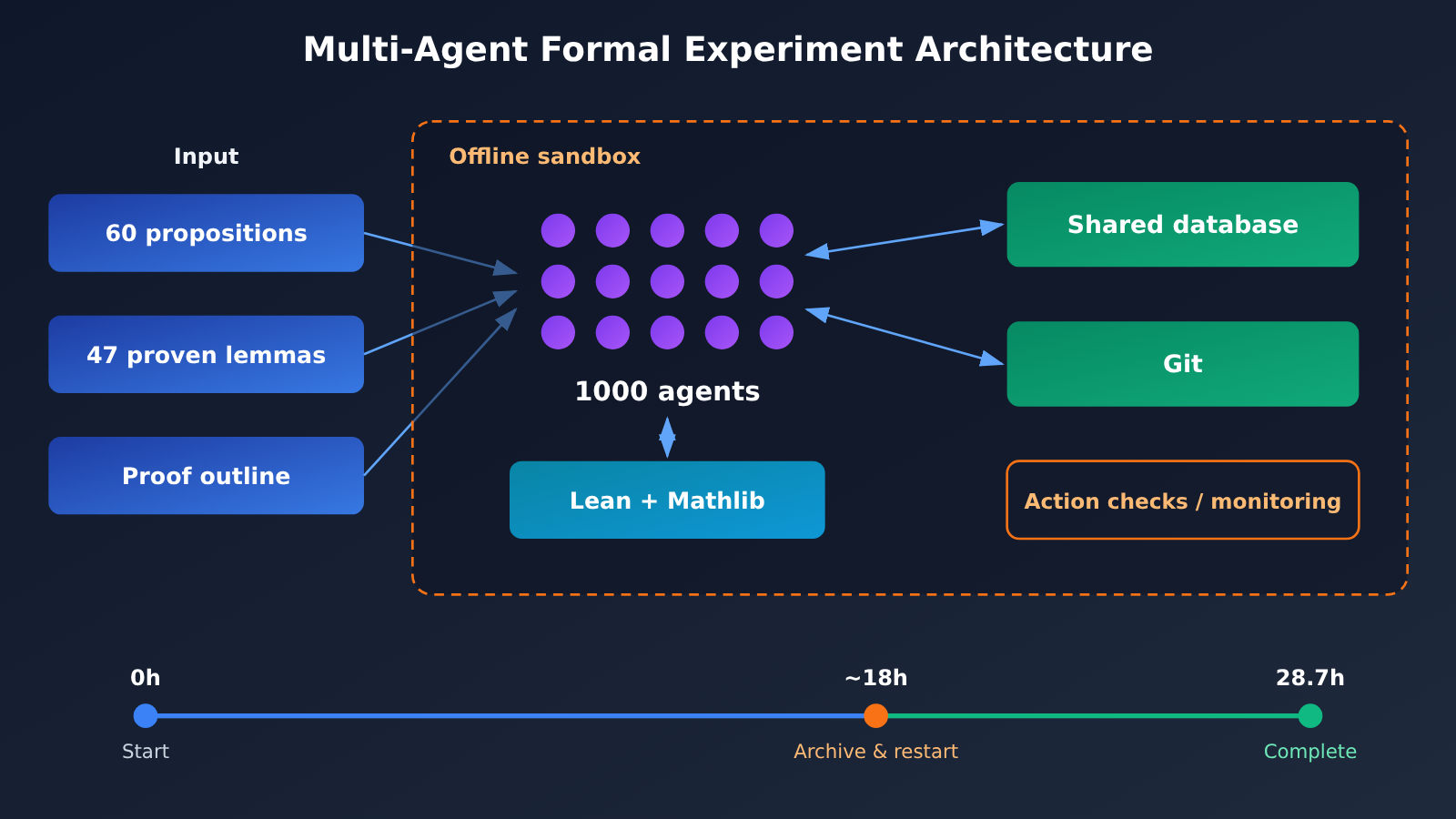
The most widely discussed example is a mathematical formalization experiment. According to the official developer blog, 1,000 early versions of Fable 5.2 Agent spent 28.7 hours reproducing a formal proof of Fermat’s Last Theorem in Lean.
The value of this case lies in its ability to organize a large-scale, long-running task—not in any new mathematical discovery.
The experimental conditions need to be explained in full:
- The inputs were provided: 60 propositions and definitions, a one-sentence outline of the classic proof strategy, and 47 lemmas that had already been proven.
- Tools and environment: Lean, Mathlib, Git, a shared database, and an offline sandbox with action checks and offline monitoring.
- The run: At around the 18-hour mark, the agents restarted from a saved state and ran for another 12 hours.
- How the authors describe it: The authors themselves call it a toy experiment and note that a specialized harness and human guidance on the direction could further improve efficiency.
So this was a formalization of an existing mathematical proof.
Even with these caveats, the case points to a promising direction: multiple model instances can divide up work, submit results, and review one another against shared state to make steady progress on an exceptionally long task. This capability is also relevant to engineering work such as large-scale code migrations and complex system refactoring.
Where Claude Fable 5.2 Doesn’t Come Out on Top Across the Board
A responsible capability review needs to include counterexamples. The same table in the official announcement includes two results where Fable 5.2 doesn’t lead.
| Evaluation | Fable 5.2 | Comparison model | Notes |
|---|---|---|---|
| AutomationBench | 51.4% | Gemini 4 Carbon 53.9% | The competitor leads on this evaluation |
| AA-Briefcase (rubric) | 66.1% | Opus 5.5 61.2% | Fable leads under the scoring rubric |
| AA-Briefcase (Elo) | 1785 | Opus 5.5 1800 | Opus leads in head-to-head preference ratings |
The AA-Briefcase results are especially telling. On the same task, Fable leads when scores are based on the rubric, while Opus leads in Elo preference ratings. Change the scoring method, and the rankings can flip—so it’s unreliable to declare a model “the clear winner” based on just one or two benchmarks.
Cost is another trade-off. In the Cursor environment, Fable 5.2 Max costs $32.79 per task, compared with $3.97 per task for Opus 5.5 High—about eight times as much for a four-percentage-point difference in scores. A small-scale experiment by independent developer Lex Toumbourou also found that 5.2 high was more accurate than 5.1, but produced roughly twice as much output and cost about twice as much per turn.
Finally, Mythos’s specialized safety and biology-related scores shouldn’t be counted as evidence of ordinary Fable’s capabilities.
Which Users Should Try Claude Fable 5.2 Now?
Based on the official model selection guide and the data above, you can roughly divide use cases as follows:
- Worth trying first: challenging long-horizon coding, complex engineering design, and research tasks that require multiple tool calls. Use your own task set to verify whether it actually performs better.
- Start with a model for everyday use: For everyday knowledge questions and routine coding, follow the official recommendation and start with a model like Opus 5.5. Upgrade only if you run into a bottleneck.
Five Things to Consider Before Trying Claude Fable 5.2
| Dimension | What to check | Recommended approach |
|---|---|---|
| Availability | Is the model currently available on your platform? What are its model ID and endpoint? | Check the platform’s current model list; don’t assume it’s available |
| Data | Are you allowed to send your task data to a third-party model? | Review data retention terms and enterprise compliance requirements |
| Acceptance criteria | What counts as a completed task? | Prepare test cases or scoring criteria in advance |
| Time | Does the wait time matter? | Track end-to-end latency as well as output speed |
| Budget | What’s the maximum cost per successful task? | Track tokens and successful tasks at each pricing tier, then calculate the cost per success |
Run a Claude Fable 5.2 Comparison Test with a Unified Interface
The minimal example below calls a model through an OpenAI-compatible interface. Replace MODEL with an ID that’s actually listed on the platform, and you can switch between models for comparison without changing the code.
import openai

client = openai.OpenAI(
    api_key="YOUR_API_KEY",
    base_url="https://api.apiyi.com/v1"  # APIYI OpenAI-compatible API
)

MODEL = "your-model-id"  # Check the platform's current model list
resp = client.chat.completions.create(
    model=MODEL,
    messages=[{"role": "user", "content": "为下面的函数补充单元测试:..."}]
)
print(resp.choices[0].message.content, resp.usage)
View Code for Comparing Multiple Models and Tracking Usage
import time
import openai

client = openai.OpenAI(
    api_key="YOUR_API_KEY",
    base_url="https://api.apiyi.com/v1"
)

# Check the platform's current model list for candidate model IDs
CANDIDATES = ["daily-model-id", "candidate-model-id"]

def run_task(model: str, prompt: str, check) -> dict:
    """Run a task and record latency, token usage, and whether it passed validation."""
    start = time.time()
    resp = client.chat.completions.create(
        model=model,
        messages=[{"role": "user", "content": prompt}],
    )
    text = resp.choices[0].message.content
    return {
        "model": model,
        "seconds": round(time.time() - start, 2),
        "prompt_tokens": resp.usage.prompt_tokens,
        "completion_tokens": resp.usage.completion_tokens,
        "passed": bool(check(text)),  # Use your own validation function
    }

def check(text: str) -> bool:
    return "def test_" in text

tasks = ["为 parse_date 函数补充单元测试:..."]
results = [run_task(m, t, check) for m in CANDIDATES for t in tasks]
for r in results:
    print(r)
After the comparison, check the actual bill to verify the costs. APIYI’s logging documentation lists fields such as model_name, prompt_tokens, completion_tokens, quota, and request_id. Divide quota by 500000 to get the charge in USD, then compare the costs before and after upgrading for each task. Note that amounts calculated using the official rates are estimates; use the platform’s actual logs as the source of truth.
🚀 Get started quickly: Sign up at APIYI apiyi.com to claim free testing credits for new users. Run 10 to 20 real tasks through the comparison process, then decide whether to move more of your traffic to the Fable tier. Check the platform’s current announcements for availability and pricing of the new model.
Frequently Asked Questions
Q1: What is Claude Fable 5.2, and how is it related to Mythos 5.2?
Fable 5.2 is a model Anthropic released on November 9, 2026. Its API model ID is `claude-fable-5-2`, and it supports a 1M context window. It shares the same underlying model as Mythos 5.2. The difference is that Fable’s safeguards allow it to be made available to general customers, while Mythos is only offered to verified organizations.
Q2: How much stronger is Claude Fable 5.2 than Opus 5.5?
In the official table, Fable scores 69.9% on FrontierSWE v2, compared with 62.3% for Opus. On the AA index, it scores 65 versus 59 at the max tier. On CursorBench 4.0’s High tier, the gap is just 0.9 percentage points. Overall, Fable 5.2 has a higher performance ceiling, but it costs twice as much per token as Opus 5.5. At higher tiers, the cost difference per task could be even greater.
Q3: Is Claude Fable 5.2 the best model for every task?
No. On AutomationBench, Gemini 4 Carbon scores 53.9%, higher than Fable 5.2’s 51.4%. Opus 5.5 ranks higher by Elo score on AA-Briefcase. Rankings can vary depending on how a benchmark is scored.
Q4: Will using Fable 5.2 always save money compared with 5.1?
Not necessarily. A 20% lower per-token price saves you 20% only if usage stays the same. Suppose a task uses 100,000 input tokens and 20,000 output tokens. Fable 5.2 would cost $1.60, compared with $2 for 5.1. But if output grows to 40,000 tokens, Fable 5.2 would cost $2.40—more than 5.1. This example illustrates how the variables relate; it doesn’t predict that the model will necessarily generate more output. We recommend checking actual token usage by task in your APIYI apiyi.com call logs.
Q5: How can I quickly compare Claude Fable 5.2 with other models through an API?
1. Sign up at APIYI apiyi.com to get an API key and free testing credits.
2. Check which model IDs are available in the platform’s model list that day.
3. Use the code in this article, set `base_url` to `https://api.apiyi.com/v1`, and run the same batch of tasks against each model.
4. Record the number of successful runs, latency, and token usage, then calculate the cost per successful run.
Q6: Does the Fermat’s Last Theorem experiment show that Fable 5.2 can do original mathematics?
No. The experiment provided 60 propositions, 47 proven lemmas, and proof outlines. It ran 1,000 agents based on early snapshots for 28.7 hours in an offline sandbox. The agents formalized existing proofs, and this was only a single run. The experiment demonstrates long-horizon organization, but it doesn’t prove that the model can make original mathematical discoveries.
Claude Fable 5.2 Key Takeaways
- Release positioning: Released on November 9, it shares the same underlying model as Mythos and is available to general customers.
- Coding ceiling: It scored 69.9% on FrontierSWE v2, higher than 5.1 and Opus 5.5 in the official table.
- Third-party validation: It scored 65 in the AA Max tier and 60.0% on CursorBench Max, but the cost per task is significantly higher.
- Vision to action: RoboDojo Sim improved from 27.6% to 64.9%, though this result is based on simulation.
- Engineering and research: It can contribute to electronic prototyping and large-scale Lean formalization, but both come with clear prerequisites.
- Not a clean sweep: Other models lead on AutomationBench and Elo-based rankings.
- Getting started: You can use the unified interface at APIYI apiyi.com to compare models on your own tasks before deciding whether to upgrade.
Summary
Key takeaways about Claude Fable 5.2:
- Major gains on difficult tasks: It has improved significantly over 5.1 on benchmarks for long-horizon coding and visual control.
- Evaluate evidence in context: Vendor evaluations, the independent AA leaderboard, and Cursor’s own environment each have their own scope. Their scores shouldn’t be compared as if they were directly equivalent.
- Higher ceilings come at a cost: The top-tier capabilities often come with several times the cost per task. A lower price per unit doesn’t necessarily mean lower task costs.
If your work mainly involves challenging long-horizon coding, complex engineering, or research tasks, it’s worth testing Fable 5.2 on your own task set now. For everyday work, it’s still best to start with a general-purpose model like Opus. We recommend using APIYI apiyi.com to compare multiple models through the same interface and calculate costs from your logs—use data, not leaderboards, to decide whether to upgrade.
📚 References
- Anthropic announcement: Fable and Mythos 5.2 release scope and official capabilities table
- Link:
anthropic.com/claude-fable-and-mythos-5-2 -
Note: Primary source for release dates, speed metrics, and comparison data (vendor-reported)
-
Fable 5.2 model specifications: Context window, output limit, and thinking modes
- Link:
platform.claude.com/docs/en/models/fable-5-2/overview -
Note: Official API documentation
-
Artificial Analysis model leaderboard: Intelligence Index and cost per task
- Link:
artificialanalysis.ai/leaderboards/models -
Note: A dynamic snapshot from a third-party organization
-
CursorBench 4.0: Evaluation in Cursor’s own environment
- Link:
prod.cursor.com/evals -
Note: An evaluation by a tool provider, not a general-purpose independent replication
-
Claude electronics prototyping research: Three prototypes developed with Diode
- Link:
anthropic.com/research/claude-electronics-design -
Note: Includes PCB Gym, BenchCAD 2.1 data, and the prototypes’ limitations
-
Fable 5.2 multi-agent team experiment: Conditions for the Lean formalization experiment
- Link:
claude.dev/blog/safely-scaling-multi-agent-teams-with-fable-5-2/ -
Note: A large-scale run from an early vendor-reported snapshot
-
Claude model selection guide: Recommendations for when to use Opus or Fable
- Link:
claude.dev/blog/which-claude-model-should-you-build-with/ - Note: Official developer guide
Author: APIYI Technical Team
Technical questions: Feel free to contact us via the APIYI homepage. For log field details and billing information, see the docs center at docs.apiyi.com.


