
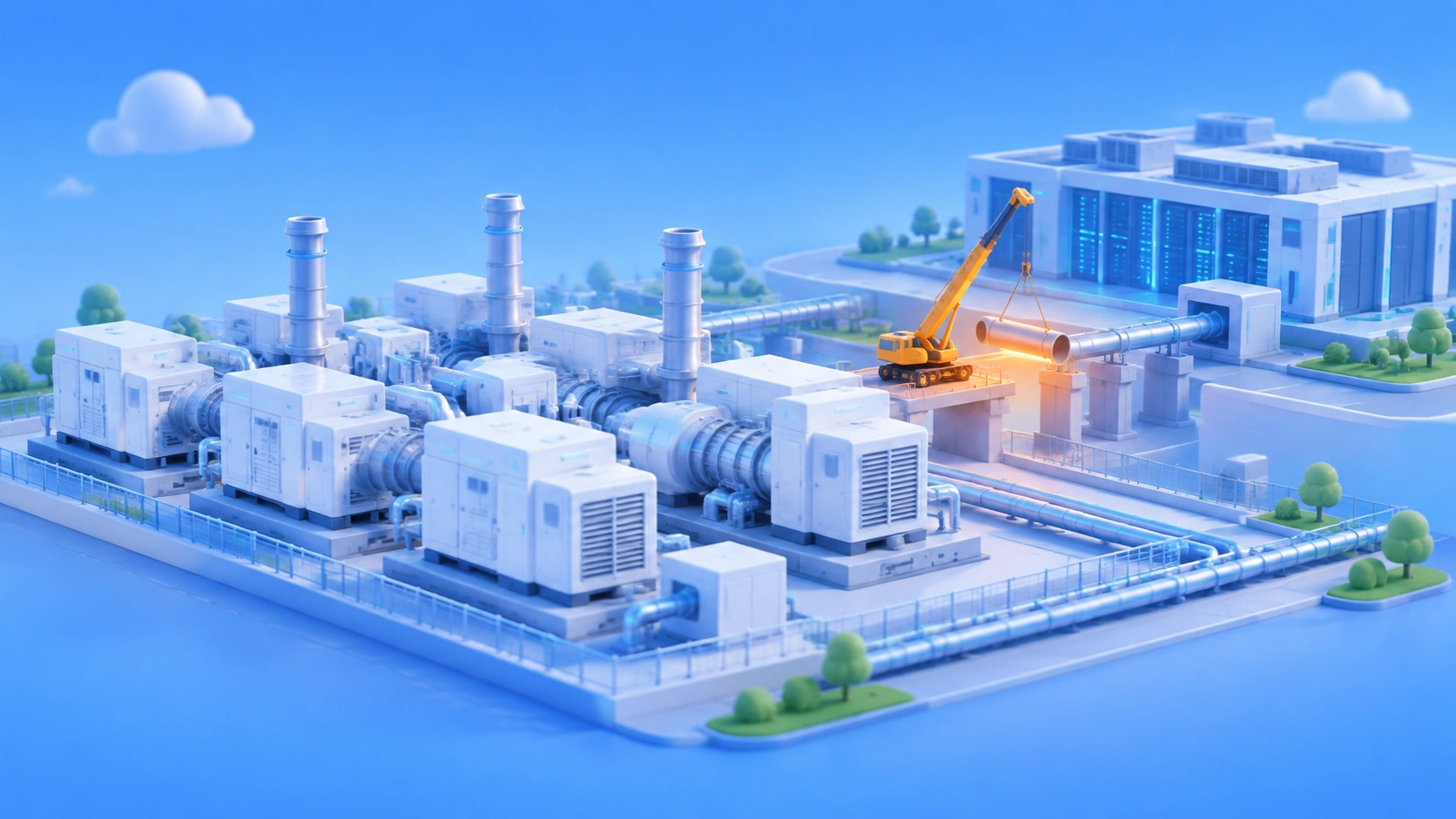
Author’s note: Three elements—approximately $3.4 billion, 1.7 GW, and engineering and construction capabilities—help explain Anthropic’s reported power equipment deal and the limits of what it can deliver.
In a nutshell: Anthropic reportedly paid approximately $3.4 billion for procurement commitments covering 1.7 GW of gas-fired power generation equipment, along with engineering and construction capabilities. The deal secures equipment and construction resources, not electricity that’s already flowing. It also can’t be directly converted into available computing capacity for Claude.
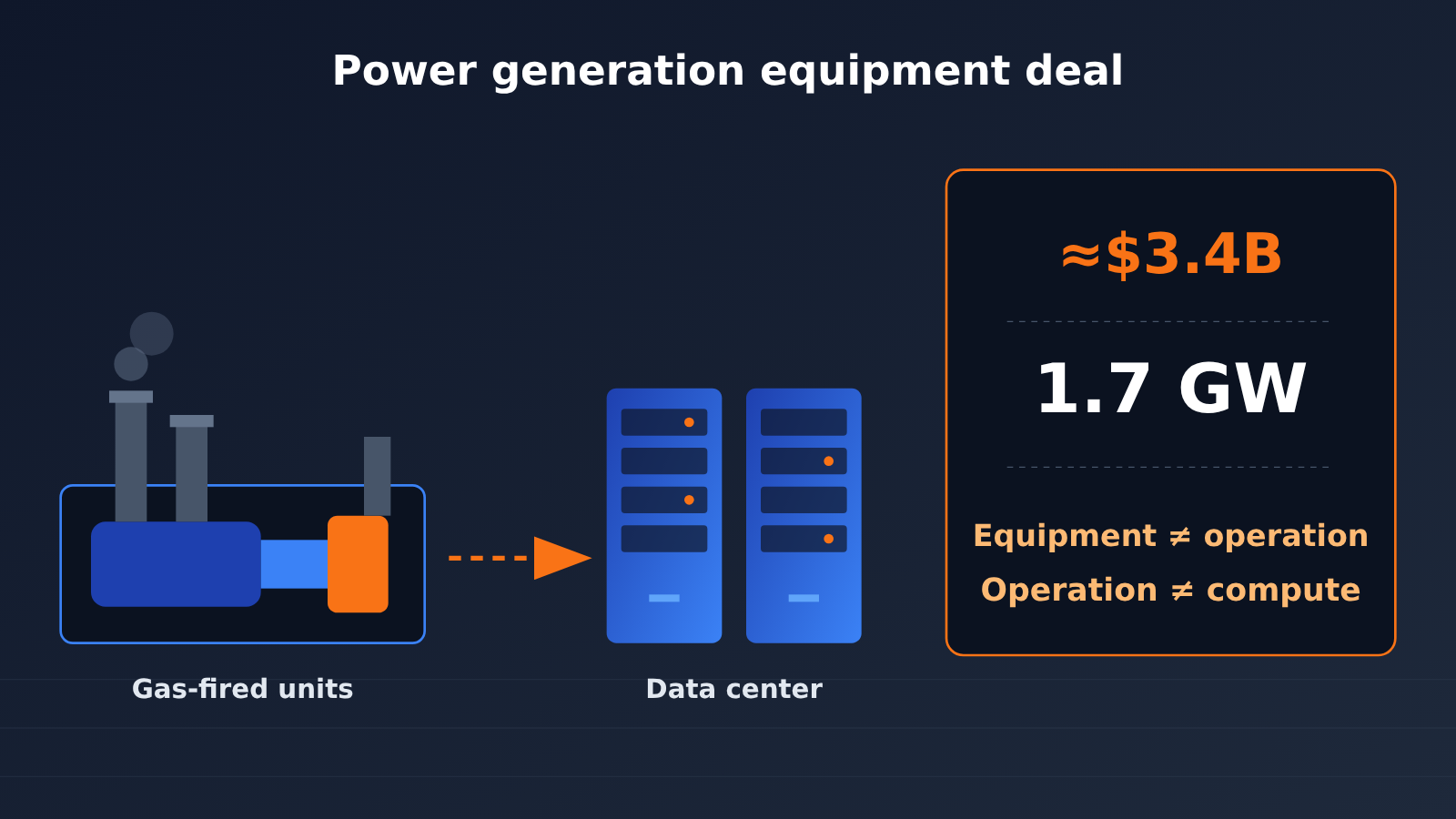
Table of contents
- Anthropic’s $3.4 billion power equipment deal: Why a September transaction came to light in November
- What resources Anthropic acquired in the $3.4 billion power equipment deal
- Why power equipment orders are strategically valuable to Anthropic
- What it takes to turn power equipment into computing capacity for Claude
- Public developments to watch in Anthropic’s power equipment deal
7 concepts to know before reading
- GW: A gigawatt, or one billion watts, measures power capacity, not annual electricity generation. 1.7 GW equals 1,700 MW.
- Procurement commitment: A contractual arrangement related to future equipment purchases or deliveries. This article describes it as reported by the media.
- EPC: Short for engineering, procurement, and construction. This article doesn’t use it as a substitute for describing the specific scope of the deal.
- On-site power generation: Installing generation facilities at or near a data center to directly support its electricity needs.
- Computing capacity: A computing system’s ability to perform tasks. It can’t be directly calculated from power generation capacity.
- Commissioning: The stage at which equipment enters operation after installation and testing. It’s separate from signing a contract or placing an order.
- Fuel cost pass-through: A contractual arrangement that passes fuel and related costs on to the energy user.
Anthropic’s Reported $3.4 Billion Power Equipment Deal: Why a September Transaction Surfaced in November
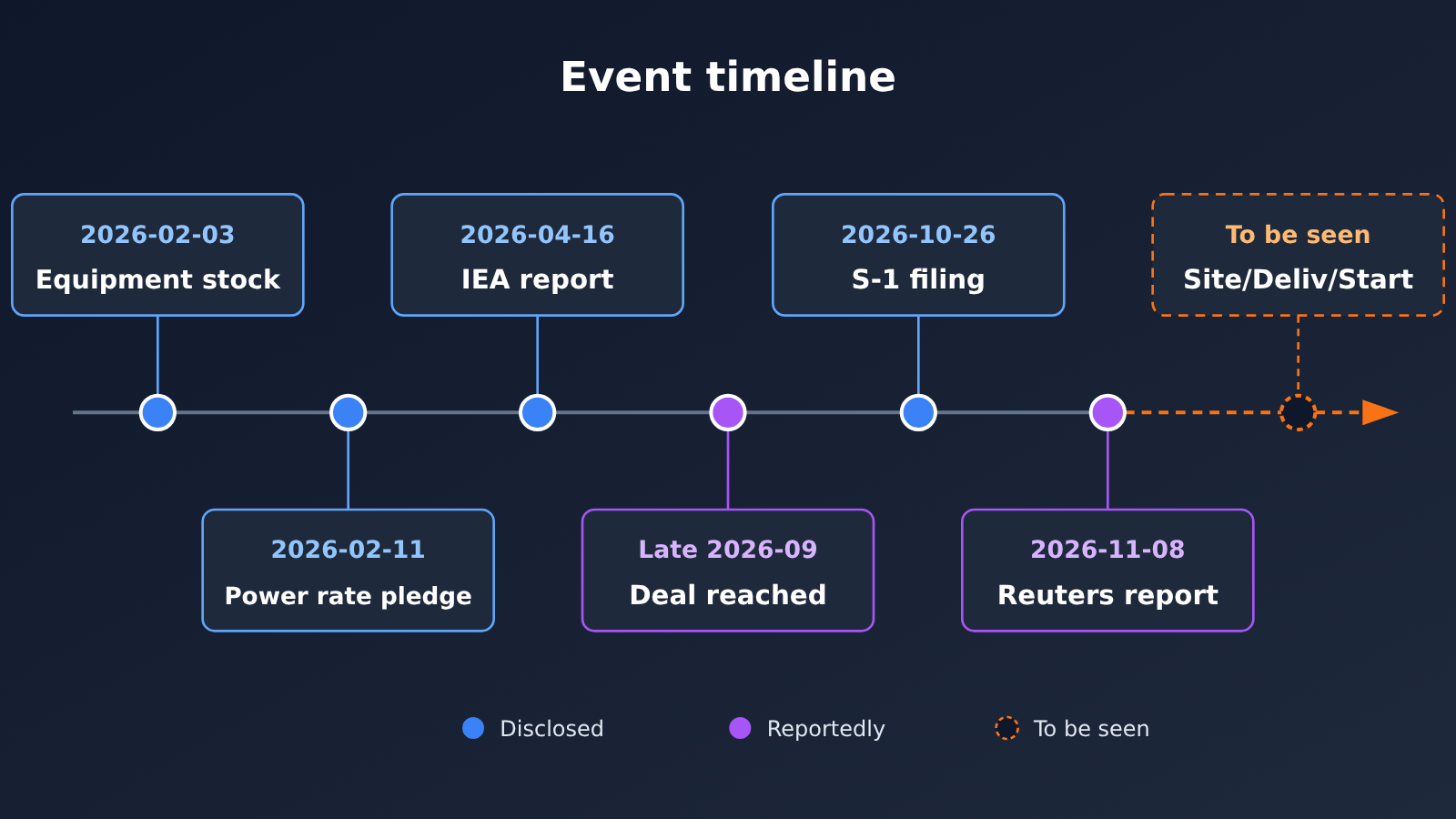
On November 8, 2026, Reuters cited a Financial Times (FT) report that Anthropic had acquired a procurement commitment for 1.7 GW of heavy-duty gas-fired generators, worth about $3.4 billion, from San Antonio, Texas-based OnePWR Solutions in late September. The deal reportedly also included the engineering and construction capacity needed to install the equipment. In other words, the agreement was signed in late September but came to public attention on November 8. Those dates shouldn’t be confused.
This wasn’t an announcement from the two companies, and it wasn’t news that the power equipment had entered service. Reuters said it couldn’t immediately verify the report independently, and neither Anthropic nor OnePWR responded to requests for comment at the time. One piece of information can be cross-checked: a page from transaction adviser Piper Sandler lists a $3.4 billion sale of OnePWR’s power generation platform in September 2026. It describes the buyer only as “a frontier AI lab,” without naming Anthropic or specifying 1.7 GW.
Read together, the two sources confirm that a transaction of the same value was disclosed. The claims that Anthropic was the buyer and that the capacity was 1.7 GW remain media reports. Also, multiple outlets repeating the same story don’t amount to confirmation from multiple independent sources. Throughout the rest of this article, the buyer, amount and capacity are treated as reported information.
Anthropic Power Equipment Deal at a Glance
| Item | What’s known | Source and confidence |
|---|---|---|
| Buyer | Anthropic (reported) | Reuters citing FT, 2026-11-08; not independently verified |
| Seller | OnePWR Solutions, San Antonio, Texas | Reuters citing FT; Piper Sandler’s page lists OnePWR |
| Amount | About $3.4 billion | Media reports; the transaction adviser’s page lists the same amount |
| Capacity | 1.7 GW of heavy-duty gas-fired generators | Found only in media reports |
| Transaction date | Late September (media) / September 2026 (adviser’s page) | The two timelines are consistent |
| Scope | Equipment procurement commitment + engineering and construction capacity needed for installation | Media reports |
| Undisclosed details | Full contract, payment schedule, installation location, delivery and commissioning dates, fuel arrangements | Not disclosed in any of the sources reviewed |
What Anthropic’s $3.4 Billion Power Equipment Deal Includes
Equipment Purchase Commitments and Construction Capacity
According to the report, the $3.4 billion covers two types of resources: purchase commitments for 1.7 GW of heavy-duty gas generation equipment, and the engineering and construction capacity needed to install it. The first addresses whether the equipment is available; the second addresses whether it can be turned into an operational power plant. With power equipment supplies tight, both are essential.
| Resource | Purpose | Details not yet disclosed |
|---|---|---|
| Gas generation equipment purchase commitments (1.7 GW) | Secure generating units for future delivery | Unit models, number of units, delivery batches |
| Engineering and construction capacity for installation | Turn the equipment into operational power facilities | Construction sites, project schedules |
| Contract price (approximately $3.4 billion) | Pay for the resources above | Breakdown of equipment and construction costs, payment schedule |
The breakdown between equipment and construction costs hasn’t been made public. This article makes no further assumptions about the assets included.
An Asset Deal, Not a Company Acquisition
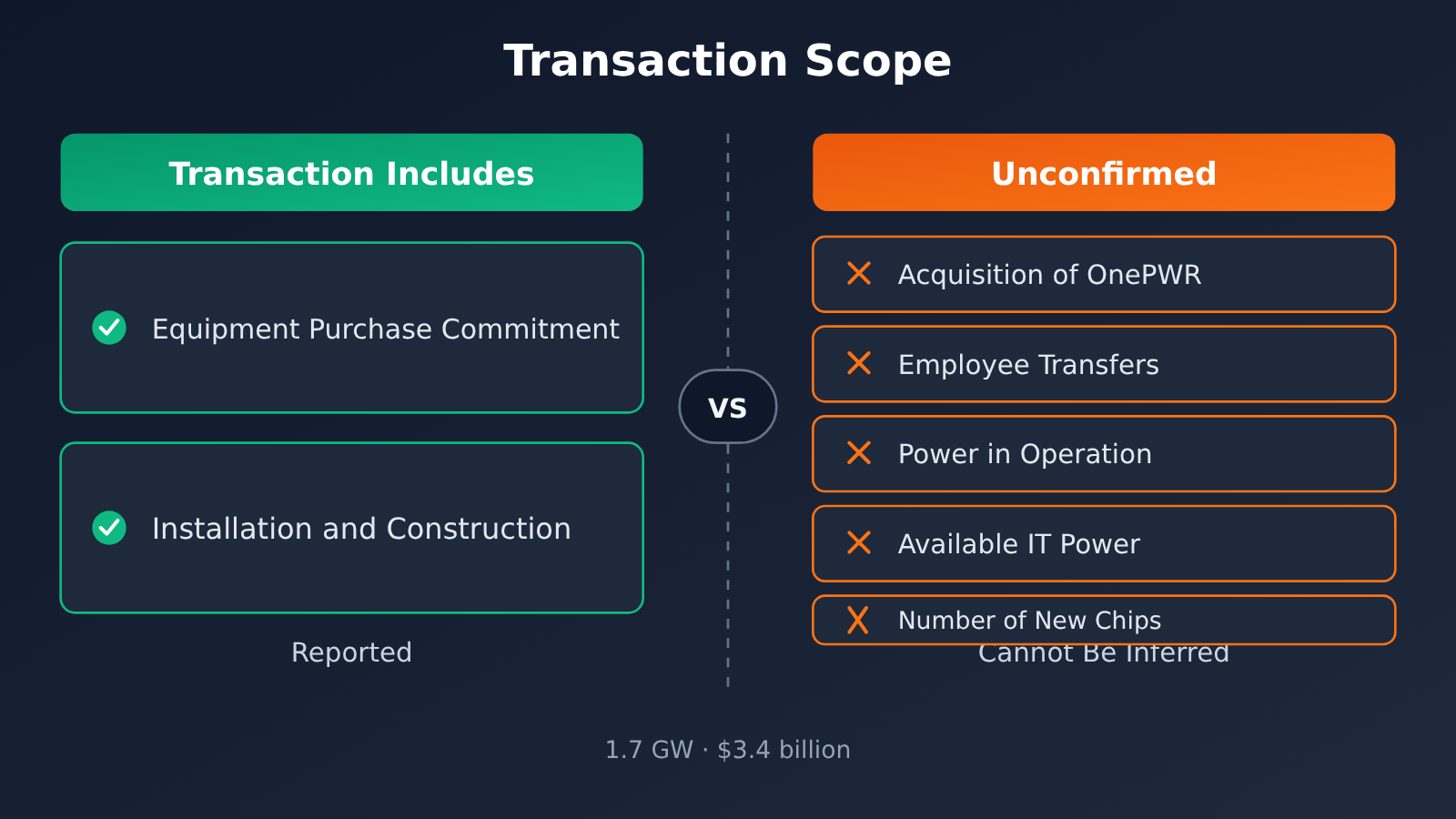
The report explicitly states that Anthropic didn’t acquire OnePWR or take on its employees. This is a deal for assets and capabilities, not a corporate acquisition. Anthropic is getting equipment and construction resources, not a power generation company or its entire business.
For background, OnePWR said in an announcement on February 3, 2026, that it had more than 400 MW of generation equipment and supporting systems in inventory and available for installation. It also expected to receive more than 800 MW of additional capacity over the following 24 months. But there’s an easy mistake to avoid here: the February announcement totals approximately 1.2 GW, while the September deal report cites 1.7 GW. The figures refer to different points in time, scopes and contract boundaries. The available disclosures don’t explain the difference, and they don’t establish that all the equipment in the February announcement was transferred to Anthropic.
How to Interpret 1.7 GW and $3.4 Billion
1.7 GW is a measure of power capacity: it describes how much power the equipment can output under specific conditions. It isn’t the amount of electricity generated in a year, nor is it a measure of GPU or TPU computing power. Based on the reported figures, we can make a couple of simple calculations:
| Calculation | Formula | Result | How to interpret it |
|---|---|---|---|
| Amount ÷ capacity | $3.4 billion ÷ 1,700 MW | Approximately $2 million/MW, or $2,000/kW | Ratio of deal value to capacity, not a vendor quote or the full cost of a power plant |
| Theoretical annual generation | 1.7 GW × 8,760 hours | 14.892 TWh (approximately 14.892 billion kWh) | An illustration of the units assuming full-power operation all year, not a forecast |
| Cost per kWh | Cannot be calculated | — | Inputs such as fuel, operations and maintenance, financing, efficiency and utilization are missing |
Actual operation also depends on delivery, maintenance, derating, fuel supply and utilization. These figures only help illustrate the units; they can’t establish an electricity price, much less the energy used per Claude request or how much API prices should fall.
Why the Power Equipment Order Matters Strategically to Anthropic
At first glance, $3.4 billion bought a batch of equipment that “hasn’t been installed yet.” So why does it matter? The answer lies in how long power equipment takes to deliver. In its S-1 filing submitted on October 26, 2026, Anthropic noted that some power equipment must be ordered and paid for years in advance. The company may pay above-market prices to secure capacity as quickly as possible, but the benefits still depend on construction finishing on schedule.
The same filing describes how Anthropic’s approach to acquiring computing resources is shifting from relying solely on cloud services to a hybrid model that also includes directly leasing chips housed at dedicated leased campuses. Campus completion and ramp-up could mean capacity becomes available later than the contract signing date. Importantly, a full-text search of the S-1 found no mention of OnePWR, so this is background context, not a description of the terms of this transaction.
The broader industry picture points in the same direction. A report published by the International Energy Agency (IEA) on April 16, 2026, noted tightening supply chains for gas turbines, transformers, advanced chips, and IT components. A large volume of project applications is also putting pressure on planning approvals and grid connections. The IEA estimated that data centers worldwide used around 485 TWh of electricity in 2025 and projected roughly 950 TWh in 2030, or about 3% of global electricity consumption. Electricity use by AI-focused data centers is expected to roughly triple over the same period. These are industry-wide figures, not Anthropic’s own growth figures.
The following is analysis based on disclosures, not a confirmed explanation of the transaction’s motivation: In an environment where equipment is scarce, advancing power supply preparations to the “equipment + construction” stage could help make future access to resources more certain. But that doesn’t tell us how many months Anthropic may have saved on delivery, how much it may have saved in costs, or whether it has achieved energy self-sufficiency.
What Has to Happen Between Power Equipment and Claude Compute Capacity
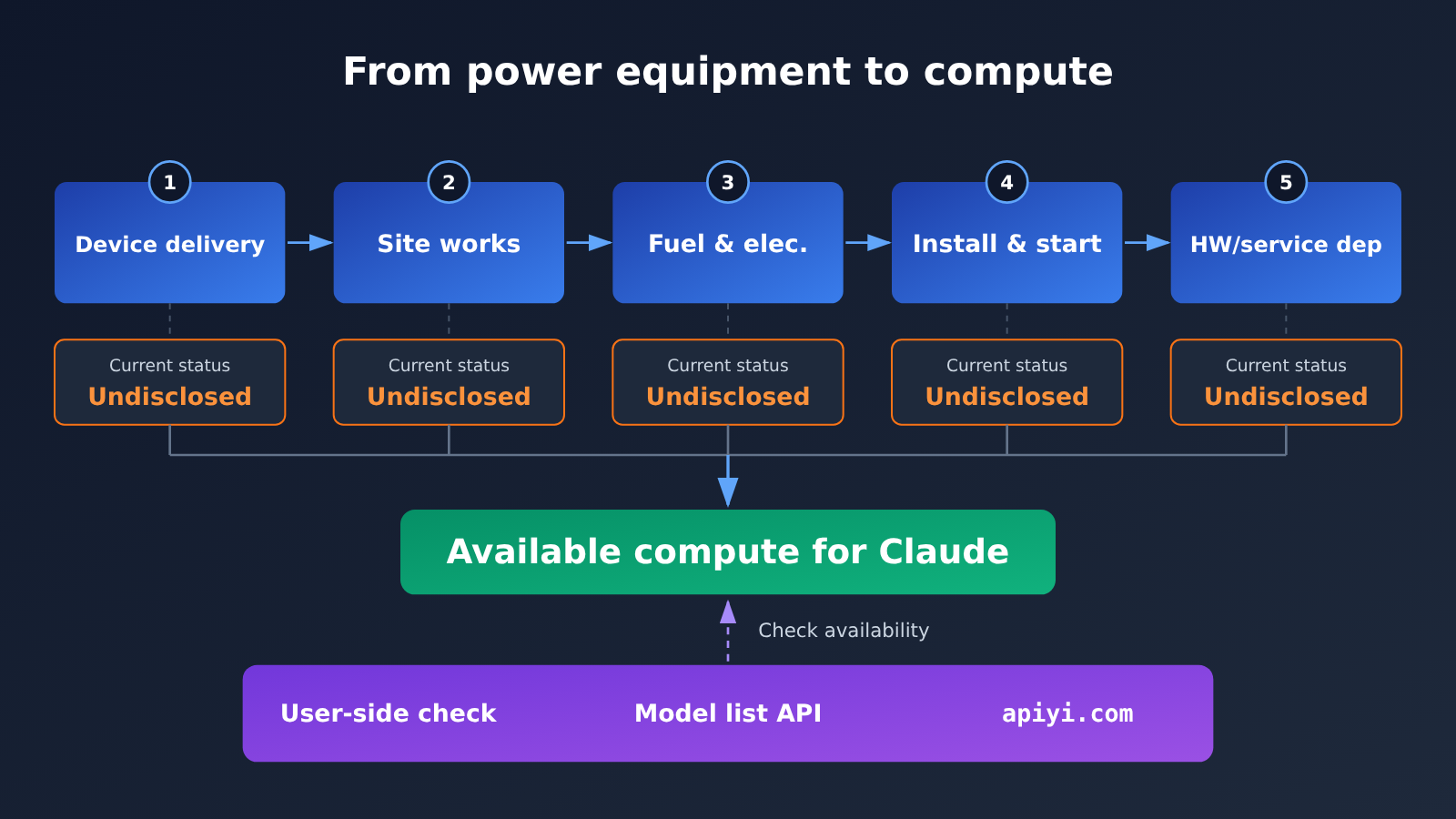
There’s a long chain between “buying equipment” and “putting compute capacity to work.” Each link could affect the final timeline:
| Stage | What needs to happen | What’s publicly known |
|---|---|---|
| 1. Equipment delivery | Units are manufactured in batches and transported to the site | Delivery batches and dates haven’t been disclosed |
| 2. Site development | Site selection, approvals, civil engineering, and construction | Installation location hasn’t been disclosed |
| 3. Fuel and electrical infrastructure | Natural gas supply, pipeline capacity, power distribution, and energy storage | Fuel arrangements haven’t been disclosed |
| 4. Installation, commissioning, and startup | Units are installed, tested together, and brought online | No announcement that the units are operational |
| 5. Computing hardware and service deployment | Chips arrive, the campus ramps up, and services are allocated | No announcement tied to this transaction |
Fuel is one of the easiest links to overlook. In its general risk disclosures, the S-1 filing says that some planned campuses rely on on-site natural gas generation and face constraints on fuel supply and pipeline capacity. Under the relevant arrangements, the company generally bears uncapped pass-through fuel and related costs. This is a general risk disclosure, not a confirmation of costs under the OnePWR contract. But it illustrates an important point: once the units arrive, keeping them running still requires a reliable fuel supply and funding.
Even if the power plant comes online without a hitch, its generating capacity won’t equal the power available to servers. Reliable operation requires redundancy and maintenance, and some power must go to cooling and other facilities. IEA analysis suggests that providing reliable on-site gas power for critical, fluctuating loads may require generation infrastructure with 30%–70% more capacity than demand. That’s an industry research finding, not a figure that can be applied directly to declare how much IT capacity this equipment will support.
Gas-fired units can technically provide continuous power. For example, Caterpillar’s XGC1900 product materials list continuous power as one of its applications, with a nominal output of up to 1900 kW per module. But that only tells us what this category of equipment can do. It doesn’t establish that this transaction includes that model, and it can’t be used to calculate the number of units purchased.
For Developers: Check Which Models Are Available to You
Upstream power supply and construction progress are separate from your experience calling an API today. The available information provides no evidence that this deal changed API pricing, quotas, latency, or stability. Rather than speculate, it’s more practical to check which models you can access directly. Here’s a minimal example using the model list endpoint:
import openai

client = openai.OpenAI(
    api_key="YOUR_API_KEY",
    base_url="https://api.apiyi.com/v1"  # APIYI OpenAI-compatible endpoint
)

# List models visible to the current account to check what's actually available
for model in client.models.list().data:
    if "claude" in model.id.lower():
        print(model.id)
View the complete code with a minimal test call
import time
import openai

client = openai.OpenAI(
    api_key="YOUR_API_KEY",
    base_url="https://api.apiyi.com/v1"  # Access models from multiple providers through APIYI
)

def list_models(keyword: str = "claude") -> list[str]:
    """Return model IDs whose names contain the keyword"""
    return [m.id for m in client.models.list().data if keyword in m.id.lower()]

def probe(model: str) -> dict:
    """Send a minimal request and record its duration and success for self-testing, not performance conclusions"""
    start = time.time()
    try:
        resp = client.chat.completions.create(
            model=model,
            messages=[{"role": "user", "content": "ping"}],
            max_tokens=5,
        )
        return {"model": model, "ok": True,
                "latency_s": round(time.time() - start, 2),
                "reply": resp.choices[0].message.content}
    except Exception as e:
        return {"model": model, "ok": False, "error": str(e)}

if __name__ == "__main__":
    for m in list_models()[:3]:
        print(probe(m))
It’s important to note that the list endpoint only shows which models are visible to your account at that moment. It doesn’t guarantee availability or pricing, and it can’t bypass upstream computing or power constraints.
🚀 What to check: When choosing a model, check available models, quotas, error rates, response latency, and actual bills separately, then make your decision based on your own application requests. You can use a single key through APIYI at apiyi.com to run small-sample tests in parallel across models such as Claude, GPT, and Gemini. New users get free testing credits.
Public Developments to Watch in Anthropic’s Power Equipment Deal
Rather than focusing on the $3.4 billion figure, it’s more useful to watch for milestones that show delivery is moving forward. The following disclosures could tell us more about actual progress than the deal value alone:
| Milestone to watch | What it means | Possible sources |
|---|---|---|
| Official company disclosure | Details such as the buyer and capacity move from “reported” to confirmed | Anthropic or OnePWR announcements, regulatory filings |
| Site and engineering arrangements | The equipment has a clear destination, and engineering work is moving forward | Local approvals, project announcements |
| Phased delivery and commissioning | The equipment moves from a contract to actual generating capacity | Supplier or project updates |
| Fuel supply and grid connection arrangements | Whether the conditions for continuous operation are in place | Pipeline- and electricity-related disclosures |
| Computing service announcements | Whether the power ultimately translates into usable services | Product and capacity announcements |
There’s another piece of context worth watching. On February 11, 2026, Anthropic said it would cover consumer electricity price increases caused by its data centers, pay 100% of the grid upgrade costs needed to connect them, and support new power generation matched to its own demand. The commitment applies directly to data centers developed with partners to serve Anthropic’s own workloads. For cases where it leases existing capacity, the company said at the time that it was still exploring its options. This gas-powered equipment deal neither proves that the commitment has been fulfilled nor that it has failed; that will depend on the project’s location, operating data, and cost-sharing arrangements.
Frequently Asked Questions
Q1: What is Anthropic’s $3.4 billion power equipment deal?
According to Reuters’ November 8, 2026 account of an FT report, Anthropic acquired roughly $3.4 billion in purchase commitments for 1.7 GW of heavy-duty gas-fired generators from OnePWR in late September. The deal also included engineering and construction capacity needed for installation. Reuters did not independently verify the report, and neither party responded to requests for comment.
Q2: Does this mean Anthropic already has 1.7 GW of power?
No. It acquired equipment and construction resources, but delivery, site work, fuel and electrical infrastructure, installation, and commissioning must still be completed before the generators can operate. There has been no announcement that they are operational. Nor can 1.7 GW be directly converted into available server power or a chip count.
Q3: Did Anthropic acquire OnePWR?
No. The report explicitly says the deal did not include acquiring OnePWR or taking on its employees. It was a deal for assets and engineering capacity, not a corporate acquisition.
Q4: Will this deal make the Claude API faster or cheaper?
There’s no evidence in the available information that the deal has changed API pricing, quotas, latency, or stability. Long-term infrastructure investment and today’s user experience are separate matters, so it’s best to rely on your own tests. With APIYI apiyi.com, you can use the same OpenAI-compatible code to compare how different models perform in practice, then factor in your bill when making a decision.
Q5: What should developers do now?
Use the model list endpoint to check which models are currently available to you, then test error rates and latency with your own real-world requests. Don’t treat upstream construction commitments as an immediate service guarantee. If you need to compare multiple models or set up failover between them, you can register at APIYI apiyi.com to get an API key and free credits, then set the `base_url` in this article’s examples to `https://api.apiyi.com/v1` to start testing.
Q6: What are the limitations of the information about this deal?
The key details come from a single media report. The transaction advisor’s page did not name the buyer or mention 1.7 GW. The full contract, payment schedule, installation sites, delivery and commissioning dates, fuel arrangements, and breakdown of equipment and engineering costs have not been disclosed. Claims that the equipment is destined for any specific campus are unsupported.
Key Takeaways: Anthropic’s $3.4 Billion Power Equipment Deal
- The deal: Anthropic reportedly agreed to acquire commitments for 1.7 GW of gas-fired power equipment and related engineering capabilities for about $3.4 billion.
- Source limitations: Reuters relayed the Financial Times report without independently verifying it. The deal adviser’s page identified the buyer only as a frontier AI lab.
- What’s included: Anthropic didn’t acquire OnePWR or take on its employees. It bought equipment and construction resources.
- What 1.7 GW means: It’s a measure of power capacity—not annual electricity generation, and certainly not available compute.
- The path to compute: Turning equipment into computing capacity still requires a site, fuel, commissioning, and hardware deployment.
- For users: Test API performance for yourself. You can compare multiple models through APIYI at apiyi.com.
Summary
There are three important distinctions to keep in mind about Anthropic’s reported $3.4 billion power equipment deal:
- What’s been confirmed: A deal adviser disclosed a transaction of a similar size, but the buyer’s identity and the 1.7 GW figure remain media-reported details.
- What was acquired: Power equipment purchase commitments and installation engineering capabilities—not a company or power that’s already online.
- What’s still needed: Equipment delivery, site construction, fuel supply, installation and commissioning, and computing deployment. Each step affects the eventual supply of compute for Claude.
The milestones worth watching are formal disclosures, site selection, phased deliveries, and commissioning. For teams using Claude and other models, it’s better to rely on business data than to infer service changes from upstream news. We recommend using APIYI at apiyi.com to quickly test multiple models through a unified interface, then choosing based on actual results and costs.
📚 References
- Reuters report (published by CNA): Coverage of Anthropic’s generator deal, 2026-11-08
- Link:
channelnewsasia.com/business/anthropic-secures-34-billion-generator-deal-ai-data-centers-ft-reports-6534256 -
Notes: Main source for the deal’s details; cites the FT, and Reuters did not independently verify the report
-
Piper Sandler OnePWR transaction disclosure: Transaction advisor’s page, dated September 2026
- Link:
pipersandler.com/investment-banking-transactions/onepwr-solutions-20260901 -
Notes: Lists the sale of a power generation platform for $3.4 billion; the buyer is unnamed
-
OnePWR equipment inventory announcement: GlobeNewswire, 2026-02-03
- Link:
globenewswire.com/news-release/2026/02/03/3231159/0/en/onepwr-solutions-announces-more-than-1-2-gw-of-power-generation-assets-ready-for-deployment.html -
Notes: Statement about the supplier’s overall resources, not confirmation of the deal
-
Anthropic electricity price impact commitment: Company policy statement, 2026-02-11
- Link:
anthropic.com/news/covering-electricity-price-increases -
Notes: Details and scope of the commitment
-
Anthropic S-1 filing: SEC disclosure, 2026-10-26
- Link:
sec.gov/Archives/edgar/data/2130357/000162828026067168/anthropicpbc-sx1.htm -
Notes: Infrastructure risk disclosures around printed pages 32, 34, and 36; provided for background only
-
IEA energy and AI report executive summary: 2026-04-16
- Link:
iea.org/reports/key-questions-on-energy-and-ai/executive-summary -
Notes: Data center electricity consumption estimates and forecasts, plus analysis of excess on-site generation capacity
-
IEA report press release: 2026-04-16
- Link:
iea.org/news/data-centre-electricity-use-surged-in-2025-even-with-tightening-bottlenecks-driving-a-scramble-for-solutions -
Notes: Background on supply chains, grid connections, and on-site generation
-
Caterpillar XGC1900 product information
- Link:
cat.com/en_US/campaigns/npi/cat-xgc1900-generator.html -
Notes: Included only to illustrate that gas generators can provide continuous power; this model is not part of the deal
-
Original Financial Times report: 2026-11-08
- Link:
ft.com/content/41bf5c6a-9735-4f1a-a8e3-2bcccad58ba0 - Notes: The full article could not be accessed for this piece; the link is provided for reference
Author: APIYI Technical Team
Technical discussions: Contact us through the APIYI homepage at apiyi.com. For more API details, visit the documentation center at docs.apiyi.com.


