
Author’s note: Claude Fable 5.2 is here, with standard API prices down 20%. This article uses official sources to explain how pricing works, how to interpret the speed claims, who should try it first, and what to check before making API calls.
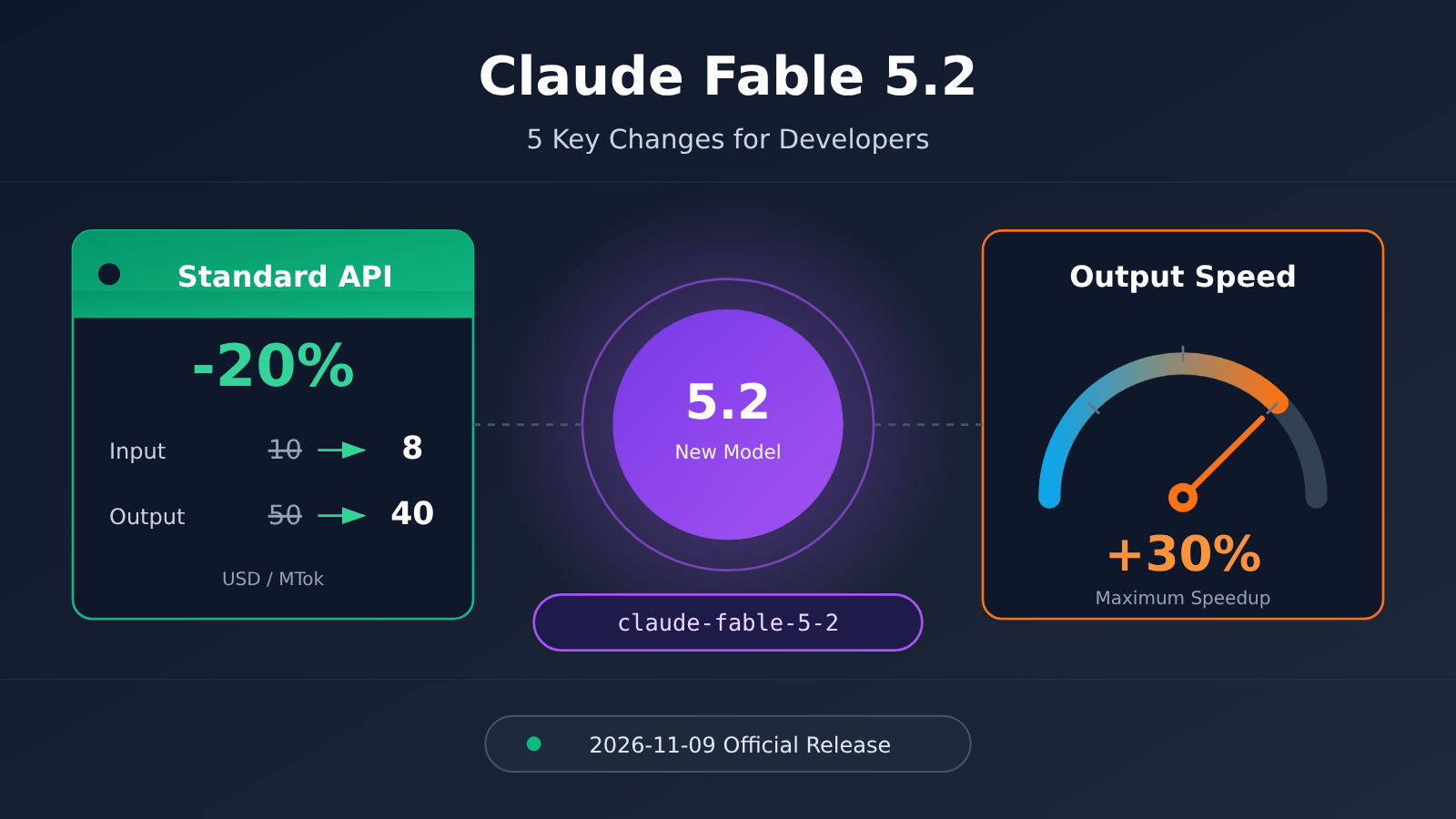
Anthropic released Claude Fable 5.2 on November 9, 2026. The standard API price per input and output token is 20% lower than for 5.1. Anthropic also says the model has improved coding, reasoning, and vision capabilities, and can generate output up to 30% faster.
This isn’t just a rumor. The official announcement, pricing page, and model documentation all list the new model, claude-fable-5-2, and its new rates. We checked the pricing page again on November 10, and the standard and fast-mode prices matched the announcement. But “20% lower” refers only to the per-token price; it doesn’t mean every task will cost 20% less. And “up to 30% faster” doesn’t mean every request will be 30% faster.
What you’ll learn: In five minutes, get up to speed on what’s changed, how much cheaper the standard API is, which claims are easy to misinterpret, and what to check before you integrate the model.
In short: Claude Fable 5.2 has lower standard API prices and a higher capability ceiling. Developers should evaluate pricing, speed, availability, and actual usage costs separately.
In this article
- Key terms: 7 terms to understand Claude Fable 5.2
- 1 What Claude Fable 5.2 brings and who can use it now
- 2 How the 20% price cut for Claude Fable 5.2’s standard API works
- 3 The 30% speed increase and fast mode are two different things
- 4 Who should try Claude Fable 5.2 first
- 5 Five things to check before calling Claude Fable 5.2
What to Know: 7 Terms for Understanding Claude Fable 5.2
These terms come up throughout the article. Let’s get on the same page first so the pricing and speed figures are easier to interpret.
- Token: A unit the model uses for processing and billing. One token doesn’t necessarily equal one Chinese character or one English word.
- MTok: One million tokens. Prices in this article are consistently shown in dollars per MTok.
- Cache reads: Reusing input content that’s already been cached. It’s billed separately at a much lower rate than standard input.
- Fast mode: Pay a higher unit price in exchange for a faster output token rate.
- Context window: The total amount of history and content that can fit in a single request. It’s a capacity limit, not a free allowance.
- Effort: A setting for adjusting the depth of reasoning. It affects both response time and token usage.
- Mythos: Uses the same underlying model as Fable, but has different access requirements and safety configurations.
1. What Claude Fable 5.2 Offers and Who Can Use It Now
Claude Fable 5.2 at a Glance
| Item | Details | Source |
|---|---|---|
| Release date | November 9, 2026 (official announcement date) | Official announcement |
| API model ID | claude-fable-5-2 |
Official model documentation |
| Capabilities | Improvements in coding, reasoning, and vision, aimed at challenging coding and long-running tasks | Vendor assessment |
| Context / maximum output | 1M tokens / 128K tokens | Official model documentation |
| Input and output modalities | Text and image input, text output | Official model documentation |
| Reasoning | Adaptive thinking is always enabled; the API’s default effort is high | Official model documentation |
| Knowledge cutoff | June 2026 (doesn’t mean it has real-time internet access) | Official model documentation |
| Standard pricing | $8 per MTok for input / $40 per MTok for output, both 20% lower than 5.1 | Official pricing page |
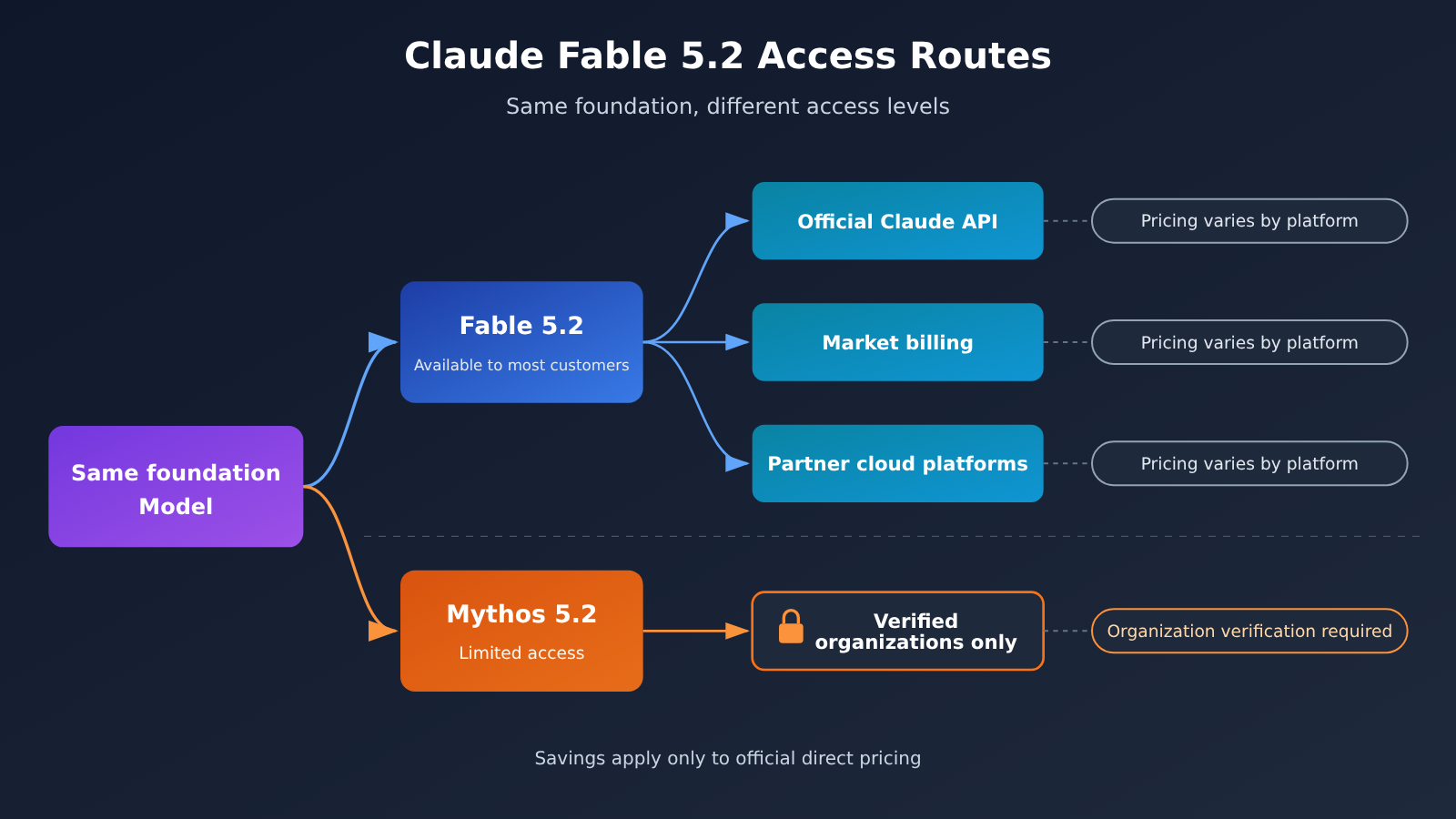
Another key point in the announcement is the relationship between Fable and Mythos. Anthropic says they use the same underlying model. Fable’s cybersecurity and biosafety safeguards are configured to make it available to general customers, while Mythos is limited to verified organizations. So, “same underlying model” doesn’t mean everyone can call Mythos directly. This release makes Fable 5.2 available to regular developers.
Fable 5.2 is available through Anthropic’s official Claude API. The official pricing page also lists direct API access, marketplace billing, and partner cloud platforms separately, and the documentation includes specific notes about platforms such as Bedrock and Foundry. Partner clouds may set their own prices, and region selection can also affect costs. So the 20% price reduction mentioned below applies only to the standard price for the official direct API.
2 How to Calculate the 20% Price Cut for the Claude Fable 5.2 Standard API
Official Standard Price Comparison: Claude Fable 5.2 vs. 5.1
The following are Anthropic’s official standard rates, in USD per MTok, retrieved on November 10, 2026. These are list prices, not the amounts actually charged to any platform account.
| Billing item | Fable 5.1 | Fable 5.2 | Change |
|---|---|---|---|
| Standard input | 10 | 8 | -20% |
| Output | 50 | 40 | -20% |
| 5-minute cache writes | 12.50 | 10 | -20% |
| 1-hour cache writes | 20 | 16 | -20% |
| Cache reads | 0.25 | 0.20 | -20% |
| Batch input / output | 5 / 25 | 4 / 20 | Both -20% |
There are three easy-to-miss details in this table:
- The “half price” for Batch isn’t part of this price cut. Batch rates are half the price of each model’s standard rates, and that was already true for 5.1. This time, the reduction is still 20%, not 60%.
- Fable 5.2 is still more expensive than Opus 5.5. Opus 5.5’s standard input and output rates are $4 and $20, respectively. Fable 5.2’s rates for those two items are exactly double.
- The 1M context is billed at standard rates, but larger requests still cost more overall. The unchanged unit price means there’s no extra surcharge; the more tokens you use, the higher the bill.
A Hypothetical Example to Work Out the 20% Cut
The calculation below is hypothetical, not an actual model invocation. Assume a request uses 100,000 standard input tokens and 20,000 billable output tokens, with no caching, tool surcharges, retries, or other multipliers:
- Fable 5.1: 0.1 × 10 + 0.02 × 50 = $2.00
- Fable 5.2 standard: 0.1 × 8 + 0.02 × 40 = $1.60
With the same usage, you save $0.40—a reduction of exactly 20%. But that depends on both input and output token counts staying the same. If the same task uses 40,000 billable output tokens after upgrading, Fable 5.2 costs 0.80 + 1.60 = $2.40, which is more than the $2.00 for 5.1. This variation is only meant to show how the variables affect the cost; it isn’t a prediction that 5.2 will necessarily generate more output.
You can use this Python snippet to recalculate costs at the official standard rates and plug in your actual usage:
# Claude Fable official standard rates (USD / MTok), retrieved on 2026-11-10
RATES = {
    "fable-5.1": {"input": 10, "output": 50, "cache_read": 0.25},
    "fable-5.2": {"input": 8, "output": 40, "cache_read": 0.20},
}

def estimate(model, input_tok, output_tok, cache_read_tok=0):
    r = RATES[model]
    return (input_tok * r["input"] + output_tok * r["output"]
            + cache_read_tok * r["cache_read"]) / 1_000_000

print(estimate("fable-5.1", 100_000, 20_000))  # 2.0
print(estimate("fable-5.2", 100_000, 20_000))  # 1.6
💡 Cost-tracking tip: When comparing costs before and after an upgrade, track token usage, accepted outputs, and rework for each task instead of looking only at unit prices. If you use multiple models, you can connect to them through APIYI (apiyi.com) with a single API key, then use the platform logs to compare usage before and after by task.
3 Claude Fable 5.2’s 30% Speed Boost and Fast Mode Are Two Different Things
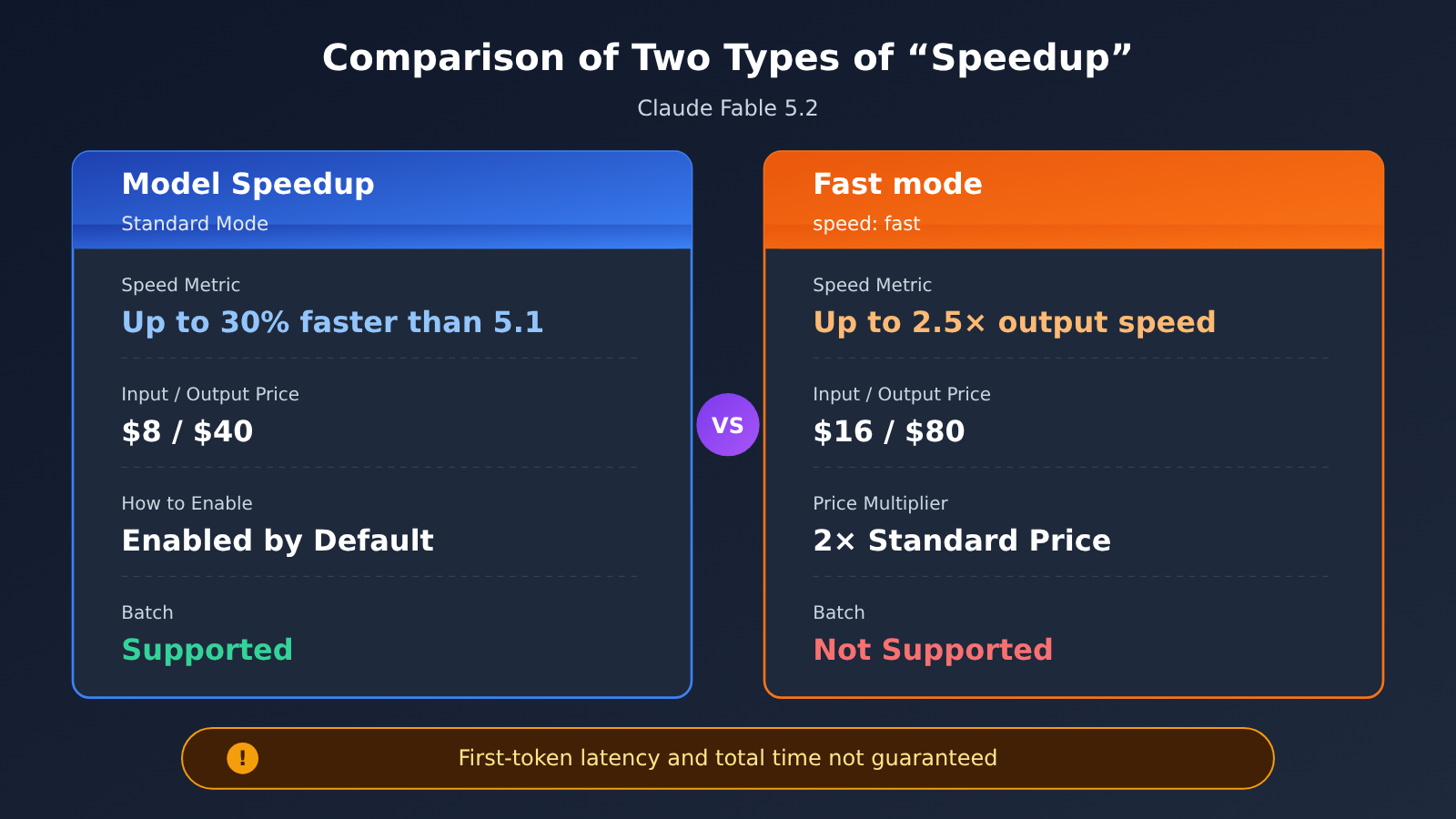
The announcement’s claim that “output generation is up to 30% faster” compares Fable 5.2 in standard mode with 5.1. It describes the maximum improvement in output speed, not a guarantee that every task will take less time. You don’t need to change any parameters or pay extra, but the actual speedup depends on the request.
Fast mode is a separate feature. It aims to deliver an output token rate of up to 2.5x, at twice the price: Fable 5.2 Fast mode costs $16 / $80 per MTok for input / output. In the Claude Messages API, enable it with speed: fast. This uses a faster inference configuration for the same model. Fast mode has separate rate limits, and you can check whether it’s active in a successful response by looking at usage.speed. Foundry uses a separate -fast deployment model, so you can’t directly reuse the same parameter syntax.
| Comparison | Standard mode (5.2’s built-in speed boost) | Fast mode |
|---|---|---|
| Speed claim | Output generation up to 30% faster than 5.1 | Output token rate up to 2.5x |
| Input / output price | $8 / $40 per MTok | $16 / $80 per MTok |
| How to enable | Default | Set speed: fast in the Messages API |
| Batch | Supported | Not supported |
| Rate limits | Standard limits | Separate rate limits |
| What isn’t guaranteed | Time for an individual task | Time to first token and overall task speedup |
Keep three metrics distinct: output rate, time to first response, and total task time. Fast mode accelerates the first one. An Agent task’s total time also includes tool execution, network transfer, and queueing, none of which get shorter just because the output rate is higher. Using the hypothetical example from the previous section, Fast mode costs $3.20, which is $1.60 more than standard mode. Whether it’s worth paying extra depends on how much your waiting time is worth and what share of the total task time is spent generating output. We haven’t run paid speed tests for this comparison, so the figures above reflect the official claims.
4 Who Should Try Claude Fable 5.2 First?
Anthropic’s official recommendation is fairly measured: for most everyday coding and knowledge work, start by evaluating Opus 5.5, then move up to Fable based on task complexity. In other words, Fable 5.2 is mainly aimed at challenging coding, research-oriented work, and long-running Agent tasks—not every model call needs to switch to it.
For capabilities, Anthropic reported two coding benchmark results in its announcement:
- FrontierCode 2.0: 5.2 scored 49.1%, compared with 32.4% for 5.1 (the results involve different effort settings)
- FrontierSWE v2: 5.2 scored 69.9%, compared with 56.3% for 5.1
Both sets of figures come from Anthropic’s own benchmarks. They show a clear improvement in the company’s reported results, but shouldn’t be treated as the success rate for tasks in your own codebase. A more reliable approach is to select a small sample of tasks from your production workload, run them on both 5.1 and 5.2, and compare pass rates and total costs.
| User type | Recommendation | Why |
|---|---|---|
| Teams tackling challenging coding or large-scale refactoring | Evaluate first | This is exactly the kind of work Anthropic is targeting, and the price has come down |
| Long-running Agent and research tasks | Evaluate first | The 1M context window and 128K output limit are especially useful here |
| Teams already using Fable 5.1 | Run a comparison test soon | The price is 20% lower, but check for compatibility changes first |
| Everyday Q&A and lightweight coding | Start with Opus 5.5 | That’s Anthropic’s recommendation, and Fable still costs twice as much |
| Individuals using only a Claude subscription | Watch for subscription promotions | API pricing and subscription allowances are separate systems |
The last row needs a little more explanation. On November 9, Anthropic launched a subscription promotion: Pro and standard Team seats could use up to 50% of their weekly limits on Fable for one week, through November 16 at 23:59 PT—that is, November 17 at 15:59 Beijing time. Eligible accounts also received a quota reset; check the official terms for specific eligibility. Keep in mind that lower API pricing doesn’t mean subscription usage limits have also been reduced. The two shouldn’t be confused.
🎯 Testing tip: The easiest way to run a comparison is to use the same code and switch between models. APIYI (apiyi.com) offers an OpenAI-compatible interface, letting you access models from Claude, OpenAI, Gemini, and others with a single API key. Check the platform’s current model list for the exact model IDs available.
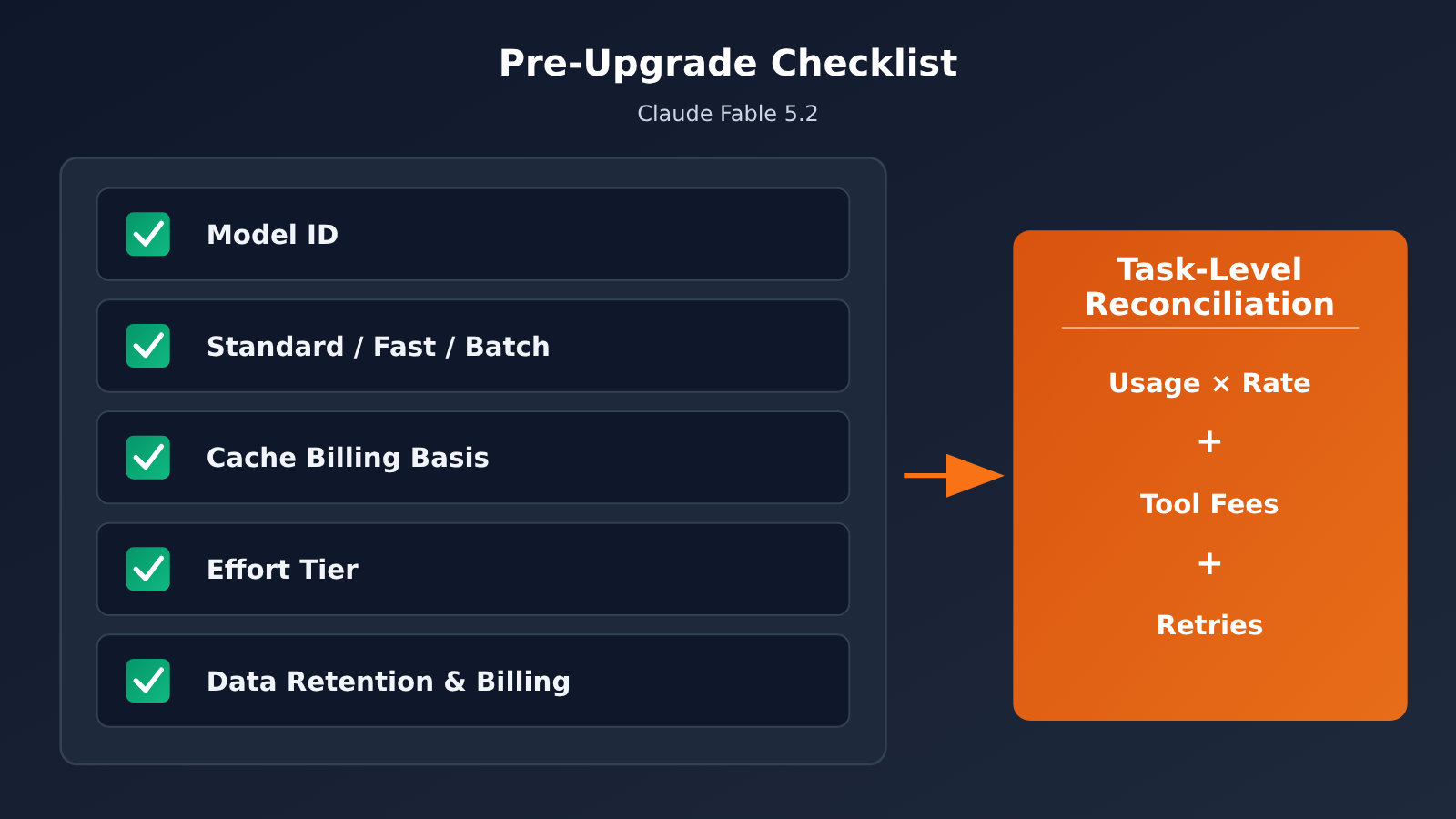
5 Things to Check Before Calling Claude Fable 5.2
Before upgrading, check the following items so you can assess how much the “price drop” will actually affect your bill.
| Check | What to confirm | Common misconception |
|---|---|---|
| ① Model | Whether your provider currently offers claude-fable-5-2, and the exact model ID |
Assuming every provider launches it on release day |
| ② Mode | Whether you’re using standard mode, fast mode, or Batch | Counting Batch’s 50% discount as part of the price drop |
| ③ Billing details | Whether regular input, cache writes, cache reads, and output are billed separately | Estimating costs using only “input + output” |
| ④ Reasoning effort | What effort level is set, and whether you’re carrying over your 5.1 settings | Assuming the same effort level requires the same amount of reasoning across versions |
| ⑤ Data and billing | Data retention requirements and actual charges | Treating the official list price as your actual bill |
A few items need more explanation:
- Reasoning effort: The official prompt guide recommends starting with high for API use, then adjusting up or down based on your own evaluations. medium is better suited to interactive scenarios, xhigh is for difficult, long-running tasks where it provides a real benefit, and max is only for evaluating the upper limit. Higher effort levels generally use more tokens, so track quality and cost every time you make an adjustment.
- Compatibility changes: The official documentation lists four changes in 5.2. If you modify the system prompt, tools, or earlier messages and then submit old thinking blocks, the request may return a 400 error by default. Thinking blocks from 5.2 can only be read by Fable 5.2 or Mythos 5.2. The old
computer_20251124tool will return an error on platforms other than Bedrock. When using the advisor tool, a 5.2 executor must be paired with a 5.2 advisor. Other restrictions—such as adaptive thinking always being enabled, not being able to forcetool_choiceto any or a tool, and not being able to prefill the assistant message—aren’t new in this release, so handle them separately during migration. - Data retention: The migration guide specifies a 30-day data retention requirement. ZDR configurations without explicit authorization can’t be carried over as-is. Teams with compliance requirements should check each item against the current official terms.
If you call the model through an aggregator, you can use logs to calculate costs by task. Here’s a minimal example. Confirm the model ID in your provider’s model list first:
import openai

client = openai.OpenAI(
    api_key="YOUR_API_KEY",
    base_url="https://api.apiyi.com/v1"
)

response = client.chat.completions.create(
    model="claude-fable-5-2",  # Confirm this ID is currently available in the platform's model list
    messages=[{"role": "user", "content": "用三点概括这段代码的风险"}]
)
print(response.choices[0].message.content)
print(response.usage)  # Record prompt / completion tokens for billing reconciliation
View the complete comparison test code
import openai
import time

client = openai.OpenAI(
    api_key="YOUR_API_KEY",
    base_url="https://api.apiyi.com/v1"
)

# Official standard rates (USD / MTok), for estimation only; actual charges are based on billing logs
RATES = {
    "claude-fable-5-1": (10, 50),
    "claude-fable-5-2": (8, 40),
}

def run_task(model: str, prompt: str) -> dict:
    start = time.time()
    resp = client.chat.completions.create(
        model=model,
        messages=[{"role": "user", "content": prompt}],
    )
    usage = resp.usage
    rin, rout = RATES[model]
    est_cost = (usage.prompt_tokens * rin + usage.completion_tokens * rout) / 1_000_000
    return {
        "model": model,
        "prompt_tokens": usage.prompt_tokens,
        "completion_tokens": usage.completion_tokens,
        "est_cost_usd": round(est_cost, 4),
        "seconds": round(time.time() - start, 2),
        "answer": resp.choices[0].message.content,
    }

tasks = ["重构以下函数并说明理由:...", "为这段模块补充单元测试:..."]
for t in tasks:
    for m in RATES:
        r = run_task(m, t)
        print(r["model"], r["prompt_tokens"], r["completion_tokens"],
              r["est_cost_usd"], r["seconds"])
        # Manually or automatically evaluate r["answer"] and record whether it passed
📊 Reconciliation tip: Treat estimates as a guide; actual charges are based on the platform logs. APIYI (apiyi.com) logs include fields such as model_name, prompt_tokens, completion_tokens, quota, and request_id. Divide quota by 500000 to get the charge in USD, making it easy to compare actual costs before and after an upgrade on a per-task basis.
Frequently Asked Questions (FAQ)
Q1: What is Claude Fable 5.2?
Claude Fable 5.2 is a model Anthropic released on November 9, 2026. Its API model ID is `claude-fable-5-2`. It’s designed for challenging coding, reasoning, vision, and long-running tasks. It supports a 1M context window and up to 128K output tokens, and is available to general customers.
Q2: What’s the difference between Claude Fable 5.2 and Mythos 5.2?
Both use the same underlying model. The difference is in access requirements and safety configurations. Fable’s configuration allows it to be offered to general customers, while Mythos is limited to verified organizations and isn’t directly available to individual developers.
Q3: Does a 20% price cut mean my bill will definitely be 20% lower?
Not necessarily. The 20% reduction applies to the unit price. Your costs will fall by the same proportion only if your token usage and billing conditions stay the same. If upgrading leads to longer outputs, higher effort settings, or more retries, your total costs could stay the same or even increase. Compare results using real tasks, and use your actual bill as the source of truth.
Q4: Is Claude Fable 5.2’s fast mode worth enabling?
Fast mode costs twice as much as standard mode ($16 / $80 per MTok) in exchange for up to 2.5× the output token rate. It doesn’t guarantee lower time to first token or shorter overall task completion time. If your bottleneck is tool execution or network latency, the speedup will be less noticeable. It’s best to try it on a small scale first for interactive use cases where wait time really matters.
Q5: How can I quickly call Claude Fable 5.2 through the API for a comparison test?
You can use an OpenAI-compatible interface that supports multiple models to make switching easier:
1. Sign up at APIYI (apiyi.com) and get an API key. New users get free testing credits.
2. Check the platform’s model list for the Fable model ID available that day.
3. Set `base_url` in the code in this article to `https://api.apiyi.com/v1` and run the same set of tasks for comparison.
Q6: What should I watch out for when migrating from Fable 5.1 to 5.2?
Pay special attention to the four compatibility changes listed by Anthropic: prefix checks for legacy thinking blocks, 5.2 thinking blocks that can’t be read by older versions, errors with older versions of the computer tool, and version pairing for the advisor tool. Also note the 30-day data retention requirement, and don’t carry over your effort settings without reviewing them.
Claude Fable 5.2 Key Takeaways
- Release: Released on November 9, 2026, under the model ID
claude-fable-5-2, and available to general customers. - Pricing: Standard input and output rates have dropped to $8 / $40 per MTok. Cache and Batch rates are also down 20%.
- Positioning: Its per-token price is still twice that of Opus 5.5. Anthropic recommends evaluating Opus 5.5 first for everyday tasks.
- Two ways to go faster: Standard mode delivers up to 30% faster output, while Fast mode reaches up to 2.5x the output speed at double the price.
- Cost considerations: The price cut translates to proportional savings only if usage stays the same. Validate costs with real tasks.
- Getting started: Use APIYI at apiyi.com to compare multiple models through a unified interface, then use logs to calculate costs.
Summary
Here are the key points from the Claude Fable 5.2 release:
- Cheaper: All rates for the official standard API are down 20%, but pricing for partner clouds, subscriptions, and third-party platforms should be confirmed separately.
- More capable, but not cheap: Its coding and long-running task capabilities have improved, but it still costs more per token than Opus 5.5. It’s better suited to difficult tasks than as a full replacement.
- Understand the speed claims: The 30% figure is the maximum improvement in standard mode; 2.5x refers to the output speed of the paid Fast mode. Neither guarantees a shorter overall task completion time.
Start by selecting a small set of representative tasks and comparing the pass rates and actual costs of 5.1, 5.2, and Opus 5.5 under the same effort settings and billing conditions. Then decide how broadly to migrate. To compare multiple models in parallel, connect through APIYI at apiyi.com and use platform logs to reconcile costs at the task level.
📚 References
- Anthropic announcement: Fable and Mythos 5.2 availability, speed claims, and evaluation results
- Link:
anthropic.com/claude-fable-and-mythos-5-2 -
Note: Official launch announcement and vendor-reported results, published on 2026-11-09
-
Claude API pricing: Standard, cache, and Batch pricing, and platform differences
- Link:
platform.claude.com/docs/en/about-claude/pricing -
Note: Official, regularly updated pricing table; prices in this article were checked on 2026-11-10
-
Fable 5.2 model specifications: Context, output, modalities, and default effort
- Link:
platform.claude.com/docs/en/models/fable-5-2/overview -
Note: Official API documentation
-
What’s new in Fable 5.2 and migration guide: Compatibility changes and data retention requirements
- Link:
platform.claude.com/docs/en/models/fable-5-2/whats-new-fable-5-2 -
Note: Required reading before upgrading; see the migration guide in the same directory as well
-
Fast mode documentation: Fast mode parameters, pricing, and limitations
- Link:
platform.claude.com/docs/en/build-with-claude/fast-mode -
Note: Official feature documentation
-
Fable 5.2 launch offers: Subscription plan promotion terms
- Link:
support.claude.com/en/articles/17506494-claude-fable-5-2-launch-offers - Note: Details of promotional usage allowances for Pro, Team, Max, and other plans
Author: APIYI Technical Team
Technical questions: Contact us from the APIYI homepage. You can find details on log fields and billing in the docs center at docs.apiyi.com.


