

Bottom Line: API Costs for AI Articles — Price the Calls First, Then the Finished Piece
Based on the price snapshot in this article — 10,000 input tokens and 3,000 output tokens — a single generation theoretically costs about $0.0066–0.10. But shipping a publishable article means stacking on revisions, fact-checks, tool calls, and human editing time.
The number actually worth comparing is the “cost per acceptable article.” This article runs seven models through the same input and output volumes, then explains how channels, caching, reasoning, and revision rounds reshape the bill.
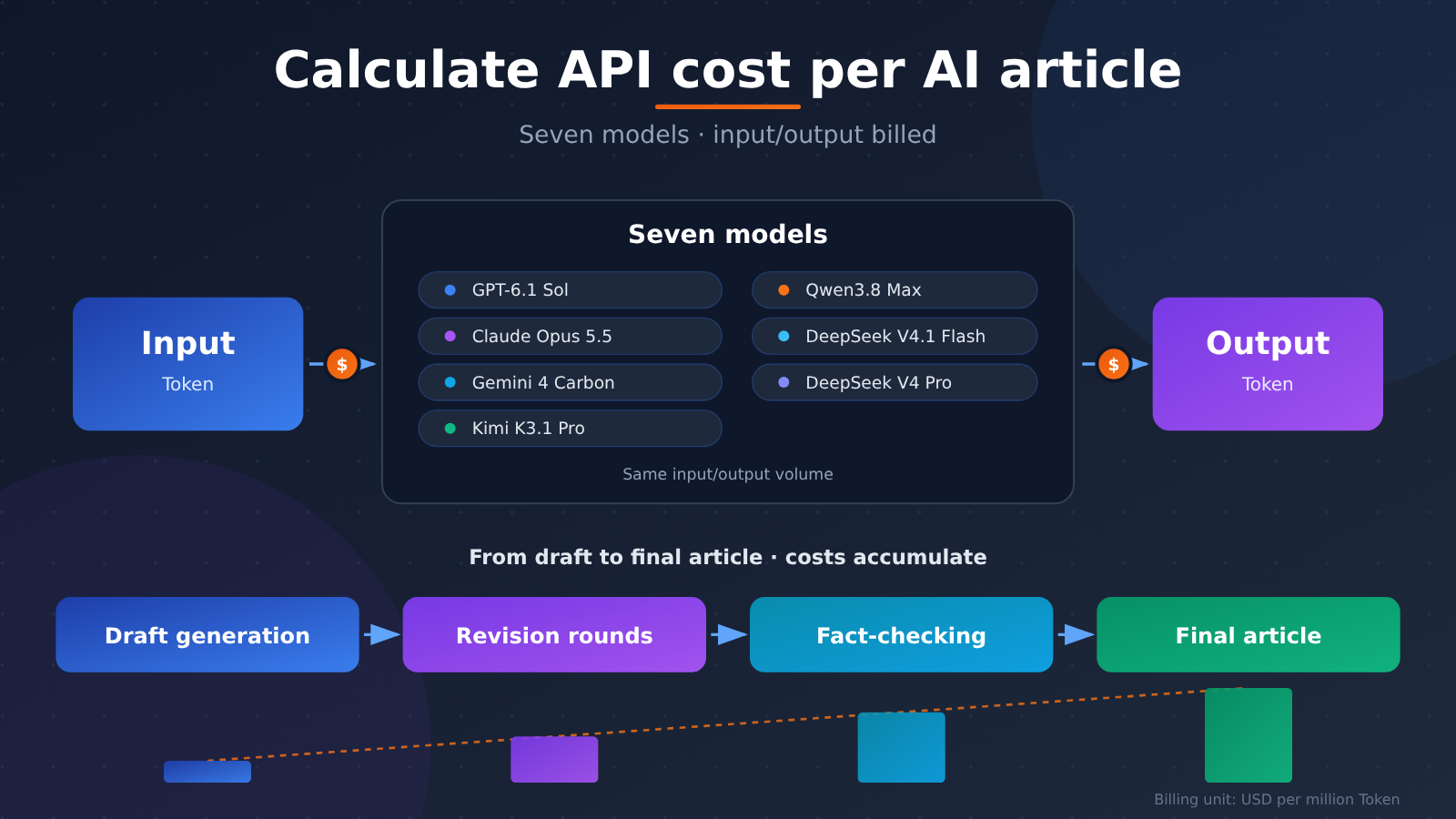
What’s Coming Up: A Roadmap for AI Article API Cost Accounting
- Understand input, output, and the billing formula.
- Compare seven models’ costs across three task scales.
- Separate platform list prices, official regional pricing, and time-based rules.
- Use call logs and editing time to pick a production setup.
Quick-start tip: You can test the same document bundle through the unified interface at APIYI apiyi.com. New users get free test credits; the exact amount and applicable rules depend on the platform’s current terms.
API Costs for AI Articles: First, Align on the Metering Basis
Token is the API unit for measuring text, and there’s no fixed conversion ratio between tokens and Chinese character counts. Source packs, prompts, article plans, and the chat history you submit all consume input tokens.
Input and output prices are usually shown as “USD per million tokens.” All simulations in this article use standard input and output unit prices, excluding caching, extended reasoning, batch discounts, and tool fees.
The formula is:
$$
C=\frac{T_{\text{input}}}{1{,}000{,}000}P_{\text{input}}
+\frac{T_{\text{output}}}{1{,}000{,}000}P_{\text{output}}
$$
Take GPT-6.1 Sol as an example, with 10,000 input tokens and 3,000 output tokens:
$$
C=0.01\times2+0.003\times10=0.05\text{ USD}
$$
That amount buys one generation. Whether the article can be published as-is depends on whether the facts, structure, and style meet the bar—the bill won’t sign off for the editor.
API Costs for AI Articles: Input and Output Price Comparison for 7 Models
The table below uses APIYI (apiyi.com)’s price snapshot at 10:45 (UTC+8) on November 12, 2026. Units are USD per million tokens, and the billing mode is pay-as-you-go token billing.
| Model | Input price | Output price | Output/input unit price ratio |
|---|---|---|---|
| GPT-6.1 Sol | 2.00 | 10.00 | 5x |
| Claude Opus 5.5 | 4.00 | 20.00 | 5x |
| Gemini 4 Carbon | 2.00 | 10.00 | 5x |
| Kimi K3.1 Pro | 2.00 | 10.00 | 5x |
| Qwen3.8 Max | 1.65 | 4.95 | 3x |
| DeepSeek V4.1 Flash | 0.30 | 1.20 | 4x |
| DeepSeek V4 Pro | 1.32 | 3.96 | 3x |
| Comparison item | Access notes |
|---|---|
| Available platforms | APIYI (apiyi.com); vendor official APIs; regions and billing rules must be checked separately |
Output tokens are usually more expensive, but when source packs are very long, input costs can also become a major expense. So when choosing a model, look at both price columns, not just the article length.
API Costs for AI Articles: What Are the Price Differences in Official Direct Access?
The following are official direct-access rules queried as of November 12, 2026, for checking channel differences; they are not substituted into the platform price table above.
| Model/channel | Official price or rule |
|---|---|
| GPT-6.1 Sol, Standard | Input 2, output 10 |
| Claude Opus 5.5, standard invocation | Input 4, output 20 |
| Gemini 4 Carbon, standard invocation | Introductory period through November 30: input 2, output 10; from December 1: input 4, output 20 |
| Qwen3.8 Max, Beijing / US Virginia Global | Input 1.65, output 4.951 |
| Qwen3.8 Max, Singapore International | Input 2, output 6 |
| Kimi K3.1 Pro, Alibaba Cloud Beijing / Singapore | 1.837/9.611 and 2/10, respectively |
| DeepSeek, two models | Peak prices match the values in the table above; off-peak is half |
Gemini’s price adjustment applies to Google official direct access; third-party channels should check their own announcements. Qwen’s platform output price of 4.95 and the official 4.951 in some regions should also be kept as separate figures.
DeepSeek’s official peak hours are 09:00–12:00 and 14:00–18:00 Beijing time on weekdays; other periods and weekends follow off-peak rules, and statutory holidays are calculated separately.
At official off-peak unit prices, Flash input is 0.15 and output is 0.60; Pro input is 0.66 and output is 1.98. The benefit of scheduling depends on whether the actual channel enforces this rule.
API Costs for AI Articles: How Do You Calculate Resource Scale and Three-Round Revisions?
Let’s compare two resource scales first. The figures below are theoretical simulations; output tokens represent the model’s metered length, not the number of Chinese characters.
| Model | 50K input + 5K output | 100K input + 10K output | Three-round total |
|---|---|---|---|
| GPT-6.1 Sol | 0.15000 | 0.30000 | 0.16200 |
| Claude Opus 5.5 | 0.30000 | 0.60000 | 0.32400 |
| Gemini 4 Carbon | 0.15000 | 0.30000 | 0.16200 |
| Kimi K3.1 Pro | 0.15000 | 0.30000 | 0.16200 |
| Qwen3.8 Max | 0.10725 | 0.21450 | 0.10395 |
| DeepSeek V4.1 Flash | 0.02100 | 0.04200 | 0.02160 |
| DeepSeek V4 Pro | 0.08580 | 0.17160 | 0.08316 |
Unit: USD. All three columns use the platform snapshot mentioned earlier and exclude caching and other fees.
Take a GPT task with 50K input and 5K output:
$$
C=0.05\times2+0.005\times10=0.15\text{ USD}
$$
Here, input costs USD 0.10 and output costs USD 0.05. For document-heavy tasks, organizing the input materials is often more worth prioritizing than compressing a few paragraphs of body text.
The “three-round total” uses the following independent invocation flow:
- First draft: input 10,000, output 3,000 tokens.
- Revision: resource pack plus first draft, input 13,000, output 3,000 tokens.
- Final draft: resource pack plus the previous version, input 13,000, output 3,000 tokens.
That’s 36,000 input tokens and 9,000 output tokens in total. For GPT, the cost is:
$$
C=0.036\times2+0.009\times10=0.162\text{ USD}
$$
That’s 3.24 times the cost of the first generation. This workflow keeps only the previous version; if every round carries the full history, input volume will keep increasing.
The chart below is useful for showing the cost gap for the same task. The data comes from the formula estimates above, not from a quality evaluation.
API Costs for AI Articles: Four Easily Overlooked Costs
API Costs and Thinking Tokens, Tool Calls
Thinking tokens are the reasoning content some models produce before generating a response. Google explicitly counts Gemini reasoning tokens as output costs, and Qwen Thinking mode’s extra reasoning also adds to the cost.
Tools like web search and page scraping may be billed separately. Track model tokens and tool requests separately—especially since a single writing request may trigger multiple searches.
API Costs and Caching, Batch API
Prompt caching reduces some input costs by reusing the same prefix. The hit volume, write cost, and expiration period determine how much you ultimately save.
Official GPT-6.1 Sol cached input is priced at 0.10; Claude Opus 5.5 cache reads are 0.20, with 5-minute and 1-hour cache writes at 5 and 8 respectively—all in USD per million tokens.
Batch API is for asynchronous batch processing. Claude’s official Batch offers a 50% discount on both input and output; Gemini’s official Batch pricing also changes with the standard price adjustment on December 1.
These rules must be verified against each access channel. For example, Alibaba Cloud’s Kimi K3.1 Pro doesn’t support Batch Inference; Qwen Beijing’s Batch File is 0.825 / 2.475, with a context limit of 256K.
The core approach is simple: for stable reference packs, evaluate caching first; for tasks that aren’t urgent to deliver, evaluate Batch; and always include cache writes in the total accounting.
API Costs for AI Articles: Tracking Actual Tokens with Code
The examples below use the OpenAI-compatible interface. The key is read from an environment variable so it doesn’t get hardcoded into the code; model availability and parameter support are subject to the current documentation.
Minimal invocation:
import os
from openai import OpenAI

client = OpenAI(
    api_key=os.environ["APIYI_API_KEY"],
    base_url="https://api.apiyi.com/v1",
)
response = client.chat.completions.create(
    model="gpt-6.1-sol",
    messages=[{"role": "user", "content": "解释输入和输出Token如何计费。"}],
)
print(response.choices[0].message.content)
A complete example for estimating standard token costs:
import os
from openai import OpenAI

client = OpenAI(
    api_key=os.environ["APIYI_API_KEY"],
    base_url="https://api.apiyi.com/v1",
)

response = client.chat.completions.create(
    model="gpt-6.1-sol",
    messages=[
        {"role": "system", "content": "仅依据提供的资料写作。"},
        {"role": "user", "content": "资料:输入输出分别计费。请写一段说明。"},
    ],
)

usage = response.usage
if usage is None:
    raise RuntimeError("响应未返回Token用量,请核对调用日志。")

input_tokens = usage.prompt_tokens
output_tokens = usage.completion_tokens
estimated_cost = (
    input_tokens * 2.0 + output_tokens * 10.0
) / 1_000_000

print(response.choices[0].message.content)
print(f"输入:{input_tokens},输出:{output_tokens}")
print(f"普通Token理论费用:${estimated_cost:.6f}")
This code estimates standard token costs. For cache details, reasoning metering, and tool fees, cross-check the provider’s usage fields against billing logs.
API Costs for AI Articles: Scenario Recommendations and Decision Tips
For budget-sensitive routine first drafts, start by testing Flash, Pro, and Qwen. For complex blogs and in-depth pieces, add GPT, Claude, and others to the candidate list, then use editing time to judge whether the higher per-unit price is actually worth it.
In the AI Writing Benchmark’s English leaderboard updated on November 11, 2026, GPT-6.1 Sol scores 95.3 overall and 98.5 in the article category — both benchmark-level results.
It supports including GPT in English blog tests. Chinese drafts still need separate validation: the financial long-form test from October 26 to November 3, 2026 covered only 26 articles, and with an unbalanced sample, it’s best treated as a lead for candidates rather than a verdict.
Standardize the source packet, target length, and tool permissions, run blind reviews with model names hidden, and record factual errors, revision rounds, editing minutes, and whether the piece was ultimately adopted.
For the final accounting, you can use:
$$
C_{\text{qualified article}}
=C_{\text{all API calls and related costs}}
+C_{\text{human editing}}
$$
Labor cost can be calculated as the hourly editing rate multiplied by actual time spent. If verification involves extra API calls or human effort, fold those into the corresponding line item too, so you don’t double-count.
API Cost for AI Articles FAQ: How Do You Compare 7 Models Fairly?
When switching models through APIYI apiyi.com, keep the source material, writing requirements, and tool permissions consistent. Generate multiple times and log usage — it’s easier to spot differences in stability and revision costs.
API Cost for AI Articles FAQ: Can Free Credits Replace Cost Accounting?
APIYI apiyi.com’s free test credits are great for validating the interface and writing style. For long-term budgeting, still calculate based on current unit prices and actual consumption, and list promotional credits as a separate item.
Conclusion: The API Cost of AI Articles Comes Down to Production Efficiency
Unit price tables are for screening, invocation logs are for accounting, and editing records are for decision-making. Compressing source material, reusing caches, and reducing rework can all be more effective than chasing the lowest output price.
We recommend validating candidate models through APIYI apiyi.com, then choosing the option that can reliably deliver qualified articles at a reasonable total cost—so editors can save their time for judgment.
References for AI Article API Costs
- APIYI model pricing and API documentation: help.apiyi.com. The platform price snapshot in this article is from November 12, 2026.
- Alibaba Cloud model pricing: alibabacloud.com/help/en/model-studio/model-pricing. Used to verify regional prices.
- Google Gemini official announcement: blog.google/innovation-and-ai/models-and-research/gemini-models/gemini-4-carbon-now-available/.
- AI Writing Benchmark: aiwritingbenchmark.com. This article uses the English leaderboard methodology as of November 11, 2026.
- Chinese in-depth long-form writing test: omnitools.ai/evals/longform-writing. See the main text for sample and task limitations.
Author: APIYI Technical Content Team. Feel free to connect with us at apiyi.com to share experiences with model invocation and article cost accounting.


