

Author’s note: Gemini 4 Hydrogen’s global standard price is $1.50 input and $7.50 output (per 1 million tokens), with no tiers within the 1-million-token window. This article explains the parts of the bill that are easy to miss and runs the numbers with two examples, comparing it against Terra, Sonnet 5.5, and Carbon.
Gemini 4 Hydrogen’s global standard price is $1.50 input, $7.50 output (per 1 million tokens), and $0.075 cache read. Google announced this model on its official blog on 2026-11-12 and stated that the entire 1-million-token window uses the same price, with no tiering by prompt length.
This price has been officially confirmed. Both the Google official blog and the Google Cloud price list show the figures above. This article is only about money: which charges on the bill are easiest to miss, how much short prompts and long prompts each cost, and how it compares with Terra, Sonnet 5.5, and Carbon.
Core value: Figure out Gemini 4 Hydrogen’s billing rules in 3 minutes and build a reliable budget based on your own usage volume.
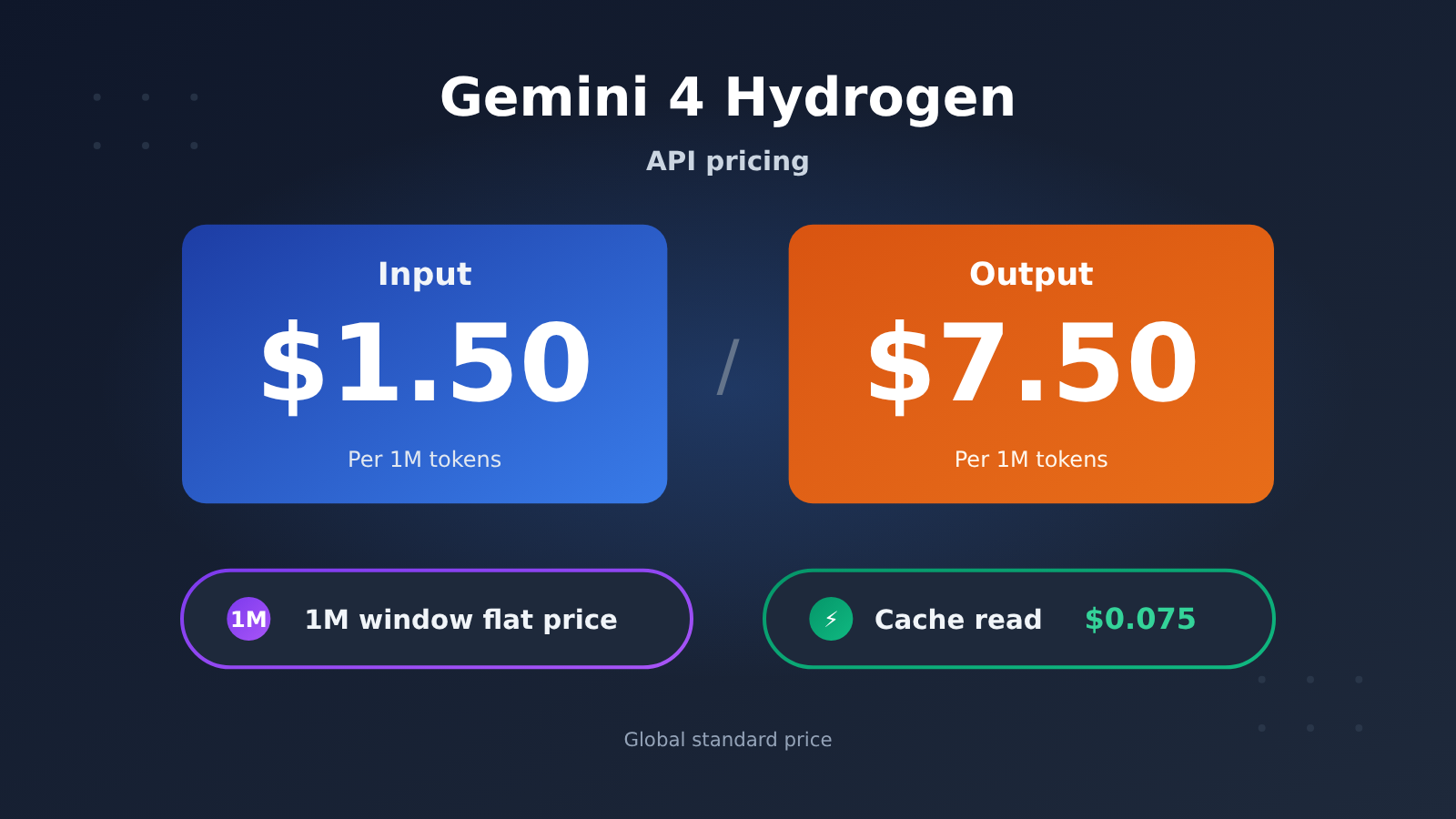
Gemini 4 Hydrogen Pricing: Key Facts at a Glance
A single sentence on capability: Hydrogen is a new model in the Gemini 4 family, with a 1-million-token context window and the high thinking level enabled by default. The rest of this article is about pricing only.
| Line item (USD / million tokens) | Global standard | Non-global | Notes |
|---|---|---|---|
| Input (text, image, video, audio) | $1.50 | $1.65 | Flat rate across the 1M window |
| Output (response + reasoning) | $7.50 | $8.25 | Thinking tokens count as output |
| Cache read | $0.075 | $0.0825 | 5% of the input price |
| Cache write | $1.875 | $2.0625 | Effective 2027-01-12 |
| Default thinking level | high | high | low / medium / xhigh also available |
Non-global pricing runs roughly 10% higher than the global standard across every line item. If your workload has to be deployed in a specific region, put $1.65 and $8.25 straight into your budget — don’t work it out at global rates first and then add the difference afterwards.
Gemini 4 Hydrogen output pricing includes reasoning tokens
Google Cloud’s price sheet describes the output rate as “response and reasoning,” meaning replies and reasoning are billed together. The model card shows the default thinking level is high, so with no configuration at all, every thinking token the model generates is billed at $7.50.
So the “10,000 output tokens” on your bill doesn’t mean 10,000 tokens of prose — part of it is the thinking process. When you budget, estimate output volume as “response + reasoning.” If the task is straightforward, try dropping to low or medium and watch how the output token count changes.
Gemini 4 Hydrogen cache write pricing isn’t in effect yet
The price sheet lists a cache write rate of $1.875 ($2.0625 non-global), but a footnote states that this price takes effect on 2027-01-12. As of this article’s publication date, 2026-11-13, there’s no need to include cache write fees in this month’s budget. Just re-run the numbers with this line item in mid-January 2027.
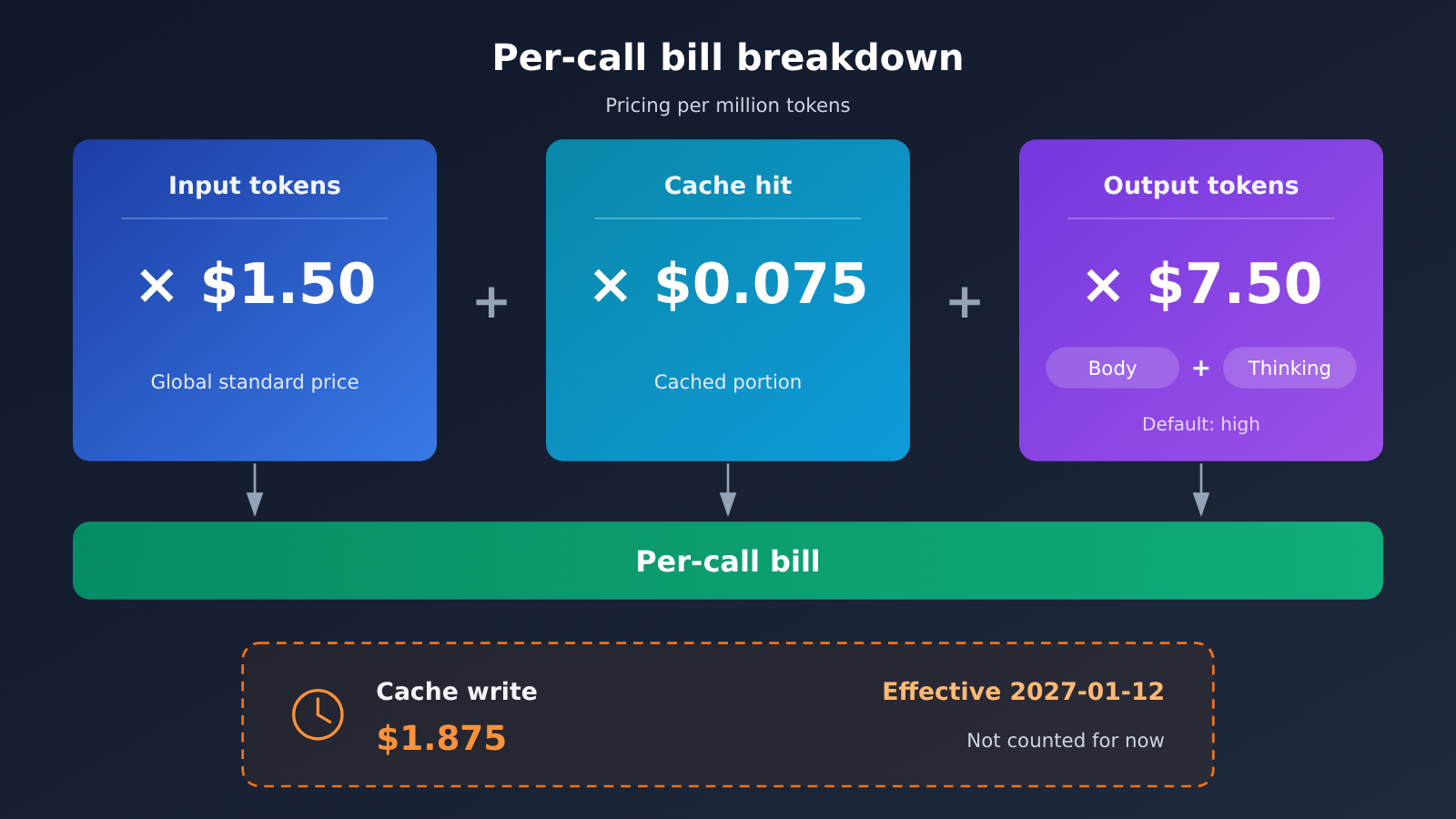
The Three Easiest Places to Miss Charges on a Gemini 4 Hydrogen Bill
A lot of budget errors don’t come from misreading the unit price — they come from misunderstanding how billing works. The table below lists the items people most often under- or over-count on Hydrogen.
| Common Mistake | Correct Understanding | Budget Impact |
|---|---|---|
| Output only counts the visible answer | Output includes thinking tokens, defaulting to high | Easy to undercount |
| Budgeting non-global deployment at global prices | Non-global is $1.65 / $8.25 | Undercounts by roughly 10% |
| Counting cache write fees today | Write pricing doesn’t take effect until 2027-01-12 | Overcounts for the current month |
| Assuming long prompts cost extra | A flat price for the 1M window | Overestimates the cost of long-document tasks |
| Applying another model’s cache threshold | The 4096-token threshold comes from Carbon’s docs | Can’t be applied directly to Hydrogen |
The last row deserves a special note. “Implicit caching minimum of 4096 tokens” is a rule from the Gemini 4 Carbon documentation. The reference material for this piece doesn’t specify Hydrogen’s cache threshold, so don’t blindly apply that number to Hydrogen.
How Much Does Gemini 4 Hydrogen Cost? Doing the Math on Short Prompts
The first example is a typical short task: 100K input tokens plus 10K output tokens, no caching. Each model is priced at the official rate or APIYI’s current listed price.
| Model | Unit Price (Input / Output) | Calculation | Cost per Request |
|---|---|---|---|
| Gemini 4 Hydrogen | $1.50 / $7.50 | 0.1×1.50 + 0.01×7.50 | $0.225 |
| GPT-6.1 Terra | $1 / $5 | 0.1×1 + 0.01×5 | $0.15 |
| Claude Sonnet 5.5 | $2 / $10 | 0.1×2 + 0.01×10 | $0.30 |
| Gemini 4 Carbon (today) | $2 / $10 | 0.1×2 + 0.01×10 | $0.30 |
| Gemini 4 Carbon (official price from December 1) | $4 / $20 | 0.1×4 + 0.01×20 | $0.60 |
For short-prompt scenarios, Terra has the lowest unit price, with Hydrogen in second place. Hydrogen is a quarter cheaper than today’s Sonnet 5.5 and Carbon. Once Carbon’s price rises to $4 / $20 on December 1, the same request will cost more than double what Hydrogen charges.
If you’re currently on Carbon and mostly run short requests, December 1 is a date worth evaluating ahead of time. At that point you can compare Hydrogen and Terra as your two candidates and pick based on the output quality for your own tasks.
How Much Does Gemini 4 Hydrogen Cost: Doing the Math for Million-Token Long Prompts
The second example is a long-document task: 1 million input tokens plus 100K output tokens, with no caching. Here, the billing rules of each model directly change the outcome.
| Model | Length rule | Formula | Cost per request |
|---|---|---|---|
| Gemini 4 Hydrogen | Flat rate within the 1M window | 1×1.50 + 0.1×7.50 | $2.25 |
| GPT-6.1 Terra | Whole-request surcharge once input exceeds 272K | 1×1×2 + 0.1×5×1.5 | $2.75 |
| Claude Sonnet 5.5 | The price sheet consulted here has no length tiers | 1×2 + 0.1×10 | $3.00 |
| Gemini 4 Carbon (promo price) | At list price | 1×2 + 0.1×10 | $3.00 |
| Gemini 4 Carbon (from December 1) | At list price | 1×4 + 0.1×20 | $6.00 |
Once we hit the long-prompt scenario, the rankings shift. Under OpenAI’s official rules, when Terra’s input exceeds 272K, the entire request’s input and cache are billed at 2× and output at 1.5×, so this request goes from being Hydrogen’s low-cost rival to costing $2.75. Hydrogen doesn’t add a surcharge inside the 1M window, making it the cheapest option at $2.25.
Sonnet 5.5’s $3.00 is calculated from the Anthropic price sheet consulted for this article, which has no length tiers. But we can’t conclude from that that Anthropic won’t add long-context fees down the road — double-check the official page before launch.
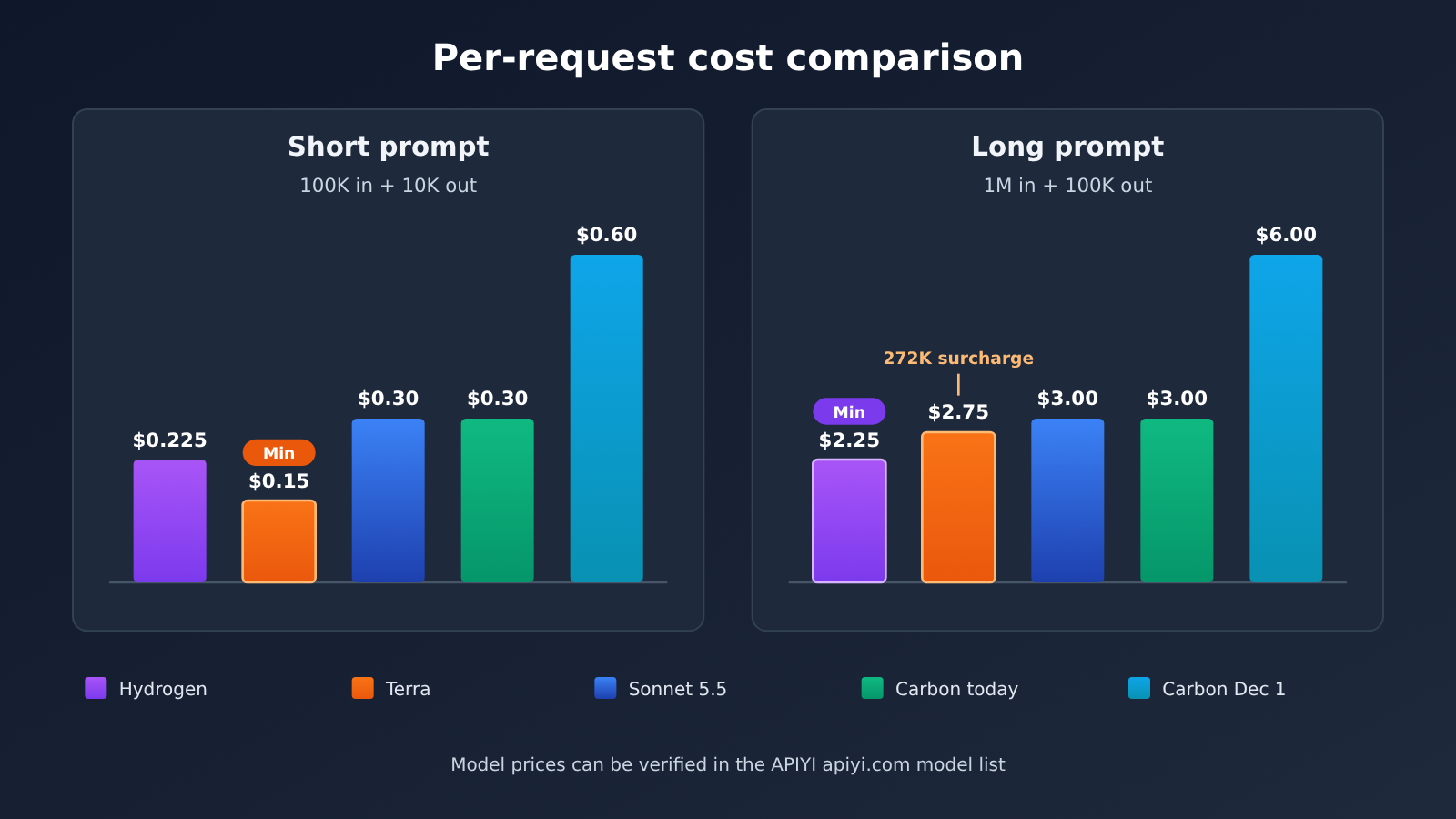
Comparison note: You can check the current prices of the comparison models above item by item in the model list on APIYI apiyi.com. Hydrogen’s price is based on Google’s official price sheet.
How Much Can Gemini 4 Hydrogen Cache Reads Save
The cache-read price is $0.075, just 5% of the input price. Using the same long prompt as above: assuming all 1M input tokens hit the cache, plus 100K output tokens ($0.75), the total comes to $0.825; the same request costs $2.25 without caching.
This example only illustrates the scale of the cache discount and shouldn’t be used as a budgeting baseline. The actual cache hit rate for a project depends on prompt structure and request intervals. Budget with the no-cache price as your ceiling and treat cache savings as a bonus.
Gemini 4 Hydrogen listing status on APIYI and comparison models
As of 2026-11-13, gemini-4-hydrogen isn’t in APIYI’s model catalog yet. It’s not listed yet, but we’ll get it up as soon as possible; model names and pricing are subject to the platform’s model catalog. If you need to call the three comparison models already listed in the table below with the same API key today, you can sign up at apiyi.com, check model names and pricing at docs.apiyi.com/models, and set the API base_url to https://api.apiyi.com/v1.
| Model name (APIYI) | Input | Output | Cache read | Notes | Available on |
|---|---|---|---|---|---|
| gemini-4-hydrogen | — | — | — | Not listed yet | Official |
| gemini-4-carbon | $2 | $10 | $0.1 | Will adjust to $4 / $20 following official pricing after Nov 30 | APIYI, Official |
| claude-sonnet-5-5 | $2 | $10 | $0.1 | Cache writes work out to roughly $2.50 after the multiplier | APIYI, Official |
| gpt-6.1-terra | $1 | $5 | $0.05 | The main table doesn’t list the 272K tier; the console is authoritative for extra-long requests | APIYI, Official |
APIYI’s Carbon documentation states that the $2 / $10 pricing lasts through 2026-11-30 and will adjust to $4 / $20 following official pricing starting December 1. Carbon supports both chat and Gemini native endpoints, with groups default and svip. Terra’s entry in the APIYI main table only lists base unit pricing and doesn’t separately note the 272K tier, so before handling extra-long requests, confirm the billing result in the console.
The integration works the same way as the OpenAI SDK. When you create the client, set base_url to https://api.apiyi.com/v1 and set model to gpt-6.1-terra, claude-sonnet-5-5, or gemini-4-carbon; you don’t need to change any other parameters. Once Hydrogen is listed, you’ll only need to change the model field to compare billing across all four models in the same codebase.
🚀 Quick start: We recommend first using APIYI apiyi.com’s free trial quota for new users to run both a short-prompt and a long-prompt sample, record the actual input and output tokens consumed, and then use the unit prices in this article to budget.
One more note: Terra’s 50% off for Batch and Flex, 2x for Fast mode, and 10% regional surcharge are all official OpenAI billing tiers, not APIYI billing tiers. The reference materials for this article didn’t provide Hydrogen’s Batch and Priority unit prices or free quota, so we won’t estimate them here.
Gemini 4 Hydrogen Pricing Impact Analysis
Impact on Developers
- Costs for long-document tasks are easier to predict: With a flat rate for the 1M context window, you no longer have to split inputs just to avoid thresholds like 272K.
- Output budgets need separate evaluation: The default thinking level is high, so reasoning-heavy tasks can produce noticeably more output tokens than the actual body length. Sample and measure first.
- Carbon users should mark December 1 on their calendars: Once Carbon’s price doubles, switching the same task to Hydrogen is cheaper for both short and long prompts.
- You can start using caching now: Currently only cache reads are billed; the write fee takes effect from 2027-01-12, so now is a good time to restructure your prompts.
Impact on Industry Pricing
- Length tiers have become a key condition for price comparisons: Comparing unit prices alone is no longer enough—you have to factor in request length to reach an accurate conclusion.
- Billing thinking tokens is becoming the norm: More and more models fold reasoning into the output price, and vendors are using tiers to let users control thinking depth.
FAQ
Q1: How much does Gemini 4 Hydrogen actually cost?
The global standard price is $1.50 for input, $7.50 for output, and $0.075 for cache reads (per 1M tokens). Non-global regions are $1.65, $8.25, and $0.0825. There are no length tiers within the 1M window.
Q2: Which is cheaper, Gemini 4 Hydrogen or Terra?
It depends on request length. At 100K input plus 10K output, Terra costs $0.15 and Hydrogen costs $0.225. At 1M input plus 100K output, Terra gets a whole-request surcharge for exceeding 272K, bringing it to $2.75, while Hydrogen is $2.25. If your request lengths vary a lot, it’s worth running Terra first on APIYI apiyi.com to get a real token distribution, then deciding which type of request dominates.
Q3: Do I need to pay for Gemini 4 Hydrogen cache writes right now?
Not currently. The cache write price of $1.875 (non-global $2.0625) listed in the price sheet takes effect from 2027-01-12; as of 2026-11-13, only cache reads are billed.
Q4: Why does Gemini 4 Hydrogen produce more output than expected?
The output price includes thinking tokens, and the default thinking level is high. You can switch to low or medium depending on task difficulty, then compare how the output token count changes.
Q5: Can I call Gemini 4 Hydrogen via API right now?
APIYI hasn’t listed Hydrogen yet—we’ll get it up as soon as possible. In the meantime, you can use the same key on APIYI apiyi.com to call gemini-4-carbon, claude-sonnet-5-5, and gpt-6.1-terra as comparisons; model names and prices are subject to the platform’s model list.
Gemini 4 Hydrogen Pricing: Key Takeaways
- Standard pricing: The global standard is $1.50 for input, $7.50 for output, and $0.075 for cache read, per million tokens.
- Non-global regions: $1.65 / $8.25 / $0.0825, about 10% more expensive.
- Output includes reasoning: Thinking defaults to high, so estimate your budget based on “response text + thinking.”
- No extra charge for length: Flat pricing for the 1M context window; long prompts are more cost-effective than Terra.
- Cache write billing starts later: The $1.875 charge begins on 2027-01-12, so you don’t need to include it in this month’s budget.
- Two examples: $0.225 for a short prompt, $2.25 for a long prompt.
- Getting started: Hydrogen isn’t available on APIYI yet, but you can use the same API key to call three comparison models first.
Summary
Key pricing takeaways for Gemini 4 Hydrogen:
- Unit prices: Input $1.50, output $7.50, cache read $0.075; non-global regions are about 10% higher.
- Easy-to-miss items: Output includes thinking tokens at the high setting, and the cache write fee won’t take effect until 2027-01-12.
- Price comparison conclusion: Terra is cheapest for short prompts, and Hydrogen is cheapest for long prompts. Carbon’s price doubles on December 1, so it’s worth re-evaluating then.
When you’re budgeting, start by measuring the distribution of request lengths, then calculate by segment using the method from the two examples in this article. That’s far more reliable than just comparing unit prices. We recommend using the comparison models on APIYI (apiyi.com) first to generate real token data; once Hydrogen is available, you can switch by changing the model field.
📚 References
- Google Official Blog: Introducing Gemini 4 Hydrogen — launch announcement and flat-rate pricing details
- Link:
blog.google/innovation-and-ai/models-and-research/gemini-models/introducing-gemini-4-hydrogen -
Notes: confirms the 1M context window has no tiered pricing — $1.50 input, $7.50 output
-
Google Cloud Vertex AI Pricing Page — line-item prices for global and non-global regions
- Link:
cloud.google.com/vertex-ai/generative-ai/pricing -
Notes: covers cache read/write, explains that output pricing includes reasoning, and lists the timing of Carbon’s price adjustment
-
Anthropic Claude Pricing Table — Sonnet 5.5 unit prices
- Link:
platform.claude.com/docs/en/about-claude/pricing -
Notes: input, output, cache write, and cache hit prices
-
OpenAI GPT-6.1 Terra Model Page — Terra unit price and the 272K tier
- Link:
developers.openai.com/api/docs/models/gpt-6.1-terra - Notes: long-context surcharge rules, plus official tiers such as Batch, Flex, and Fast
Author: APIYI Technical Team
Technical Discussion: Feel free to reach us through the APIYI homepage. For model versions and the latest pricing, check the docs.apiyi.com documentation center.


