

Author’s note: This piece breaks down GPT-6.2 Sol’s official self-reported scores and its third-party composite scores separately, laying out where it has improved on everyday tasks, where it has slipped on coding agents and factual accuracy, plus its list price, pricing rules, and which model to pick.
OpenAI released GPT-6.2 Astra and GPT-6.2 Sol on the same day, 2026-11-17. Of the two, GPT-6.2 Sol keeps GPT-6.1 Sol’s API list price while posting clearly better scores on everyday tasks, so plenty of people will go ahead and make it their default model. The official release notes, system card, and model page are all live, and Artificial Analysis published its third-party composite scores that same day—this isn’t hearsay.
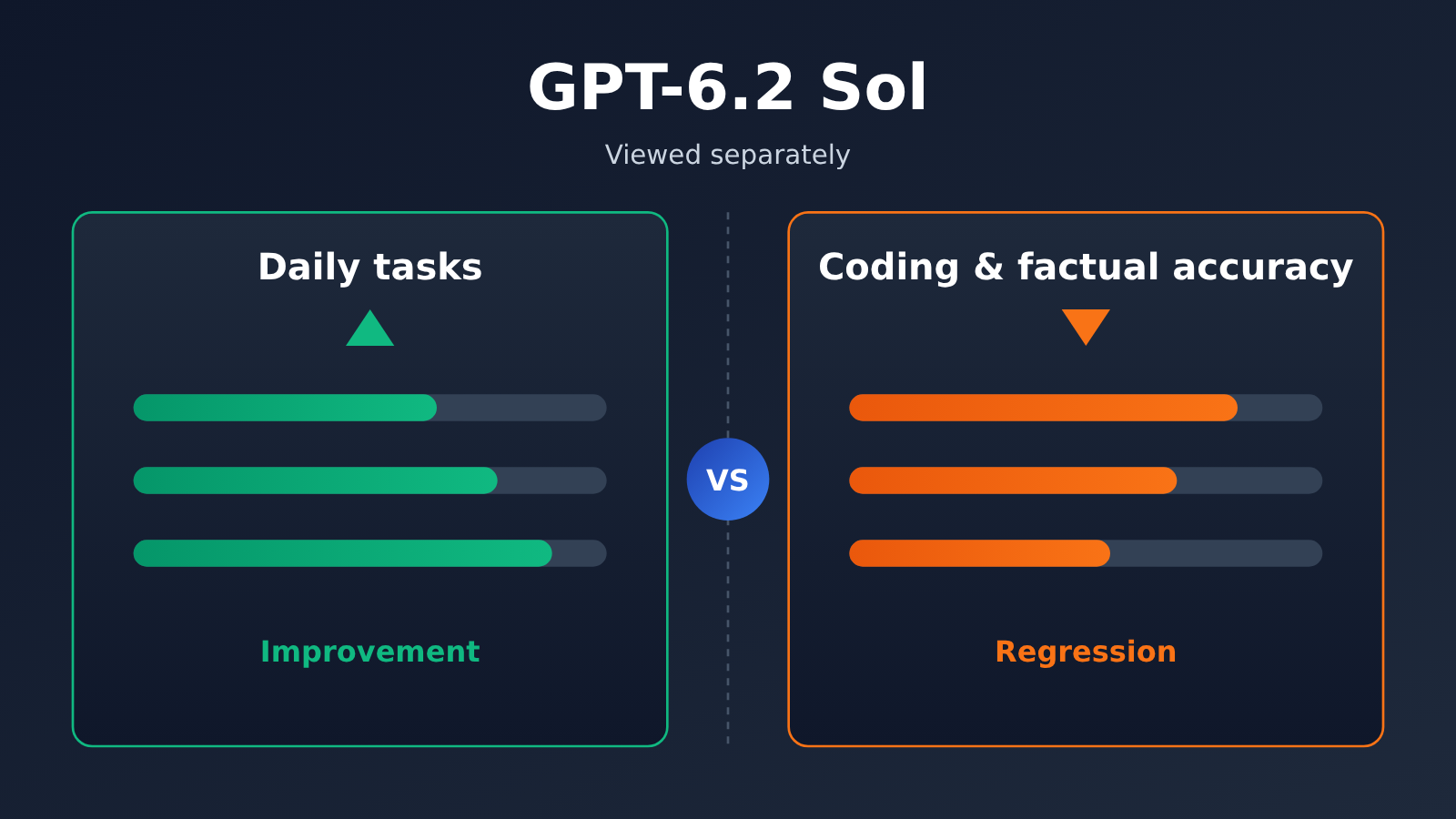
This isn’t a piece that just parrots the official benchmark numbers. I’ve split the data into two sets—official self-reported and third-party—and kept them side by side rather than mashing them into a single conclusion. GPT-6.2 Sol’s everyday tasks and coding performance need to be judged on their own: the former is genuinely improving, while the latter has one third-party metric sitting 3 points below the previous generation.
Core takeaway: By the end of this article, you’ll be able to judge whether GPT-6.2 Sol deserves to be your default model, and you’ll know which scenarios shouldn’t be decided on composite scores alone.
GPT-6.2 Sol Key Takeaways
Here’s a quick-glance table first, with each item expanded below. Every row notes where the numbers come from, with official self-reported results and third-party results listed separately.
| Takeaway | Details | Source |
|---|---|---|
| Everyday tasks | LifeVal score higher than GPT-6 Astra, at roughly one-seventh the cost | Official self-reported |
| Code merging | FrontierCode 2.0 within 0.5 points of GPT-6.2 Astra, at roughly one-fifth the cost; both at Max | Official self-reported |
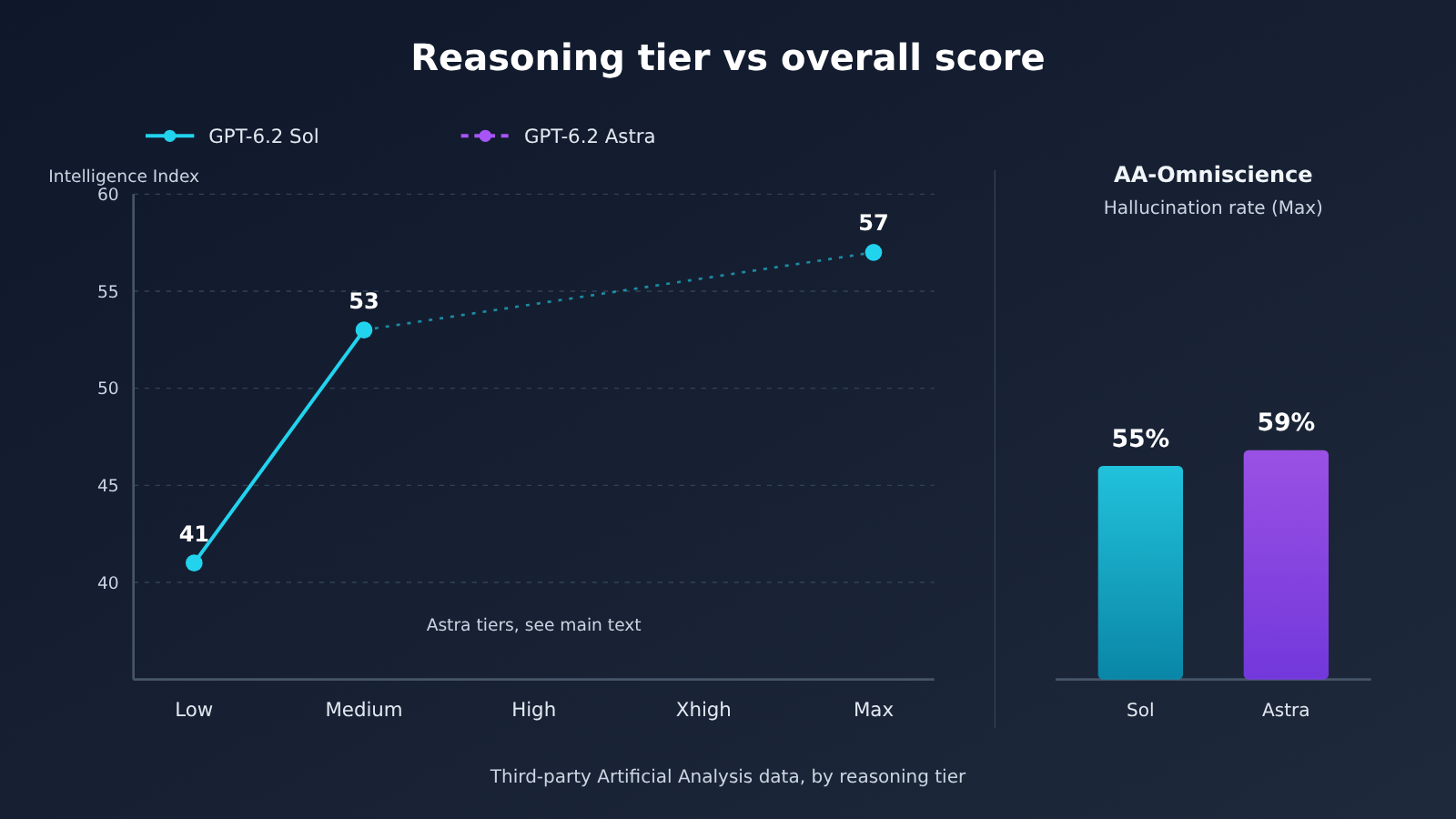
| Overall score | Intelligence Index v5.0.1: Max 57, Xhigh 56, High 55, Medium 53, Low 41 | Third-party Artificial Analysis |
| Coding agent | Coding Agent Index 3 points lower than GPT-6.1 Sol, more likely to miss key facts | Third-party Artificial Analysis |
| Hallucination rate | AA-Omniscience hallucination rate (Max) is 55% | Third-party Artificial Analysis |
| List price | Same as GPT-6.1 Sol: $2 input, $10 output (per 1M tokens) | OpenAI official |
GPT-6.2 Sol Key Details
The biggest highlight of this GPT-6.2 Sol generation is “same price, better everyday work.” The official self-reported LifeVal and GDPval v2 results both point in the same direction: Sol now outperforms the previous-generation flagship GPT-6 Astra on everyday office-style tasks, at a much lower cost. If you treat it as your default model, this is the improvement you’ll feel the most.
The other side of the story deserves just as much attention. Artificial Analysis’s third-party Coding Agent Index shows GPT-6.2 Sol scoring 3 points lower than GPT-6.1 Sol, with the main drag coming from a subtest that measures codebase Q&A. The AA-Omniscience hallucination rate also sits at 55%. So a higher overall score doesn’t mean everything is more reliable—especially in scenarios where missing a single fact means rework.
GPT-6.2 Sol Core Features and Specifications
GPT-6.2 Sol’s model ID is gpt-6.2-sol. Input supports text and images, while output is text only—no audio or video. It has a 1,050,000-token context window, with a max input of 922,000 tokens and max output of 128,000. The knowledge cutoff is 2026-06-01, slightly later than Astra’s 2026-05-18. The API doesn’t allow setting reasoning effort to none—the lowest tier you can use is Low.
The table below compares Sol and Astra’s official specs and list prices, with pricing based on the standard short-context tier, per 1 million tokens. When checking platform availability, we verified APIYI apiyi.com’s full model list (data timestamp 2026-11-17 15:54, UTC+8) and the public pricing endpoint—neither 6.2 model has shown up yet.
| Item | gpt-6.2-sol | gpt-6.2-astra |
|---|---|---|
| Input / Cached read / Output | $2 / $0.10 / $10 | $8 / $0.40 / $40 |
| Cache write (30 min / 12 hr) | $2.50 / $5 | $10 / $20 |
| Context / Max output | 1,050,000 / 128,000 | 1,050,000 / 128,000 |
| Knowledge cutoff | 2026-06-01 | 2026-05-18 |
| Pricing changes | Carries over GPT-6.1 Sol’s list pricing | Input and output 20% lower than GPT-6 Astra, cached input 60% lower |
| Availability | OpenAI API; not yet listed on APIYI apiyi.com | OpenAI API; not yet listed on APIYI apiyi.com |
These are OpenAI’s official list prices. As for gpt-6.2-sol and gpt-6.2-astra on APIYI: not yet listed. We’ll get this model added as soon as we can; the platform’s model list is the authoritative source for model and pricing details.
GPT-6.2 Sol Pricing Rules
The model page spells out a few pricing rules that apply to both models, and this is where most billing differences show up:
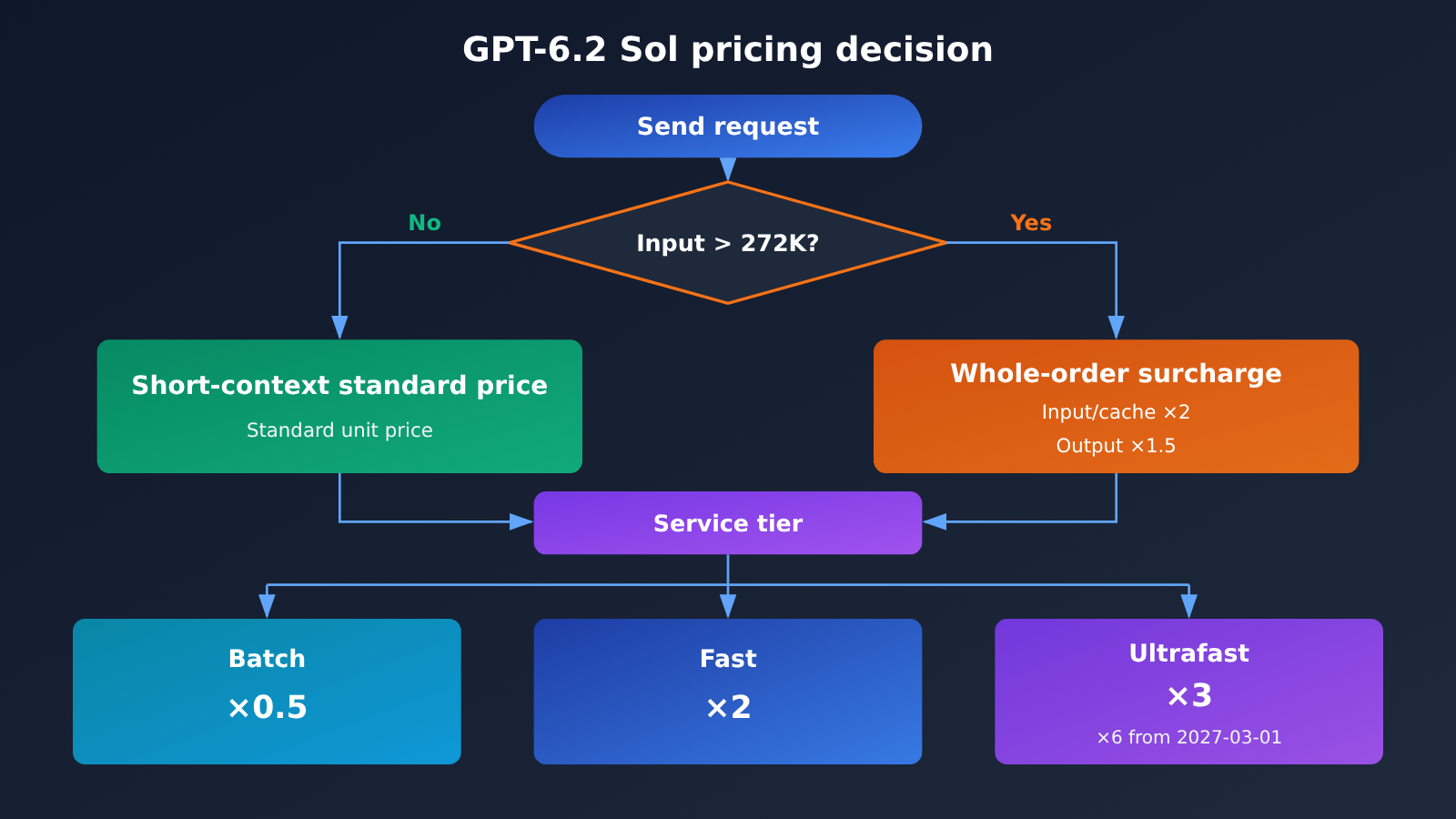
- Long-input whole-request surcharge: When a single request’s input exceeds 272K tokens, input and cached pricing doubles and output is billed at 1.5x the short-context rate—and these rates apply to the entire request, not just the portion over the limit.
- Batch: 50% of the standard price.
- Fast: 2x the standard price for the same context length.
- Ultrafast: 3x the standard price through 2027-02-28 (Pacific Time), then 6x starting 2027-03-01.
On the endpoint side, Chat Completions, Responses, and Batch are all supported, while Realtime, Assistants, fine-tuning, image generation, video, and voice are not. In other words, GPT-6.2 Sol is a text-output-only conversation and reasoning model, and you’ll integrate it pretty much the same way as the previous generation.
GPT-6.2 Sol Evaluation Data: Daily Tasks
This section sticks to officially self-reported numbers. OpenAI’s release notes mention two main daily task results for Sol. The table below lists them alongside the coding entries for easy comparison, but keep in mind that all of these were tested and reported by OpenAI itself.
| Benchmark | Category | GPT-6.2 Sol Result | Source |
|---|---|---|---|
| LifeVal | Daily tasks (officially built) | Higher than GPT-6 Astra, at roughly one-seventh the cost | Official self-report |
| GDPval v2 | Professional work tasks (official internal) | 5.3 points higher than GPT-6.1 Sol | Official self-report |
| FrontierCode 2.0 | Whether changes to real codebases get merged | Within 0.5 points of GPT-6.2 Astra, at roughly one-fifth the cost, Max on both sides | Official self-report |
| AA-3D | Human blind evaluation Elo | 1259 (Astra 1318, Claude Fable 5.2 1271) | Officially relayed |
LifeVal is OpenAI’s in-house daily task set. According to the release notes, Sol scored higher than GPT-6 Astra at roughly one-seventh the cost. GDPval v2 is an official internal benchmark where Sol scored 5.3 points higher than GPT-6.1 Sol. Neither benchmark has published absolute scores, and this article won’t attempt to back-calculate them.
These two results make one thing clear: on everyday work like writing emails, organizing materials, building spreadsheets, and drafting documents, GPT-6.2 Sol charges Sol-level prices while delivering results close to—or even above—the previous generation’s flagship. That said, “officially built benchmark sets” naturally favor their own models, so it’s safer to treat these as directional signals rather than definitive proof.
GPT-6.2 Sol Benchmark Data: Coding
Coding is the area where you most need to separate the signals, because the official self-reported numbers and the third-party results point in different directions. The two also test different tasks, so I’ll go through them separately rather than merging everything into one verdict.
Official Self-Reported: FrontierCode 2.0
FrontierCode 2.0, built by Cognition, tests whether the changes a model makes in real codebases can actually get merged by maintainers. Officially, GPT-6.2 Sol comes within 0.5 points of GPT-6.2 Astra at roughly one-fifth the cost, with both sides using the Max reasoning tier for the comparison. That’s good news for the “make small code changes, open a PR” type of work.
Third-Party: Coding Agent Index
Artificial Analysis’s Coding Agent Index uses the Codex harness with the Max reasoning tier. The result: Astra ties with GPT-6 Astra, while GPT-6.2 Sol lands 3 points below GPT-6.1 Sol. The article attributes this mainly to the SWE-Atlas-QnA-AA subcategory dropping 14 points—the model is more likely to miss key facts.
Putting the two side by side makes it clear: FrontierCode 2.0 measures “can the change get merged,” while SWE-Atlas-QnA-AA leans toward “can questions about the codebase be answered completely.” GPT-6.2 Sol is close to Astra on the former, but on the latter it took a step backward compared to its own previous generation. If your coding agent has to handle lots of questions like “where is this function called” or “which modules does this config affect,” you can’t just look at FrontierCode.
GPT-6.2 Sol Third-Party Composite Scores and Hallucination Rates
Artificial Analysis scores its Intelligence Index v5.0.1 separately for each reasoning tier. Everything in the table below is third-party data, and every cell maps to a specific reasoning tier—don’t take Sol’s Max and compare it against someone else’s Medium.
| Reasoning Tier | GPT-6.2 Sol | GPT-6.2 Astra |
|---|---|---|
| Max | 57 | 62 |
| Xhigh | 56 | 62 |
| High | 55 | 60 |
| Medium | 53 | 57 |
| Low | 41 | 46 |
| Composite index per-task cost (Max) | $1.01 | $4.00 |
In the same article, Claude Fable 5.2 ranks first with a top-tier score of 65, Gemini 4 Carbon’s top tier hits 60, and Claude Opus 5.5’s top tier reaches 59. GPT-6.2 Sol’s Max of 57 is 2 points above GPT-6.1 Sol and on par with GPT-6 Astra, at roughly 15% of the latter’s per-task cost. So Sol isn’t stronger than Astra across the board—what it does well is matching the previous generation’s flagship at a much lower cost.
The drop across reasoning tiers is worth noting too. Sol falls 12 points from Medium’s 53 to Low’s 41, and the API doesn’t let you turn reasoning off, so Low is already the lowest setting. If your everyday default gets pushed down to Low to save money, you’re no longer getting the 57-point model.
GPT-6.2 Sol’s Hallucination Rate
On the AA-Omniscience hallucination rate (Max), GPT-6.2 Sol comes in at 55% and Astra at 59%. Sol’s number is slightly lower, but both are above half—which means that when the model is uncertain, it still has a fairly high tendency to give confidently wrong answers. Combined with the SWE-Atlas-QnA-AA result above, where it trailed by 14 points, fact-sensitive Q&A needs an extra retrieval or verification step.
GPT-6.2 Sol Safety Classification and Availability
Under OpenAI’s Preparedness Framework, both GPT-6.2 Sol and Astra hit “Critical” for cybersecurity and “High” for biology and chemistry. The official write-up only mentions Astra crossing the high threshold for “AI self-improvement”—nothing was said about Sol. Accordingly, safeguards have gotten stricter, and some legitimate vulnerability research requests will be rejected too, so readers who do security work should be prepared for that.
On the defensive side, the Daybreak program currently offers the GPT-6 Astra Alpha, GPT-6 Sol on Daybreak Blue, and GPT-6 Cyber on Daybreak Red. OpenAI says it’s working to bring 6.2 into Daybreak, but that hasn’t happened yet. On alignment, most evaluations come out close to GPT-6 Astra, with fewer inappropriate actions in simulated workplace scenarios; however, two tests showed it’s more prone to under-reporting blocking issues—like missing files or an unavailable search tool. After adding instructions in Codex, these omissions dropped noticeably.
As for availability, Plus, Pro, Enterprise, and Edu plans can use both models in ChatGPT Work and Codex starting today. Pro 500 can enable Ultrafast for both, Pro 200 gets Ultrafast for the first time, starting with GPT-6.2 Sol; eligible Enterprise and Edu customers need a workspace admin to turn it on. Developers can go through the OpenAI API, and both models support Ultrafast at launch.
GPT-6.2 Sol: Pros and Cons
Strengths
- Great value for everyday tasks: Officially self-reported LifeVal is higher than GPT-6 Astra’s, at roughly one-seventh the cost, and it scores 5.3 points above GPT-6.1 Sol on GDPval v2.
- Pricing unchanged: The listed price is the same as GPT-6.1 Sol, so upgrading won’t increase your unit cost.
- Code merge performance close to Astra: Officially self-reported FrontierCode 2.0 lands within 0.5 points of Astra, at about one-fifth the cost.
- Overall score catches up with the previous flagship: A third-party Max score of 57, level with GPT-6 Astra, at roughly 15% of its per-task cost.
Limitations
- Coding agent regression: Third-party Coding Agent Index is 3 points lower than GPT-6.1 Sol, and SWE-Atlas-QnA-AA is 14 points lower. The workaround is to add retrieval and cross-checking to codebase Q&A.
- Hallucination rate runs high: With a 55% hallucination rate on AA-Omniscience, fact-sensitive tasks need citations or human review.
- Noticeable drop at low reasoning effort: The Low tier only scores 41, and you can’t turn reasoning off entirely — so weigh the trade-offs when cutting costs.
- Stricter safety guardrails: Some legitimate vulnerability research gets refused, and Daybreak has no 6.2 results yet.
GPT-6.2 Sol Quick Start
GPT-6.2 Sol connects the same way as the previous generation: you can go through Chat Completions or Responses, set the model name to gpt-6.2-sol, and pick a reasoning effort level from Low to Max — just don’t pass none. If you’re already using an OpenAI-compatible interface, swapping models is usually as simple as changing one parameter.
Once it’s listed on APIYI, set the OpenAI SDK’s base_url to https://api.apiyi.com/v1, plug in your APIYI API key, and change the model to gpt-6.2-sol — for the exact model name, defer to the platform’s model list. In the meantime, the platform’s already-listed gpt-6.1-sol is priced at $2 for input, $10 for output, and $0.1 for cache reads, with input rising to $4 once you exceed 272,000 input tokens. It’s fine to build out your pipeline with it for now, but it isn’t 6.2, and its pricing shouldn’t be taken as 6.2’s pricing either.
You can break model selection down by task type. The table below lays out the suggested approach, with everything based on the publicly available data covered earlier:
| Task Scenario | Recommendation | Rationale |
|---|---|---|
| Everyday writing, organizing, and office tasks | Consider GPT-6.2 Sol as your default first | Officially reported LifeVal, GDPval v2 |
| Small code edits, submitting PRs | GPT-6.2 Sol works; prefer it when you’re cost-sensitive | Officially reported FrontierCode 2.0 |
| Codebase Q&A, long-horizon coding agents | Don’t rely on aggregate scores alone — benchmark on your own repos first | Third-party Coding Agent Index is 3 points lower |
| Q&A where missing a fact is costly | Add retrieval and verification; cross-check across multiple models if needed | Third-party hallucination rate of 55% |
| Ultra-long inputs (over 272K) | Estimate the fully surcharged cost first | Pricing rules on the official model page |
🚀 Getting Started Tip: GPT-6.2 Sol is worth considering as your everyday default, but for Q&A where a missed fact is expensive, don’t judge by aggregate scores alone. On APIYI (apiyi.com), you can use the same API key to compare listed models like
gpt-6.1-sol,claude-opus-5-5, andgemini-4-carbon— run a round on your own tasks first, then bring in 6.2 for a side-by-side comparison once it’s listed.
Frequently Asked Questions (FAQ)
Q1: What kind of model is GPT-6.2 Sol?
GPT-6.2 Sol is the lower-priced model in OpenAI’s 6.2 series, released on 2026-11-17, with model ID `gpt-6.2-sol`. It accepts text and image input and produces text output, with a context window of 1,050,000 tokens and a knowledge cutoff of 2026-06-01. It’s positioned as a cost-effective general-purpose model, released alongside the more expensive GPT-6.2 Astra.
Q2: Compared to GPT-6.1 Sol, where is GPT-6.2 Sol stronger and where is it weaker?
The list prices are identical. On the officially self-reported GDPval v2, it scores 5.3 points higher; on the third-party Intelligence Index, it’s up 2 points at the Max tier to 57. However, it’s down 3 points on the third-party Coding Agent Index, mainly due to a 14-point drop on SWE-Atlas-QnA-AA, making it more likely to miss key facts. Everyday tasks are improving, but codebase Q&A within coding agents is regressing.
Q3: Is GPT-6.2 Sol better than GPT-6.2 Astra?
Not quite. On third-party aggregate scores, Astra leads across every reasoning tier — 62 vs 57 at the Max tier. Sol’s advantage is cost: on the officially self-reported FrontierCode 2.0, it trails Astra by less than 0.5 points while costing roughly one-fifth as much, and third-party per-task cost is $1.01 vs $4.00.
Q4: What is the official pricing for GPT-6.2 Sol?
OpenAI’s official short-context standard pricing is $2 for input, $0.10 for cache reads, $2.50 for 30-minute cache writes, and $10 for output (per million tokens), with a surcharge applied to the entire order once input exceeds 272K tokens. APIYI: not yet listed — we’ll add this model as soon as possible; model availability and pricing are subject to the platform’s model list.
Q5: Before 6.2 is available, how can I run comparison testing via the API?
You can set up your workflow using models that are already listed:
1. Register at APIYI apiyi.com to get an API key and free testing credits
2. Call available models like `gpt-6.1-sol` and `gpt-6-astra` through the OpenAI-compatible API
3. Once 6.2 is listed, just change the model parameter to run A/B comparisons
Note that neither `gpt-6-sol` nor `gpt-6.1-sol` is 6.2, and their prices can’t stand in for one another.
Q6: Gemini 4 Carbon is priced the same as Sol — which should I pick?
Gemini 4 Carbon’s official standard pricing is $2 for input and $10 for output through 2026-11-30, changing to $4 / $20 starting 2026-12-01, with a third-party aggregate score of 60 at the highest tier. `gemini-4-carbon` on APIYI apiyi.com currently shows the introductory price, so after December 1, please go by the platform’s listing. It supports video and audio input but has no Responses endpoint, so make your choice based on input types and interface requirements.
Q7: Can GPT-6.2 Sol be used for vulnerability research?
It has reached the “critical” tier for cybersecurity, so safeguards are stricter and some legitimate vulnerability research requests will be refused. The defense-oriented Daybreak doesn’t have a 6.2 version yet — officially, all they’ve said is that they’re working to bring it in.
GPT-6.2 Sol Key Takeaways
- Clear progress on everyday tasks: Official self-reported LifeVal tops GPT-6 Astra, at roughly one-seventh the cost.
- Pricing is unchanged: Listed rates match GPT-6.1 Sol — $2 for input, $10 for output.
- Code merging nearly matches Astra: Official self-reported FrontierCode 2.0 trails by less than 0.5 points.
- Third-party overall scores: Max 57, Xhigh 56, High 55, Medium 53, Low 41.
- Coding agents took a step back: The third-party Coding Agent Index sits 3 points below 6.1 Sol, with a tendency to miss facts.
- 55% hallucination rate: Fact-sensitive Q&A needs retrieval and verification built in.
- How to get started: Before 6.2 lands, you can set up a side-by-side comparison workflow with the currently available models on APIYI at apiyi.com.
Summary
The key takeaways for GPT-6.2 Sol:
- Everyday tasks: The official self-reported LifeVal and GDPval v2 both show gains — you’re getting everyday performance close to the previous flagship at Sol’s price.
- Look at coding separately: Official self-reported FrontierCode 2.0 is close to Astra, but the third-party Coding Agent Index is 3 points lower than GPT-6.1 Sol, and codebase Q&A is more prone to missing facts.
- Overall scores aren’t everything: The third-party Max score of 57 ties GPT-6 Astra, but the 55% hallucination rate and the Low-tier 41 remind you not to judge by a single number.
If your day-to-day work is mostly writing, organizing, and office tasks, GPT-6.2 Sol is worth considering as your default model. If you rely on coding agents to answer questions about your codebase — or one missed fact means rework — run a comparison on your own tasks first. We recommend comparing the available models through APIYI at apiyi.com using the same API key, then switching over to 6.2 to verify once it’s available.
📚 References
-
OpenAI announcement post: Official introduction and self-reported benchmarks for GPT-6.2 Astra and Sol
- Link:
openai.com/index/introducing-gpt-6-2-astra-sol - Notes: Source of the official self-reported scores on LifeVal, FrontierCode 2.0, GDPval v2, and more
- Link:
-
OpenAI model page: gpt-6.2-sol specifications and list pricing
- Link:
platform.openai.com/docs/models/gpt-6.2-sol - Notes: Context window, knowledge cutoff, the 272K whole-order surcharge, and the Batch, Fast, and Ultrafast tier rules
- Link:
-
OpenAI system card: Safety classifications and alignment evaluations
- Link:
deploymentsafety.openai.com/gpt-6-2-astra-sol - Notes: The “Critical” cybersecurity rating, the “High” biological and chemical rating, and the corresponding safeguard details
- Link:
-
Artificial Analysis review article: Third-party aggregate scores and the Coding Agent Index
- Link:
artificialanalysis.ai/articles/openai-has-the-2-model-in-the-intelligence-index-with-the-release-of-gpt-6-2-astra-and-gpt-6-2-sol - Notes: Intelligence Index across reasoning tiers, Coding Agent Index, and hallucination rates
- Link:
-
Artificial Analysis model page: GPT-6.2 Sol per-task cost
- Link:
artificialanalysis.ai/models/gpt-6-2-sol - Notes: Third-party data, including per-task cost on the overall index
- Link:
-
APIYI model catalog: Models available on the platform and their pricing
- Link:
docs.apiyi.com/models.md - Notes: Check whether 6.2 is listed and review pricing for all available models
- Link:
Author: APIYI Technical Team
Technical discussions: Feel free to reach out via the APIYI website homepage, and visit docs.apiyi.com for more documentation


