

Author’s note: Using two cost calculations — one for short prompts, one for long prompts — this explains when Gemini 4 Hydrogen and GPT-6.1 Terra are actually cheaper, and how modality, tool calls, and knowledge cutoff affect which one you pick.
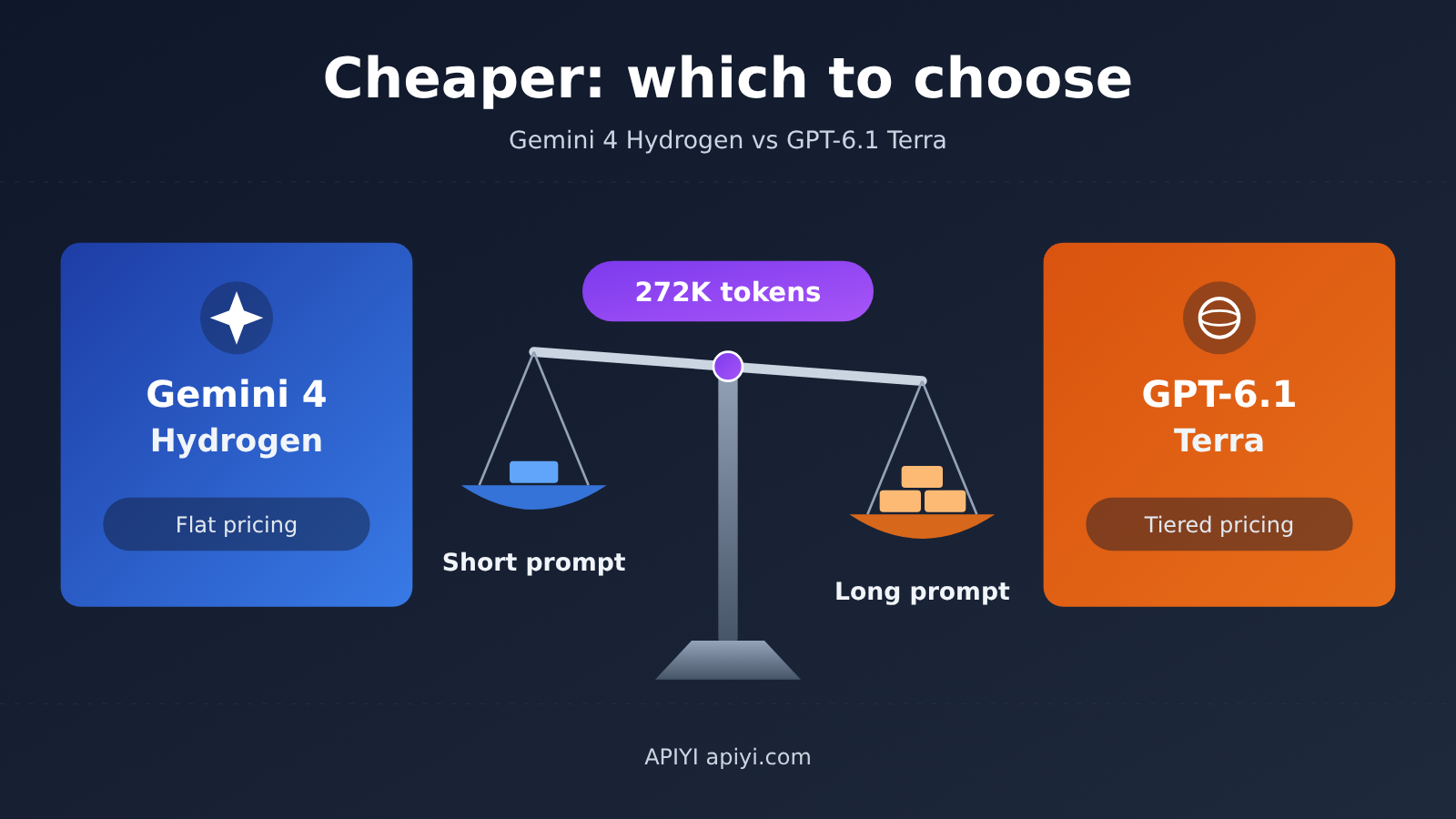
For a “fast and cheap” model, the two most recent candidates are Gemini 4 Hydrogen and GPT-6.1 Terra. Gemini 4 Hydrogen launched on 2026-11-12, and GPT-6.1 Terra’s official model page already lists full specs as of 2026-11-13. Looking at list prices alone, GPT-6.1 Terra has the lower per-million-token rate — but that conclusion only holds for a subset of requests.
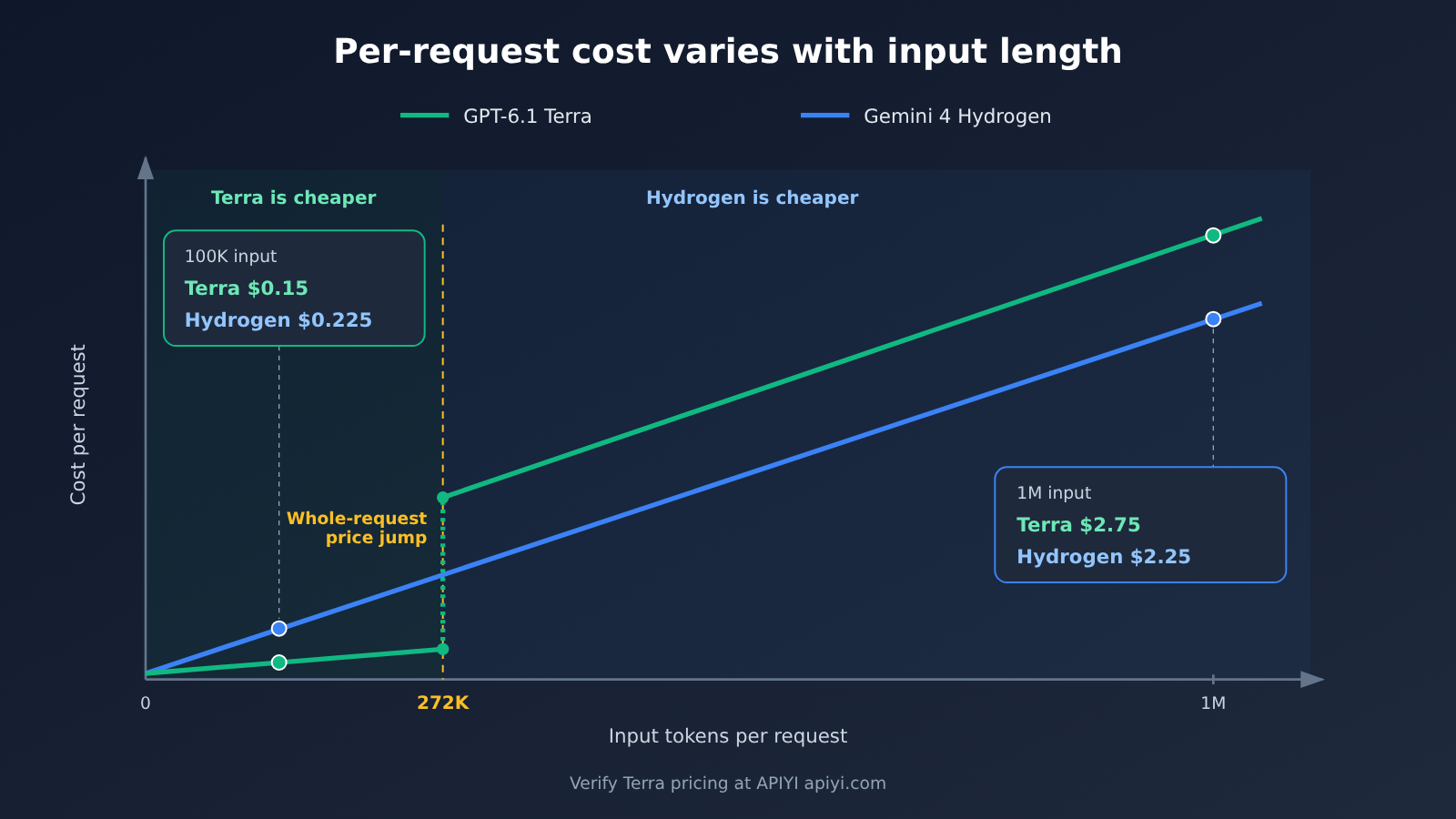
This isn’t a “read the unit price and call it done” comparison. Once GPT-6.1 Terra’s input goes past 272K tokens, the entire request gets repriced, and the math flips for long-prompt workloads. This article runs two cost calculations using official pricing, then layers in modality, tool calls, knowledge cutoff, and official benchmark scores to tell you which kind of work belongs with which model. GPT-6.1 Terra is now available on APIYI (apiyi.com), so you can call it directly with the same API key.
Key takeaway: after reading this, you’ll be able to judge which of Gemini 4 Hydrogen and GPT-6.1 Terra is genuinely cheaper based on the length and input type of your requests.
Gemini 4 Hydrogen vs GPT-6.1 Terra: Core Differences
Let’s put the raw specs for both models side by side first. The table below draws on Google’s launch blog and model card, plus OpenAI’s official GPT-6.1 Terra model page.
| Dimension | Gemini 4 Hydrogen | GPT-6.1 Terra | Key difference |
|---|---|---|---|
| Model ID | gemini-4-hydrogen |
gpt-6.1-terra |
Use the full model name in calls |
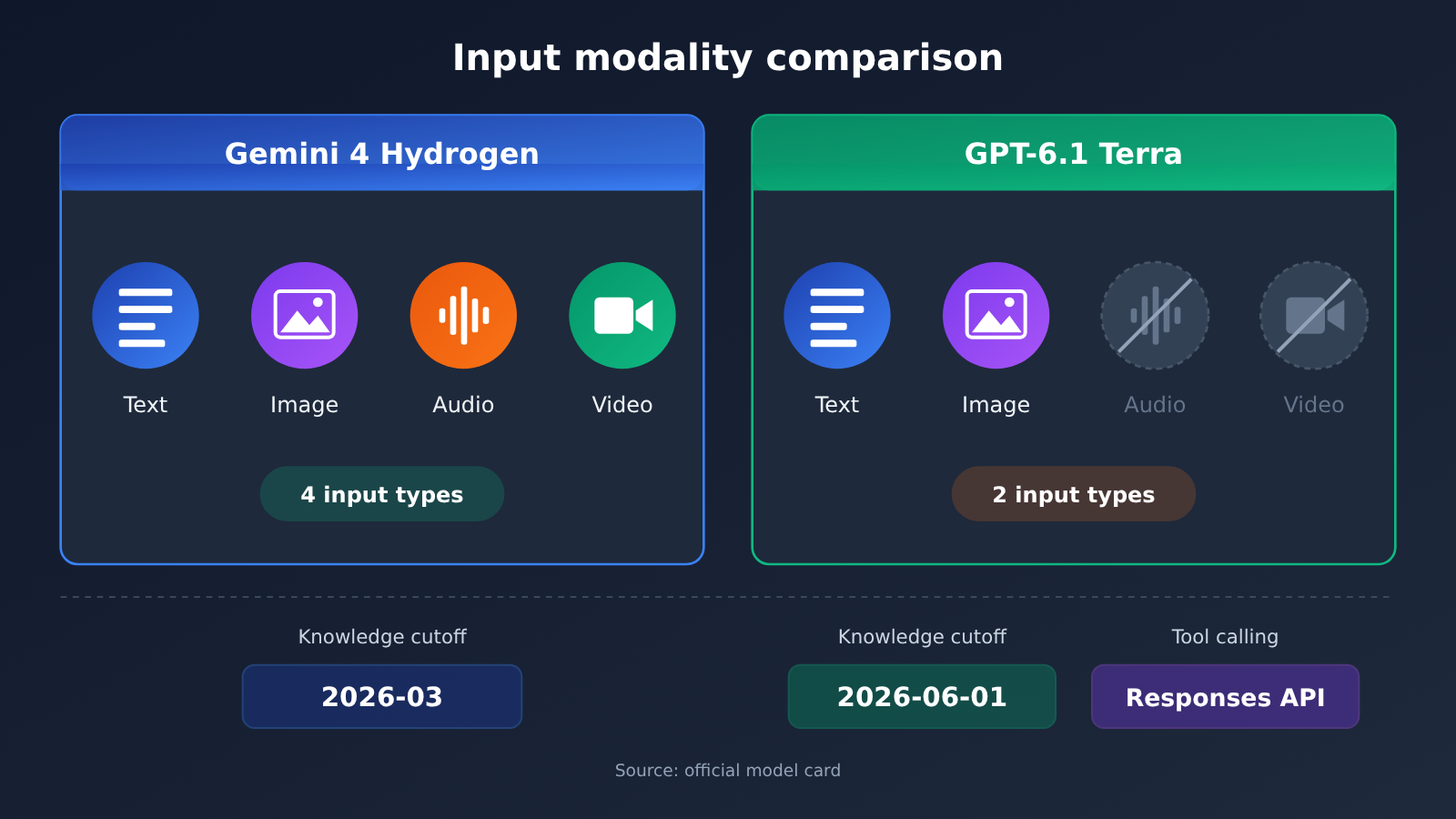
| Input modalities | Text, image, audio, video | Text and image only | Terra doesn’t support audio or video |
| Output | Text | Text | Same |
| Context window | Up to 1M total (model card) | 1,050,000; max input 922,000 | Similar scale |
| Max output | 64K default synchronous; up to 1M for long background output | 128,000 | Different definitions |
| Knowledge cutoff | 2026-03 | 2026-06-01 | Terra is newer |
| Reasoning levels | low / medium / high (default) / xhigh | none / low / medium (default) / high / xhigh / max | Different default level |
| Pricing | Flat global standard price | Surcharge on the whole request when input exceeds 272K | Long prompts are the dividing line |
When it comes to the context window, the two official Gemini 4 Hydrogen documents don’t quite agree. The model card says up to 1M total, 64K default synchronous output, and up to 1M for long-running background output; the launch blog says native 1M input and up to 1M output. For long-output tasks, it’s best to design your calls around the model card’s split between synchronous and background modes.
Modality Differences Between GPT-6.1 Terra and Gemini 4 Hydrogen
Modality differences are a reason to choose one model over the other, not just a line in a spec table. GPT-6.1 Terra accepts only text and images; the official docs explicitly say it doesn’t support audio or video. If your pipeline includes analyzing meeting recordings after transcription, short-video content moderation, or customer service QA with voice, GPT-6.1 Terra can’t handle those raw inputs. You’d have to use another model or tool to convert audio and video to text first.
The Gemini 4 Hydrogen model card lists four input types: text, image, audio, and video. For businesses with mixed multimodal workloads, one less preprocessing step means one less invocation cost and one less point of failure. In that case, even if GPT-6.1 Terra has a lower unit price, the whole pipeline may not be cheaper.
GPT-6.1 Terra: Tool Calls and Knowledge Cutoff
OpenAI’s official documentation states that GPT-6.1 Terra tool calls must go through the Responses API. If your legacy code uses Chat Completions for function calling, you’ll need to migrate to the Responses approach; don’t assume the chat endpoint can reliably handle tool calls too.
For knowledge cutoff, GPT-6.1 Terra is 2026-06-01, while Gemini 4 Hydrogen is 2026-03. That’s about three months apart. For Q&A tasks that need to know about new libraries, APIs, and policies from the first half of 2026, GPT-6.1 Terra hits fewer “I don’t know” snags. OpenAI positions GPT-6.1 Terra for visual reasoning, precise computer use, and clear, natural writing.
Gemini 4 Hydrogen vs GPT-6.1 Terra Price Comparison: Which Is Cheaper
Prices are in USD per 1 million tokens, checked on 2026-11-13.
| Price item | Gemini 4 Hydrogen (global standard price) | GPT-6.1 Terra (standard price) | Available platforms |
|---|---|---|---|
| Input | $1.50 | $1 (2× for the entire request over 272K) | Hydrogen: Google official; Terra: OpenAI official, APIYI apiyi.com |
| Output | $7.50 (includes reasoning) | $5 (1.5× for the entire request over 272K) | Same as above |
| Cache read | $0.075 | $0.05 (2× for the entire request over 272K) | Same as above |
| Cache write | $1.875 (effective 2027-01-12) | 30 minutes $1.25, 12 hours $2.50 | Same as above |
| Other tiers | Non-global: input $1.65, output $8.25 | Official Batch / Flex at half price, regional processing +10%, Fast mode 2× | See official pages |
Note that Batch, Flex, regional processing, and Fast mode are tiers listed on OpenAI’s official page; they don’t mean APIYI offers tiers with the same names.
Case 1: Short prompt with 100K input + 10K output
This is the shape of most everyday requests. Input stays under 272K, so GPT-6.1 Terra is billed at standard rates. All calculations below assume no caching:
- GPT-6.1 Terra: 0.1 × $1 + 0.01 × $5 = $0.15
- Gemini 4 Hydrogen: 0.1 × $1.50 + 0.01 × $7.50 = $0.225
GPT-6.1 Terra costs $0.075 less here. Under 272K, its input and output unit prices are both lower than Gemini 4 Hydrogen’s, so Terra being cheaper in short-prompt scenarios holds consistently.
Case Two: Long Prompt, 1M Input + 100K Output
The catch here is GPT-6.1 Terra’s tiered rule: once input exceeds 272K tokens, the entire order is billed at 2x for input and cache and 1.5x for output — the markup isn’t applied only to the portion beyond the threshold.
- Gemini 4 Hydrogen (flat pricing): 1 × $1.50 + 0.1 × $7.50 = $2.25
- GPT-6.1 Terra (whole-order markup): input 1 × $1 × 2 = $2, output 0.1 × $5 × 1.5 = $0.75, total $2.75
This case flips the result: Gemini 4 Hydrogen comes out $0.50 cheaper. Once you cross 272K, GPT-6.1 Terra’s effective input price rises to $2 — higher than Gemini 4 Hydrogen’s $1.50 — while output rises to $7.50, level with Gemini 4 Hydrogen. So for long documents, whole-codebase dumps, or long sessions that pile up context, Gemini 4 Hydrogen is the more economical choice.
| Request shape | Gemini 4 Hydrogen | GPT-6.1 Terra | Cheaper option |
|---|---|---|---|
| 100K input + 10K output (under 272K) | $0.225 | $0.15 | GPT-6.1 Terra, $0.075 less |
| 1M input + 100K output (over 272K) | $2.25 | $2.75 | Gemini 4 Hydrogen, $0.50 less |
Gemini 4 Hydrogen’s Reasoning Tokens Count Too
Gemini 4 Hydrogen’s default thinking level is high, and the output bill includes reasoning tokens. That means the visible answer text you see in the interface might only be a few hundred words, but the billed output tokens will be higher. For cost-sensitive batch jobs, you can set the thinking level to low or medium and then check whether the quality is still good enough. GPT-6.1 Terra’s default reasoning level is medium, and you can also lower it through reasoning.effort.
Official Benchmark Comparison: GPT-6.1 Terra vs Gemini 4 Hydrogen
The table below comes from the GPT-6.1 Terra column in the official model cards. For competitors, we use the highest reasoning level or the best result available, and SWE-sweep comes from a public leaderboard. Some Sonnet scores are also included for reference.
| Benchmark | GPT-6.1 Terra | Gemini 4 Hydrogen | Sonnet |
|---|---|---|---|
| SWE-sweep | 5.8% | 13.5% | — |
| Terminal-Bench 4.1 | Not reported | 57.0% | 63.9% |
| Agents’ Last Exam v1.1 | 69.8% | 71.6% | — |
| AutomationBench-AA | 60.2% | 76.1% | — |
| Vending-Bench 2 | $9107 | $14549 | — |
| OSWorld-2.1 offline | 74.2% | 77.6% | 83.9% |
| MKA | 43.8% | 53.4% | — |
| Chartography | 63.2% | 66.6% | — |
| Terminal-Bench-Science 0.1 | 58.3% | 51.4% | 59.9% |
| HLE-Diamond | 47.3% | 58.8% | — |
There are three things to keep in mind when reading this table. First, in every cell where scores are reported, GPT-6.1 Terra didn’t take first place in a single category. Second, the Terra cell for Terminal-Bench 4.1 is blank—the official model card doesn’t provide a number, so you can’t infer from that that its terminal capability is worse. Third, on Terminal-Bench-Science, GPT-6.1 Terra beats Gemini 4 Hydrogen but falls below Sonnet; on OSWorld-2.1 computer operation, it’s lower than both.
This doesn’t mean Gemini 4 Hydrogen is stronger on every task. Benchmarks cover specific tests, and GPT-6.1 Terra’s headline pitch—”clear, natural writing”—has no corresponding cell. For “fast and cheap” needs, benchmarks are better for ruling out obvious weaknesses than for deciding everything.
GPT-6.1 Terra vs Gemini 4 Hydrogen: Which One Fits Your Use Case?
When to choose GPT-6.1 Terra
- High-volume, short requests: support replies, copy rewrites, summaries, classification. Single inputs are well under 272K, and Terra’s per-unit price is lower.
- You need fresher knowledge: for anything involving new information from March through June 2026, Terra’s 2026-06-01 cutoff gives it the advantage.
- Text-plus-image input: screenshot Q&A, chart comprehension. Terra accepts image input, and its official positioning includes visual reasoning.
- Agents already built on the Responses API: tool calls are required to go through Responses, so new projects can simply be written that way from day one.
When to choose Gemini 4 Hydrogen
- A single input over 272K: a full contract, an entire code repository, a very long conversation log. Hydrogen’s flat pricing lets you sidestep the surcharge that gets applied to the whole request.
- Audio and video input: Terra doesn’t support these, while Hydrogen’s model card lists both modalities.
- Automation and agent-style tasks: in the official tables, Hydrogen scores higher on items like AutomationBench-AA and Vending-Bench 2.
- Very long outputs: the model card states that background long outputs can reach up to 1 million, which makes it well suited to generating long documents in bulk.
How to Call GPT-6.1 Terra via APIYI
GPT-6.1 Terra is now available on APIYI. Its model ID is gpt-6.1-terra. The platform’s master price table lists input at $1, output at $5, and cached read at $0.05, matching the official standard rates. Note that the master table doesn’t separately mark the 272K tier, so for extra-long requests, the actual charge shown in the console applies. Don’t take that to mean a 1M-token input is also billed at $1.
The endpoints listed for this ID in the platform master table are responses (marked as preferred) and chat. Based on the official requirements, use Responses whenever tool calls are involved. The simplest call looks like this:
from openai import OpenAI

client = OpenAI(
    api_key="YOUR_APIYI_KEY",
    base_url="https://api.apiyi.com/v1",  # APIYI unified endpoint
)

resp = client.responses.create(
    model="gpt-6.1-terra",
    input="用三句话解释什么是整单阶梯计费",
    reasoning={"effort": "low"},
)
print(resp.output_text)
Tool calls use the same Responses syntax. Reuse the client above:
tools = [{
    "type": "function",
    "name": "get_order_status",
    "description": "查询订单物流状态",
    "parameters": {
        "type": "object",
        "properties": {"order_id": {"type": "string"}},
        "required": ["order_id"],
    },
}]

resp = client.responses.create(
    model="gpt-6.1-terra",
    input="订单 A1024 现在到哪了?",
    tools=tools,
)
for item in resp.output:
    if item.type == "function_call":
        print(item.name, item.arguments)
Before you decide, you can use a small function to estimate the cost of a single request at the official standard rates, with the 272K rule built in:
def terra_cost(input_m, output_m):
    # Units: millions of tokens; if input exceeds 272K, the whole order gets a surcharge
    over = input_m > 0.272
    return input_m * 1 * (2 if over else 1) + output_m * 5 * (1.5 if over else 1)

def hydrogen_cost(input_m, output_m):
    return input_m * 1.50 + output_m * 7.50

print(terra_cost(0.1, 0.01), hydrogen_cost(0.1, 0.01))  # 0.15  0.225
print(terra_cost(1, 0.1), hydrogen_cost(1, 0.1))        # 2.75  2.25
🚀 Quick start: You can run GPT-6.1 Terra today on APIYI at apiyi.com with the same API key. Use
gpt-6.1-terraas the model ID. New users get a free trial quota, so it’s a good idea to validate costs with your own real request lengths first.
Gemini 4 Hydrogen is not yet available on APIYI. We’ll get it listed as soon as possible; model names and prices are subject to the platform’s model list. Also, the group name for this model is spelled differently in the platform docs and the pricing API, so when selecting a group, go by what the console displays.
Gemini 4 Hydrogen vs. GPT-6.1 Terra: Decision Recommendations
| Your situation | Recommendation | Why |
|---|---|---|
| Most request inputs are under 272K | GPT-6.1 Terra | Lower unit pricing for both input and output |
| You often stuff in more than 300K tokens | Gemini 4 Hydrogen | Terra applies a surcharge to the entire request, while Hydrogen uses flat pricing |
| Inputs include audio or video | Gemini 4 Hydrogen | Terra doesn’t support these two modalities |
| You need new knowledge from mid-2026 | GPT-6.1 Terra | Knowledge cutoff is 2026-06-01 |
| You have a mix of both request types | Route by length | Send requests under 272K to Terra and those over 272K to Hydrogen |
The most practical approach is to route by request length. At the gateway layer, estimate the input tokens first: send anything under 272K to GPT-6.1 Terra, and send anything over that to Gemini 4 Hydrogen. At the same time, pin audio and video requests to Gemini 4 Hydrogen. That way, you get the cheaper pricing tier on both sides.
💡 Recommendation: Run the estimation function above against your own logs to see which side of 272K your request length distribution falls on. You can get started on the GPT-6.1 Terra side using the unified interface at APIYI apiyi.com. Once Hydrogen is available, switch over and compare—you’ll only need to change the model ID in your code.
Common Questions (FAQ)
Q1: Which is actually cheaper — Gemini 4 Hydrogen or GPT-6.1 Terra?
It depends on request length. When input stays under 272K, GPT-6.1 Terra is cheaper — for example, 100K input + 10K output costs $0.15 versus $0.225. Above 272K, Terra applies a surcharge to the entire request, so 1M input + 100K output costs $2.75 versus $2.25, making Gemini 4 Hydrogen cheaper.
Q2: How does GPT-6.1 Terra’s 272K surcharge work?
As soon as a single request’s input exceeds 272K tokens, the whole request is billed at 2x for input and cache reads and 1.5x for output — it’s not a surcharge on just the excess portion. So going from 270K to 280K input causes a noticeable jump in cost.
Q3: Can GPT-6.1 Terra handle audio and video?
No. The official page states that GPT-6.1 Terra’s input is limited to text and images — no audio or video — and its output is text. If you need to process audio and video directly, Gemini 4 Hydrogen’s model card lists both as supported inputs.
Q4: Can GPT-6.1 Terra tool calling use Chat Completions?
Officially, GPT-6.1 Terra tool calling must go through the Responses API. In the APIYI master table, this ID’s endpoints include responses (preferred) and chat — use responses for function calling, and don’t rely on the chat endpoint for tool calls.
Q5: Can I call these two models on APIYI right now?
GPT-6.1 Terra is already listed. You can call it on APIYI apiyi.com using the model ID `gpt-6.1-terra`, priced at $1 input, $5 output, and $0.05 cached read; for over-length requests, the actual charge shown in the console applies. Gemini 4 Hydrogen isn’t listed yet — we’ll get it up as soon as possible; model names and prices are subject to the platform’s model list.
Q6: How does GPT-6.1 Terra perform in the official benchmarks?
In the cells where the official table has scores, GPT-6.1 Terra didn’t take first place. On Terminal-Bench-Science it’s above Gemini 4 Hydrogen but below Sonnet; on OSWorld-2.1 computer use it’s below both. Terminal-Bench 4.1 is blank for it, so you can’t conclude from that that its terminal ability is worse.
Q7: Why is Gemini 4 Hydrogen’s actual output cost higher than my estimate?
Gemini 4 Hydrogen’s default thinking tier is high, and the output bill includes reasoning tokens, so the billed output tokens can exceed the visible text you see. For cost-sensitive tasks, you can lower the thinking tier and then re-evaluate quality.
Gemini 4 Hydrogen vs GPT-6.1 Terra: Key Takeaways
- Terra is cheaper for short prompts: 100K input + 10K output costs $0.15 vs $0.225.
- Hydrogen is cheaper for long prompts: 1M input + 100K output, Terra comes to $2.75 after the surcharge, Hydrogen $2.25.
- 272K is the dividing line: past it, Terra doubles the input rate and charges 1.5x for output, applied to the whole request.
- Modality decides whether it’s even usable: Terra handles text and images only, so audio/video input means Hydrogen.
- Terra has fresher knowledge: cut-off 2026-06-01, versus 2026-03 for Hydrogen.
- Terra does tool calls through Responses: watch out when migrating old Chat function-calling code.
- Getting started: GPT-6.1 Terra is already live on APIYI, Hydrogen is pending.
Summary
When comparing Gemini 4 Hydrogen and GPT-6.1 Terra, “cheaper” depends on whether you’re talking about the same kind of work:
- Short requests: GPT-6.1 Terra wins across the board on unit price — the budget pick for high-frequency small tasks.
- Long requests: past 272K, GPT-6.1 Terra applies its surcharges to the whole request, while Gemini 4 Hydrogen’s flat rate comes out ahead.
- Non-price factors: pick Gemini 4 Hydrogen for audio/video input; pick GPT-6.1 Terra when you need fresher knowledge and mostly text and images.
The recommendation is to chart your own request-length distribution first, then route around the 272K threshold rather than picking one model outright. GPT-6.1 Terra is available right now through APIYI’s OpenAI-compatible interface at apiyi.com — testing with real requests is the most direct way to verify your costs.
📚 References
- Google Blog – Introducing Gemini 4 Hydrogen: Launch details and pricing
- Link:
blog.google/innovation-and-ai/models-and-research/gemini-models/introducing-gemini-4-hydrogen -
Notes: Release date, global standard pricing, and window details
-
Google DeepMind – Gemini 4 Hydrogen model card: Specifications and benchmarks
- Link:
deepmind.google/models/model-cards/gemini-4-hydrogen -
Notes: Modalities, knowledge cutoff, thinking tiers, and output limits
-
Vertex AI generative AI pricing: Gemini billing details
- Link:
cloud.google.com/vertex-ai/generative-ai/pricing -
Notes: Global vs. non-global pricing, effective date for cache writes
-
OpenAI – GPT-6.1 Terra model page: Specifications, pricing, and the 272K tiers
- Link:
developers.openai.com/api/docs/models/gpt-6.1-terra -
Notes: Modalities, context, and Responses tool-calling requirements
-
APIYI model list: Models and pricing already available on the platform
- Link:
docs.apiyi.com/models - Notes: Verify gpt-6.1-terra pricing and endpoints
Author: APIYI Technical Team
Technical discussion: Feel free to reach us through the APIYI website homepage. For more integration resources, visit the docs.apiyi.com documentation center.


