

Author’s note: This article breaks down GPT-6-Cyber’s purpose, prerequisites, and what remains undisclosed, based on OpenAI’s official changelog.
On November 5, 2026, OpenAI added an entry to its developer documentation changelog announcing GPT-6-Cyber, a dedicated model for security use cases. The official description summarizes its purpose in one sentence: investigate vulnerabilities, reproduce them in authorized testing environments, and validate fixes. OpenAI also notes that you need to complete the Daybreak setup before sending your first request.
This isn’t a rumor—the information comes from the official changelog in OpenAI’s developer documentation. But the entry is brief, so there’s only a limited amount we can confirm. Claims about pricing, benchmark scores, and availability have already appeared online, but none are supported by the official materials.
What you’ll get from this article: Based solely on the official entry, we’ll explain what GPT-6-Cyber can do, its usage boundaries, and what information we’re still waiting for OpenAI to provide, so you can decide whether it’s worth evaluating now.
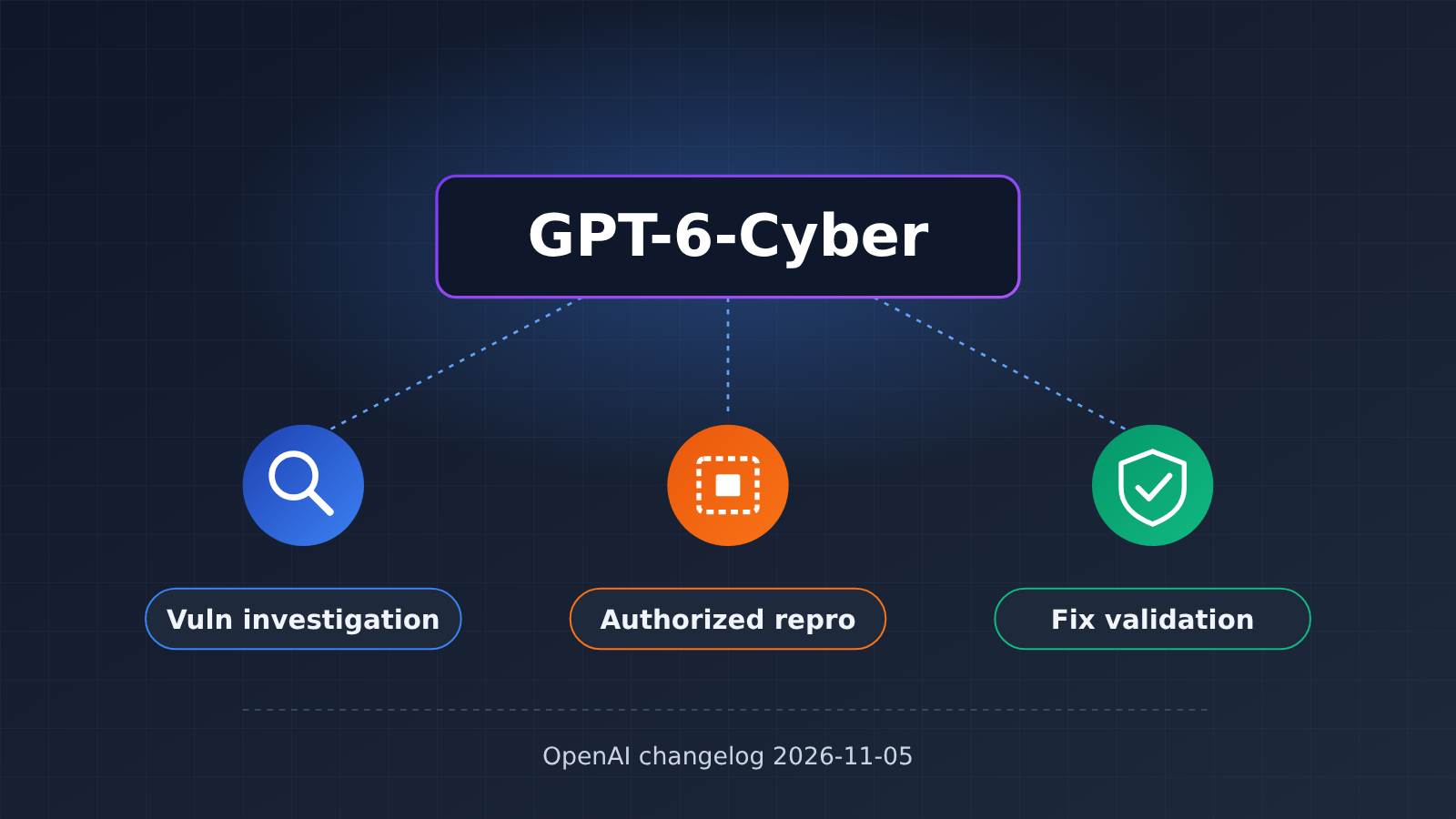
GPT-6-Cyber at a Glance
Let’s start with what the official text confirms. The table includes only details explicitly stated in the changelog; everything else is marked as “not disclosed.”
| Item | Details | Source Status |
|---|---|---|
| Release date | 2026-11-05 (changelog entry date) | ✅ Officially confirmed |
| Publisher | OpenAI, published in the developer documentation changelog | ✅ Officially confirmed |
| Model name | GPT-6-Cyber | ✅ Officially confirmed |
| Intended use | Investigating vulnerabilities, reproducing them in authorized test environments, and validating fixes | ✅ Officially confirmed |
| Prerequisite | Review and complete Daybreak setup before the first request | ✅ Officially confirmed |
| Pricing / access requirements / API parameters | Not mentioned in the changelog | ❓ Not disclosed |
Based on this entry, OpenAI’s positioning for GPT-6-Cyber is clear: it’s a specialized model for security engineering workflows, not a general-purpose conversational model. The official description focuses on vulnerabilities and specifies an “authorized test environment” in the first sentence. That makes the usage boundary part of the product’s positioning, not an afterthought.
What Is Daybreak Setup for GPT-6-Cyber?
The changelog says, “See Daybreak setup before sending your first request.” This suggests two things: first, you likely can’t invoke GPT-6-Cyber simply by obtaining an API key; second, OpenAI has designed a separate onboarding process for it.
The available material doesn’t explain what Daybreak setup involves—whether it requires an application, organizational review, identity verification, or just technical configuration. Until the official documentation provides details, it’s best not to treat any secondhand description as the definitive process.
Understanding GPT-6-Cyber’s Three Core Use Cases
The official announcement names three actions: investigate, reproduce, and verify. Together, they cover the full lifecycle of how a security team handles a vulnerability. Below, we explain each stage using general security engineering practices. These explanations reflect industry knowledge, not official statements from OpenAI about the model’s capabilities.
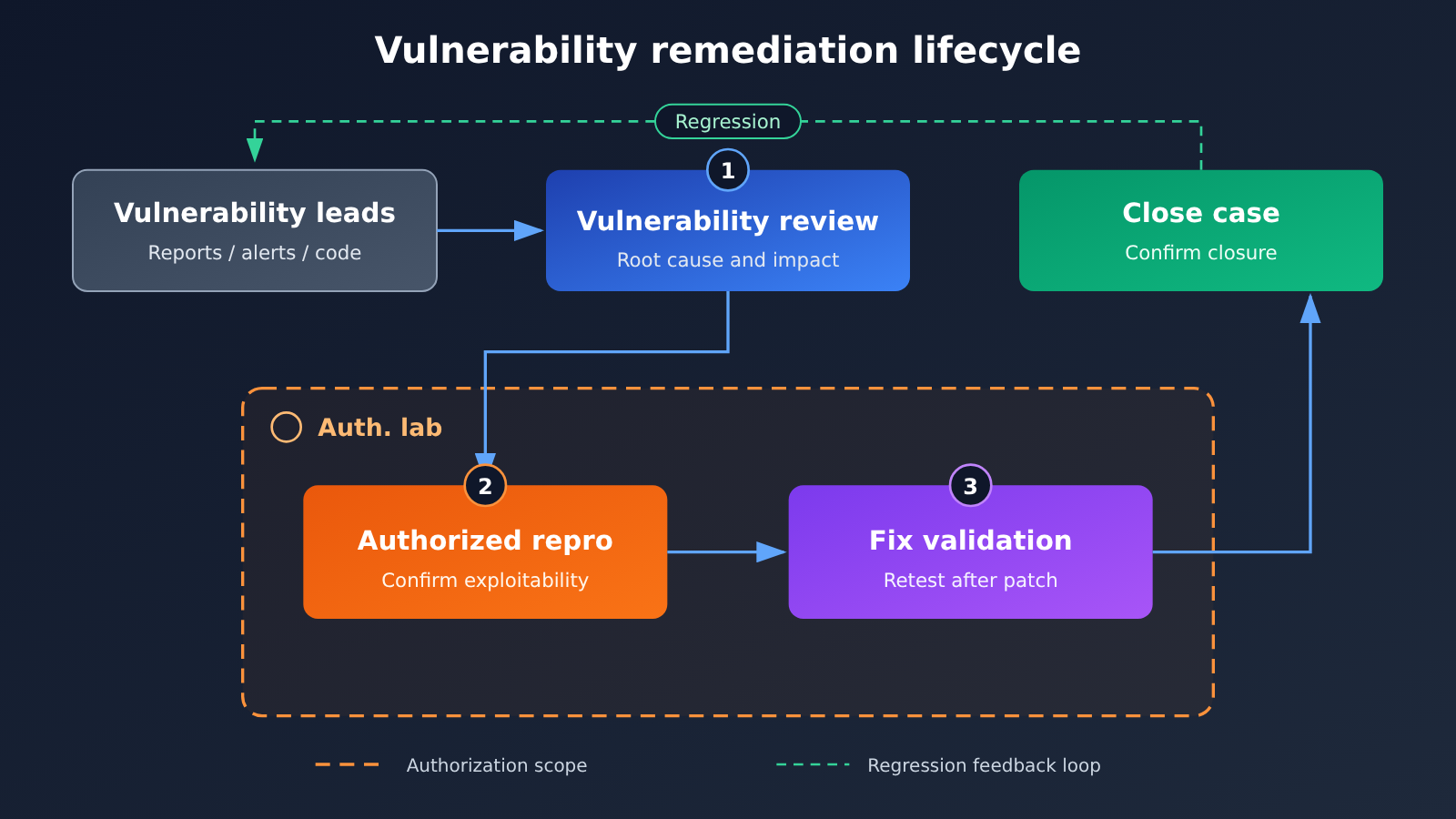
| Stage | Official wording | Meaning in a security workflow | Typical output |
|---|---|---|---|
| Vulnerability investigation | investigate vulnerabilities | Analyze vulnerability leads to identify the root cause, trigger conditions, and scope of impact | Root cause analysis, impact assessment |
| Authorized reproduction | reproduce them in an authorized test environment | Confirm that the vulnerability exists and can be triggered in an authorized test environment | Reproduction steps, verification records |
| Fix verification | verify fixes | Retest before and after a patch is deployed to confirm the vulnerability is closed and no new issues have been introduced | Regression test results, fix confirmation |
GPT-6-Cyber: Vulnerability Investigation
An investigation usually starts with a lead: an externally submitted vulnerability report, an alert from a scanning tool, or suspicious logic found during a code audit. The goal is to answer a few questions: Where is the problem? Under what conditions can it be triggered? Which systems and data are affected? This step depends heavily on understanding the code and its system context, and it’s often one of the most time-consuming parts of a security team’s work.
GPT-6-Cyber: Authorized Reproduction
Reproduction is a key step in determining whether a vulnerability is real. Many vulnerability reports are theoretical. Once a team successfully triggers the issue in an actual environment, it can determine its priority and allocate resources to fix it. The official announcement specifically emphasizes that reproduction must happen in an “authorized test environment,” which we’ll explore separately in the next section.
GPT-6-Cyber: Fix Verification
Fix verification is often underestimated. Writing a patch doesn’t necessarily mean the problem is solved. In practice, a patch may cover only some trigger paths, or the fix may introduce new regressions. Verification involves retesting using the same methods used to reproduce the vulnerability, confirming that the original attack path no longer works. By explicitly listing this as a use case, the announcement positions GPT-6-Cyber for the full workflow from discovery to closure—not just “finding bugs.”
What GPT-6-Cyber’s Authorized Test Environment Means for Compliance
“Authorized test environment” is the most noteworthy phrase in this changelog. Vulnerability reproduction is a double-edged sword: the same steps can be security work in your own test environment, but an attack if used against an unauthorized production system. By including this qualifier in its one-sentence model description, OpenAI has established a boundary for use at the product level.
OpenAI hasn’t yet published a specific definition of “authorized test environment” or details of the related policies. Based on common industry practice, enterprises adopting similar tools typically consider the following points as part of their internal preparations:
- Clear authorization scope: The test target belongs to the organization, or the asset owner has provided written authorization. The scope and testing window are documented.
- Environment isolation: Reproduction takes place in a separate test or staging environment, isolated from production data and real users.
- Auditable process: Logs record who tested which target, when, and what they did.
- Data minimization: Code, logs, and configurations submitted to the model are sanitized where possible to avoid exposing keys and user data.
For enterprise technical teams, this means evaluating GPT-6-Cyber is more than a technology selection decision. Security, legal, and compliance teams also need to be involved. Once OpenAI publishes its official policies, compare them with your internal penetration testing authorization process to make sure they align.
GPT-6-Cyber: Confirmed and Unconfirmed Information
There are plenty of claims circulating right now. The table below separates information into two categories: “officially confirmed” and “not yet public.” Before evaluating the model, check each item and leave unconfirmed details out of internal plans.
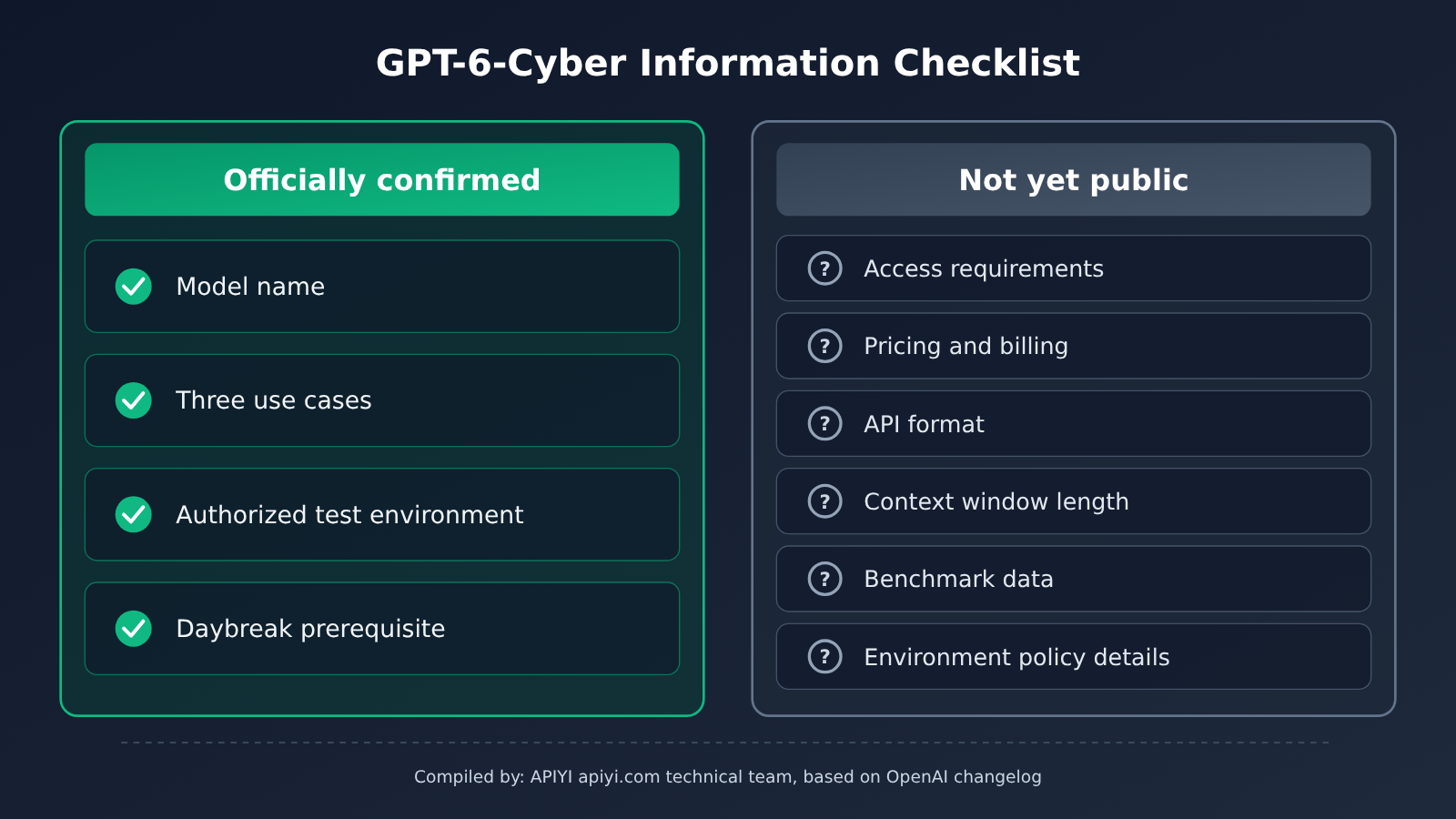
| Item to confirm | Why it matters | Current status |
|---|---|---|
| Access requirements | Whether it will be publicly available, restricted by organization or identity, or subject to approval | Not public |
| Daybreak setup process | Determines how long it takes to go from application to first invocation | Only a preliminary review is mentioned; details aren’t public |
| Pricing and billing | Affects the cost of large-scale code audits and regression tests | Not public |
| API format | Whether it supports Chat Completions, Responses, and other formats determines integration costs | Not public |
| Technical parameters such as context length | Affects whether it can process large codebases or long logs in one go | Not public |
| Benchmark data | Shows how it actually differs from general-purpose models | Not public |
| Authorized testing environment policy | Defines the specific boundaries for compliant use | Not public |
It’s worth emphasizing that no official materials currently provide GPT-6-Cyber benchmark scores, comparisons with general-purpose models, or pricing information. If you see claims with specific numbers, first check whether they come from official OpenAI documentation.
📌 Comparison tip: Once official access becomes available, test GPT-6-Cyber and your current general-purpose model against the same set of internal vulnerability samples. You can prepare a baseline for the general-purpose model in advance through the unified API at APIYI apiyi.com, then compare the results directly.
Preparing to Evaluate GPT-6-Cyber
While access requirements are still unclear, your team can start with work that doesn’t depend on the new model. A practical first step is to build a small vulnerability report triage workflow using an existing general-purpose model, then collect samples and define evaluation criteria. Once GPT-6-Cyber becomes available, you can swap out the model name and run a comparison.
The example below uses an OpenAI-compatible API to call a general-purpose model and organize a vulnerability report into a structured format. Note: The official API model identifier and access method for GPT-6-Cyber haven’t been announced. Replace the model name in the example with one you can actually access.
import openai

client = openai.OpenAI(
    api_key="YOUR_API_KEY",
    base_url="https://api.apiyi.com/v1"  # APIYI OpenAI-compatible API
)

response = client.chat.completions.create(
    model="YOUR_MODEL_NAME",  # Replace with an available general-purpose model
    messages=[{"role": "user", "content": "请把以下漏洞报告整理为:根因、触发条件、影响范围、修复建议四部分。\n<报告内容>"}]
)
print(response.choices[0].message.content)
View the full implementation (including redaction and structured output)
import re
import openai
from typing import Optional

client = openai.OpenAI(
    api_key="YOUR_API_KEY",
    base_url="https://api.apiyi.com/v1"  # APIYI unified API, making it easy to switch models for comparison later
)

SYSTEM_PROMPT = (
    "你是企业内部的安全工程助手,只处理已获授权的内部资产。"
    "请将漏洞报告整理为:根因、触发条件、影响范围、复现前提、修复建议、验证要点。"
    "不要输出针对第三方系统的攻击步骤。"
)

def redact(text: str) -> str:
    """Perform basic redaction before submission: remove suspected keys, email addresses, and internal IPs."""
    text = re.sub(r"(?i)(api[_-]?key|secret|token)\s*[:=]\s*\S+", r"\1=<REDACTED>", text)
    text = re.sub(r"[\w.+-]+@[\w-]+\.[\w.]+", "<EMAIL>", text)
    text = re.sub(r"\b10\.\d+\.\d+\.\d+\b", "<INTERNAL_IP>", text)
    return text

def triage_report(report: str, model: str, extra_context: Optional[str] = None) -> str:
    content = redact(report)
    if extra_context:
        content += "\n\n补充上下文:\n" + redact(extra_context)
    try:
        resp = client.chat.completions.create(
            model=model,
            messages=[
                {"role": "system", "content": SYSTEM_PROMPT},
                {"role": "user", "content": content},
            ],
            temperature=0.2,
        )
        return resp.choices[0].message.content
    except Exception as e:
        return f"Error: {e}"

if __name__ == "__main__":
    sample = "登录接口在 token=abc123 时未校验过期时间,联系人 [email protected],服务器 10.0.3.15"
    # Replace the model name with an available model; use this for comparison once GPT-6-Cyber is available
    print(triage_report(sample, model="YOUR_MODEL_NAME"))
🚀 Quick start: To try the workflow above, sign up at APIYI apiyi.com for free testing credits. A single API key lets you call popular general-purpose models from OpenAI, Claude, Gemini, and others, making it easy to establish an evaluation baseline in advance. Note that APIYI hasn’t confirmed whether it will provide access to GPT-6-Cyber; check the platform’s announcements for updates.
To make future comparisons meaningful, the table below lists the dimensions to consider during evaluation. You can use a general-purpose model to prepare samples and scoring criteria for the first three during the preparation phase.
| Evaluation criterion | What to do while preparing | What to assess once the new model is available |
|---|---|---|
| Root cause identification accuracy | Collect resolved internal vulnerabilities as ground truth | Differences from general-purpose model conclusions |
| Reproduction step usability | Document manual reproduction steps in an isolated environment | Whether generated steps can be executed directly in an authorized environment |
| Fix verification completeness | Compile historical patches and regression test cases | Whether the model can identify trigger paths missed by patches |
| Compliance and data security | Establish data sanitization rules and an authorization checklist | Whether official policies align with internal processes |
GPT-6-Cyber Impact Analysis
Impact on Developers and Enterprise Technical Teams
- Security workflows may gain a specialized model option: Using general-purpose models for vulnerability analysis has traditionally required extensive prompt constraints. A specialized model offers a more targeted option, though its effectiveness still needs to be tested.
- Access requirements may be higher than for general-purpose models: The Daybreak setup prerequisites indicate that there are extra steps before model invocation. Teams should allow time for these steps and involve security and compliance leads early.
- Authorization shifts from team practice to product requirement: The official use description specifies authorized testing environments, making internal authorization records and audit processes more important.
Impact on the Security Industry
- Model providers are beginning to tailor security capabilities to specific use cases: OpenAI has separated security use into a standalone model with its own access process. This reflects a more nuanced approach to high-risk scenarios among Large Language Model providers.
- Fix verification is getting more attention: By putting “verifying fixes” alongside “investigation,” the official description could encourage the industry to focus on closing the vulnerability lifecycle, rather than just counting discoveries.
Frequently Asked Questions
Q1: What is GPT-6-Cyber?
GPT-6-Cyber is a security-focused model announced by OpenAI in its developer changelog on 2026-11-05. According to OpenAI, it’s designed to investigate vulnerabilities, reproduce them in authorized testing environments, and verify fixes.
Q2: How does GPT-6-Cyber differ from general-purpose GPT models?
According to OpenAI’s description, general-purpose models handle a broad range of tasks, while GPT-6-Cyber focuses on the full vulnerability-handling workflow. It also requires users to complete the Daybreak setup first and use it in an authorized testing environment. There are no official benchmark results comparing their capabilities, so a quantitative comparison isn’t possible yet.
Q3: Can I call GPT-6-Cyber directly now?
OpenAI has only said that users need to review the Daybreak setup before their first request. It hasn’t said whether the model is publicly available or whether an application or approval is required. Check the OpenAI developer documentation for updates rather than relying on secondhand information.
Q4: How much does GPT-6-Cyber cost?
The official changelog doesn’t provide pricing or billing details. Until OpenAI publishes them, no specific price can be verified. If you’d like to estimate invocation costs for security analysis tasks in the meantime, you can run a batch of samples with a general-purpose model on APIYI apiyi.com to get a reference point for token usage.
Q5: What can I do while waiting for access?
Start by organizing internally resolved vulnerability cases, establishing data anonymization and authorization rules, and building a report-preparation workflow with a general-purpose model as an evaluation baseline. With the OpenAI-compatible interface from APIYI apiyi.com, you can use the same code to compare multiple general-purpose models side by side, with fewer changes needed when you integrate a new model later.
Q6: What exactly is an “authorized testing environment”?
OpenAI hasn’t published an official definition yet. By industry convention, it generally means a testing environment whose assets belong to your organization or are covered by written authorization, that’s isolated from production, and where operations can be audited. The precise boundaries will depend on OpenAI’s official policy once it’s published.
GPT-6-Cyber Key Takeaways
- Clear official positioning: GPT-6-Cyber targets three stages: vulnerability investigation, authorized reproduction, and fix verification.
- Setup comes first: Users must review the Daybreak setup before their first request; the process hasn’t been disclosed.
- Authorization is a firm boundary: Reproduction is limited to an authorized test environment, so enterprises need supporting compliance processes.
- Key details are still pending: Access requirements, pricing, interface details, technical specifications, and evaluation results haven’t been announced.
- Prepare a baseline: Use general-purpose models through APIYI apiyi.com to build an evaluation workflow, then compare results once official access opens.
Summary
Here’s what we can confirm about GPT-6-Cyber so far:
- Purpose: It covers the full workflow, from vulnerability investigation and reproduction in an authorized test environment to fix verification.
- Prerequisite: The Daybreak setup must be completed before the first call; official details are still pending.
- Boundary: The official one-line description explicitly mentions an “authorized test environment,” making compliance preparation just as important as technical evaluation.
For most teams, the best approach now is to follow official documentation updates while preparing test samples, evaluation criteria, and authorization processes. There’s no need to rush into decisions based on unconfirmed information. Consider using general-purpose models through APIYI apiyi.com to get your evaluation workflow running, so you can quickly run comparative tests once GPT-6-Cyber’s access requirements are clear.
📚 References
- OpenAI API Changelog: GPT-6-Cyber release notes (2026-11-05)
- Link:
developers.openai.com/api/docs/changelog - Description: The source for all official facts in this article, including the model’s intended use and the Daybreak setup prerequisite notice
Author: APIYI Technical Team
Technical discussions: Contact us through the APIYI homepage. For more integration resources, visit the documentation center at docs.apiyi.com.


