

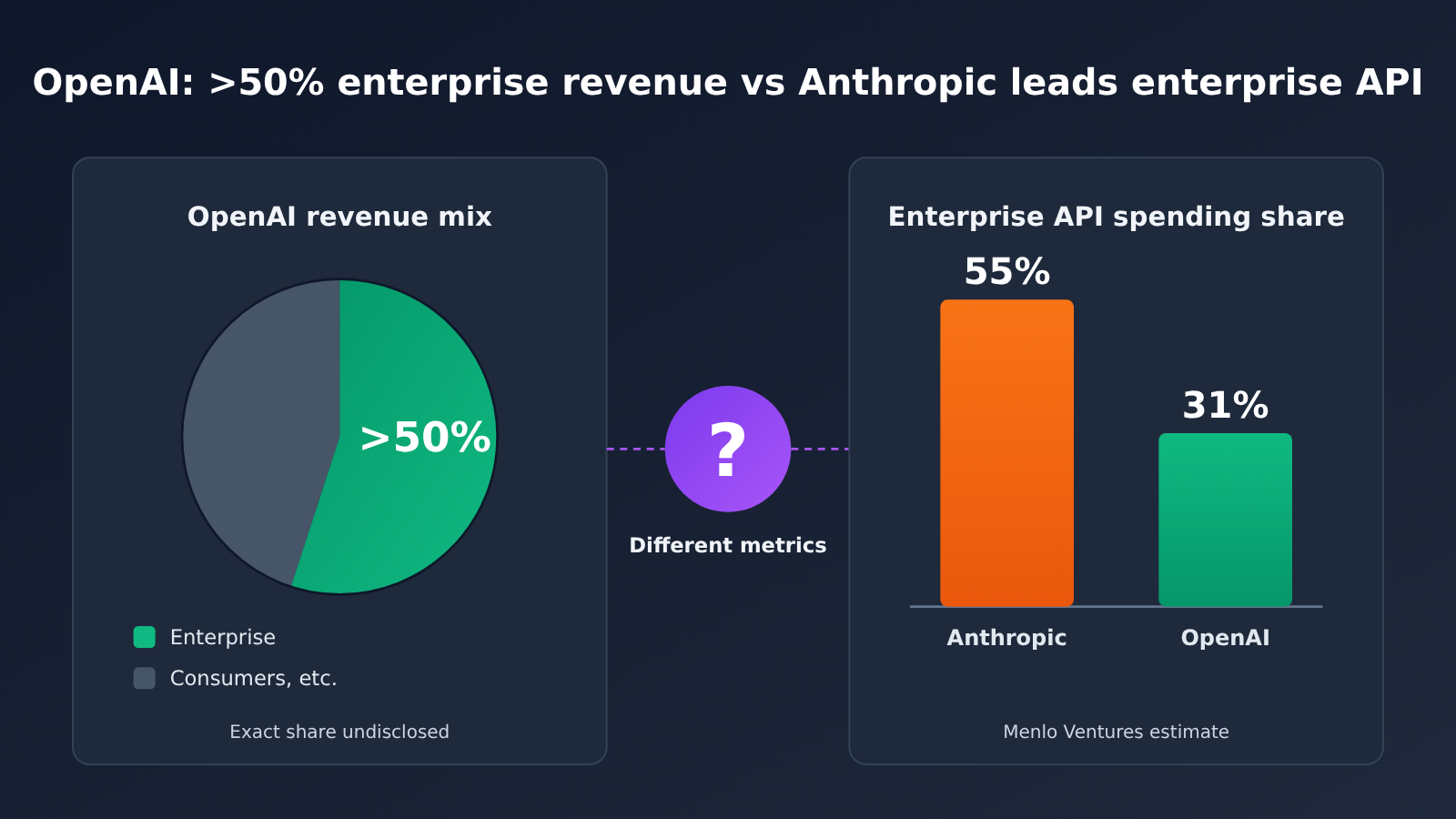
Author’s note: For the first time, more than half of OpenAI’s revenue comes from enterprise customers. Yet Anthropic still leads in enterprise API spending. These findings don’t contradict each other—they measure fundamentally different things.
On November 4, 2026, OpenAI President Greg Brockman said at the WSJ Tech conference that more than half of OpenAI’s revenue now comes from its enterprise business. Just one day later, Menlo Ventures’ 2026 State of Enterprise AI report estimated that Anthropic accounted for 55% of enterprise LLM API spending in production, while OpenAI accounted for 31%.
Put those two headlines together, and it’s natural to ask: “Who’s actually winning?” The data isn’t conflicting. The original materials from Reuters, TechCrunch, WSJ, and Menlo corroborate one another; the difference lies in what’s being measured. This article uses three distinct metrics to explain how OpenAI and Anthropic are competing in the enterprise market.
What you’ll learn: By the end, you’ll understand the difference between revenue share, API spending share, and product adoption. You’ll also see why enterprises buy models from multiple providers—and how to use that insight to plan your own model integration strategy.
OpenAI Gets More Than Half Its Revenue From Enterprise: Key Takeaways
First, let’s break down what Brockman disclosed. He said OpenAI’s revenue used to be split roughly 30% enterprise and 70% consumer. Today, enterprise is its largest revenue source. Importantly, he made clear that consumer revenue hasn’t fallen—it’s still growing, just more slowly than enterprise revenue.
| Item | Details |
|---|---|
| Announcement date | November 4, 2026, US local time; reported on November 5 |
| Venue | WSJ Technology Conference, Napa, California |
| Speaker | Greg Brockman, OpenAI co-founder and president |
| Key disclosure | Enterprise contributes more than half of revenue, but the exact percentage wasn’t disclosed |
| Third-quarter performance | Annualized revenue run rate grew about 70% quarter over quarter, and the enterprise business doubled in size |
| New partnership | Partnership with JPMorgan Chase on Codex and cybersecurity models; financial terms weren’t disclosed |
| IPO comments | Asked whether OpenAI could be ready for an IPO in 2027, he replied, “I think so” |
Brockman also acknowledged that OpenAI struggled in the enterprise market in the first half of 2026. Although it already had Codex, it lacked a presence in the agentic coding market. The turning point came in the third quarter, which he attributed to the launches of GPT-5.6 Sol and ChatGPT Work, along with the expansion of its enterprise business.
Two Easy Ways to Misread OpenAI’s Enterprise Revenue Figures
There are two potential pitfalls here. First, the 70% figure refers to quarter-over-quarter growth in the annualized revenue run rate (ARR), not a 70% increase in GAAP quarterly operating revenue. ARR generally extrapolates revenue from a given period over a full year; it isn’t revenue already earned over that year.
Second, Reuters has reported OpenAI’s annualized revenue as both “nearly $70 billion” and “nearly $50 billion.” That doesn’t mean revenue shrank. The difference comes from how revenue through cloud partners is accounted for: OpenAI records only its own share of some sales through cloud channels, while Anthropic may record the full amount paid by customers. The earlier $70 billion figure used a similar gross-revenue calculation to make it comparable with Anthropic.
Why Anthropic Leads in Enterprise APIs: Three Metrics You Can’t Interchange
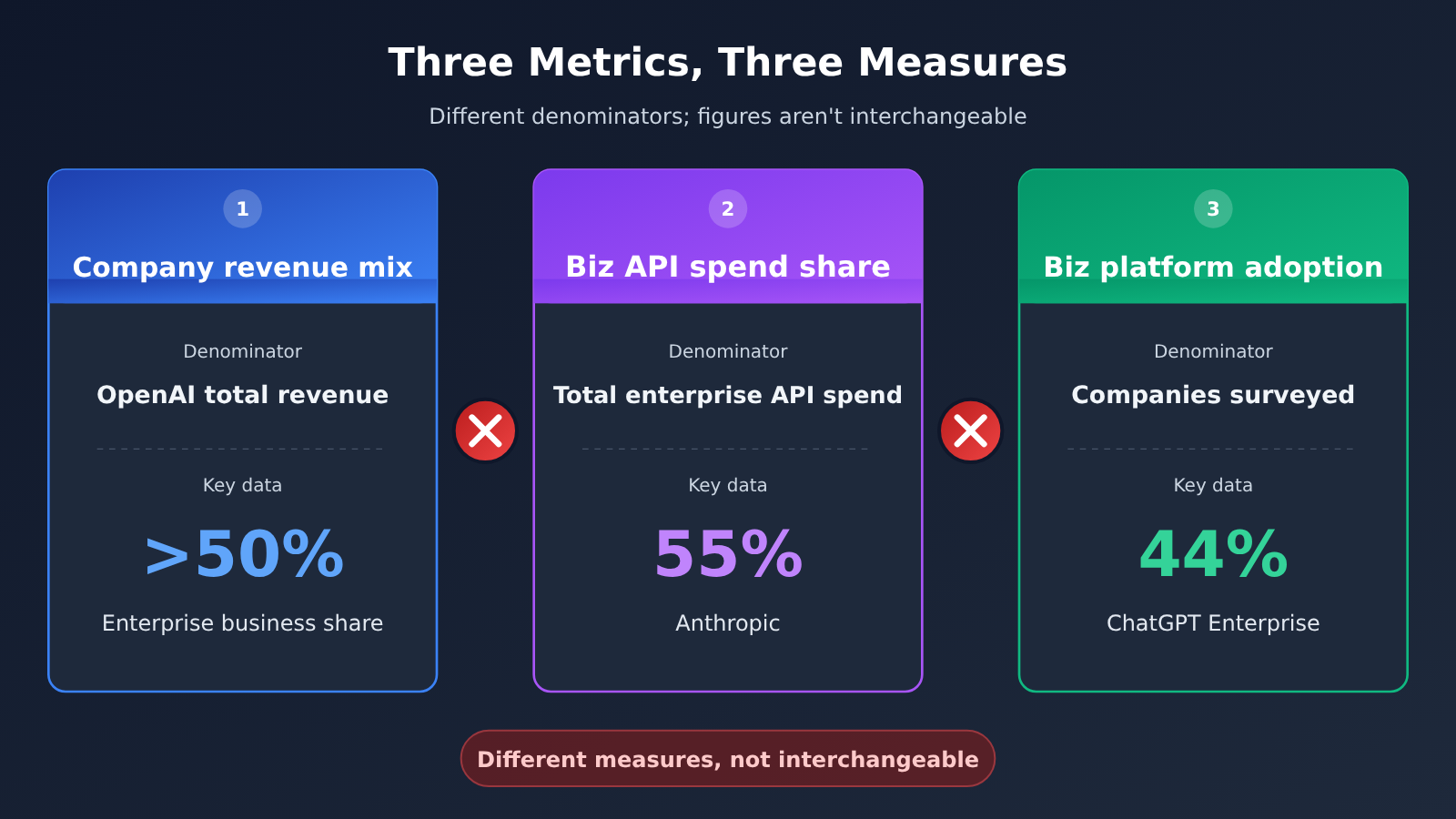
The key distinction is that “more than half of OpenAI’s revenue comes from enterprises” and “Anthropic leads the enterprise API market” answer two entirely different questions. Add Morning Consult’s enterprise platform adoption rate, and there are three separate metrics in circulation.
| Metric | Question it answers | Denominator | Representative data |
|---|---|---|---|
| Company revenue mix | Where does OpenAI’s revenue come from? | OpenAI’s total revenue | Enterprise business accounts for over 50% (Brockman) |
| Enterprise API spending share | Which providers get enterprises’ model API spending? | Total enterprise LLM API spending | Anthropic 55%, OpenAI 31% (Menlo estimate) |
| Enterprise platform adoption rate | How many companies have approved or use a product? | Number of surveyed companies | ChatGPT Enterprise at 44% among large enterprises (Morning Consult) |
Think of it this way: OpenAI getting more than half its revenue from enterprises means “the enterprise slice of OpenAI’s own pie has grown.” Anthropic’s 55% share of API spending means “Anthropic has the largest slice of the overall enterprise API pie.” The first includes multiple enterprise revenue streams, such as ChatGPT Business, Enterprise, API, and Codex. The second looks only at model API calls in production.
It’s also worth noting that OpenAI hasn’t disclosed the individual revenue contributions of Business, Enterprise, API, Codex, or Work. So “enterprise revenue” can’t be equated with ChatGPT Enterprise subscription revenue or treated as API revenue.
Enterprise API Spending Share: Anthropic Rises From 40% to 55%
Here are Menlo Ventures’ estimates of enterprise LLM API spending in production for 2026. These are estimates, and the rounded figures may not add up to 100%.
| Model provider | Previous year’s share | 2026 share | Change |
|---|---|---|---|
| Anthropic | 40% | 55% | Significant increase |
| OpenAI | 27% | 31% | Slight increase |
| 21% | 9% | Significant decrease | |
| Open-source models | — | About 4% (about 19% of tokens) | High usage, low spending |
The open-source models row is particularly noteworthy. Their share of token usage has risen to 19%, but their share of spending is only about 4%—showing that high usage doesn’t necessarily mean high spending. It’s also a reminder that you can’t judge a model’s commercial competitiveness by price or call volume alone.
🎯 Technical recommendation: Market share tells you what the market is choosing overall, but it’s no substitute for testing on your own use cases. Try calling Claude and GPT models through APIYI at apiyi.com using the same API key, then compare performance and cost on real tasks before deciding.
OpenAI vs. Anthropic in the Enterprise: Platform Adoption Tells a Different Story
The rankings look very different if we focus on whether a company has approved or is using an AI platform. Morning Consult surveyed 3,003 US business decision-makers from July 21–24, 2026, and published the results on August 3.
| Platform | Adoption at companies with 5,000+ employees | Adoption at companies with 1,000–4,999 employees |
|---|---|---|
| Microsoft Copilot | 73% | Not disclosed |
| Google Gemini | 47% | 74% |
| OpenAI ChatGPT Enterprise | 44% | 72% |
| Anthropic Claude | 20% | Not disclosed |
At large enterprises, Claude’s adoption rate is just 20%, well below Copilot, Gemini, and ChatGPT Enterprise. That may seem at odds with Anthropic’s 55% share of API spending, but again, the metrics measure different things.
The adoption figures track whether a platform has been approved or is in use. A company that gives every employee a Copilot account and one that spends a large monthly budget on the Claude API carry the same weight in this table. Copilot and Gemini benefit from Microsoft 365 and Google Workspace’s existing distribution channels, making broad adoption easier. API spending, on the other hand, better reflects which models development teams are paying to use in production, particularly for agent and coding tasks. So Morning Consult’s adoption rates should never be interpreted as model API market share.
The Reality of the Enterprise API Market: Multiple Vendors Coexist
Treating OpenAI and Anthropic as an either-or choice doesn’t reflect the reality of the enterprise market. Morning Consult data shows that only 27% of large enterprises use a single primary AI platform. Meanwhile, 44% added at least one platform in the past year, and only 5% reduced the number they use.
Plans for the next 12 months show a similar mix of priorities:
- Continued expansion: 56% may increase the number of approved platforms, while 45% may increase their use of open-source or self-hosted models.
- Consolidation at the same time: 47% may consolidate and reduce the number of platforms, while 36% may replace their current primary platform.
- Building in-house capabilities: 66% plan to build internal AI capabilities based on foundation models.
In other words, enterprises are bringing in new models while also seeking unified governance, procurement, and billing. For development teams, the most practical approach is to keep models interchangeable at the architectural level rather than tie the business to a single vendor.
Why Enterprises Are Willing to Pay for Model Quality
Anthropic’s lead in API spending reflects enterprise purchasing priorities. Among the factors large enterprises value most, output accuracy and quality rank first, followed by security and privacy, and legal compliance. Total cost of ownership (TCO) ranks only eighth out of 12 factors.
| Purchasing decision factor | Percentage rating it very important | Percentage citing it as an important reason to switch platforms |
|---|---|---|
| Output accuracy and quality | 78% | 49% (better quality or performance) |
| Security, privacy, and data handling | 75% | 48% (security, privacy, or data governance) |
| Legal, risk, and compliance | 73% | — |
| Lower total cost of ownership | Ranked 8th | 22% |
These figures explain a key point: the lowest price per unit doesn’t necessarily win the enterprise API market. When models are used for long-running agent tasks and production code, the cost of fixing an error is often far greater than the difference in token pricing. Menlo also notes that Anthropic’s market share growth is closely tied to the Opus series’ performance on long-running tasks and coding.
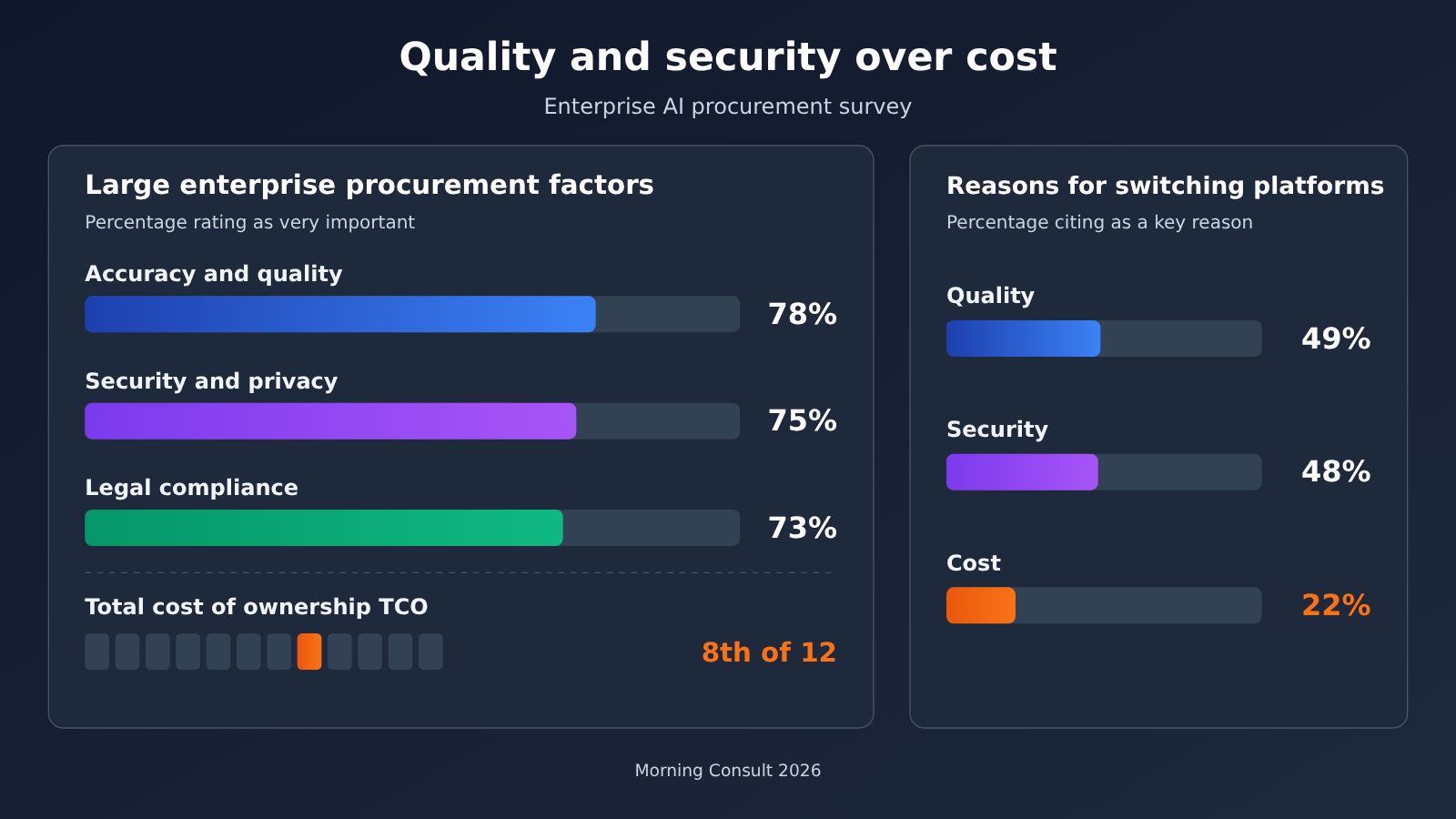
Chart data source: Morning Consult 2026 enterprise AI survey. To evaluate quality differences between models for your own business, you can run multi-model comparison tests through APIYI at apiyi.com.
OpenAI’s Second-Half Rebound: The Enterprise API Landscape Is Shifting
Anthropic’s lead doesn’t mean the race is settled. On November 5, the WSJ cited enterprise spending data from OpenRouter: At the start of the year, Anthropic accounted for roughly three-quarters of spending among companies using both providers’ models. By September 2026, the two were roughly even.
It’s worth noting that OpenRouter is a model aggregation platform, so its data doesn’t represent the entire industry. Its users also tend to skew toward developers and startups. That makes the figures more useful for tracking trends than measuring industry-wide market share.
OpenAI’s rebound is being driven primarily by Codex and its Agent product line:
- Rapid growth in Codex users: Weekly active users rose from over 2 million on March 31 to more than 5 million on June 2. (Note that this is a June figure, not the latest November count.)
- Expanding from programmers to knowledge workers: Axios reported that knowledge workers account for around 20% of Codex users and are growing more than three times as fast as the developer segment.
- ChatGPT Work launch: Released on July 9, it’s designed to handle long-running, multi-step tasks across applications.
- Enterprise delivery network: In April, OpenAI launched Codex Labs with systems integrators including Accenture, Capgemini, Infosys, PwC, and TCS. In June, it launched the OpenAI Partner Network with a $150 million investment.
Menlo estimates that Claude Code and Codex together account for roughly 70% of the $34 billion AI coding application market, or about $24 billion. Coding Agents have become the main battleground in the two companies’ fight for enterprise budgets.
Agents Are Reshaping Enterprise API Consumption
Menlo cites OpenRouter data showing that Agents now account for roughly 80% of the platform’s total token consumption. Agent-driven traffic has grown about 37-fold since overtaking human-driven traffic in February 2026, while human-driven traffic grew only about fivefold over the same period. Token consumption is shifting from being tied to the number of users to being driven by task volume, the number of parallel tasks, and execution time.
That’s also one reason enterprise AI spending has exceeded expectations. Menlo estimates that enterprise AI spending reached an average of 4.7 times the previous year’s level, compared with the 1.9-fold increase companies had originally expected. For development teams, usage monitoring and budget control are becoming just as important as model selection.
How to Respond to Competitive Changes With a Multi-Model Enterprise API Strategy
Since enterprises commonly use multiple vendors, the most practical approach for developers is to make it easy to switch between OpenAI and Anthropic models using the same code. Here’s a minimal example that calls models from different providers through an OpenAI-compatible interface:
import openai

client = openai.OpenAI(
    api_key="YOUR_API_KEY",
    base_url="https://api.apiyi.com/v1"  # APIYI's unified interface: access models from multiple providers with one key
)

# Use the actual model names listed on the platform
for model in ["gpt-6.1-sol", "claude-opus"]:
    resp = client.chat.completions.create(
        model=model,
        messages=[{"role": "user", "content": "用三句话总结企业 API 选型要点"}]
    )
    print(model, "=>", resp.choices[0].message.content)
See the full implementation: Multi-model comparison with latency and token usage
import time
import openai
from typing import List, Dict

client = openai.OpenAI(
    api_key="YOUR_API_KEY",
    base_url="https://api.apiyi.com/v1"  # Unified endpoint for easy side-by-side comparisons
)

def compare_models(prompt: str, models: List[str]) -> List[Dict]:
    """Call multiple models for the same task and record latency and token usage."""
    results = []
    for model in models:
        start = time.time()
        try:
            resp = client.chat.completions.create(
                model=model,
                messages=[
                    {"role": "system", "content": "你是严谨的企业技术顾问"},
                    {"role": "user", "content": prompt}
                ],
                max_tokens=800
            )
            results.append({
                "model": model,
                "latency_s": round(time.time() - start, 2),
                "prompt_tokens": resp.usage.prompt_tokens,
                "completion_tokens": resp.usage.completion_tokens,
                "answer": resp.choices[0].message.content
            })
        except Exception as e:
            results.append({"model": model, "error": str(e)})
    return results

if __name__ == "__main__":
    task = "审查以下函数的潜在并发问题,并给出修改建议:..."
    # Use the model names listed on the platform
    for r in compare_models(task, ["gpt-6.1-sol", "gpt-6.1-terra", "claude-opus"]):
        print(r)
🚀 Get started: Sign up at APIYI apiyi.com to claim free testing credits, then run your real coding, documentation, or agent tasks through different models. The platform offers an OpenAI-compatible interface and pay-as-you-go pricing, so switching models only requires changing the
modelparameter.
Frequently Asked Questions
Q1: Does OpenAI earning more than half its revenue from enterprises contradict Anthropic’s lead in the enterprise API market?
No. The first figure describes OpenAI’s own revenue mix: more than half comes from enterprise business. The second is Menlo’s estimate of total enterprise API spending, with Anthropic at 55% and OpenAI at 31%. They use different denominators: one looks at where OpenAI’s revenue comes from, while the other looks at where enterprise API budgets go.
Q2: Why does Claude have the highest share of API spending when its enterprise adoption rate is only 20%?
The adoption rate only measures whether a company has approved or is using a platform, not how much it spends. Copilot and Gemini are easier to roll out broadly through office suites, while more of Claude’s budget goes toward production coding and long-running tasks. To see how Claude performs on these tasks for yourself, you can quickly test it with free credits through APIYI apiyi.com.
Q3: Did OpenAI’s revenue fall from $70 billion to $50 billion?
No. The two figures use different comparison methods, mainly differing in whether cloud partner revenue is counted on a gross basis. The $70 billion figure was grossed up to make it comparable with Anthropic’s, and both are annualized revenue run rates, not realized full-year revenue.
Q4: Is price the most important factor when enterprises choose a model?
Not at large enterprises. Morning Consult found that quality (78%), security and privacy (75%), and compliance (73%) matter most, while TCO ranks eighth. Among companies that switched platforms, only 22% cited lower costs as an important reason.
Q5: How can development teams avoid getting locked into a single model provider?
A good starting point is to standardize on an OpenAI-compatible interface, make model names configurable, and build evaluation sets for critical tasks that you retest regularly. With an aggregation platform like APIYI apiyi.com, you can access OpenAI, Claude, Gemini, and other models using a single API key, reducing the cost of switching.
Q6: What are the limitations of this market data?
Menlo’s market share and spending figures are estimates; OpenRouter’s data skews toward developers and startups and doesn’t represent the entire industry; and Morning Consult’s sample consists of US business decision-makers. OpenAI hasn’t publicly disclosed a breakdown of its enterprise revenue, so there’s no basis for any “precise breakdown.”
OpenAI vs. Anthropic in the Enterprise API Market: Key Takeaways
- Don’t mix up the three metrics: Revenue mix, API spending share, and platform adoption rate all use different denominators.
- Enterprise accounts for over half of OpenAI’s revenue: Its enterprise business is growing faster, but consumer revenue is still growing.
- Anthropic leads in API spending: Menlo estimates its share at 55%, thanks to Opus’s long-running task and coding capabilities.
- OpenAI rebounded in the second half: Codex and new models drove its recovery, with OpenRouter data showing the two companies roughly level by September.
- Most enterprises use multiple providers: Only 27% of large enterprises rely on a single primary platform, and quality and security take priority over price.
- Getting started: Use one key through APIYI at apiyi.com to compare models from multiple providers, and base your selection on hands-on testing rather than market share.
Summary
OpenAI earning more than half its revenue from enterprise customers and Anthropic leading the enterprise API market are two sides of the same competition:
- OpenAI’s shift: Its revenue mix has moved from roughly 70% consumer to predominantly enterprise. Its enterprise business doubled in the third quarter, driven mainly by Codex and ChatGPT Work.
- Anthropic’s advantage: It still accounts for the majority of API spending in enterprise production environments, largely because of model quality on long-running tasks and coding.
- What’s next: Multi-provider enterprise environments will become the norm. Competition will center on agent capabilities, security and compliance, and the delivery ecosystem—not just price.
For developers and enterprise buyers, it’s better to keep your architecture flexible and continuously evaluate models on your own real-world tasks than to bet on a single provider. APIYI at apiyi.com offers a quick way to set up a multi-model comparison environment, with a unified interface and free credits for new users to help turn market data into your own selection criteria.
📚 References
- Reuters: OpenAI enterprise revenue tops 50% and IPO remarks: Coverage of Brockman’s comments at the WSJ Tech conference
- Link:
reuters.com/legal/transactional/openai-ready-ipo-2027-now-counts-majority-sales-enterprises-brockman-says-2026-11-05/ -
Notes: Firsthand reporting on enterprise revenue share, third-quarter growth, and the JPMorgan partnership
-
Reuters: OpenAI’s annualized revenue neared $50 billion in September: Explanation of changes to the revenue calculation
- Link:
reuters.com/business/openais-annualized-revenue-20-billion-less-than-previously-signaled-ft-reports-2026-10-08/ -
Notes: Key context for understanding the difference between the $50 billion and $70 billion figures
-
Menlo Ventures: 2026 The State of Enterprise AI: Estimates of enterprise API spending shares
- Link:
menlovc.com/perspective/2026-the-state-of-enterprise-ai/ -
Notes: Source for Anthropic’s 55% share, OpenAI’s 31% share, and agent token trends
-
Morning Consult: State of Enterprise AI: Survey of AI platform adoption among U.S. enterprises
- Link:
morningconsult.com/articles/state-of-enterprise-ai -
Notes: Data on platform adoption, multi-vendor strategies, and purchasing factors
-
WSJ: OpenAI’s rough first half and coding business takeoff: Cites OpenRouter enterprise spending data
- Link:
wsj.com/tech/openai-had-rough-first-half-of-year-before-coding-takeoff-brockman-says-6c97d9e5 - Notes: Reference for spending trends on OpenAI and Anthropic among shared enterprise customers
Author: APIYI Technical Team
Technical discussions: Contact us on the APIYI homepage at apiyi.com. For more integration guides, visit the documentation center at docs.apiyi.com.


