
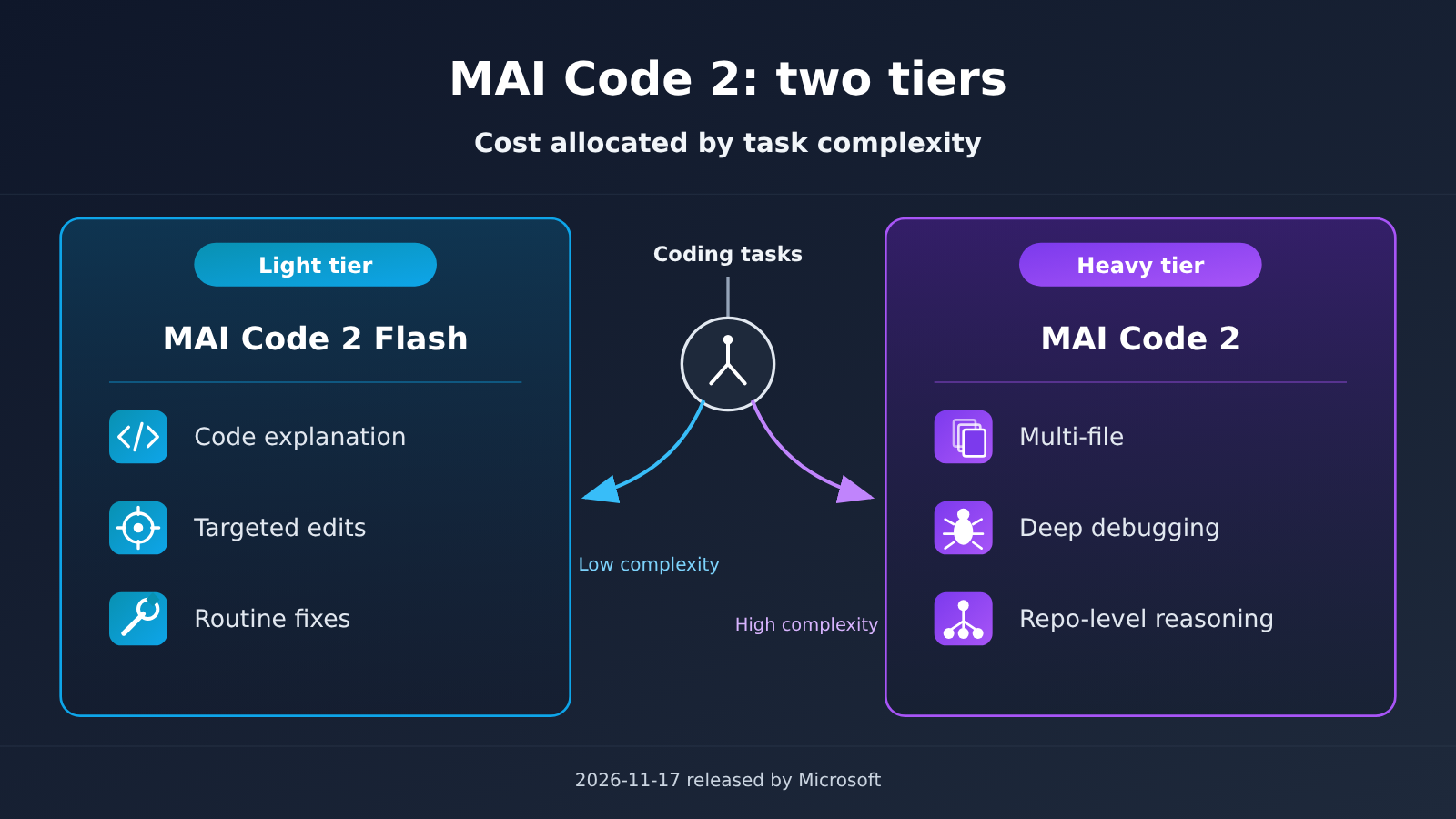
Microsoft offers separate models for complex engineering work and high-frequency everyday tasks. Our take: this gives enterprises a new option for allocating cost by task complexity. On November 17, 2026, Microsoft released MAI Code 2 and MAI Code 2 Flash. The former targets multi-file edits, deep debugging, and repository-level reasoning. The latter targets code explanation, pinpoint edits, routine fixes, and high-frequency iteration.
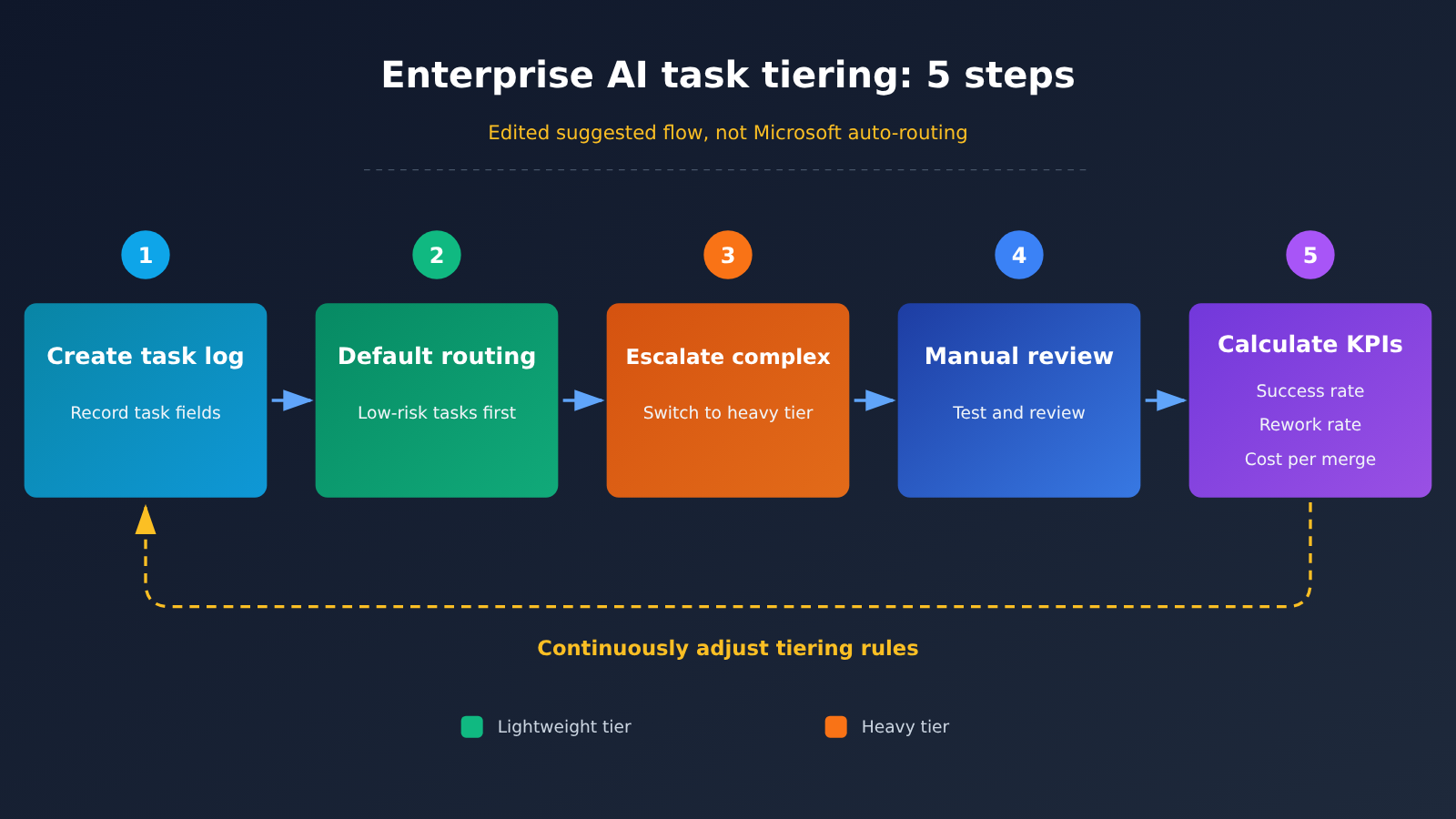
The core conclusion here: when evaluating coding AI, enterprises shouldn’t just ask which model is “strongest.” The more important questions are which tasks can go to the lightweight tier, which tasks must be escalated to the heavyweight tier, and how much each successful merge actually cost. One caveat: the task-tiering workflow below is an editorial suggestion, not an automatic routing guarantee that Microsoft already provides.
What you’ll learn from this article
- How MAI Code 2 and MAI Code 2 Flash differ in positioning, plus which channels they’re available on today and which are still “coming soon.”
- What the model cards disclose, and which details are vendor self-reported and not yet independently verified.
- How enterprises can borrow the “two-tier” idea to build their own coding-task tiering workflow, then measure results with success rate, rework rate, and cost per merge.
- What to check on data residency and permissions before a pilot, and a few common misreadings to avoid.
MAI Code 2 analysis index
Part one, “Objective facts,” walks through the two-tier positioning, launch channels, model card specs, enterprise case studies, and how this relates to MAI Work Flash — sourced from Microsoft’s public materials and GitHub pricing documentation. Part two, “Analysis and judgment,” is our editorial view: first the business logic behind the two tiers, then a five-step process (build a task ledger, set default routing, define escalation rules, add human acceptance, and track metrics), and finally the pilot checks and misreadings to avoid.
To Know: Key Concepts for Understanding the Two-Tier MAI Code 2 Launch
| Concept | Brief explanation |
|---|---|
| MAI Code 2 | Microsoft’s heavyweight coding model, positioned for multi-file work, deep debugging, and repository-level reasoning |
| MAI Code 2 Flash | The lightweight tier in the same family, positioned for code explanation, targeted edits, routine fixes, and high-frequency iteration |
| MAI Work Flash | A derivative model further optimized from Code 2 Flash, serving office and data scenarios such as M365 and FabricIQ |
| Foundry | Microsoft’s enterprise platform for model and AI application development, where Flash is offered as a limited-access preview |
| Limited-access preview | A restricted-access preview that requires an application or meeting certain conditions; not the same as full general availability |
| Context window | The total number of tokens a model can process in a single pass; the model card lists 1.05M |
| Repository-level reasoning | Understanding the structure and dependencies of the entire codebase before making changes, rather than looking only at a single file |
| Model routing | A strategy for assigning requests to different models based on task characteristics, implementable through manual rules or code |
| Rework rate | The share of AI output that gets sent back and needs further revision; a key metric for measuring real efficiency |
| Data residency | The geographic region where data is stored and processed, which matters for compliance requirements |
Quick Look: The Impact of MAI Code 2’s Dual-Tier Release
- Enterprise technical leads: Procurement and evaluation shift from “pick the single strongest model” to “match different tiers to different tasks.” You’ll need to prepare task classification and cost accounting standards.
- Developers using GitHub Copilot: Both models are already available in Copilot, so you can proactively switch based on task size day to day—though the exact options available depend on your organization’s policy.
- Teams building apps on Foundry: Only Flash is currently available, and only as a limited preview. Confirm access eligibility first, and don’t schedule based on full availability.
- Developers relying on third-party platforms: Channels like OpenRouter, Vercel, Hermes, OpenCode, and Kilo are marked “coming soon” in the release notes, so don’t write them into production plans before they actually open up.
- Compliance and security teams: Every additional model adds another set of data flows and permission boundaries. Complete the review before the pilot.
1. The Facts: What MAI Code 2 and Flash Actually Launched
This section only summarizes information from Microsoft’s public materials. Performance and case-study content comes from vendor announcements or secondhand accounts, not independent evaluation—and our team hasn’t benchmarked either model.
1.1 MAI Code 2’s Dual-Tier Positioning: What Code 2 and Flash Each Handle
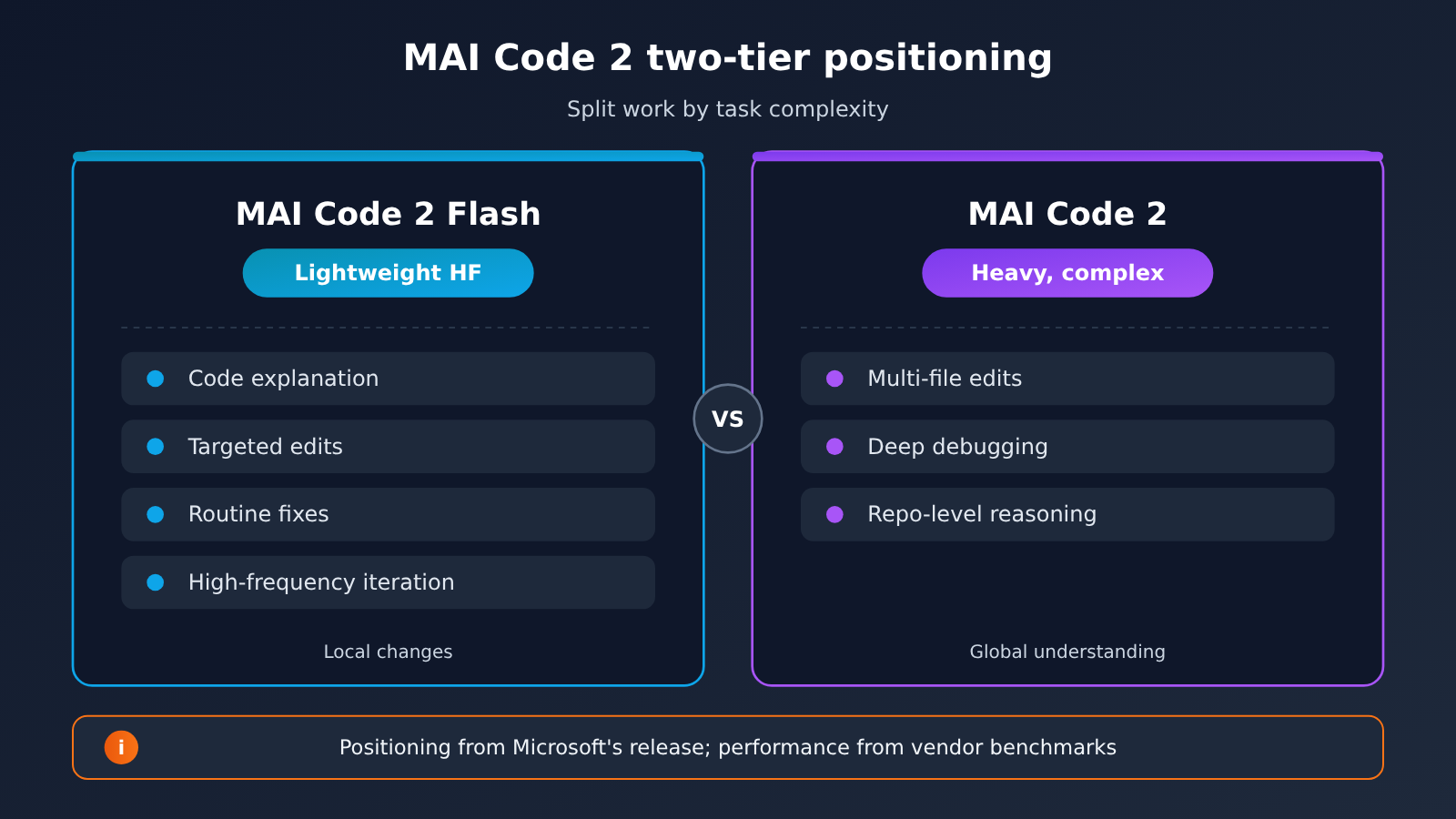
Microsoft’s announcement lays out the division of labor between the two models fairly clearly: the heavyweight tier handles complex engineering tasks that require a global understanding, while the lightweight tier handles high-frequency, local, fast-paced everyday tasks.
| Dimension | MAI Code 2 | MAI Code 2 Flash |
|---|---|---|
| Official positioning | Multi-file edits, deep debugging, repository-level reasoning | Code explanation, targeted edits, routine fixes, high-frequency iteration |
| Task characteristics | Heavy cross-file dependencies, requires understanding of the overall structure | Well-defined scope, changes concentrated locally |
| Selection advice (our assessment) | First assess cross-file correctness | First assess local task quality and response speed |
| Evaluation nature | Vendor evaluation | Vendor evaluation |
1.2 MAI Code 2’s Launch Channels and Availability Status
Availability is the part most easily misread. According to Microsoft’s announcement and the Azure AI Foundry blog, the status of each channel is as follows:
| Channel | MAI Code 2 | MAI Code 2 Flash | Status notes |
|---|---|---|---|
| GitHub Copilot | Available | Available | Live |
| Microsoft Foundry | Not listed as available | Limited-access preview | Requires eligibility approval |
| OpenRouter, Vercel, Hermes, OpenCode, Kilo | Coming soon | Coming soon | The announcement labels them as soon, which doesn’t mean they’re fully rolled out |
1.3 MAI Code 2 Model Card Specs
Microsoft also released model cards for two models at the same time. The publicly confirmed specs so far are as follows:
- Input modalities are text and images; output modality is text.
- The model context window is 1.05M tokens, with an input cap of 922k and an output cap of 128k.
- These are model card specs, not a guarantee of available quota at every product entry point. Check the specific product limits before use. For example, the context available in a given IDE plugin may be smaller than the model card figure.
As for the total parameter count, public materials contain inconsistent versions, so this article does not rely on or cite them.
1.4 MAI Code 2 Enterprise Customization Cases and MAI Work Flash
On the MAI Code 2 model page, Microsoft mentions customized model scenarios for two companies: AT&T and Woven by Toyota. This content is a vendor’s account. It describes specific customized usage by specific enterprises and shouldn’t be generalized as “all enterprise tasks will get the same results.”
Another item worth calling out separately is MAI Work Flash. The release announcement says it’s a derivative model further optimized from Code 2 Flash, serving M365 and FabricIQ. So MAI Work Flash’s results in office scenarios shouldn’t be cited directly as the results of the base Code 2 Flash.
1.5 When Budgeting, Separate Promotional Rates from Long-Term Costs
The GitHub Copilot pricing documentation lists the USD rates per million tokens as follows, in the order of input / cached input / output:
| Model | Promotional Rate | Regular Rate from May 17, 2027 |
|---|---|---|
| MAI Code 2 | 0.50 / 0.025 / 2.50 | 1.00 / 0.05 / 5.00 |
| MAI Code 2 Flash | 0.05 / 0.005 / 0.25 | 0.10 / 0.01 / 0.50 |
Microsoft didn’t specify the exact time zone for that date. These are Copilot billing rates, so don’t take them directly as quotes from Foundry or third-party platforms. The relative cost claims in Microsoft’s press release are based on the 50% promotional price and specific benchmark configurations; for long-term enterprise budgeting, you should also account for the regular price, failed retries, and manual rework.
2. Analysis and Takeaway: The Enterprise Task Tiering Behind MAI Code 2’s Two Tiers
The following is the editorial team’s analysis and recommendations and doesn’t represent Microsoft’s official position. The section below is not a description of the automatic routing features in Microsoft’s products; the enterprise triage, escalation, and acceptance rules proposed here need to be designed and validated separately.
2.1 Why MAI Code 2 comes in two tiers: the competitive focus shifts from the overall leaderboard to cost allocation
Enterprise requests can include everything from “refactor the entire module” to “explain a single function,” and the mix should come from your team’s own records rather than from an assumption that most tasks are simple. If simple tasks are always handed to a large model, you may be adding unnecessary cost, and the actual latency still has to be measured. If everything goes to the lightweight model instead, complex tasks tend to fail and get reworked over and over.
The two-tier release essentially puts this trade-off on the table: vendors no longer talk only about the ceiling of a single model, but offer a pair with a clear division of labor. For enterprises, what really makes the difference is whether you can route the right tasks to the right tier and keep accounting for the results. This judgment is based on the official positioning in section 1.1; how large the actual cost gap is has to be verified by each team with its own data.
2.2 Step One: Set Up a Task Ledger for MAI Code 2-Style Dual-Tier Models
Don’t rush to integrate models just yet. Instead, spend two to four weeks logging the programming tasks your team actually hands to AI. The ledger doesn’t need to be complex—the key is to record the fields that let you judge complexity:
| Ledger field | What to record | Used to judge |
|---|---|---|
| Task type | Explanation, fix, new feature, refactoring, debugging | Initial tiering |
| Number of files involved | Single file or multiple files | Whether repo-level understanding is needed |
| Reproducible error present | Has error logs or test cases | Debugging depth |
| Acceptance method | Unit tests pass, manual review, post-launch observation | Acceptance cost |
| Result | Passed first time, reworked a few times, abandoned | Whether the tier was chosen correctly |
Once you have a ledger, the tiering rules that follow have a basis—rather than lines drawn by gut feel.
2.3 Step Two: Set a Low-Cost Default Routing
We recommend starting only low-risk, clearly scoped tasks with sufficient acceptance criteria on the lightweight tier. File count can serve as a clue, but it can’t determine risk on its own: a change to authentication, payment, or production config inside a single file may also need to be escalated directly with stronger manual review.
You can start with a manual triage table instead of immediately wiring in an automatic agent/router: code explanation and side-effect-free advisory tasks go on the lightweight tier first; cross-module changes and debugging with an unclear root cause go to the complex tier; tasks involving secrets, production permissions, or security boundaries go through the owner’s review first. This article did not run integration tests and doesn’t guarantee that any third party already supports these two models.
2.4 Step Three: Set Escalation Rules for Complex Tasks
Default routing only answers “which path do we take first” — you still need to be clear about when to escalate. Two kinds of triggers are worth adopting:
- Upfront escalation: When the ledger shows the task spans multiple files, needs repository-level understanding, or requires deep debugging, hand it straight to the heavy tier.
- After-the-fact escalation: When the lightweight tier’s output fails tests, or the same task gets reworked more than an agreed number of times, switch to the heavy tier — automatically or manually — and retry.
For every attempt, record the task ID, model, usage, acceptance result, and reason for escalation. Retries should carry the failure information from the previous round, with a cap on attempts or budget; if the cap is exceeded, hand it to a human instead of looping forever. Don’t call it a success just because the output mentions a function name or the words “tests passed” — run trustworthy tests and check the actual changes.
2.5 Step Four: Human Review Is Non-Negotiable
Whichever tier the model belongs to, output has to go through human review before it gets merged. Set different review intensity by task tier: for pinpoint edits from the lightweight tier, passing tests plus a quick review is usually enough; for multi-file changes from the heavy tier, a senior engineer needs to look at dependency relationships and potential side effects. No matter how good a vendor’s benchmark scores are, they can’t replace acceptance testing inside your own codebase.
2.6 Step 5: Measure MAI Code 2’s tiering with success rate, rework rate, and cost per merge
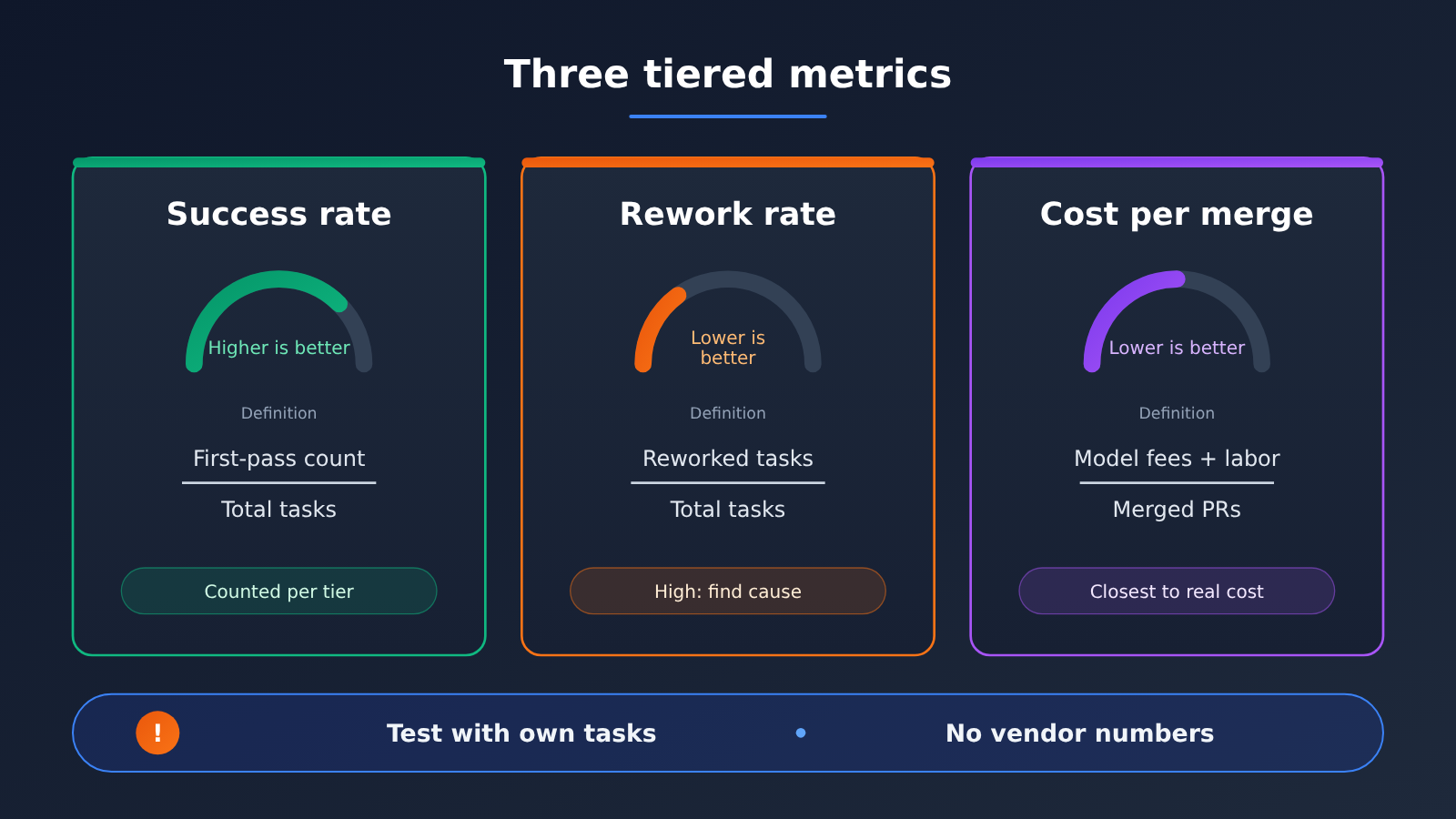
Looking only at token unit price can lead to the wrong conclusion: the lightweight tier is cheaper per call, but if a task takes three rounds of rework, the total cost can end up higher. I recommend tracking these three metrics:
| Metric | How to calculate | Notes |
|---|---|---|
| Success rate | Tasks that pass acceptance on the first try ÷ total tasks | Break it down by tier and by task type |
| Rework rate | Tasks sent back to be redone ÷ total tasks | When it’s high, also check tier assignment, missing context, and how acceptance is defined |
| Cost per merge | (Model invocation cost + labor for review and rework, converted to cost) ÷ number of successfully merged PRs | Closest to real business cost |
Measure these three metrics on your own tasks; don’t just adopt the “efficiency gain percentage” figures vendors or media outlets cite. Results can vary a lot across codebases, languages, and acceptance criteria.
2.7 Pre-Pilot Checks: Data Residency and Permissions for MAI Code 2
Every additional model tier you introduce adds another set of data flows. Before the pilot, I recommend checking at least the following items:
- Data residency: Confirm whether the data processing region for the channel you use (Copilot, Foundry, or a third-party platform) meets the compliance requirements for your industry and region. Flash on Foundry is in restricted preview, and preview terms may differ from the general availability terms.
- Code access permissions: Repository-level inference means the model may be able to read a broader range of code. Limit which repositories and directories it can access, and exclude sensitive content such as secrets and configuration files.
- Organization policies: Whether you can switch models in Copilot, and which models you can switch to, depends on the organization admin’s settings, so confirm this in advance.
- Audit logs: Make sure that for each invocation, the model, requester, and input scope can all be traced, so you can review them afterward.
2.8 Three Things You Shouldn’t Read Too Much Into About MAI Code 2
- Product routing is not the same as the enterprise governance process described in this article. Even if the product you use offers automatic model selection, you still need to independently verify the routing rules, acceptance thresholds, and permissions. Don’t assume that the five-step approach in this article has already been implemented automatically.
- It doesn’t mean Microsoft is abandoning its partnership with OpenAI. Launching an in-house coding model doesn’t lead to the conclusion that Microsoft is dropping OpenAI models, and the available public materials don’t support that inference.
- It doesn’t mean vendor benchmarks can be reused as-is. The performance data and enterprise case studies both come from Microsoft. AT&T and Woven by Toyota are specific customized scenarios, and MAI Work Flash is a separately optimized derivative model. None of their results can be directly transferred to your tasks.
2.9 Signals to Watch After MAI Code 2
What follows are predictive observations that still need to be confirmed by future facts. First, when channels like OpenRouter will actually open up — and what the billing model will look like once they do. Second, when Flash on Foundry will exit its limited preview, and whether the heavy tier will also make its way to Foundry. Third, how much the context limit at the product level differs from the 1.05M stated in the model card — this directly affects whether repository-level tasks can fit into the context in a single pass.
The signal sent by the dual-tier release is pretty straightforward: the value of coding AI isn’t about calling the strongest model every time, but about finding the balance point between cost and quality for each type of task. Register your tasks clearly first, then let the data decide where the dividing line sits — that’s more reliable than chasing any single leaderboard ranking. As The Analects (Book XV, Duke Ling of Wei) puts it: “To do a good job, one must first sharpen one’s tools.”
References
- Microsoft AI: MAI Code 2 and Flash announcement
- Microsoft Foundry: Model choice and enterprise customization
- Official model card for MAI Code 2 and Flash
- Microsoft AI: Enterprise customization case studies
- GitHub: Copilot model pricing and promotion dates


