
Author’s note: The open-source weights for ERNIE-5.5-Flash-Base are now available to download. This article looks at architecture, hardware requirements, intended use, and cost to help you decide whether to deploy the base model yourself or call an API on demand.
On November 5, 2026, Baidu officially released and open-sourced ERNIE-5.5-Flash-Base. This sparse MoE base model has 280B total parameters and activates 14B per token, achieving state-of-the-art results for its size on several benchmarks. The weights are available on Hugging Face in both FP8 and BF16 versions, alongside a vLLM plugin and an SGLang Cookbook. This time, it’s not just a paper without the weights.
This isn’t another benchmark recap. Many teams see “open source + SOTA” and get ready to download the weights and deploy, overlooking one key fact: this is a base model that hasn’t undergone mid-training or post-training. It’s a strong starting point for training, but you can’t use it directly as a chatbot.
What you’ll learn: By the end of this article, you’ll know which use cases suit ERNIE-5.5-Flash-Base, roughly how much GPU memory self-deployment requires, and when calling an API on demand makes more financial sense.
ERNIE 5.5 Flash Base: Key Facts
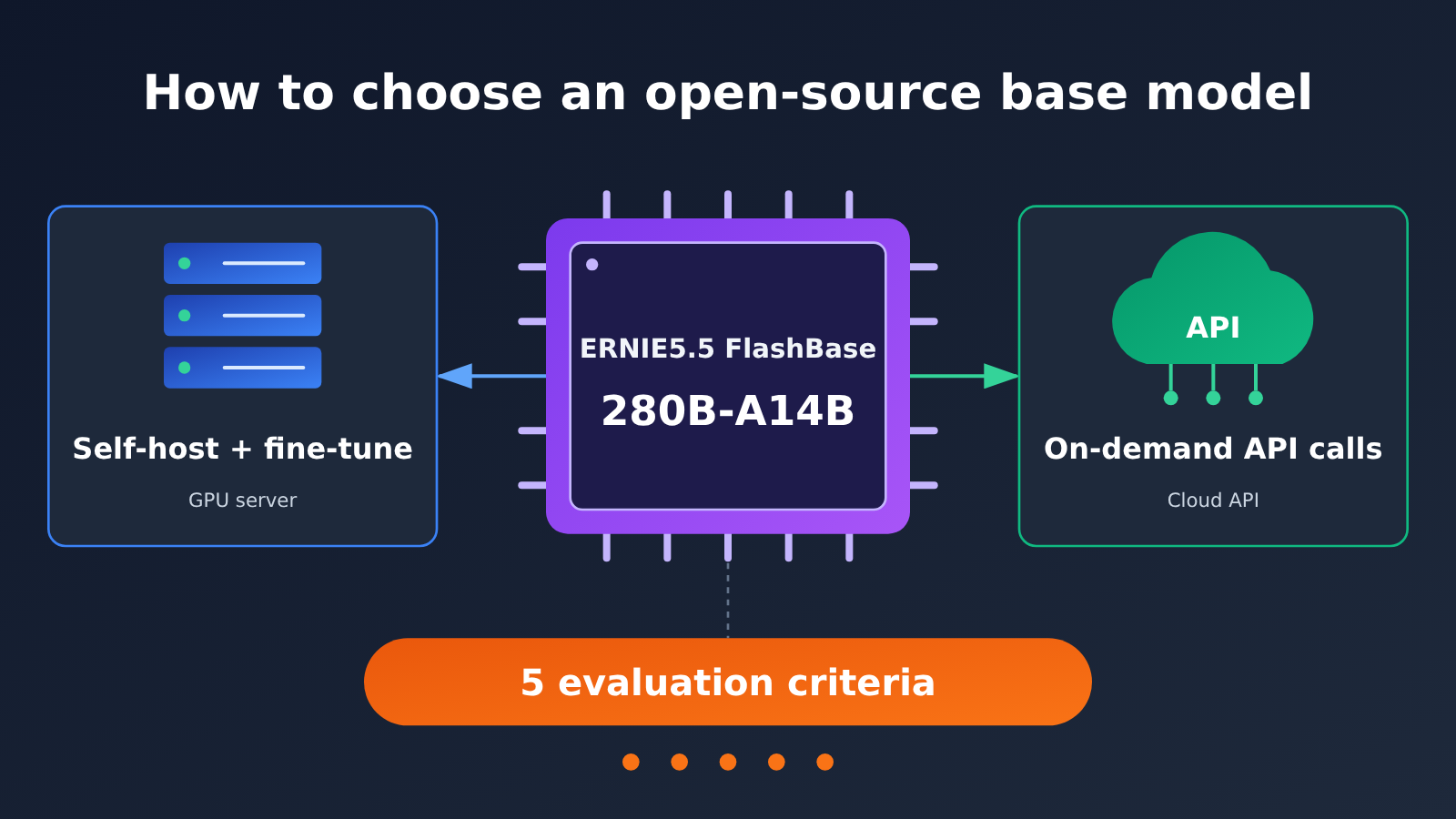
Let’s start with a quick overview of the model. These details will shape your decision to deploy it yourself or access it through an API.
| Key point | Details | What it means for your choice |
|---|---|---|
| Model type | Pretraining checkpoint, with no mid-training or post-training | Not ready for direct conversation; suited to further training |
| Parameter count | 280B total parameters, with 14B activated per token | Lower inference compute, but weight memory requirements are based on 280B parameters |
| Context | 128K training context; up to 1M tokens for fine-tuning and inference | Well suited to domain adaptation for long documents and repository-level code |
| Weight formats | FP8 and BF16 available on Hugging Face | FP8 significantly lowers deployment requirements |
| Ecosystem support | vLLM plugin and SGLang Cookbook | Works with mainstream inference frameworks |
What “Base” Means in ERNIE 5.5 Flash Base
A Base model has learned to predict the next token, but it hasn’t learned to follow instructions and provide answers. Give it a question, and it may generate more questions instead of answering. Baidu puts it clearly: developers can use this shared starting point for domain adaptation, instruction fine-tuning, reasoning enhancement, and agent training.
So the first consideration is straightforward: if you want to use a model, Base isn’t what you’re looking for; if you want to train one, it’s a strong starting point. Baidu has also said that the full release of ERNIE 5.5 Flash is coming soon, so teams that want a model ready for conversation can wait for that release.
ERNIE 5.5 Flash Base’s Similarly Sized Competitors
In Baidu’s published benchmarks, the comparison models include DeepSeek-V4-Flash-Base (284B-A13B), Hy3-preview-Base (295B-A21B), and MiMo-V2.5-Base (310B-A15B). ERNIE 5.5 Flash Base stands out in reasoning, coding, subject-matter knowledge, and long-context tasks. For teams fine-tuning a model for coding agents or long-document understanding, it’s worth adding to the shortlist.
How Wenxin 5.5 Flash Base Works: Three Efficiency Improvements
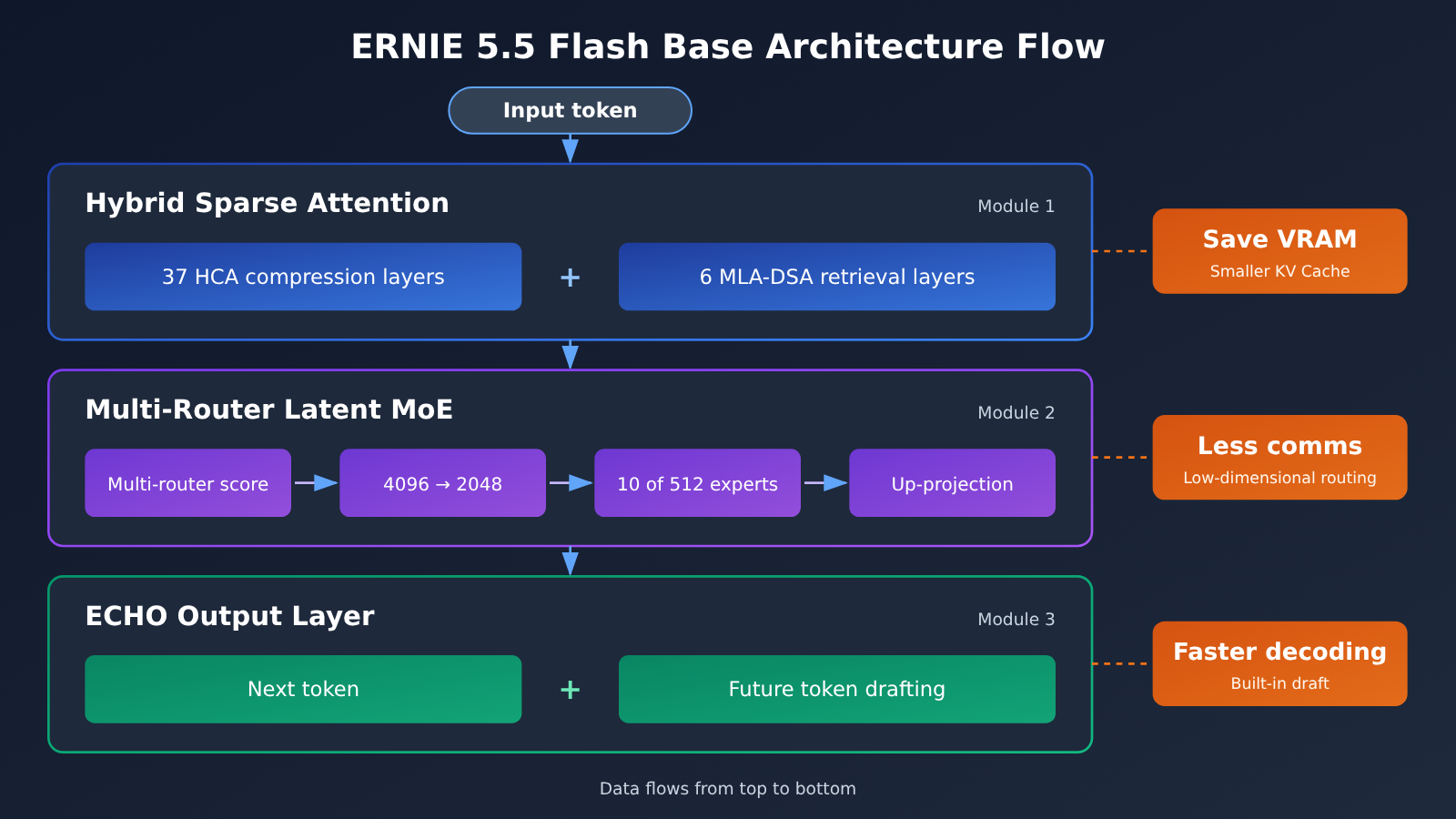
Understanding the architecture helps you estimate deployment costs. The Wenxin team treated efficiency as a design variable during pretraining, focusing on three areas: attention, expert routing, and future-token prediction.
| Module | Key design | Deployment benefit |
|---|---|---|
| Hybrid sparse attention | 37 of 43 layers use HCA (compressing every 128 tokens into one cache entry); 6 layers use MLA + DSA sparse retrieval | Much smaller KV Cache, reducing GPU memory use for long contexts |
| Multi-Router Latent MoE | Multiple Sigmoid routers score experts together; 10 of 512 routed experts are selected, plus 1 shared expert; experts compute in a 2048-dimensional latent space | Expert FLOPs and dispatch communication are roughly halved |
| ECHO | Reuses the backbone’s final layer to predict future tokens | Can serve directly as a built-in draft model for speculative decoding without adding parameters |
| Supporting designs | MultiMax output head and R2L tokenizer with a vocabulary of about 200,000 | More robust handling of numbers and arithmetic |
Why Wenxin 5.5 Flash Base Uses Less KV Cache
Traditional models store a full KV Cache at every layer, putting more pressure on GPU memory as the context grows. Wenxin 5.5 Flash Base lets 37 layers look only at compressed “summaries,” while just 6 layers access history token by token. Those 6 layers use a lightweight Indexer to select the Top-K positions for detailed computation. That means at 128K context and beyond, KV Cache usage is much lower than in a full-attention model of comparable size—a tangible GPU memory saving for teams running their own deployments.
How ECHO Speeds Up Inference
During pretraining, ECHO predicts just 1 additional token. As a draft model, though, it can draft multiple consecutive tokens, with a higher acceptance rate than an external MTP module trained the same way. If your inference framework supports this speculative decoding path, you can get a substantial throughput boost when self-hosting. That’s also an advantage of open weights over an API: you have full control over inference optimizations like these.
Getting Started with Wenxin 5.5 Flash Base: Self-Deployment
If you’re planning to train or run private inference on this base model, here’s the shortest path to getting started. There’s no code in this guide; key parameters are explained in plain language.
Step 1: Estimate GPU Memory Requirements
An MoE model’s compute requirements depend on its activated parameters, but all weights must be loaded. GPU memory requirements are therefore based on the full 280B parameters. The table below provides rough estimates using “bytes per parameter × parameter count.” It excludes KV Cache, activations, and framework overhead, so check the official documentation and test for yourself.
| Weight version | Estimated GPU memory for weights | Deployment recommendation (estimated) | Best suited for |
|---|---|---|---|
| FP8 | About 280GB | A single machine with 8 80GB-class GPUs, leaving room for KV Cache | Inference evaluation, lightweight serving |
| BF16 | About 560GB | A single machine with 8 high-memory GPUs or multi-node tensor parallelism | Precision-sensitive evaluation and a starting point for fine-tuning |
| Full-parameter fine-tuning | Much higher than inference (also requires optimizer states and gradients) | Multi-node cluster with a distributed training framework | Deep domain adaptation |
| LoRA-style fine-tuning | Between inference and full-parameter fine-tuning | Depends on rank and sequence length | Domain adaptation for small and midsize teams |
Step 2: Choose an Inference Framework and Load the Weights
The official release also includes a vLLM plugin and an SGLang Cookbook. We recommend starting with those resources:
- Download the FP8 or BF16 weights from Hugging Face. Reserve roughly as much disk space as the weights require in GPU memory.
- Install vLLM and load the official plugin, or configure the startup parameters using the SGLang Cookbook.
- Match the tensor parallelism size to the number of GPUs (the
tensor-parallel-sizeparameter in vLLM). - Start with a context length of around 32K, then gradually increase it while monitoring KV Cache usage.
- Run a smoke test with a completion-style prompt—for example, give it the beginning of a code snippet and ask it to complete it, rather than asking a direct question.
Step 3: Define Your Training Goal
Once the Base weights are deployed, the real work begins. There are three common paths: continued pretraining on domain-specific data, SFT on instruction data, and reasoning reinforcement or Agent trajectory training on top of SFT. During pretraining, Wenxin was already trained on code-related data such as commits, issues, PRs, and CI-validated fixes, as well as long-form data such as multi-hop question-answering tasks. That makes software engineering and long-document tasks especially promising areas for fine-tuning.
🎯 Technical tip: Before investing GPU resources in fine-tuning, run your business evaluation set against an existing instruction model to establish a baseline score. APIYI apiyi.com provides a unified interface to leading models from multiple providers, so you can establish a comparison baseline at low cost before deciding whether training the base model is worth the investment.
Getting Started with ERNIE 5.5 Flash Base: API Options
First, an important note: APIYI doesn’t currently offer ERNIE models, including ERNIE 5.5 Flash Base, but plans to add them soon. Base models also aren’t well suited for direct use as conversational APIs. Most applications need an instruction-tuned or reasoning model instead.
If you need to integrate these capabilities into a product right away, you can build your workflow with an established model that’s already available, then switch models and compare results once the production version of ERNIE 5.5 Flash launches. APIYI supports both OpenAI and Anthropic API formats, so switching models only requires changing the model parameter, not rewriting your invocation logic.
Pricing for Available Alternatives on APIYI
The prices below are based on APIYI’s pricing page at docs.apiyi.com/models and are in US dollars per million tokens. Check the page for the latest prices before making calls.
| Model | Input | Output | Cache | Best for | Availability |
|---|---|---|---|---|---|
| deepseek-v4.1-flash | $0.3 | $1.2 | $0.006 | High-concurrency, cost-sensitive tasks | APIYI apiyi.com |
| kimi-k3.1-pro | $2 | $10 | $0.2 | Long-context and Chinese-language tasks | APIYI apiyi.com |
| claude-sonnet-5-5 | $2 | $10 | $0.1 | Core coding and Agent tasks | APIYI apiyi.com |
| claude-opus-5-5 | $4 | $20 | $0.2 | Complex reasoning and difficult tasks | APIYI apiyi.com |
| ERNIE 5.5 Flash Base / production version | — | — | — | Not currently available on APIYI | Coming soon |
APIYI also offers Chinese-developed models such as the qwen3.8 series, as well as the gpt-image-2.6-flare and gpt-image-2.6-sunburst image models ($5 for text input, $8 for image input, and $30 for output; check the pricing page for current rates). Note that deepseek-v4.1-flash in the table is an instruction model available for direct use. It isn’t the same model as DeepSeek-V4-Flash-Base, which was included in the benchmark comparison.
Integration
For the OpenAI format, set the SDK’s base_url to the endpoint provided in the APIYI documentation and set api_key to the key generated in the console. Projects using the Anthropic SDK can also connect directly. For the full endpoint URLs, parameter details, and examples, see the APIYI documentation center at docs.apiyi.com.
🚀 Quick start: Try building a working prototype with deepseek-v4.1-flash or claude-sonnet-5-5 on APIYI at apiyi.com. Once the production version of ERNIE 5.5 Flash becomes available on the platform, you can run an A/B comparison by changing just the model name.
ERNIE 5.5 Flash Base: Self-Deployment vs. API Calls
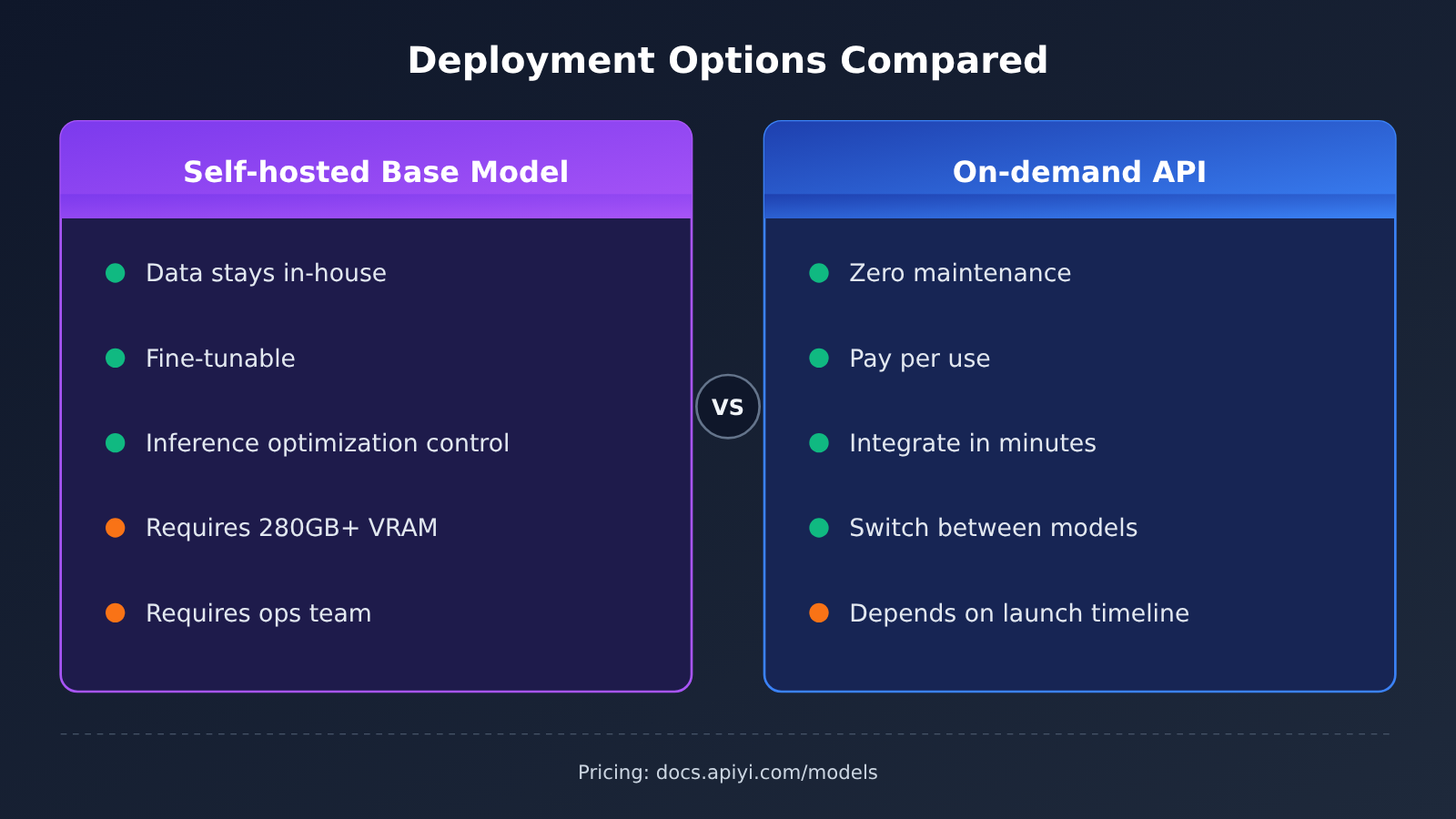
The table below compares five factors to help you decide which approach fits your team.
| Decision factor | Choose self-deployed Base | Choose on-demand API calls |
|---|---|---|
| Use case | Domain-adaptive continued pretraining, SFT, RL, or controlled research experiments | Ready-to-use applications such as Q&A, writing, and coding assistants |
| Data compliance | Data must stay within the internal network; private deployment is required | Cloud processing is acceptable, along with the provider’s compliance terms |
| Usage volume | Sustained high workloads with consistently high GPU utilization | Variable traffic or limited daily call volume |
| Team capabilities | Engineers are available to manage training and inference operations | The team focuses on application development and doesn’t want to maintain a cluster |
| Time to launch | A training cycle of several weeks to months is acceptable | You need to launch this week |
Two Typical ERNIE 5.5 Flash Base Users
Teams suited to self-deployment: These include teams in finance, healthcare, government, and enterprises with private deployment requirements. They have substantial domain-specific corpora and want to train a dedicated model. They choose ERNIE 5.5 Flash Base for its pretrained foundation in code and long-context tasks, as well as the KV Cache savings offered by the HCA architecture.
Teams suited to API calls: These include application teams building SaaS products, content tools, or customer service systems. They need reliability, speed, and usage-based pricing. Starting directly with a Base model would add an unnecessary training step. A better approach is to launch with a mature instruction-tuned model and focus on the product.
The Two Approaches Can Run in Parallel
Many teams use a hybrid approach: they call an API for production stability while experimenting internally with Base weights. Once their self-trained model outperforms the API baseline on evaluation datasets, they gradually shift traffic over. This minimizes risk and gives their in-house development work a clear benchmark.
💡 Recommendation: If you’re still unsure, start with the numbers: use the unit prices on the APIYI pricing page to calculate your estimated monthly API cost, then compare it with GPU rental or depreciation costs. Run a small-scale trial for a week through the unified interface at APIYI apiyi.com. Making a decision based on actual token usage will be much more accurate than estimating by feel.
Frequently Asked Questions (FAQ)
Q1: What is ERNIE 5.5 Flash Base?
It’s a base model open-sourced by Baidu on November 5, 2026. It uses a sparse MoE architecture with 280B total parameters, activating 14B per token, and was pretrained from scratch on 33.5T tokens. The released weights are from the end of pretraining and are intended primarily for further training, not direct conversation.
Q2: How does ERNIE 5.5 Flash Base differ from DeepSeek-V4-Flash-Base?
The two are similar in size, with DeepSeek-V4-Flash-Base at 284B-A13B. DeepSeek-V4-Flash-Base is also a strong foundation model, but according to Baidu’s published evaluations, ERNIE 5.5 Flash Base leads in reasoning, coding, academic subjects, and long-context tasks. Architecturally, ERNIE combines HCA and MLA attention with multi-router MoE, placing greater emphasis on compressing the KV Cache and improving routing robustness.
Q3: When will the final version of ERNIE 5.5 Flash be released?
Baidu says the final version will be released soon, but as of this writing (November 6, 2026), it hasn’t provided a specific date. The final version will build on Base with post-training, making it better suited for direct integration into applications.
Q4: What is ERNIE 5.5 Flash Base best suited for?
It’s mainly suited to the following use cases:
– **Repository-level code model training**: Its pretraining data includes engineering data such as commits, PRs, and CI fixes.
– **Domain models for long documents**: Examples include long-context understanding of legal case files and research reports, with support for 1M tokens in fine-tuning and inference.
– **Training method research**: It provides a common starting point for comparing different SFT and RL strategies.
Q5: Can I access ERNIE 5.5 Flash Base through an API now?
APIYI doesn’t currently offer this model or the ERNIE series, but we’ll make them available as soon as possible. For now, you can access models already available on APIYI at apiyi.com, including deepseek-v4.1-flash, kimi-k3.1-pro, and claude-sonnet-5-5. The platform supports OpenAI and Anthropic API formats. See docs.apiyi.com/models for pricing.
Q6: What are the limitations of self-hosting ERNIE 5.5 Flash Base?
First, GPU memory requirements are high: even with FP8 weights, the weights alone need approximately 280GB. Second, the Base model isn’t ready to use out of the box and requires further training. Third, long-context inference still needs space reserved for the KV Cache. If your team lacks training and operations experience, consider starting with an API instead.
Q7: What can small and midsize teams do with ERNIE 5.5 Flash Base?
You can rent cloud GPUs to run FP8 inference and evaluate its capabilities, or use LoRA-style methods for lightweight domain adaptation. For production traffic, an API is still recommended. You can use the application baseline established through APIYI at apiyi.com as a benchmark for your self-trained model.
ERNIE 5.5 Flash Base Key Takeaways
- Built as a training starting point: Base hasn’t undergone post-training, so it’s suited to fine-tuning and research, not direct conversation.
- Compute scales with activated parameters; memory with total parameters: Only 14B parameters are activated, but FP8 weights still require approximately 280GB of GPU memory.
- Long contexts use less cache: 37 HCA compression layers and 6 MLA-DSA layers significantly reduce the KV cache.
- Strong foundation for code and long documents: It’s well suited to building domain-specific models for repository-level code and long documents.
- The ecosystem is ready: A vLLM plugin and SGLang Cookbook were released alongside the model, making inference integration easier.
- Not yet available via API: APIYI hasn’t launched the ERNIE series yet, but you can use available models to establish a business baseline.
Summary
The key considerations when choosing ERNIE 5.5 Flash Base:
- Start with your goal: If you want to train a model, self-deploy Base. If you want to use a model, choose an API or wait for the official release.
- Calculate the requirements: Weight memory requirements of approximately 280GB for FP8 and 560GB for BF16 are hard constraints.
- Run the numbers: Compare monthly API fees with GPU costs based on your actual usage. A hybrid approach carries the least risk.
For most application teams, the most practical path is to get the business running through an API first, then experiment internally with the open-source Base model. We recommend using available models through APIYI at apiyi.com to quickly establish a baseline. See docs.apiyi.com for API documentation and docs.apiyi.com/models for pricing. Once the ERNIE series is available, you can compare it using the same code by changing the model name.
📚 References
- QbitAI – Report on Baidu’s Open-Source ERNIE 5.5 Flash Base: An overview of the model release and benchmarks
- Link:
qbitai.com/2026/11/507787.html -
Notes: Includes comparisons with similarly sized base models and an introduction to the core technology
-
APIYI Documentation Center: API endpoints and instructions for OpenAI- and Anthropic-compatible calls
- Link:
docs.apiyi.com -
Notes: Essential reading before integration, with parameters and examples
-
APIYI Model Pricing Page: Input, output, and cache pricing for available models
- Link:
docs.apiyi.com/models - Notes: All prices in this article are subject to the current figures on this page
Author: APIYI Technical Team
Technical discussions: Contact us through the APIYI homepage at apiyi.com. For more integration resources, visit the documentation center at docs.apiyi.com.


