
Author’s note: Brockman confirmed that more than half of OpenAI’s revenue now comes from enterprise business. This article traces how that shift happened and what it means for enterprise buyers and developers.
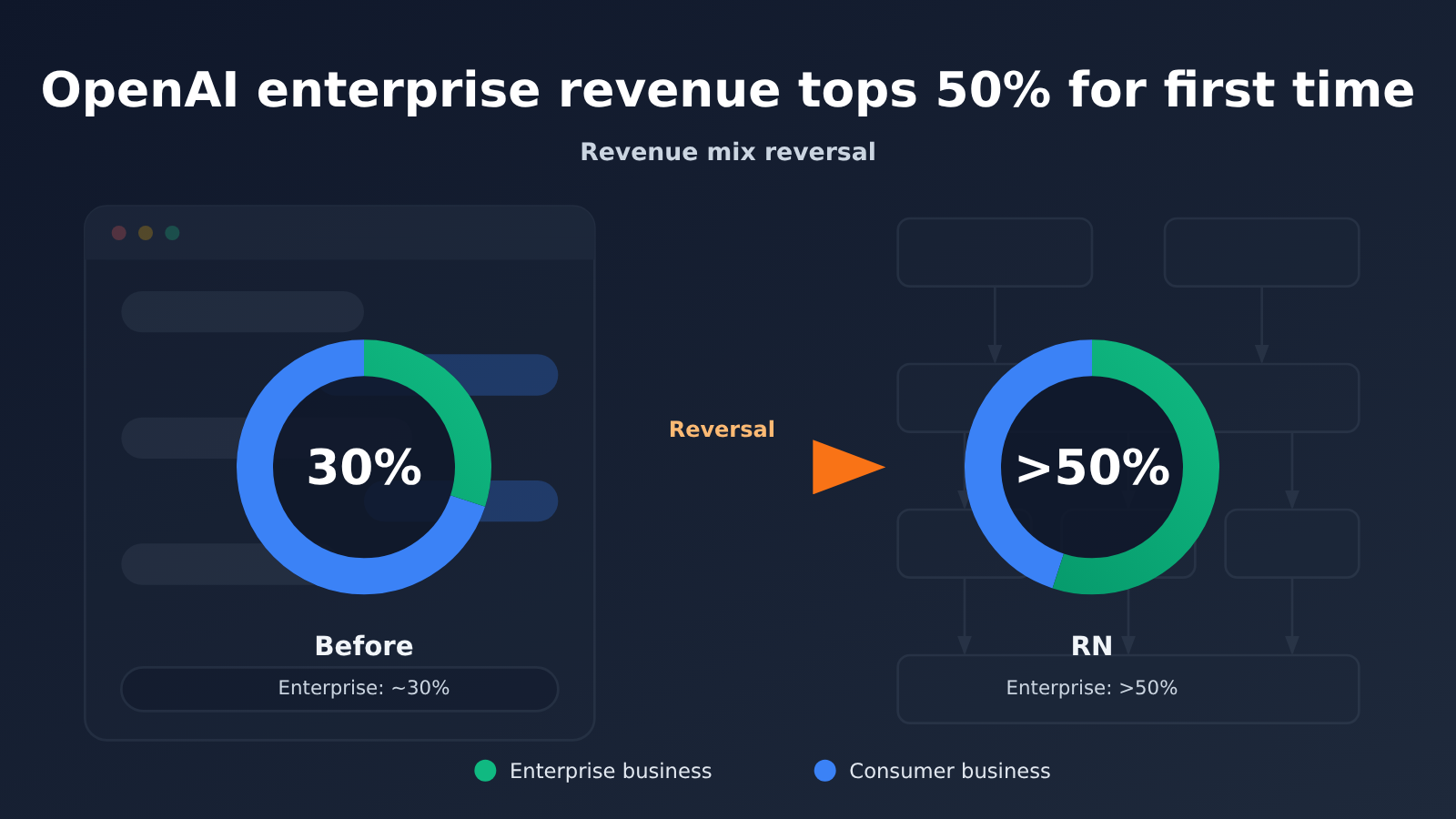
On November 4, 2026, OpenAI co-founder and president Greg Brockman revealed at The Wall Street Journal’s Tech Live conference that more than half of OpenAI’s revenue now comes from enterprise business. He recalled that the revenue split between enterprise and consumer business used to be roughly 30/70. Enterprise business has now become the company’s largest source of revenue.
This doesn’t mean OpenAI is abandoning consumers. Brockman stressed at the event that consumer revenue hasn’t declined—it’s still growing. Enterprise revenue is simply growing faster. Reuters, TechCrunch, and WSJ all reported on his remarks on November 5.
Key takeaway: This article traces the timeline behind the shift in OpenAI’s revenue mix, clears up several easily confused metrics, and examines why enterprise AI is becoming the most important revenue engine for AI model companies.
OpenAI Gets Over Half Its Revenue From Businesses: Key Facts
Here’s a quick look at the key facts from the disclosure. Note that Brockman said only “more than half”—he didn’t give an exact percentage.
| Item | Details |
|---|---|
| Disclosure date | November 4, 2026 (U.S. local time); reported November 5 |
| Venue | Wall Street Journal Technology Conference in Napa, California |
| Speaker | Greg Brockman, OpenAI co-founder and president |
| Key takeaway | Business revenue accounts for more than half of total revenue, up from around 30% |
| Consumer business | Revenue is still growing, but more slowly than business revenue |
| Third-quarter performance | Annualized revenue run rate grew about 70% quarter over quarter, while the business segment doubled in size |
| New partnership | Partnership with JPMorgan Chase involving Codex and cybersecurity models |
| IPO comments | Asked whether OpenAI could be ready for an IPO in 2027, Brockman replied, “I think so” |
Two details are worth emphasizing. First, the 70% figure refers to quarter-over-quarter growth in the annualized revenue run rate—not a 70% increase in audited quarterly revenue. Second, “I think so” means only that Brockman believes the company could be ready to go public in 2027. It doesn’t mean an IPO date has been set or an application filed.
Timeline: The Shift in OpenAI’s Revenue Mix
Business revenue didn’t become the majority overnight. OpenAI’s official announcements and media reports show a gradual shift over roughly a year.
| Date | Milestone | Source |
|---|---|---|
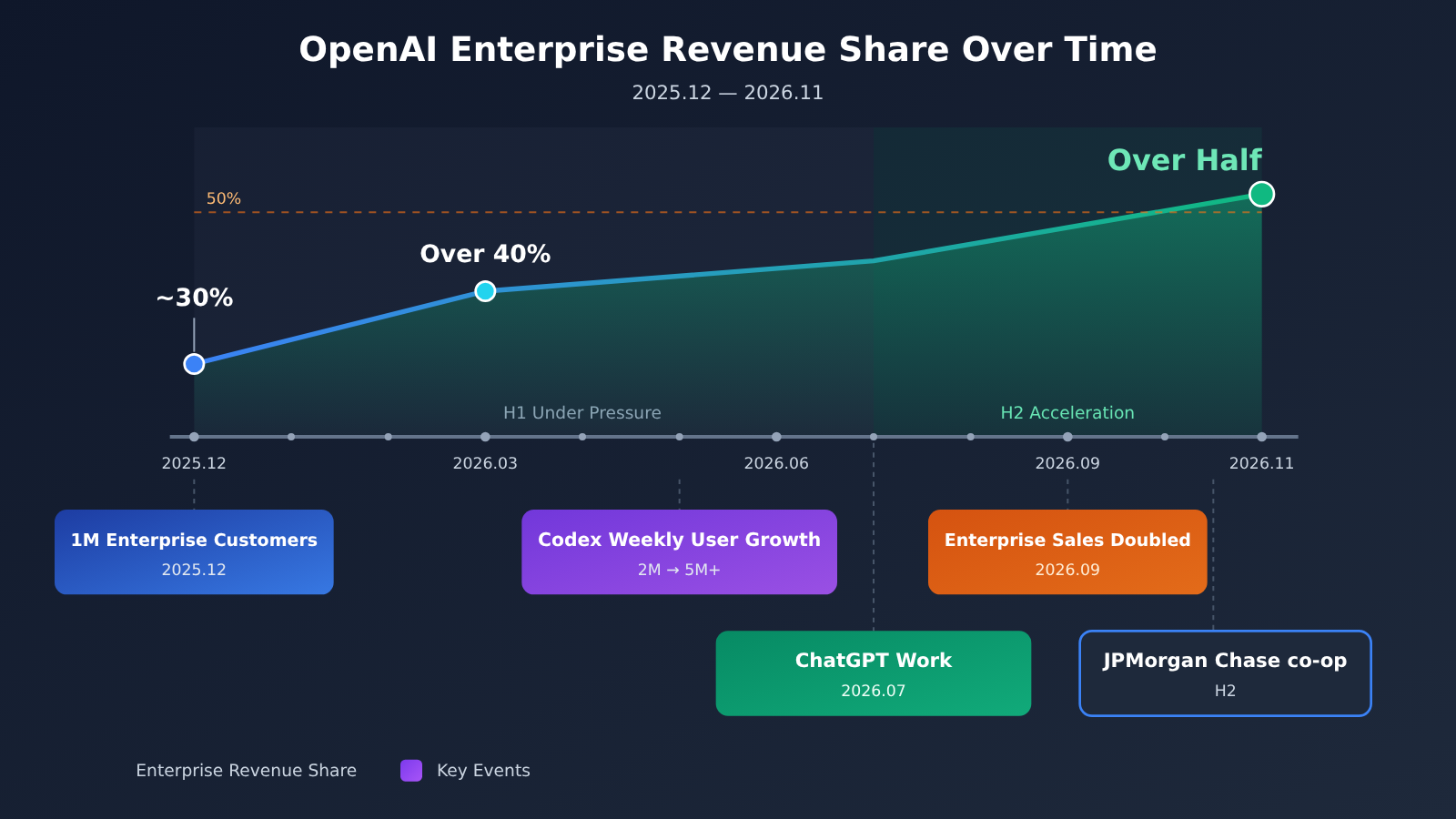
| 2025-12-17 | More than 1 million business customers use its tools, with over 7 million Workplace seats | OpenAI enterprise AI report |
| 2026-03-31 | Business revenue accounts for more than 40% of the total, with parity with consumer revenue expected by year-end | OpenAI funding announcement |
| 2026-04-08 | Chief revenue officer confirms business revenue is still above 40%; Codex has 3 million weekly active users | OpenAI official blog |
| 2026-07-09 | ChatGPT Work officially launches | OpenAI |
| 2026-09-29 | Business sales have more than doubled since July | Reuters |
| 2026-11-04 | Business revenue officially surpasses consumer revenue | Brockman’s public remarks |
In March, OpenAI expected business and consumer revenue to reach parity by the end of the year. In fact, business revenue crossed the halfway mark in early November. That suggests third-quarter business growth exceeded the company’s own expectations from earlier in the year.
Before OpenAI’s Enterprise Revenue Rebound: Competitive Pressure in the First Half
To understand this shift in revenue mix, we need to look beyond the outcome and consider what OpenAI went through in the first half of the year. Brockman acknowledged that OpenAI struggled in the enterprise market during the first and second quarters of 2026. The WSJ headline called that period “Rough.”
The main challenge was agentic coding. Brockman said that although OpenAI already had Codex, it had little presence in the market and wasn’t getting enough attention. Coding is one of the areas where enterprise AI spending is most concentrated: Menlo Ventures estimated the 2026 market for AI coding applications at around $34 billion.
Three Drivers of the Third-Quarter Rebound
Brockman attributed the third-quarter turnaround to several key factors, while emphasizing that it was the result of sustained investment, not an overnight change:
- Model upgrade: The release of GPT-5.6 Sol made the model more useful in enterprise settings.
- ChatGPT Work launch: It shifted ChatGPT from a question-and-answer assistant to an agent that can carry out multistep tasks and deliver complete documents and reports.
- Enterprise sales expansion: Codex Labs, partnerships with seven global systems integrators, and the OpenAI Partner Network launched in June.
Codex’s user growth also points to that shift. According to publicly released figures, Codex grew from 2 million weekly active users at the end of March to more than 5 million in early June. Enterprise knowledge workers accounted for around one-fifth of those users and were growing more than three times as fast as the developer user base. It’s worth noting that 5 million is the public figure from June, not the latest figure for November.
OpenAI’s Enterprise Revenue and Its Competition With Anthropic: Don’t Confuse the Metrics
When discussing OpenAI’s enterprise revenue, it’s easy to compare figures that measure different things. At least four kinds of data are publicly available, and each tells a different story.
| Data | What it measures | What it doesn’t mean |
|---|---|---|
| Enterprise accounts for over half of revenue (Brockman) | OpenAI’s own revenue mix | OpenAI’s share of the enterprise market |
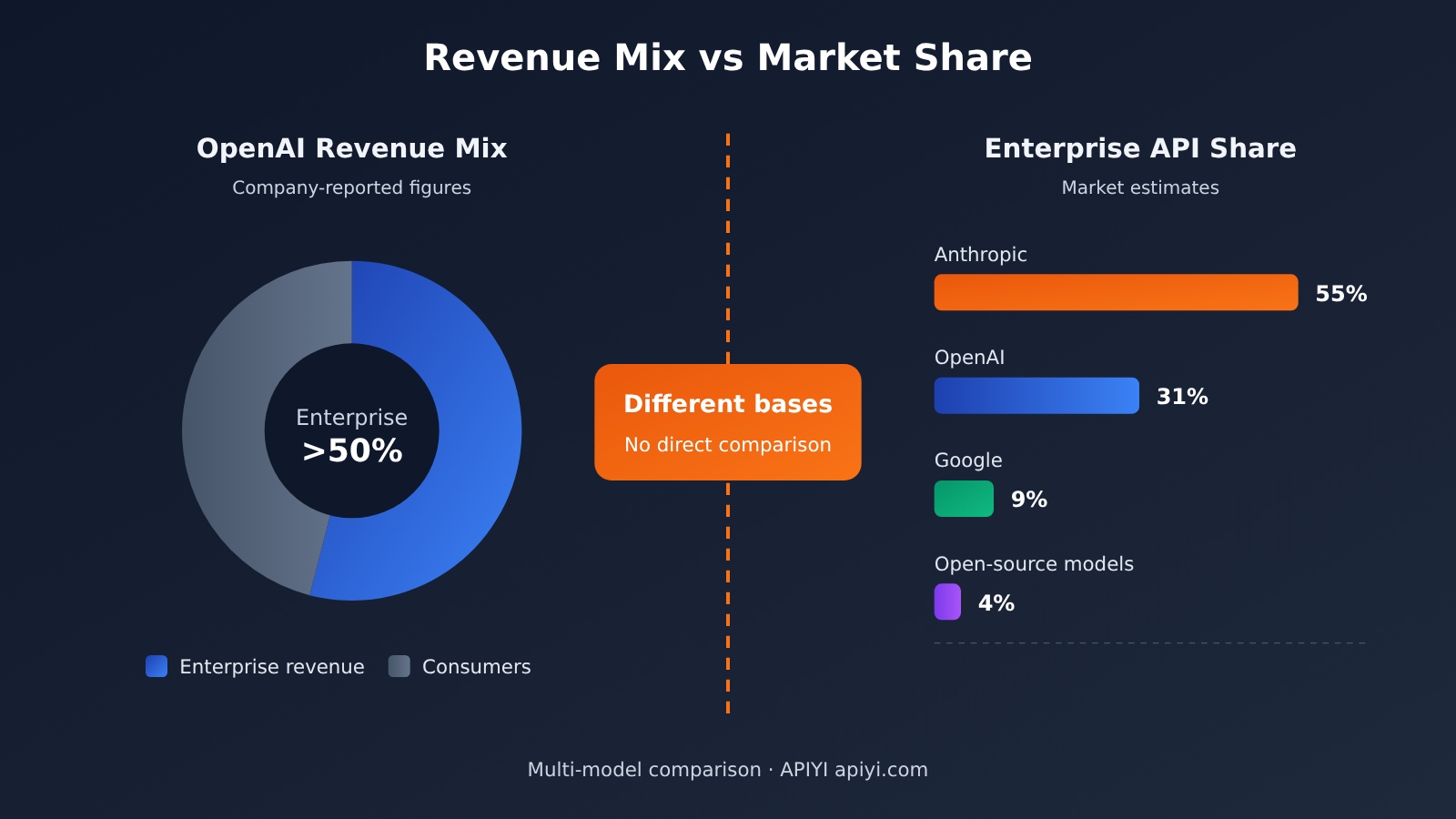
| Enterprise API spending share: Anthropic 55%, OpenAI 31% (Menlo) | Estimated vendor distribution of enterprise LLM API spending in production | Enterprise’s share of OpenAI’s revenue |
| Joint customers’ spending shifted from roughly 3:1 to about even (WSJ) | How companies using both vendors’ products split their spending between them | Overall enterprise AI market share |
| Agents account for about 80% of token consumption (OpenRouter) | The traffic mix on one model aggregation platform | Usage patterns across the entire industry |
Together, these figures offer a more complete picture of the competition. In enterprise API spending, Menlo estimates that Anthropic still leads, with its share rising from 40% the previous year to 55%. OpenAI’s share rose from 27% to 31%. But according to WSJ, among companies buying products from both vendors, Anthropic took roughly three-quarters of their combined spending at the start of the year. By September, the split was roughly even—a clear improvement in OpenAI’s competitive position.
These figures aren’t contradictory. The first is an annual estimate for the overall market; the second tracks changes within a specific customer group. Together, they show how quickly OpenAI was catching up in the second half of the year.
Two Annualized Revenue Figures: $50 Billion and $70 Billion
OpenAI’s annualized revenue is another figure that’s easy to misread. In late September, Reuters reported that OpenAI’s annualized revenue run rate was approaching $70 billion. In October, it reported that the September figure was close to $50 billion. That doesn’t mean revenue had “shrunk” by $20 billion.
The difference comes from how revenue through cloud platform partners is accounted for. OpenAI records only its own share of some sales through cloud partners, while Anthropic’s approach may record the full amount paid by customers as revenue and then count the cloud platform’s share as an expense. The earlier $70 billion figure presented to investors used a similar “gross” treatment to make it easier to compare with Anthropic. Also, an annualized revenue run rate extrapolates a full-year figure from revenue in a given period; it isn’t the same as actual full-year revenue.
OpenAI Enterprise Revenue Analysis: Why Companies Don’t Choose a Single Vendor
JPMorgan Chase is a useful example of how enterprises buy AI. At the conference, Brockman announced a partnership between OpenAI and JPMorgan Chase involving Codex and OpenAI’s cybersecurity models for enterprise transformation, knowledge work, and internal security. Additional reporting shows that JPMorgan Chase is also working with Anthropic on cybersecurity.
This shows that enterprise AI procurement isn’t a zero-sum choice between two vendors. Companies buy products from different providers based on the task, model capabilities, and security requirements. For model providers, winning a major enterprise customer doesn’t mean capturing its entire budget. For enterprises, a multi-vendor strategy is a standard way to reduce risk and optimize costs.
What This Means for Developers
- Multiple models are becoming the norm: A single enterprise project may use models from different providers for coding, security, and knowledge Q&A. Developers need to be able to switch between and compare them quickly.
- Cost management matters more: Menlo data shows that actual enterprise AI spending averaged 4.7 times the previous year’s level, while companies had expected only a 1.9-fold increase. Parallel agents and continuous background operation are among the main reasons for budget overruns.
- Quality oversight can’t be skipped: Axios reports that managing multiple agent workflows at once creates oversight challenges. Data and code produced by agents still need expert review.
For teams that need to use multiple models, a unified interface can significantly reduce switching costs. Here’s a minimal example of calling a model through an OpenAI-compatible interface:
import openai

client = openai.OpenAI(
    api_key="YOUR_API_KEY",
    base_url="https://api.apiyi.com/v1"  # APIYI unified interface, OpenAI-compatible
)

response = client.chat.completions.create(
    model="gpt-6.1-sol",  # Check the platform's model list for the model ID
    messages=[{"role": "user", "content": "总结本周销售会议的三个待办事项"}]
)
print(response.choices[0].message.content)
View the full code for comparing models and tracking usage
import time
import openai

client = openai.OpenAI(
    api_key="YOUR_API_KEY",
    base_url="https://api.apiyi.com/v1"  # Call models from multiple providers with one key
)

# Check the platform's model list for model IDs; you can substitute Claude, Gemini, and others
MODELS = ["gpt-6.1-sol", "gpt-6.1-terra", "claude-sonnet", "gemini-pro"]

def compare_models(prompt: str):
    """Call multiple models on the same task and record latency and token usage for cost assessment."""
    results = []
    for model in MODELS:
        start = time.time()
        try:
            resp = client.chat.completions.create(
                model=model,
                messages=[{"role": "user", "content": prompt}],
                max_tokens=800
            )
            results.append({
                "model": model,
                "latency": round(time.time() - start, 2),
                "input_tokens": resp.usage.prompt_tokens,
                "output_tokens": resp.usage.completion_tokens,
                "answer": resp.choices[0].message.content[:120]
            })
        except Exception as e:
            results.append({"model": model, "error": str(e)})
    return results

for r in compare_models("审查这段权限校验逻辑是否存在越权风险:..."):
    print(r)
🚀 Get started: If your team is deciding which models to use for different tasks, consider applying for free testing credits through APIYI at apiyi.com. Use the same code to compare OpenAI, Claude, and Gemini on real business data and token costs before deciding on your vendor mix.
How OpenAI’s Enterprise Revenue Grows: From Seats to Workflows
Why can enterprise revenue grow faster than consumer revenue? The key is that it comes from more than one source. The reference material breaks it down into direct purchases, development and API usage, and workflow deployment, with ecosystem integration providing another route to adoption.
| Revenue layer | Typical form | Revenue drivers |
|---|---|---|
| Direct purchases | ChatGPT Business ($20/user/month for Standard when billed annually), custom Enterprise pricing | Number of seats, seat tiers |
| Development and API usage | In-house enterprise applications billed by token through the API | Usage volume, model tier |
| Workflow deployment | Codex, Work, and Agents connected to code repositories, office software, and security systems | Number of tasks, degree of parallelism, duration |
| Ecosystem and integration | System integrators and the Partner Network supporting production deployments | Number of business processes covered |
The ceiling for consumer subscriptions is relatively clear: a user pays anywhere from $8 to $200 per month. Enterprise revenue, on the other hand, depends on two multipliers: the number of customers and how deeply each customer uses the products. A company might start by buying a few hundred seats, then have its development team use Codex and its internal systems invoke models through the API. Eventually, it could have Agents running tasks continuously in the background.
Agents are also changing how tokens are consumed. Menlo cites OpenRouter data showing that Agents now account for roughly 80% of token consumption on the platform. Agent traffic has grown about 37-fold since it overtook human-driven traffic in February 2026, while human traffic grew about fivefold over the same period. These figures represent only OpenRouter, a developer-focused platform, and can’t be directly applied to the entire industry. Still, the trend is worth watching: token consumption is shifting from being driven by user count to being driven by task volume.
Why Enterprise Buyers Place More Weight on Governance
ChatGPT Enterprise is more than a bulk purchase of individual Plus accounts. It includes management controls such as SCIM, EKM, and RBAC, data residency in ten regions, SLAs, custom legal terms, and a commitment not to use enterprise data to train models by default. In the JPMorgan Chase case, Brockman specifically emphasized financial institutions’ high expectations for trust, security, and reliability—a point that illustrates why these capabilities matter.
Customer cases can offer another point of reference. An OpenAI-published Credit Saison case study reported a 954% ROI from a ChatGPT Enterprise pilot involving 315 participants, with each person saving about 14 hours per month. However, these figures were self-reported by the company and published by OpenAI. They aren’t the findings of an independent audit and don’t represent an industry average.
The table below lists selected public prices for OpenAI’s official API in Standard mode, as a reference for estimating usage costs:
| Model | Input ($/million tokens) | Output ($/million tokens) | Use cases | Available platforms |
|---|---|---|---|---|
| GPT-6 Astra | $10 | $50 | Advanced reasoning, complex analysis | Official OpenAI platform, APIYI apiyi.com |
| GPT-6.1 Sol | $2 | $10 | General enterprise tasks, programming | Official OpenAI platform, APIYI apiyi.com |
| GPT-6.1 Terra | $1 | $5 | High-frequency business processes | Official OpenAI platform, APIYI apiyi.com |
| GPT-6 Luna | $0.10 | $0.50 | Batch classification, lightweight Agent subtasks | Official OpenAI platform, APIYI apiyi.com |
Modes such as Fast and Flex/Batch, as well as long contexts and cache writes, affect actual costs. API usage and ChatGPT subscriptions are also billed separately.
Frequently Asked Questions
Q1: Does OpenAI earning more than half its revenue from businesses mean it’s abandoning consumers?
No. Brockman has made it clear that consumer revenue is still growing; enterprise revenue is just growing faster. Reuters sources also said OpenAI’s consumer revenue in the third quarter exceeded its consumer revenue for all of 2025. ChatGPT Work and Codex are also available to individual paying users.
Q2: Does OpenAI earning over half its revenue from businesses contradict Menlo’s 31% market share estimate?
No. They measure different things. “Over half” refers to the share of OpenAI’s own revenue that comes from businesses. The 31% figure is Menlo’s estimate of OpenAI’s share of spending across the entire enterprise API market. One describes OpenAI’s revenue mix; the other describes market share.
Q3: Are all 2 million Business Customers listed on OpenAI’s website paying enterprise customers?
Not necessarily. The figure refers to the number of Business Customers using OpenAI; it doesn’t mean there are 2 million paying Enterprise customers. OpenAI hasn’t published separate revenue figures for Business, Enterprise, API, or Codex either.
Q4: How can small and midsize teams try enterprise-grade model capabilities on a budget?
You don’t need to sign an Enterprise contract right away. Start by testing a business use case on a small scale through an API. For example, you can use the free testing credits at APIYI apiyi.com to run a specific workflow through an OpenAI-compatible interface, then scale up once you’ve assessed the results and costs.
Q5: Is it complicated for a business to use both OpenAI and Claude?
If you integrate with each provider directly, you’ll need to manage multiple SDKs, billing accounts, and API keys. A simpler option is an aggregation platform: at APIYI apiyi.com, you can access OpenAI, Claude, Gemini, and other models with a single API key. Just change the model parameter to switch between them, making it easier to run A/B comparisons and assign models to different tasks.
Q6: What should businesses watch out for when deploying agents?
The main concerns are cost and quality. Running agents in parallel or in the background can push spending over budget, so usage monitoring is essential. Agent-generated data analysis and code can also contain errors, so keep a professional review step in the process.
OpenAI Enterprise Revenue: Key Takeaways
- Revenue mix has flipped: Enterprise business grew from roughly 30% to more than half of revenue, while consumer revenue continues to grow.
- A tough first half: OpenAI had little presence in agentic coding, but rebounded in the third quarter with Work and Codex.
- Keep the metrics separate: OpenAI’s own revenue mix, API market share, and spending by shared customers are three different things.
- Multi-vendor is the norm: JPMorgan Chase works with both OpenAI and Anthropic; procurement isn’t a zero-sum game.
- Growth depends on depth: Seats, APIs, agents, and workflows all add up. How deeply customers use them determines enterprise revenue.
- Getting started: Use APIYI apiyi.com’s free credits to run a small-scale test before deciding on your vendor mix.
Summary
For the first time, enterprise business accounts for more than half of OpenAI’s revenue. It’s a sign that ChatGPT is expanding beyond a consumer product to become infrastructure businesses rely on for day-to-day operations. The shift comes down to three things:
- Enterprise revenue has a multiplier effect: Beyond customer count, what matters is how deeply each customer uses the products and how many workflows they cover.
- Agents change the billing model: Token consumption is increasingly tied to task volume, not just the number of users.
- Competition remains intense: Anthropic still leads in enterprise API spending, OpenAI is catching up quickly, and businesses are happy to use multiple providers.
For developers and enterprise technology teams, it’s better to build the ability to choose models by task and evaluate costs using data than to bet on a single vendor. Try APIYI apiyi.com to quickly test how different models perform in your business scenarios. The platform offers an OpenAI-compatible interface and free credits for new users.
📚 References
- Reuters – Brockman on Enterprise Revenue and IPO Readiness: Reported 2026-11-05
- Link:
reuters.com/legal/transactional/openai-ready-ipo-2027-now-counts-majority-sales-enterprises-brockman-says-2026-11-05 -
Details: Original report on enterprise revenue exceeding half of sales and Brockman’s comments on IPO readiness
-
WSJ – OpenAI’s Coding Business Took Off After a Tough First Half: Reported 2026-11
- Link:
wsj.com/tech/openai-had-rough-first-half-of-year-before-coding-takeoff-brockman-says-6c97d9e5 -
Details: Competitive pressure in the first half and changes in spending by shared customers
-
Reuters – OpenAI’s Annualized Revenue Nears $50 Billion in September: Reported 2026-10-08
- Link:
reuters.com/business/openais-annualized-revenue-20-billion-less-than-previously-signaled-ft-reports-2026-10-08 -
Details: Explanation of the difference between the $50 billion and $70 billion figures
-
OpenAI – The next phase of enterprise AI: Official blog
- Link:
openai.com/index/next-phase-of-enterprise-ai -
Details: Enterprise revenue exceeding 40% of the total and information on customer expansion
-
Menlo Ventures – 2026 The State of Enterprise AI: Industry report
- Link:
menlovc.com/perspective/2026-the-state-of-enterprise-ai -
Details: Estimates of enterprise AI spending and API market share
-
OpenAI – Credit Saison Customer Story: Published 2026-10-29
- Link:
openai.com/index/credit-saison - Details: Enterprise pilot ROI case study (self-reported company data)
Author: APIYI Technical Team
Technical discussions: Visit the APIYI homepage at apiyi.com to contact us. For more integration resources, check out the documentation center at docs.apiyi.com.


