
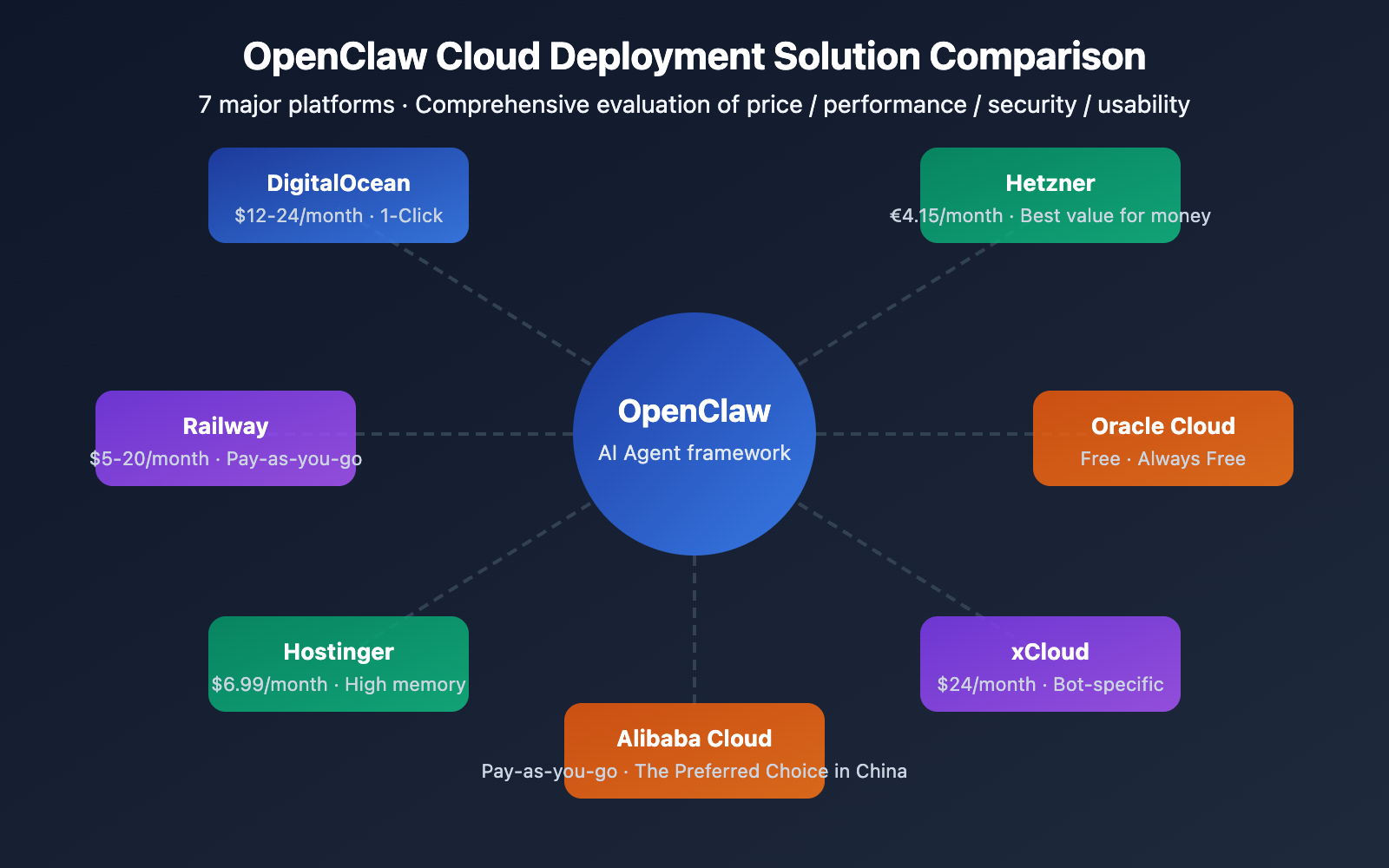
OpenClaw, as an open-source AI Agent framework, supports deployment across various cloud platforms. But with so many options like DigitalOcean, Hetzner, Railway, and Oracle Cloud, how do you find the most cost-effective OpenClaw cloud deployment solution?
This article systematically compares 7 mainstream OpenClaw cloud deployment platforms across four dimensions: price, performance, security, and ease of use, to help you make a quick decision.
🎯 Quick Decision: If your need is just to call AI model APIs rather than deploying a full Agent, APIYI apiyi.com provides ready-to-use unified API interfaces. You don't need to build your own server; just pay-as-you-go to access 200+ mainstream models.
Analyzing Hardware Requirements for OpenClaw Cloud Deployment
Before choosing an OpenClaw cloud deployment platform, you first need to clarify your resource requirements. Different usage scenarios have significantly different demands on server configuration.
Three Recommended OpenClaw Deployment Configurations
| Use Case | CPU | Memory | Disk | Suitable For |
|---|---|---|---|---|
| Text-only Agent | 2 vCPU | 4 GB RAM | 40 GB SSD | Individual developers, lightweight testing |
| Standard + Browser Automation | 4 vCPU | 8 GB RAM | 80 GB SSD | Small/medium teams, production environments |
| Heavy Automation + Multi-Agent | 4+ vCPU | 16 GB RAM | 120 GB+ SSD | Enterprise-level, high-concurrency scenarios |
Overview of OpenClaw Deployment Methods
OpenClaw supports multiple deployment methods to suit users with different technical backgrounds:
- Local Deployment: macOS LaunchAgent, Linux systemd, Windows WSL2 – suitable for development and debugging.
- VPS Deployment: Managing processes via systemd, with non-loopback address binding and authentication mechanisms.
- Cloud Platform Hosting: PaaS platforms like Fly.io, Railway, Render, supporting persistent volume storage.
- Docker Deployment: Single container or Docker Compose orchestration, simplifying environment configuration.
💡 Deployment Advice: For production environments, we recommend deploying OpenClaw using Docker to ensure environment consistency. If you need your Agent to call AI models, you can get unified model interfaces through APIYI apiyi.com, which supports 200+ models including OpenAI, Claude, and Gemini.
Comprehensive Comparison of 7 OpenClaw Cloud Deployment Platforms
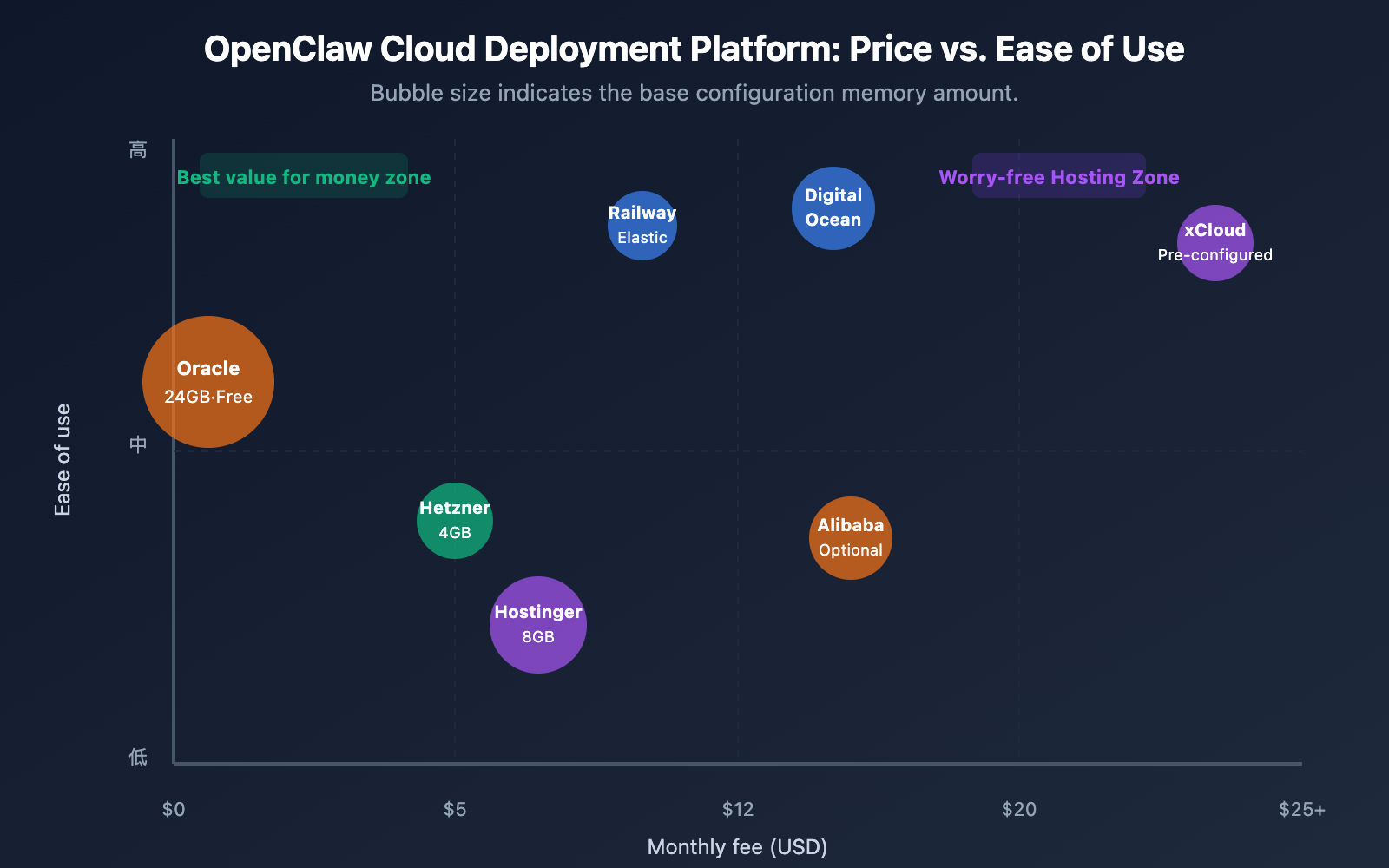
OpenClaw Cloud Deployment Platform Core Parameter Comparison
| Platform | Starting Price | Base Configuration | One-Click Deployment | Data Centers | Ideal Stage |
|---|---|---|---|---|---|
| DigitalOcean | $12-24/month | 2 vCPU / 4 GB | ✅ 1-Click | 15 Global | Production |
| Hostinger | $6.99/month | 2 vCPU / 8 GB | ❌ Manual | 8 Global | Budget-Conscious |
| Hetzner | €4.15/month+ | 2 vCPU / 4 GB | ❌ Manual | Europe + US | Best Value |
| Railway | $5-20/month | Elastic Pay-as-you-go | ✅ Template | US | Rapid Prototyping |
| Oracle Cloud | Free | 4 ARM CPU / 24 GB | ❌ Manual | 40+ Global | Learning/Testing |
| xCloud | $24/month | Pre-configured | ✅ One-Click | Depends on Underlying | Telegram/WhatsApp Bot |
| Alibaba Cloud | Pay-as-you-go | Optional Configuration | ❌ Manual | Primarily Asia-Pacific | Domestic Deployment |
Detailed Review of OpenClaw Cloud Deployment Platforms
1. DigitalOcean — The Reliable Choice for OpenClaw Deployment
DigitalOcean offers a 1-Click Deploy template and is currently one of the cloud deployment platforms recommended in the official OpenClaw documentation.
Advantages:
- 1-Click App deployment, no manual environment configuration needed
- Comprehensive security hardening documentation, providing best practices for firewalls and SSH keys
- Droplet supports snapshots and automatic backups
- Rich community tutorials, making it easy to find solutions to problems
Disadvantages:
- Price for equivalent configuration is about 40% higher than Hetzner
- High-end instances (8 vCPU / 16 GB) cost $96/month, which is relatively expensive
Recommended Configuration:
# DigitalOcean Recommended Droplet Configuration
plan: Basic Droplet
vcpu: 4
ram: 8 GB
disk: 80 GB SSD
region: sgp1  # Singapore, lowest latency in Asia-Pacific
monthly_cost: $48
2. Hostinger — Budget Deployment Option for OpenClaw
Hostinger's VPS plans offer a high memory-to-price ratio, suitable for budget-conscious scenarios that still require decent performance.
Advantages:
- Starting price is only $6.99/month, including 2 vCPU + 8 GB RAM
- 100 GB NVMe high-speed storage
- Provides AI assistant for server management
Disadvantages:
- No dedicated one-click deployment template for OpenClaw
- Requires manual installation of Docker and environment configuration
- Relatively fewer technical documents
3. Hetzner — The King of Value for OpenClaw Deployment
Hetzner is widely recognized by the community as the best value-for-money OpenClaw cloud deployment platform, especially favored by European developers.
Advantages:
- Extremely low price: CX22 (2 vCPU / 4 GB) is only €4.15/month
- Excellent network performance, 20 TB outbound traffic
- Supports ARM64 architecture (CAX series), offering even better value
- Well-established community deployment tutorials
Disadvantages:
- Data centers are mainly in Europe and the US, with higher latency in Asia-Pacific
- No one-click deployment support, requires manual configuration
- Management interface features are relatively simple
Recommended Configuration:
# Hetzner Recommended Configuration
plan: CPX31
vcpu: 4 (AMD EPYC)
ram: 8 GB
disk: 160 GB SSD
region: fsn1  # Finland
monthly_cost: €10.49  # Approximately $11.5
4. Railway — Rapid Deployment Platform for OpenClaw
Railway uses a pay-as-you-go model and supports one-click deployment via templates, making it ideal for quickly validating ideas.
Advantages:
- Supports direct deployment from GitHub repositories
- Pay-as-you-go billing, pay only for what you use
- Built-in persistent volume storage
- Comprehensive deployment logs and monitoring
Disadvantages:
- Costs for high-load scenarios may exceed traditional VPS
- Resource elasticity has upper limits
- Limited free tier ($5/month)
5. Oracle Cloud — Free Deployment Option for OpenClaw
Oracle Cloud's Always Free resources currently offer the most powerful free OpenClaw cloud deployment option.
Advantages:
- Permanently free: 4 ARM CPU + 24 GB RAM + 200 GB storage
- Configuration far exceeds most paid entry-level plans
- 40+ global data centers
Disadvantages:
- Strict registration review, difficult to pass in some regions
- Need to confirm OpenClaw compatibility with ARM architecture
- Free resources may be reclaimed (when idle for long periods)
- Technical support limited to paying users
6. xCloud — Dedicated Platform for OpenClaw Bot Deployment
xCloud provides pre-configured OpenClaw environments, specifically optimized for Telegram and WhatsApp Bot scenarios.
Advantages:
- One-click deployment of OpenClaw + Bot integration
- Pre-configured Telegram/WhatsApp connectors
- Includes SSL certificates and domain management
Disadvantages:
- Monthly cost of $24, average value for money
- Limited customization flexibility
- Tied to specific Bot scenarios
7. Alibaba Cloud — Top Choice for Domestic OpenClaw Deployment
For users needing to deploy OpenClaw within China, Alibaba Cloud is one of the few cloud service providers offering official support.
Advantages:
- Simple Application Server simplifies deployment
- Lowest access latency within China
- Chinese documentation and technical support
- Compliance is guaranteed
Disadvantages:
- Price for equivalent configuration is higher than overseas platforms
- Some overseas AI APIs require additional network configuration
- Pay-as-you-go billing rules are relatively complex
🔧 API Invocation Tip: No matter which OpenClaw cloud deployment platform you choose, the Agent needs to call AI model APIs. Using APIYI (apiyi.com) allows you to access all mainstream models with one key, simplifying the API configuration process for OpenClaw.
OpenClaw Cloud Deployment Security Configuration Guide
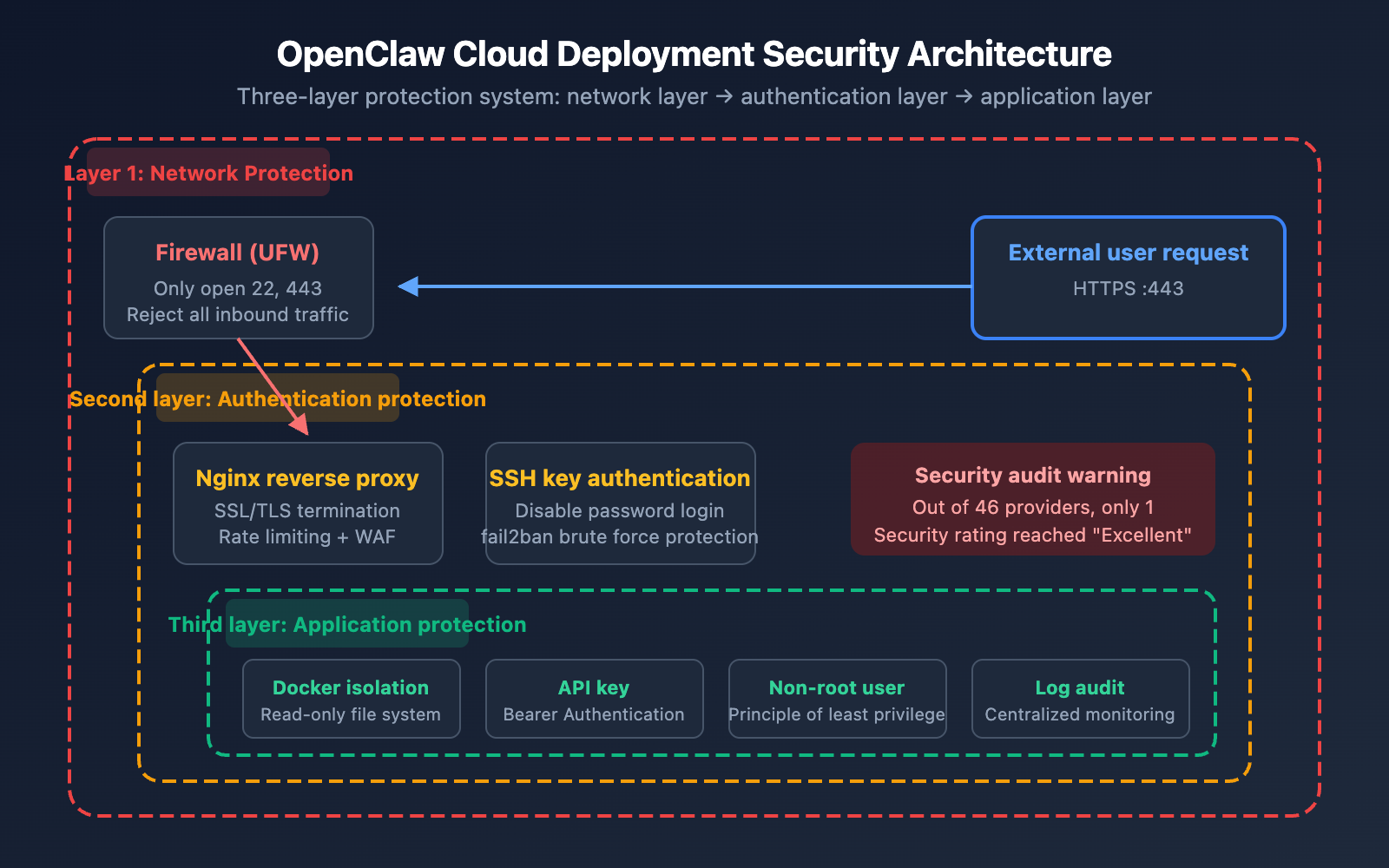
Security is the most overlooked yet critical aspect of OpenClaw cloud deployment. According to community security audits, out of 46 OpenClaw hosting service providers, only 1 achieved a security rating of "Strong/Excellent."
OpenClaw Deployment Security Checklist
| Security Item | Necessity | Specific Measures |
|---|---|---|
| SSH Key Authentication | Mandatory | Disable password login, allow keys only |
| Firewall Configuration | Mandatory | Open only necessary ports (22, 443) |
| API Authentication | Mandatory | Configure Bearer Token or API Key |
| Non-root User | Highly Recommended | Create a dedicated openclaw user to run the service |
| Automatic Updates | Recommended | Enable unattended-upgrades |
| Network Isolation | Recommended | Use Docker network to isolate container communication |
| Log Auditing | Recommended | Configure fail2ban + centralized logging |
OpenClaw Docker Secure Deployment Example
# docker-compose.yml - OpenClaw Secure Deployment Configuration
version: '3.8'
services:
  openclaw:
    image: openclaw/openclaw:latest
    restart: unless-stopped
    ports:
      - "127.0.0.1:3000:3000"  # Bind to localhost only
    environment:
      - OPENCLAW_AUTH_TOKEN=${AUTH_TOKEN}
      - OPENCLAW_API_BASE=https://api.apiyi.com/v1
      - OPENCLAW_API_KEY=${APIYI_KEY}
    volumes:
      - openclaw_data:/app/data
    networks:
      - openclaw_net
    security_opt:
      - no-new-privileges:true
    read_only: true
    tmpfs:
      - /tmp

  nginx:
    image: nginx:alpine
    ports:
      - "443:443"
    volumes:
      - ./nginx.conf:/etc/nginx/nginx.conf:ro
      - ./certs:/etc/nginx/certs:ro
    networks:
      - openclaw_net

volumes:
  openclaw_data:

networks:
  openclaw_net:
    driver: bridge
Key Security Points:
- Bind to Loopback Address:
127.0.0.1:3000:3000prevents direct exposure of the service port. - Nginx Reverse Proxy: Terminates SSL via HTTPS, exposing only port 443 externally.
- Read-Only Filesystem:
read_only: trueprevents file tampering inside the container. - Privilege Restriction:
no-new-privilegesprevents privilege escalation attacks.
OpenClaw Cloud Deployment Platform Selection Decision Guide
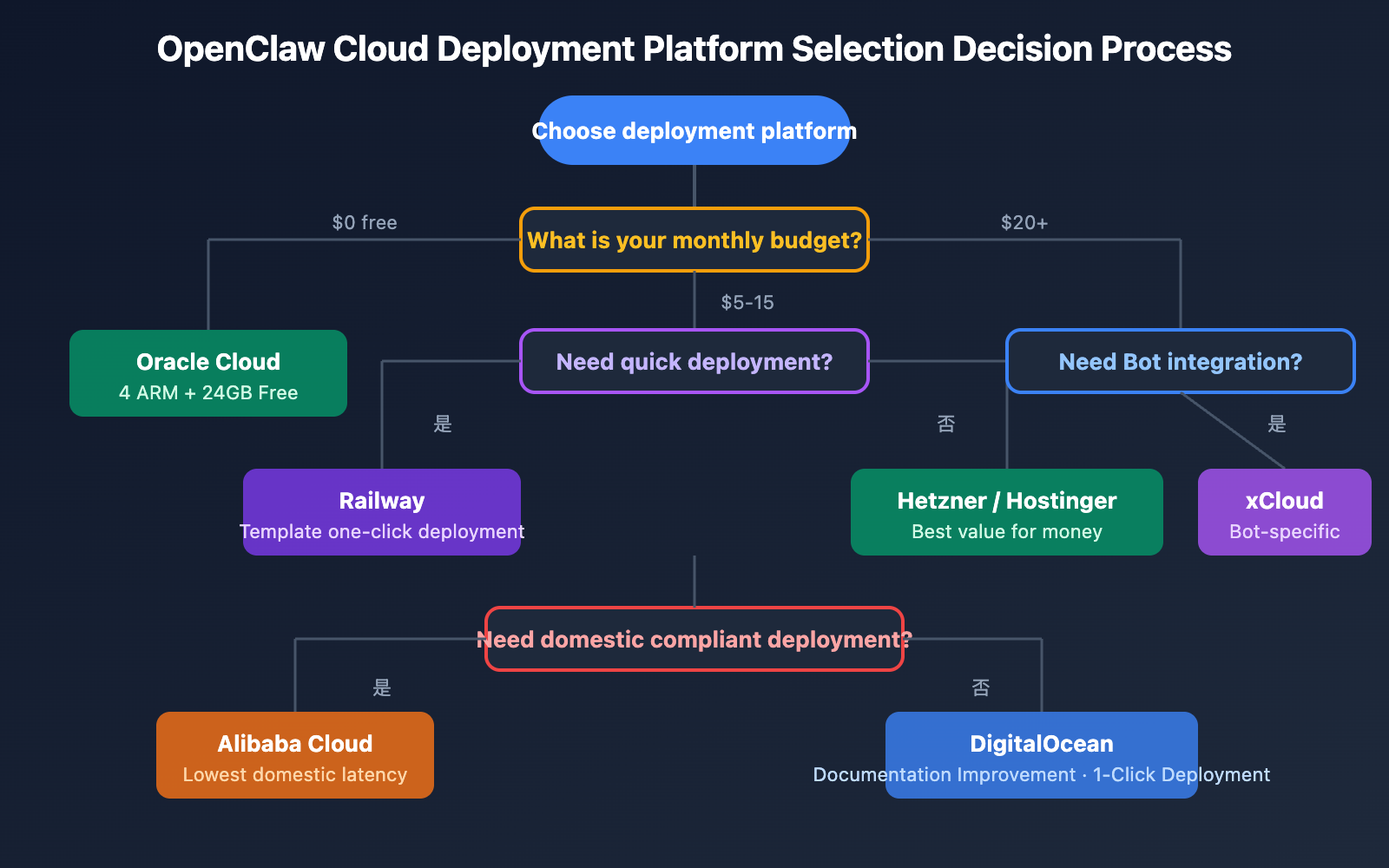
Choosing an OpenClaw Cloud Deployment Platform by Use Case
| Use Case | Recommended Platform | Reason | Estimated Monthly Cost |
|---|---|---|---|
| Personal Learning & Testing | Oracle Cloud | Permanently free, sufficient resources | $0 |
| Personal Developer Production | Hetzner | Best value for money, active community | $5-12 |
| Rapid Prototyping | Railway | Pay-as-you-go, fastest deployment | $5-20 |
| Small/Medium Team Standard Deployment | DigitalOcean | Excellent documentation, easy maintenance | $24-48 |
| Telegram/WhatsApp Bot | xCloud | One-click integration, ready-to-use | $24 |
| Budget Sensitive + High Memory Needs | Hostinger | High memory ratio, low price | $7-15 |
| Domestic (China) Compliant Deployment | Alibaba Cloud | Low latency in China, compliance guaranteed | Pay-as-you-go |
OpenClaw Deployment Cost Optimization Strategies
1. Separate Compute and API Call Costs
OpenClaw's running costs are split into two parts: server costs and AI model API call costs. Choose a cost-effective platform for the server, and reduce API costs through aggregation platforms.
🎯 Cost Optimization Tip: The main cost for an OpenClaw Agent often isn't the server, but the AI model API calls. Using an API proxy service via APIYI (apiyi.com) can get you better model invocation prices while supporting flexible switching between multiple models.
2. Make Good Use of Free Credits
- Oracle Cloud Always Free: Top choice for long-term testing and learning
- Railway's $5 monthly free credit: Great for lightweight prototypes
- DigitalOcean's $200 Credit for new users (60 days): Useful for production environment evaluation
3. Choose the Right Instance Spec
Avoid over-provisioning. For pure text agent scenarios, 2 vCPUs + 4 GB RAM is usually more than enough; you don't need a high-spec instance. Monitor your actual resource usage and upgrade as needed.
OpenClaw Cloud Deployment FAQ
Q1: Which platform is the cheapest for OpenClaw cloud deployment?
For free, the top choice is Oracle Cloud Always Free (4 ARM CPU + 24 GB RAM). Among paid options, Hetzner offers the best value for money, with the CX22 plan (€4.15/month) sufficient for basic OpenClaw deployment needs.
Q2: Is Docker mandatory for OpenClaw deployment?
It's not mandatory, but it's highly recommended. Docker ensures environment consistency, simplifies the deployment process, and makes migration and upgrades easier. Direct deployment on the system is possible but requires manual dependency management.
Q3: How do I call AI models after deploying OpenClaw?
The OpenClaw Agent needs to be configured with the AI model's API endpoint and key. You can connect directly to each model provider's API, or use APIYI (apiyi.com) to get a unified interface. A single API Key can be used to call 200+ models like GPT-4o, Claude, and Gemini, simplifying configuration management.
Q4: Which platform should users in China choose for OpenClaw deployment?
Users in China should first consider Alibaba Cloud Simple Application Server for the lowest latency and guaranteed compliance. If latency isn't a major concern, Hetzner's US data centers are also a good option. For API calls, using APIYI's (apiyi.com) proxy service is recommended to ensure stability.
Q5: How do I ensure security after deploying OpenClaw?
Make sure to do these three things: configure the API authentication token, use a firewall to limit exposed ports, and enable HTTPS via an Nginx reverse proxy. Refer to the Docker Compose example in the security configuration section of this article for deployment.
Q6: Can I deploy multiple OpenClaw Agents simultaneously?
Yes, you can. Using Docker Compose, you can run multiple OpenClaw instances on the same server, distinguished by different ports. It's recommended to have 8 GB or more of RAM to support 2-3 concurrent Agents.
Summary: Choosing the Best OpenClaw Cloud Deployment Plan for You
The core logic for choosing an OpenClaw cloud deployment platform:
- Budget First: Hetzner (Paid) or Oracle Cloud (Free)
- Ease of Use First: DigitalOcean (1-Click) or Railway (Template Deployment)
- Scenario First: xCloud (Bot Integration) or Alibaba Cloud (Domestic Deployment)
Regardless of the platform you choose, pay close attention to security configuration. Docker deployment + Nginx reverse proxy + API authentication is the standard practice for OpenClaw production environments.
📌 Final Reminder: Deploying OpenClaw is to run AI Agents, and the core capabilities of an Agent come from AI model APIs. We recommend using APIYI (apiyi.com) to centrally manage model invocations. The platform provides access to 200+ models, pay-as-you-go pricing, and Chinese technical support, allowing you to focus on Agent logic development rather than API integration.
We hope this comparison of OpenClaw cloud deployment solutions helps you make a quick decision. If you have specific deployment questions, feel free to discuss them in the comments.


