
Author's Note: The official OpenAI gpt-image-2 is now live, but there are still more cost-effective reverse-engineered solutions available. This article provides a detailed guide on how to integrate the latest image generation capabilities at a low cost using the APIYI official reverse-engineered model gpt-image-2-all.
On April 21, 2026, OpenAI officially released ChatGPT Images 2.0, making gpt-image-2 the most anticipated image generation model in the industry. However, as of this writing, the official API has not been fully opened to all developers, and many teams are anxiously searching for gpt-image-2 Reverse API (API proxy service) channels to gain early access.
This isn't just another introductory guide. It’s a practical integration manual based on the APIYI official reverse-engineered model gpt-image-2-all, with all code verified in production environments.
Core Value: After reading this, you'll know where to get the gpt-image-2 Reverse API, how to complete the integration in 3 minutes, and understand the differences and risks between official reverse-engineered channels and direct official connections.
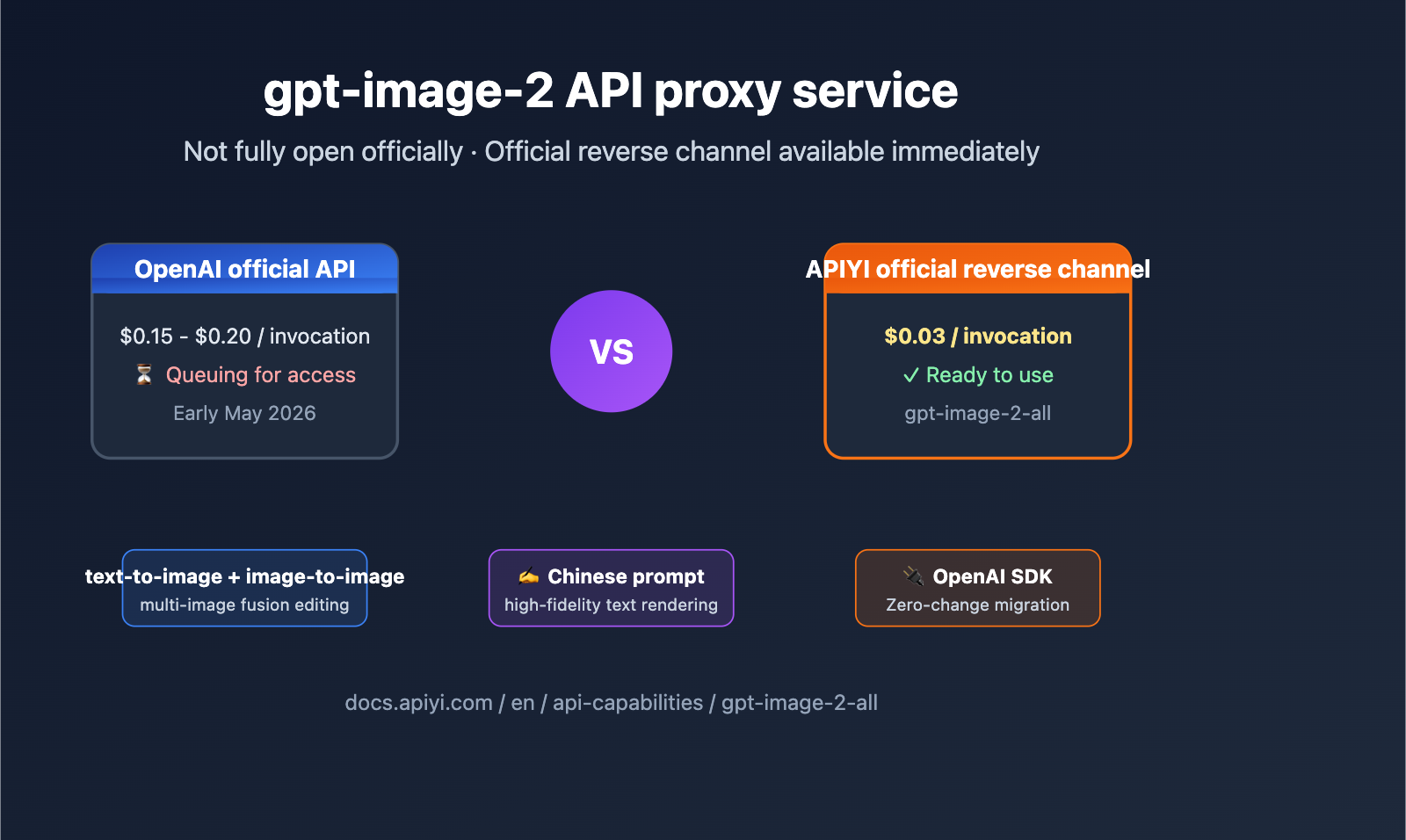
gpt-image-2 Reverse API Key Takeaways
| Feature | Description | Value |
|---|---|---|
| Official API Status | OpenAI gpt-image-2 official API is open but expensive | Reverse API is a necessary alternative for early access |
| APIYI Reverse Channel | gpt-image-2-all connects to the latest ChatGPT web image capabilities via reverse engineering |
No waiting in line, available immediately |
| Pricing | Flat rate of $0.03/call, regardless of resolution or quality | Approx. 80% cheaper than the estimated official $0.15-$0.20 |
| Compatibility | Standard OpenAI SDK protocol, supports chat/completions, images/generations, images/edits | Almost zero code changes required |
| Capabilities | Supports text-to-image, image-to-image, multi-image fusion, Chinese prompts, high-fidelity text rendering | Full reproduction of ChatGPT web-based Images 2.0 capabilities |
What exactly is a Reverse API?
A Reverse API (reverse-engineered API) is a channel that provides services via standard API protocols by reverse-engineering official web or internal interfaces when the official API is unavailable or restricted. It is not an official OpenAI product, but a technical solution implemented by third-party platforms based on web sessions, cookies, and request simulation.
For gpt-image-2, there are very few channels that can truly provide a stable Reverse API. The gpt-image-2-all released by APIYI is one of the most transparent and publicly available reverse-engineered solutions, with complete technical documentation available at docs.apiyi.com/en/api-capabilities/gpt-image-2-all/overview.
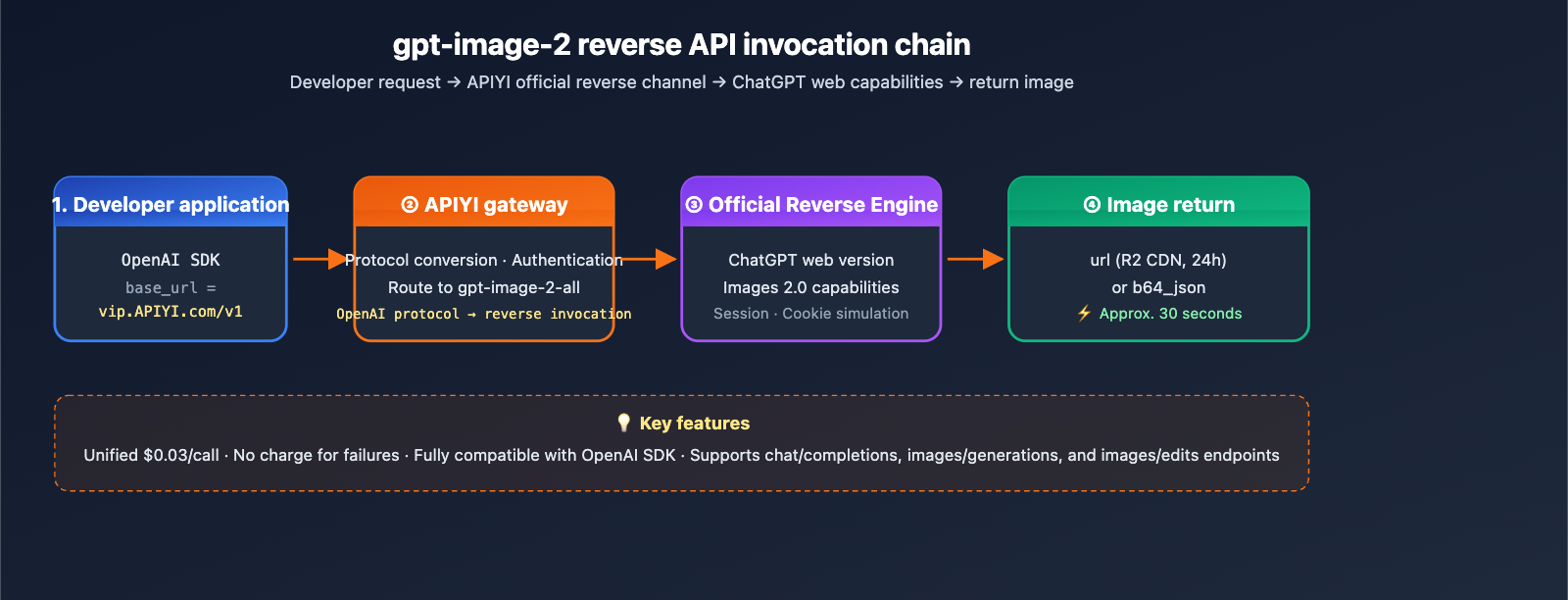
gpt-image-2 Reverse API Quick Start
Minimalist Example (Text-to-Image)
Here is the simplest way to make a call; you can generate an image with just 10 lines of code:
import openai

client = openai.OpenAI(
    api_key="YOUR_APIYI_KEY",
    base_url="https://vip.apiyi.com/v1"
)

response = client.images.generate(
    model="gpt-image-2-all",
    prompt="A cyberpunk-style Tokyo night scene, with neon signs written in Chinese saying 'The future is here'"
)
print(response.data[0].url)
View full implementation code (including image-to-image, error handling, and timeout control)
import openai
import base64
from pathlib import Path
from typing import Optional

client = openai.OpenAI(
    api_key="YOUR_APIYI_KEY",
    base_url="https://vip.apiyi.com/v1",
    timeout=120,  # Official recommendation is ≥120s, gpt-image-2 generation takes about 30s
)

def text_to_image(prompt: str, save_path: str = "output.png") -> str:
    """Text-to-image: Generate images via apiyi gpt-image-2-all"""
    try:
        resp = client.images.generate(
            model="gpt-image-2-all",
            prompt=prompt,
            response_format="url",
        )
        image_url = resp.data[0].url
        return image_url
    except openai.APIError as e:
        print(f"API Error: {e}")
        return ""

def image_to_image(
    reference_image: str,
    edit_prompt: str,
    save_path: str = "edited.png"
) -> Optional[str]:
    """Image-to-image: Edit based on a reference image, supports single/multi-image fusion"""
    with open(reference_image, "rb") as f:
        resp = client.images.edit(
            model="gpt-image-2-all",
            image=f,
            prompt=edit_prompt,
            response_format="b64_json",
        )
    b64_data = resp.data[0].b64_json
    if b64_data.startswith("data:image"):
        b64_data = b64_data.split(",", 1)[1]
    Path(save_path).write_bytes(base64.b64decode(b64_data))
    return save_path

# Usage example
url = text_to_image("A 16:9 landscape AI summit promotional poster, with the main title 'AI Summit 2026'")
print(f"Image URL: {url}")

edited = image_to_image(
    reference_image="./original.png",
    edit_prompt="Replace the background with a spring garden in full cherry blossom bloom, keeping the character's pose unchanged",
)
print(f"Edited image: {edited}")
Integration Tip:
gpt-image-2-allis fully compatible with the OpenAI SDK. Simply point thebase_urltohttps://vip.apiyi.com/v1, and your existing code will require almost zero changes. Register at APIYI (apiyi.com) to get free testing credits, perfect for teams to complete product integration before the official API is widely released.
gpt-image-2 Reverse API Channel Comparison
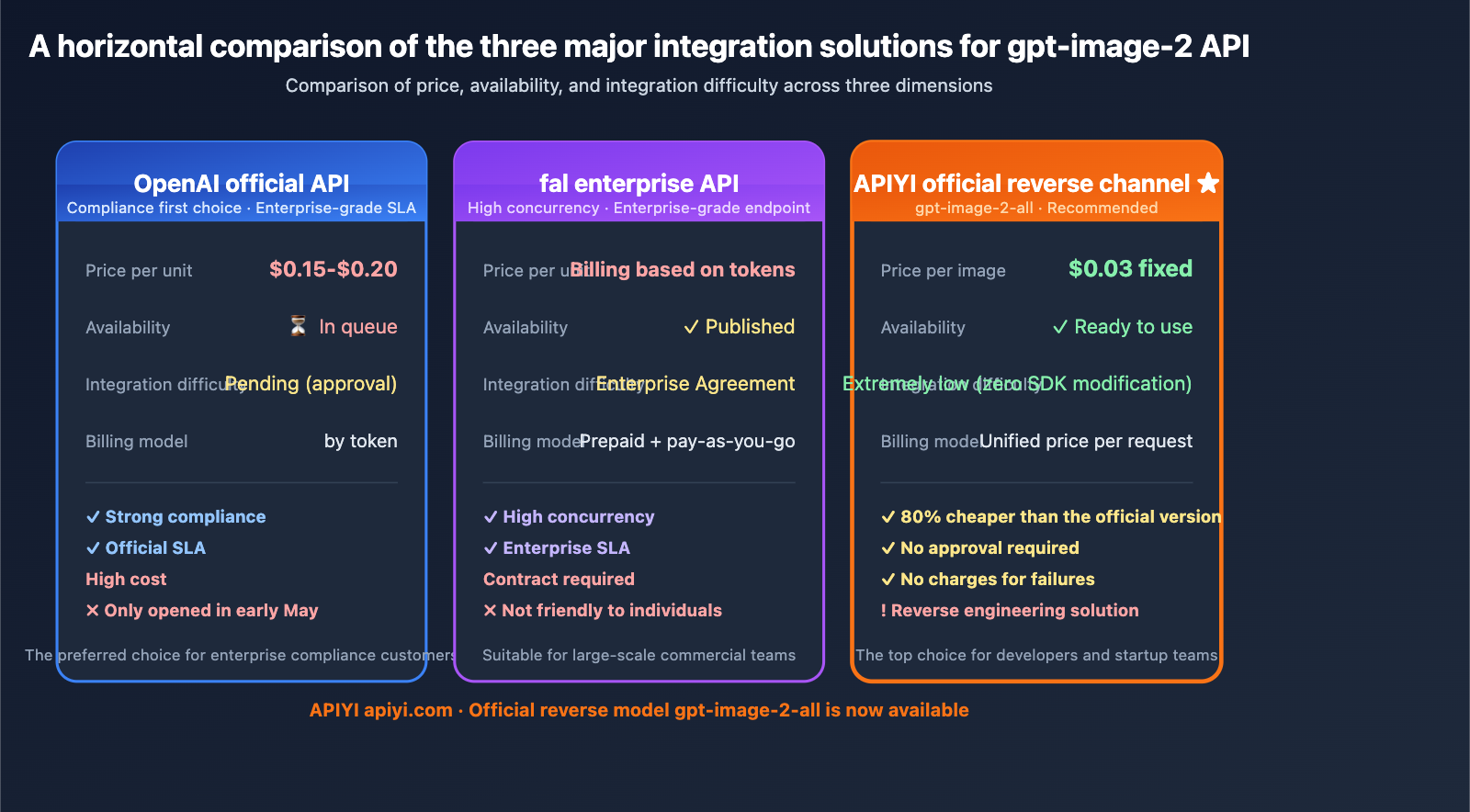
| Integration Plan | Price (Per Image) | Availability | Difficulty | Target Audience |
|---|---|---|---|---|
| OpenAI Official API | ~$0.15-$0.20 (Token-based) | Gradual rollout from early May 2026 | Requires approval | Enterprise compliance |
| fal Enterprise API | Token-based, high barrier | Requires enterprise agreement | Medium | Large-scale commercial |
| apiyi gpt-image-2-all (Reverse) | Fixed $0.03 / request | Available now, no queue | Very low, zero-change | Developers, startups, individuals |
| Other Proxy Channels | Opaque pricing, $0.05-$0.10 | Inconsistent stability | Medium | Not recommended |
Channel Analysis
OpenAI Official API Analysis: The official channel leads in compliance and long-term stability. However, as of late April 2026, access is primarily for enterprise and ChatGPT Plus/Team subscribers. Most small and medium-sized developers face wait times until after May, and token-based pricing is significantly higher. In contrast, APIYI's reverse channel gpt-image-2-all is better suited for validation and small-to-medium production scenarios in terms of availability and cost.
fal Enterprise API Analysis: fal launched its enterprise-grade endpoint for gpt-image-2 on April 21, 2026, performing well in high-concurrency and SLA guarantees. However, it targets enterprise clients, requiring agreements and prepayments, which is unfriendly to independent developers. For teams needing to quickly validate gpt-image-2 capabilities, APIYI's reverse channel is faster and cheaper.
Other Proxy Channel Analysis: There are other small proxy services offering gpt-image-2 access, but they generally suffer from opaque pricing, high failure rates, and lack of documentation. By comparison, APIYI provides complete technical documentation at docs.apiyi.com and explicitly promises "no charges for failed requests," making it more trustworthy in terms of transparency and stability.
Note on Comparison: The price and availability data above are sourced from official OpenAI announcements, fal enterprise API releases, and official APIYI documentation. You can verify this by testing on the APIYI (apiyi.com) platform.
Capabilities of gpt-image-2-all
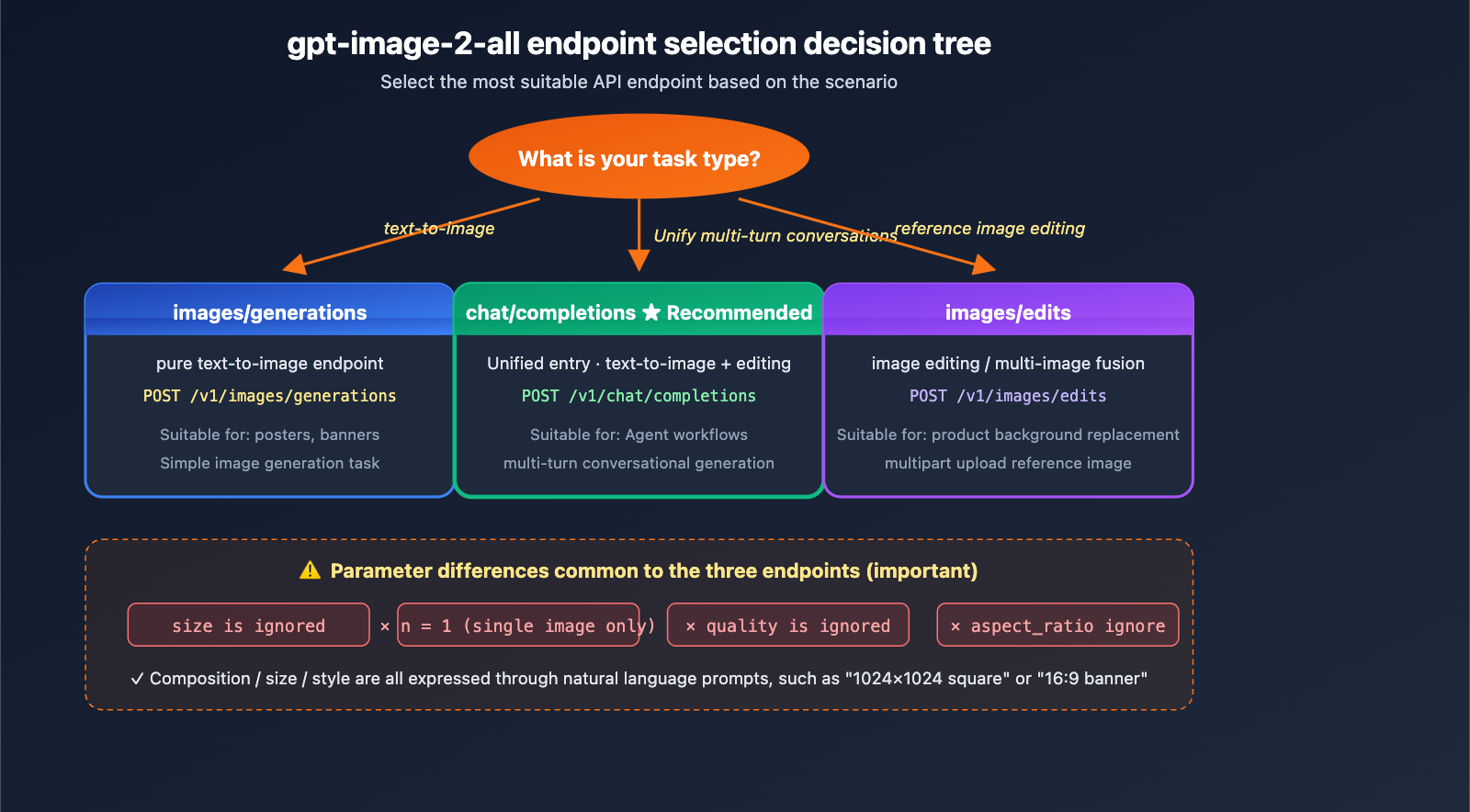
Based on the official documentation at docs.apiyi.com/en/api-capabilities/gpt-image-2-all/overview, this model supports three core endpoints:
| Endpoint | Purpose | Request Format | Recommended Use Case |
|---|---|---|---|
| POST /v1/chat/completions | Unified entry for text-to-image and editing | JSON | Recommended; best compatibility |
| POST /v1/images/generations | Pure text-to-image | JSON | Simple image generation tasks |
| POST /v1/images/edits | Image editing (blending, local modification) | multipart | image-to-image scenarios |
Important Parameter Restrictions
The gpt-image-2-all model uses a different parameter system than traditional DALL-E or gpt-image-1. The following parameters will be ignored; please do not include them to avoid validation errors:
size: Explicit size parameters are not supported. Composition is controlled by natural language in the prompt (e.g., "1024×1024 square", "16:9 banner").n: Only one image is returned per request; for multiple images, please use concurrent calls.quality: Uses a unified quality standard; there are no "hd" or "standard" tiers.aspect_ratio: Aspect ratio is also controlled via the prompt.
Reference Image Upload Guidelines
- Supported Formats: PNG / JPG / WebP
- Maximum Size: ≤ 10MB
- Return Format:
url(R2 CDN link, valid for approximately 24 hours) orb64_json(includes built-in prefix). - Generation Time: Approximately 30 seconds; we recommend setting your client timeout to ≥ 120 seconds.
FAQ
Q1: What is the gpt-image-2 Reverse API?
A Reverse API is a channel that allows third-party platforms to connect to the latest image capabilities of the ChatGPT web interface via reverse engineering before the official API is available to all developers. It then provides these services using the standard OpenAI SDK protocol. APIYI's gpt-image-2-all is currently one of the most transparent and well-documented reverse-engineered solutions available.
Q2: What is the difference between the gpt-image-2 Reverse API and the official API?
The official API leads in compliance and SLA guarantees, but it requires a waitlist approval process and is more expensive, billed by token (approx. $0.15–$0.20 per request). The APIYI reverse-engineered channel gpt-image-2-all is available immediately with a flat rate of $0.03 per request, making it ideal for validation phases and small-to-medium-scale production. However, as a reverse-engineered solution, its long-term stability depends on the session mechanism of the ChatGPT web interface.
Q3: When will the official gpt-image-2 API be available to all developers?
According to the OpenAI press conference on April 21, 2026, API access for gpt-image-2 is being rolled out first to ChatGPT Plus, Team, and Enterprise subscribers. General developer API access is expected to open in early May 2026. Until then, the Reverse API remains the fastest way to get started.
Q4: Which use cases are best suited for the gpt-image-2 Reverse API?
It is primarily suited for the following scenarios:
- Social Media Graphic Generation: Posters, banners, and social media images that require fast turnaround and high-quality Chinese text rendering.
- Batch E-commerce Asset Production: Product scene replacement and size variations, leveraging the flat $0.03 pricing to control costs.
- Product Prototyping: UI sketches, infographics, and flowcharts, utilizing 2K resolution and precise text capabilities.
- Content Operations Automation: Integrating with n8n/Dify workflows to quickly generate cover images and illustrations.
Q5: How can I quickly invoke the gpt-image-2 Reverse API?
We recommend using the APIYI reverse-engineered channel gpt-image-2-all for quick integration:
- Visit APIYI (apiyi.com) to register an account; new users receive free testing credits.
- Create an API key in the console and save it.
- Use the code example in this article, replacing the
base_urlwithhttps://vip.apiyi.com/v1. - Invoke the
gpt-image-2-allmodel; the rest of the protocol is identical to the OpenAI SDK.
APIYI also supports unified access to various mainstream image models like gpt-image-2, Nano Banana Pro, and Flux, making it easy to compare and switch between them.
Q6: What are the known limitations of the gpt-image-2 Reverse API?
Here are the current limitations:
- Single Image per Request: Each call returns only one image; if you need multiple images, you must make concurrent calls.
- No size/quality Parameters: Composition and aspect ratio are controlled entirely by natural language prompts, which requires some prompt engineering experience.
- Longer Generation Time: Approximately 30 seconds per image; we recommend setting your client timeout to ≥ 120 seconds.
- Stability Depends on the Web Interface: As a reverse-engineered solution, if OpenAI updates its web interface, it may briefly affect availability. APIYI promises "no charge for failed requests" to minimize user costs.
- Compliance Considerations: For production environments involving strict compliance reviews, we still recommend waiting for the official API to be released.
Q7: How do I migrate existing code based on gpt-image-1 or DALL-E 3?
Migration is very simple and takes three steps:
- Change the
modelparameter fromdall-e-3/gpt-image-1togpt-image-2-all. - Change the
base_urltohttps://vip.apiyi.com/v1. - Delete unsupported parameters such as
size,n,quality, andaspect_ratio, and incorporate your composition requirements directly into the prompt text.
Q8: Is it safe and compliant to use the gpt-image-2 Reverse API?
As an API proxy service, APIYI provides enterprise-grade key management and traffic isolation, ensuring that requests are not stored. However, because it is a reverse-engineered channel that relies on the ChatGPT web interface, if your business involves highly regulated industries like finance or healthcare, we recommend waiting for the official OpenAI API to open to all developers. Using gpt-image-2-all is the most economical choice for development, testing, and prototype validation.
gpt-image-2 Reverse API Key Takeaways
- Official API Not Fully Open: As of late April 2026, general developers still need to wait until early May to access the official gpt-image-2.
- Reverse API is an Immediate Solution: Connects to the ChatGPT web interface via reverse engineering; callable using the standard OpenAI protocol.
- APIYI Reverse Channel Offers Transparent Pricing:
gpt-image-2-allis a flat $0.03 per request, approximately 80% cheaper than the estimated official price. - Full Support for Three Endpoints: Fully compatible with
chat/completions,images/generations, andimages/edits. - Low Integration Cost: Register at APIYI (apiyi.com) to get started with zero-change migration for the OpenAI SDK.
- Note Parameter Differences: Parameters like
size,n, andqualityare ignored; composition must be expressed in natural language within the prompt. - Official API Recommended for Compliance: For highly regulated industries, we recommend waiting for the official API; the reverse-engineered channel is best for prototyping and small-to-medium production.
Summary
The core value of the gpt-image-2 Reverse API lies in:
- Solving the "Waiting Game": It provides a practical, ready-to-use alternative before official API access is granted to general developers.
- Significant Cost Advantage: The APIYI official reverse channel is fixed at $0.03 per request, which is about 80% cheaper than official estimated pricing.
- Zero-Cost Migration: It's fully compatible with the OpenAI SDK. If you already have DALL-E 3 or gpt-image-1 code, you can switch over in just three simple steps.
If you're looking for a reliable source for the gpt-image-2 Reverse API, we recommend registering an account directly at APIYI (apiyi.com) and using the gpt-image-2-all reverse model for integration. The platform offers free credits and comprehensive documentation, so you can verify your first model invocation in just 5 minutes.
Related Articles
If you're interested in integrating the gpt-image-2 Reverse API, we recommend checking out these resources:
- 📘 gpt-image-2-all API Official Launch: $0.03/Request Integration Tutorial – Learn the full technical details of the APIYI reverse model.
- 📊 gpt-image-2 vs. Nano Banana Pro: Image Model Comparison – A deep dive into the capability differences between mainstream image models.
- 🚀 6 Industry Use Cases for gpt-image-2 – Explore real-world applications in e-commerce, education, social media, and more.
📚 References
-
APIYI gpt-image-2-all Official Documentation: Complete technical specifications and parameter details.
- Link:
docs.apiyi.com/en/api-capabilities/gpt-image-2-all/overview - Description: The authoritative documentation for the reverse-engineered model, including all supported endpoints, parameters, limitations, and example code.
- Link:
-
OpenAI ChatGPT Images 2.0 Release Page: Official introduction to the capabilities of gpt-image-2.
- Link:
openai.com/index/introducing-chatgpt-images-2-0/ - Description: First-hand information to understand the native capabilities of gpt-image-2.
- Link:
-
OpenAI gpt-image-2 API Documentation: Official API reference from the OpenAI platform.
- Link:
developers.openai.com/api/docs/models/gpt-image-2 - Description: A reference for migrating once the official API is released, including details on token billing.
- Link:
-
APIYI Platform Console: Registration, API key management, and usage statistics.
- Link:
apiyi.com - Description: New users receive free credits upon registration, with support for unified access to various models like gpt-image-2-all.
- Link:
Author: APIYI Technical Team
Technical Discussion: Feel free to share your real-world test cases for the gpt-image-2 Reverse API in the comments. For more documentation, visit the APIYI documentation center at docs.apiyi.com.


