

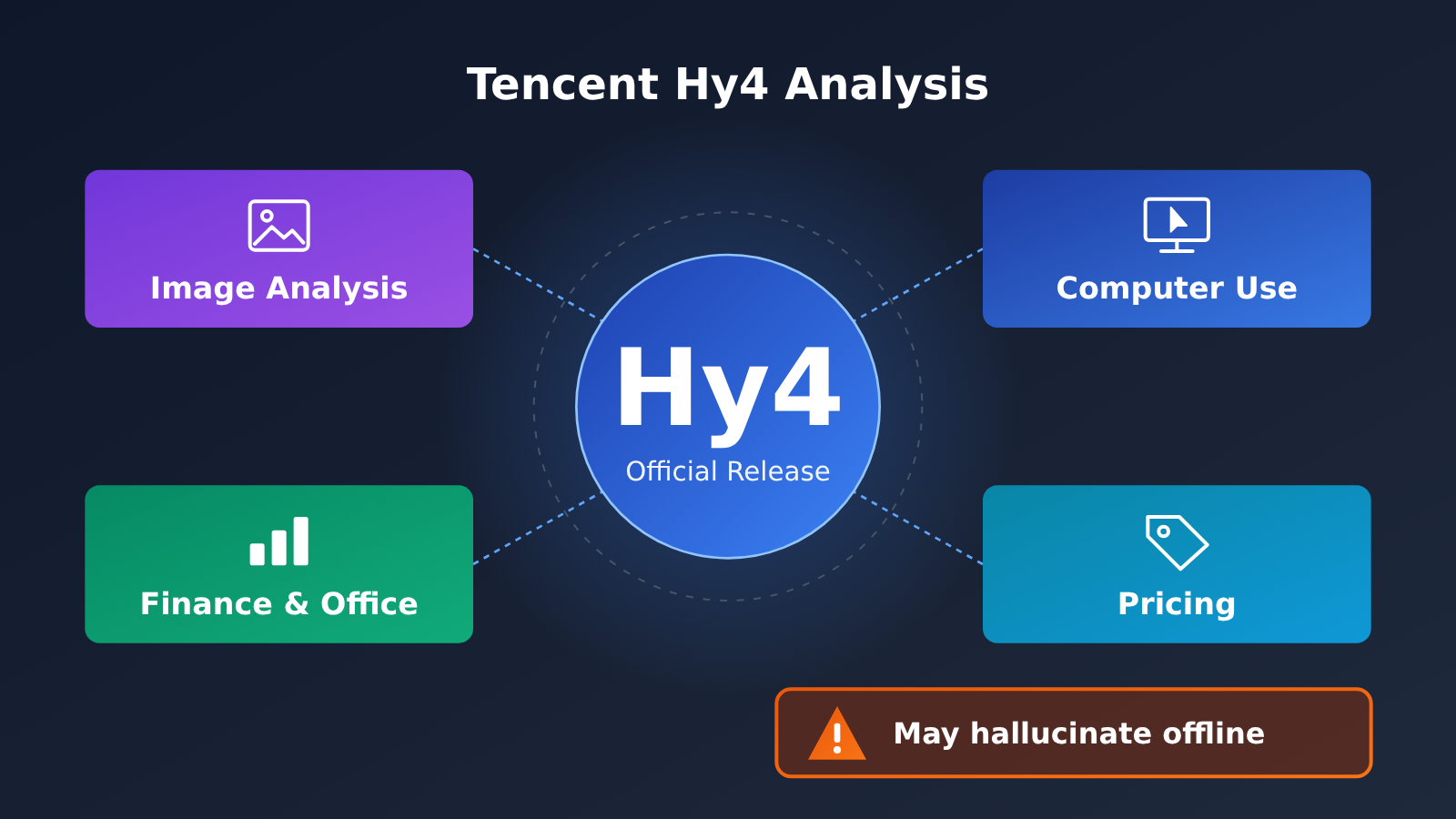
Author’s note: Tencent Hy4 has officially launched, adding image understanding and computer operation for the first time. This article compares Tencent’s claims with partner testing and independent third-party evaluations to clarify what the model can—and can’t—do.
About two months after releasing the preview, Tencent has launched the official version of Hy4. It supports image understanding and autonomous operation of computer software for the first time, with pricing unchanged from the preview. Tencent says it now ranks among the strongest open-weight models, although the weights won’t be released until a date that hasn’t yet been announced.
This isn’t a recap of the launch event. Tencent’s own tests, partner feedback, and independent evaluations from Artificial Analysis don’t always agree—and some of the differences are substantial. We’ll compare all three point by point, separating vendor claims from independent findings.
What you’ll get: A clear picture of Hy4’s new capabilities, pricing, the tasks where it falls noticeably behind, and how to use it safely for coding, finance, and office work.
Tencent Hy4 at a Glance
Here’s a summary of what’s been confirmed so far. Most capability descriptions in the table come from Tencent; third-party data is identified separately later in the article.
| Item | Details |
|---|---|
| Developer | Tencent |
| Release timeline | The production version launched about two months after the preview |
| Availability | Tencent Cloud, OpenRouter, and Tencent’s own apps, including Yuanbao |
| Model weights | Planned for release, with no date announced; a safety report will be published alongside the weights |
| Key new capabilities | Image understanding and autonomous operation of computer software, both supported for the first time |
| Main areas of improvement | Coding, finance, and office work |
| Pricing | Approximately $0.83 per million input tokens and $2.50 per million output tokens, unchanged from the preview |
| Future plans | A faster, cheaper Hy4 flash version, with timing and pricing yet to be announced |
The Background Behind Tencent Hy4’s Release
Tencent’s previous-generation Hy3 has 295 billion parameters and was released under the Apache 2.0 license. In the months since, Zhipu released GLM-5.3, DeepSeek released V4.1-Flash-1017, and Moonshot AI introduced Kimi K3.1 Pro. Competition among Chinese models has been fierce, and Hy4 is Tencent’s bid to return to the front of the pack.
Another important piece of context is a change in how models are evaluated. Artificial Analysis revised its overall index in late October, and 60% of it is now based on private test sets that aren’t publicly available. Under the new methodology, the gap between open models and leading models widened from 3 points to 12. That means Hy4’s score shouldn’t be compared directly with rankings published before the revision.
Tencent Hy4: Multimodal and Computer-Use Capabilities
Image understanding and computer use are the two biggest changes in this generation of Hy4. The first lets the model see images; the second lets it take action. Together, they could enable it to handle real office and development workflows.
Hy4 Image Understanding: Using Code to Crop Images and Find Details
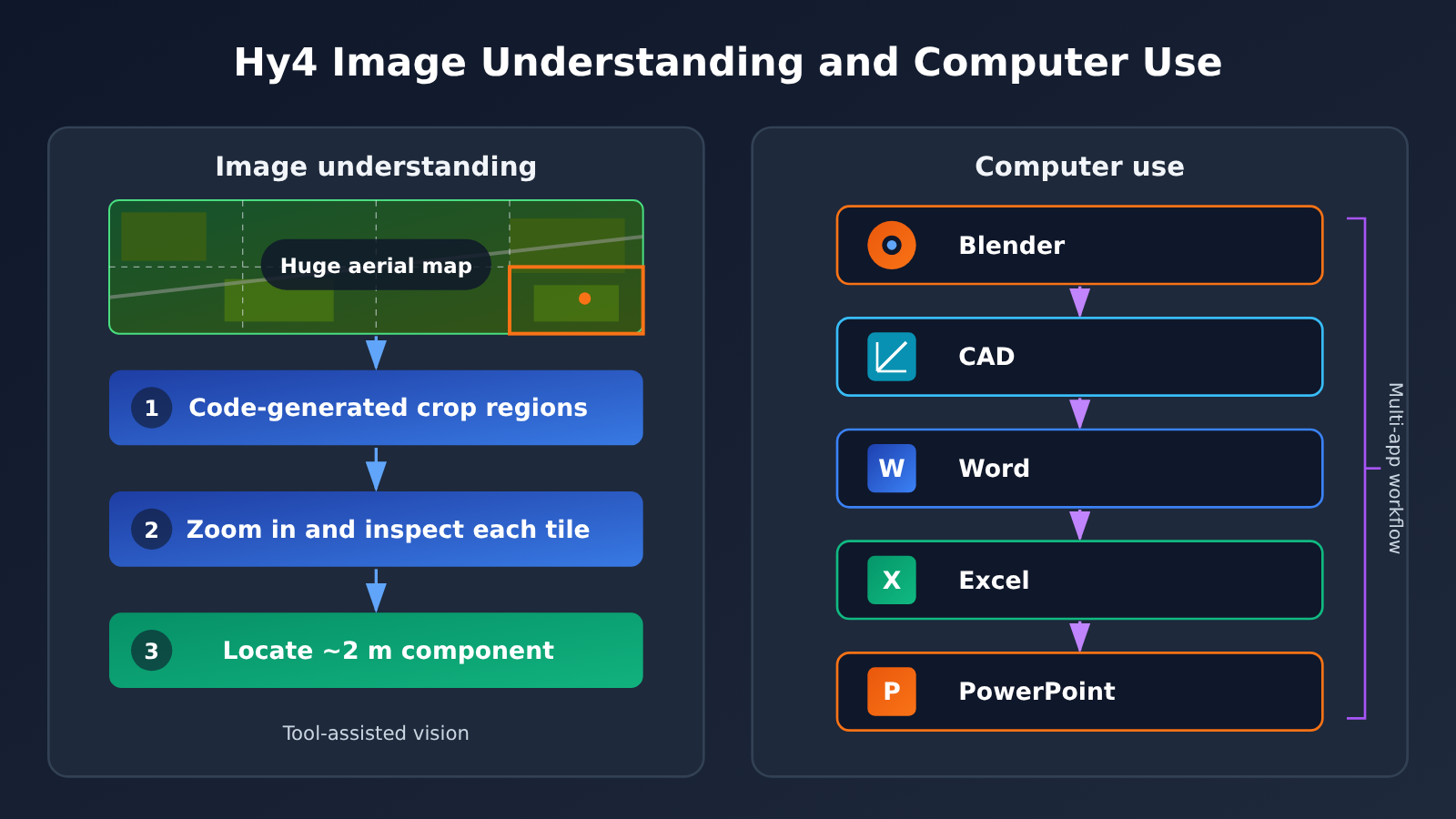
In Tencent’s demo, Hy4 had to find a roughly two-meter component on a warehouse roof in a 2.8-gigapixel aerial image. Rather than trying to “see” the entire image at once, it used code to generate crop regions, then zoomed in and checked them one by one. This tool-assisted approach to image understanding could be useful for working with oversized technical drawings, remote-sensing imagery, and complex charts.
Tencent also says image understanding can help with programming, such as building websites and games from design mockups. For game development, Tencent worked with its own game studios to adapt Hy4 for mainstream engines including Unreal, Unity, and Godot. According to the Honor of Kings development team, Hy4 makes almost no mistakes on configuration tasks and is much more successful than before at identifying the root causes of bugs. That said, this is feedback from a Tencent internal team, and no testing methodology has been made public.
Hy4 Computer Use: Professional Software and Multi-App Workflows
Hy4 can autonomously operate a computer for the first time, directly controlling software to complete tasks. Tencent trained it specifically on professional tools such as Blender and CAD software, as well as tasks that require using multiple applications in sequence. In office settings, Hy4 can collaborate with people in real time on Word, Excel, and PowerPoint files.
There’s an important point of comparison here. On the same day, analyst firm SemiAnalysis released the GDPx benchmark, which tests AI agents operating professional software such as Siemens NX in simulated real-world work environments. Individual tasks can last up to eight hours. No model scored above 12%; even the top-ranked Claude Opus 5.5 scored just 12%. Hy4 didn’t appear on the leaderboard, but the results are a reminder that computer use is still at an early stage across the industry. There’s a big gap between “being able to operate software” and “being able to independently complete professional work.”
Hy4 Helps Train Its Own “Descendants”
Tencent also showcased a less conventional direction: using Hy4 to improve AI development itself. In tests of internal research tasks across seven fields, Tencent says Hy4 ranked first among open models. Paired with the Hyra 2.0 agent system, Hy4 increased the throughput of Tencent’s internal training infrastructure by about 20% over six steps.
Hy4 then autonomously trained a version of Jev, a decision-making model from US startup TypeSafe AI. This Hyra-Jev variant outperformed the original Jev on six of eight benchmarks. Tencent also plans to release two specialized models for biology and physics produced using this approach as open models. These are all Tencent’s own tests, but they point to its long-term goal: making Hy4 an accelerator for internal AI research and development.
Tencent Hy4 Evaluation Comparison: Vendor, Partners, and Independent Researchers
This is the most important section of the article. The same model looks quite different depending on who’s evaluating it, so make sure you know who’s making each claim before choosing a model.
| Source | Key finding | Type | Reliability notes |
|---|---|---|---|
| Tencent official | More than 200 finance professionals evaluated nearly 600 real-world tasks, with Hy4 ranking ahead of DeepSeek V4.1 Flash, Kimi K3.1 Pro, and GLM-5.3 Flash | Vendor self-test | Testing methodology details weren’t disclosed |
| Tencent official | After its search feature was revamped, the hallucination rate during web searches fell from nearly 16% to about 5% | Vendor internal test | Limited to web search scenarios |
| Tencent official | Across Tencent’s own 12 benchmarks, Claude Opus 5.5 outperformed Hy4 on all 12, while GPT 6.1 Sol led on 8 | Vendor self-test | Tencent acknowledges the gap, making this a useful reference |
| Partner Comein | Hy4 was the only Chinese model tied with Claude Opus 5.5 for second place, and clearly outperformed GPT-6.1 Sol on data queries | Partner self-test | Limited to its financial data query scenarios |
| Partner Manus | Hy4 successfully completed almost all document-related tasks | Partner self-test | Task difficulty and scope weren’t disclosed |
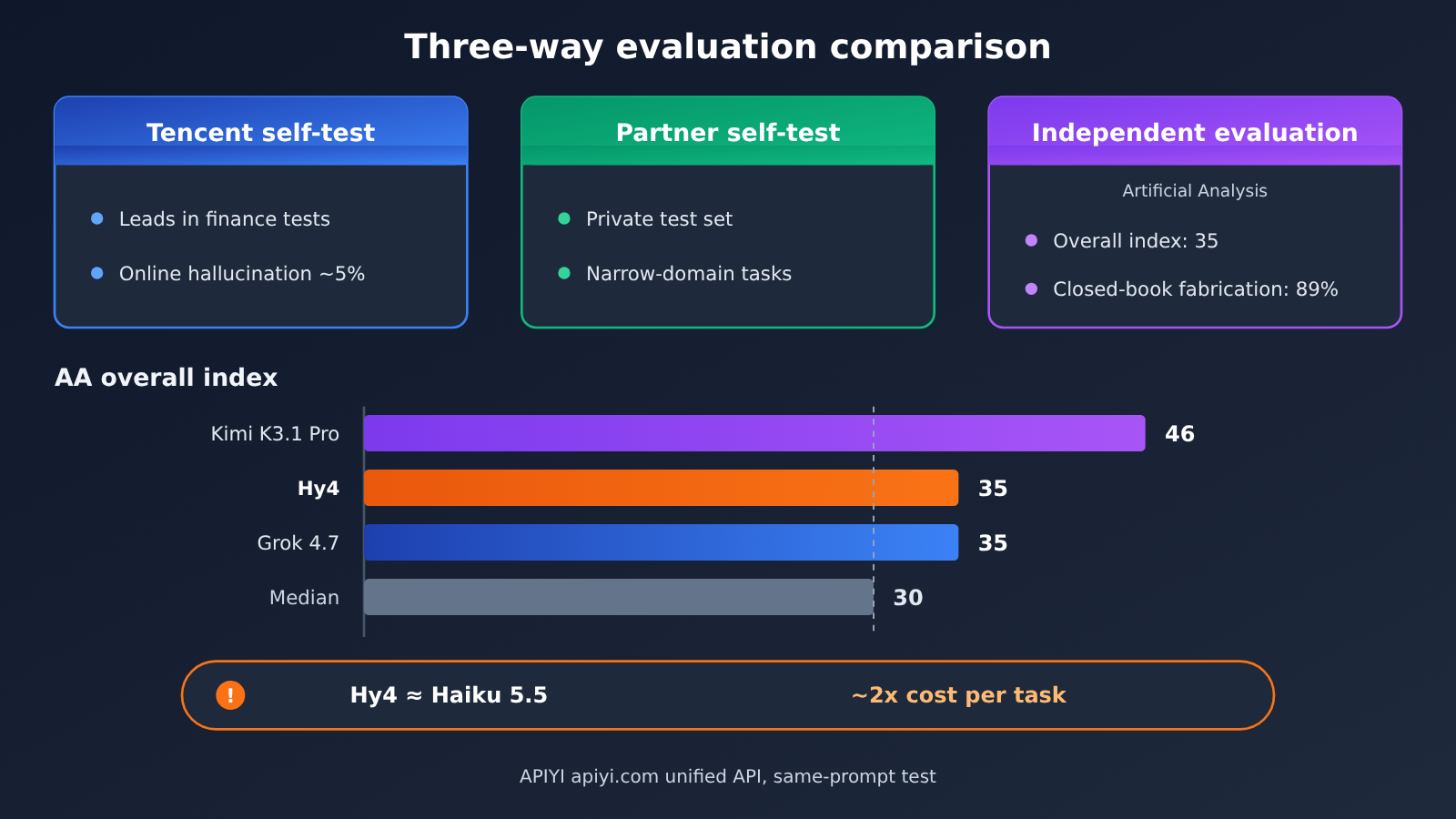
| Artificial Analysis | Hy4 scored 35 on the overall index, above the median of 30 and tied with Grok 4.7. It ranked second among Chinese models, behind Kimi K3.1 Pro at 46 | Independent third-party evaluation | 60% of the test set is private, making it harder to optimize specifically for the test |
| Artificial Analysis | Without web access, Hy4 answered about half of factual questions correctly and made up an answer 89% of the time when it didn’t know | Independent third-party evaluation | Closed-book factual knowledge accuracy test |
Key Differences Between Tencent’s Hy4 Self-Tests and Independent Evaluations
The clearest disagreement is in the comparison between Hy4 and Kimi K3.1 Pro. Tencent’s financial tests rank Hy4 ahead of Kimi, but on the Artificial Analysis overall index, Hy4 trails Kimi by 11 points. These results aren’t necessarily contradictory: the financial tests cover a narrow use case, while the overall index spans knowledge work, coding, science, common sense, and more. Hy4 appears to have an advantage in finance, where Tencent has focused its efforts, but it doesn’t lead in overall capability.
There’s also a point worth noting about value for money. Artificial Analysis data shows that Hy4’s overall score is roughly on par with Anthropic’s smallest model, Haiku 5.5, while Haiku 5.5’s cost per task on that benchmark is nearly half of Hy4’s. In other words, you can’t conclude that “Hy4 is cheaper” based on token prices alone—you also need to account for how many tokens it actually uses to complete a task.
Where Tencent Hy4 Falls Short on Difficult Tasks
Tencent itself acknowledges that Hy4 still lags well behind the best commercial models in advanced mathematics, longer programming projects, and complex image analysis. The largest gap appears on Hy-FrontierMath T5:
| Benchmark / Dimension | Hy4 | GPT 6.1 Sol | Claude Opus 5.5 | Source |
|---|---|---|---|---|
| Hy-FrontierMath T5 | 13.0 | 97.5 | 91.3 | Tencent official |
| Tencent’s 12 in-house benchmarks | Behind Opus 5.5 on all 12 | Ahead of Hy4 on 8 | Ahead on all 12 | Tencent official |
| AA Intelligence Index | 35 | Not provided in the source material | Not provided in the source material | Artificial Analysis |
| Factual accuracy without web access | About half correct; fabricated answers 89% of the time when it didn’t know | Not provided in the source material | Not provided in the source material | Artificial Analysis |
A score of 13.0 versus scores above 90 isn’t just “a little weaker”—it’s in a completely different league. If your work involves competition-level mathematical reasoning, long-term engineering projects, or high-precision image analysis, Hy4 isn’t currently suitable as your primary model.
Tencent Hy4 Impact Analysis: What It Means for Developers and Product Teams
What This Means for Developers: With and Without Search, It’s Like Two Different Models
Put the two figures together—“about a 5% hallucination rate with web access” and “89% fabrication without web access”—and the takeaway is clear: Hy4’s factual reliability depends heavily on external retrieval. Tencent’s 5% figure comes from internal testing with web search, while Artificial Analysis measured the 89% fabrication rate under closed-book conditions. When integrating Hy4 into a product, it’s sensible to design around it as a model that requires retrieval.
Here are a few practical ways to do that:
- Use retrieval for every factual question: Retrieve sources through search or RAG first, then have the model answer based on those sources rather than relying on memory.
- Explicitly allow “I don’t know” in the prompt: Tell the model to respond with “Not mentioned in the provided material” when the information isn’t available, reducing the chance of fabrication.
- Require citations: Have the model identify the source passage for each conclusion so people can spot-check its answers.
- Double-check critical numbers: Verify figures in financial and reporting outputs with code or rules. As the GDPx evaluation points out, a single incorrect number in a table can make the entire output unreliable.
Here’s a minimal example combining retrieval-augmented generation with permission to decline to answer. Replace the model name with one you have access to; check your platform’s console for the specific Hy4 model ID.
import openai

client = openai.OpenAI(
    api_key="YOUR_API_KEY",
    base_url="https://api.apiyi.com/v1"
)

context = "(这里放检索召回的资料片段)"
resp = client.chat.completions.create(
    model="your-model-name",
    messages=[
        {"role": "system", "content": "只依据给定资料回答;资料没有的内容回答“资料未提及”,并标注出处段落。"},
        {"role": "user", "content": f"资料:{context}\n\n问题:该公司三季度营收是多少?"}
    ],
    temperature=0
)
print(resp.choices[0].message.content)
View the full implementation: Compare multiple models on the same questions and track refusal rates
import openai
from typing import List, Dict

client = openai.OpenAI(
    api_key="YOUR_API_KEY",
    base_url="https://api.apiyi.com/v1"
)

SYSTEM = (
    "只依据给定资料回答问题。"
    "如果资料中没有答案,必须只回答:资料未提及。"
    "回答时注明依据的资料段落编号。"
)

def ask(model: str, context: str, question: str) -> str:
    try:
        resp = client.chat.completions.create(
            model=model,
            messages=[
                {"role": "system", "content": SYSTEM},
                {"role": "user", "content": f"资料:\n{context}\n\n问题:{question}"}
            ],
            temperature=0,
            max_tokens=500
        )
        return resp.choices[0].message.content
    except Exception as e:
        return f"Error: {e}"

def evaluate(models: List[str], cases: List[Dict]) -> None:
    """Cases with answerable=False deliberately omit the answer from the context to test fabrication tendencies."""
    for m in models:
        refused, fabricated = 0, 0
        for c in cases:
            out = ask(m, c["context"], c["question"])
            if not c["answerable"]:
                if "资料未提及" in out:
                    refused += 1
                else:
                    fabricated += 1
        print(f"{m}: 正确拒答 {refused},疑似编造 {fabricated}")

cases = [
    {"context": "[1] 公司二季度营收 12 亿元。", "question": "三季度营收是多少?", "answerable": False},
    {"context": "[1] 公司二季度营收 12 亿元。", "question": "二季度营收是多少?", "answerable": True},
]

# Replace the list with the model IDs you want to compare
evaluate(["model-a", "model-b"], cases)
🎯 Model selection tip: When evaluating a new model like Hy4, the most reliable approach is to compare candidates on the same real-world tasks from your own business, rather than relying on leaderboards alone. APIYI apiyi.com offers a unified OpenAI-compatible interface: one API key gives you access to Claude, GPT, Gemini, and models from several Chinese providers, making it easier to run candidates against the same test set. Check the model list in the console to see whether Hy4 is available on the platform.
What Hy4 Means for Product Leaders: Where It Fits and Where It Doesn’t
Based on information from all three sources, here’s a rough guide to where Hy4 may—and may not—be a good fit.
| Task type | Fit | Evidence | Recommendation |
|---|---|---|---|
| Financial data queries and research report organization | Relatively well suited | Tencent’s financial tests and Comein’s feedback, both based on their own testing | Always use retrieval and programmatically verify key figures |
| Word, Excel, and PowerPoint document processing | Relatively well suited | Tencent’s real-time collaboration capabilities and Manus’s feedback on high completion rates for document tasks | Start with a pilot on low-risk document tasks |
| Game engine configuration and bug identification | Worth trying | Feedback from Tencent’s internal game teams | Suitable for configuration and troubleshooting, but not for long-running projects |
| Webpage and mini-game prototyping | Worth trying | Image understanding can assist with coding | Use it for prototypes; production code needs human review |
| Question answering with web search | Worth trying | Internal testing found a hallucination rate of approximately 5% with web access | Enable retrieval and require citations |
| Knowledge questions without web access | Not recommended | It made up answers 89% of the time when it didn’t know | Avoid asking the model to answer factual questions from memory |
| Advanced mathematics and competition-level reasoning | Not recommended | Scored just 13.0 on Hy-FrontierMath T5 | Choose a leading commercial model |
| Long-running coding projects and complex image analysis | Not recommended | Tencent has acknowledged that Hy4 noticeably lags behind | Choose a stronger model or break the task into smaller parts |
Industry Impact: Open Weights and Tighter Regulation
Tencent plans to release Hy4’s weights, which could give businesses the option to deploy it privately. But the release date and license haven’t been announced, so it’s too early to include it in plans with firm delivery timelines.
The regulatory landscape is changing too. In October, China’s Ministry of Commerce and Ministry of Science and Technology published a draft export control framework covering model weights for models ranked in the global top ten or with more than two trillion parameters. The draft includes a fast track with automatic approval for open-source releases. On safety, Tencent says it deliberately filtered hacking-related material from training data. Its security lab found no increased risk of misuse, and biological hazards were well below its risk threshold. A detailed safety report will be released alongside the weights.
Tencent Hy4 FAQ
Q1: What is Tencent Hy4?
Hy4 is Tencent’s full-release Large Language Model, launched after its preview. It’s the first to support image understanding and autonomous operation of computer software, with a focus on coding, finance, and office tasks. It’s currently available through Tencent Cloud, OpenRouter, and apps such as Yuanbao. Its weights will be released later.
Q2: How does Hy4 compare with Kimi K3.1 Pro and Claude Opus 5.5?
In Tencent’s own financial tests, Hy4 ranked ahead of Kimi K3.1 Pro. But in Artificial Analysis’s independent evaluation, Hy4 scored 35, behind Kimi’s 46. Compared with Claude Opus 5.5, Hy4 trailed on all 12 of Tencent’s own benchmarks. To compare them on your own use cases, you can use APIYI at apiyi.com to invoke multiple models through a unified interface and test them on the same questions.
Q3: When will Hy4’s weights and Hy4 flash be released?
As of November 6, 2026, Tencent hasn’t announced a specific release date or license for the weights. It has only said that the safety report will be released alongside them. The faster, cheaper Hy4 flash has also only been confirmed as planned, with no release date or pricing announced. Keep an eye on official updates.
Q4: Is Hy4 expensive?
Hy4 costs about $0.83 per million input tokens and $2.50 per million output tokens, the same as the preview. But Artificial Analysis data shows that Haiku 5.5, which has a similar score, costs almost half as much per task. You’ll need to factor in actual task usage to calculate total costs.
Q5: How can you reduce the risk of Hy4 making up facts?
The key is not to rely on its memory for factual answers: enable web search or connect it to RAG, allow it to answer “not mentioned in the source material” in your prompt, and ask it to cite its sources. The comparison script above can help you track refusals and fabricated answers across models. Combined with the free testing credits for new users at APIYI, apiyi.com, you can run an initial validation at low cost.
Q6: What are Hy4’s known limitations?
There are three main limitations: first, it trails significantly on difficult tasks, scoring just 13.0 on Hy-FrontierMath T5; second, its knowledge is unreliable without web access—it makes up an answer 89% of the time when it doesn’t know one; third, several positive findings come from Tencent’s or its partners’ own tests, with methodology details undisclosed, so you’ll need to verify them with your own data.
Tencent Hy4: Key Takeaways
- Two firsts: Hy4 supports image understanding and autonomous computer operation for the first time, including Blender, CAD, and Office documents.
- Pricing is unchanged: Around $0.83 per million input tokens and $2.50 per million output tokens, the same as the preview version.
- Above average in independent testing: It scored 35 on the AA Intelligence Index, ranking second among Chinese models but well behind Kimi K3.1 Pro.
- Retrieval is essential: Its hallucination rate is around 5% with internet access. Without it, the model makes up an answer 89% of the time when it doesn’t know one.
- Lags on difficult tasks: It falls noticeably behind leading commercial models in advanced mathematics, long coding projects, and complex image analysis.
- Verify self-reported results: Financial rankings and partner conclusions largely come from self-testing, so validate them against your own samples before deployment.
- Compare on equal footing: Use the unified interface from APIYI apiyi.com to compare alternatives to Hy4 or benchmark models on the same test set.
Summary
The key points about Tencent Hy4:
- Capabilities have improved significantly: Image understanding and computer operation are the biggest additions in this generation, with particular attention paid to finance and office workflows.
- Separate the three perspectives: The vendor’s and partners’ self-reported results are more optimistic. Independent testing by Artificial Analysis places Hy4 second among Chinese models, close to Haiku 5.5.
- The weaknesses are specific: It’s prone to making things up without internet access and falls noticeably behind on advanced math and long coding projects. These factors directly affect model selection.
If you’re working on financial data queries, document processing, or game configuration, Hy4 is worth a pilot with retrieval. If your use case depends on closed-book knowledge or difficult reasoning, a stronger model is currently a better fit. Start by testing candidate models on the same questions through the unified interface at APIYI apiyi.com, then decide based on cost and accuracy.
📚 References
- THE DECODER – Tencent releases Hy4 with vision and computer use: Coverage of the Hy4 release
- Link:
the-decoder.com/tencent-releases-hy4-with-vision-and-computer-use-claims-second-place-among-chinese-ai-models -
Details: Includes official Tencent data, partner feedback, and independent evaluation results from Artificial Analysis
-
THE DECODER – SemiAnalysis GDPx benchmark coverage: AI agent evaluation in real-world work scenarios
- Link:
the-decoder.com/no-ai-agent-scores-above-12-percent-on-semianalysis-new-real-world-work-benchmark -
Details: An overview of how computer-use agents perform in professional software
-
Artificial Analysis: Independent model evaluation organization
- Link:
artificialanalysis.ai - Details: Find the latest results for the Intelligence Index, AA-Omniscience, and other evaluations
Author: APIYI Technical Team
Technical discussions: Contact us through the APIYI homepage at apiyi.com. For more integration resources, visit the documentation center at docs.apiyi.com.


