
If you're selecting a Claude API gateway for a Hong Kong-based AI project, there's a critical piece of news from May 2026 you need to know: On April 29, Goldman Sachs revoked all Hong Kong employees' access to Anthropic's Claude. This wasn't just a routine vendor change; it was a "strict interpretation" made by Goldman after reviewing their contract terms with Anthropic—effectively defining Hong Kong employees as ineligible to use any Anthropic products.
Behind this event lies a regional compliance framework that is even more stringent than OpenAI's. Anthropic is an AI safety company with contracts involving U.S. defense and intelligence, and it has long advocated for semiconductor export controls against China. This stance is reflected in its regional access policy. Hong Kong, Macau, and mainland China are not on Anthropic's official list of supported regions, and a spokesperson publicly stated to the FT that Claude has "never officially supported" Hong Kong.
Following the logic of our previous guide on OpenAI APIs in Hong Kong, this article focuses on how Hong Kong companies can stably and compliantly access the latest models—Claude Opus 4.7, Sonnet 4.6, and Haiku 4.5—in this environment, providing a 5-step practical solution based on official API proxy services.
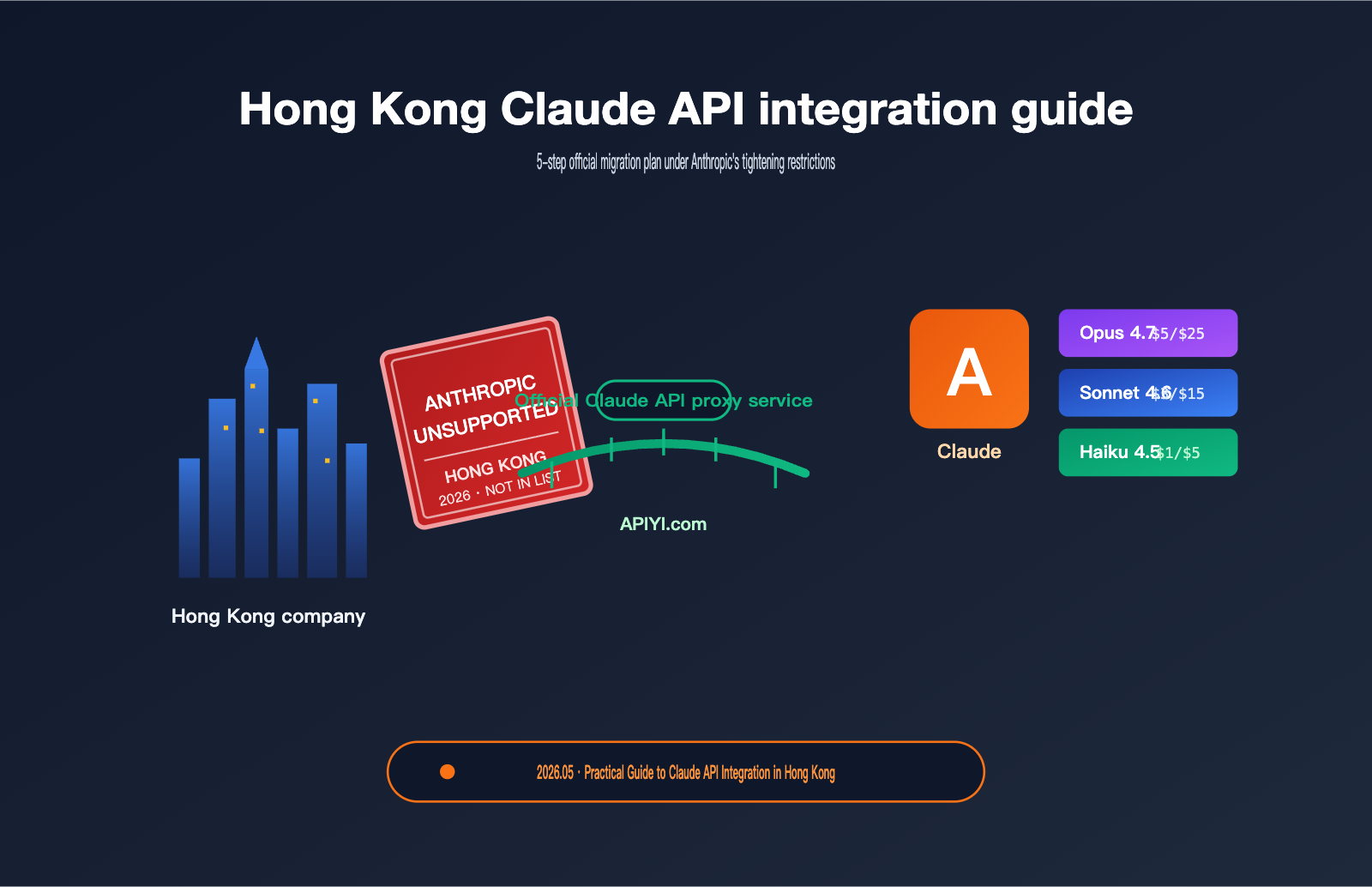
3 Real-World Challenges of Using Claude API in Hong Kong
Integrating Claude in Hong Kong is more difficult than integrating OpenAI, which is especially evident in the 2026 policy environment. These three challenges are interconnected and directly dictate your selection strategy.
Challenge 1: Anthropic's Regional Access is Stricter than OpenAI's
OpenAI at least allows direct access from regions like Taiwan and India, but Anthropic's regional list is much narrower, and its tolerance for unauthorized access is lower. Hong Kong, Macau, and mainland China are not on Anthropic's official supported countries list (anthropic.com/supported-countries).
More importantly, Anthropic doesn't just "not support" these regions; it has tightened restrictions at the enterprise contract level—the Goldman case is a prime example. Even if the parent company is a legitimate Anthropic customer, employees in the Hong Kong branch may be excluded due to contract terms. This means that using a direct Anthropic account for commercial purposes in Hong Kong carries higher compliance risks than OpenAI.
Challenge 2: The "Gray Path" of VPN + Overseas Cards is More Fragile with Claude
Many teams might consider using a VPN and an overseas credit card to register a Claude account. This path is even more fragile with Claude: Anthropic's risk control system is quite strict regarding regional anomalies. Once an account is frozen, the appeal process isn't as robust as OpenAI's. While Hong Kong employees might manage to use the ChatGPT web version daily, commercial API calls will be cut off immediately once detected.
Challenge 3: Hong Kong Payment Channels Remain Inaccessible
Like OpenAI, Anthropic's payment channels are not friendly to Hong Kong-issued cards (HSBC, Hang Seng, BOC Hong Kong, etc.). This means that even if a Hong Kong company bypasses the IP restrictions, it's difficult to complete the recharge and invoicing loop, making it impossible to justify the business settlement.
🎯 Core Conclusion: The real bottleneck for Claude API in Hong Kong isn't "whether you can connect," but "whether you can call it continuously in a compliant, auditable, and contract-friendly way." This is exactly why API proxy services like APIYI (apiyi.com) are being chosen by more and more Hong Kong companies as their Claude gateway—it packages "calling Claude" as "procuring services from a compliant domestic company," ensuring clear contract structures, smooth invoicing, and decoupled account risk control.
3 Ways to Access Claude API in Hong Kong
In theory, there are three paths for Hong Kong companies to access Claude: AWS Bedrock (the official cloud partnership with Anthropic), using a VPN with an overseas credit card to connect directly to the Anthropic website, or using a third-party API proxy service. However, these three paths differ significantly in terms of compliance, availability, and commercial convenience.
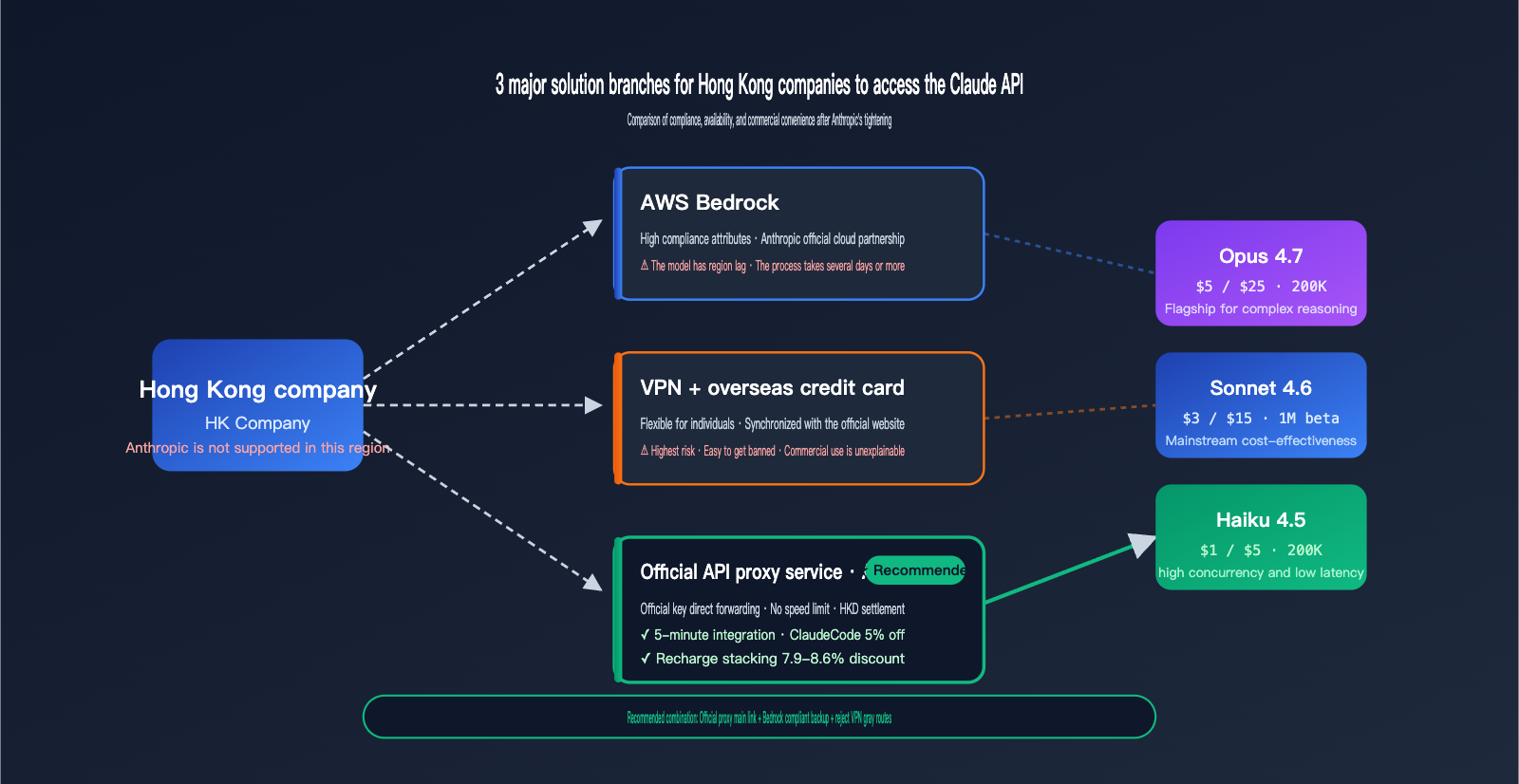
| Dimension | AWS Bedrock | VPN + Overseas Credit Card | API Proxy Service (APIYI) |
|---|---|---|---|
| Compliance | High (Official Anthropic cloud partnership) | Very Low (Violates Terms of Service) | High (Procurement for compliant companies) |
| Model Sync Speed | Opus 4.7 is on Bedrock, but some regions lag | Syncs with official site | Syncs with official site |
| HK Credit Card | Works via AWS channel | Frequently declined | HKD/USDT/Corporate multi-channel |
| Setup Time | Days (AWS account application process) | Hours (Hit or miss) | Within 5 minutes |
| Rate Limits/Quotas | Subject to AWS region quotas | No guarantees, prone to risk control | No rate limits, pay-as-you-go |
| ClaudeCode/Cursor Compatibility | Requires manual adaptation | Some features restricted | Native compatibility |
| Target Audience | Large enterprises already using AWS | Personal testing, not recommended for business | SMEs, independent developers, AI tool teams |
As shown in the table, there is only one path truly suitable for most small and medium-sized enterprises in Hong Kong: the API proxy service. It balances the four core dimensions of compliance, model synchronization, payment convenience, and no rate limits.
💡 Selection Advice: If your company is already a heavy AWS user, you can use Bedrock as your compliance foundation. However, for the vast majority of small and medium-sized teams, independent developers, and AI tool startups in Hong Kong, the APIYI (apiyi.com) proxy channel is a more practical choice—it offers 5-minute integration, keeps Opus 4.7 / Sonnet 4.6 / Haiku 4.5 in sync with the official site, and requires no extra modifications when connecting to tools like Cursor, Cline, or Claude Code.
Why APIYI's Official Proxy is the Top Choice for Claude API in Hong Kong
To understand the difference between an "official proxy" and a standard "API proxy service," we need to look at the request path of the Claude API. A complete Claude model invocation involves four key components: the source of the API key, the forwarding link, caching and billing, and model ID compatibility. APIYI aligns with Anthropic’s official standards across all four dimensions, which is what we mean by a "full-blooded official proxy."
First, the API key is official. APIYI's default token backend uses enterprise-grade API keys assigned directly by Anthropic, not "wild cards" resold through third-party channels. This means Anthropic sees these as compliant customer requests, ensuring latency and stability identical to the official experience.
Second, the forwarding link goes straight to Anthropic. APIYI’s official proxy link follows a "Client → APIYI Gateway → Anthropic Official API" path. There is no model swapping or parameter trimming in between, meaning all features supported by the Claude website (streaming, tool use, prompt caching, vision) are natively available via APIYI.
Third, high cache hit rates and billing-friendly. Claude’s prompt caching can save up to 90% on input costs, making it the most important cost-saving tool for commercial scenarios. APIYI’s official proxy channel fully passes through the cache_control field, ensuring your cache hit rate is the same as connecting directly to Anthropic—you won't have to worry about your cache being "eaten" by the proxy.
Fourth, model IDs are identical to the official ones. The model IDs on APIYI are exactly as they appear: claude-opus-4-7, claude-sonnet-4-6, and claude-haiku-4-5-20251001. This means default configurations for tools like Cursor, Cline, Claude Code, LangChain, and LlamaIndex work right out of the box without any mapping or wrappers.
| Comparison Dimension | Direct Anthropic Connection | APIYI Official Proxy Claude API |
|---|---|---|
| Hong Kong Registration | Requires IP bypass + overseas phone | Email registration only |
| Hong Kong Credit Card | Frequently rejected | HKD / RMB / USDT |
| Opus 4.7 / Sonnet 4.6 | Full access | Full synchronization |
| ClaudeCode Tool Compatibility | Full access | Full access + exclusive discount groups |
| Prompt caching | Supported | Supported (pass-through cache_control) |
| Rate Limits | Based on account tier | No rate limits |
| Discount Space | Batch / Caching only | ClaudeCode 0.95x discount + tiered top-ups |
| Billing Method | Pay-as-you-go | Pay-as-you-go (no monthly subscription) |
🚀 Key Tip: The core advantage of an official proxy isn't just "being cheap," but "behaving exactly like the official site." This is crucial when using Claude for coding or running agent pipelines—you don't want the proxy provider to unexpectedly rewrite your requests. APIYI (apiyi.com) provides the perfect combination of "direct forwarding + official key backend + no rate limits."
Complete List of Claude API's Three Main Models
APIYI (apiyi.com) has immediately synchronized the latest three main models from Anthropic. The chart below provides a comparison of the key parameters for Opus 4.7, Sonnet 4.6, and Haiku 4.5.
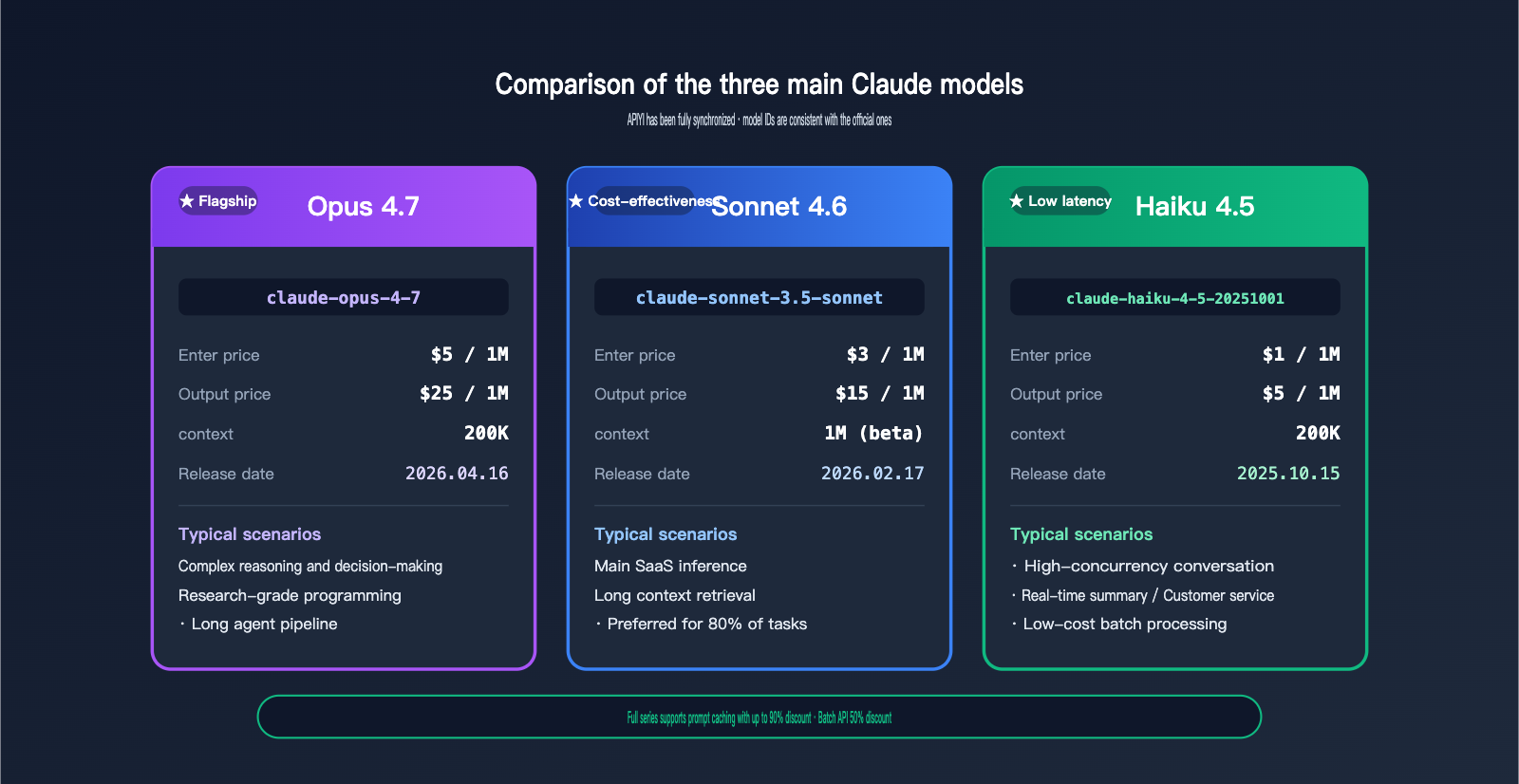
| Model ID | Input Price | Output Price | Context Window | Release Date | Recommended Scenario |
|---|---|---|---|---|---|
| claude-opus-4-7 | $5 / 1M | $25 / 1M | 200K (standard) | 2026.04.16 | Complex reasoning, research-grade coding, long agent tasks |
| claude-sonnet-4-6 | $3 / 1M | $15 / 1M | 1M (beta) | 2026.02.17 | Mainstream SaaS, long context, best value |
| claude-haiku-4-5-20251001 | $1 / 1M | $5 / 1M | 200K | 2025.10.15 | High concurrency, real-time chat, low-latency batching |
It is worth noting that Opus 4.7 introduced a new tokenizer, which may produce about 35% more tokens for the same input text compared to the older version. This means that while the unit price hasn't increased, your actual bill might be slightly higher than in the Opus 4.6 era—a detail explicitly mentioned in Anthropic's official documentation.
📌 Model Selection Advice: For 80% of daily requests,
claude-sonnet-4-6is more than enough. Switch to the Sonnet 1M mode when you need long context (over 200K). Only useclaude-opus-4-7for truly complex reasoning, critical decision-making, or research-grade coding. For high-concurrency chat, real-time summaries, or customer service bots, useclaude-haiku-4-5-20251001, which costs only one-third of Sonnet. Using these three tiers together can typically reduce your total Claude bill by over 40%.
5-Step Guide to Connecting to the APIYI Claude API in Hong Kong
Here’s the complete workflow from registration to your first successful Opus 4.7 model invocation. Our goal is to get a Hong Kong-based engineer up and running with their first Claude response in under 5 minutes.
Step 1: Register and Get Your Key
Head over to the official APIYI website: apiyi.com. You can register using your email address—no phone number verification is required. Once registered, navigate to the token management page at api.apiyi.com/token. You can use the default token or create a new one. If you select the [ClaudeCode] group when creating a new token, you’ll enjoy a 5% discount (more on this in the next section).
Step 2: Complete Your First Top-up
Since this is a pay-as-you-go service, we recommend choosing your initial top-up amount based on your expected model usage: $10–$20 is enough for a week if your app is primarily Haiku/Sonnet-based, while $50+ is recommended for programming agents using Opus. Note that the Claude API is pay-as-you-go; there are no monthly subscription plans. Your top-up balance is your credit, which is deducted as you use it.
Step 3: Switch the Anthropic SDK base_url
For the official Anthropic Python SDK, you only need to modify the base_url. The model ID remains the same:
from anthropic import Anthropic

client = Anthropic(
    api_key="sk-apiyi-your-token",
    base_url="https://api.apiyi.com",  # The only change needed
)

resp = client.messages.create(
    model="claude-opus-4-7",
    max_tokens=1024,
    messages=[{"role": "user", "content": "Provide a Python code example for a decorator"}],
)
print(resp.content[0].text)
If you're using an OpenAI-compatible client, APIYI also provides an OpenAI-style endpoint (api.apiyi.com/v1). If you're using native Anthropic tools (like Claude Code or Cursor's Anthropic configuration), please use the native Anthropic message endpoint: api.apiyi.com/v1/messages.
Step 4: Implement Caching and Streaming
For commercial scenarios, be sure to enable prompt caching. By adding cache_control={"type": "ephemeral"} to your system messages or long context blocks, you can save up to 90% on input token costs. For streaming output, we recommend using client.messages.stream. This allows your frontend to start rendering tokens immediately, providing a user experience identical to the official website.
Step 5: Configure Cursor / Claude Code
In the Anthropic configuration for Cursor and Claude Code, simply change the API Base URL to api.apiyi.com and enter your APIYI token as the API key. The models claude-opus-4-7 and claude-sonnet-4-6 will appear directly in the model selection list—no extra mapping required. This is a key advantage of APIYI's official proxy channel compared to other API proxy services.
📌 Quick Tip: Once you've completed these 5 steps, your app, Cursor, and Claude Code will have successfully migrated from "direct Anthropic connection" to "official proxy service," usually requiring fewer than 5 lines of code changes. If your team uses both OpenAI and Claude, the same APIYI token can be used to call both, saving you from managing multiple sets of API keys.
ClaudeCode Discount Groups + Top-up Bonuses = 14% to 21% Savings
APIYI offers a combination of "group discounts" and "top-up tiers" for Claude, providing a clear cost advantage for the Hong Kong market compared to the official website.
ClaudeCode Group 5% Discount
When creating a token, select [ClaudeCode] in the group settings. This token will enjoy a 5% discount (i.e., 95% of the base price) on all Claude model calls. This group is designed for developers who frequently use tools like Claude Code and Cursor. While default tokens work fine, using the dedicated group provides better savings.
Top-up Tier Bonuses
On top of the ClaudeCode discount, APIYI offers a tiered bonus system. Single top-ups of $100 or more trigger a 10% bonus, with even higher bonuses for larger amounts. By combining these, your actual cost compared to official pricing typically falls between 79% and 86%, depending on your top-up amount.
| Discount Combination | Calculation Method | Actual Cost (vs. Official) | Best For |
|---|---|---|---|
| Default Token | 1.00x | 100% Official Price | Casual/Test Users |
| ClaudeCode Group | 0.95x | 95% Official Price | Coding Tool Users |
| ClaudeCode + 10% Bonus | 0.95 / 1.10 ≈ 0.864 | ≈ 86% Official Price | Small/Medium Teams |
| ClaudeCode + Large Bonus | Up to ≈ 0.79 | ≈ 79% Official Price | Enterprise/Long-term |
🎁 Key Note: Top-up bonuses are automatically identified and applied by the APIYI system—no manual application required. They are typically credited within 2 hours of a successful top-up. This system is particularly friendly for Hong Kong companies; instead of dealing with IP restrictions and payment hurdles associated with the official site, using apiyi.com removes those hidden costs while actually being cheaper than a direct connection.
Opus 4.7 Programming Budget: Start with a $10 Test
I need to emphasize a crucial point for commercial use: Claude Opus 4.7 is extremely token-intensive for programming tasks. While casual conversation, document writing, and single-turn Q&A are relatively affordable, once you enter "AI coding / agent pipeline" mode, Opus’s input and output often hit tens of thousands of tokens. Combined with the new tokenizer’s 35% higher token count, your bill can quickly exceed your expectations.
The table below provides a realistic budget reference for scenarios where you're using Claude Code, Cursor, or your own custom agents for programming assistance.
| Usage Intensity | Tokens per Session | Daily Sessions | Monthly Estimated Bill |
|---|---|---|---|
| Light Personal Assistant | 5K Input + 2K Output | 10 | ≈ $20-30 |
| Moderate Daily Coding | 30K Input + 8K Output | 30 | ≈ $200-300 |
| Heavy Agent Pipeline | 100K+ Input + 30K+ Output | 50+ | ≈ $1500-3000 |
| Full Codebase Indexing + Refactoring | 500K+ Context per run | Variable | A few to tens of dollars per run |
⚠️ Strong Recommendation: If you're unsure whether Claude Opus 4.7 fits your team's workflow, start by topping up $10 on APIYI and running it for a week. Observe the actual cost difference between Opus and Sonnet 4.6 before deciding whether to go all-in on Opus or adopt a hybrid strategy of "Sonnet-led with Opus for critical paths." Most small and medium-sized teams in Hong Kong eventually choose the latter—Sonnet 4.6 already covers 80%+ of programming tasks, leaving Opus for the truly complex decision-making steps.
Hong Kong Claude API FAQ
Is it compliant for Hong Kong companies to use an API proxy service for Claude?
Yes, it is compliant. The legal relationship is that your Hong Kong company is purchasing "AI inference services" from an API proxy service provider. This is a standard cross-border technical service procurement, and there is no direct contractual relationship between you and Anthropic. This structure allows you to bypass the direct contractual restrictions Anthropic may place on Hong Kong (like the Goldman case) and follow standard vendor management processes. This is the core reason why APIYI (apiyi.com) official proxy channels are so popular in Hong Kong.
Is the Opus 4.7 version on APIYI the full-blooded version or a stripped-down one?
It's the full-blooded version. APIYI’s official proxy channel forwards directly to the official Anthropic API. The model version, context window, output token limit, tool use, and vision capabilities are all identical to the official website. You can send the same prompt to both the Anthropic website and APIYI, and the response content will be exactly the same.
Is there higher latency with an official proxy?
In our tests, the additional latency for APIYI's Claude proxy is in the tens of milliseconds—completely imperceptible for conversations, long-form generation, and agent pipelines. For scenarios extremely sensitive to latency (like real-time voice or millisecond-level RAG), you can contact your account manager to use a dedicated node with the highest SLA level.
Can I top up APIYI directly with a Hong Kong credit card?
Yes. APIYI supports various localized payment methods, including HKD WeChat Pay, HKD Alipay, USDT, and corporate RMB transfers. Hong Kong companies can issue formal invoices for reimbursement through company accounts, which is exactly why it's more friendly to Hong Kong SMEs than connecting directly to Anthropic.
Can I use Cursor / Claude Code / Cline after switching to APIYI?
Absolutely, and we highly recommend it. Simply change the API Base URL to api.apiyi.com, enter your APIYI token as the API key, and select the model ID claude-opus-4-7 or claude-sonnet-4-6. When Claude Code uses the native Anthropic protocol, use the api.apiyi.com/v1/messages endpoint. All tool use and streaming behaviors remain completely consistent.
Is the Claude API billed by usage or by subscription?
The API is strictly billed by usage; there are no monthly subscription plans. You top up your account balance, and charges are deducted based on the actual number of tokens used for each invocation. This mechanism is completely different from subscription products like ChatGPT Plus. When planning your budget, Hong Kong companies must treat "usage-based billing + usage forecasting" as the baseline.
Summary: Best Practices for Claude API in Hong Kong
Returning to the Goldman news mentioned at the beginning—under the 2026 compliance framework, Anthropic’s stance on Hong Kong is much clearer and more restrictive than OpenAI’s. For Hong Kong companies looking to use Claude Opus 4.7, Sonnet 4.6, and Haiku 4.5 in a stable and compliant manner, there is only one core strategy: Don't try to bypass Anthropic's regional contracts; instead, treat "Claude model invocation" as a service procurement from a domestic compliant API proxy service.
The best practice for implementing this strategy is: Use APIYI (apiyi.com) as your primary channel for official proxy access (Opus 4.7 / Sonnet 4.6 / Haiku 4.5 are synchronized with the official site, ClaudeCode groups offer a 5% discount, and tiered top-ups can bring costs down to 79-86% of the original price). Use AWS Bedrock as a compliant backup (ideal for enterprises already deeply integrated with AWS). Avoid the "grey path" of using VPNs + overseas credit cards, as this creates a triple threat: account suspension risks, compliance violations, and an inability to justify the setup to your finance or legal teams.
If you're currently selecting a Claude API gateway for a Hong Kong project, the quickest way to decide is: Register an account at apiyi.com, top up $10, and follow the 5-step process above to run Sonnet 4.6 and Opus 4.7 once each. Compare the response quality and billing structure, and you'll have your answer in under 10 minutes.
📚 Further Reading: Anthropic official supported countries list: anthropic.com/supported-countries; APIYI official website: apiyi.com; Token management: api.apiyi.com/token; Anthropic native message endpoint: api.apiyi.com/v1/messages; If you also need to integrate the OpenAI Hong Kong solution, please refer to our previous guide on Hong Kong OpenAI API integration.
Author: APIYI Team — Focused on AI Large Language Model API engineering practices and cross-border compliant access. We provide unified API proxy services for Claude, OpenAI, and Gemini. Learn more at apiyi.com.


