
If you've been hearing the name "Project Glasswing" lately but aren't sure how it connects to Claude, Anthropic, or the Mythos Preview, this guide is for you. Project Glasswing is an AI cybersecurity alliance launched by Anthropic on April 7, 2026, in partnership with 11 global tech giants. Its goal is to use Claude Mythos Preview—a "yet-to-be-released but already operational" top-tier model—to harden the world's most critical software before attackers can weaponize similar capabilities.
Core Value: Learn the core objectives of Project Glasswing, its 12 founding partners, the $100 million commitment, and why it's so vital for the future of the AI industry in just 3 minutes.
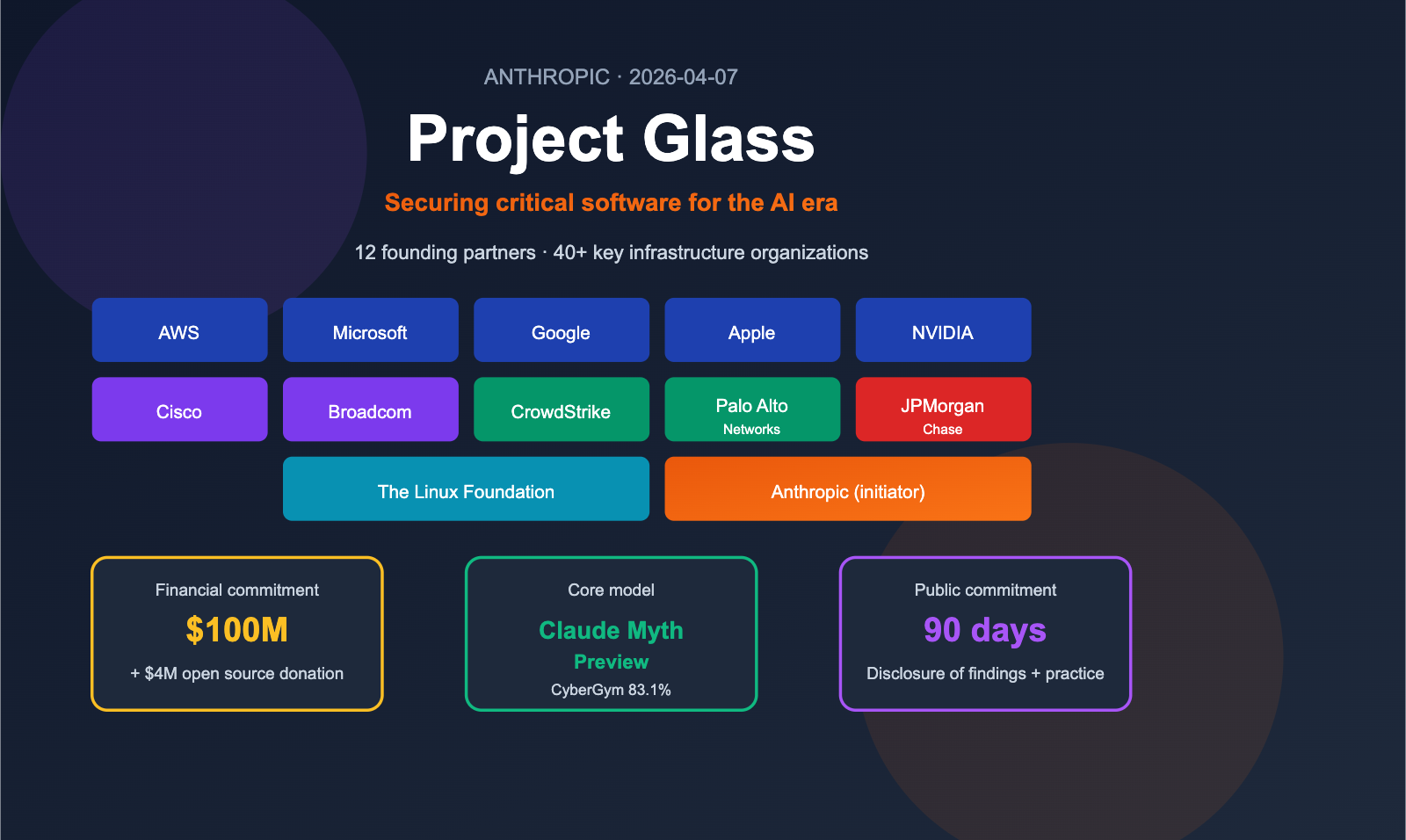
What is Project Glasswing? A Quick Overview
In a nutshell: Project Glasswing = Anthropic + 12 tech/financial giants + Claude Mythos Preview, forming a closed AI cybersecurity alliance.
The background for its formation is straightforward—Anthropic internally verified that Claude Mythos Preview has reached a "generational leap" in autonomous vulnerability discovery and exploit chain construction. Once this capability falls into the hands of attackers, it could trigger systemic risks. Anthropic chose not to release the model publicly, but instead locked it within Glasswing, allowing the defense side to utilize it first.
| Item | Details |
|---|---|
| Project Name | Project Glasswing |
| Initiator | Anthropic |
| Announcement Date | April 7, 2026 |
| Founding Partners | 12 tech/financial/open-source organizations |
| Additional Invitees | 40+ critical software infrastructure organizations |
| Core Model | Claude Mythos Preview (not publicly released) |
| Funding Commitment | $100 million in model credits + $4 million in direct donations |
| Model Pricing | $25 / $125 (input/output, per million tokens) |
| Access Methods | Claude API · Amazon Bedrock · Google Cloud Vertex AI · Microsoft Foundry |
| Public Commitment | Disclose findings and vulnerabilities within 90 days where possible |
| Project Slogan | Securing critical software for the AI era |
💡 Quick Take: Glasswing isn't just another "industry alliance"; it's a "controlled release of a frontier model." Anthropic is using this approach to answer a critical question: Once a model's capabilities cross a certain threshold, how should it be opened up without triggering systemic risks? If you need to access the currently available Claude Opus 4.6 / Sonnet 4.6 models, you can connect via APIYI (apiyi.com) to enjoy stable, low-latency model invocation in China.
Why Project Glasswing Emerged
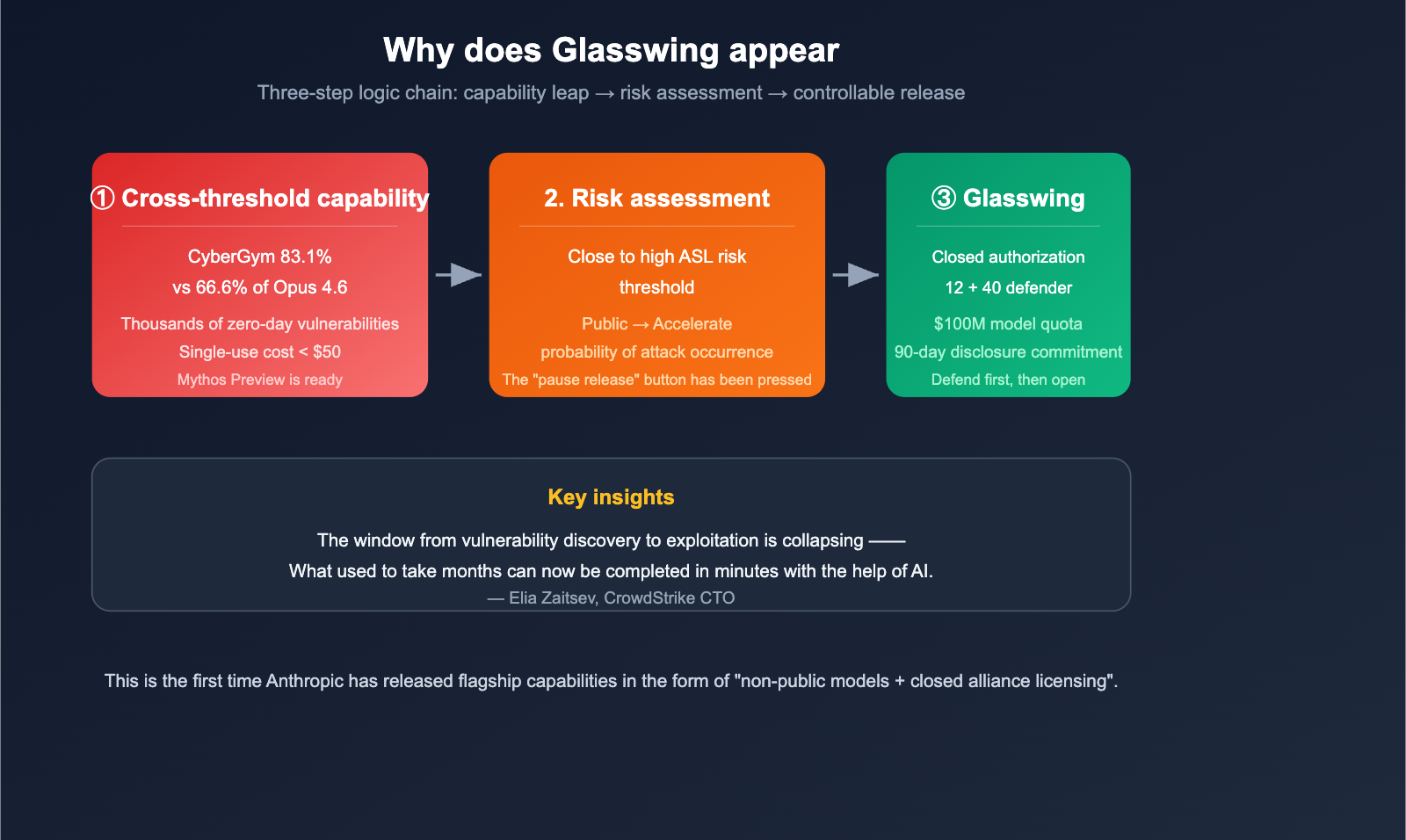
To understand why Glasswing emerged, you need to grasp one fact: Claude Mythos Preview has autonomously discovered "thousands of zero-day vulnerabilities" over the past few weeks, spanning every major operating system and browser. Two of the most representative cases include:
- OpenBSD: A kernel bug hidden for 27 years (introduced in 1998) that bypassed over 5 million automated fuzzing tests.
- FFmpeg: A 16-year-old vulnerability that had never been detected by traditional automated tools.
What makes Anthropic even more cautious is the unit cost of Mythos: finding an OpenBSD-level vulnerability takes less than 1,000 full inferences, costing under $20,000, with a single successful run costing less than $50.
On the CyberGym security benchmark, Mythos scored 83.1%, far surpassing Claude Opus 4.6's 66.6%. This isn't just an incremental improvement; it's a quantum leap.
Because of the "double-edged sword" nature of this capability, Anthropic made an unusual decision: the model is live, but it won't be released publicly. Instead, it's locked within a closed alliance of top-tier defenders. That’s why Project Glasswing was born.
🛡️ CrowdStrike CTO Elia Zaitsev's comment: "The window from vulnerability discovery to exploitation is collapsing—what used to take months can now be done in minutes with the help of AI." This perfectly summarizes why Glasswing must exist.
The 12 Founding Partners of Project Glasswing
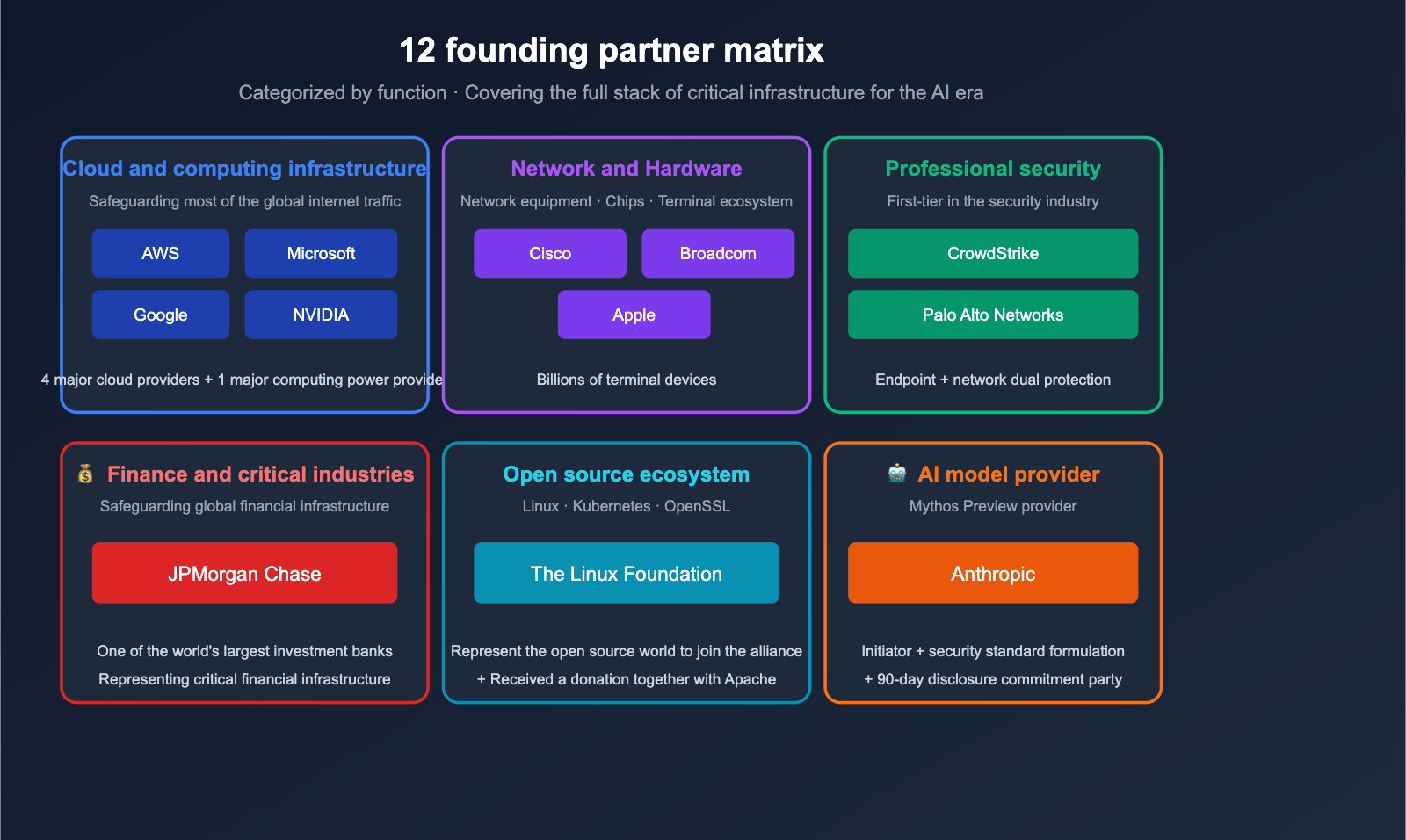
The founding partners of Project Glasswing cover almost every essential element of the AI-era infrastructure. These 12 organizations weren't chosen at random; they were selected based on the criteria: "If the software they manage fails, the whole world catches a cold."
| Category | Partners | What They Protect |
|---|---|---|
| Cloud & Compute Infrastructure | Amazon Web Services, Microsoft, Google | The majority of global internet traffic |
| Network & Hardware | Cisco, Broadcom, NVIDIA | Network equipment, chips, and AI compute foundation |
| Devices & Ecosystem | Apple | Billions of iOS/macOS devices |
| Finance & Critical Industries | JPMorgan Chase | Global financial infrastructure |
| Professional Security Vendors | CrowdStrike, Palo Alto Networks | Top-tier endpoint protection and cybersecurity |
| Open Source Ecosystem | The Linux Foundation | Linux kernel, Kubernetes, OpenSSL, etc. |
| AI Model Providers | Anthropic | Claude Mythos Preview and security standards |
Beyond these 12 founding members, Anthropic has invited 40+ organizations that maintain critical software infrastructure to join the testing. These invitees cover more specialized fields, such as embedded systems, industrial control, cryptographic libraries, and container runtimes.
Key Insight from Cisco SVP Anthony Grieco
"AI capabilities have crossed a critical threshold, which fundamentally changes the urgency of protecting critical infrastructure."
Key Insight from AWS Amy Herzog
"Our team analyzes over 400 trillion network flows every day; AI is at the core of our large-scale defense capabilities."
Key Insight from Linux Foundation's Jim Zemlin
"Open-source maintainers can now use AI-powered vulnerability discovery tools—it's no longer just for companies that can afford expensive security teams."
These three quotes summarize the demands of the three types of participants in Glasswing: Big Tech wants a first-mover advantage, open-source communities want equal weapons, and security firms want next-generation capabilities.
The Core Commitments of Project Glasswing
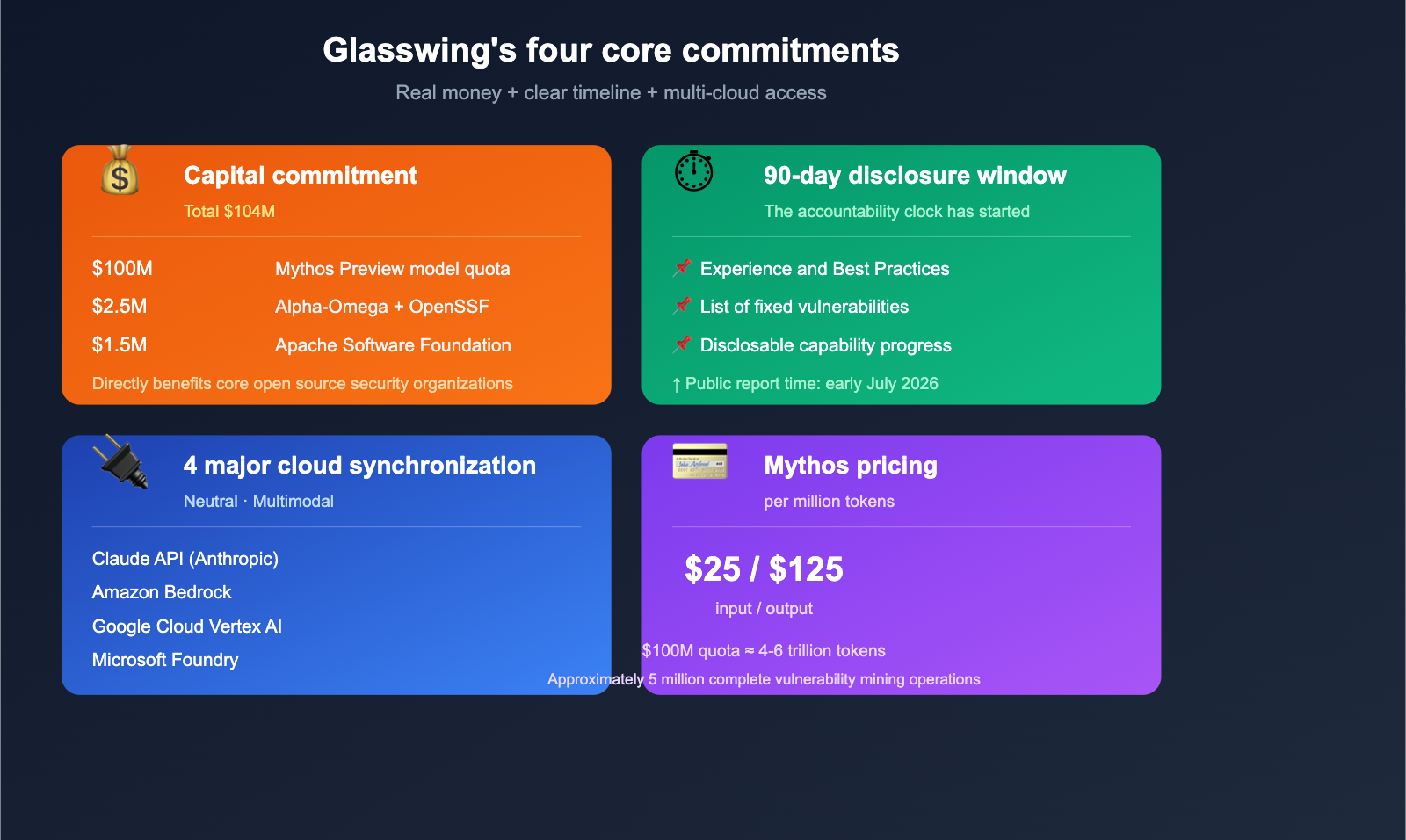
Glasswing isn't just another "manifesto-style" alliance full of empty slogans; it’s a hands-on initiative backed by real funding and a clear timeline.
$100 Million in Model Credits
Anthropic is providing participants of Glasswing with $100 million in Claude Mythos Preview credits. With pricing at $25/$125 per million tokens, this essentially provides the entire alliance with the compute power needed for large-scale "vulnerability research and exploit chain construction."
$4 Million in Direct Grants for Open Source Security
The funding goes directly to key organizations in open source security:
- $2.5 million: Alpha-Omega and OpenSSF (via the Linux Foundation)
- $1.5 million: Apache Software Foundation
This marks the first time Anthropic has funded the open source security ecosystem at this scale. The goal is simple: to ensure that the volunteer teams maintaining projects relied upon by billions of users can also leverage cutting-edge models.
90-Day Disclosure Window
Anthropic has made a public commitment to publish the following within 90 days:
- Lessons learned and best practices
- A list of patched vulnerabilities
- Progress on capabilities that can be safely disclosed
This sets a clear "accountability clock" for the project, ensuring it doesn't turn into a black-box collaboration.
Simultaneous Access via 4 Major Cloud Platforms
Claude Mythos Preview is being made available to participants through four entry points:
| Entry Point | Provider |
|---|---|
| Claude API | Anthropic (Direct) |
| Amazon Bedrock | AWS |
| Google Cloud Vertex AI | |
| Microsoft Foundry | Microsoft |
This highlights the "neutrality" of Glasswing—by opening up through all three major cloud providers simultaneously, they're preventing any single company from monopolizing access.
Specific Goals of Project Glasswing
The slogan for Glasswing is "Securing critical software for the AI era." Its concrete goals include:
- Large-scale vulnerability discovery and patching: Identifying and fixing issues before attackers can weaponize them.
- Providing a "lasting advantage" to defenders: Ensuring attackers can't use AI to gain a permanent upper hand.
- Lowering the barrier to entry for security capabilities: Enabling small open source teams to utilize cutting-edge models.
- Co-developing industry practices: Focusing on vulnerability disclosure, software updates, supply chain security, and Secure-by-Design principles.
Regarding the fourth point, Glasswing will collaborate with external security organizations to produce practice recommendations in five key areas:
- Vulnerability disclosure processes
- Software update workflows
- Open source / supply chain security
- Secure-by-Design development practices
- Tiered response and automation
How Project Glasswing Differs from Standard AI Safety Research
Many people ask, "There's so much AI safety research out there; what makes Glasswing special?" The answer lies in the fact that it's a "first" across three dimensions:
First: Treating "Unreleased Models" as Public Safety Assets
In the past, frontier models were either released publicly or kept entirely closed-source. Glasswing has created a third path: Authorize defenders in a limited scope first, then release publicly. This could become the standard release paradigm for future ASL-4 level models.
First: 12 Giants Hitting the "Collaboration Button" Simultaneously
Previously, AWS, Microsoft, Google, and Apple mostly operated in silos regarding security. Glasswing marks the first time they have collaborated around the same model + the same vulnerability list, which is a historic event in itself.
First: Bringing Open Source Maintainers to the "Frontier Model Table"
Through the "Claude for Open Source" program, maintainers of open-source projects can apply to use Mythos Preview. This means maintainers of critical projects like OpenSSL, Apache, and the Linux Kernel are standing on the same defensive line as AWS, Apple, and Google for the first time.
What Project Glasswing Means for the Average Developer
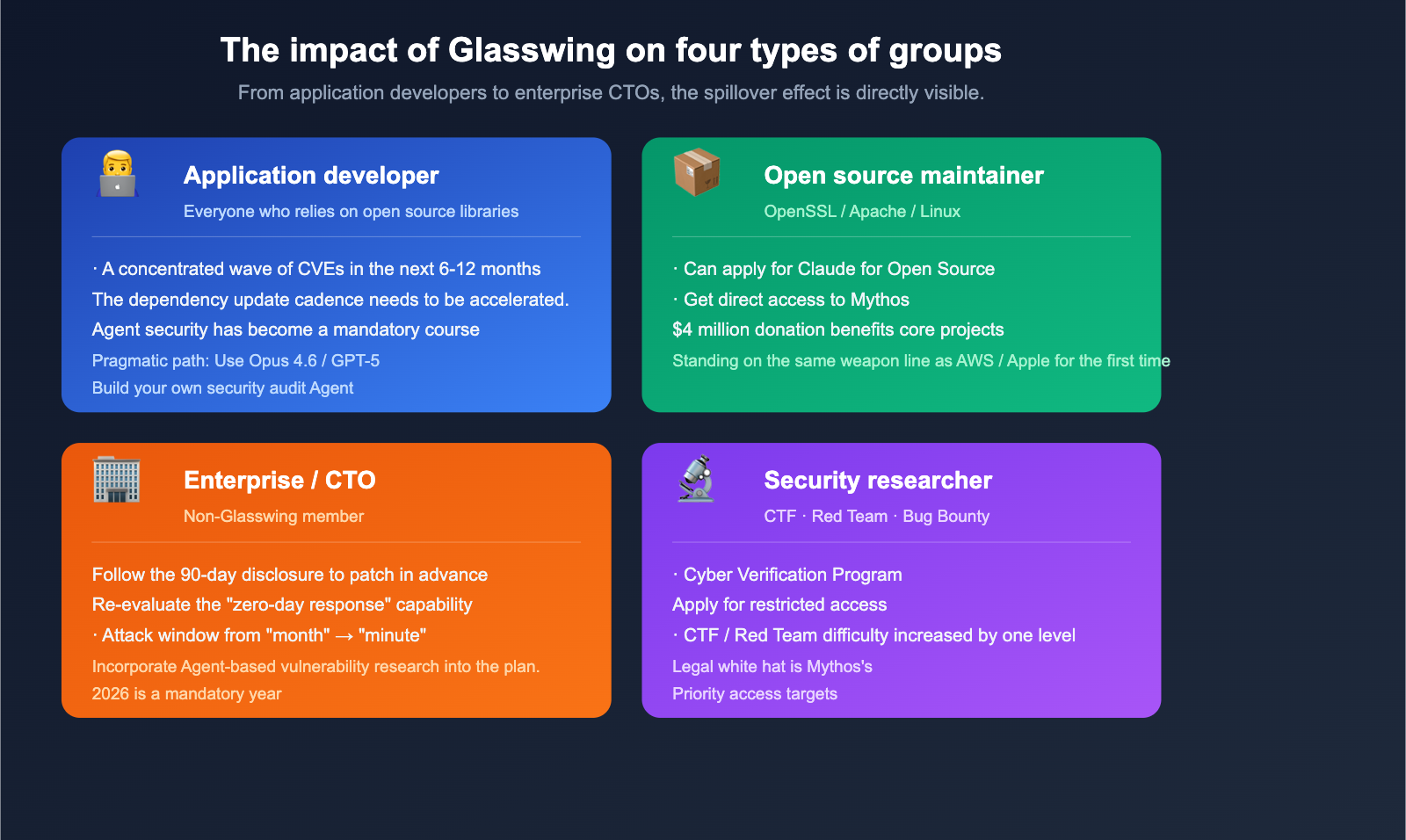
Although Glasswing is a closed project, its spillover effects will directly impact every developer and end-user.
For Application Developers
- The open-source libraries you rely on daily (OpenSSL, FFmpeg, libpng, etc.) will undergo an AI-driven "major vulnerability check."
- You'll see a wave of "quietly patched" CVE announcements over the next 6–12 months; we recommend keeping your dependencies updated.
- Agent security is becoming a mandatory skill—any application integrating an LLM needs to re-examine its attack surface.
- In the absence of Mythos, the most pragmatic approach is to build your own security audit agents using currently available models like Claude Opus 4.6 or GPT-5, which you can access via APIYI (apiyi.com).
For Open Source Maintainers
- You can apply to join the "Claude for Open Source" program to gain Mythos access.
- The $4 million donation from the Linux Foundation and Apache will directly benefit core projects.
- Vulnerability response workflows will be reshaped, potentially moving from "monthly" to "daily" responses.
For Enterprises / CTOs
- If you aren't a Glasswing member, your best strategy is to follow the 90-day disclosure cycle and plan your patching windows in advance.
- Re-evaluate your company's "zero-day response" capability—the attack window in the AI era has compressed from "months" to "minutes."
- Security teams need to incorporate "Agent-based vulnerability research" into their 2026 planning.
For Security Researchers
- Glasswing has launched the Cyber Verification Program, where authorized security researchers can apply for restricted access.
- Over the next 6 months, the difficulty of CTFs, bug bounties, and red team exercises will be pushed up by an order of magnitude.
🎯 Actionable Advice: For the vast majority of developers, the most important thing today isn't waiting for Mythos to be unblocked, but using the most powerful models currently available to build your own security workflows. Claude Opus 4.6, GPT-5, and Gemini 3 Pro are already highly practical for code auditing and vulnerability analysis. We recommend using APIYI (apiyi.com) to access mainstream models in one place, pay-as-you-go, and keep pace with the latest in security agent development.
Project Glasswing FAQ
Q1: Can regular developers join Project Glasswing?
Joining the 12 founding members directly isn't possible, but there are two indirect paths: (1) If you're a maintainer of a core open-source project, you can apply through the "Claude for Open Source" program; (2) If you're a verified security researcher, you can apply for the upcoming "Cyber Verification Program (CVP)" from Anthropic to gain restricted access. While regular app developers can't use Mythos directly in the short term, you can build security workflows using the most powerful models currently available, such as Claude Opus 4.6, via APIYI (apiyi.com).
Q2: Why is Anthropic locking Mythos away instead of releasing it to everyone?
Because Mythos's combined capabilities in autonomous vulnerability discovery and exploit chain construction approach the ASL high-risk threshold. Anthropic's risk assessment clearly indicates that a full public release would "significantly increase the probability of large-scale cyberattacks from 2026 onwards." Glasswing is a compromise: let the defenders use it first, refine security strategies based on their feedback, and then consider a broader release.
Q3: How is Project Glasswing different from typical AI security companies?
The biggest difference is that Glasswing doesn't sell products. It's a collaborative framework consisting of "frontier models + critical infrastructure + open-source ecosystems." Professional security firms like CrowdStrike and Palo Alto Networks are members of Glasswing, but Glasswing itself doesn't compete with them—it provides "generational" capabilities that individual vendors simply cannot build on their own.
Q4: $100 million in model credits sounds like a lot, but what can it actually accomplish?
Based on the Mythos Preview pricing of $25/$125 per million tokens, $100 million can theoretically support 4-6 trillion tokens of input and output. Using the OpenBSD case as a benchmark (1,000 inferences for ~$20,000), it could execute approximately 5 million full-scale vulnerability discovery tasks. This scale is enough to thoroughly "scan" all major operating systems, browsers, cryptographic libraries, and container runtimes.
Q5: What public results can we expect after 90 days?
According to Anthropic's commitment, the following will be released in early July 2026: (1) A list of patched vulnerabilities (via coordinated disclosure); (2) Best practices for security improvements; and (3) Progress on capabilities that can be safely disclosed. Expect a wave of CVE announcements for core projects like OpenSSL, FFmpeg, and the Linux Kernel.
Q6: What can developers in China do today for “AI-era security”?
Three practical steps: (1) Update the lock files for your daily open-source dependencies to prepare for the upcoming wave of CVEs; (2) Run LLM-driven security audit agents on your own codebases using Claude Opus 4.6 or GPT-5; (3) Incorporate agent security into your 2026 technical roadmap. If you need stable access to top-tier international models to build these workflows, you can use APIYI (apiyi.com) for one-stop access, avoiding account and network issues.
Summary
Project Glasswing is one of the most significant events in the AI security landscape of 2026. It represents three key shifts:
- AI model capabilities have crossed the critical threshold of the offense-defense balance: With scores of 60+ Elo, 83.1% on CyberGym, and thousands of zero-day vulnerabilities discovered, these figures show that frontier models have the power to reshape the cybersecurity landscape.
- The release paradigm for frontier models is being redefined: Moving from "public release first, commercial use later" to "Glasswing first, public release later" may become the standard paradigm for ASL-4 models.
- Defenders have gained a collective first-mover advantage for the first time: 12 industry giants, $100 million in credits, and a 90-day disclosure commitment—this is an unprecedented scale of collaboration.
🚀 Actionable Advice: Before Mythos is fully released, the most practical thing you can do is master the most powerful models currently available. Claude Opus 4.6, GPT-5, and Gemini 3 Pro are already production-ready for code understanding, vulnerability analysis, and security auditing. We recommend using APIYI (apiyi.com) for stable, pay-as-you-go, and compliant access, allowing you to migrate seamlessly once Mythos or subsequent Glasswing results are released.
Author: APIYI Team — Dedicated to providing developers with stable access to mainstream AI models. Visit apiyi.com to learn more.
References
-
Anthropic Official Page – Project Glasswing
- Link:
anthropic.com/glasswing - Description: Official source detailing the 12 founding partners, funding commitments, and project goals.
- Link:
-
CyberScoop – In-depth Project Report
- Link:
cyberscoop.com/project-glasswing-anthropic-ai-open-source-software-vulnerabilities - Description: Third-party analysis and interpretation of Glasswing.
- Link:
-
CSO Online – Glasswing and the Future of Vulnerability Discovery
- Link:
csoonline.com/article/4155342/what-anthropic-glasswing-reveals-about-the-future-of-vulnerability-discovery.html - Description: An industry-focused analysis of the project's impact.
- Link:
-
CrowdStrike Official Blog – Founding Member
- Link:
crowdstrike.com/en-us/blog/crowdstrike-founding-member-anthropic-mythos-frontier-model-to-secure-ai - Description: Insights into the collaboration from the perspective of a founding member.
- Link:
-
Anthropic – Claude Mythos Preview Introduction
- Link:
red.anthropic.com/2026/mythos-preview - Description: Details on the capabilities of the Mythos model and the reasoning behind its limited release.
- Link:
-
Techloy – 7 Things You Need to Know
- Link:
techloy.com/what-is-project-glasswing-7-things-to-know-about-anthropics-new-mythos-ai-security-alliance - Description: A beginner-friendly summary of the initiative.
- Link:


