

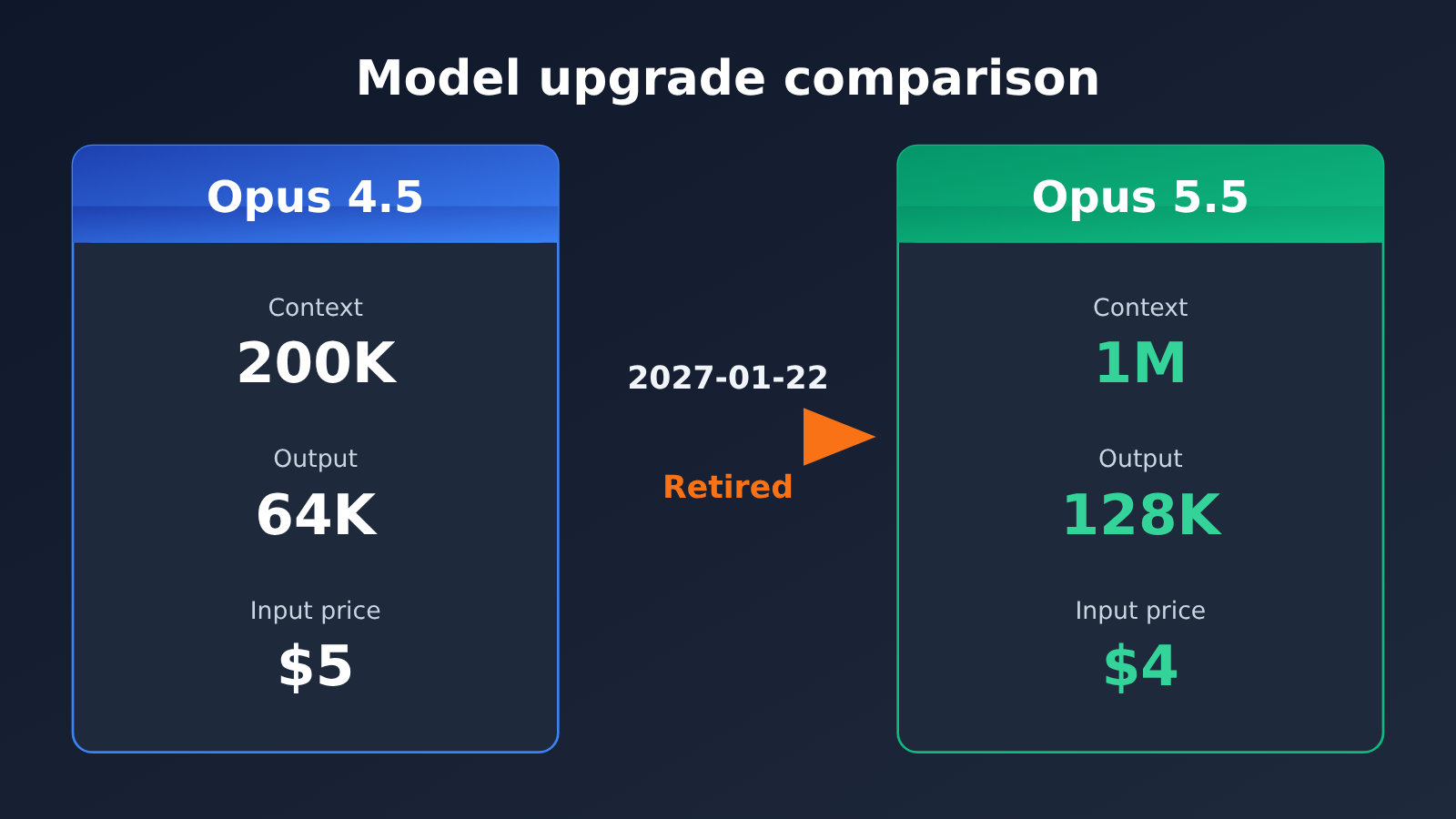
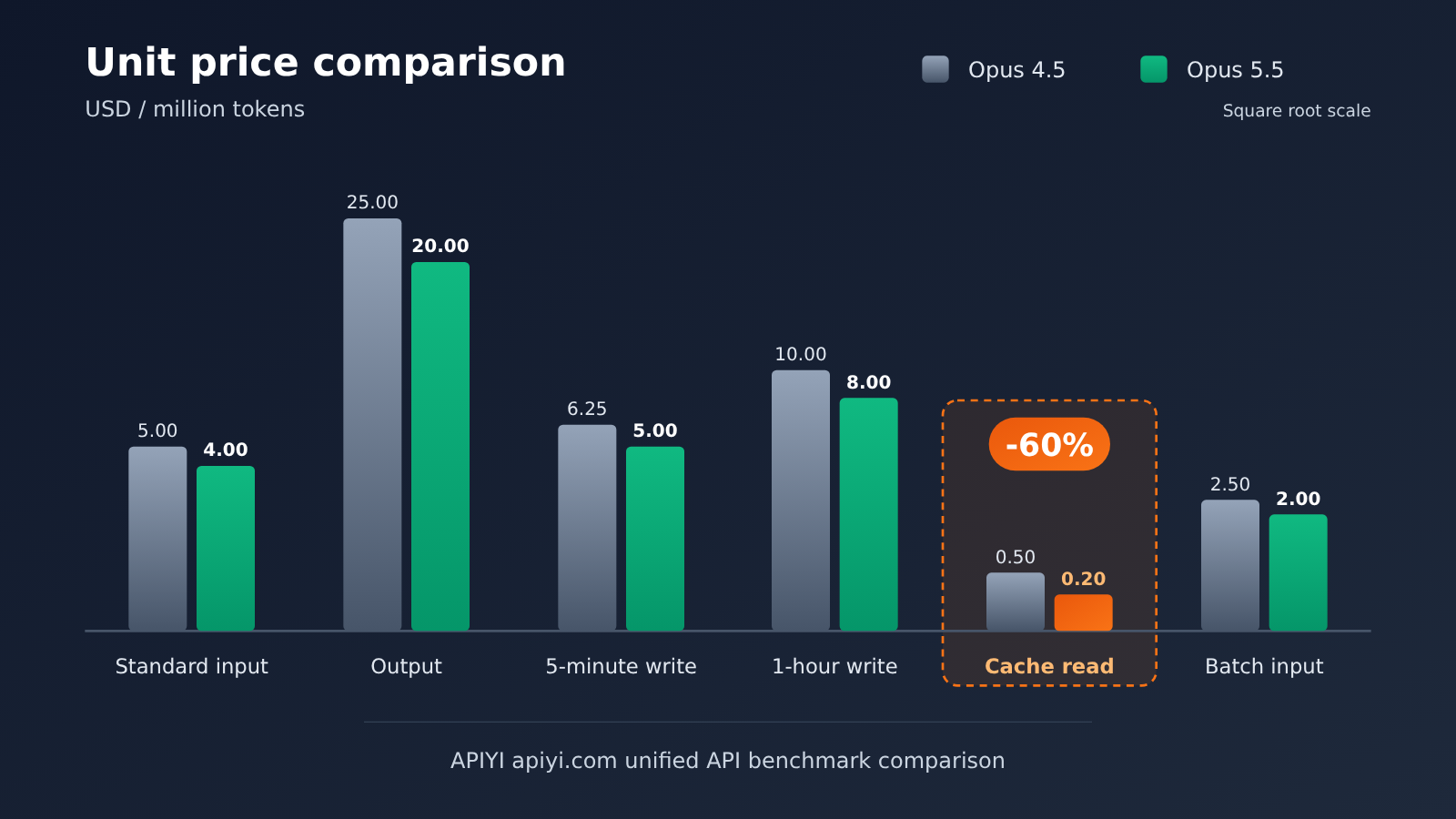
Upgrading from Claude Opus 4.5 to Claude Opus 5.5 comes down to five changes: a bigger context window, a lower unit price, a lower caching threshold, noticeably better benchmark scores, and a shift from manual thinking budgets to adaptive thinking governed by effort. Under the same Claude API pricing scheme, Opus 5.5 cuts input and output unit prices by 20% each and cache-read pricing by 60%. The context window grows from 200K to 1M tokens, and the standard maximum output grows from 64K to 128K tokens.
This upgrade can’t be finished by just swapping the model name. Anthropic notified developers on November 23, 2026 that Claude Opus 4.5 is scheduled to retire from the Claude API on January 22, 2027, with Claude Opus 5.5 as the recommended replacement. During migration, token counts, thinking-token billing, and the default effort value all change, so your bill won’t necessarily drop in proportion to the unit-price cuts — measure it against your own workloads.
What you’ll learn from this article:
- The specific differences between Claude Opus 4.5 and Opus 5.5 in context, output limits, vision specs, and knowledge cutoff
- What each generation’s official benchmark numbers actually represent, which ones are directly comparable, and which aren’t
- A unit-price comparison between the two generations on the Claude API, plus a hypothetical bill you can recalculate yourself
- How to change request parameters and thinking settings when switching from
claude-opus-4-5toclaude-opus-5-5 - A ready-to-run two-model comparison script for validating quality and cost before retirement
Index: The intro uses tables to explain effort, adaptive thinking, prompt caching, and other concepts, then gives a quick impact summary by audience. The objective-facts section covers the timeline, capability specs, benchmark data, API pricing, and invocation methods in order, all based on Anthropic’s first-party Claude API public documentation. The analysis-and-judgment section discusses how real costs will change, how to pick an effort level, and what order to migrate in, with code examples. It ends with migration FAQs.
Concepts to know before migrating to Claude Opus 5.5
The table below covers only the concepts you need to understand this article that aren’t already common knowledge.
| Concept | Brief explanation |
|---|---|
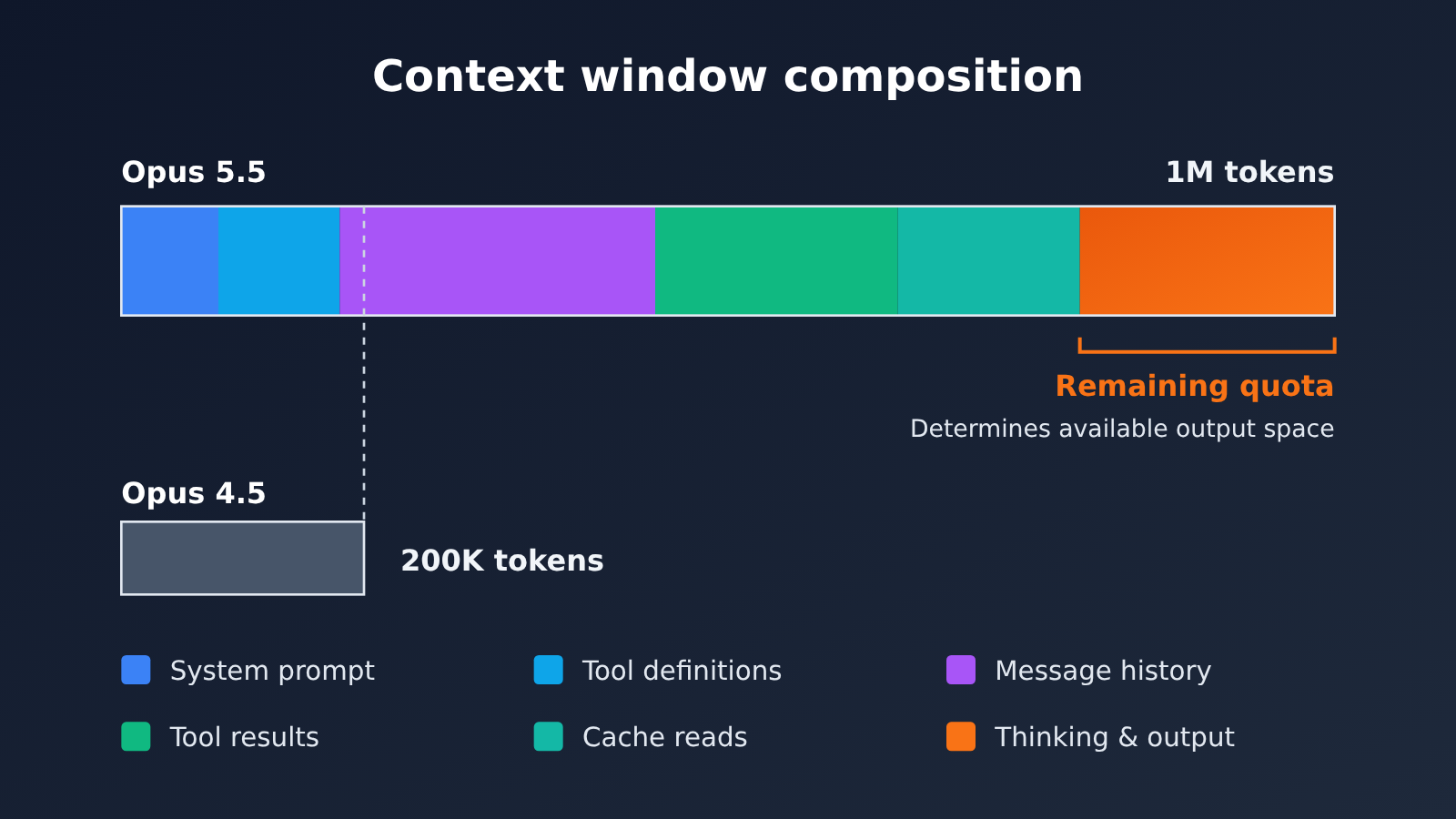
| Context window | The total number of tokens a single request can hold, including the system prompt, tool definitions, message history, tool results, and the output generated this turn. Input read from cache also occupies the window |
| Default max output | The per-request output ceiling allowed by the API. The actual amount generated is further constrained by the request’s max_tokens, the remaining context, and stop conditions |
| Extended thinking | How Opus 4.5 thinks: normal generation by default; developers enable it manually and pass in a thinking budget |
| Adaptive thinking | How Opus 5.5 thinks: always on; the model can think less — or skip thinking entirely — for simple requests |
| effort | Opus 5.5 tunes how much it thinks via output_config.effort, with options low, medium, high, xhigh, and max; the default is medium |
| Prompt caching | Caching reusable prefixes such as fixed system instructions and tool definitions, so later hits are billed at the lower cache-read rate |
| Cache write/read | The first write to the cache is billed at the write rate, in two tiers — 5 minutes and 1 hour; subsequent hits are billed at the read rate |
| Batch API | An asynchronous batch-processing endpoint whose base unit price is half that of a regular request |
| Fast mode | A speed-up mode for Opus 5.5 on the first-party Claude API. The unit price is higher, and output tokens per second can be up to 2.5x |
| Tokenization | The way text is split into tokens. The same piece of text may yield a different token count across model generations |
Claude Opus 5.5 Upgrade Impact at a Glance
- Developers currently calling Opus 4.5: The retirement date is set — you’ll need to finish swapping model IDs and running regression tests before January 22, 2027. Thinking-related parameters need to be redesigned; you can’t just map the old budget numbers straight onto the new tiers.
- Long-document and code-repository applications: The 1 million token context window is now the default spec, and the full window is billed at the standard rate. Material you previously had to feed in batches can now potentially go into a single request for cross-document verification.
- Cost-sensitive teams: Unit prices are down across the board, with cache reads seeing the biggest drop, and the minimum cacheable prefix falling from 4,096 to 512 tokens. But tokenization on the new model can produce up to roughly 35% more tokens, and adaptive thinking also generates billable output tokens — so you’ll want to measure the real savings yourself.
- Applications working with screenshots and table images: The maximum image long edge rises from 1,568 to 2,576 pixels, preserving more detail, and the per-image token cap goes from about 1,600 to 4,784 — which means image input costs may go up.
The Objective Facts: What Happened Between Claude Opus 4.5 and Opus 5.5
The data in this section is based on Anthropic’s first-party Claude API materials as verified on November 24, 2026. Specifications, dates, and pricing for cloud platforms and subscription products follow each provider’s official documentation.
Claude Opus 4.5 and Opus 5.5: Release and Retirement Timeline
Claude Opus 4.5 launched on November 24, 2025, and Claude Opus 5.5 launched on September 22, 2026. On November 23, 2026, Anthropic notified developers in its release notes that Opus 4.5 is scheduled to retire from the Claude API on January 22, 2027, with Opus 5.5 as the recommended replacement. Counting from today, that leaves you roughly two months to migrate.
Claude Opus 5.5 Capability Specs Comparison
Both models accept text and image input and output text natively. The main spec differences:
| Spec | Claude Opus 4.5 | Claude Opus 5.5 |
|---|---|---|
| Context window | 200K tokens | 1M tokens (default tier, full window at standard pricing) |
| Standard max output | 64K tokens | 128K tokens |
| Max image long edge | 1,568 px | 2,576 px |
| Token cap per single image | ~1,600 | 4,784 |
| Max images or PDF pages per request | 100 | 600 |
| Reliable knowledge cutoff | May 2025 | June 2026 |
| Training data cutoff | August 2025 | June 2026 |
| Thinking mode | Extended thinking manually enabled, with a budget you allocate | Adaptive thinking always on, tuned via effort |
| Model ID | claude-opus-4-5-20251101 or claude-opus-4-5 |
claude-opus-5-5 (a fixed model with no date suffix) |
The context window is five times larger and standard output is twice as large. Keep in mind that the context window is the total for everything, so how much room you have left for the final response and thinking depends on the remaining budget. High-resolution image support carries over from Claude Opus 4.7 and works better for densely packed tables, UI screenshots, and diagrams. On top of that, the Batch API offers a 300K-token max output beta exclusive to Opus 5.5, and large-file requests are still bound by request body size limits.
Claude Opus 5.5 Official Benchmark Data
The benchmark data comes from the system cards and release pages of each of the two model generations. The configurations aren’t completely identical, so the table below lists the test conditions alongside the scores:
| Benchmark | Claude Opus 4.5 | Claude Opus 5.5 | Comparability notes |
|---|---|---|---|
| SWE-bench Pro | 52.0% (extended thinking off, average of 5 runs); 51.6% with a 64K thinking budget | 89.9% (adaptive thinking, max effort, average of 5 runs) |
Same benchmark name, so you can see the direction of progress, but the reasoning configurations differ |
| SWE-bench Multilingual | 76.2% (identical in both configurations) | 93.9% | Same as above; covers 300 questions across 9 languages |
| Terminal-Bench | 59.27% on v2.0 (Terminus-2 framework, 128K evaluation thinking budget) | 66.4% on v4.0 (xhigh); Opus 5 scores 52.3% in the same table |
Different versions, so you can’t subtract them directly |
| GDPval-AA v2.1 | No data on the same basis | 1,846 Elo (max effort, covering 44 occupations) |
Only describes Opus 5.5’s own level |
SWE-bench Pro focuses on real, actively maintained code repositories and cross-file changes. The scores from the two reports can be placed side by side to show the direction of progress, but confirming a strict generational gain requires a fixed test framework, context, and reasoning budget. For Terminal-Bench, the quotable same-table gap is that Opus 5.5 is 14.1 percentage points higher than Opus 5. The 128K thinking budget in the 4.5 evaluation was an experimental configuration; the regular API output limit is still 64K.
Anthropic also published a knowledge-work test: a hard-to-find earnings report is placed in a web page copy, and the model is asked to write a quarterly results report. An automatic grader checks every number and quote item by item, and fabricating any one of them fails the entire report. Under various effort settings, Opus 5.5 produced 18 reports in total, 16 of which passed; the control group was Claude Fable 5.1 and Claude Opus 5, and this was an Anthropic internal test. Note also that most of the evaluations above use max or xhigh, while production requests default to starting from medium.
Claude Opus 5.5 API Pricing Comparison
The prices below are in USD per million tokens, using the published unit prices for standard speed and global inference:
| Pricing item | Claude Opus 4.5 | Claude Opus 5.5 | Reduction |
|---|---|---|---|
| Standard input | 5.00 | 4.00 | 20% |
| Output | 25.00 | 20.00 | 20% |
| 5-minute cache write | 6.25 | 5.00 | 20% |
| 1-hour cache write | 10.00 | 8.00 | 20% |
| Cache read | 0.50 | 0.20 | 60% |
| Batch API input/output | 2.50/12.50 | 2.00/10.00 | 20% |
The cache read multiplier has dropped from 0.10x the base input price to 0.05x, and the minimum cache prefix length has also fallen from 4,096 to 512 tokens, so some shorter shared prefixes can now be cached. Other billing conditions: Opus 5.5 Fast mode input/output is $8/$40 per million tokens; choosing US-only inference triggers a 1.1x token rate; cloud platforms and subscription products have their own pricing tables.
Calling Claude Opus 5.5: What’s Changed
The entry point for creating messages is still POST /v1/messages, the SDK method is still client.messages.create(), and the core fields are still model, messages, and max_tokens. The model ID and the anthropic-version HTTP header are two separate settings—the latter marks the protocol version and gets set automatically by the official SDK. When you go through a cloud platform, pick that platform’s model ID from its own spec page.
| Item | Claude Opus 4.5 | Claude Opus 5.5 |
|---|---|---|
| Model ID | claude-opus-4-5-20251101/’claude-opus-4-5|claude-opus-5-5` |
|
| Default generation mode | Standard generation; extended thinking has to be turned on manually | Adaptive thinking is always on—just omit thinking and it runs |
| Thinking control | Pass in a thinking budget | Pick a level via output_config.effort |
| Default effort | high |
medium |
What max_tokens means |
Output limit | A hard cap shared by thinking and the response body |
| Thinking billing | Billed as output once enabled | Hidden thinking content is also billed as output tokens |
The message structure for multi-turn calls stays the same: your app keeps submitting the message history it already has, and the tool loop handles tool requests and thinking state based on response block types, passing the assistant messages it receives back unchanged.
Analysis: Claude Opus 5.5’s Real Costs and Migration Strategy
How Much Will Claude Opus 5.5 Bills Drop?
A 20% unit price cut doesn’t mean a 20% bill cut. Start with a reproducible assumption: the same batch of requests on both generations produces 1 million regular input tokens, 200,000 output tokens, 1 million 5-minute cache writes, and 5 million cache reads. Opus 4.5 comes to 5 + 5 + 6.25 + 2.50 = 18.75 USD, and Opus 5.5 comes to 4 + 4 + 5 + 1 = 14.00 USD — roughly 25.3% lower. The higher the share of cache reads, the more noticeable the savings, thanks to the 60% cache price cut.
But two factors can pull that percentage back. The first is tokenization: the migration guide says the new model’s text tokenization is about 1 to 1.35 times that of the old model. If 1 million input tokens become 1.3 million on 5.5, regular input cost goes from $5 to $5.20 — actually more expensive. The break-even point is 1.25x, and the same logic applies to output: 100 output tokens on the old model cost the same as 125 output tokens on the new model. The second is thinking tokens: short tasks that used to run with thinking disabled will have adaptive thinking on by default after migration; even if the visible answer is the same length, thinking tokens can eat up the unit-price difference.
Conversely, if the new model can complete tasks in fewer turns, follow-up input and output will both decrease, and savings could exceed the unit-price reduction. The official launch page mentions about 40% savings on typical workloads, but it’s measured against Claude Opus 5, not Opus 4.5, so it shouldn’t be plugged directly into a migration budget.
💰 Cost advice: First estimate token counts for the same batch of tasks across both model generations, then send a small amount of live traffic and check the
usagebilling. With APIYI (apiyi.com), you can call both generations with one API key on a pay-as-you-go basis, making it easy to compare bills in the same codebase.
How to Choose the effort Level for Claude Opus 5.5
Don’t convert old thinking-budget numbers into the new levels—they don’t work the same way. A more reliable approach is to look at effort alongside three metrics: business quality, response latency, and total cost. Here’s how I’d choose:
- Short tasks that previously had thinking turned off: Put
lowand the defaultmediuminto the same replay batch, judge the answers against business rules, and record total output tokens and visible text length to see how much budget thinking consumes. - Complex tasks where thinking was previously enabled manually: Start with
mediumorhigh, and tryxhighif quality falls short.max, often used in official evaluations, suits scenarios where quality requirements are extremely high and cost and latency are less of a concern. - Leave headroom for
max_tokens: It constrains both thinking and visible output, so setting it too low can truncate the response body.
How to Switch Calls from Claude Opus 4.5 to Opus 5.5
You can carry out the migration in the following order:
- Inventory the model IDs, thinking parameters, and
max_tokenssettings in your existing calls, and mark which requests have extended thinking enabled. - Prepare a representative set of real-world tasks as a regression suite, and lock down acceptance criteria—for example, whether key fields are correct and whether citations are traceable.
- Run the regression suite on both model generations separately, and record pass rate, regular input, cache writes, cache reads, output tokens, and latency.
- Adjust effort and
max_tokensbased on the results, then gradually ramp up traffic. Make sure to complete the switch by January 22, 2027.
Here’s the minimal invocation example using the OpenAI-compatible interface—just replace the model name to complete the first round of validation:
from openai import OpenAI

client = OpenAI(
    api_key="YOUR_API_KEY",
    base_url="https://api.apiyi.com/v1"  # APIYI unified interface
)

resp = client.chat.completions.create(
    model="claude-opus-5-5",  # Previously claude-opus-4-5; for the exact name, refer to the platform's model list
    messages=[{"role": "user", "content": "用三句话说明提示缓存的计费方式"}],
    max_tokens=4096
)
print(resp.choices[0].message.content)
print(resp.usage)
If you’re using the native Messages format, the request body structure for adjusting effort is as follows (this is a first-party Claude API field; whether an aggregation platform passes this parameter through depends on the platform’s documentation):
{
  "model": "claude-opus-5-5",
  "max_tokens": 16000,
  "output_config": { "effort": "low" },
  "messages": [{ "role": "user", "content": "总结这份修订记录的主要变更" }]
}
View the full code: Claude Opus 4.5 vs Opus 5.5 dual-model comparison script
import time
from openai import OpenAI

client = OpenAI(
    api_key="YOUR_API_KEY",
    base_url="https://api.apiyi.com/v1"
)

# Claude API public pricing (USD per million tokens); for estimation only—actual billing depends on the platform you use
PRICES = {
    "claude-opus-4-5": {"input": 5.00, "output": 25.00},
    "claude-opus-5-5": {"input": 4.00, "output": 20.00},
}

TASKS = [
    {"id": "t1", "prompt": "从下面的修订记录中列出所有接口变更:……", "must_include": ["POST"]},
    {"id": "t2", "prompt": "根据以下财报摘要写一段季度业绩说明:……", "must_include": ["营收"]},
]

def run(model: str, task: dict) -> dict:
    start = time.time()
    resp = client.chat.completions.create(
        model=model,
        messages=[{"role": "user", "content": task["prompt"]}],
        max_tokens=8192,
    )
    latency = time.time() - start
    text = resp.choices[0].message.content or ""
    usage = resp.usage
    price = PRICES[model]
    cost = (usage.prompt_tokens * price["input"]
            + usage.completion_tokens * price["output"]) / 1_000_000
    passed = all(k in text for k in task["must_include"])
    return {
        "model": model, "task": task["id"], "passed": passed,
        "prompt_tokens": usage.prompt_tokens,
        "completion_tokens": usage.completion_tokens,  # Thinking tokens are also billed as output
        "visible_chars": len(text), "latency_s": round(latency, 2),
        "cost_usd": round(cost, 6),
    }

def main():
    results = [run(m, t) for m in PRICES for t in TASKS]
    for r in results:
        print(r)
    for m in PRICES:
        rows = [r for r in results if r["model"] == m]
        ok = sum(r["passed"] for r in rows)
        total = sum(r["cost_usd"] for r in rows)
        per_success = total / ok if ok else float("inf")
        print(f"{m}: 通过 {ok}/{len(rows)},总成本 {total:.4f} 美元,"
              f"每次成功交付成本 {per_success:.4f} 美元")

if __name__ == "__main__":
    main()
This script calculates cost per completion based on successful deliveries, which gets much closer to a real budget than looking at unit price alone. If your workload uses caching, multiply the itemized cache-write and cache-read counts by their respective unit prices. Follow-up requests sent after a tool returns, along with retries, should also be attributed to the task they belong to.
🚀 Quick start: We recommend signing up at APIYI apiyi.com, then using the free trial credits for new users to run the comparison script above first. Once you’ve confirmed the pass rate and per-delivery cost of both model generations on your regression set, you can decide on the production effort level.
Which scenarios are most worth migrating first?
Long-document verification tasks benefit most directly. Take a service manual, several historical revision records, and user feedback, for example. If the estimated total is above 200k and below 1 million tokens, Opus 4.5 can only be fed in batches, while Opus 5.5 can attempt to check cross-document conflicts in a single request. For these scenarios, we recommend treating file fidelity, recall, and generation budget as three independent metrics, and focusing on whether the batching workflow drops cross-page references.
Code maintenance tasks are also worth validating first. Scores across the SWE-bench series consistently trend upward. By contrast, high-volume short Q&A and endpoints that originally didn’t enable thinking need more caution: tokenization changes and thinking tokens may keep costs flat or even push them higher, so run a comparison with the low setting first. This judgment is based on extrapolating from the official billing rules; the actual results still depend on your task distribution.
Claude Opus 5.5 Migration FAQ
Q1: When will Claude Opus 4.5 stop being available?
According to the Claude API announcement, Opus 4.5 is scheduled to retire on January 22, 2027, with Opus 5.5 recommended as its replacement. Dates on other cloud platforms are subject to their own official lifecycle documentation.
Q2: Can I just change the model name to claude-opus-5-5 and start using it?
Basic calls will work as-is; the endpoint and message structure stay the same. But the default effort changes from `high` to `medium`, adaptive thinking is always on, and `max_tokens` now caps both thinking and response text. Run regression tests before shipping to production.
Q3: Is Claude Opus 5.5 guaranteed to be cheaper than Opus 4.5?
The unit price is lower across the board, but that doesn’t necessarily mean it’s cheaper overall. The new model’s token count can be up to 1.35x that of the old model; once it exceeds 1.25x, standard input costs actually end up higher. Thinking tokens are billed as output too. Tasks with high cache hit rates and fewer interaction turns will see more noticeable savings.
Q4: How can I quickly compare the two generations in China?
You can use APIYI at apiyi.com to call both models with the same API key and OpenAI-compatible interface. Set `base_url` to `https://api.apiyi.com/v1`, run the same set of tasks with the script in this article, and compare pass rates and costs.
Q5: Does the 1M context window cost extra?
In the first-party Claude API, 1M is the default spec for Opus 5.5, and the full window uses standard pricing. The fuller the window, the higher the input cost per request will naturally be; prompt caching can help reduce the cost of repeated material.
Q6: What limitations should I be aware of with Opus 5.5?
High-resolution images can be up to about 4,784 tokens each, so image-heavy requests will cost more. Benchmark data is mostly based on `max` or `xhigh`, so you’ll need to validate performance under the default `medium` yourself. Fast mode costs twice the standard rate, and US-only inference carries a 1.1x rate surcharge.
Q7: How can I control costs during the migration testing phase?
Start with a small regression set, set `max_tokens` to a reasonable range, and prioritize testing `low` and `medium`. New users can claim free testing credits at APIYI apiyi.com and complete the first round of comparison before the official switch.
The gap between the two generations isn’t just in benchmark scores—it’s also in pricing structure and how thinking is controlled. With about two months until Opus 4.5 retires, a safer cadence is to finish the regression set and comparison tests this month, then settle on effort and budget next month and ramp up gradually. For comparison validation, you can use APIYI’s unified interface at apiyi.com to switch between the two generations in the same codebase, and decide on a migration plan based on measured data rather than the price table.
References
-
Claude Opus 5.5 spec page: context, output limits, vision specs and Batch specs
- Link:
platform.claude.com/docs/en/models/opus-5-5/overview - Notes: the main basis for the spec comparison in this article
- Link:
-
Claude Opus 5.5 migration guide: tokenization changes, request constraints, thinking billing
- Link:
platform.claude.com/docs/en/models/opus-5-5/migration-guide - Notes: authoritative guidance on adjusting parameters during migration
- Link:
-
Claude API pricing table: unit prices for both model generations, caching and data residency billing
- Link:
platform.claude.com/docs/en/about-claude/pricing - Notes: the basis for the price table and the hypothetical bill calculations
- Link:
-
Model deprecation notes: lifecycle of each model in the Claude API
- Link:
platform.claude.com/docs/en/about-claude/model-deprecations - Notes: confirms the Opus 4.5 retirement date
- Link:
-
Effort documentation: explanation of adaptive thinking levels
- Link:
platform.claude.com/docs/en/build-with-claude/effort - Notes: reference for choosing an effort level
- Link:
-
Claude Opus 5.5 system card: SWE-bench and other evaluation configurations and results
- Link:
anthropic.com/claude-opus-5-5-system-card - Notes: for verifying evaluation conditions and comparability
- Link:
Author: APIYI Technical Team
Technical discussion: If you run into model invocation or billing issues during migration, feel free to reach out through the APIYI apiyi.com homepage.


