

Author’s note: When using AI for math, choose separately for competition calculation, expert-level Q&A and proofs, and Lean formalization. This article breaks down three types of leaderboard methodologies, gives a first choice and backup for each task type, calculates the per-problem cost using APIYI pricing, and includes a ten-problem validation method.
The same “best at math” claim can look very different depending on which leaderboard you check. GPT-6.2, Claude Fable 5.2, and Gemini 4 all have their own headline numbers, but those numbers come from different problem setters, different reasoning settings, and some are vendor-reported. Competition coaches, researchers, and engineering teams building math products are most likely to stumble here.
This is not an overall ranking, and it won’t declare a single winner. This article does only three things: first, it splits math tasks into three categories—competition calculation, expert-level Q&A and proofs, and Lean formalization; second, it explains who runs each leaderboard and what methodology it uses; finally, it calculates the per-problem cost using APIYI pricing and gives you a ten-problem validation method you can run yourself.
Core value: After reading this, you’ll be able to pick a first-choice and backup model for your task type, and use a record sheet to verify whether that choice holds up.
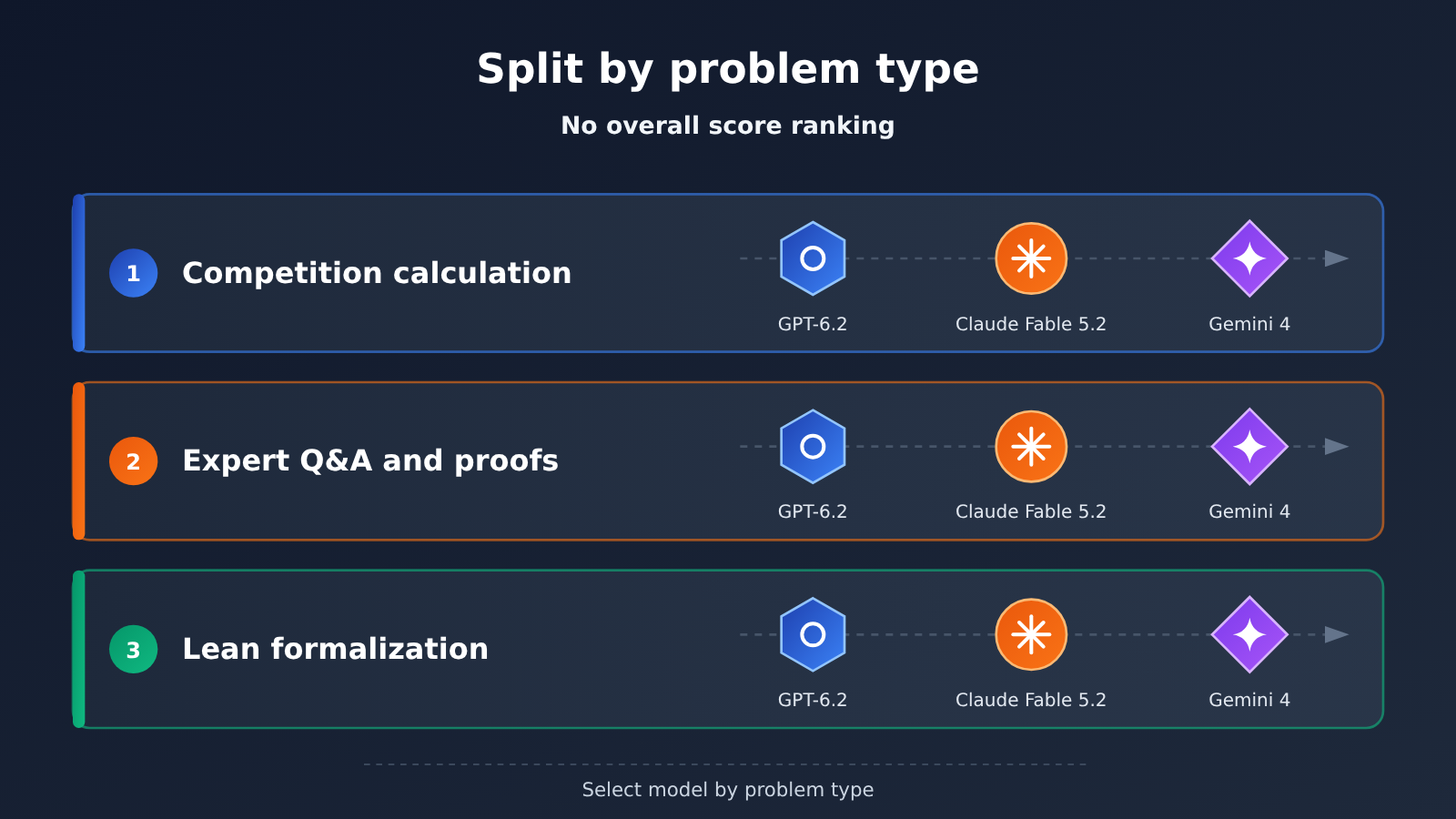
GPT-6.2, Claude Fable 5.2, and Gemini 4: Why the Math Leaderboards Don’t Agree
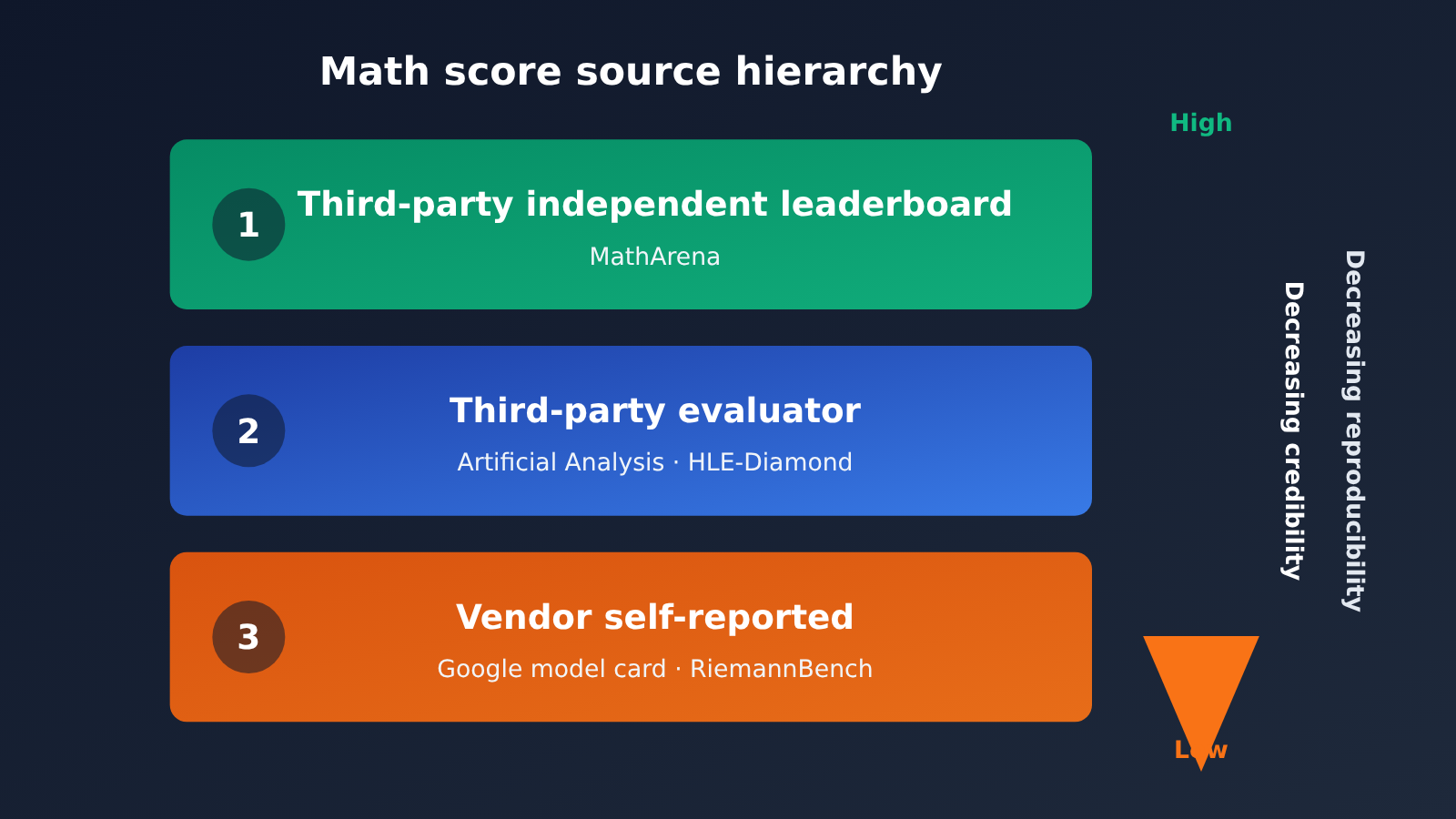
Before we talk about AI doing math, the most important step is figuring out who’s doing the grading. The same model can look completely different on an independent leaderboard versus in a vendor’s launch post — and that’s not necessarily because anyone is faking results. It’s because the problem sets, the reasoning tiers, the number of samples, and the scoring rules are all different.
| Leaderboard | Operator / Type | What it measures | What to watch for |
|---|---|---|---|
| MathArena expected performance | Third-party independent leaderboard | Expected performance on competition-style math problems | New models take time to be added; some models weren’t listed on the day itself |
| MathArena LeanLean | Third-party independent leaderboard | Lean formal proofs | Only a subset of models are currently included |
| HLE-Diamond | Run by Artificial Analysis | Expert-level Q&A, with a reasoning subscore | The tier matters a lot — the same model can score very differently across tiers |
| RiemannBench | Self-reported in Google’s model card | Research-level math | No independent reproduction data yet |
| BenchLeader Math Index | Third-party independent index | Aggregates results from independent publishers | Uses only independent results, not numbers self-reported in launch posts |
Why the top spot keeps changing
MathArena leans toward competition problems whose answers can be checked automatically, so it’s the most sensitive to whether a model actually computes correctly. HLE-Diamond leans more toward expert knowledge and multi-step reasoning, with a high share of Q&A-format items. LeanLean requires proofs that the Lean compiler will accept, which puts enormous demands on a model’s command of formal languages. These three task types test different abilities — a model leading in one category doesn’t necessarily lead in another.
Another variable people often overlook is the reasoning tier. In the reference material, Claude Fable 5.2 scores 80.2% overall on HLE-Diamond at the max tier, but 75.8% at the xhigh tier — the tier name sounds higher, yet the score is lower. So whenever you cite any number, you have to state the date, the leaderboard, and the tier at the same time. Otherwise the comparison is meaningless.
Key Differences in Math Scores: GPT-6.2, Claude Fable 5.2, and Gemini 4
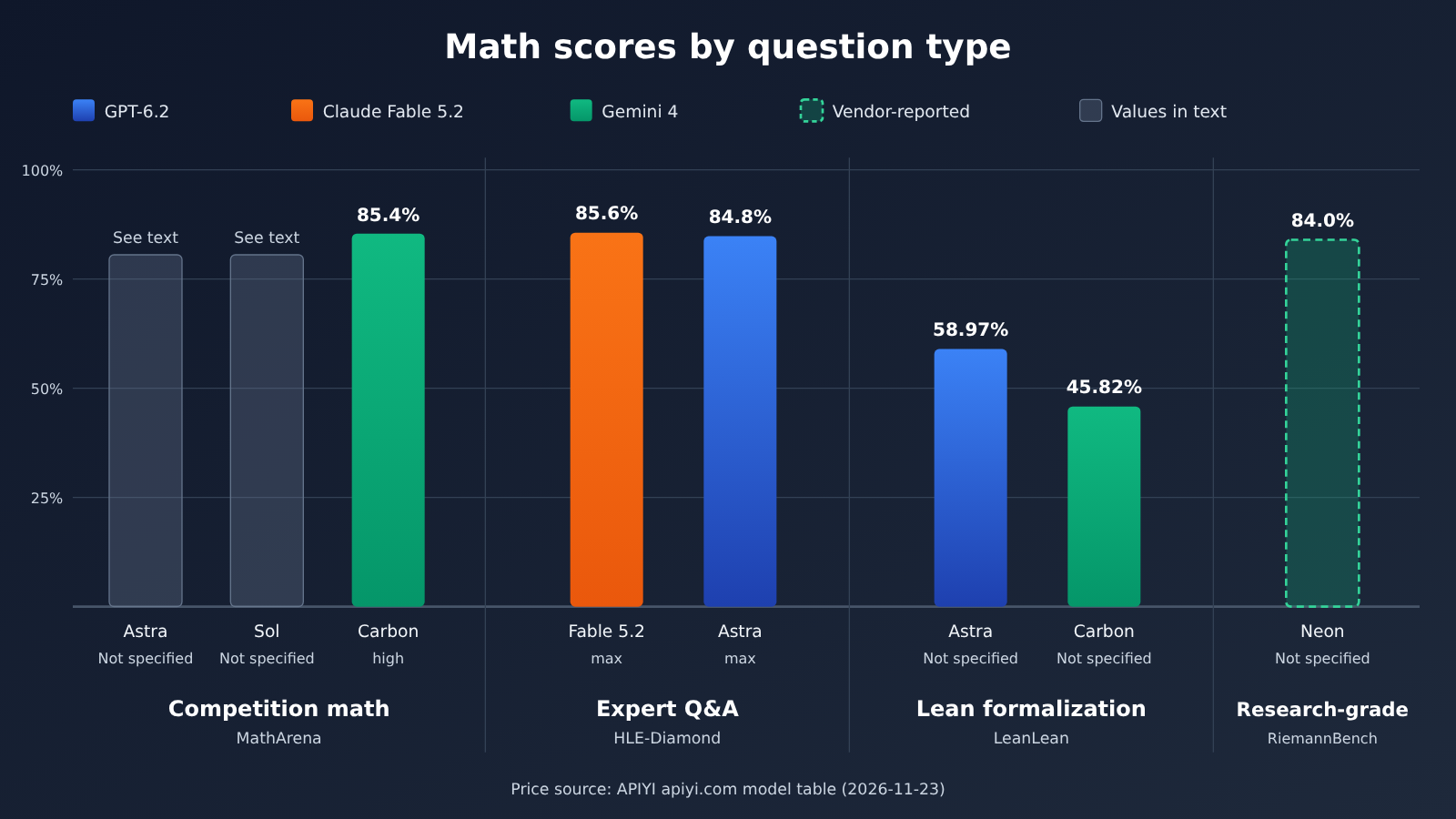
The table below groups the figures from the reference materials by task type. Each entry notes the source type, date, and tier. Where the source materials don’t specify a tier, the table marks it as “not specified” rather than making an assumption.
| Task type / Leaderboard (date) | GPT-6.2 | Claude Fable 5.2 | Gemini 4 | Source type |
|---|---|---|---|---|
| Competition math MathArena (as of 2026-11-23) | Astra 92.9% (max); Sol 91.2% (tier not specified) | 82.1% (max) | Carbon 85.4% (high); Neon not listed that day | Third-party independent leaderboard |
| Lean formalization LeanLean (October 2026 table) | Astra 58.97% (tier not specified) | Not listed | Carbon 45.82% (tier not specified); Neon not listed | Third-party independent leaderboard |
| Expert Q&A HLE-Diamond (as of 2026-11-23) | Astra reasoning subscore 84.8% (max) | Overall score 80.2% (max), reasoning subscore 85.6%; xhigh overall score 75.8% | Neon 71.3% | Fable and Astra data come from Artificial Analysis; Neon is self-reported by Google |
| Research-level RiemannBench (as of 2026-11-23) | No data | No data | Neon 84.0% | Self-reported in Google’s model card |
| Math composite index BenchLeader (2026-11-21) | Astra 72.3 | 72.5 | Neon 71.6; Carbon 71.2 | Third-party independent index |
Comparative Reading: Error Margins and Composite Indices
Another independent dataset is worth placing alongside the first. In MathArena’s snapshot published by Tbreak on 2026-11-14, Gemini 4 Carbon scored 85.4% ± 3.0, Claude Fable 5.2 scored 82.8% ± 5.3, and GPT-6.1 Sol scored 80.6% ± 2.7 — with overlapping error margins across all three. That tells you a few points of difference on competition problems isn’t necessarily a stable gap, and your own problem set could easily produce a different ranking.
BenchLeader’s math index (2026-11-21) squeezes all five models into a band between 71 and 73: Claude Opus 5.5 at 72.6, Fable 5.2 at 72.5, GPT-6.2 Astra at 72.3. A composite index averages away the differences between problem types, which is exactly why “pick by total score” carries so little information — the real differences are buried in the subscores.
FrontierMath deserves a separate note. On the Epoch AI model pages, both GPT-6.2 Astra and Claude Fable 5.2 are marked at 100% on Tier 4 v2 — that’s Epoch’s own inclusion methodology. With both sitting at a perfect score, it can’t distinguish between them, so this article doesn’t use it as a selection criterion.
GPT-6.2 benchmark analysis: GPT-6.2 Astra appears on both the independent competition leaderboard and the Lean formalization leaderboard, ranking near the top of each — the most complete coverage of the group. But Astra carries a higher unit price, while the Sol model trails Astra by about 2 points on competition problems at roughly one-third the cost, so dividing the work between them makes more sense than picking just one.
Claude Fable 5.2 benchmark analysis: On Artificial Analysis’s HLE-Diamond, Fable 5.2 hits a total score of 80.2% at the max tier and 85.6% on the reasoning subscore — expert-level Q&A is where its numbers are most solid. But it isn’t included on LeanLean, it doesn’t lead on the competition leaderboard, and its score drops at the xhigh tier, so you’ll want to explicitly lock in the max tier when calling it.
Gemini 4 benchmark analysis: Gemini 4 is a family with several models. Carbon is included on the independent competition leaderboard and has a low unit price; Neon’s headline numbers come mainly from Google’s self-reported figures, with no comparable scores on independent leaderboards yet; Argon and Hydrogen have no math results at all in the available references — they’re simply “unknown.”
Where to Use AI for Math: Choosing GPT-6.2, Claude Fable 5.2, or Gemini 4 by Problem Type
Putting those numbers to work on concrete tasks, the conclusion is that each of the three problem types has its own first choice. The table below lists the top pick, the alternative, and the rationale, citing only figures that have a source.
| Problem type | Typical users | Top pick | Alternative | Rationale |
|---|---|---|---|---|
| Competition computation | Competition coaches, problem-bank products | GPT-6.2 Sol | GPT-6.2 Astra, Gemini 4 Carbon | On MathArena, Sol and Astra are about 2 points apart at roughly one-third the cost; Carbon scores 85.4% (high) at the same price tier |
| Expert-level Q&A and proofs | Researchers, research-assistant tools | Claude Fable 5.2 (max) | GPT-6.2 Astra (max) | HLE-Diamond reasoning subscore: 85.6% vs 84.8% — a very small gap, so cross-checking with both models is recommended |
| Lean formalization | Formal-verification teams | GPT-6.2 Astra | Gemini 4 Carbon | The only two models listed on LeanLean, 58.97% vs 45.82% |
| Research-level exploration | Frontier math research | To be validated | Gemini 4 Neon as a candidate | RiemannBench 84.0% is Google’s self-reported figure and needs independent retesting |
When to choose GPT-6.2
- Large-batch competition problem solving and checking: prefer
gpt-6.2-sol. When answers can be verified automatically, use the cheaper model for volume and escalate only the problems Sol fails togpt-6.2-astra. - When you need Lean proof output:
gpt-6.2-astracurrently has the best numbers on the independent leaderboard, but 58.97% still means plenty of problems need human-written proofs to fill the gaps.
When to choose Claude Fable 5.2
- Expert-level open-ended Q&A: for things like sounding out a research direction or reviewing a proof approach, use
claude-fable-5-2locked to the max setting. - A second opinion on proof drafts: its reasoning subscore is close to Astra’s, so it works well as a mutual reviewer with GPT-6.2 and reduces single-model blind spots.
When to choose Gemini 4
- Long-context, document-heavy math tasks:
gemini-4-carbonhas a context window of 1,048,576 and max output of 65,536, which makes it a good fit for loading a whole textbook or a collection of papers into context and then asking questions. - Cost-sensitive backup for competition problems: Carbon has the same per-unit price as Sol, so it can serve as a cross-check model for Sol.
- Research-level problem exploration:
gemini-4-neonis a reasonable candidate, but until independent data appears, it’s not advisable to rely on it alone.
GPT-6.2, Claude Fable 5.2, and Gemini 4 Pricing and Endpoints
Pricing is based on the APIYI apiyi.com model catalog, with data updated on 2026-11-23 10:23 (UTC+8), in USD per million tokens. For official pricing, the Epoch AI model pages list GPT-6.2 Astra (released 2026-11-17) and Claude Fable 5.2 (released 2026-11-09) at $8 input / $40 output, matching the table below.
| Model ID | Input | Output | Cached read | Available platforms |
|---|---|---|---|---|
gpt-6.2-astra |
$8 | $40 | $0.4 | APIYI, Official API |
gpt-6.2-sol |
$2 | $10 | $0.1 | APIYI, Official API |
claude-fable-5-2 |
$8 | $40 | $0.2 | APIYI, Official API |
gemini-4-carbon |
$2 | $10 | $0.1 | APIYI, Official API |
gemini-4-neon |
$3 | $15 | $0.15 | APIYI, Official API |
gemini-4-argon |
$2 | $10 | $0.1 | APIYI, Official API |
gemini-4-hydrogen |
$1.5 | $7.5 | $0.075 | APIYI, Official API |
Integration stays OpenAI-compatible. To switch models, you only need to change the model field:
- base_url:
https://api.apiyi.com/v1 - Chat Completions endpoint:
https://api.apiyi.com/v1/chat/completions - Auth header:
Authorization: Bearer YOUR_API_KEY - Key request body fields: set
modelto the model ID from the table above, put your questions inmessages, and use the reasoning-tier parameter name described on the model page gemini-4-carbonsupports both OpenAI Chat Completions and Gemini Generate Content endpoints, so teams with existing Gemini SDK code can keep their protocol unchanged- Both GPT-6.2 models have a 1,050,000 context window, 922,000 max input, and 128,000 max output, so long proof outputs won’t be cut off at just tens of thousands of tokens
🚀 Quick start: We recommend signing up at APIYI apiyi.com and claiming free trial credits first. Then use the same API key to call the seven models in the table one by one, run through the ten-question acceptance test below, and decide on your primary and backup models for production.
How to Calculate the Cost of Doing Math with AI: Per-Question Cost Comparison
There are two ways to measure cost, and you can’t compare them directly. The first is the actual spend reported by leaderboard providers. Apidog’s 2026-11-23 summary puts GPT-6.2 Astra at about $2.46 per question on MathArena, with Sol at roughly one-third of that. Tbreak’s 2026-11-14 numbers cover the full benchmark run: Carbon $15.70, GPT-6.1 Sol $1.07, and Fable 5.2 $40.20. The first is per question; the second is per full run. The denominators differ, so you can’t subtract them or convert them into a statement about which one is cheaper by how much.
The second method is to estimate from unit prices and token usage. The references don’t give typical token consumption for each model, so the table below uses an assumed task to demonstrate the calculation: 2,000 input tokens and 20,000 output tokens (including reasoning) per question, with caching excluded.
| Model | Input cost | Output cost | Assumed per-question cost |
|---|---|---|---|
gpt-6.2-astra |
$0.016 | $0.800 | $0.816 |
claude-fable-5-2 |
$0.016 | $0.800 | $0.816 |
gemini-4-neon |
$0.006 | $0.300 | $0.306 |
gpt-6.2-sol |
$0.004 | $0.200 | $0.204 |
gemini-4-carbon |
$0.004 | $0.200 | $0.204 |
gemini-4-argon |
$0.004 | $0.200 | $0.204 |
gemini-4-hydrogen |
$0.003 | $0.150 | $0.153 |
This table only shows the unit-price structure: output cost accounts for the vast majority, so the real cost depends on how long the model “thinks” on your problem. Astra’s roughly $2.46 per question on MathArena is clearly higher than the assumed value, which shows that reasoning tokens at the high end go far beyond 20,000. The right approach is to read the actual prompt_tokens and completion_tokens from the usage field of each response, then multiply by the unit price.
💰 Cost tip: For batch competition-style tasks, use a tiered strategy: run Sol or Carbon first, then escalate failed questions to Astra. This is usually more economical than using high-priced models for everything. On APIYI apiyi.com, these models share one billing account, so tiered routing doesn’t require maintaining multiple keys.
Decision Recommendations: The Ten-Question Acceptance Test
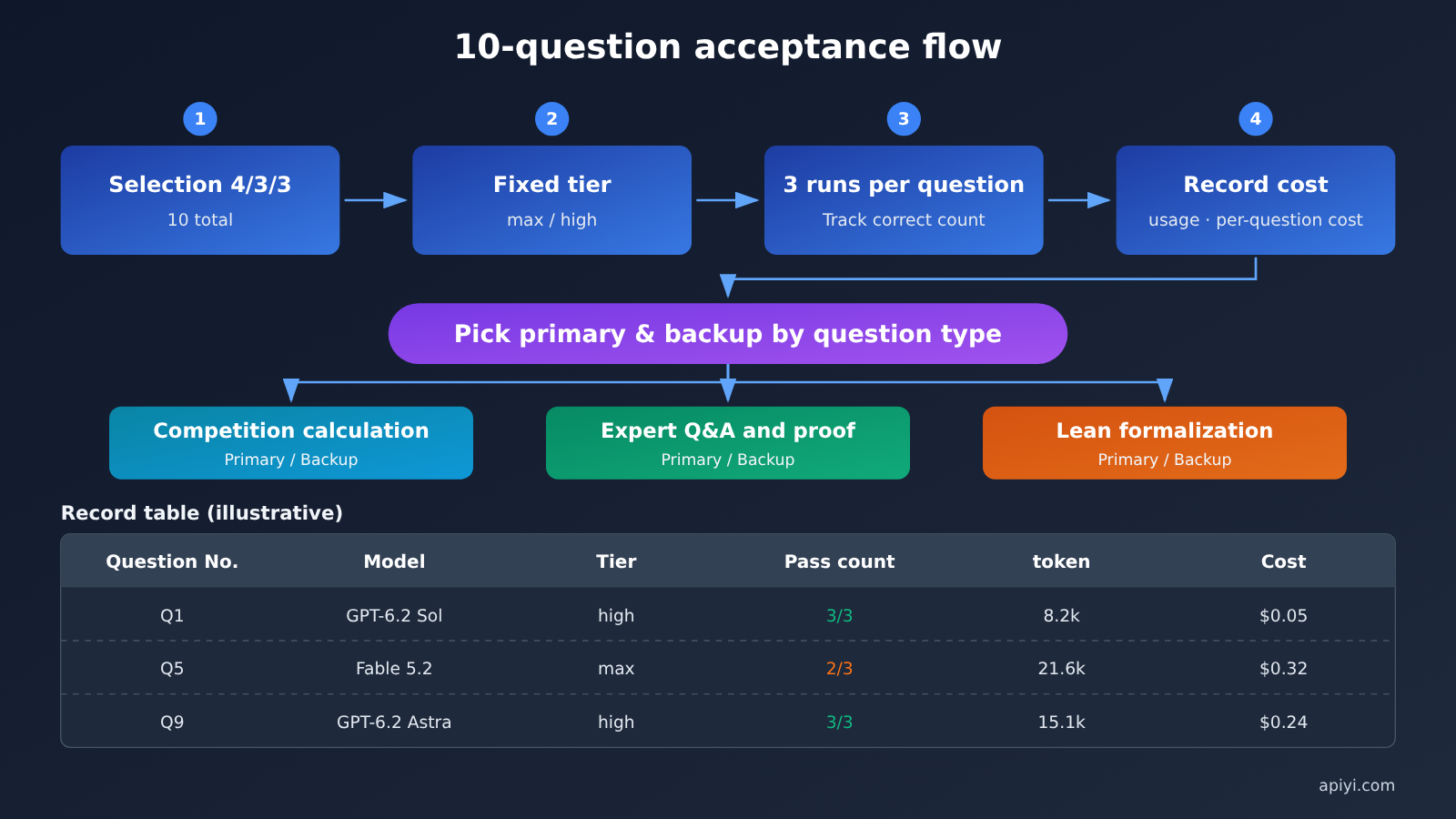
Leaderboards only narrow down the candidates — the final validation has to come from your own questions. The method below holds three variables steady (tier, questions, and pricing), so ten questions are enough to give you results you can actually compare.
- Pick the questions: Choose ten questions in proportion to your business mix — say, 4 competition-style calculations, 3 expert Q&A or proof problems, and 3 Lean formalizations. Write the reference answer or grading rubric for each one ahead of time.
- Fix the tier: Use the same tier name across all models. For Fable 5.2 and Astra, remember to specify max; if you’re running Carbon on high, note that in the record sheet so you’re not comparing max against high.
- Fix the input: The same system prompt and the same question text for everyone — don’t tune prompts for individual models.
- Run each question 3 times: Competition answers can fluctuate with sampling, so count how many of the 3 runs are correct to cut down on randomness.
- Grading rules: For calculation problems, the final answer must match exactly; for proofs, score point by point against the rubric you wrote in advance, and a pass requires hitting every key step; for Lean, the code must compile with no
sorry. - Record cost: For each call, note the token counts in
usage, then use the price table above to work out the per-question cost. - Draw conclusions: Calculate the pass rate and average per-question cost for each question type separately. If the pass rates differ by no more than one question, pick the cheaper model; if one is clearly higher, then check whether the cost fits your budget.
A good one-sentence acceptance criterion: On the same batch of questions at the same tier, the model’s pass rate on your target question types is no lower than the alternative model’s, and the per-question cost is within budget. A model that misses this bar shouldn’t enter your production routing, even if it sits at the top of some leaderboard.
💡 Recommendation: Which model to choose depends mainly on your question mix and your budget. Run these ten questions side by side through APIYI apiyi.com with a single API key — the results will track your real scenario more closely than any single leaderboard.
Common Questions (FAQ)
Q1: Why can GPT-6.2, Claude Fable 5.2, and Gemini 4 each claim to be #1 at math?
Because they’re each citing a different leaderboard. GPT-6.2 Astra leads the independent MathArena competition board, Claude Fable 5.2 stands out on HLE-Diamond run by Artificial Analysis, and Gemini 4 Neon’s 84.0% on RiemannBench is self-reported in Google’s model card. The problem types and sources differ, so naturally the conclusions differ too.
Q2: For Claude Fable 5.2, should I choose the max tier or the xhigh tier?
According to the reference material, on HLE-Diamond the max tier scores 80.2% overall while the xhigh tier scores 75.8%. Until your own acceptance tests disprove this, stick with the max tier for math Q&A and log the tier in your request logs so you can review it later.
Q3: How should I divide the work between GPT-6.2 Sol and Astra?
Apidog’s 2026-11-23 roundup shows that Sol trails Astra by about 2 points on MathArena while costing roughly one-third as much. A sensible split: use Sol as the workhorse for bulk competition-style problems, and hand the failures or Lean formalization tasks over to Astra.
Q4: Are Gemini 4’s Argon and Hydrogen suitable for math?
The reference material doesn’t include math scores for these two models, so that’s unknown. They’re cheaper per unit, so you can add them to your ten-question acceptance run and let your own pass rate decide whether to adopt them — rather than guessing from the model names.
Q5: How do I test these models with the same code?
Set `base_url` to `https://api.apiyi.com/v1`, then change only the `model` field to switch between the seven models. Once you register at APIYI apiyi.com you get free testing credits — enough for one round of ten questions with 3 runs each.
Q6: What are the limitations of these leaderboard numbers?
Three main ones. First, coverage is incomplete — neither Fable 5.2 nor Gemini 4 Neon appears in the LeanLean table. Second, the error ranges overlap — in the Tbreak snapshot, all three vendors’ competition scores have ranges that cover one another. Third, self-reported numbers lack independent reproduction. These figures are only good for narrowing down the candidates; they can’t replace your own acceptance testing.
GPT-6.2, Claude Fable 5.2, and Gemini 4 for Math: Model Selection Key Takeaways
- Divide the work by task type: competitive calculation, expert Q&A and proof, and Lean formalization each call for a different model.
- Check how the leaderboard is measured first: distinguish independent third-party leaderboards, third-party evaluation organizations, and vendor self-reports.
- Numbers must come with their tier: on HLE-Diamond, Fable 5.2’s max and xhigh tiers differ by 4.4 points.
- Competition problems are about cost-effectiveness: GPT-6.2 Sol is close to Astra’s score at roughly one-third the cost.
- For Lean, look at Astra: on LeanLean, Astra scores 58.97% and Carbon 45.82%, with the rest not listed.
- Don’t compare costs across different denominators: per-problem cost and full-run cost can’t be subtracted directly from each other.
- Verify with ten problems yourself: same problems, same tier, record pass rate and per-problem cost — all it takes is one key on APIYI.
Summary
When using AI for math, the core of model selection isn’t who has the highest total score — it’s three things:
- Know your task type: for competitive calculation, GPT-6.2 Sol is the first choice, with Astra and Gemini 4 Carbon as backups; for expert Q&A and proof, Claude Fable 5.2 (max) is the first choice, with GPT-6.2 Astra (max) as backup; for Lean formalization, GPT-6.2 Astra is the first choice, with Gemini 4 Carbon as backup.
- Understand the measurement basis: MathArena is an independent leaderboard, HLE-Diamond is run by Artificial Analysis, and RiemannBench is Google’s self-report — always cite them with a date and tier.
- Do the math per problem: multiply the actual token usage in the response by the unit price, and compare pass rate and per-problem cost by task type.
I recommend taking the ten problems you encounter most often and running one round with the verification method in this article. Call these models side by side through APIYI at apiyi.com — one API key and an OpenAI-compatible interface is all you need to reach a selection conclusion that fits your own scenario.
📚 References
-
Apidog blog post “Best AI Model for Math 2026: Claude vs GPT-6 vs Gemini 4”: a roundup of public math results as of 2026-11-23
- Link:
apidog.com/blog - Notes: compiles MathArena, LeanLean, HLE-Diamond, and RiemannBench numbers, plus the per-question cost basis
- Link:
-
MathArena: an independent third-party math benchmark leaderboard
- Link:
matharena.ai - Notes: competition-style expected performance and the LeanLean formalization leaderboard
- Link:
-
Artificial Analysis: the operator of HLE-Diamond
- Link:
artificialanalysis.ai - Notes: expert-level Q&A scores and reasoning sub-scores
- Link:
-
Epoch AI model pages: model release dates, official pricing, and FrontierMath inclusion
- Link:
epoch.ai - Notes: used to verify the release dates and per-unit prices of GPT-6.2 Astra and Claude Fable 5.2
- Link:
-
Tbreak MathArena snapshot (2026-11-14) and BenchLeader Math Index (2026-11-21): supplementary independent data
- Notes: provides error ranges, full-run benchmark cost, and a composite index built only from independent scores
Author: APIYI Technical Team
Technical discussion: Feel free to contact us through the homepage of the APIYI website; for more model and endpoint details, visit the docs.apiyi.com documentation center


