

Author’s note: This article compares GPT-6.2 Astra and Gemini 4 Carbon across four dimensions—input modalities, long-context billing, pricing dates, and capability numbers—and wraps up with recommendations by task type.
On November 17, 2026, OpenAI released GPT-6.2 Astra and GPT-6.2 Sol. Just a week earlier, on November 10, Google had launched Gemini 4 Carbon. With two new models dropping so close together and their third-party composite scores nearly tied, plenty of developers are asking the same question: GPT-6.2 Astra or Gemini 4 Carbon—which one should you actually pick?
This isn’t one of those fence-sitting “each has its merits” writeups. Our position: the difference between these two models isn’t really about composite scores—it comes down to three concrete things. First, which inputs each model can accept. Second, how billing works once you go past 272K. Third, when Carbon’s official introductory pricing expires. Since that introductory price ends on November 30, this article won’t hand down a “which one’s cheaper” verdict—instead, we’ll lay out both models’ prices on both dates, plain and clear.
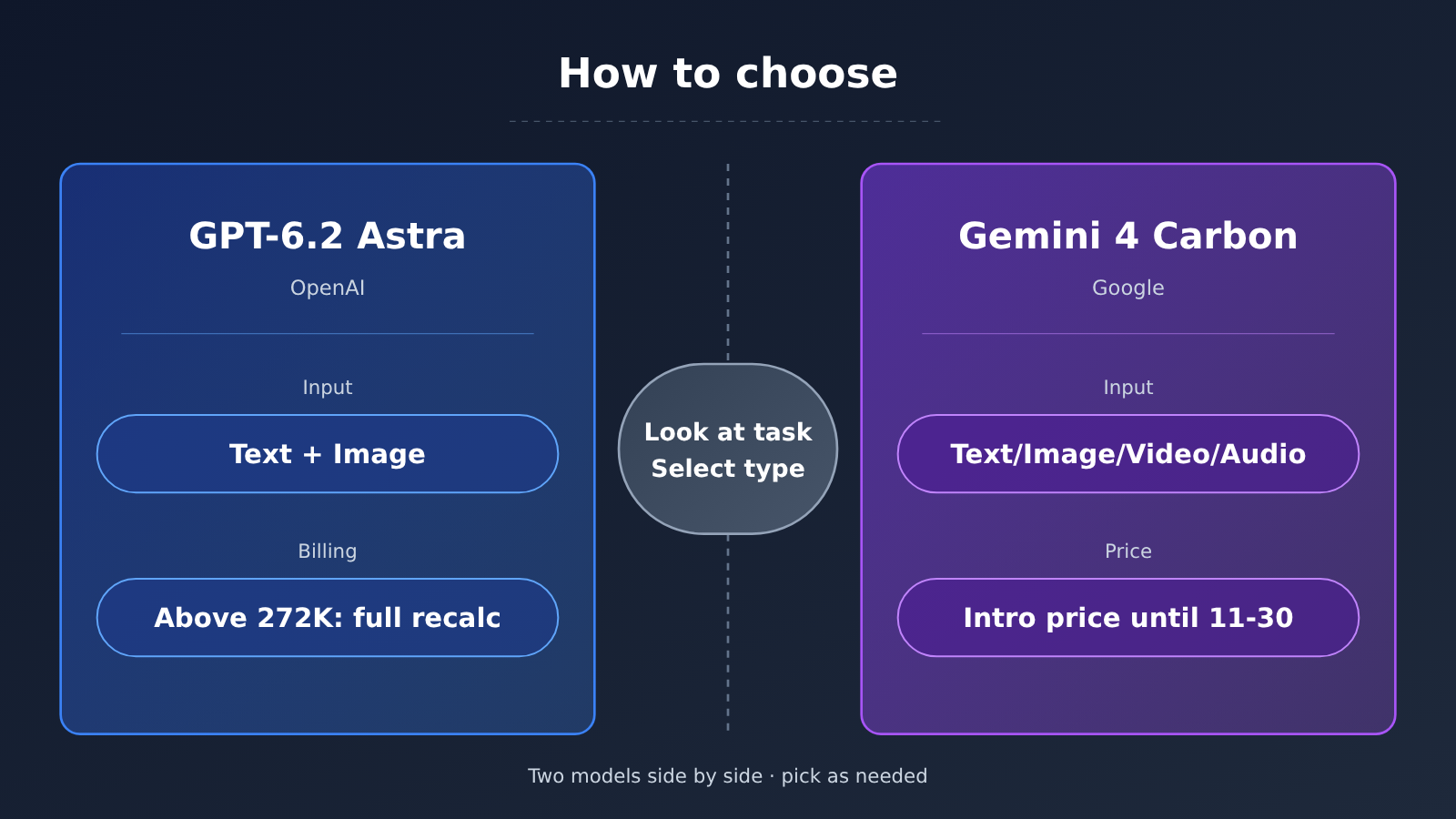
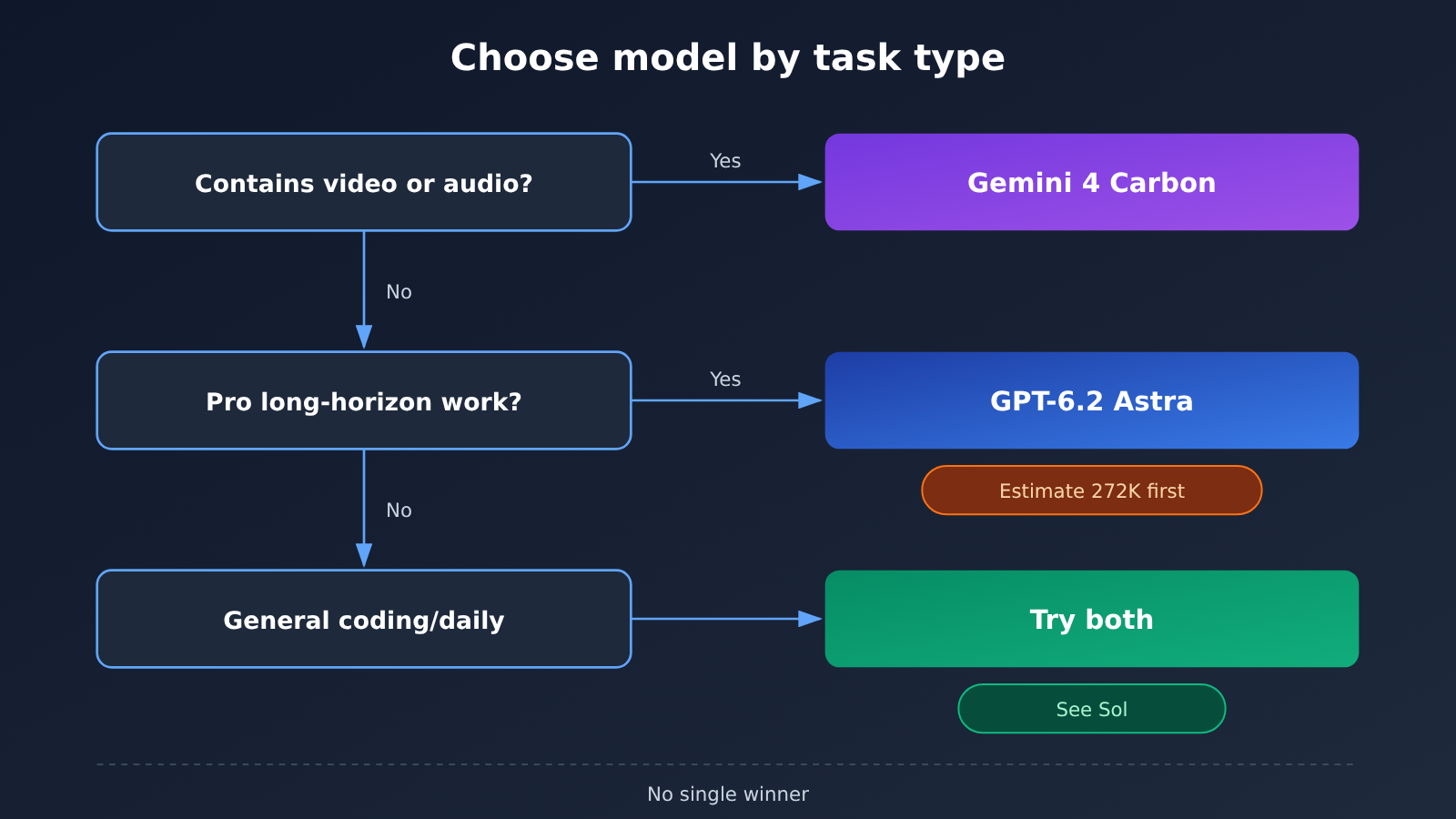
Core takeaway: by the end of this article, you’ll be able to judge which model to try first based on the task type you’re actually working with. Handling video or audio, or want to integrate right now? Look at Carbon first. Working with professional documents or scientific tasks—and comfortable with the 272K whole-request recalculation rule? Look at Astra first.
Key Takeaways: GPT-6.2 Astra and Gemini 4 Carbon
| Key Point | GPT-6.2 Astra | Gemini 4 Carbon | What It Means for Your Choice |
|---|---|---|---|
| Release date | 2026-11-17 (OpenAI) | 2026-11-10 (Google) | Both are brand-new models, and docs are still being updated |
| Input modalities | Text, images | Text, images, video, audio | For tasks involving audio or video, the coverage gap is substantial |
| Long-context billing | The entire request is billed higher above 272K | Google’s price list has no 272K doubling rule | Long-document costs need to be estimated separately |
| Price validity | Official standard pricing, no end date | Intro pricing until 2026-11-30, doubles from 12-01 | You can’t draw long-term conclusions from current prices |
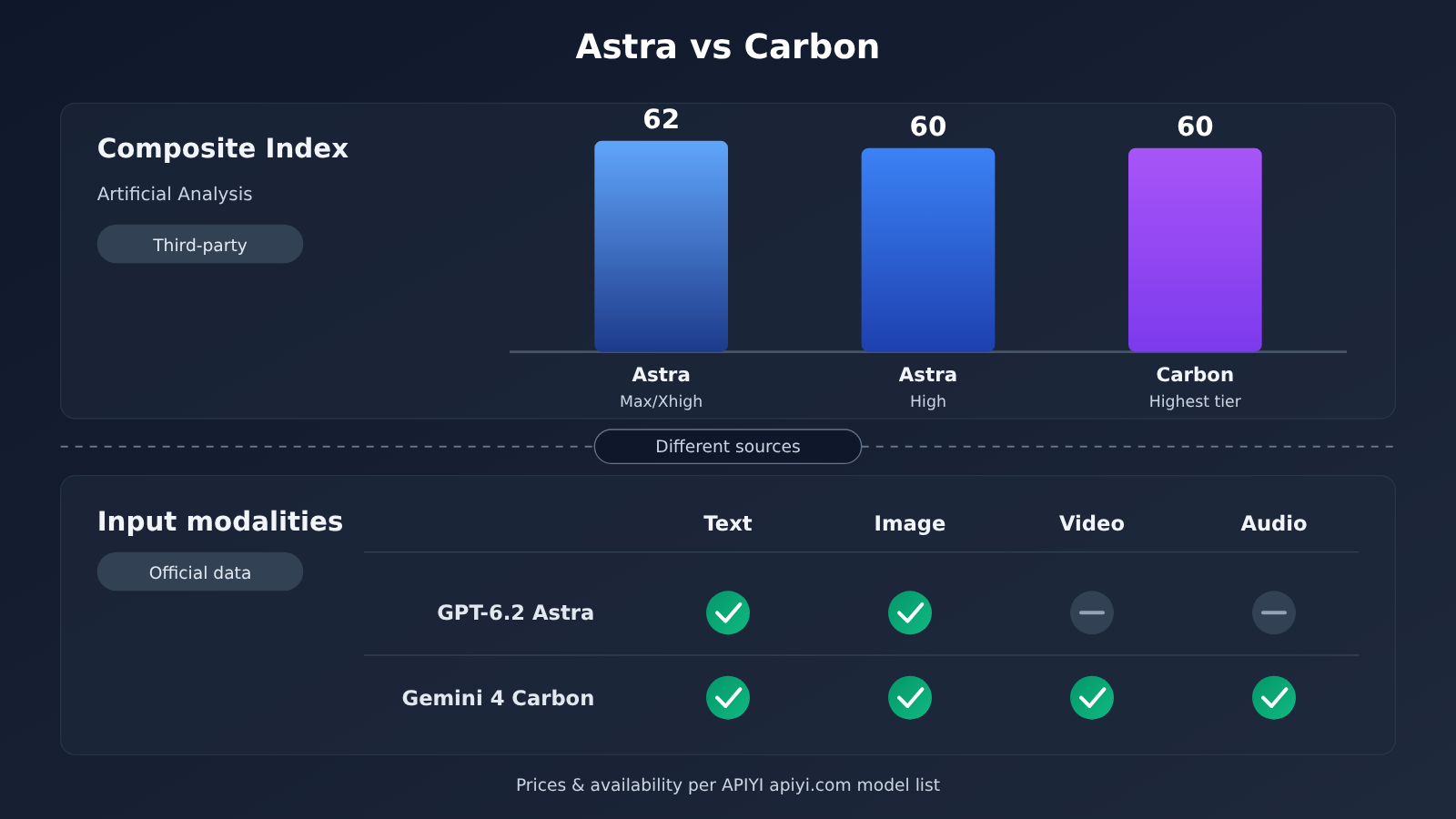
| Third-party composite scores | Max/Xhigh 62, High 60 | 60 at the top tier | The reasoning tiers differ, so scores aren’t directly equivalent |
Release Background: GPT-6.2 Astra and Gemini 4 Carbon
In an official post, OpenAI announced that GPT-6.2 Astra and Sol are available starting today, with model IDs gpt-6.2-astra and gpt-6.2-sol respectively. On the ChatGPT side, they’re rolling out to Plus, Pro, Enterprise, and Edu users, while developers can call them through the OpenAI API — both models support Ultrafast at launch. One thing worth noting: the API doesn’t allow setting reasoning effort to none, so Astra will always run reasoning.
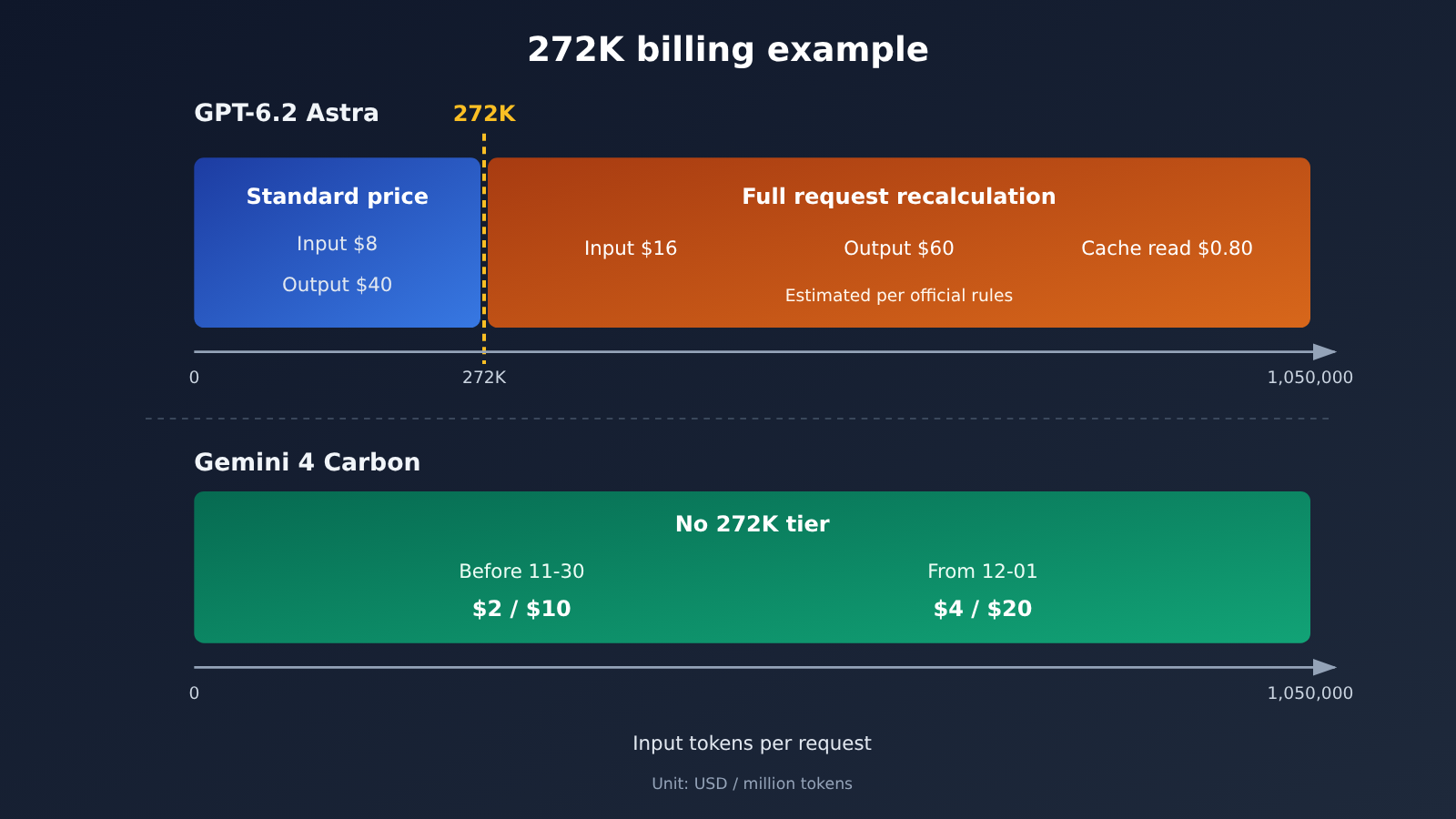
Gemini 4 Carbon’s release notes were published on November 10. A footnote spells out that the introductory price matches Argon’s, and once November 30 ends, it shifts to $4 for input and $20 for output. This detail directly affects model selection, which is why every price in this article is tagged with the date it applies.
GPT-6.2 Astra vs Gemini 4 Carbon: Core Differences
Input Modalities and Spec Differences
The specs below come from OpenAI’s official model page and APIYI’s gemini-4-carbon model description page. For Carbon’s context window, max output, and knowledge cutoff, the APIYI description page is the authoritative source.
| Spec | GPT-6.2 Astra | Gemini 4 Carbon |
|---|---|---|
| Input | Text, images | Text, images, video, audio |
| Output | Text | Text |
| Context window | 1,050,000 | 1,048,576 |
| Max input | 922,000 | Not listed separately on the description page |
| Max output | 128,000 | 65,536 |
| Knowledge cutoff | 2026-05-18 | 2026-03 |
| Reasoning | Supports reasoning tokens; effort can’t be set to none | Thinking tokens are already included in the official output price |
| Endpoints | Chat Completions, Responses, Batch | On APIYI: chat and Gemini generateContent; no Responses |
The biggest difference in this table is the input row. Astra’s official model page explicitly states that audio and video aren’t supported, and the Realtime, voice, and video endpoints don’t support them either. Tasks like analyzing transcribed meeting recordings, moderating video content, or understanding teaching materials with visuals—these inputs are inherently audio/video-based, and Astra’s API can’t accept them directly. You’d need to convert them to text or extract frames elsewhere first. Carbon, on the other hand, can read these inputs as-is.
The second difference is max output. Astra can generate up to 128,000 tokens in a single response, while Carbon’s limit sits at 65,536 per the APIYI description page. If you need to produce a very long report or code file in one pass, this is worth keeping in mind.
GPT-6.2 Astra and Gemini 4 Carbon Pricing and Long-Context Billing
Prices like these only make sense with a date attached. The table below uses US dollars per 1 million tokens, and these are all official list prices—not platform prices.
| Pricing item (standard tier) | GPT-6.2 Astra (short context) | Gemini 4 Carbon (through 2026-11-30) | Gemini 4 Carbon (from 2026-12-01) |
|---|---|---|---|
| Input | $8 | $2 | $4 |
| Output | $40 | $10 (includes thinking tokens) | $20 (includes thinking tokens) |
| Cache read | $0.40 | $0.10 | $0.20 |
| Cache write | $10 for 30 min, $20 for 12 h | Implicit caching only | Implicit caching only |
| Over 272K | Input and cache doubled, output ×1.5, applies to the entire request | No such rule in the price list | No such rule in the price list |
GPT-6.2 Astra’s official list price is $8 for input, $0.40 for cache reads, and $40 for output. It’s not listed yet—we’ll add the model as soon as we can, and the model name and pricing defer to the platform’s model list. According to OpenAI’s announcement, these prices are 20% lower than GPT-6 Astra for input and output, and 60% lower for cached input. One thing to watch when checking prices: the APIYI master table at apiyi.com (data as of 2026-11-17 15:54, UTC+8) and the public pricing endpoint currently only show gpt-6-astra, which isn’t 6.2—so don’t treat the prices in that row as Astra 6.2’s.
The thing to watch out for with Astra is the 272K rule. The official model page spells it out: when a single request’s input exceeds 272K tokens, input and cache rates double, output is charged at 1.5× the short-context rate, and the entire request is billed at those rates—not just the portion that exceeds the threshold. Running the numbers under that rule, a request with 300K input tokens would be billed at $16 for the full input, $60 for output, and $0.80 for cache reads. If your task means stuffing a whole set of contracts or a batch of papers into the context, it’s best to count the tokens first, or split each input to stay under 272K before comparing costs.
Astra’s other pricing tiers break down like this: Batch is 50% of the standard price, Fast is 2× the standard price at the same context length, and Ultrafast runs at 3× the standard price through 2027-02-28 (Pacific Time), then jumps to 6× from 2027-03-01. On reasoning tokens, the official model page only says “reasoning tokens supported”—this article won’t take a position on whether they’re billed separately, so defer to the official billing documentation before you integrate.
Over on the Gemini 4 Carbon side, both Google’s AI Studio pricing page and the Cloud price list state that the output price includes thinking tokens, only implicit caching is supported, and there’s no free tier. Cloud’s global region matches the table above, while non-global regions run about 10% higher—for example, $2.20 for input and $11 for output before November 30. Google’s price list doesn’t have a line for “everything doubles over 272K.”
On APIYI, gemini-4-carbon went live on 2026-11-11. The description page lists input at $2, cache reads at $0.1, and output at $10, with the model available under the Default and SVIP groups at a 1× rate multiplier. What that page shows is the introductory price—it doesn’t mention the official price adjustment on December 1. After December 1, treat the platform’s model list as the source of truth—don’t build long-term budgets around today’s numbers.
Capability Numbers: Read Official Self-Reports and Third-Party Data Separately
The capability numbers come from two sources, and you have to read them separately—you can’t merge them into a single conclusion.
First source: Artificial Analysis third-party data (Intelligence Index v5.0.1). This index scores each reasoning tier separately:
| Model and Reasoning Tier | Overall Score | Notes |
|---|---|---|
| Claude Fable 5.2 (highest tier) | 65 | #1 on the third-party leaderboard |
| GPT-6.2 Astra (Max / Xhigh) | 62 | Astra’s two highest tiers |
| GPT-6.2 Astra (High) | 60 | Same score as Carbon’s highest tier, but a different tier |
| Gemini 4 Carbon (highest tier) | 60 | Cited in the third-party article |
| GPT-6.2 Astra (Medium / Low) | 57 / 46 | The lower the tier, the lower the score |
| GPT-6.2 Sol (Max) | 57 | Per-task cost is roughly a quarter of Astra Max’s |
“Astra High at 60” and “Carbon’s highest tier at 60” share the same score, but that doesn’t mean High-tier Astra equals Carbon. The two differ in reasoning tier, token consumption, and per-task cost—it’s just that this particular index happened to give them the same number. The third party also provided other reference points: Astra (Max) has a per-task cost of $4.00 on the overall index, and its AA-Omniscience hallucination rate (Max) is 59%. On the Coding Agent Index under the Codex harness, Astra is on par with GPT-6 Astra.
Second source: OpenAI’s official self-reported numbers. Everything below comes from OpenAI’s announcement, and it’s mostly relative comparisons against its own older models or Claude Fable 5.2, with no mention of Gemini 4 Carbon:
- Agents’ Last Exam (long-horizon professional workflows): OpenAI reports Astra scores 5.2 points higher than GPT-6 Astra at less than a third of the cost.
- Terminal-Bench-Science 0.1: OpenAI reports it’s 9 percentage points higher than GPT-6 Astra.
- Vals Science Index: OpenAI claims a new record, but the announcement doesn’t give an absolute score.
- Harvey LAB-AA v1.1: OpenAI reports a pass rate more than double Claude Fable 5.2’s, without giving an absolute pass rate.
- GDPval v2 (OpenAI internal): 6.2 percentage points higher than GPT-6 Astra, with 22% fewer output tokens.
Judging from the self-reported content, Astra’s focus is long-running professional tasks in documents, law, and science. The reference materials don’t include comparison data for Carbon on these benchmarks, so this article won’t draw conclusions about which of the two is stronger on professional tasks.
Scenario Recommendations for GPT-6.2 Astra and Gemini 4 Carbon
When to Reach for Gemini 4 Carbon
- Input includes video or audio: Think lecture video summaries, QA reviews of customer service recordings, or product demo analysis with visuals on screen. Astra can’t take these inputs directly, but Carbon can.
- You need to launch and validate right now: Carbon is already listed on APIYI and can be called directly through the OpenAI-compatible chat endpoint. Astra 6.2 is still waiting to be added to the platform.
- Long context per request, budgets estimated per call: Google’s price sheet doesn’t have the 272K whole-request doubling rule, so there’s one less variable to juggle when estimating. That said, unit prices will double starting December 1, so budget based on the new rates.
When to Reach for GPT-6.2 Astra
- Professional documents and legal materials: The officially reported Harvey LAB-AA and Agents’ Last Exam benchmarks both focus on this type of task, and OpenAI even offers a lawyer-oriented “Astra for Law” configuration.
- Scientific computing and research workflows: Terminal-Bench-Science and Vals Science Index are both officially reported highlights, and third-party coverage also notes that Astra leads on Terminal-Bench-Science 0.1.
- You need long outputs: A maximum single output of 128,000 tokens makes it a good fit for generating lengthy reports in one go.
- You can keep per-request input under 272K: Short-context requests are billed at standard rates; once you cross that threshold, the entire request gets recalculated, so these tasks work best paired with a chunking strategy.
Tasks Where Either Model Is Worth a Try
For general coding and everyday tasks, you don’t have to pick strictly between these two. Officially self-reported results show GPT-6.2 Sol trailing Astra by less than 0.5 points on FrontierCode 2.0, at roughly one-fifth of the cost. GPT-6.2 Sol’s official pricing is $2 for input, $0.10 for cached reads, and $10 for output. It’s not listed yet, but we’ll add this model to the platform as soon as possible; model names and prices are subject to the platform’s model list. Note that the gpt-6.1-sol and gpt-6-sol models currently on the APIYI master list are not 6.2.
GPT-6.2 Astra vs. Gemini 4 Carbon: Decision Guide
| Your Task | Start With | Why | Where to Access |
|---|---|---|---|
| Video and audio understanding | Gemini 4 Carbon | The only one with native audio and video input | APIYI apiyi.com already lists gemini-4-carbon |
| Integrating and shipping this week | Gemini 4 Carbon | Already callable on the platform | Available on APIYI |
| Legal, compliance, and professional documents | GPT-6.2 Astra | Officially stated as its flagship focus | OpenAI API; not yet listed on APIYI |
| Long-running scientific tasks | GPT-6.2 Astra | Both official reports and third parties highlight scientific work | OpenAI API; not yet listed on APIYI |
| Single input over 272K | Run the numbers for each side | Astra recalculates the entire request, while Carbon’s prices rise in December | Check each price list |
| General coding and everyday Q&A | Try both, and take a look at Sol too | Officially reported that the coding gap between Sol and Astra is small | Depends on listing availability |
💡 How to choose: Start by ruling out options based on input modality, then estimate costs based on whether you’ll exceed 272K and the pricing dates, and finally run a test with your own samples. You can get Gemini 4 Carbon working end to end on APIYI with the same API key, then switch the model name for a side-by-side comparison once Astra 6.2 is listed—no code changes required.
GPT-6.2 Astra and Gemini 4 Carbon Quick Start
Carbon is already callable. The steps below use the OpenAI-compatible approach, so there’s no new SDK involved.
- Get a key: Register on APIYI and create an API key — new users get free test credits.
- Set base_url: In the official OpenAI SDK or any compatible client, set base_url to
https://api.apiyi.com/v1and fill in your key as the api_key. - Specify the model: Set model to
gemini-4-carbonand go through the chat completions endpoint. This model doesn’t have a Responses endpoint on the platform, so if your code uses Responses, you’ll need to switch back to the chat endpoint, or use Gemini’s native generateContent. - Pass multimodal content: Text and images can be sent in the OpenAI-compatible message format; for the exact field syntax for video and audio, refer to the model’s documentation page on the platform.
- Control output length: Carbon’s maximum output is 65,536 — don’t set max_tokens above this value.
Once Astra 6.2 goes live, all you’ll need to do to hook it up is change the model to gpt-6.2-astra. There are two things to prepare in advance: first, don’t set reasoning effort to none — the API will reject it; second, count your input tokens before each call, because once you exceed 272K, the billing for the entire request changes.
🚀 Quick start: If you want to compare both routes on the same day, you can use the free credits on APIYI at apiyi.com to run Carbon first, get your samples, prompts, and scoring scripts in order, then once Astra 6.2 goes live, just swap the model and rerun.
Frequently Asked Questions (FAQ)
Q1: What are GPT-6.2 Astra and Gemini 4 Carbon?
GPT-6.2 Astra is OpenAI’s flagship reasoning model released on 2026-11-17. It takes text and image input, outputs text, and has a context window of 1,050,000. Gemini 4 Carbon is Google’s model released on 2026-11-10. It takes text, image, video, and audio input, and outputs text.
Q2: Who scores higher on third-party aggregate benchmarks?
According to Artificial Analysis’s third-party Intelligence Index v5.0.1, Astra scores 62 on the Max and Xhigh tiers and 60 on the High tier; Carbon’s top tier scores 60. Since the tiers differ, you can’t treat High-tier Astra as equivalent to Carbon, and you shouldn’t read these scores alongside OpenAI’s officially self-reported benchmark numbers either.
Q3: Which one is cheaper right now?
This article won’t make that call. Carbon’s official standard pricing through 2026-11-30 is $2 input, $10 output, and $0.10 cache read; starting 2026-12-01, it becomes $4, $20, and $0.20. Astra’s official short-context pricing is $8, $40, and $0.40, but anything over 272K gets recalculated for the entire request. Your actual cost depends on your input length and output length. On APIYI (apiyi.com), Carbon is currently showing introductory pricing—after December 1, please go by the platform’s listings.
Q4: Which tasks can only use Carbon?
Tasks where the input itself is video or audio and you don’t want to transcribe or extract frames first. Astra’s official model page explicitly doesn’t support audio or video input, nor Realtime or voice endpoints.
Q5: How do I get started via the API?
Carbon is already listed on the platform: grab an API key from APIYI, set base_url to `https://api.apiyi.com/v1`, fill in `gemini-4-carbon` as the model, and call the chat endpoint. GPT-6.2 Astra and Sol aren’t listed yet—we’ll add the model as soon as we can; model names and pricing are subject to the platform’s model list.
Q6: What are Astra’s known limitations?
OpenAI has called out a few things: the guardrails are stricter, so some legitimate vulnerability research requests get rejected; in two alignment tests, it’s more prone to missing task-blocking issues—like missing files or an unavailable search tool—without flagging them, though adding the relevant instructions in Codex significantly reduces these omissions; and third-party testing measured a 59% hallucination rate on the Max tier. Also worth noting: OpenAI has only said it will work to bring 6.2 into Daybreak—that doesn’t mean it’s already there.
Q7: Do Carbon’s thinking tokens cost extra?
Google’s pricing page states that Carbon’s output price already includes thinking tokens. Astra’s official model page only mentions support for reasoning tokens; this article won’t judge whether they’re billed separately, so please go by OpenAI’s billing documentation.
GPT-6.2 Astra and Gemini 4 Carbon Key Takeaways
- Modality decides the first round of screening: Only Carbon can directly accept video and audio input.
- 272K is Astra’s cost tipping point: Cross it and input pricing doubles, output goes ×1.5—and it applies to the entire request.
- Carbon’s pricing has a deadline: After November 30, the official unit price doubles, so budget based on the new price.
- Don’t merge the two sets of scores: For third-party numbers, check the reasoning tier; official self-reported results mostly compare against the company’s own older models.
- Astra is positioned for professional tasks: Its official self-reported results focus on law, science, and long-horizon professional workflows.
- Availability depends on the platform: Carbon is already callable through APIYI at apiyi.com, while Astra 6.2 isn’t listed yet.
Summary
GPT-6.2 Astra and Gemini 4 Carbon score nearly identical on third-party composite benchmarks, so what actually matters when choosing between them comes down to three things:
- Input modality: For audio and video tasks, start with Carbon; for text-plus-image professional work, start with Astra.
- Billing rules: Astra recalculates the whole request once you cross 272K, and Carbon’s unit price doubles starting December 1. Estimate costs for both based on your own token distribution.
- Data sources: Read official self-reported numbers and third-party leaderboards separately, and third-party scores must always come with the reasoning tier.
It’s worth running your own real samples first before committing to either one long-term. Carbon connects directly through APIYI’s OpenAI-compatible API at apiyi.com, and once Astra 6.2 is listed, you can run a side-by-side comparison in the same codebase by simply swapping the model name.
📚 References
-
OpenAI Release Post: Introducing GPT-6.2 Astra and Sol — official release notes and self-reported benchmarks
- Link:
openai.com/index/introducing-gpt-6-2-astra-sol - Notes: Pricing overview, availability, safety and alignment details
- Link:
-
OpenAI Model Page: gpt-6.2-astra — specs and pricing rules
- Link:
platform.openai.com/docs/models/gpt-6.2-astra - Notes: 272K whole-request pricing rules, endpoint support, Batch/Fast/Ultrafast multipliers
- Link:
-
OpenAI System Card — safety evaluation details
- Link:
deploymentsafety.openai.com/gpt-6-2-astra-sol - Notes: Preparedness framework tier classifications and alignment testing
- Link:
-
Google Release Notes: Gemini 4 Carbon — introductory pricing and deadline
- Link:
blog.google/innovation-and-ai/models-and-research/gemini-models/gemini-4-carbon-now-available - Notes: The footnote spells out the pricing that kicks in after November 30
- Link:
-
Artificial Analysis (Third-Party Article) — Intelligence Index tier scores
- Link:
artificialanalysis.ai/articles/openai-has-the-2-model-in-the-intelligence-index-with-the-release-of-gpt-6-2-astra-and-gpt-6-2-sol - Notes: Composite scores per reasoning tier, per-task cost, and hallucination rates
- Link:
Author: APIYI Technical Team
Technical Discussion: Feel free to reach out via the APIYI homepage. Model documentation and pricing details are available in the docs.apiyi.com documentation center.


