

Author’s note: This piece lays out the positioning and pricing of the four Gemini 4 models that have already launched, gives the budget formula for after the December 1 price increase, and uses three clues—billing lines, model IDs, and the model selector—to sort out the Helium rumor.
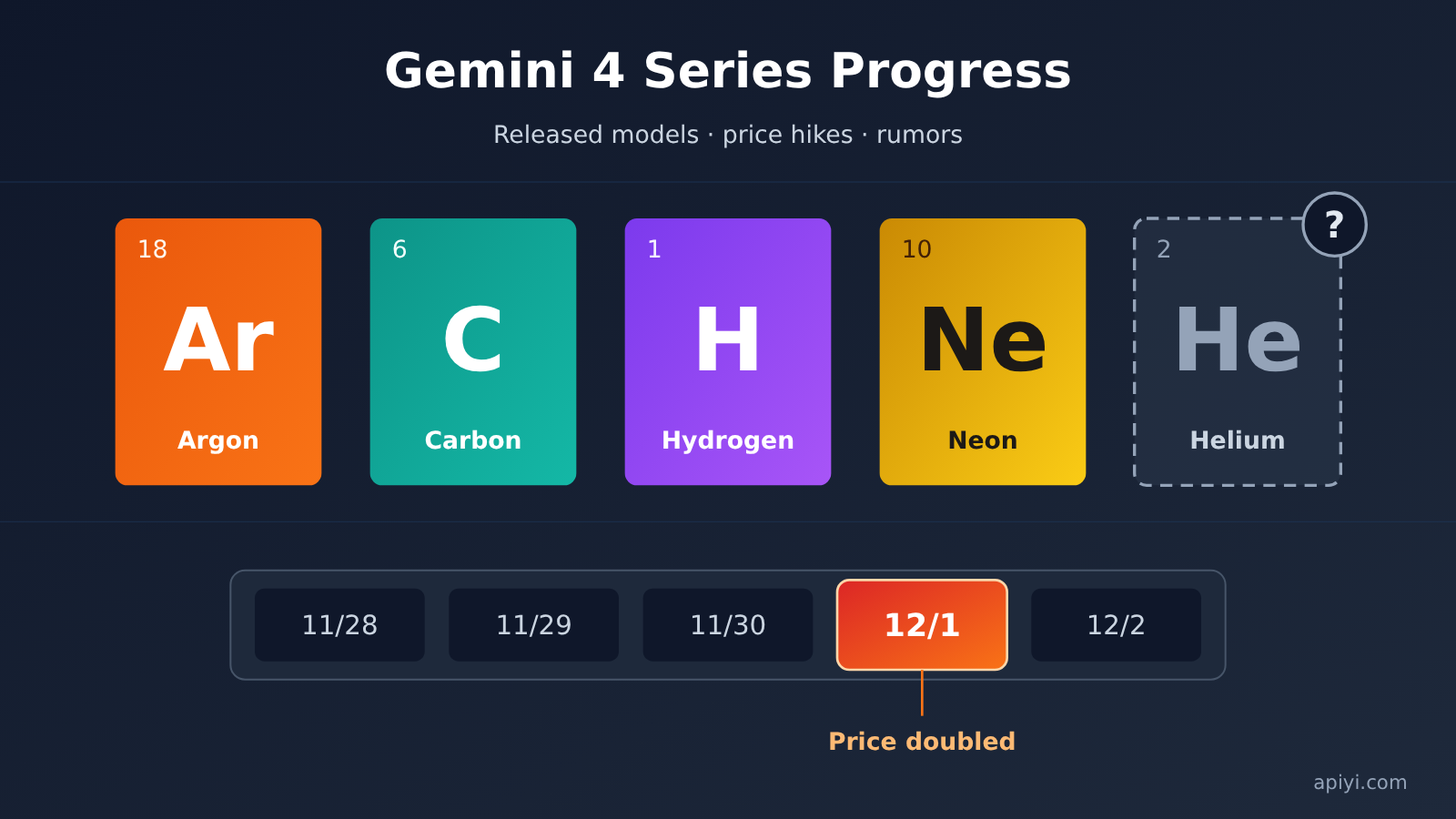
December 1 is only a few days away. The limited-time pricing for Gemini 4 Argon and Carbon ends on November 30, and the unit prices for input, output, and cache read all double at the same time. Meanwhile, a name called Helium is being repeatedly shared on social platforms, and many people assume a fifth model is about to launch.
This isn’t another rumor roundup. This article relies only on Google’s pricing page, model cards, deprecation page, and platform model list to answer the three things app developers care about most: which Gemini 4 models you can call right now, what your bill will look like after December 1, and whether there’s any concrete evidence behind the Helium claims.
Core value: By the end, you’ll have a comparison table of the four Gemini 4 models, a budget formula you can plug your own usage into, and a method for judging model rumors. Every model call costs tokens, and all four are already live on APIYI apiyi.com, so you can follow the routing approach in this article and check it directly against your bill.
Key details on the released Gemini 4 models
As of 2026-11-26, Google’s public model reference lists exactly four Gemini 4 identifiers: gemini-4-argon, gemini-4-carbon, gemini-4-hydrogen, and gemini-4-neon. There is no fifth. The table below puts all four models’ release timing, specs, and pricing side by side.
| Model | Release / availability | Context / max synchronous output | Thinking levels seen in public evaluations | Current price (input/output/cached read) | From December 1 |
|---|---|---|---|---|---|
gemini-4-argon |
Released 09-30, paid tier opened 10-13 | 1,048,576 / 65,536 | medium, high | $2 / $10 / $0.10 | $4 / $20 / $0.20 |
gemini-4-carbon |
Released 10-28, available 11-10 | 1,048,576 / 65,536 | low, high | $2 / $10 / $0.10 | $4 / $20 / $0.20 |
gemini-4-hydrogen |
GA on 11-12, includes free tier | See model page | See model page | $1.50 / $7.50 / $0.075 | Unchanged (standard price) |
gemini-4-neon |
Released 11-18 and GA same day | See model page | low, medium, high, xhigh | $3 / $15 / $0.15 | Unchanged (standard price) |
Prices are per 1M tokens, data as of 2026-11-26; model names and prices are subject to the platform’s model list. The per-unit prices for the four models on the APIYI apiyi.com model list match Google’s item by item. After Google restores the $4 / $20 pricing on December 1, APIYI will adjust accordingly.
The Gemini 4 Family Lineage
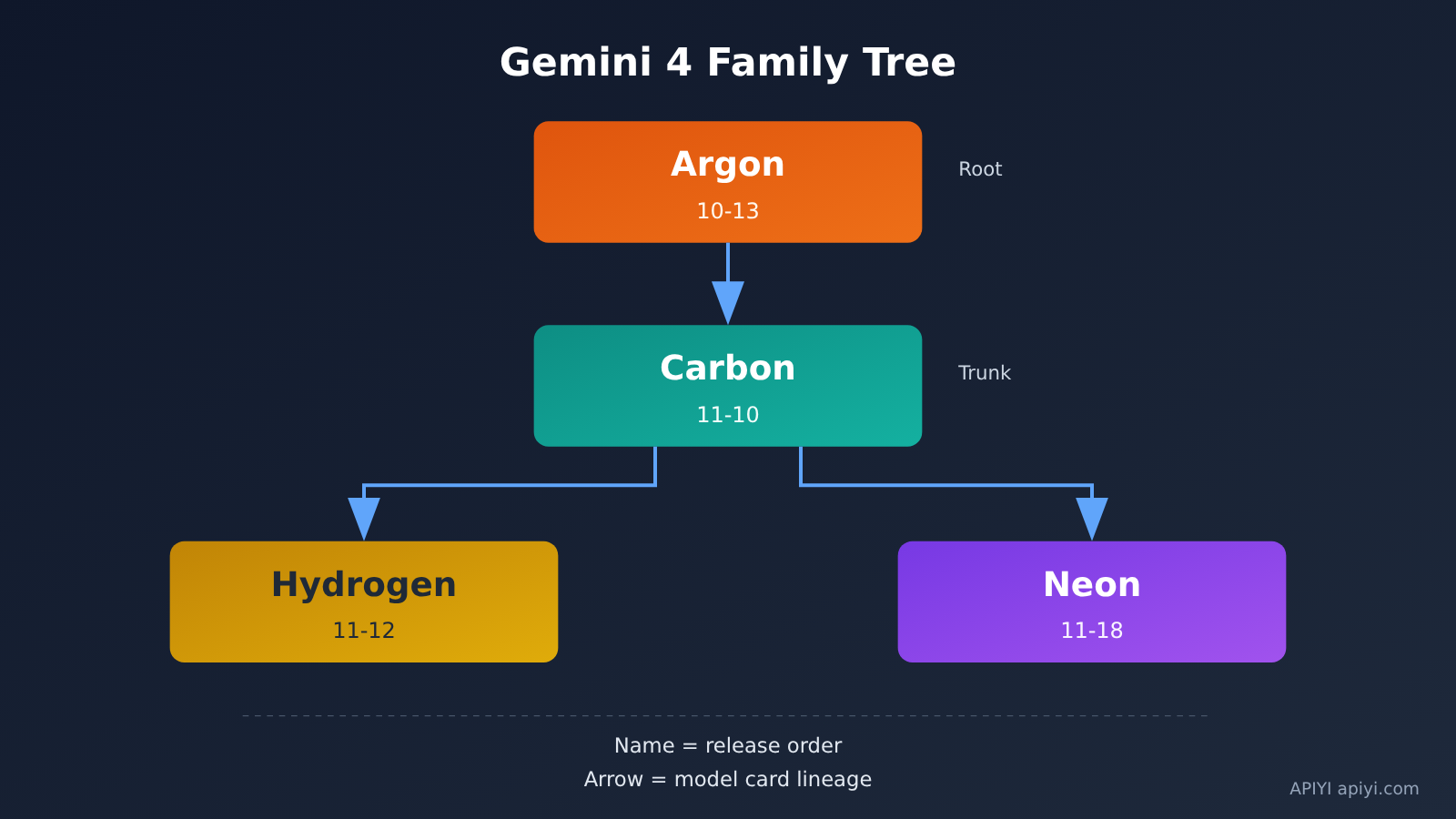
The names follow the periodic table, but they record shipping order, not lineage. The Google model cards spell it out clearly: Argon is a brand-new frontier model, not a modification or fine-tune of any older model; Carbon’s card says it’s based on Argon; Hydrogen’s card says it’s adapted from Carbon — a phrase repeated seven times across seven sections; Neon’s card copies Carbon’s line verbatim.
So Gemini 4 is really one trunk plus two branches: Argon is the root, Carbon is the trunk, and both Hydrogen and Neon branch off from Carbon. Once you understand that, you won’t misread “bigger atomic number” as “newer and stronger” when choosing a model.
Choosing Between Gemini 4 Neon and Carbon
Neon currently scores the highest in the family. In the Artificial Analysis Intelligence Index v5.0.1 cited on the model card, Neon sits at 61, above Claude Opus 5.5’s 59 and GPT-6.2 Sol’s 57 — that’s the official self-reported figure. It also self-reports CWE-bench v2 at 70.7%, 3.4 points above Carbon, and Terminal-Bench 4.1 at 65.2%.
But when you look at it by tier, the picture gets murkier. At the low tier, Carbon is 54 while Neon is only 44 — Carbon leads by 10 points; at the high tier, both are 60. In Artificial Analysis’s per-task cost figures, Carbon’s high tier runs about $7.76 and 39.2 minutes, while Neon xhigh runs about $6.44 and 26.4 minutes. Note that Carbon’s numbers are calculated at the 4/20 standard price, so after December 1, moving heavy reasoning tasks to Neon might actually save you money.
Gemini 4 Price Hike: What’s Changing and How to Budget
On December 1, only Argon and Carbon actually change. Both follow the same schedule: the limited-time price of 2/10 with caching at 0.10 holds through November 30, after which it reverts to 4/20 with caching at 0.20. Neon and Hydrogen stay at standard pricing, with no expiry date.
A Gemini 4 budget formula you can plug numbers into directly
Monthly cost = input millions of tokens × input unit price + output millions of tokens × output unit price + cached-read millions of tokens × cached-read unit price
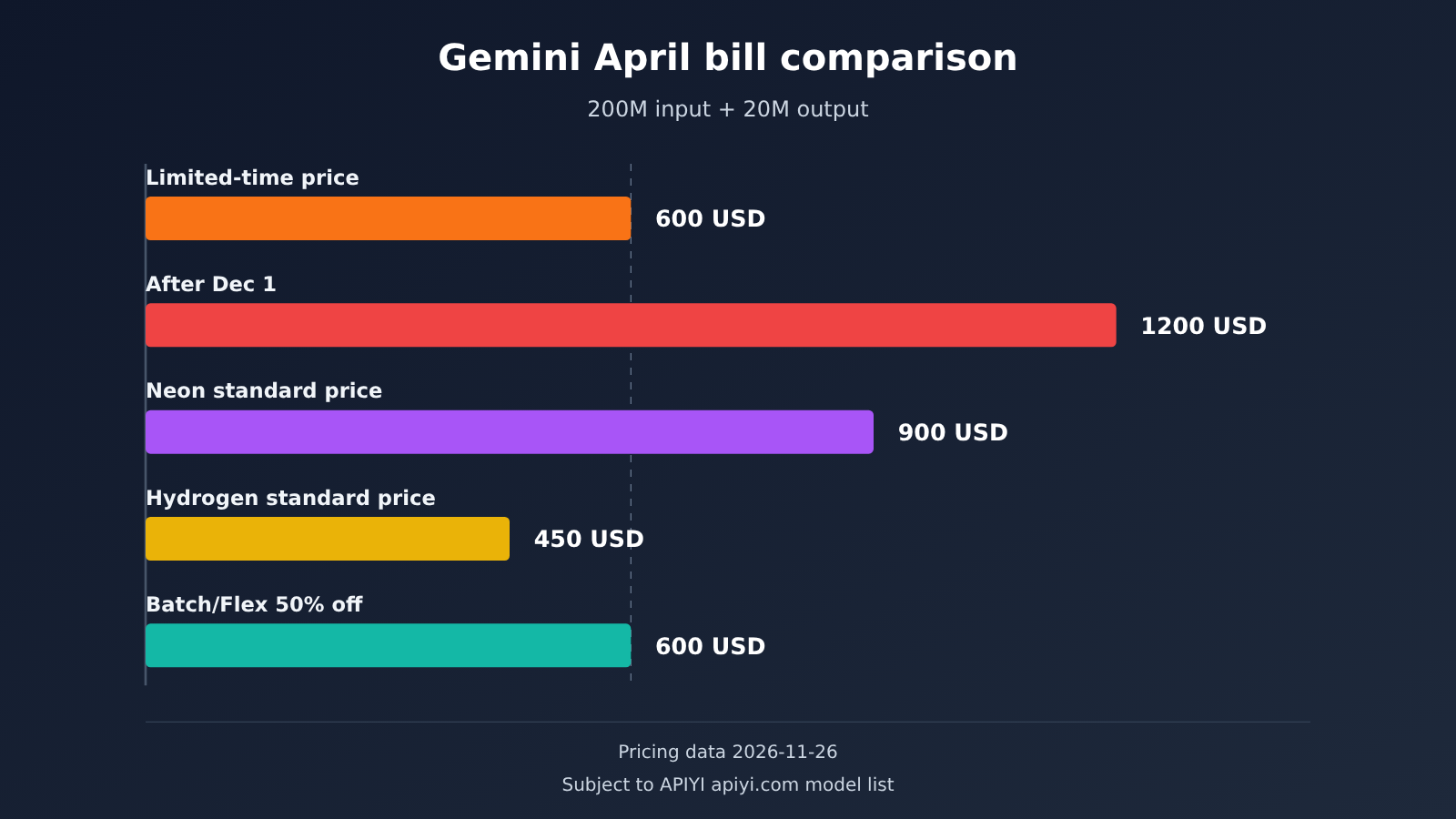
Take 200 million input tokens plus 20 million output tokens per month, excluding cache, as an example. Plugging that into the four models gives:
| Pricing plan | Input portion | Output portion | Monthly total |
|---|---|---|---|
| Argon / Carbon limited-time price 2/10 | 200 × 2 = 400 | 20 × 10 = 200 | $600 |
| Argon / Carbon 4/20 from December 1 | 200 × 4 = 800 | 20 × 20 = 400 | $1200 |
| Neon standard price 3/15 | 200 × 3 = 600 | 20 × 15 = 300 | $900 |
| Hydrogen standard price 1.5/7.5 | 200 × 1.5 = 300 | 20 × 7.5 = 150 | $450 |
| Argon / Carbon 4/20 via Batch or Flex | 50% off | 50% off | $600 |
Batch and Flex are 50% off standard pricing across all four models. In other words, for offline jobs where latency doesn’t matter, running Batch after December brings the bill back down to limited-time-price levels. Plug your own usage into the table above and you can check it month by month against the usage records in the APIYI apiyi.com dashboard.
December brings more than just Gemini 4 changes
Other pricing and routing shifts land in the same month: Gemini 2.5 Pro and 2.5 Flash switch routes on 12-01, Omni 1.1 Flash switches on 12-03, and Gemini 3.8 Flash doubles on 2027-01-01. If your systems are still running these older models, schedule that alongside your Gemini 4 budget adjustment — otherwise you’ll end up with two billing changes in one month and no way to tell where they came from.
There’s also a Contributor tier on Argon and Hydrogen, priced at 1/5 with caching at 0.05. But it’s an invite-only private preview, and your content gets used to improve Google products. Carbon and Neon don’t have this tier. For most commercial use cases, it’s not a cost-cutting lever you can count on by default.
Gemini 4 Quick Start: Key Integration Points
All four models support two endpoints on APIYI: the OpenAI-compatible /v1/chat/completions, and Gemini’s native /v1beta/models/model-name:generateContent. OpenAI Responses and Anthropic Messages formats aren’t supported right now. The integration steps, in a nutshell:
- Grab an API key at APIYI apiyi.com — new users get free testing credits;
- Point the OpenAI SDK’s
base_urlathttps://api.apiyi.com/v1and setmodelto a model ID likegemini-4-neon; - If you need native fields, switch to a path such as
/v1beta/models/gemini-4-carbon:generateContent; - Handle the known issues with thinking models using the table below.
| Known Issue | Symptom | Workaround |
|---|---|---|
Thinking tokens count toward max_tokens |
Empty body returned when the budget is too small | Keep the client-side max_tokens at 1024 or above |
| Sampling parameters have no effect | temperature, top_p, top_k don’t throw errors but do nothing |
Don’t rely on them to control randomness |
| Multi-turn and tool calls | Failing to echo back thoughtSignature may return 400 |
Echo back the previous turn’s thoughtSignature unchanged |
| Version mismatch | The native response’s modelVersion doesn’t match the requested model |
Log the responseId and rerun in isolation — don’t just trust the HTTP 200 |
On the group side, Argon has three groups — Gemini_Reverse (0.5x), Default, and SVIP — while Carbon only has Default and SVIP.
🚀 Integration tip: If you want to compare Carbon and Neon on your own tasks before December 1, you can switch the
modelparameter with the same key through APIYI apiyi.com and run the comparison directly. Group multipliers and pricing are based on the platform’s model list.
Sifting the Helium Rumor: Is There Evidence for a Fifth Gemini 4 Model?
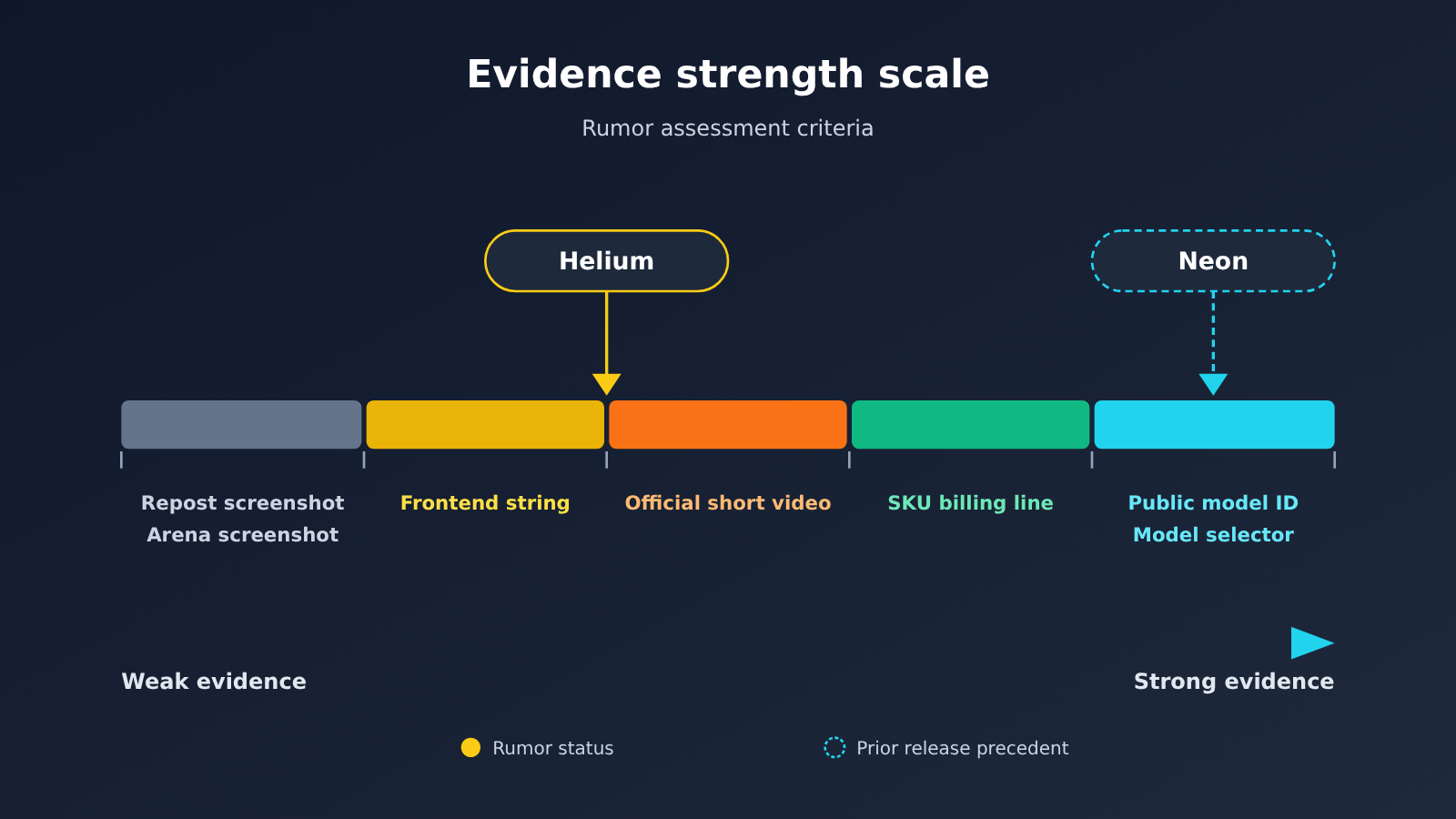
Bottom line first: Helium is just a rumor right now, and the evidence is weak to moderate. It’s stronger than an arena screenshot, but far weaker than a SKU billing line — and there’s no Google documentation backing it at all.
The two clues are these. On 11-19, DeepMind’s Omar Sanseviero posted a short video that lights up Hydrogen, Carbon, Neon, and Argon in sequence, ending on Helium, with a closing line reading “Gemini 4 will return” — no date, no price, no capability description. TestingCatalog later read that as a Flash Lite tier. On 11-23, a user posted the strings TIER_HELIUM and TIER_HELIUM_DISCOVERY_CARD from the Gemini web front-end source, sitting alongside feature strings for storyboard, learning-mode, and the like; the screenshot contains no model ID such as gemini-4-helium.
| Signal | Neon precedent | Helium status |
|---|---|---|
| Web front-end references | Upgrade prompt appeared on 11-16 | Has a TIER_HELIUM string, but it looks more like a subscription tier or feature card name |
| Google Cloud SKU billing line | Appeared 11-18, GA the same day | None |
| Public model ID | Has gemini-4-neon |
None |
| Subscription plans page | — | Still only three tiers: AI Plus, AI Pro, AI Ultra |
Other rumored names this month offer a reference point too: Oxygen, Krypton, and Helix all surfaced this month, and none of them actually shipped. Krypton was retracted and folded into Hydrogen, and Helix came from a personal repo that was deleted the next day. When you’re judging a rumor, look for a Google billing line, a model ID, and whether there’s a fifth tile in the model selector — not how many forwarded screenshots are floating around.
Two pieces of evidence that Argon isn’t being retired
The comparison chart in the Neon announcement listed only Carbon, Neon, and Hydrogen, leaving out Argon — which sparked speculation that “Argon is getting retired.” That doesn’t hold up either, and there are two direct pieces of evidence:
- Deprecation page: In the Google API deprecation page’s 11-23 record,
gemini-4-argonhas its own line, with no announced shutdown date and no designated replacement model; on the same page,gemini-2.5-proandgemini-2.5-flashexplicitly state a 12-01 shutdown and name their replacements. - Model selector: The head of AI Studio replied to a mockup of the periodic-table model selector, saying it’s genuinely live, and a user recording from 11-21 shows the Gemini web model switcher has likewise turned into a periodic table, with all four present.
Gemini 4 Impact Analysis
For app developers: After December, Argon and Carbon cost roughly 2.7x per unit compared to Hydrogen, and about 1.33x compared to Neon. This isn’t a “should we switch models” question — it’s a routing question: which requests actually justify $4 input / $20 output pricing? Push simple classification, summarization, and batch extraction onto Hydrogen or Batch. For long-chain agents and hard reasoning tasks, compare Carbon vs Neon on a per-task cost basis.
For the ecosystem: On 11-24, OpenCode said Neon is now available in its hosted Console at the same price as Google. On 11-20, when Logan Kilpatrick was asked about paid subscriptions being used in third-party harnesses, he replied “December 2nd we take the first step.” That’s just an employee statement — no docs, no scope, no rate-limit details — so don’t plan around it.
FAQ
Q1: How many Gemini 4 models can I call right now?
As of 2026-11-26, there are only four: Argon, Carbon, Hydrogen, and Neon. Their model IDs are `gemini-4-argon`, `gemini-4-carbon`, `gemini-4-hydrogen`, and `gemini-4-neon`.
Q2: Which Gemini 4 models go up in price on December 1?
Only Argon and Carbon — from 2/10 (with $0.10 caching) back to 4/20 (with $0.20 caching). Neon and Hydrogen stay at standard pricing. APIYI apiyi.com will mirror Google’s adjustments; the platform’s model list is the source of truth.
Q3: Will Helium be the fifth Gemini 4 model?
Right now there’s no billing line, no model ID, and no matching tier on the subscription page — so it’s just a rumor.
Q4: Will Argon be discontinued?
The deprecation page lists no shutdown date and no replacement model, and Argon is still in the model selector. No signs of retirement.
Q5: What’s the fastest way to compare real Carbon vs Neon costs?
Sign up at APIYI apiyi.com to get test credits, use `https://api.apiyi.com/v1` as your `base_url`, run the same batch of tasks against each model ID, then plug the returned token usage into the formulas in this article.
Q6: What are the limitations of Gemini 4 integration?
It doesn’t support the OpenAI Responses or Anthropic Messages formats; sampling parameters have no effect; thinking tokens count toward `max_tokens`; and multi-turn conversations require passing back `thoughtSignature`.
Gemini 4 Key Takeaways
- Four models live: Argon, Carbon, Hydrogen, Neon. There’s no fifth public model ID.
- Lineage: Argon is the root, Carbon is the main trunk, and Hydrogen and Neon branch off from Carbon.
- Price hike scope: Only Argon and Carbon double to input 4 / output 20 starting December 1.
- Cost-saving tactics: Batch and Flex give you half off, and light tasks can be routed to Hydrogen.
- Judging rumors: Look at billing lines, model IDs, and the model selector. Helium has none of the three.
- Getting started: Through APIYI’s unified interface, just switch model IDs to compare costs.
Coming back to today: what Gemini 4 users should do
- Run the numbers: Plug last month’s usage into the formula and work out your Argon / Carbon monthly bill after December 1;
- Route requests: Send latency-tolerant work through Batch, move simple tasks to Hydrogen, and compare Neon’s per-task cost for heavy reasoning tasks;
- Tighten your integration: Check
max_tokens,thoughtSignature, andmodelVersionvalidation; - Don’t schedule around rumors: Until Helium shows up with billing lines and model IDs, don’t put it in your roadmap.
I’d recommend running a side-by-side comparison before November 30 using the same Key through APIYI apiyi.com, then letting real token usage decide which requests are worth 4 dollars input and 20 dollars output.
📚 References
-
Google Blog: Gemini 4 Carbon and Neon Launch Announcement: release and availability dates
- Link:
blog.google - Notes: official launch information for Carbon and Neon
- Link:
-
Gemini 4 Neon Model Card: lineage and officially self-reported benchmark scores
- Link:
deepmind.google/models/model-cards/gemini-4-neon - Notes: source for the intelligence index and benchmark data
- Link:
-
APIYI Model List and Announcements: platform pricing, model groups, and endpoints
- Link:
docs.apiyi.com/models.md - Notes: data updated 2026-11-26, including the announcement about the synchronized adjustment on December 1
- Link:
Author: APIYI Technical Team
Technical Inquiries: Feel free to contact us through the APIYI website homepage. For more resources, visit the docs.apiyi.com documentation center.


