

Direct answer: based on public evidence, GTA 6’s world content is primarily handcrafted, and there’s currently no public evidence that generative AI played a role in creating its world content. On February 3, 2026, Take-Two CEO Strauss Zelnick said in an interview with GamesIndustry.biz that generative AI wasn’t involved in the content Rockstar was building at the time, and that the game world was designed by hand — building by building, street by street. That said, this is an executive’s description of content production at a specific point in time, not an audit of every internal tool used in the finished product. At the Take-Two group level, hundreds of AI pilots are indeed underway, and GTA 6’s official credits list job titles such as “AI programming” and “animation machine learning R&D” — but those are different things from “using generative AI to make game content.”
What you’ll learn from this article:
- Which claims about GTA 6 and generative AI have public sources, and which are speculation
- What “group AI pilots,” “Rockstar content production,” “traditional game AI,” and “machine learning” each refer to — and why they shouldn’t be conflated
- The handcrafted development process Rockstar North has publicly described, and the precise meaning of the ~600,000 animation figure
- How a runnable Python snippet can help you understand behavior-tree-style pedestrian AI, plus how to sensibly use large language models to assist design in your own projects
Index: The sections below start with a concept table and an at-a-glance impact summary to build a basic framework. The “Objective Facts” section then goes through Take-Two’s CEO statement, group pilots, the 10-K annual report, Rockstar North interviews, official credits, and launch information one by one, noting what each piece of evidence proves and what it doesn’t. The “Analysis and Judgment” section breaks down the four layers of meaning behind the word “AI” in games. A quick-start section follows with a behavior tree code example, and the article wraps up with an FAQ and references.
To Know: Key Concepts for Understanding the GTA 6 Generative AI Discussion
Before we get into “does GTA 6 actually use AI,” it helps to untangle a few terms that often get mixed up. The table below only covers the concepts directly relevant to understanding this article.
| Concept | Brief explanation |
|---|---|
| Generative AI | Models that can generate new content—text, images, audio, 3D assets, and so on—from a prompt, such as Large Language Models and image generation models |
| Traditional game AI | Rule-based systems that control NPC behavior in games, like state machines, behavior trees, and pathfinding; these usually don’t involve generating new content |
| Behavior Tree | A way of organizing NPC decision-making in a tree structure, built from nodes such as selectors, sequences, conditions, and actions |
| Procedural generation / procedural art | Placing or generating assets in bulk (vegetation, road details, etc.) using rules and algorithms, with the rules designed by artists and technical staff |
| Machine learning (ML) | An umbrella term for techniques that let models learn patterns from data; generative AI is just one branch of it |
| Animation machine learning | Using machine learning to process animation data, such as motion matching, transitions, and blending—not the same as having AI generate animations out of thin air |
| 10-K | An annual report that U.S. public companies file with the SEC, covering business, investments, and risk factor disclosures |
| Take-Two | The parent company of Rockstar Games, which also owns other game brands |
Quick Overview: The Impact of the GTA 6 Generative AI Controversy
This story doesn’t mean the same thing to every group, so below we only list the impacts that differ substantively and are backed by public evidence.
| Group | Main impact |
|---|---|
| Regular players | You can confirm that the official positioning on content creation is “hand-crafted,” but you shouldn’t take a single interview to mean “there’s no AI technology in the game whatsoever” |
| Game developers | Rockstar’s approach shows that the core competitiveness of a AAA open world still lies in art direction, narrative trade-offs, and systems design, with AI tools playing more of a supporting role |
| AI application developers | “Game AI” and “generative AI” differ greatly on a technical level; when building related products or content, you need to distinguish them accurately to avoid misleading users |
| Content creators and media | When reporting, distinguish between group-wide pilots, a single title, and traditional game AI; it’s not appropriate to treat job titles in the credits as evidence of generative AI use |
The Objective Facts About GTA 6 and Generative AI
This section only states facts that have public sources, and notes the boundary of the evidence behind each one.
Take-Two CEO on GTA 6’s Handcrafted Development (2026-02-03)
On February 3, 2026, Take-Two CEO Strauss Zelnick gave an interview to GamesIndustry.biz. According to the report, he said generative AI wasn’t involved in what Rockstar was building at the time, and explained that Rockstar’s worlds are designed by hand—building by building, street by street. The report’s headline also noted that generative AI tools are bringing cost and time efficiencies to the company.
The limits of this evidence are clear: it’s a group CEO’s verbal statement in February 2026 about content production, and it applies to “what was being built at the time.” It supports the claim that “the company positions GTA 6’s world content as handcrafted,” but it doesn’t amount to an item-by-item audit of every internal toolchain in the version launching in November.
Take-Two’s Group-Wide AI Pilots and Their Relationship to GTA 6
Around the same period, another interview in The Game Business mentioned that Take-Two had run hundreds of AI-related pilots and deployed projects across its brands. It’s worth emphasizing that this is a group-wide description; it doesn’t specify which studio these projects were at or which product they were used for.
So you can’t directly equate “Take-Two is using AI extensively” with “GTA 6 used generative AI to create content.” The former is a group-wide exploration of tools and processes; the latter requires evidence specific to a particular title, and there’s no such evidence in the public record so far.
AI Investment and Risk in Take-Two’s 10-K Annual Report
In Take-Two’s 10-K annual report for the fiscal year ended March 31, 2026, the company documents its AI investment and also includes AI-related matters in its risk factor disclosures. This type of disclosure is standard practice for public companies and reflects a company-level strategic and compliance perspective. The 10-K is also not a technical description of the GTA 6 production process, so it shouldn’t be used to infer which tools were used on a specific title.
The Handcrafted Development Process Rockstar North Has Publicly Described
On August 27, 2026, The New York Times published a report based on a publicly arranged visit to Rockstar North. According to the report’s overview, Rockstar’s development process has several characteristics:
- On-the-ground visits: The team visits prototype locations in person to build up real-world material for its fictional city.
- Narrative-driven trade-offs: Story and characters determine gameplay trade-offs, rather than piling on features first and finding a justification later.
- Layered art direction: Art direction is applied layer by layer across neighborhoods and interior spaces.
- A dedicated pedestrian team: A department focuses specifically on developing more believable pedestrians (NPCs).
The studio also cited a figure of about 600,000 animations. It’s important to understand exactly what that figure measures: it refers to the number of animation entries, not work hours and not the number of motion-capture sessions. Turning it into “how many people worked for how many years” or “how many motion-capture shoots took place” would be a misreading.
AI-Related Roles in GTA 6’s Official Credits
GTA 6’s end credits, published on Rockstar’s official site, list several role types relevant here, including open-world and crowd writing, procedural art, AI and gameplay systems programming, and animation machine learning R&D. These titles show that Rockstar does have people working on “AI” and “machine learning” in-house, but in the game industry, “AI programming” usually means NPC behavior and gameplay systems. It doesn’t mean generative AI is being used to make content.
GTA 6 Gameplay Footage and Launch Information
Rockstar released a long-form gameplay video on August 27, 2026, and the video description notes that the footage was captured in-game on PS5. That description only proves how the video was captured; it says nothing about the development tools used.
According to an announcement on Take-Two’s investor relations page, GTA 6 launched on PS5 and Xbox Series X|S on November 19, 2026.
| Evidence | Date | Source | What it can prove | What it can’t prove |
|---|---|---|---|---|
| CEO interview | 2026-02-03 | GamesIndustry.biz | The company said the content at the time didn’t use generative AI and the world was handcrafted | That every internal tool in the finished product avoided AI |
| Group pilot interview | Early 2026 | The Game Business | The group has hundreds of AI pilots and projects across its brands | That those projects were used for GTA 6 |
| 10-K annual report | Fiscal year ended 2026-03-31 | SEC | Group-level AI investment and risk disclosures | The production pipeline for specific titles |
| Rockstar North interview | 2026-08-27 | The New York Times | On-site visits, narrative-driven development, layered art, pedestrian team | Full toolchain details |
| Official credits | After launch | Rockstar official site | AI programming, procedural art, animation ML R&D roles exist | That generative AI was used to create content |
| Gameplay video description | 2026-08-27 | Rockstar official site | The video was captured in-game on PS5 | Whether AI was used during development |
The Four Meanings of “AI” in GTA 6: An Analytical Take
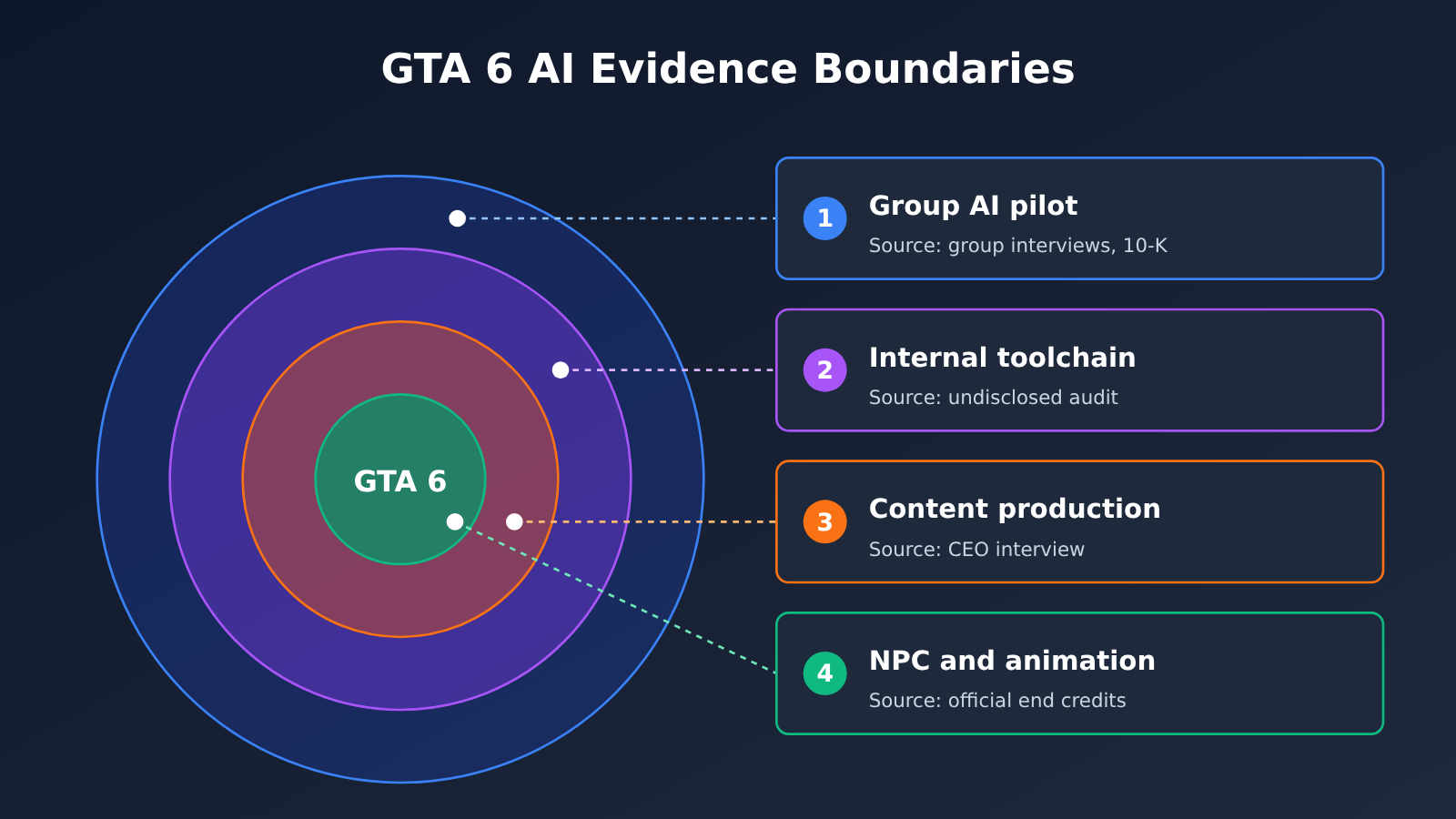
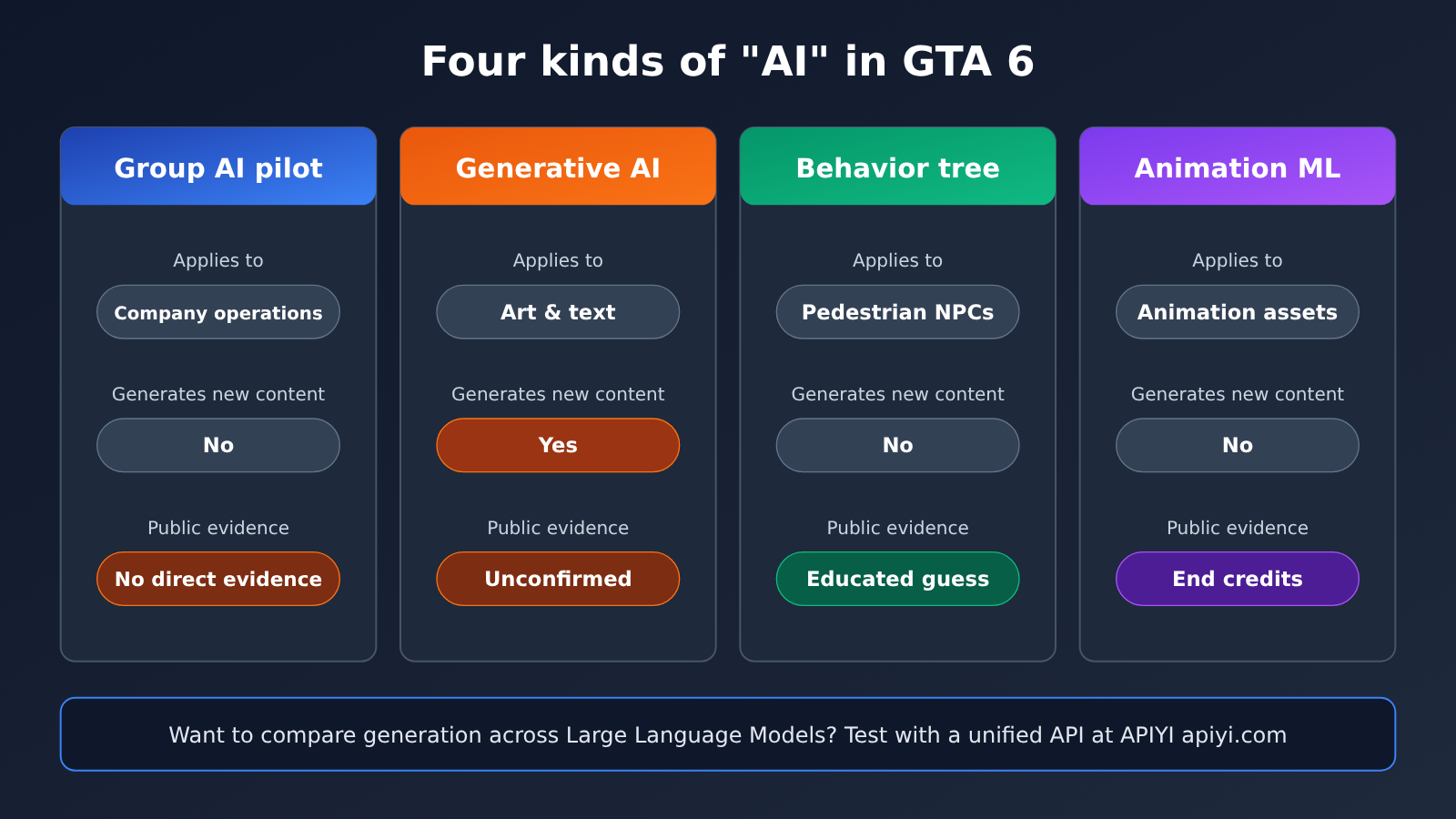
The following is an analysis and interpretation based on the facts from the previous article. It doesn’t represent any official statement from Rockstar or Take-Two. When people talk about GTA 6, the word “AI” can map to at least four different layers—and mixing them together leads to a whole lot of misunderstanding.
| Layer | What it refers to | Relationship to GTA 6 (based on public evidence) |
|---|---|---|
| Corporate AI pilot | Take-Two’s cross-brand efficiency tools and process experiments | Company-wide; no stated connection to GTA 6 |
| Generative AI content creation | Using models to generate game content like art, text, and voice | CEO said the content at the time didn’t use it; the world was hand-designed |
| Traditional game AI | Rule-based systems for NPC decision-making, pathfinding, crowd simulation, etc. | Credits list AI and gameplay systems programming, which is standard industry practice |
| Machine learning R&D | Technical R&D using ML to process data such as animation | Credits list animation machine learning R&D; the specific methods haven’t been disclosed |
Traditional Game AI: How Behavior Trees Drive GTA 6-Style Pedestrians
Pedestrians in an open world “look like real people” mainly thanks to traditional game AI, not generative models. Here I’ll borrow Epic Games’ public behavior tree documentation to explain the concept (and to be clear, this is just a conceptual explanation—it doesn’t mean Rockstar uses Unreal Engine). Behavior trees break an NPC’s decisions down into selector nodes, sequence nodes, condition checks, and concrete actions: for example, “run away if there’s danger; otherwise check the weather—open an umbrella if it’s raining, otherwise keep wandering.”
These systems are predictable, debuggable, and precisely controllable by designers. Rockstar North mentioned that a department specifically develops more believable pedestrians. Combined with the “crowd scripting” and “AI and gameplay systems programming” listed in the credits, it’s reasonable to infer that pedestrian behavior is the result of rule systems, animation assets, and hand-written dialogue working together—but the specific implementation details haven’t been made public.
Programmatic tools and hands-on art direction aren’t mutually exclusive
When “procedural art” turns up in the credits, some people assume it clashes with “hand-crafted design.” In actual industry practice, though, the rules behind procedural tools are written by people, and they’re typically used to batch-process repetitive work. Epic’s procedural content generation documentation, for example, describes placing vegetation, rocks, and other assets in bulk using rules — and that’s useful here only as a conceptual reference too.
In this setup, the art director decides “what this street looks like,” while the procedural tools lay down a huge amount of detail according to rules, which people then refine layer by layer. That can coexist with what Rockstar North calls “layer-by-layer art direction over neighborhoods and interiors” — the key question is who holds the creative intent.
How to make sense of animation machine learning in the GTA 6 credits
“Animation machine learning R&D” is the role most likely to be misread as “using AI to generate animation.” Machine learning has plenty of uses in animation — matching and smoothly blending transitions between a large library of existing motions, for instance — and those methods usually build on animation that was hand-made or captured. Combined with the studio’s figure of roughly 600,000 animations, a reasonable reading is that machine learning may be used to manage and schedule a massive animation library rather than to create from scratch. That’s still an inference, though — Rockstar hasn’t disclosed the technical details.
Understanding GTA 6 Pedestrian AI Through Code: A Quick Start
The most direct way to understand the difference between “traditional game AI” and “generative AI” is to write it yourself. Below, we’ll start with a minimal example that calls a Large Language Model, asking it to act as a design assistant and draft a list of pedestrian behavior nodes. Then, in the full code walkthrough, we’ll implement a behavior tree that actually drives an NPC. Note the division of labor: the Large Language Model is only used for brainstorming during the design phase — at runtime, NPC decisions come entirely from a deterministic behavior tree, and the final design still needs human review.
Minimal Example: Drafting Pedestrian Behavior Nodes with a Large Language Model
import openai

client = openai.OpenAI(
    api_key="YOUR_API_KEY",
    base_url="https://api.apiyi.com/v1"  # APIYI unified interface, compatible with the OpenAI SDK
)

response = client.chat.completions.create(
    model="gpt-4o-mini",
    messages=[
        {"role": "system", "content": "你是游戏策划助理,只输出行为树节点草稿,供设计师审核。"},
        {"role": "user", "content": "为开放世界城市中的普通路人列出 6 个行为树节点,按优先级排序。"}
    ]
)
print(response.choices[0].message.content)
View the full code: behavior-tree-driven pedestrian AI + optional design assistance
import random
import openai
from typing import Callable, List

# ========== Part 1: Traditional game AI — behavior trees ==========
SUCCESS, FAILURE = "SUCCESS", "FAILURE"

class Node:
    def tick(self, npc: dict) -> str:
        raise NotImplementedError

class Condition(Node):
    def __init__(self, name: str, check: Callable[[dict], bool]):
        self.name, self.check = name, check
    def tick(self, npc):
        return SUCCESS if self.check(npc) else FAILURE

class Action(Node):
    def __init__(self, name: str, act: Callable[[dict], None]):
        self.name, self.act = name, act
    def tick(self, npc):
        self.act(npc)
        return SUCCESS

class Sequence(Node):
    """Sequence node: succeeds only when all child nodes succeed"""
    def __init__(self, children: List[Node]):
        self.children = children
    def tick(self, npc):
        for child in self.children:
            if child.tick(npc) == FAILURE:
                return FAILURE
        return SUCCESS

class Selector(Node):
    """Selector node: starts from the highest priority; returns as soon as any child succeeds"""
    def __init__(self, children: List[Node]):
        self.children = children
    def tick(self, npc):
        for child in self.children:
            if child.tick(npc) == SUCCESS:
                return SUCCESS
        return FAILURE

def build_pedestrian_tree() -> Node:
    return Selector([
        Sequence([
            Condition("听到枪声", lambda n: n["danger"]),
            Action("逃离", lambda n: n.update(state="逃离现场")),
        ]),
        Sequence([
            Condition("正在下雨", lambda n: n["raining"]),
            Action("撑伞", lambda n: n.update(state="撑伞快走")),
        ]),
        Sequence([
            Condition("遇到熟人", lambda n: n["friend_nearby"]),
            Action("寒暄", lambda n: n.update(state="停下聊天")),
        ]),
        Action("闲逛", lambda n: n.update(state="沿人行道闲逛")),
    ])

def simulate(steps: int = 5):
    tree = build_pedestrian_tree()
    npc = {"state": "idle"}
    for i in range(steps):
        npc.update(
            danger=random.random() < 0.1,
            raining=random.random() < 0.3,
            friend_nearby=random.random() < 0.2,
        )
        tree.tick(npc)
        print(f"第 {i + 1} 帧:{npc['state']}")

# ========== Part 2: Generative AI assistance during design (optional) ==========
def draft_design_notes(prompt: str, model: str = "gpt-4o-mini") -> str:
    client = openai.OpenAI(
        api_key="YOUR_API_KEY",
        base_url="https://api.apiyi.com/v1"
    )
    try:
        resp = client.chat.completions.create(
            model=model,
            messages=[
                {"role": "system", "content": "你是游戏策划助理,输出仅作草稿,需设计师审核后才可采用。"},
                {"role": "user", "content": prompt},
            ],
            max_tokens=800,
        )
        return resp.choices[0].message.content
    except Exception as e:
        return f"Error: {e}"

if __name__ == "__main__":
    simulate()
    # print(draft_design_notes("Suggest 3 more pedestrian behavior nodes for a rainy scene"))
After you run simulate(), you’ll see that the pedestrian’s behavior each frame is determined by the behavior tree according to priority. The same inputs always produce the same results — exactly the controllability a game needs at runtime. Meanwhile, draft_design_notes() returns non-deterministic text drafts, which belong only in the design phase, where a human can sift through and rewrite them.
🚀 Quick Start Tip: If you want to compare how different Large Language Models handle supporting tasks like drafting planning documents and suggesting dialogue style, you can get free test credits through APIYI apiyi.com. A single API key lets you call mainstream models like OpenAI, Claude, and Gemini—just change the
modelparameter to switch and compare.
How Developers Should Think About Rockstar’s Handcrafted Development Philosophy
The following is still analytical judgment. Judging from public information, Rockstar’s external emphasis is that “humans determine creative intent”: on-site visits, narrative-driven gameplay trade-offs, layered art direction, and dedicated polishing of NPC passersby. These steps determine whether an open world feels “believable,” and they’re also the part generative AI is currently least able to replace. For small and mid-sized teams, what’s worth borrowing isn’t the 3A-level headcount, but this working order of “define intent first, then use tools to execute.”
On the other hand, the group-level hundreds of AI pilots and the efficiency gains mentioned by the CEO also show that the penetration of AI tools in large game companies is real, and it’s more likely to be concentrated in non-content areas like internal processes, testing, localization, and operations. This is just speculation based on the group’s public statements, and it’s worth continuing to watch whether more specific disclosures follow. For developers, the safer approach is: keep runtime systems deterministic, introduce Large Language Model assistance only in design and process stages, and retain human review.
FAQ
Q1: Did GTA 6 actually use generative AI?
Based on publicly available evidence, Take-Two’s CEO said in February 2026 that generative AI was not involved in what Rockstar was building at the time, and that the world was hand-designed. However, this isn’t an audit of all the internal tools used in the finished product, and there’s currently no public evidence showing that the content was made with generative AI.
Q2: Were Take-Two’s hundreds of AI pilots used for GTA 6?
The description in the interview referred to the group’s cross-brand efforts and didn’t specify which title it was used for. Treating the group’s pilots as direct evidence of how GTA 6 uses AI is overreach.
Q3: Does the “AI programming” credit at the end mean generative AI was used?
That’s not the right way to read it. In the game industry, “AI programming” usually refers to traditional game AI such as NPC behavior, pathfinding, and gameplay systems—it’s a different thing from models that generate content.
Q4: Where did the roughly 600,000 animations come from?
This is the studio’s stated count of animation entries—not work hours, and not the number of motion-capture sessions. Rockstar hasn’t disclosed the detailed production method, so it’s best not to convert it yourself.
Q5: I want to try using a Large Language Model to assist with design in my own game project. How do I get started?
I’d suggest starting with design-phase tasks such as design drafts and dialogue style references, while keeping runtime logic on deterministic approaches like behavior trees. You can sign up at APIYI apiyi.com to get an API key and free credits, then set `base_url` in the code in this article to `https://api.apiyi.com/v1` and you’re good to go.
Q6: How can I compare how different Large Language Models perform when assisting with game copywriting?
Prepare the same set of prompts, generate with different models, and have designers score the results manually. With APIYI apiyi.com’s OpenAI-compatible interface, you only need to switch the `model` parameter—making it easy to compare side by side in the same script.
References
The following public sources are cited for overview purposes only; please refer to the original articles for full details.
- GamesIndustry.biz – Take-Two CEO interview (2026-02-03): remarks on generative AI and handcrafted worlds
- Link:
gamesindustry.biz/take-two-ceo-says-generative-ai-tools-are-driving-costs-and-time-efficiencies-but-that-its-worlds-are-handcrafted
- Link:
- The Game Business – Take-Two CEO interview: description of the group’s cross-brand AI pilots and projects already in production (group-wide)
- Link:
thegamebusiness.com/p/take-two-ceo-googles-project-genie
- Link:
- SEC – Take-Two 10-K annual report (fiscal year ended 2026-03-31): group AI investment and risk disclosures
- Link:
sec.gov/Archives/edgar/data/946581/000162828026037434/ttwo-20260331.htm
- Link:
- Take-Two Investor Relations – GTA 6 launch announcement: coming to PS5 and Xbox Series X|S on 2026-11-19
- Link:
take2games.com/ir/news/rockstar-games-announces-grand-theft-auto-vi-now-available
- Link:
- The New York Times – report on the Rockstar North press visit (2026-08-27): on-site walkthrough, narrative-driven design, layer-by-layer art direction, and the stated figure of roughly 600,000 animations
- Link:
nytimes.com/2026/08/27/arts/grand-theft-auto-vi-trailer-extended-look-rockstar.html
- Link:
- Rockstar official site – GTA 6 end credits: roles including AI and gameplay systems programming, procedural art, and animation machine learning R&D
- Link:
rockstargames.com/VI/credits
- Link:
- Rockstar official site – GTA 6 extended gameplay look: notes that the footage was captured in-game on PS5
- Link:
rockstargames.com/VI/an-extended-look
- Link:
- Epic Games developer documentation – behavior trees and procedural content generation: used here for conceptual explanation only; does not imply that Rockstar uses Unreal Engine
- Link:
dev.epicgames.com/documentation
- Link:
Author: APIYI technical team
Technical discussion: If you’d like to test how multiple models perform in scenarios such as game design assistance, feel free to visit APIYI apiyi.com and get in touch with us. For more integration details, check out the docs.apiyi.com documentation center.


