
Author’s note: So far, there’s only an official Qwen 4 teaser poster and a Qwen3.8-Flash-Next architecture preview. This article separates what’s confirmed, what’s rumored, and what’s unknown, and provides a checklist for preparing to switch models after release.
First, the bottom line: As of November 9, 2026, Qwen 4 has not been officially released. The Qwen team has published only a teaser poster, with no release date, model variants, or pricing. The sizes, context window, and release dates circulating online all come from third-party rumors, so don’t put your current project plans on hold because of them.
A more practical approach is to keep your business running on the Qwen3.8 series while preparing your evaluation set, model configuration, and rollback switch. Once Qwen 4 actually launches, you’ll just need to change the model name and run an evaluation to complete the switch. This isn’t another “complete guide to Qwen 4 specifications.” Below, we’ll separate official information from rumors and unknowns, rather than treating rumors as a release announcement.
What you’ll get: In three minutes, you’ll understand what’s known about Qwen 4, how to read the architecture preview, and how to prepare for a model switch with a practical checklist.
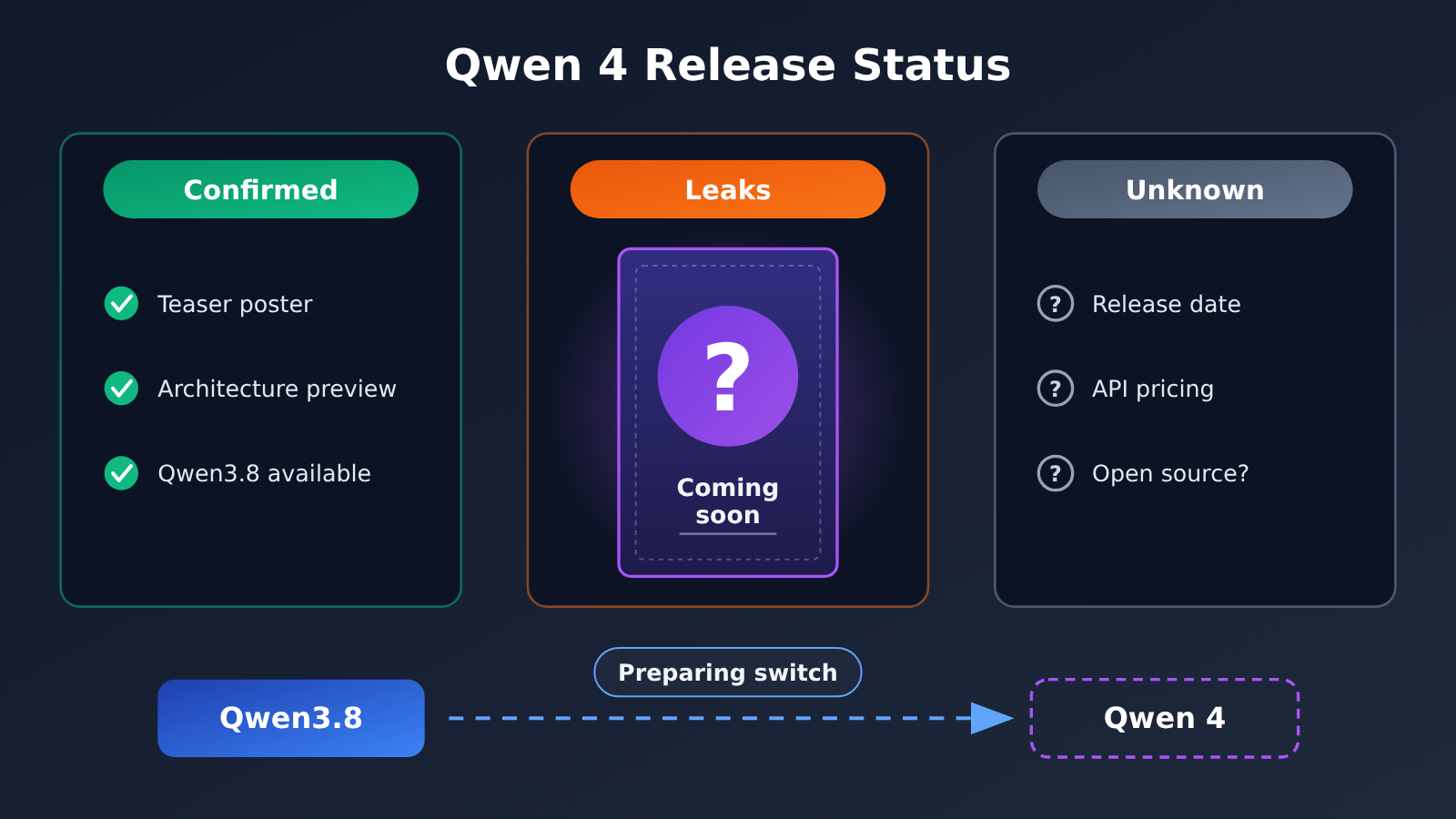
Qwen 4 Release Status at a Glance: Confirmed, Reported, and Unknown
Information about Qwen 4 comes from all sorts of places: official account teasers, official model cards, third-party reports, and secondhand community posts. If you lump them together, it’s easy to mistake “someone said it” for “it’s official.” The table below is the starting point for this article; each section that follows builds on it.
| Item | Confirmed (Official) | Reported (Unconfirmed) | Unknown |
|---|---|---|---|
| Release status | Not released; only teased | Release date rumors | Official release date |
| Official activity | On November 6, the official X account posted a teaser image with the caption “The becoming begins.” | — | Timing of further official announcements |
| Architecture | The Qwen3.8-Flash-Next model card describes it as an experimental preview of the Qwen4 architecture | Third-party reports of model sizes and parameter counts | Whether the final architecture will match the preview |
| Models and sizes | Not announced | Accounts including TestingCatalog have reported model names and parameter counts | Final model names and parameter counts |
| Context length | Not announced | May be mentioned in reports | Official context length |
| Pricing | Not announced | — | API pricing |
| Open source | Not announced | — | Whether it’ll be open source and when weights will be released |
| Currently available | The Qwen3.8 series is available; Flash-Next is a preview | — | When the Qwen 4 API will be available |
In short: The only things officially confirmed are that it’s coming and that there’s a preview of its architecture. Everything else is still up in the air. When you see a Qwen 4 claim with specific numbers, first check whether it comes from an official model card, an official announcement, or a third-party account.
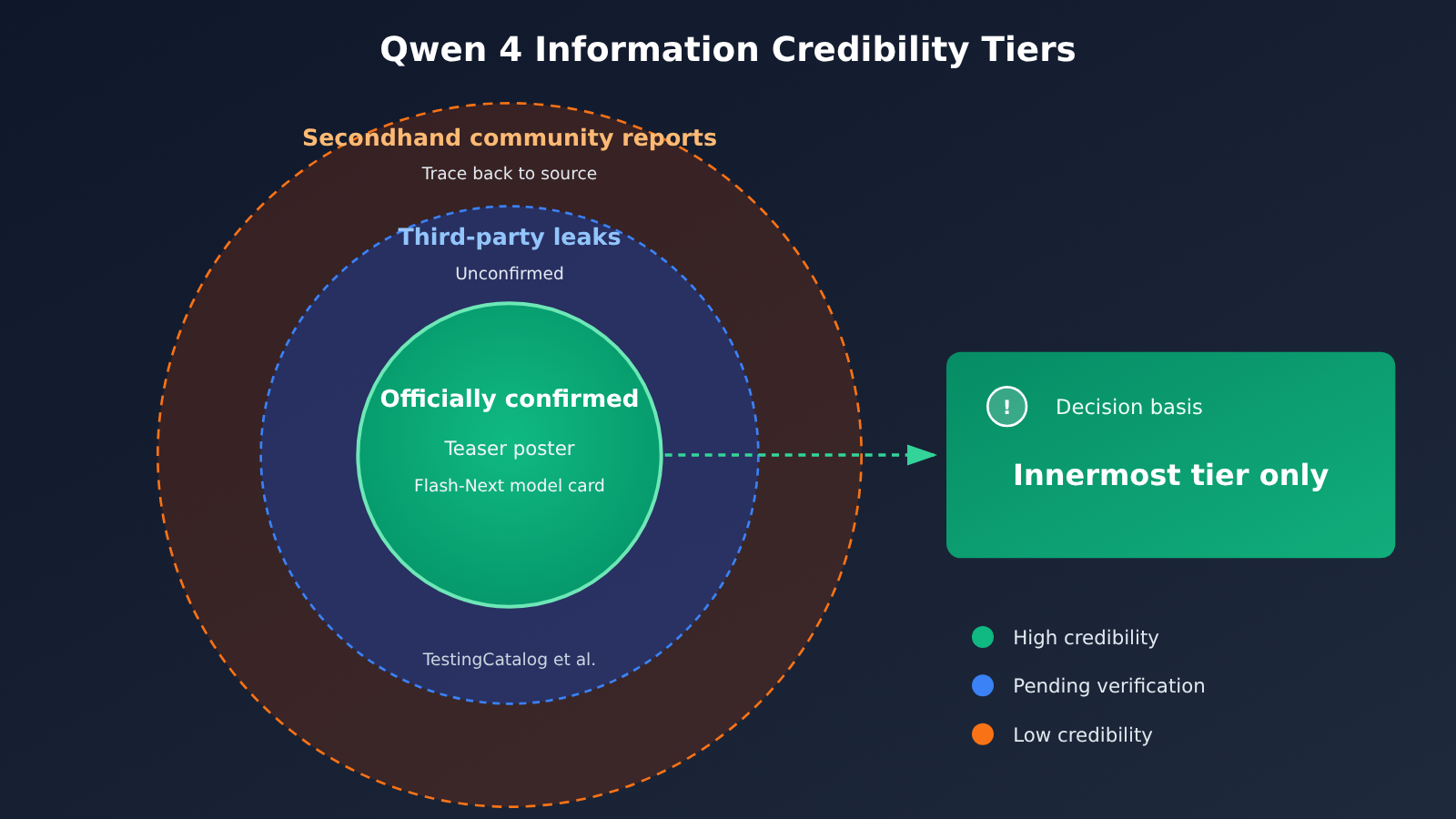
What We Know About Qwen 4: Teaser Poster, Model Card, and Currently Available Models
What the Qwen 4 Teaser Poster Tells Us
On November 6, Qwen’s official X account posted a teaser poster with the caption “The becoming begins.” The signal is clear: a new generation of models is on the way, and the official team is building anticipation. But the poster doesn’t give a release date, model name, or pricing, so it only suggests something is coming soon—not when or what it will be.
There are usually several steps between a teaser and an official launch, including a model card, technical report, and API availability. For developers, the poster is a cue to start preparing, not a reason to switch models yet.
Qwen3.8-Flash-Next Model Card: An Official Architecture Preview
The most technically substantive official information comes from the Qwen3.8-Flash-Next model card. It explicitly describes the model as an experimental preview of the Qwen4 architecture and lists architectural changes and related parameters. It’s currently the most reliable first-hand source for understanding Qwen 4’s technical direction.
Two points are worth keeping in mind. First, “experimental preview” means it’s intended to test the new architecture; the final release may differ in scale, training data, and alignment strategy. Second, it’s still named as part of the Qwen3.8 series, and the team hasn’t called it Qwen 4. You can’t directly infer the capabilities of the final Qwen 4 release from its performance.
Currently Available Qwen Models
The Qwen3.8 series is currently available for production use, while Qwen3.8-Flash-Next is a preview. This table offers a quick overview of where each model stands:
| Model | Current Status | Best Suited For | Availability |
|---|---|---|---|
| Qwen3.8 series | Released and available | Production workloads, baseline evaluations | Official channels; APIYI apiyi.com supports the Qwen series, with specific models listed in the console |
| Qwen3.8-Flash-Next | Experimental preview of the Qwen4 architecture | Technical research, tracking architectural direction | Check the official model card and release channels |
| Qwen 4 | Not released | N/A | Not available; check official channels and platform consoles after launch |
💡 Choosing a model: If you need to launch a production workload now, build on the Qwen3.8 series. With APIYI apiyi.com, you can use one API key to call Qwen and other mainstream models, making it easy to compare them while you wait for Qwen 4. Check the console’s model list for the specific Qwen3.8 models available.
Qwen 4 Rumors and Unknowns: What You Shouldn’t Take as Fact Yet
How to Read Third-Party Leaks from TestingCatalog and Others
Third-party accounts such as TestingCatalog have shared supposed Qwen 4 model variants and specifications. These accounts sometimes uncover clues early, but their information hasn’t been officially confirmed. Claims about model size, context length, and release dates may change before launch—or may have been inaccurate from the start.
A sensible approach is to treat leaks as “possible directions,” not “specifications you can put in a requirements document.” For example, if a leak suggests a longer context window, you can reserve long-text cases in your evaluation set, but you shouldn’t remove your existing chunking logic on that basis.
There’s another common misconception: some people are passing off parameters from the Qwen3.8-Flash-Next model card as Qwen 4 specifications. The official model card describes only an architecture preview. It isn’t a formal Qwen 4 release, and its parameters aren’t the final version’s specifications.
5 Things We Still Don’t Know About Qwen 4
Based on the information currently available for verification, there are no official answers to these questions:
- Release date: The poster doesn’t give one, and there’s been no official announcement. Any specific date is speculation.
- Model variants and parameter sizes: The available sizes and their parameter counts haven’t been announced.
- Context length: There’s no official data on how long a context window the final version will support.
- Pricing: API pricing hasn’t been announced, so cost estimates will have to use Qwen3.8 as a baseline for now.
- Open-source status and API availability: Whether it will be open source, when weights will be released, and when the API will be available are all still uncertain.
These five details are exactly what product decisions depend on most. Until they’re confirmed, betting your business on Qwen 4 is risky. That’s why this article recommends sticking to your existing schedule while preparing for its arrival.
Qwen 4 Architecture Preview: How to Read the Qwen3.8-Flash-Next Model Card
How to read the model card
Since Qwen3.8-Flash-Next is currently the closest official material available to Qwen 4, it’s important to understand its model card. For specific architecture changes and parameter counts, refer to the official model card rather than relying on screenshots or secondhand summaries on social media. Caveats like “experimental preview” can easily get lost in retelling, and parameter counts can be attributed to the wrong model.
Use the dimensions in the table below to guide your reading, and ask yourself one question for each: What does this mean for my business?
| Reading dimension | What to look for | What it means for your business |
|---|---|---|
| Architecture changes | Structural changes listed in the model card | Assess potential changes in inference speed, GPU memory usage, and long-text performance |
| Parameter details | Official figures such as total and active parameter counts | Estimate self-hosting costs; the figures apply only to the preview model |
| Positioning | The exact wording around “experimental preview” | Remember that preview performance isn’t the same as final-release performance |
| Usage restrictions | License, recommended uses, and known issues | Decide whether you can use it for research or internal testing |
| Inference configuration | Recommended sampling parameters and template formats | Prompts and parameters may need adjustment when switching models |
What the preview model can and can’t tell you
An architecture preview is valuable because it shows the direction of development. If the model card describes design choices aimed at inference efficiency or long-context handling, the final release will likely continue in that direction. You can add relevant use cases to your evaluation set ahead of time.
But the preview model’s performance doesn’t represent the final release. The final version may differ in training scale, data mix, and alignment tuning, so don’t use a Flash-Next test result to make promises about Qwen 4’s performance. This article doesn’t provide any Qwen 4 benchmark scores either, because there’s currently no verifiable data for a final release.
How to Switch After Qwen 4 Launches: Preparing for an OpenAI-Compatible API
What Qwen 4 Means for Developers and Product Teams
For developers, the most immediate impact of Qwen 4’s release is another candidate model to evaluate against existing solutions. For product teams, managing the timeline matters more: don’t lock down requirements too early or delay plans because of rumors, but make sure you can evaluate the new model within a few days of its release.
The good news is that if your integration uses an OpenAI-compatible API, switching should be straightforward. You’ll generally only need to change the model parameter in your request to the new model ID; you can keep the existing messages structure and parameters such as temperature and max_tokens. The time-consuming work isn’t changing the code—it’s evaluation, phased rollout, and rollback preparation.
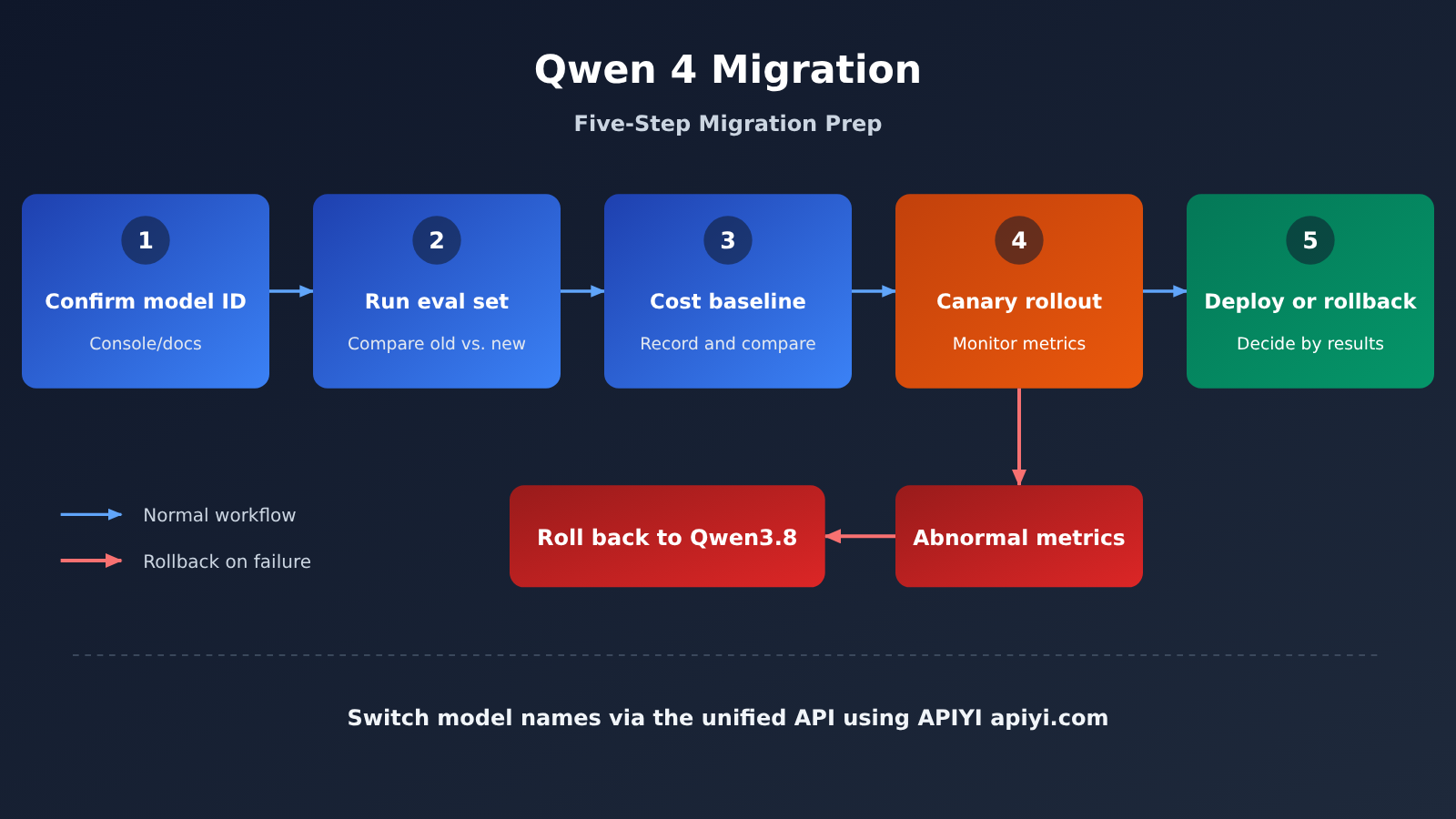
5 Steps to Prepare for the Switch
- Confirm the model ID: Once Qwen 4 launches, check the official documentation and platform console for its model ID. Don’t copy the name from social media. Put the model name in a configuration file or environment variable rather than hard-coding it into your application logic.
- Prepare an evaluation set: Select dozens to hundreds of representative requests from real workloads, covering scenarios like general Q&A, long texts, structured output, and tool calls. Run them through your current Qwen3.8 model first and save the results as a baseline.
- Record your cost baseline: Track average input and output tokens, cost per request, and latency for your current model. Once Qwen 4 pricing is announced, you can calculate how much the switch will change your costs.
- Roll out to a small portion of traffic: Once the model passes evaluation, route a small portion of traffic to it and monitor error rates, latency, and user feedback.
- Keep a rollback switch: Don’t delete the old model configuration. Make sure you can switch back to Qwen3.8 with a single configuration change.
If you’re calling the model through APIYI, set base_url to https://api.apiyi.com/v1 and use the OpenAI SDK as usual. When switching, you only need to change the model parameter; the API key and request structure can stay the same.
Post-Launch Migration Checklist
| Check | Action | Suggested Owner | Completion Criteria |
|---|---|---|---|
| Model ID | Verify the Qwen 4 model name in the official documentation and console | Backend | Model name in the configuration matches the console |
| API compatibility | Confirm the request format remains unchanged with the OpenAI-compatible API | Backend | All smoke tests pass |
| Evaluation comparison | Run the same evaluation set on both models | ML/Product | Key metrics meet or exceed the Qwen3.8 baseline |
| prompt adaptation | Check system prompts and output format constraints | Product/ML | Structured output parsing success rate meets the target |
| Cost comparison | Estimate the new model’s cost using actual usage | Product/Finance | Cost changes stay within budget |
| Gradual rollout | Switch a small portion of traffic and monitor results | Backend/Operations | No significant deterioration in error rates or latency |
| Rollback plan | Keep the old model configuration and switch | Operations | One-click rollback has been tested |
🚀 Preparation tip: You can view the model list, usage, billing, and invocation logs in the APIYI apiyi.com console. Establish a usage and cost baseline with Qwen3.8 now. Once Qwen 4 launches, comparing token usage and responses in the logs will make evaluation much faster. Check the console’s model list to see whether and when Qwen 4 becomes available.
Qwen 4 FAQ
Q1: Has Qwen 4 been released yet?
No. As of November 9, 2026, the official team has only released a teaser poster on November 6. It hasn’t announced a release date, model lineup, or pricing. Qwen3.8-Flash-Next is an experimental preview of the Qwen4 architecture, not the official Qwen 4 release.
Q2: Can I trust the Qwen 4 parameter counts and context lengths circulating online?
Most Qwen 4 specifications with specific numbers currently come from third-party leaks, including TestingCatalog, and haven’t been officially confirmed. The parameters in the official model card apply to the Qwen3.8-Flash-Next preview model and can’t be assumed to apply to the official Qwen 4 release. When making decisions, rely on official announcements and the original model cards.
Q3: Should I wait for Qwen 4 or use Qwen3.8 for my project now?
We recommend starting with the Qwen3.8 series. The release date is unknown, and waiting will slow down your progress. As long as your integration uses an OpenAI-compatible API and the model name is configurable, the main cost of switching later will be evaluation rather than development. With APIYI at apiyi.com, you can use a single key to access models and compare Qwen with other leading models.
Q4: Is Qwen 4 available on APIYI? How can I use it as soon as it’s available?
Qwen 4 hasn’t been released yet. Check the model list and documentation in the APIYI console at apiyi.com for availability, the model ID, and pricing. You can register now and use the free testing credits for new users to get your Qwen3.8 integration working. Once Qwen 4 appears in the model list, you can change the `model` parameter and start evaluating it.
Qwen 4 Key Takeaways
- Release status: Qwen 4 hasn’t been released. The only official announcement so far is a teaser poster dated November 6.
- Only firsthand technical source: The Qwen3.8-Flash-Next model card describes it as an experimental preview of the Qwen4 architecture.
- Limits of the leaks: Third-party claims about model variants and parameters, including those from TestingCatalog, haven’t been officially confirmed.
- Five unknowns: Release date, model variants and sizes, context window, pricing, and open-source and API availability dates.
- What to use now: Keep using the Qwen3.8 series in production. Don’t delay your plans for rumors.
- Switching essentials: With an OpenAI-compatible interface, you only need to change
model. The real work is evaluation, staged rollout, and rollback. - Getting started: Use a single key to access the Qwen series through APIYI at apiyi.com, and establish a baseline with usage logs.
Summary: Qwen 4 Release Verification Checklist
The current state of Qwen 4 comes down to three points. First, there’s an official teaser, but no release. The date, model variants, and pricing haven’t been announced. Second, the Qwen3.8-Flash-Next model card provides an experimental preview of the Qwen4 architecture and is the best source for understanding its technical direction—but a preview isn’t the final release. Third, third-party leaks can be useful, but shouldn’t be treated as specifications.
Instead of checking for leaks every day, get ready for a potential switch. When Qwen 4 launches, work through this checklist to quickly decide whether to make the move:
| Check | What to verify | Source | Status |
|---|---|---|---|
| Official release | Whether there’s an official release announcement, not just a teaser | Official Qwen accounts and blog | To be verified |
| Model variants and sizes | Official model names and parameter counts | Official model cards and technical reports | To be verified |
| Context window | Official maximum context window | Official model cards and documentation | To be verified |
| Pricing | API input and output pricing | Official pricing page and platform console | To be verified |
| Open-source status | Whether it’s open source, the license, and when weights will be released | Official repository and model cards | To be verified |
| Differences from the preview | Whether the release architecture matches the Flash-Next preview | Comparison of official model cards | To be verified |
| Platform availability | Whether the model is available and its model ID | APIYI console model list | To be verified |
| Evaluation results | Comparison of the new and old models on your own evaluation set | Internal evaluation | Run after release |
| Rollback readiness | Whether Qwen3.8 configuration and switches are retained | Internal configuration | Can be completed now |
We recommend preparing your evaluation set, cost baseline, and rollback switch now. Use the Qwen3.8 series through APIYI at apiyi.com to test your workflow, and establish a baseline using the console’s usage data and logs. Once Qwen 4 is available, you’ll be ready to evaluate it quickly and switch smoothly.
📚 References
- Official Qwen X account: November 6 Qwen 4 teaser poster
-
Note: The only official teaser, captioned “The becoming begins.” It included no date, model names, or pricing.
-
Official Qwen3.8-Flash-Next model card: An experimental preview of the Qwen4 architecture
-
Note: Refer to the original model card for architecture changes and parameters rather than relying on secondhand accounts.
-
Third-party reports from TestingCatalog and others: Rumors about Qwen 4 model variants and parameters
-
Note: These offer a general indication only and haven’t been officially confirmed.
-
APIYI Documentation Center: Model lists, invocation methods, and billing details
- Link:
docs.apiyi.com - Note: Refer to the console and documentation for available models, model IDs, and pricing.
Author: APIYI Technical Team
Technical discussion: Contact us through the APIYI homepage at apiyi.com. For more integration resources, visit the documentation center at docs.apiyi.com.


