

Summary: This article uses two Minecraft Ender Dragon completion experiments to show that when accounting for Agent long-running task costs, you have to spell out the roles involved, the acceptance endpoint, cache and output metering, the rate date, and the basis for actual billing.
Bottom line first: what do the $93 and $520 Agent long-running task costs actually represent?
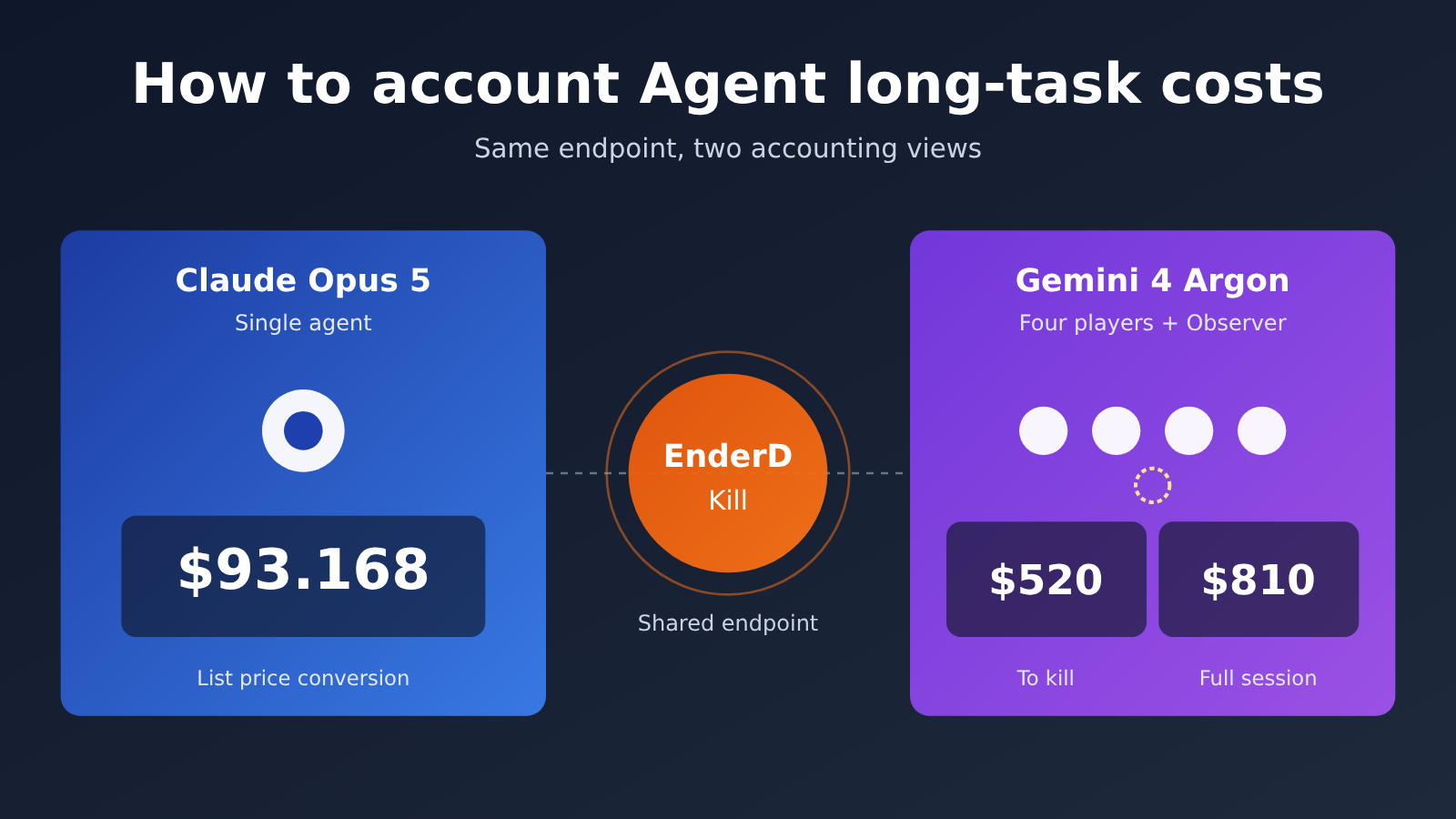
$93.168 is the amount you get by converting the usage from one Claude Opus 5 subscription session by AI Bengineering at Anthropic’s API list price. The project was not billed at this amount; it reflects “how much it would cost if you were billed per token through the API.” The roughly $520 figure is the model usage for four Gemini 4 Argon players in a Google DeepMind paper, from the first program to defeating the Ender Dragon, estimated at Google’s launch pricing.
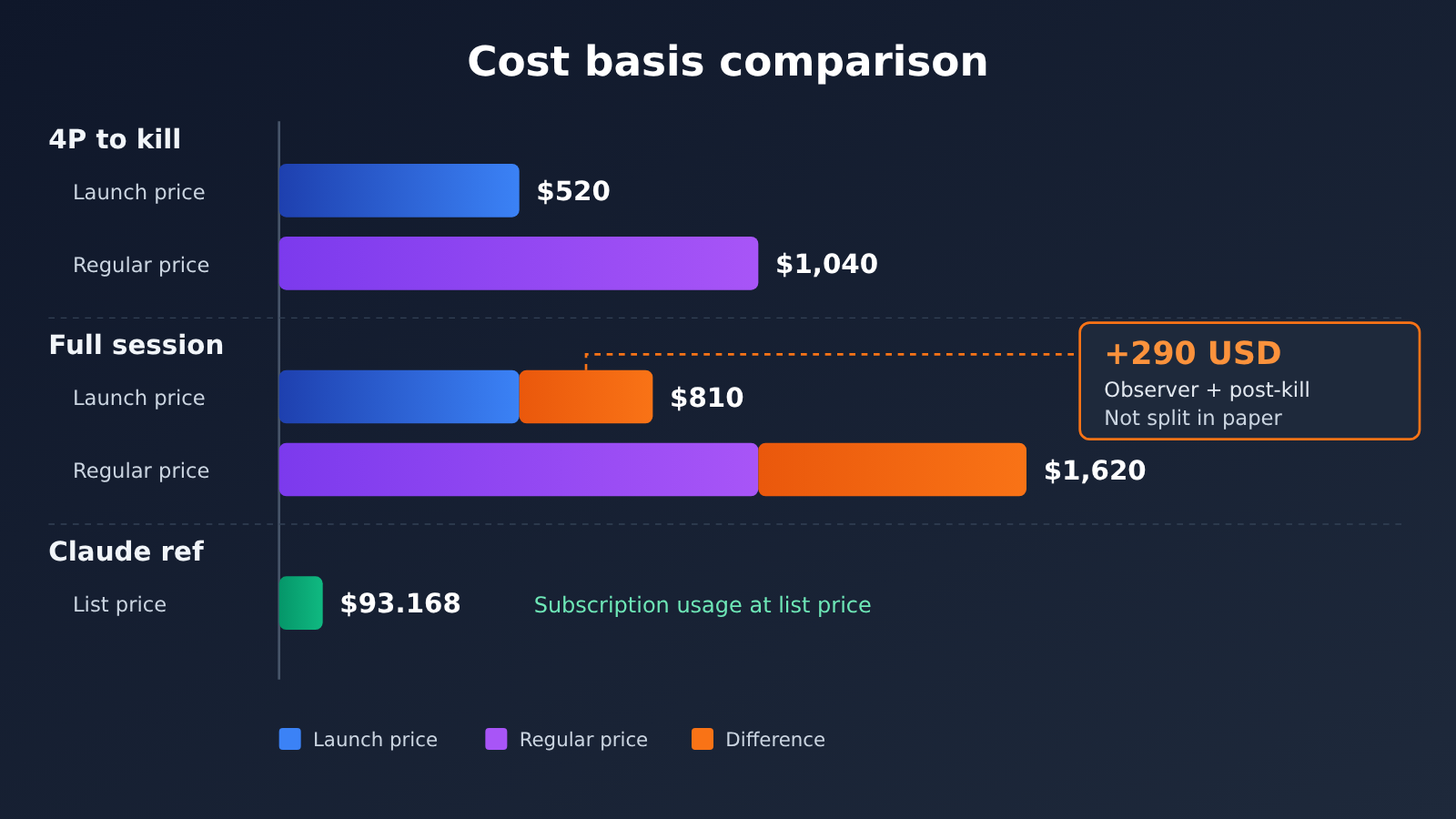
If you also count the Observer agent, which only supervises, and continued activity after the kill, Gemini’s full-session estimate rises to about $810. At Google’s standard rates, these two figures come to roughly $1,040 and $1,620, respectively. The two sets of experiments differ in game version, difficulty, team size, and operation interface, so the gap between $93 and $520 cannot be attributed to “which model is cheaper.” They are best used to demonstrate how an Agent long-running task cost should be recorded so someone else can reproduce it.
Knowledge Map and Index: The Five Stages of Agent Long-Task Cost Accounting
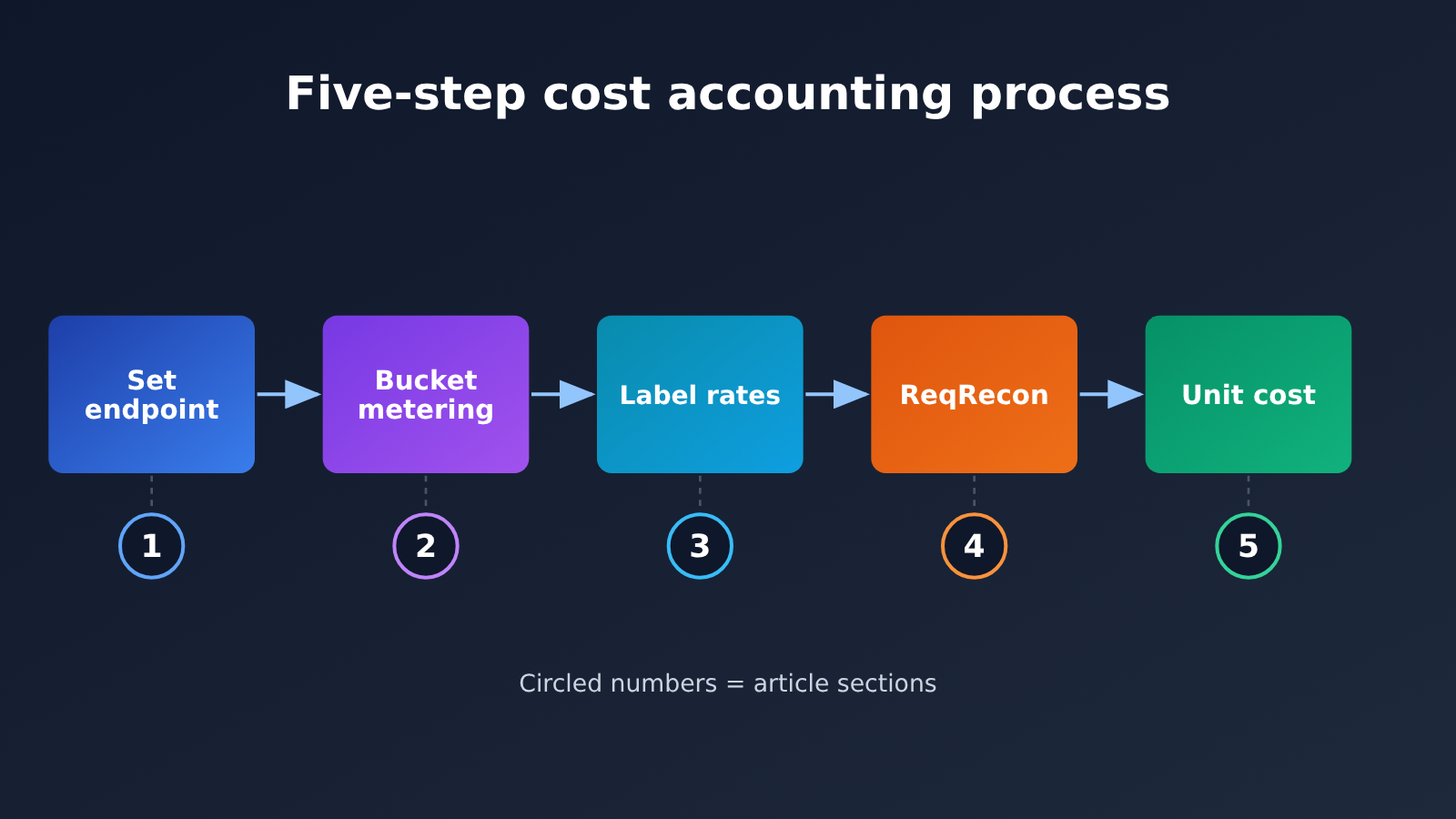
The table below doubles as a knowledge map and a reading order. The boundary you set in the previous section is the precondition for the calculations in the next one, and the final section consolidates all the conventions above into a ledger you can use for your own project.
| # | Stage | Question it answers | What it gives the later sections |
|---|---|---|---|
| 1 | Define the object and the endpoint | Whose cost is this, and up to which moment is it counted | The statistical boundary that every later number follows |
| 2 | Recomputing the Claude bill | Which metering buckets make up $93.168 | The practice of splitting cache reads, cache writes, and output into buckets |
| 3 | Aligning the Gemini rate windows | What’s the difference between 520, 810, 1,040, and 1,620 | How rate dates and scope expansion affect the final amount |
| 4 | Mapping to requests and platform spend | How valuations line up with the actual bill | Native usage fields, request IDs, and log reconciliation |
| 5 | Budget and acceptance ledger | How to budget your own tasks and compute cost per successful run | Fields and worked examples you can apply directly |
Section 1 has to be read first. Sections 2 and 3 are optional depending on which model you care about, and sections 4 and 5 are aimed at engineering and finance readers who need to book these costs in a real business.
To Know: Terms Needed to Understand Agent Long-Task Costs
| Term | Concise Explanation |
|---|---|
| API list price | The reference price published by a model provider for a specific channel, billing tier, and date |
| Subscription quota | A fixed-fee plan that allows the model to run within a quota; this Claude session obtained usage this way |
| Regular input tokens | The portion of prompt input that remains after deducting cache reads and cache creation, billed at the regular input rate |
| Cache read tokens | Tokens that hit when an existing input prefix is reused, billed at the lower read rate |
| Cache writes and TTL | Creating a reusable cache and its validity duration; Claude’s 5-minute and 1-hour write rates differ |
| Implicit caching | The server automatically determines whether to reuse the request prefix; this is the mechanism listed in the Gemini 4 Argon Standard price table |
| Reasoning tokens | Tokens consumed by the model’s internal thinking; both examples in this article count them within the disclosed total output |
| Observer | The fifth Gemini agent in the DeepMind experiment, which only records, supervises, and does not control the other roles |
| Acceptance endpoint | The moment when a stage is judged complete by an external event; both experiments can use kill progress recorded by the server |
| Wall-clock time | The real time elapsed from the agreed start point to the endpoint, including model requests, tool actions, and waiting |
| Request ID | An identifier that maps one upstream request from the application to its response, invocation logs, and consumption records |
| Group multiplier | The multiplier a platform applies to the consumed amount based on the actual billing model and token group |
1. Agent Long-Task Costs: Define the Scope First, and See What Each of the Two Bills Covers
Both experiments share one external success signal: the Free the End advancement that the Minecraft server records for a player—in other words, the Ender Dragon has been killed. On the Claude side, the advancement was recorded for AI_M1KE at 04:39:50 UTC on September 15, 2026; on the Gemini side, bulicame earned the same advancement to complete the validation. The endpoint was the same, but the participants and tooling layers were very different.
| Comparison item | AI Bengineering · Claude | Google DeepMind · Gemini |
|---|---|---|
| Game conditions | Java 1.21.4, Survival, Normal, fixed seed 97996358 | Java 1.20.4, Survival, Easy, random world, cheats disabled |
| Main operator | A single Claude Opus 5 (1M, high) agent | Four Gemini 4 Argon instances, each controlling one player |
| Auxiliary metering | A very small amount of Claude Haiku 4.5; subagents launched: 0 | A fifth Argon acts as Observer, read-only and does not play |
| Tooling layer | Observation, pathfinding, resource, and combat operations prebuilt in Mine AI MCP | The model writes its own JavaScript, which is handed to Mineflayer and a pathfinding plugin for execution |
| Cost boundary | The entire Claude session, including wrap-up after the kill | First counts the four players up to the kill; also reports a full-session figure including the Observer and post-win activity |
| Cost basis | Subscription usage converted at Anthropic list prices | Estimated from Google’s public pricing and usage counts |
This table shows that the Claude figure covers “the entire session,” while Gemini’s $520 covers only “four players up to the kill.” The former includes wrap-up after the kill; the latter excludes the Observer. The former has a layer of high-level game tools prebuilt by the project team; the latter has the model write its own programs to drive the bots. The game difficulty, version, and world seed also differ. Comparing dollar amounts under these conditions can only show the usage scale of each operating approach—it cannot tell us anything about per-model unit prices or which model is more capable.
There’s one more detail that’s easy to confuse: the server logs on the Claude side show that the project owner was present as an observer, but the project notes say that after the first prompt, no one continued to guide the operations. This human observer doesn’t generate token usage, and is not the same thing as the Observer agent in the Gemini experiment, which consumes model calls. When accounting for costs, the “observer” role needs to be labeled as either a human or a model.
2. Line-by-line recomputation of the long-task Agent cost: Claude’s $93.168
In the original result file published by AI Bengineering, the cost basis is marked as list in modelUsage, meaning Anthropic API list prices are applied per token. This amount doesn’t include the purchase price of the subscription itself, nor host, game server, and tooling runtime overhead. Recomputed from the original metering buckets as follows:
| Metering item | Original token count | USD per million tokens | Recomputed USD |
|---|---|---|---|
| Opus 5 cache read | 163,325,079 | 0.50 | 81.6625395 |
| Opus 5 cache write (1-hour TTL) | 779,047 | 10.00 | 7.7904700 |
| Opus 5 total output (including 67,071 reasoning tokens) | 148,383 | 25.00 | 3.7095750 |
| Opus 5 standard input | 770 | 5.00 | 0.0038500 |
| Haiku 4.5 standard input | 1,616 | 1.00 | 0.0016160 |
| Haiku 4.5 output | 15 | 5.00 | 0.0000750 |
| Session total | 164,254,910 | — | 93.1681255 |
2.1 The weight of cache reads in the Claude bill
Opus 5’s total input was 164,104,896 tokens, of which cache reads accounted for about 99.52%. The read unit price is only one-tenth of standard input, but after accumulating to more than 163 million tokens, it still contributed about 87.65% of the full-session estimate. Cache reads and writes together came to about $89.45, while output was only about $3.71.
This shows that the main expense of a long-session Agent comes from “re-sending the long context on every turn.” Here’s a static sensitivity calculation: holding the actually observed input volume fixed, if all three input categories were priced at the standard input rate of $5 per million, input cost would be about $820.52 and total model estimate about $824.24. This figure doesn’t simulate changes in context compression, reasoning paths, or cache state on rerun; it’s only meant to show how much cache amplifies or compresses this bill.
2.2 Cache-write TTL and attribution of reasoning tokens
The original field ephemeral_1h_input_tokens=779047 directly proves that the writes in this run used a 1-hour TTL. Under Anthropic’s pricing rules, the 1-hour write price is 2x standard input and the 5-minute write price is 1.25x, so when recomputing you must first confirm the TTL, then choose the rate.
The 67,071 reasoning tokens are already included in the 148,383 output tokens. Adding a separate “reasoning” line would double-charge. Both examples must follow this rule: reasoning is a sub-item of output, used for attribution observation, and isn’t priced separately.
2.3 Book model time and wall-clock time separately
The dataset gives the run interval as 00:43:30 to 04:40:21 UTC, a gap of 3 hours 56 minutes 51 seconds; the kill happened 3 hours 56 minutes 20 seconds after the starting point. In the original results, duration_api_ms is 1,066,036, about 17.77 minutes, accounting for only about 7.50% of the published wall-clock start-to-end duration. The duration_ms in the same file is 12,791,868, about 3 hours 33 minutes, which uses a different measurement boundary than the dataset’s start and end timestamps; the authors don’t explain what the difference is attributed to.
Most of the remaining time went to game-world progression, walking, mining, and combat waiting. The project doesn’t provide separately accountable controller CPU or cloud machine bills. The 389 Claude Code turns, 388 MCP tool calls, and API-internal elapsed time are three different metrics and should be recorded separately in bookkeeping. Model billing is counted by token, while runtime infrastructure is counted by wall clock and resources; the two can’t be converted into each other.
3. Reconciling the Rate Window for Long-Horizon Agent Costs: Gemini’s Four Dollar Figures
Section 6 of the DeepMind paper gives two sets of measurement endpoints and two sets of pricing, which combine into four dollar figures:
| Measurement endpoint and participants | Disclosed usage metrics | Launch-price estimate | Regular-price estimate |
|---|---|---|---|
| Defeating the Ender Dragon, four players | About 24,000 model invocations, about 1.35 billion input tokens, 91% cache hit rate, and about 16 million output tokens (including about 4 million reasoning tokens) | About $520 | About $1,040 |
| Full session, players plus Observer, including post-kill activity | The paper does not disclose itemized token counts for this portion | About $810 | About $1,620 |
3.1 Recomputing the $520 Figure Using Rounded Data
Using the paper’s approximate volumes: 1.35 billion input multiplied by 91% gives about 1.2285 billion cached input and about 121.5 million regular input, with 16 million output tokens (reasoning included). At launch pricing of $2 / $0.10 / $10 per million (regular input, cached input, output), the three charges are $243, $122.85, and $160 respectively, for a total of $525.85. Doubling the rates gives $1,051.70 for the same usage.
The published total token counts and cache hit rate are rounded, so this calculation table only serves to verify the order of magnitude; for formal citation, we still use the authors’ published figures of about $520 and about $1,040. Both cost sets in the paper are estimates obtained by multiplying public prices by usage counts; they do not provide the actual bill payable for this run, standalone model service costs, or cloud machine costs.
3.2 The Extra $810
At the launch price, $810 and $520 differ by $290; at the standard price, they differ by $580. This portion comes from both the expanded personnel scope (adding the Observer) and the longer time window (roughly a day of continued activity after the kill). The paper does not break down the contribution of each. So you can’t call the $290 “supervision cost.”
The time basis also needs to be distinguished: the 27 hours and 14 minutes from the first program to the kill is wall-clock time, including about 20 minutes of pauses caused by six infrastructure restarts; approximately 24,000 is the number of model requests; and 2,783 is the number of programs executed by the player. These correspond to time, billing, and actions, respectively, and can’t be conflated into a single “step count.”
3.3 Rate-Switch Date and Cache-Hit-Rate Sensitivity
In the Google Gemini Developer API, the launch price for Argon Standard applies through November 30, 2026. Starting December 1, regular input and output change to $4 / $20 per million, and cached input is $0.20. The price table lists only implicit caching. Neither the announcement nor the pricing section specifies which time zone the switch uses. For tasks that run across the date boundary, the rate version should correspond to each request’s actual billing time, rather than applying one price to the entire run.
Cache hit rate is highly sensitive to budget. Holding other conditions fixed, for every 1 percentage point drop in hit rate across 1.35 billion input tokens, 13.5 million tokens move from the cached price to the regular price. At the launch price, the difference is $1.90 per million, adding about $25.65 to the book estimate; at the standard price, it adds about $51.30. This is a static estimate based on published usage. The 91% hit rate belongs only to this trial; it can’t be carried over directly to a different task structure.
4. Grounding Long-Running Agent Costs in Request Logs and Platform Spend
The dollar figures in the previous two sections are estimates based on “usage × list price.” What the business actually needs is: the raw usage for each request, the rate version that applied at the time, and what the platform actually settled as spend. These three map to three different kinds of evidence and can’t stand in for one another.
4.1 Public List Prices and Applicable Conditions
Using the public catalog as queried on November 23, 2026, the per-source unit prices are as follows (USD per million tokens):
| Source and scope | Standard input | Cache read | Output | Date and conditions |
|---|---|---|---|---|
| Google Argon Standard launch pricing | $2 | $0.10 | $10 | Through 2026-11-30, implicit cache only |
| Google Argon Standard regular pricing | $4 | $0.20 | $20 | From 2026-12-01, implicit cache only |
| APIYI gemini-4-argon public catalog | $2 | $0.10 | $10 | Queried 2026-11-23; verified against channel price list and token group |
| APIYI claude-opus-5 public catalog | $5 | $0.50 | $25 | Queried 2026-11-23; cache writes verified against endpoint, TTL, and billing rules |
Note that the original Claude subscription sessions, DeepMind experiments, and Vals tests did not use APIYI billing records as proof. The platform catalog shown here is only meant to demonstrate “how to apply pricing to the same usage across different channels and dates.”
4.2 Bucket Fields in Claude’s Native Messages API
Claude cache metering has to be obtained through the native /v1/messages endpoint, with cache declared in the request via cache_control. The response usage should separately record input_tokens, cache_read_input_tokens, cache_creation_input_tokens, and output_tokens; when TTL details are available, split cache writes into 5-minute and 1-hour tiers. APIYI’s public documentation also states that long-term writes are billed at 2× standard input and short-term writes at 1.25×; the actual multiplier depends on the token group and usage details.
4.3 Usage Fields in Gemini Native Responses
In the Gemini native API’s usageMetadata, promptTokenCount is total prompt volume, cachedContentTokenCount is the portion that hit cache, and standard input is the difference between the two. candidatesTokenCount, thoughtsTokenCount, and toolUsePromptTokenCount should be stored as-is. When there’s no additional tool metering, billable output can be calculated as candidates plus thoughts; tool input should be handled separately under the actual pricing rules.
4.4 Matching Backend Spend with Request IDs
On the application side, store the request ID, the model actually billed, the endpoint used, and the project ownership for each call. Then check the invocation logs for settlement time, billed usage, cache volume, and spend amount. APIYI’s log time column displays according to the timezone set on the account, defaulting to UTC+0, and amounts already include the model group multiplier; top-up bonuses require a separate conversion to effective procurement cost. The timezone shown in logs only reflects the platform’s own setting and should not be used as evidence for the timezone in which Google changes prices.
When the client times out or a stream is interrupted, first confirm whether the backend has already settled it. If it has been billed, count that attempt toward the corresponding task; merge multiple observations of the same request to avoid double counting. Taxes, currency conversion, quota purchases, and discounts are payment terms and should be handled with their respective records. You can think of the division of labor this way: response usage provides the measurement, log spend reflects platform settlement, and invoices plus top-up records reflect actual payment.
5. Using one ledger to budget and accept the cost of long-running Agent tasks
5.1 Budget walkthrough for a hypothetical task
Suppose an Agent task consists of two execution agents and one Observer agent, priced at the Google Argon Standard launch price. All usage and extra fees in the table below are fictional. They’re only here to demonstrate the calculation method: no upstream calls were made, and no actual charges were incurred. Reasoning tokens are listed as a sub-item of output.
| Role | Regular input | Cache reads | Total output | Of which reasoning | Model budget |
|---|---|---|---|---|---|
| A execution agent | 200,000 | 300,000 | 60,000 | 20,000 | $1.03 |
| B execution agent | 150,000 | 250,000 | 30,000 | 8,000 | $0.625 |
| Observer agent | 50,000 | 50,000 | 10,000 | 2,000 | $0.205 |
| Whole task | 400,000 | 600,000 | 100,000 | 30,000 | $1.86 |
Of the whole task’s 1 million input tokens, 60% hit the cache, and the model budget is $1.86. If none hit the cache, the same input and output volume would cost $3.00. Now assume sandbox costs of $0.40 and third-party tools of $0.10; the task budgets under the two scenarios are $2.36 and $3.50, respectively. If the entire round of requests falls in the regular-price time window, the model line becomes $3.72 and $6.00. For tasks that span a rate-change date, weight each request individually rather than picking one of the prices.
In this example, the Observer agent accounts for about 11% of the model budget. It doesn’t directly advance the task, but it does consume tokens. This is the same situation as in the Gemini experiment, where the Observer was counted in the full session; it should be a separate row in the budget table.
5.2 Ledger fields and unit success cost
We recommend that your own task ledger include at least the following fields:
- Identity and attribution: task ID, run ID, agent role, request ID, invocation attempt number
- Time: timestamp and UTC offset, task wall-clock start and end, duration of each run
- Metering: provider and protocol, actual billing model and group, raw usage, normalized token categories
- Pricing: rate date and source, model budget, log consumption, actual procurement conversion, tool and runtime environment costs
- Acceptance: acceptance status, successful end event and timestamp
The acceptance endpoint comes from business records, just as the two experiment groups used server-side kill progress to determine completion, rather than relying on the model’s own report. The DeepMind paper even records cases where an agent retracted a report of an unsuccessful action, and where it found that a teammate’s reported carried item didn’t match—which shows that model self-reports need external event verification.
When comparing different batches, divide the batch’s total cost (model, sandbox, tools) by the number of accepted successes to get the unit success cost. All failed but billed runs are included in the batch total cost and are not removed from the denominator; when the number of successes is zero, the metric is recorded as not applicable. For parallel runs, machine time is aggregated by resource, and end-to-end waiting is calculated from actual start and end times.
5.3 How to verify a bill you can recalculate
Whenever you get any cost figure for a long-running Agent task, you can ask item by item: which roles were counted, and whether the Observer and retries were included; is the endpoint an external acceptance event or the end of the session; are cache reads, cache writes (including TTL), regular input, and output bucketed separately, and is reasoning being double-counted; which channel and date does the rate come from; is this a catalog estimate, platform consumption, or actual payment. If you can answer all five, the number can be recomputed—and compared with another number. Both $93.168 and about $520 can answer these five questions, but their answers differ, so each is valid on its own terms, yet they can’t be directly subtracted from each other.
References
- AI Bengineering – Beat the Game Minecraft Dataset: Claude run configuration, cost breakdown, and raw results
- Link:
huggingface.co/datasets/aibengineering/beat-the-game-minecraft
- Link:
- Google DeepMind Gemini 4 Argon Minecraft Paper: Methodology, 27-hour trajectory, and cost estimates in Section 6
- Link:
arxiv.org/html/2610.22319v1
- Link:
- Anthropic API Pricing and Prompt Caching Documentation: Opus 5 and cache write TTL rates
- Link:
platform.claude.com/docs/en/about-claude/pricing
- Link:
- Google Gemini 4 Argon Standard Pricing: Launch price and regular pricing starting December 1
- Link:
aistudio.google.com/docs/pricing
- Link:
- Gemini GenerateContent Usage Fields: Definitions of each usageMetadata field
- Link:
ai.google.dev/api/generate-content
- Link:
- APIYI Model Directory and Log Billing Documentation: Public catalog prices, cache billing, and log consumption calculation
- Link:
docs.apiyi.com/models.md,docs.apiyi.com/faq/log-billing-explained
- Link:


