

Author’s note: This article compares GPT-6.2 Sol and Claude Opus 5.5 using the same repository, the same batch of tasks, and the same set of acceptance criteria — and spreads the cost of failures and retries across the tasks that actually passed acceptance.
Bottom line first: On sticker price, GPT-6.2 Sol’s standard tier costs roughly half of Claude Opus 5.5 — $2 vs $4 for input, $10 vs $20 for output (per million tokens). But choosing a coding agent isn’t just about unit price. Cheap per request doesn’t mean cheap per mergeable task. What really drives routing is the acceptance pass rate on the same repository, and “cost per accepted task” once you factor in failures and retries.
Public benchmarks are good for shortlisting candidate configurations, not for treating as your actual bill. In Artificial Analysis’s data, the two models swap relative rankings between the max tier and the medium tier. We haven’t published our own scores here — instead, we’re giving you a reproducible comparison method, two task samples, and a cost formula. All worked numbers are explicitly labeled “hypothetical.”
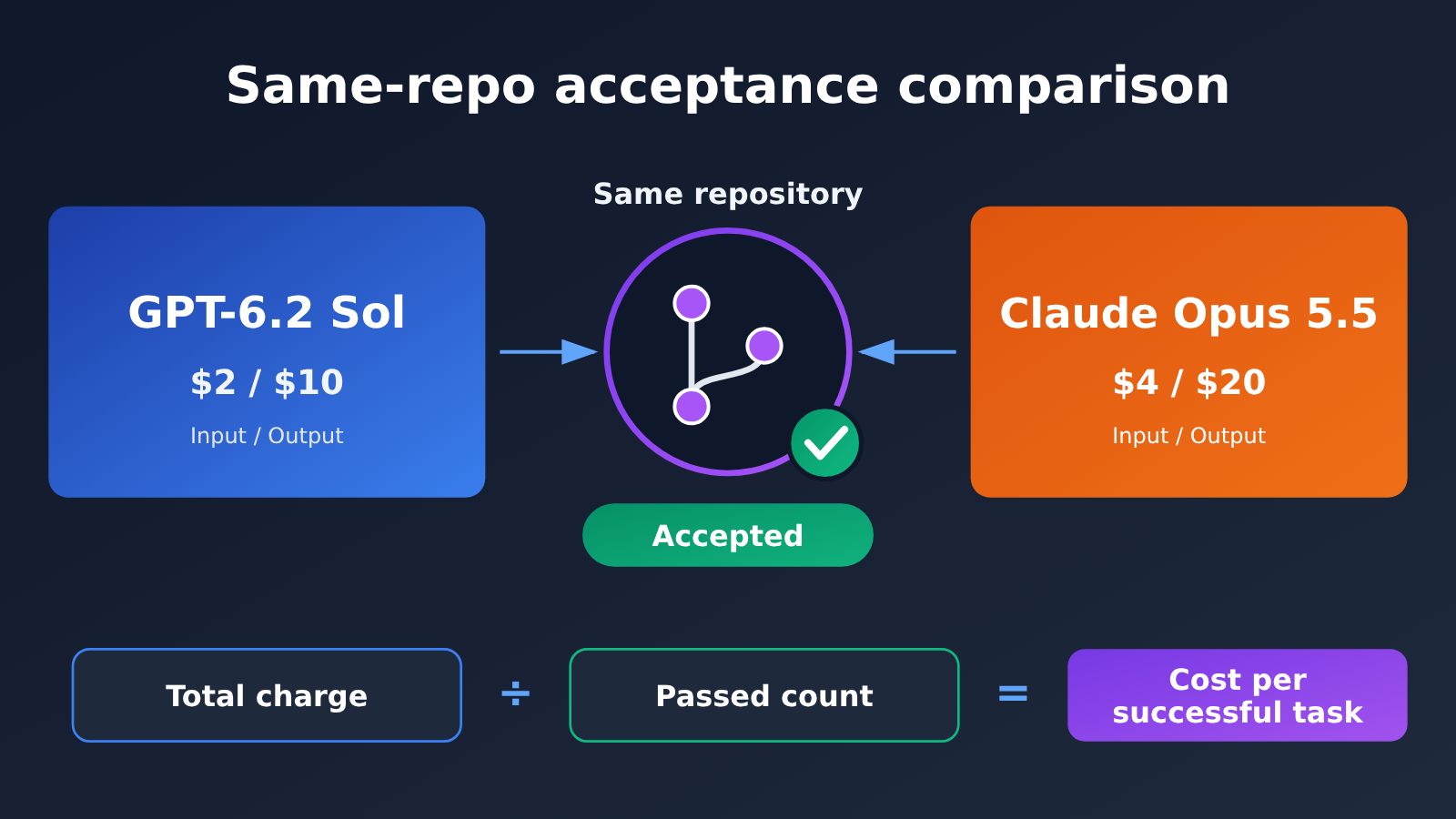
GPT-6.2 Sol vs Claude Opus 5.5 at a Glance
| Comparison | GPT-6.2 Sol | Claude Opus 5.5 | What the difference means |
|---|---|---|---|
| Release date | 2026-11-17 (GitHub announcement the same day) | 2026-09-22 | Sol just launched; routing and grouping status need to be verified item by item |
| APIYI model ID | gpt-6.2-sol |
claude-opus-5-5 (plus a -thinking version) |
The main experiment uses the exact IDs; the thinking version runs separately as a third group |
| APIYI endpoint | Responses (recommended), chat | chat, messages | The main experiment should pick a protocol both sides support, or use an equivalent adapter |
| Upstream standard pricing (input / cache read / output) | $2 / $0.10 / $10 (≤272K input) | $4 / $0.20 / $20 | Sol is cheaper per request |
| Long-context pricing | Above 272K, the entire request bills at $4 / $0.20 / $15 | Unit price stays flat within the 1M context | The price gap narrows for large repos and long-context tasks |
| Public benchmark (AA, max tier) | Overall 57, estimated $1.01 per item | Overall 59, estimated $10.04 per item | High-tier scores are close, but the cost gap is huge |
| Public benchmark (AA, medium tier) | Overall 53, estimated $0.41 per item | Overall 48, estimated $2.45 per item | Switch tiers and relative performance shifts |
Reading guide: each step builds on the result of the previous one, so it’s best to read them in order.
- Start by verifying the listed entry point and billing: confirm which ID your key can reach, which endpoint, and which tier you’re billed at.
- Then set up a same-repo comparison: fix the commit, environment, and budget so the numbers that follow are actually comparable.
- Next, validate first and settle costs after: failures and retries both count toward cost, while the denominator only counts tasks that truly pass acceptance.
- Finally, cross-check against public evaluations: use them to narrow down candidate configurations, and let local gates decide the final routing.
To Know: 7 terms used in this article
| Term | Meaning |
|---|---|
| Baseline commit | Both sides’ tests start from the same Git commit |
| Agent runtime environment | The program and environment that give the model tools like reading files, editing, and running tests |
| Reasoning effort | The setting for how much reasoning compute the service allocates to a request; same-named tiers aren’t necessarily equivalent between the two vendors |
| Cache hit | The repeated prefix in a request is reused from the provider’s cache and billed at the cache-read price |
| Acceptance pass rate | Tasks passing the pre-agreed acceptance checks ÷ total tasks |
| Cost per accepted task | The model’s spend across all tasks in the group ÷ tasks that ultimately pass |
| Fallback | Switching routes or models when the intended model is unavailable or hits a limit |
1. GPT-6.2 Sol vs Claude Opus 5.5: first verify the listed access points and billing
1.1 Listing status of GPT-6.2 Sol and Claude Opus 5.5 on APIYI
As of November 23, 2026, APIYI apiyi.com’s public model catalog and public pricing endpoint both list gpt-6.2-sol and claude-opus-5-5, and they also list claude-opus-5-5-thinking separately. An older article on the site dated November 18 said “Sol is not yet listed”—that was the historical state at the time, and it no longer applies. Even so, your API key, its group, upstream routing, and actual billing still need to be checked separately; don’t rely on the catalog alone.
| Model ID | Supported endpoints | Role in the comparison experiment |
|---|---|---|
gpt-6.2-sol |
Responses (recommended in the docs), chat | Main experiment Group A |
claude-opus-5-5 |
chat, messages | Main experiment Group B |
claude-opus-5-5-thinking |
See the catalog | Optional third group; don’t count it with Group B |
1.2 Price per million tokens for GPT-6.2 Sol and Claude Opus 5.5
The table below separates upstream direct prices from APIYI catalog prices. All prices are in USD per million tokens.
| Channel and tier | Input | Cache read | Output | Notes |
|---|---|---|---|---|
| OpenAI direct Sol (≤272K input) | $2 | $0.10 | $10 | Standard tier |
| OpenAI direct Sol (>272K input) | $4 | $0.20 | $15 | Once over the threshold, the entire request is billed at this tier |
| Anthropic direct Opus 5.5 | $4 | $0.20 | $20 | Standard global routing, same unit price within the 1M context; 5-minute and 1-hour cache writes are $5 and $8, respectively |
| APIYI Sol standard tier | $2 | $0.10 | $10 | Public catalog price |
| APIYI Sol long tier | $3 | See your bill | $11.25 (estimated) | Output price estimated from the published 3.75 multiplier using the formula in the docs |
| APIYI Opus 5.5 standard tier | $4 | $0.20 | $20 | Public catalog price |
APIYI’s “completion multiplier” is the ratio of the output unit price to the input unit price. Long-tier input at $3 multiplied by 3.75 gives an output price of $11.25. This number is estimated from public metadata, not measured from a bill. For long-tier cache pricing and actual charges, rely on your project bill.
1.3 Why list prices can only estimate the cost of a single request
A price table can only answer “which model is cheaper for the same token count.” It can’t answer “how many tokens will each model need to complete a task.” Coding agents read files, run tests, and edit code over multiple turns, and the number of turns, output length, and cache hit rate can vary widely between models.
Sol’s 272K threshold also creates a nonlinear effect: once a request with a long context crosses the threshold, the entire request is billed at the higher tier. Opus’s unit price stays the same within the 1M context. So in large-repository scenarios, the actual price gap has to be assessed from the bill.
🎯 Technical tip: Before running a comparison, use the same API key on APIYI apiyi.com to call the two exact IDs separately, and confirm the group and unit price in the invocation logs—so you don’t finish the experiment only to find it went through a different route.
2. Running a Controlled Comparison Between GPT-6.2 Sol and Claude Opus 5.5 in the Same Repo
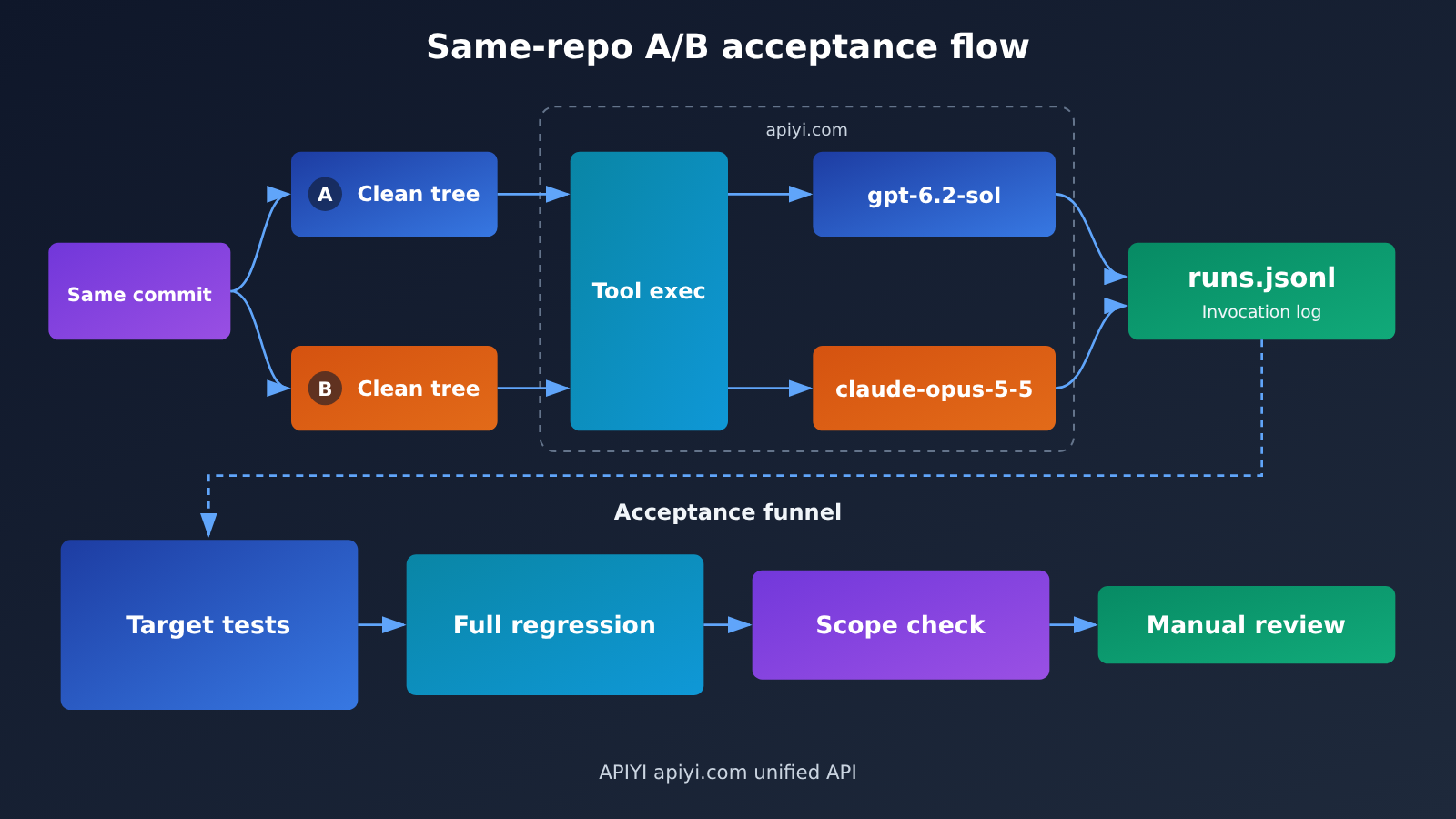
2.1 Main experiment: fixed variables in the same agent environment
The goal of the main experiment is to vary exactly one thing: the model. Before you start, the following needs to be written into the experiment description:
- Code and dependencies: pin the same Git commit, use two clean workspaces, and lock dependency versions.
- Input conditions: identical prompt text, file permissions, and test tooling.
- Budget constraints: same wall-clock limit, max attempt count, and per-task cost cap.
- Tool runner: both sides share a single runner. Pick a protocol both sides support (chat), or use an equivalent adapter and record the protocol differences.
- Cache conditions: either both cold-start or both warm up — don’t run one cold and one warm.
- Run logs: capture the service route, input/output usage, the inference settings actually in effect, and whether any fallbacks occurred.
Reasoning effort needs special attention here. An effort level with the same name isn’t necessarily equivalent across the two vendors — “both set to high” doesn’t mean both sides invest the same reasoning compute. Log the level that actually took effect, and if necessary, run a separate round for each level.
2.2 Unified Invocation and Logging Example for GPT-6.2 Sol and Claude Opus 5.5
The minimal example below invokes both models through the OpenAI-compatible chat interface and writes usage to a log. The parameter name for reasoning effort varies by protocol; here it’s just recorded as metadata, so check each endpoint’s documentation for how to actually pass it.
import json, time
import openai

client = openai.OpenAI(
    api_key="YOUR_API_KEY",
    base_url="https://api.apiyi.com/v1"  # APIYI unified interface, both models share one key
)

def run_attempt(task_id, commit, model, prompt, attempt, effort="default", cache="cold"):
    t0 = time.time()
    resp = client.chat.completions.create(
        model=model,
        messages=[{"role": "user", "content": prompt}],
    )
    u = resp.usage
    cached = getattr(getattr(u, "prompt_tokens_details", None), "cached_tokens", None)
    record = {
        "task": task_id, "commit": commit, "model": model,
        "endpoint": "chat", "effort": effort, "attempt": attempt,
        "cache": cache, "input_tokens": u.prompt_tokens,
        "cached_tokens": cached, "output_tokens": u.completion_tokens,
        "seconds": round(time.time() - t0, 1),
        "billed_usd": None,   # backfilled with the actual charge from the invocation log
        "tests": None, "review": None,
    }
    with open("runs.jsonl", "a") as f:
        f.write(json.dumps(record, ensure_ascii=False) + "\n")
    return resp.choices[0].message.content
The billed_usd field is deliberately left empty — instead of estimating it by multiplying token count by list price, it’s backfilled afterward with the actual charge from the invocation log. That way long-context tiers, caching, and grouping multipliers all get counted automatically.
2.3 Side experiment: each model’s native toolchain
If you care more about “the stack your team would actually use,” you can add a side experiment: run Sol with Codex and Opus with Claude Code, with both sides using their usual settings. These numbers reflect the combined performance of “model + toolchain + default configuration,” so you can’t use them to judge the models in isolation.
Both experiment groups need to follow two rules. First, seal the acceptance samples before you start running. Second, interleave the two models so one group’s output doesn’t get copied into the other group’s workspace.
3. Validate changes first, then calculate the success cost of GPT-6.2 Sol and Claude Opus 5.5
3.1 Two Reproducible Coding Tasks
Both tasks are designed as editing tasks at a small scale, so you can port them into your own small repository.
| Task | Requirement | Key use case | Additional constraints |
|---|---|---|---|
| A: Inventory CLI sorting | Add a --sort name option |
Given input beta,Able,able, the output with the option enabled is Able,able,beta: case-insensitive, with items sharing the same name preserving their original order |
Default output and existing tests pass unchanged; verify empty lists and existing sort options |
| B: Amount formatting deduplication | Extract the duplicated amount formatting logic from invoice preview and export into a shared module, with input in integer cents | 0, 105, and −105 cents render as $0.00, $1.05, and -$1.05 respectively |
Existing export interfaces, preview snapshots, and regression tests pass, with no new dependencies introduced |
Task A mainly tests stable sorting and edge-case handling, while Task B mainly tests whether refactoring breaks existing interfaces. Both tasks have clear pass/fail criteria, making them a good starting point for comparison.
3.2 Acceptance Criteria and Log Fields
An attempt must satisfy all four of the following to pass:
- The target tests pass.
- The full regression test suite passes.
- There are no changes beyond the task scope.
- Manual review confirms it can be merged.
Each attempt should record the following fields: task, commit, model ID, endpoint, reasoning level, attempt number, cache conditions, input usage, output usage, actual charge, duration, test conclusion, and review conclusion. Manual review minutes are reported separately and are not converted into API costs.
3.3 Failure Amortization Formula and Worked Example
- Pass rate = number passed ÷ number of tasks in the same group
- Cost per accepted successful task = sum of actual charges for all attempts in the same group ÷ number passed
Spend on failed tasks and retries all goes into the numerator; the denominator only counts tasks that passed. If a group has zero passes, just report the total and 0/N — don’t compute this value, because dividing by zero gets you nothing meaningful.
Worked example (hypothetical data, just to demonstrate the role of the denominator): 10 tasks each on both sides. Say Sol spends $6 total and passes 6, giving a cost per successful task of $1. Say Opus spends $8 total and passes 10, giving a cost per successful task of $0.80. Under these assumptions, the side with the lower unit price actually ends up paying more per successful task.
import json
from collections import defaultdict

def summarize(path="runs.jsonl"):
    spend, passed, tasks = defaultdict(float), defaultdict(set), defaultdict(set)
    for line in open(path):
        r = json.loads(line)
        spend[r["model"]] += r["billed_usd"] or 0
        tasks[r["model"]].add(r["task"])
        if r["tests"] == "pass" and r["review"] == "mergeable":
            passed[r["model"]].add(r["task"])
    for m in spend:
        n, k = len(tasks[m]), len(passed[m])
        cps = f"${spend[m]/k:.2f}" if k else "N/A"
        print(f"{m}: passed {k}/{n}, total ${spend[m]:.2f}, cost per successful task {cps}")
When comparing, both sides must use the same channel and the same discount basis. The amounts in APIYI invocation logs already include the applicable group multiplier; the equivalent discount from top-up bonuses has to be calculated separately, so don’t mix log amounts on one side with post-discount prices on the other.
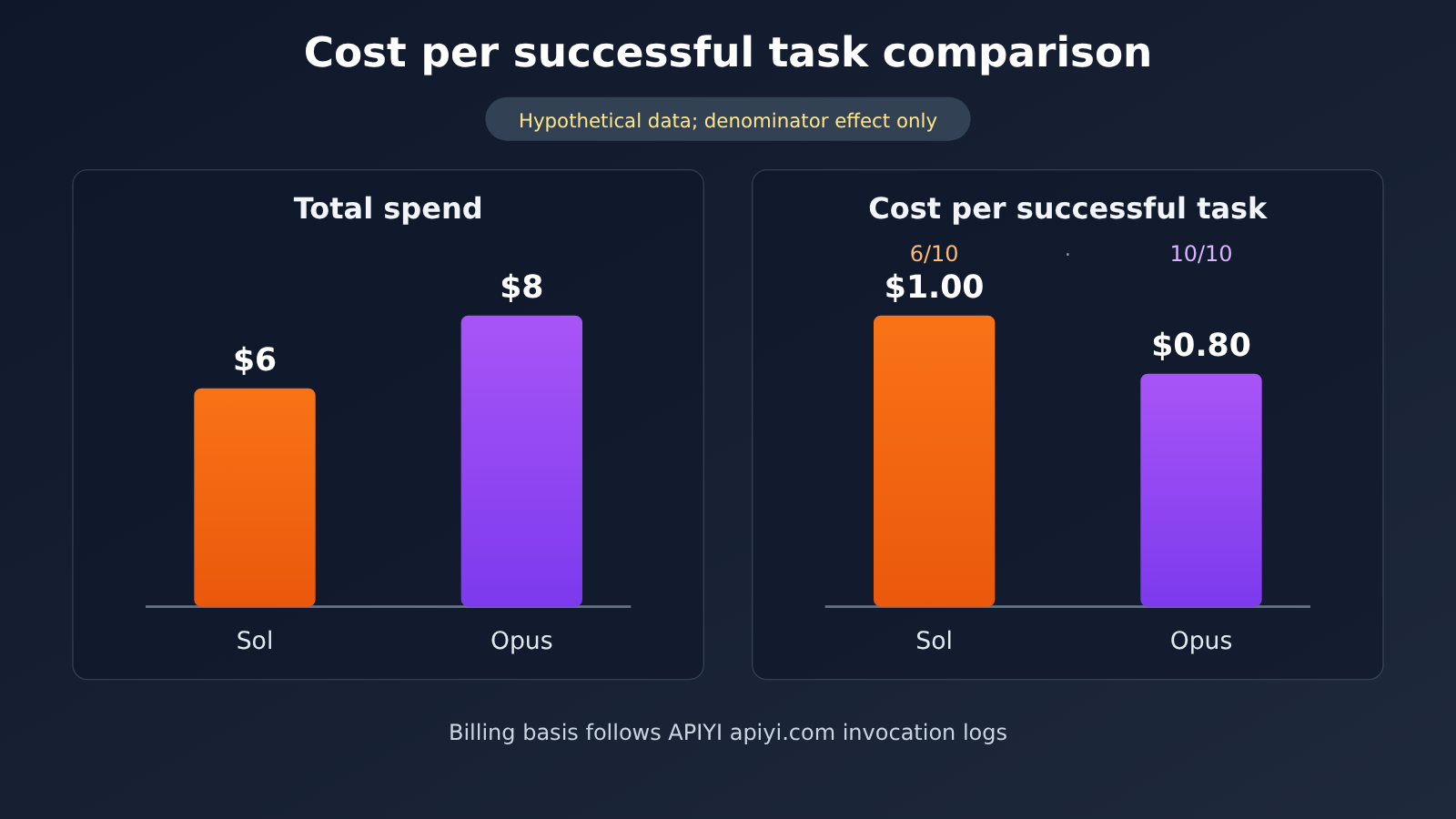
💰 Billing basis tip: backfill
billed_usdconsistently from APIYI apiyi.com invocation logs, and the two models get compared under the same channel and the same group multiplier — no need to fuss with cross-platform exchange rates and discounts.
4. How to Read the Public Benchmarks for GPT-6.2 Sol vs. Claude Opus 5.5, and What Your Own Results Mean
4.1 Artificial Analysis’s Two Tiers Show How Much Configuration Matters
The table below comes from Artificial Analysis Intelligence Index v5.0.1, with Opus scores taken from the Default Fallback configuration.
| Reasoning tier | GPT-6.2 Sol overall score | Claude Opus 5.5 overall score | Estimated average cost per task for Sol | Estimated average cost per task for Opus |
|---|---|---|---|---|
| max | 57 | 59 | $1.01 | $10.04 |
| medium | 53 | 48 | $0.41 | $2.45 |
AA’s cost method works like this: first, take the average token cost per task based on the number of tasks in each evaluation, then weight it by the index weights. You can see from the table that Opus is slightly higher at the max tier, while Sol edges ahead at the medium tier. The cost gap is also pretty clear at both tiers.
These numbers only tell you that “the tier changes relative performance.” They aren’t acceptance costs for your repo, actual usage bills, or win rates for either side.
4.2 Go Back to Task Categories and Thresholds to Make Routing Decisions
A good way to use public benchmarks is as a filter: use them to pick one or two reasoning tiers per model that are worth testing locally, then set thresholds by task category. For example:
- Small editing tasks (like Task A): if both sides hit an acceptable pass rate, choose the one with the lower cost per successful task.
- Cross-module refactoring tasks (like Task B): set a pass-rate floor first. Eliminate any configuration that misses the floor, then compare cost.
- Long-context tasks: track these as a separate group, because once Sol goes past 272K, the entire request is billed at the high tier — and that changes the conclusion.
The conditions behind the recommendation are pretty clear. If Sol’s pass rate on your task categories is close to Opus, its lower unit price directly translates into a cost advantage. If Sol needs more retries or rework, Opus’s higher unit price may be offset by its higher pass rate. The thinking version and toolchain results from side experiments should be judged as independent groups, not mixed into the main experiment.
💡 Selection tip: Start with APIYI apiyi.com’s free trial quota for new users, run Task A and Task B once each, and get your first pass-rate and cost-per-success data. Then decide whether to expand the task set.
The conclusion you can actually put into practice is a routing table: each task category maps to one model and reasoning tier, with acceptable pass-rate and cost thresholds spelled out. This table needs to be retested regularly as models update. If you need to maintain multiple routes such as Sol and Opus, you can use APIYI apiyi.com to switch and track billing with a single API key.
📚 References
- OpenAI announcement: the joint launch and product positioning of GPT-6.2 Astra and Sol
- Link:
openai.com/index/introducing-gpt-6-2-astra-sol/
- Link:
- OpenAI API model documentation: GPT-6.2 Sol’s 272K threshold, whole-request billing, and standard pricing
- Link:
developers.openai.com/api/docs/models/gpt-6.2-sol
- Link:
- Anthropic announcement: official release of Claude Opus 5.5 (2026-09-22)
- Link:
anthropic.com/claude-opus-5-5
- Link:
- Claude Platform pricing documentation: Opus standard, caching, and long-context pricing
- Link:
platform.claude.com/docs/en/about-claude/pricing
- Link:
- GitHub Changelog: GPT-6.2 Astra and Sol now available (2026-11-17)
- Link:
github.blog/changelog/2026-11-17-openais-gpt-6-2-astra-and-gpt-6-2-sol-now-available/
- Link:
- Artificial Analysis comparison page: benchmark setup, metrics, and cost methodology for both models
- Link:
artificialanalysis.ai/models/comparisons/claude-opus-5-5-vs-gpt-6-2-sol
- Link:
- APIYI documentation center: the full model list, an explanation of model rate multipliers, and costs shown in call logs
- Link:
docs.apiyi.com
- Link:
- APIYI public pricing API: the two-tier pricing multipliers for gpt-6.2-sol (read back on 2026-11-23)
- Link:
api.apiyi.com/api/pricing
- Link:
Author: APIYI Technical Team
Technical discussion: Feel free to get in touch with us through the APIYI homepage. For more model and billing information, check out the docs.apiyi.com documentation center.


