

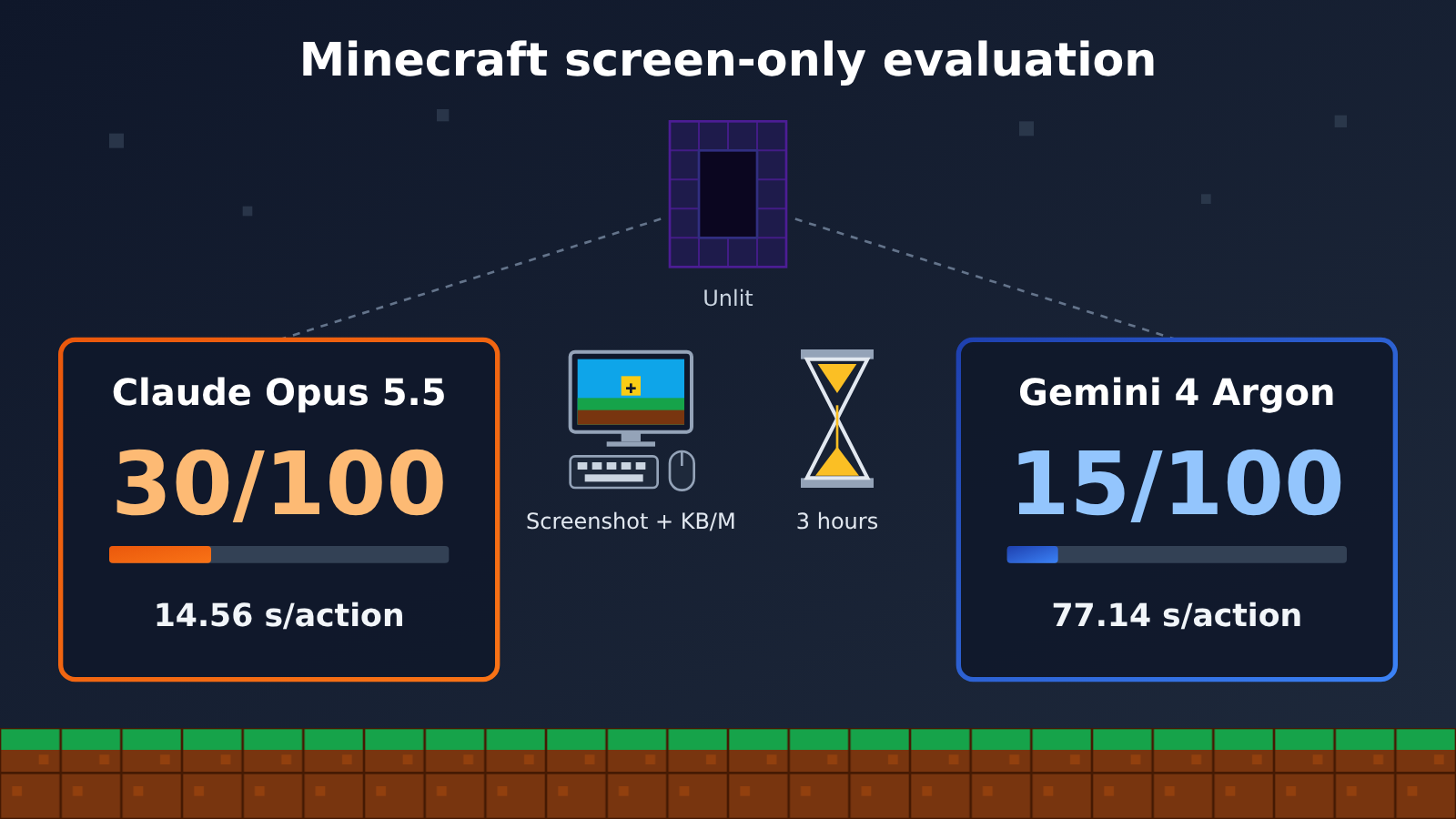
Summary: Vals AI’s CUA-bench gives each model up to three hours and allows it to play Minecraft only by looking at screenshots and using a keyboard and mouse. Under those conditions, Claude Opus 5.5 scored 30/100 and Gemini 4 Argon scored 15/100. The two scores measure how far each run configuration progressed in sequence before entering the Nether—not who could beat the game.
Bottom line: How Claude Opus 5.5 and Gemini 4 Argon differ on the Minecraft task
In the Minecraft task, Claude Opus 5.5 (Max reasoning tier, Claude Code tool harness) earned twice the progress score of Gemini 4 Argon (High reasoning tier, Antigravity tool harness), and its average interval between actions was also much shorter. Argon’s estimated API cost for this round was lower, but it only reached a score of 15.
Neither model entered the Nether, and the highest of the nine publicly available individual-task records was only 30 points. So the answer to “how far can they go” is: under screen-only operation and a three-hour cap, both configurations remained stuck in the early resource-gathering and crafting stages.
We should clarify the methodology first. This article is a comparison based on published materials. The data comes from Vals’ release page, the public AI Bengineering dataset, and a DeepMind preprint; we did not rerun these experiments.
Comparison at a Glance: Three Minecraft Metrics in One Table
| Comparison dimension | Claude Opus 5.5 | Gemini 4 Argon | What the difference means |
|---|---|---|---|
| Reasoning tier / harness | Max / Claude Code | High / Antigravity | Both configurations differ, so the gap can’t be attributed to the model alone |
| Ordered progress score | 30/100 | 15/100 | A 15-point gap; Opus 5.5 ties the highest score for this item |
| Average action interval | 14.56 seconds | 77.14 seconds | A 62.58-second gap; Argon is about 5.30× |
| Estimated API cost for one run | $31.08 | $19.35 | Counts only requests that returned usage data, so treat it as a lower bound |
| Valid runs | 1 run | 1 run | Single-run result; can’t establish stability |
| Six-game aggregate (reference) | 14.00%, 14.71 seconds, $188.04 | 4.83%, 70.51 seconds, $193.78 | Aggregate basis; don’t apply it to the Minecraft item |
The data was checked on November 23, 2026. On the Vals leaderboard, you need to select the Minecraft item (field name minecraft_nether). The aggregate leaderboard figures are averages across six games and are often mistaken for the Minecraft score, so keep them separate when reading.
Reading order: Section 1 establishes what these two scores actually measured; Section 2 follows the 13-level scoring ladder and looks at where the three hours went in the official recording; Section 3 places it on the same permissions comparison table as two Ender Dragon completion experiments; Section 4 adapts the method to acceptance testing for your own desktop agent. Sections 3 and 4 depend on the framing from the first two sections, so don’t skip ahead.
To Know: Key Terms for Understanding the Minecraft Evaluation
| Term | Definition |
|---|---|
| CUA-bench | Vals AI’s benchmark for computer-use agents, covering six commercially released games |
| Harness | The execution layer that connects model decisions to the screen, keyboard, and mouse, including tool calls and environment configuration |
| MCP | A protocol agents use to connect to external tools; Vals uses it to control the desktop, while community experiments use it to hook into advanced in-game tools |
| Ordered milestones | Progress confirmed in sequence; if an earlier stage isn’t passed, later stages don’t score |
| Nether | The dimension reached through a portal; entering it is the final level of this benchmark item |
| Wall-clock time | Actual elapsed time, including thinking, waiting, and action execution |
| Average action interval | The average time elapsed between two adjacent operation actions |
| Holdout game | A game whose name the evaluator withholds, used to observe performance on unfamiliar tasks |
| Estimated API cost | The amount calculated from metered requests and listed unit prices; it isn’t the actual bill |
1. How to Read the Minecraft Task Results for Claude Opus 5.5 and Gemini 4 Argon
1.1 Scores: Tied at the Top with 30, No Perfect Score in Nine Records
The Minecraft task has nine verifiable scores: three at 30, one at 25, one at 20, three at 15, and one at 5. GPT-6 Astra, Claude Opus 5, and Claude Opus 5.5 are tied at 30. Gemini 4 Argon’s 15 puts it in the lower-middle of the pack.
This means that with only screenshots and keyboard/mouse input, none of the publicly evaluated setups has made it all the way down the 13-step ladder into the Nether. Opus 5.5’s 30 is already the ceiling for this task, but there’s still a big gap between that and a perfect score.
1.2 Action Interval: More Than Just Model Inference
The 14.56 seconds and 77.14 seconds are the average wait from one action to the next. They include network, model inference, tool execution, and game response. Vals didn’t break down the time spent on each of those parts, so you can’t read 77.14 seconds as “Argon is slow at thinking.”
In a real-time game, longer intervals mean fewer actions attempted in the same three hours and fewer chances to correct mistakes. That can partly explain the progress gap, but the tool harness and reasoning level affect the interval too.
1.3 Cost: A Lower-Bound Estimate, and Only for a Single Round
The $31.08 and $19.35 figures were calculated by Vals from requests that returned usage and the recorded unit prices; the raw values are $31.080317 and $19.353702. Requests that didn’t return usage are excluded, so the amounts are only lower-bound estimates.
Each model ran once, and the reasoning level and tool harness were different too. These numbers answer “how did these two systems perform in this round?” They don’t show that a model can’t complete the task with more time or different tools.
2. Before Entering the Nether: Where Minecraft’s Three Hours Go
2.1 Minecraft’s 13-Level Ordered Scoring Ladder
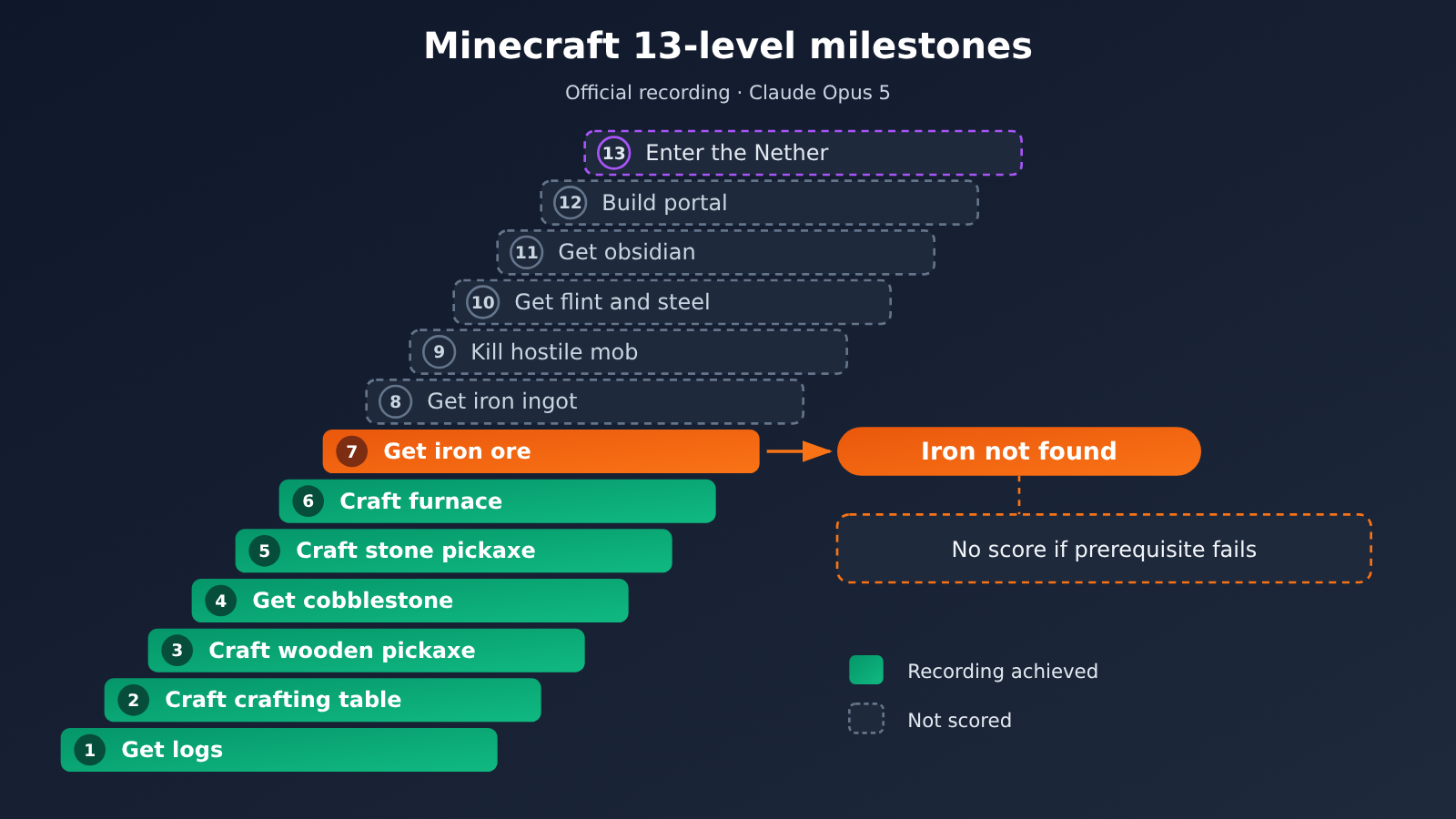
Vals breaks the run from a blank start to entering the Nether into 13 cumulative milestones worth up to 100 points. If a prerequisite step hasn’t scored yet, later conditions that happen to be met early don’t pay out.
| No. | Milestone | No. | Milestone |
|---|---|---|---|
| 1 | Get a log | 8 | Get an iron ingot |
| 2 | Craft a crafting table | 9 | Kill a hostile mob |
| 3 | Craft a wooden pickaxe | 10 | Get flint and steel |
| 4 | Get cobblestone | 11 | Get obsidian |
| 5 | Craft a stone pickaxe | 12 | Build a portal |
| 6 | Craft a furnace | 13 | Enter the Nether |
| 7 | Get iron ore | — | — |
The release page doesn’t disclose the point value of each level, nor does it list which level Opus 5.5 and Argon each stopped at. So this article doesn’t try to reverse-engineer specific stages from 30 or 15 points — it sticks to what the published scores say.
2.2 What Fits Inside the Same Three-Hour Timer
Three hours is real wall-clock time. Reading the screen, figuring out the controls, planning, executing in-game actions, and retrying after mistakes all share that single budget; if the agent finishes early, it’s scored on whatever it managed to achieve. If the platform fails, the run can be resumed with the same save, conversation, and remaining time; if it can’t be resumed, the run is repeated and the interrupted attempt is dropped.
The permission boundary matters just as much. On the game side, input is limited to keyboard and mouse and observation comes only from the screen; the game console, save files, memory, and direct network requests are all closed off to the agent. The tool shell can run shell or Python inside an isolated CPU sandbox to do local reasoning from screen information, then use MCP to drive the GPU desktop that’s running the game. The scoring side, meanwhile, can read save state the agent can’t see in order to verify results.
2.3 Claude Opus 5 in the Official Recording: About 97 Minutes to Craft a Stone Pickaxe
In the sped-up Minecraft footage Vals released, the operator is an older Claude Opus 5 (Max, Claude Code, 30 points) — not this article’s subject, Opus 5.5. The written log shows it picked up cobblestone around minute 50, crafted a stone pickaxe around minute 97, then made a furnace, and ultimately never found iron.
The five-second clip that was made public comes from around the one-hour mark, and it shows the agent heading back to the birch forest to restock wood. The example is a vivid one: navigating a 3D block world from screenshots, identifying blocks, and opening the crafting interface — every step is far slower than it is for a human. A stage that takes a human player a few minutes can eat up more than half an hour of the agent’s time.
3. Side-by-Side Comparison of the Three Minecraft Experiments: Permissions, Clocks, and Endpoints
3.1 Configuration Comparison of the Three Experiments
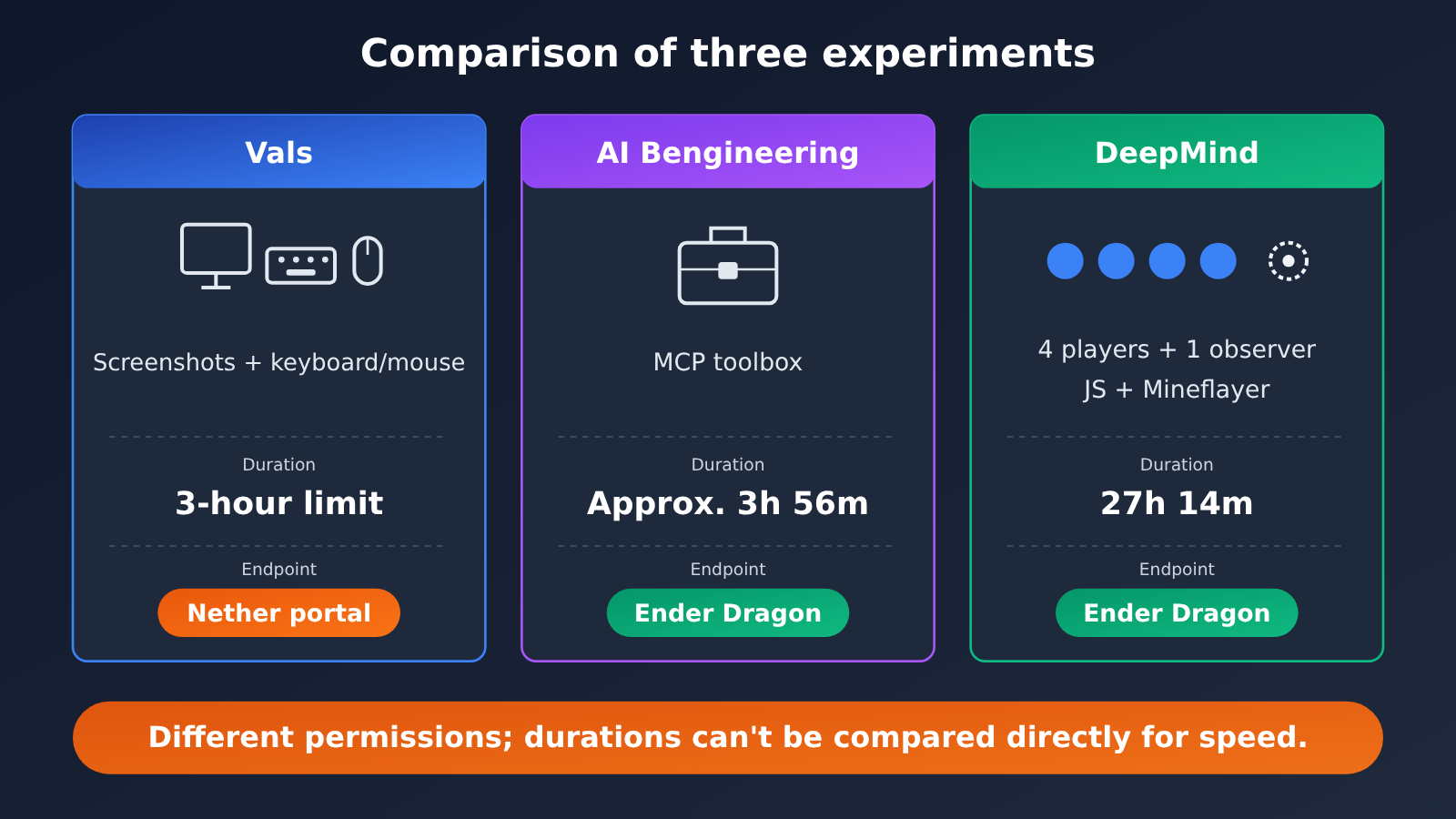
Besides Vals’ screen-operation evaluation, two other 2026 experiments in which AI defeated the Ender Dragon are often compared. Their permissions and endpoints are completely different, so we need to align the definitions first.
| Experiment | Model and number of players | Observation and action interface | World settings | Verifiable endpoint |
|---|---|---|---|---|
| Vals CUA-bench | Opus 5.5 and Argon, each in a separate run | Screenshots, keyboard, mouse, up to 3 hours | Version, seed, and difficulty not disclosed | Highest goal was entering the Nether; none of the nine records achieved full marks |
| AI Bengineering community project | One Claude Opus 5 (1M, high) primary operator | Claude Code calls Mine AI MCP high-level tools | Java 1.21.4, Normal, fixed seed | Defeated the Ender Dragon in about 3 hours 56 minutes |
| Google DeepMind research | Four Gemini 4 Argon players, with a fifth only supervising | Players write JavaScript, with execution and pathfinding handled by Mineflayer | Java 1.20.4, Easy, random world | Defeated the Ender Dragon 27 hours 14 minutes after the first program |
3.2 Community Claude Opus 5 case: higher-level tools shortened the path
During AI Bengineering runs, Mine AI MCP wraps observation, pathfinding, resource handling, and combat into callable tools; the model picks goals, decides the call order, and revises its plan based on returned results. The full run logged 388 tool calls across 37 tools. Server logs show it entered the Nether at about 55 min 15 s and reached kill progress at about 3 h 56 min 20 s.
The equivalent API list price for this run is estimated at about $93.17. The actual run used a Claude subscription, and the project notes say it wasn’t charged that amount. Dataset estimates put API overhead at about 17.8 minutes, with the rest mainly spent waiting on tools like walking and mining. It’s not pure screenshot-and-keyboard control, but it’s also not a pre-written walkthrough script.
3.3 DeepMind’s four Gemini 4 Argon agents: long-task collaboration and recovery
Each of DeepMind’s four Argon instances controls one player, sending short self-written JavaScript over the command line; Mineflayer returns state like positions, inventory, blocks, and entities with higher precision than the screen. They lit the Nether portal at about 1 h 42 min, lit the End portal at about 13 h 17 min, and finally defeated the Ender Dragon at 27 h 14 min, with the four players dying a combined 605 times along the way.
Before the kill they ran 2,783 programs in total, about 22% of which ended in errors. The paper documents collaboration details like shared chest locations, rescuing a drowning teammate’s items, and correcting false success reports. The authors estimate about $520 at Google’s launch price and about $1,040 at standard price. It’s a complete case, good for observing collaboration and failure recovery, but it can’t be used to estimate reliability.
3.4 The Two Types of Questions Need to Be Asked Separately
Putting all three runs together, it’s clear they’re answering two different performance questions:
- What Vals asks: Can an agent, using only the screen and keyboard/mouse, make incremental early-game progress by following visual feedback step by step?
- What the two Ender Dragon runs ask: With the help of game state and high-level tools, can an agent complete long tasks spanning anywhere from several hours to dozens of hours?
So “Claude clears the game in 4 hours, Gemini in 27 hours” doesn’t prove that Opus is six times faster than Argon. The player count, interface, difficulty, seed, and version were all different. Likewise, the 30-vs-15 gap in Vals can’t be broken down into the separate contributions of model, reasoning tier, and tool scaffold.
4. Transferring the Minecraft Evaluation Method to Desktop Agent Acceptance
4.1 Five-Stage Synthetic Order Test
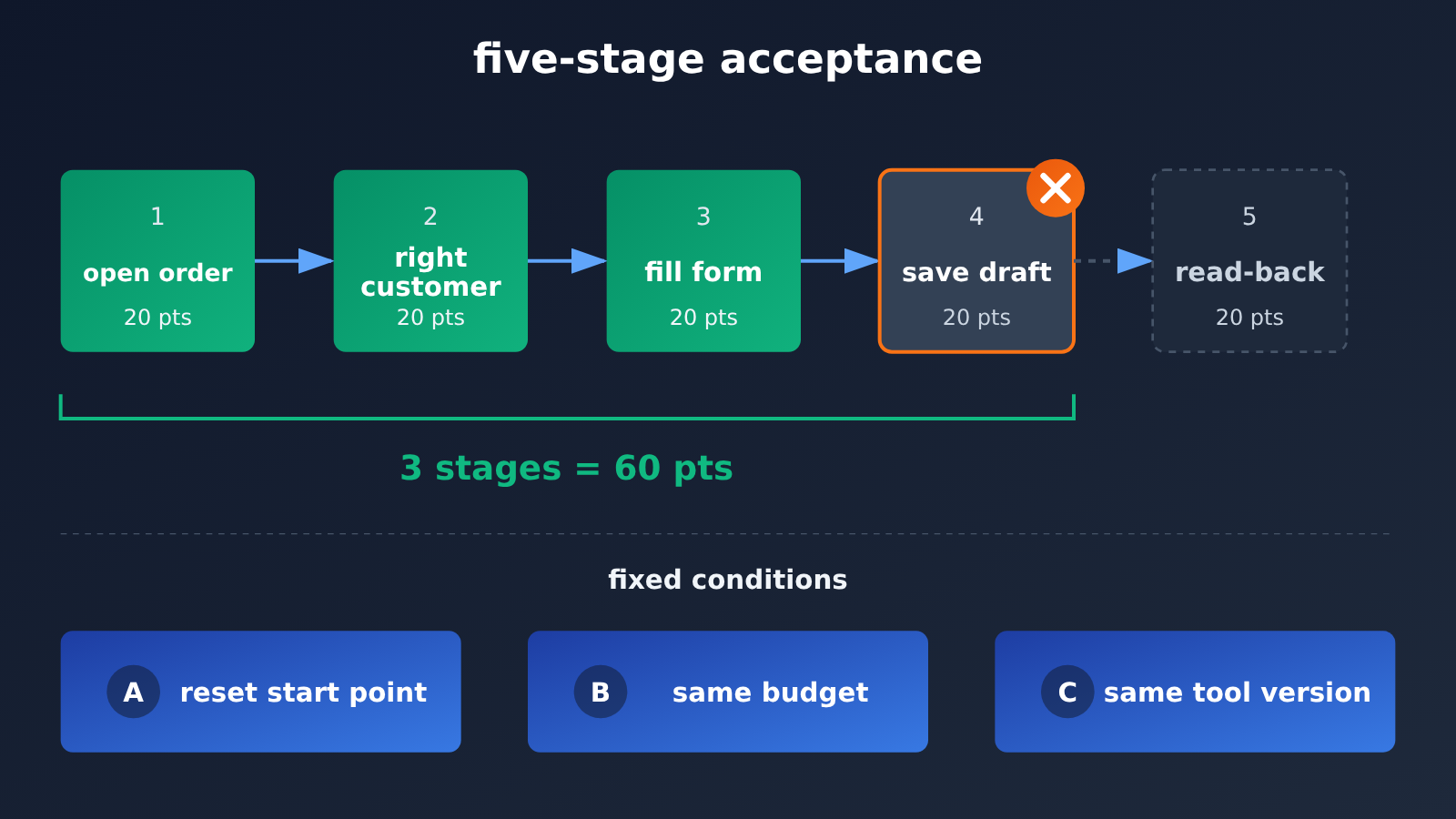
Vals’s ordered-milestone idea can be carried straight into a business scenario. In the test system, use a synthetic order to design five stages — “open the order → select the correct customer → fill in the form → save draft → read back and confirm” — with each stage accepted via post-hoc screenshots or test system logs, and the save action written only to the test environment.
| Acceptance item | How it’s set up | What gets recorded |
|---|---|---|
| Ordered score | 20 points per stage across five stages; k is the number of consecutive stages passed starting from stage one; score = 20×k | Score per round |
| Starting point | At least three pre-selected starting points, reset before each run | Starting point ID |
| Permissions and environment | Same screen and keyboard/mouse interface, same resolution, same initial data, same time limit | Tool version |
| Run configuration | Same tool shell, only the model swapped; or state “model + tool shell + reasoning tier” | Config label |
| Process metrics | Completion rate, median wall-clock time, average action interval, cost | Numeric values |
| Failure attribution | Timeouts, voluntary termination, model failures, and interruption recovery counted separately | Failure category |
Example: the first three stages are verified as passed, but the fourth fails — even if the last screenshot sits on the read-back page, the run still scores only 60. Milestone completion rate equals the number of valid rounds that reached that stage divided by the total number of valid rounds.
4.2 How to Record Model IDs and Costs
According to the APIYI model price master list read on November 23, 2026, the catalog lists claude-opus-5-5 (regular input/output/cache read $4/$20/$0.20; endpoints chat, messages) and gemini-4-argon ($2/$10/$0.10; endpoints chat, gemini), in USD per million tokens, and the page notes that it updates automatically. These are public catalog prices; none of the three experiments above used APIYI billing.
Once integrated, screenshot capture, keyboard/mouse execution, logging, and timing still need to be configured in your own runtime environment. Costs should be tracked separately for regular input, cache reads and writes, output, and tool-environment overhead. Google announced that Argon’s introductory period on official channels ends on November 30, 2026, and actual pricing across different channels depends on each channel’s own bill.
4.3 Strengths and Limits of This Method
- Strength: Ordered scoring prevents false successes where “the last screenshot looks right”; fixed starting points and resets make multi-round results comparable.
- Strength: Recording action intervals and wall-clock time separately lets you tell whether the slowness comes from the model or from the tool environment.
- Limitation: Three starting points is still a small sample — good only for initial screening, not enough to draw reliability conclusions.
- Limitation: Swapping the tool shell changes several variables at once, so the conclusion applies to “this configuration,” not “this model.”
Back to the title: given only screenshots and keyboard/mouse, with a three-hour time limit, the Claude Opus 5.5 configuration reached 30 points and the Gemini 4 Argon configuration reached 15, and neither made it to the lower bound. What’s really worth remembering is the framing: a screen-operation evaluation and a playthrough experiment that leans on game state measure two different capabilities, so before comparing, spell out the number of people, the interface, the clock, and the endpoint.
References
-
Vals AI CUA-bench Leaderboard and Evaluation Methodology: Minecraft individual score, 13-level scoring rules, operation constraints
- Link:
vals.ai/benchmarks/cua_bench - Note: Select the Minecraft individual entry and check the minecraft_nether column
- Link:
-
Vals Official Minecraft Recording: Claude Opus 5 accelerated gameplay clip
- Link:
vals.ai/benchmarks/cua_bench/minecraft.mp4 - Note: Watch the screenshot-based navigation and resource crafting process
- Link:
-
AI Bengineering Community Dataset: Run records, server logs, and cost breakdown for Claude Opus 5 defeating the Ender Dragon
- Link:
huggingface.co/datasets/aibengineering/beat-the-game-minecraft - Note: Includes run.json, result.json, and server logs
- Link:
-
Mine AI MCP Project: The game tooling layer used in community experiments
- Link:
github.com/aibengineering/mine-ai-mcp - Note: Tool documentation and reproduction instructions
- Link:
-
DeepMind Preprint: Four Gemini 4 Argon agents collaborating to defeat the Ender Dragon
- Link:
arxiv.org/html/2610.22319v1 - Note: Methods, 27-hour trajectory, validation, and limitations sections
- Link:
-
APIYI Model Price Master List: Model IDs, endpoints, and public catalog prices
- Link:
docs.apiyi.com/models.md - Note: The page updates automatically; refer to the values current as of the day you read it
- Link:
Author: APIYI Technical Team


