
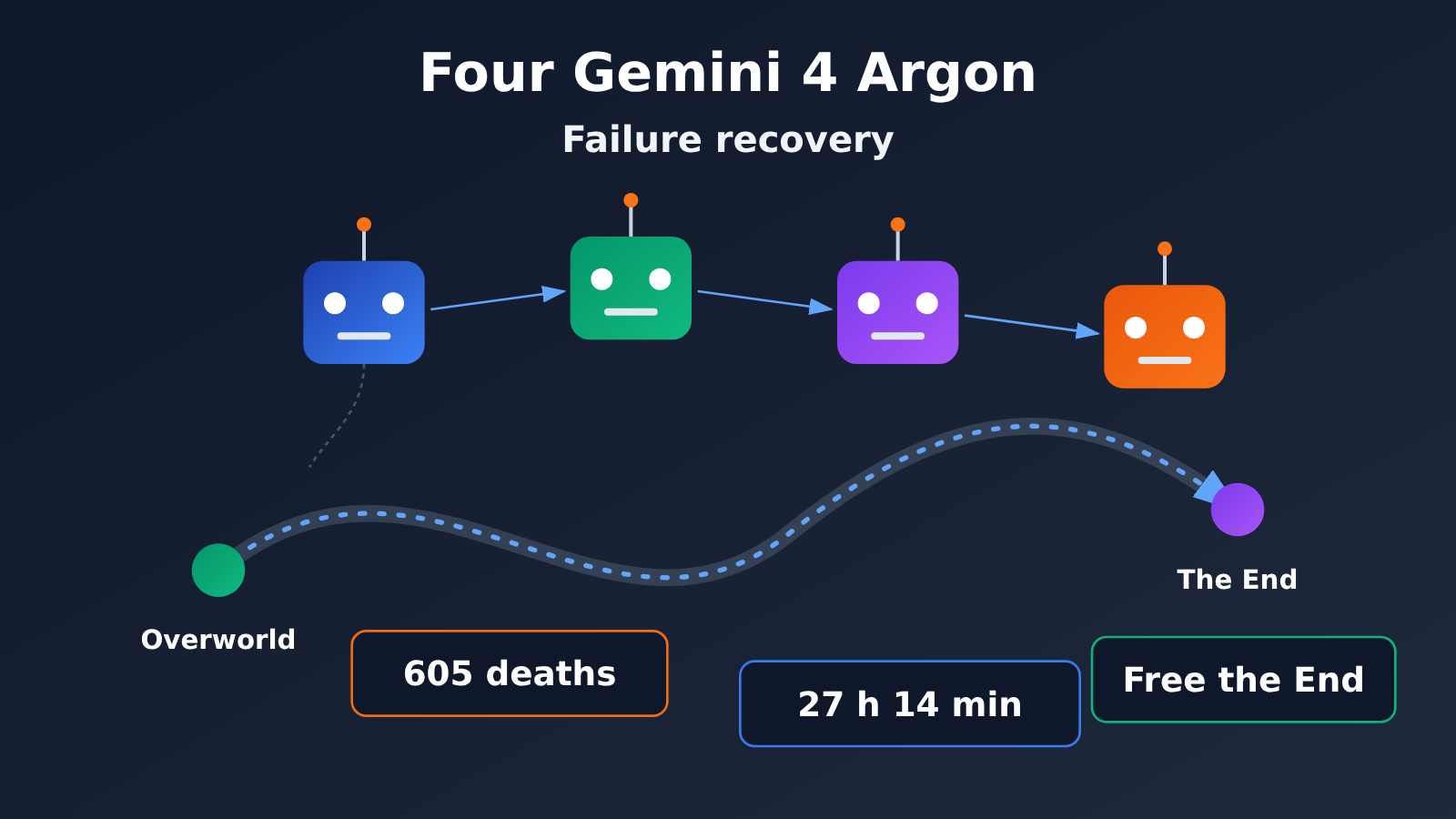
Abstract: Four Gemini 4 Argon agents racked up a combined 605 deaths over a 27-hour, 14-minute Minecraft run — and still beat the Ender Dragon. This breakdown looks at how they handed off critical items, corrected false reports, repeatedly read the real state of the world, and how developers can apply the same habits to their own multi-step tasks.
One team member drowned while carrying all 12 Eyes of Ender. Their teammates sent the drop location, the item count, and the exact moment the items would despawn straight to the nearest companion. That companion recovered everything before the deadline, and the team went on to light the End portal. This little slice shows that whether a multi-agent team can catch a failure comes down to two things. First, whether the handoff information is enough to directly drive the next action. Second, whether the result can be checked against the actual in-game state, instead of just trusting what the chat claims.
The research comes from Maxence Faldor, Satinder Singh, and Roberta Raileanu at Google DeepMind; preprint v1 was submitted to arXiv on October 15, 2026. The experiment ran on Minecraft Java 1.20.4, survival mode, Easy difficulty, a randomly generated new world, with cheats disabled. From the first program launch to the Ender Dragon’s defeat took 27 hours and 14 minutes. The final evidence is the Free the End advancement the server recorded for the player bulicame — a record that exists independently of the team’s chat. Keep in mind this is a single complete run from a first launch: it’s good for explaining collaboration and recovery mechanisms, but it can’t be used to estimate success probability, and it doesn’t show that multiple agents beat a single agent.
Knowledge Map and Reading Order for the Gemini 4 Argon Four-Agent Experiment
The table below lists the question each of the four sections answers and the paper evidence it draws on, and it doubles as an index.
| No. | Question it answers | Key evidence | What you’ll be able to do afterward |
|---|---|---|---|
| 1 | How 12 Eyes of Ender were recovered before the deadline | Paper Figures 8 and 9 | Write a handoff message you can execute directly |
| 2 | How a mistake turns into a rule you can follow next time | Paper Figures 5 and 6, §4 | Tell apart the three layers where things get captured: chat, shared memory, and program |
| 3 | How, after a restart, you notice a success message was sent too early | Paper Figures 13 and 14, §5, §8 | Verify a “claim” separately from the “actual state” |
| 4 | How to run a recovery drill for your own multi-step task | Synthetic trials designed by the editors | Validate a recovery process with four types of failure input |
Reading in order is recommended. Section 1 gives a complete sample of one successful handoff. Section 2 explains where this handoff capability builds up from. Section 3 adds the counter-case: what to do when a claim conflicts with reality. Section 4 takes the fields, states, and acceptance methods distilled from the first three sections outside of Minecraft. If you only care about shipping this in a real system, you can jump straight to Section 4 and refer back to Sections 1 and 3 whenever a field’s meaning is unclear.
To Know: Terminology You’ll Need to Understand the Gemini 4 Argon Experiment
| Term | Concise Explanation |
|---|---|
| Agent | A program unit that, within a given goal and set of permissions, repeatedly observes, decides, calls tools, and reads back results |
| Mineflayer | A JavaScript library that lets a program connect to a Minecraft server as a bot and read/write game state within permitted bounds |
| Persistent memory | A record area that stores plans, experience, and progress across multiple rounds, split into private and shared sections |
| Context compression | The operation of retaining key information while shrinking historical input when a conversation nears its length limit |
| Eye of Ender | A game item used to locate strongholds and activate the End portal |
| Item despawn deadline | The cutoff point after which a dropped item in the world can no longer be picked up |
| Checkpoint | A saved state that can be re-read or recovered from after a failure |
| Independent acceptance | Another role verifying, based on the original records or the state of output, whether an action or endpoint was actually achieved |
| State transition | How a work item moves between pending, in progress, blocked, verifiable, and accepted |
| Idempotent retry | Repeated requests for the same operation that ultimately produce only one effective result |
| Fault injection | Deliberately creating exits, dropped responses, restarts, and other failures in controlled tests to measure recovery ability |
1. How the Gemini 4 Argon Team Recovered 12 Eyes of Ender
1.1 The Three Timestamps in the Gemini 4 Argon Handoff
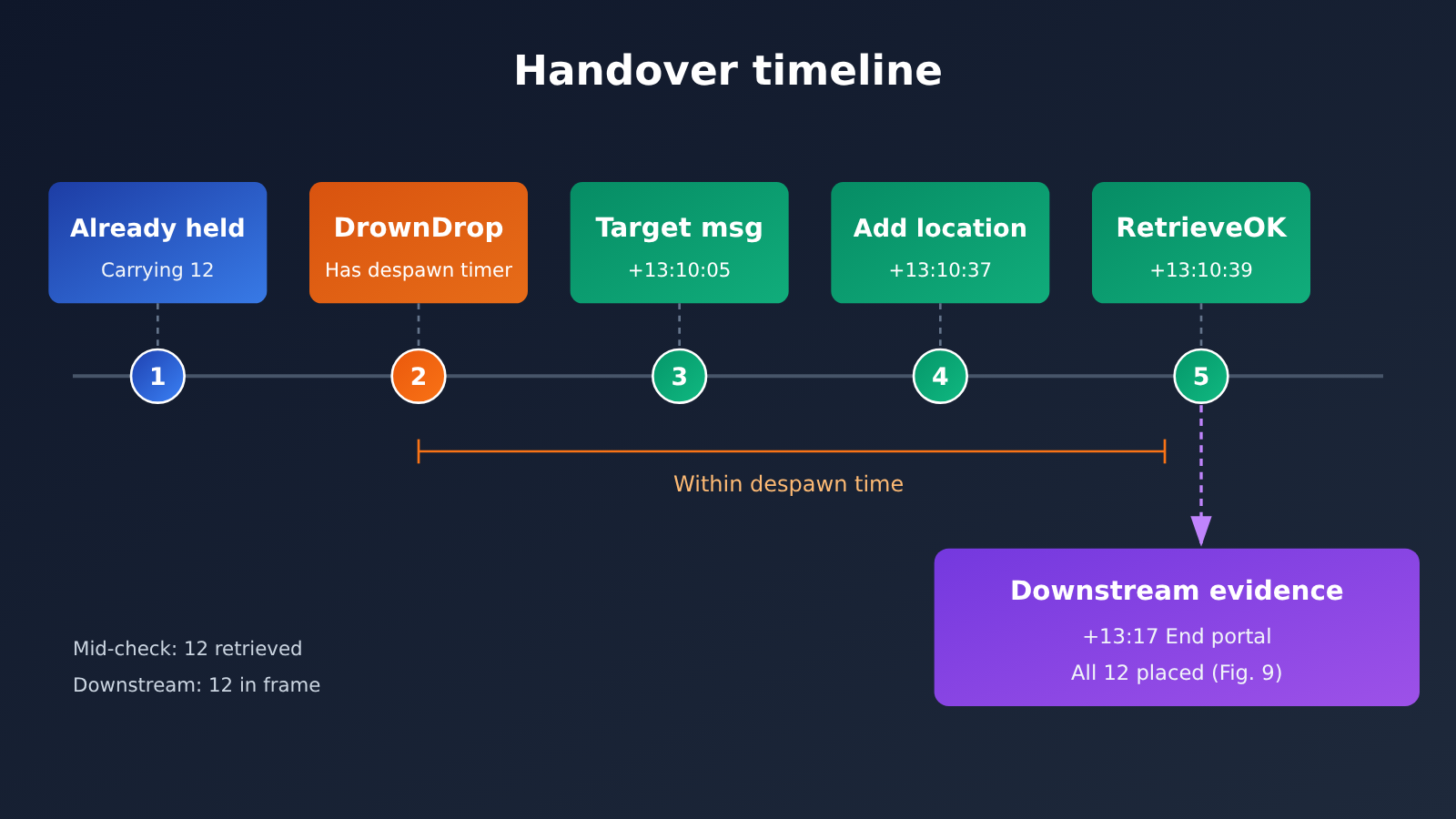
Figure 8 in the paper documents this incident. auratian drowned while carrying all 12 Eyes of Ender, and the items dropped into the water. The closest teammate, bulicame, was about 8 meters away. The following times are measured from the start of the first program run:
- +13:10:05: janesick sent a direct notification to bulicame, telling them the death location, the number of dropped items, and when the items were expected to despawn.
- +13:10:37: auratian added location information.
- +13:10:39: bulicame reported that all 12 had been recovered.
The main text of the paper says that at the time of this recovery, the items had about two and a half minutes left before despawning. That’s what the paper’s main text says; the public materials don’t include a complete step-by-step trace that would let us recompute it, so this article relays it as stated in the original. At about 13 hours and 17 minutes, bulicame reported activating the End Portal, and Figure 9 shows that all 12 eyes had been placed in the frames. “Reporting that 12 were recovered” was an intermediate confirmation; “there really are 12 in the frames” was the downstream delivery confirmation, and only the latter shows that this handoff actually cleared the blocker.
1.2 What a Usable Gemini 4 Argon Handoff Message Contains
If you break down janesick’s notification, you can see the minimum elements of an actionable handoff: what critical resource had a problem, where it is, how many there are, who is taking over, and by when it must be done. Without a deadline, the person taking over can’t tell whether they need to drop what they’re doing. Without a count, they can’t check whether the recovery is complete. Writing these elements as a structured record looks roughly like this:
{
  "resource": "ender_eye",
  "event": "dropped_on_death",
  "location": {"x": 0, "y": 0, "z": 0},
  "count": 12,
  "assignee": "bulicame",
  "deadline": "despawn_time",
  "verify": "assignee_inventory_count == 12",
  "downstream": "end_portal_frames_filled == 12"
}
The coordinate values are placeholders. The state chain corresponding to this structure is: held → dropped with a time limit → nearby teammate takes over → count verification → upstream dependency unblocked. These state names are this article’s way of organizing the incident; the paper doesn’t use this terminology.
2. How Four Gemini 4 Argon Agents Turn Mistakes into Executable Rules
2.1 The Division of Labor Was the Gemini 4 Argon Team’s Own Proposal
The researchers didn’t preset roles, a completion route, or a high-level completion function for the players. They gave them only a final goal, a set of action interfaces, and general work requirements: observe first, verify afterward, accumulate reusable tools, maintain shared memory, and report honestly. Each of the four agents runs on a separate cloud host, sending short JavaScript programs it wrote through the command line. On the bot side, Mineflayer and the standard pathfinding plugin run; after execution, the bot returns location, inventory, blocks, entities, and execution results as text. This interface can read information occluded by blocks as well as the Ender Dragon’s internal behavioral state, so the state it obtains is more precise than the game screen.
As shown in Figure 5, about ten minutes after the first program started running, janesick proposed a division of labor in chat, and auratian proposed a different arrangement within about a minute. Eventually, gyldenia handled scouting and finding supplies, bulicame searched for diamonds and took part in later combat, janesick handled iron smelting, tool crafting, and stronghold locating, and auratian prepared the Nether portal. The division of labor shifts by stage. At about 1 hour 42 minutes, the Nether portal was lit.
A fifth Observer, also using Argon, only reads records and writes real-time reports. It can make limited interventions when the environment fails, but it isn’t responsible for setting strategy for the players. The paper records that it didn’t join the game or execute any game programs. Human researchers retained pause and stop authority, and the paper reports no human intervention in strategy or operations in this run.
2.2 How a Single Fireball Incident Made It into Team Rules
Figure 6 records an incident around hour 9: a dropped item was destroyed by a Ghast’s fireball. The two messages that followed turned that loss into actionable advice.
| Time | Speaker | Content | Nature |
|---|---|---|---|
| +9:04:41 | auratian | Don’t let the program finish in exposed terrain; first gear up inside a sealed tunnel, then put the crossing of the exposed section into the same program | Avoidance rule |
| +9:06:43 | janesick | There’s a two-block drop on the return trip, and a script that pathfinds assuming a one-block height change will get stuck — better to add steps you can climb up and down one level at a time | Fault diagnosis and repair proposal |
These two messages show the team did exchange avoidance rules and concrete diagnoses. That said, the added steps were only a repair proposal at the time — the chat itself can’t prove the steps were ever fixed. When reviewing, record “proposed” and “done” separately.
2.3 From Written Experience to Code Reuse
Section 4 of the paper gives two scale figures on how experience settles into code. Around minute 19, gyldenia shared a workaround for Mineflayer crafting operations, and a helper function containing that fix later showed up in 655 programs across four players combined. The authors counted 146 state or code entries that players maintained across programs, 42 of which were helper functions. One counter, built specifically so that leftover actions from timed-out programs stop on their own, was referenced in 1,519 programs. Programs time out after 60 seconds by default, and the Agent can specify its own value. 655 and 1,519 are reference counts for different code items — they can’t be added together into a total program count.
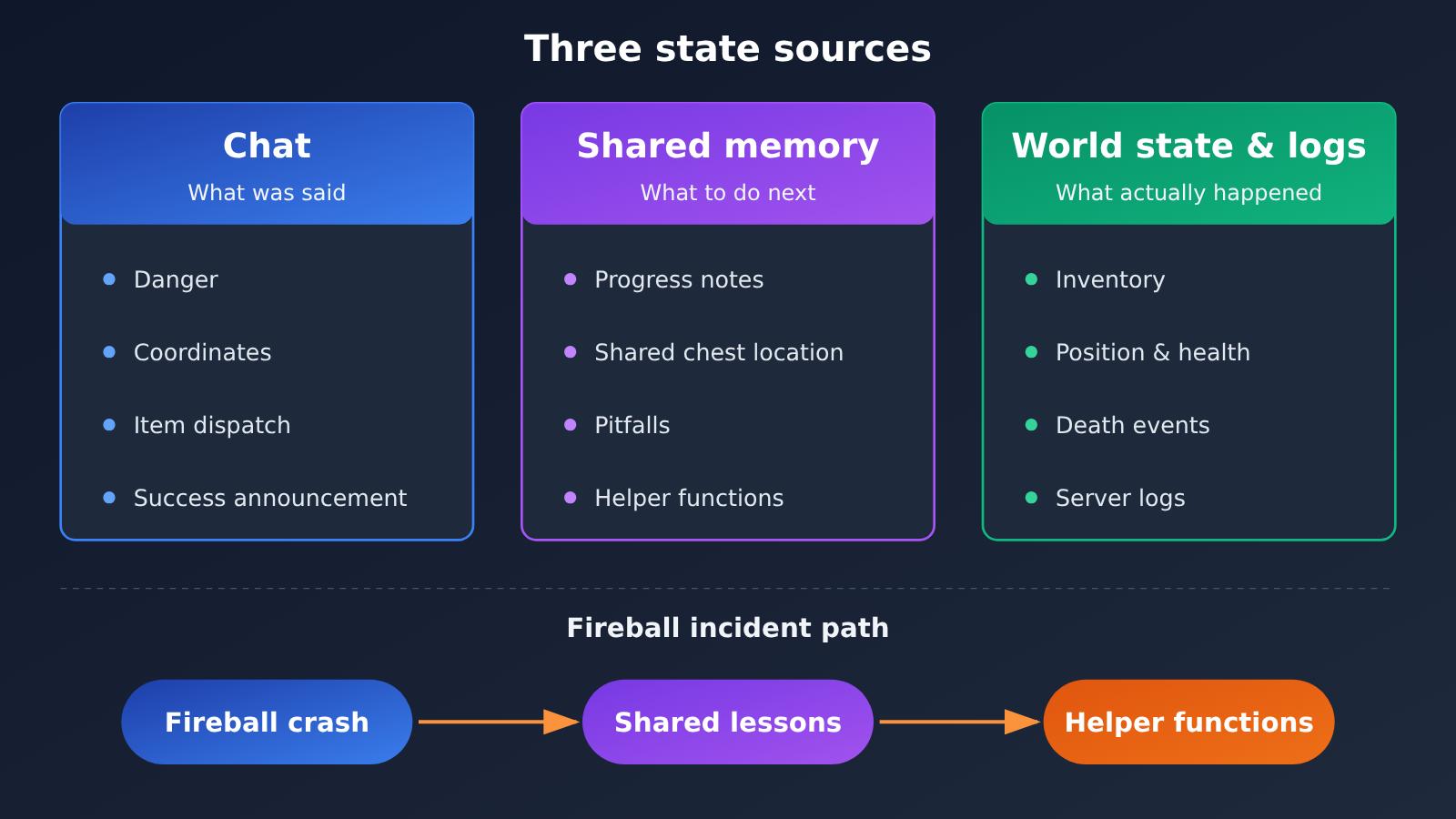
This lets us separate three sources of state, each answering a different question:
| State source | What it contained in the experiment | Question it answers |
|---|---|---|
| In-game chat | hazards, coordinates, items, assignments, announcements | What the team currently knows and has claimed |
| Private and shared persistent memory | progress notes, shared chest and entrance locations, pitfalls hit, next-step plans; before context compaction, information to keep is written into memory | How to continue when a new round starts or someone else takes over |
| Game world, program output, server logs | inventory, position, health, death and progress events, world saves | Whether actions actually took effect, and whether the current state conflicts with earlier claims |
3. How to Catch a Premature Success Message After a Gemini 4 Argon Restart
3.1 The Retracted 14 vs. the Actually Recovered 12
The event recorded in Figure 14 happened before the drowning incident. At +12:02:36, auratian’s script sent a message saying it had deposited 14 Eyes of Ender in the shared chest in the Overworld. About two minutes later, at +12:04:46, auratian issued a correction: the save used for the restart had been saved after their own death, and their inventory was empty when they respawned; the previous success announcement had come from a script branch that didn’t check the conditions.
So “14” was a retracted claim, while the “12” actually recovered in Figure 8 belongs to the later event—the two numbers shouldn’t be mixed up. The paper gives another example: janesick reported bringing back 12 Blaze Powder one second after dying, and gyldenia pointed out the contradiction within three minutes. Just because a script can send a success message doesn’t mean there’s actually anything in the inventory.
3.2 Saves, Restarts, and Endgame Verification for Gemini 4 Argon
The server saves every five minutes. Six infrastructure restarts paused the run for about 20 minutes total, and that downtime is counted inside the 27 hours 14 minutes. The paper describes several distinct layers of persistence: world saves, restart recovery, context compression, and global objects living in the bot program’s memory. Plans stored in shared memory can survive, but whether inventory, handed-off items, and tasks can keep going has to be confirmed by re-reading actual state after a restart. You can’t assume variables in the process will be preserved just because the world restarted.
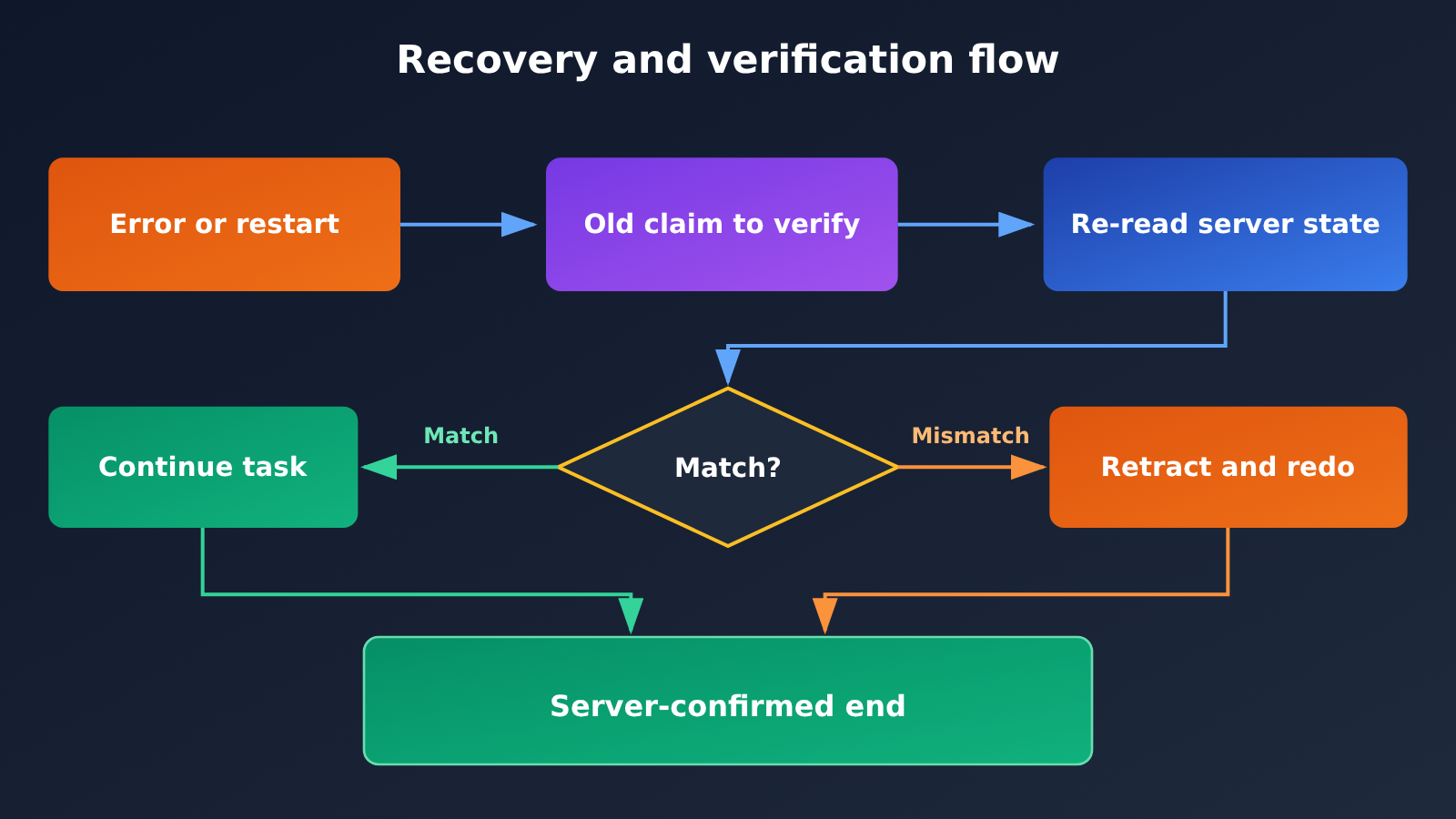
The endgame phase also depended on state reads. The team adjusted its judgment based on the Ender Dragon’s internal state and health. Around hour 21, auratian found the blocker: the end crystals were continuously healing the dragon. The team then pillared up to the top of the pillars with dirt and took out all ten crystals. The last one was destroyed at about 26 hours 34 minutes, and bulicame completed the kill roughly 39 minutes later. The server’s Free the End record for bulicame is win evidence that’s independent of chat. The paper reports that the 2,783 programs run before the kill, along with their outputs, communication records, and server logs, were preserved — but the public version only offers some figures and text descriptions, with no downloadable full trajectory.
3.3 How Should We Read 605 Deaths?
Figure 13, based on server logs, counts a combined 605 deaths among the top four players by kills. All these failures happened within a single successful run — not 605 restarts.
| Cause of death | Count |
|---|---|
| Normal mobs | 351 |
| Ender Dragon | 69 |
| Drowning | 67 |
| Fall and void | 57 |
| Lava and fire | 47 |
| Other | 14 |
| Total | 605 |
Three numbers are easy to confuse, and each has its own unit: about 22% of programs ended in an error — a program-level metric; 605 is the number of character deaths; 6 is the number of infrastructure restarts. Some End actions used a quit-then-retry strategy, but Figure 13 doesn’t distinguish intentional deaths from accidental ones. In another figure, 229 chat messages were tagged using rule-based matching: 173 contained exact coordinates, 64 involved shared chests, 24 were warnings, 20 involved item recovery, and 11 were experience tips. A single message can belong to multiple categories at once, so you can’t use that to say there were 20 separate rescues, and the counts for each category can’t be added together.
4. Using the Gemini 4 Argon Approach to Run Recovery Drills for Multi-Step API Tasks
4.1 Task and State Fields for the Gemini 4 Argon-Style Drill
What follows is an editorially designed synthetic exercise — it wasn’t actually run this round. The task is to generate a validation report for a synthetic CSV inside an isolated environment, with no production writes attached. There are three roles: read-and-organize, write-the-report, and independent review. The shared record keeps at least these fields: task_id, input_version, owner, state, deadline, completed_steps, evidence_uri. Every time someone new takes over, the version number increments.
State moves through “unclaimed → in progress → blocked or verifiable → accepted.” Old claims aren’t deleted — they’re marked as retracted. The reviewer treats the output file’s row count, content checksum, and unique task record as evidence, which mirrors the experiment’s practice of “reading the world state, not trusting chat announcements.”
import csv, hashlib
from pathlib import Path

def verify_report(record, expected_rows):
    """Reviewer role: judge only from the actual artifact, never from the executor's completion claim."""
    p = Path(record["evidence_uri"])
    if not p.exists():
        return {"ok": False, "reason": "missing_output"}
    data = p.read_bytes()
    rows = list(csv.reader(data.decode("utf-8").splitlines()))
    if len(rows) - 1 != expected_rows:          # subtract the header row
        return {"ok": False, "reason": f"row_mismatch:{len(rows)-1}"}
    return {"ok": True, "sha256": hashlib.sha256(data).hexdigest()}

def accept_or_retract(record, claims, expected_rows):
    result = verify_report(record, expected_rows)
    if result["ok"]:
        record["state"] = "accepted"
    else:
        for c in claims:                         # keep the old claim, only flip the marker
            if c["task_id"] == record["task_id"] and c["status"] == "claimed_done":
                c["status"] = "retracted"
                c["reason"] = result["reason"]
        record["state"] = "blocked"
    return record, result

def idempotent_write(record, content, out_dir):
    """Use task_id + input_version as the unique key so repeated requests land only one result."""
    target = Path(out_dir) / f'{record["task_id"]}_v{record["input_version"]}.csv'
    if target.exists():
        return target                            # already written, return it directly
    tmp = target.with_suffix(".tmp")
    tmp.write_text(content, encoding="utf-8")
    tmp.rename(target)
    return target
4.2 Four Types of Fault Inputs and Verifiable Expectations
| Fault injection | Corresponding experimental symptom | Acceptance expectation |
|---|---|---|
| The organizing role exits after claiming a task, leaving the result unhanded off | A team member carrying the Eye of Ender drowns | Claim state is readable; once re-claim conditions are met, another role takes over, first checking the latest checkpoint and the missing artifacts |
| The write succeeds, but the response is deliberately dropped | Uncertain whether the action took effect | Retry with the same task_id; in the end there’s only one valid report, with no duplicate submission |
| A role declares the report complete, but the actual output is empty or has the wrong line count | The false report of 14 Eyes of Ender | The verifying role reads the file back, logs an alert, and retracts the old claim, then re-validates after the fix |
| The service restarts, or a role holding a stale version submits results late | The save is from after the death, and the inventory is empty | Recover from the persisted state, refuse to overwrite newer results, and complete acceptance with the same input version |
There are two acceptance criteria: produce exactly one correct report, and keep all retraction records intact. Each round records recovery time, the number of duplicate writes, the number of false passes, and the endpoint success rate.
4.3 When You Want to Compare Single-Role and Multi-Role
DeepMind’s experiment had no single-agent control under the same setup, so you can’t derive the net benefit of multi-agent from it. If you want to measure it yourself, you need to do a few things: use the same model, the same test data, and the same tool permissions for the single-role baseline and the multi-role group; pre-agree on a matched time or token cap; run multiple rounds under the same set of fault conditions; and report the endpoint pass rate, recovery time, dispatch overhead, and whole-group cost for both groups.
Costs should be counted per group. The paper estimates that up to the kill, the four players made about 24,000 model calls, with about 1.35 billion input tokens — roughly 91% of which came from cache — and about 16 million output tokens. At Google’s introductory pricing that’s about $520, and at standard pricing about $1,040. If you also count the Observer and a day of activity after the win, the full session is estimated at about $810 or $1,620. These are estimates based on the price list, not actual bills.
The final test is simple: after injecting the four kinds of faults, the verifying role only looks at the actual artifacts. If it can confirm “one correct report plus a complete chain of retraction records,” that means this recovery process can catch failures.
Sources:
- DeepMind preprint paper: arxiv.org/abs/2610.22319
- Full paper (Methods, 27-hour run, Verification, Limitations): arxiv.org/html/2610.22319v1
- Mineflayer project: github.com/PrismarineJS/mineflayer
- AWS Builders’ Library on retry and idempotency design: aws.amazon.com/builders-library/making-retries-safe-with-idempotent-APIs


