
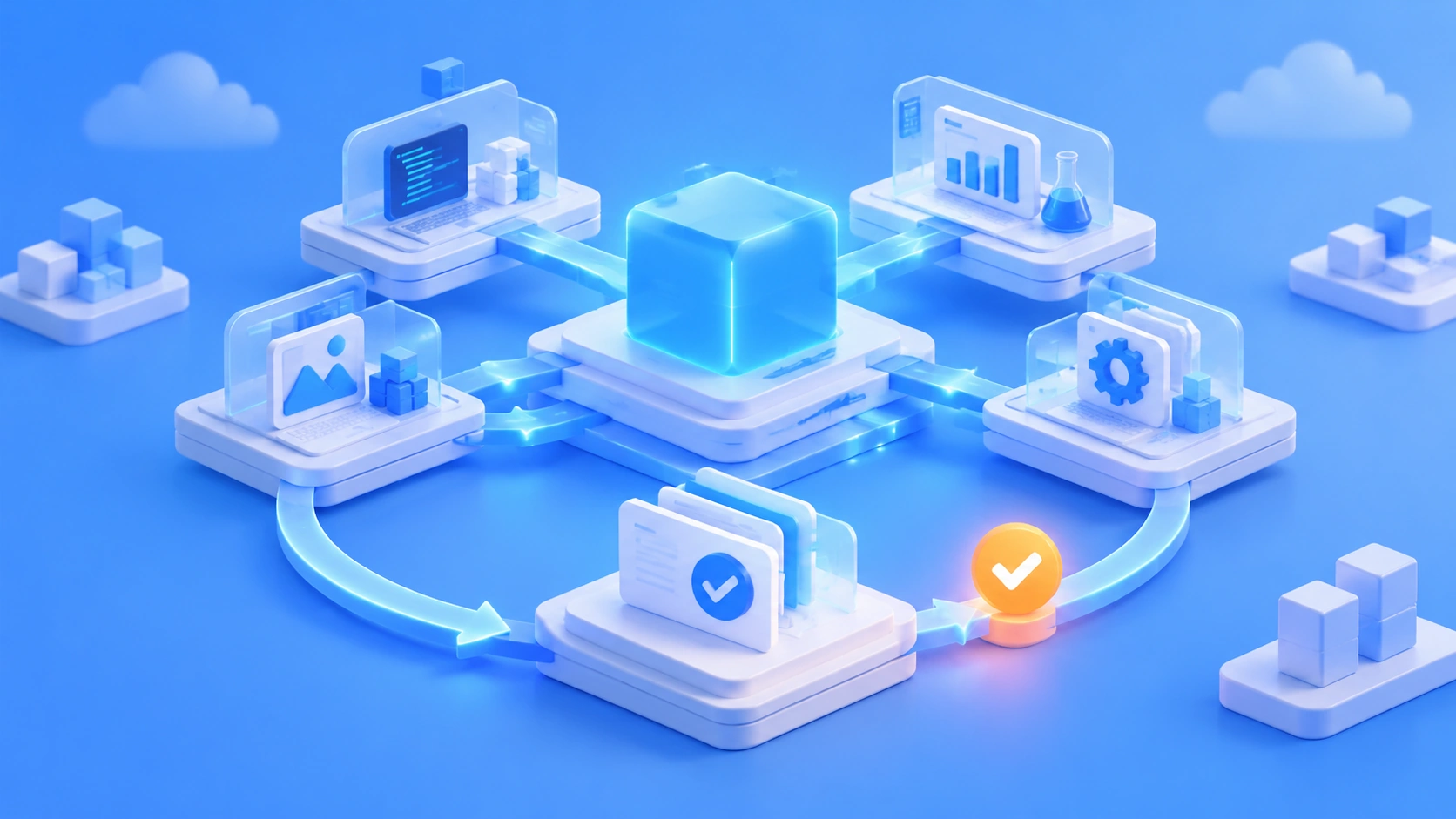
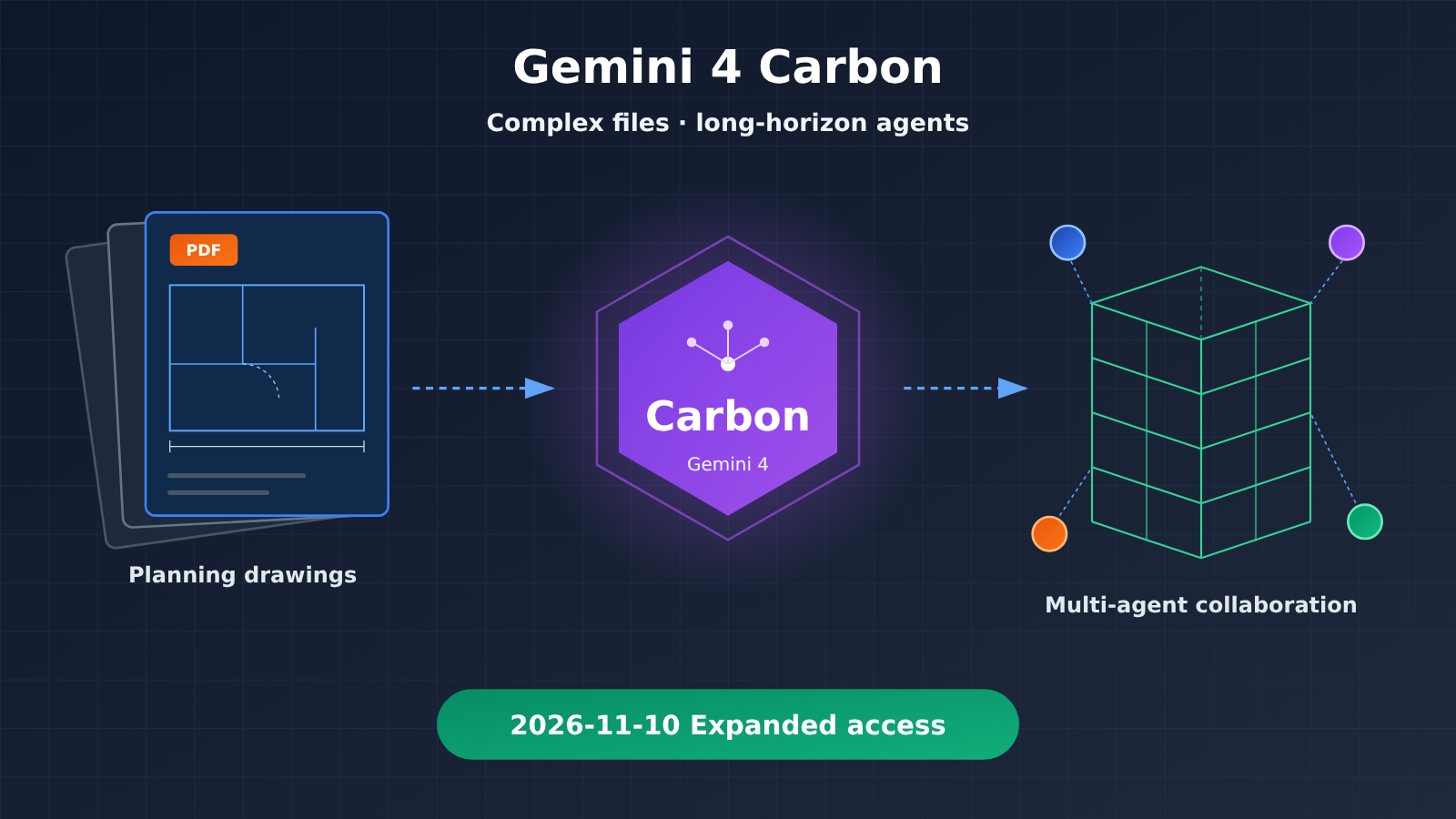
Gemini 4 Carbon’s expanded access is worth watching, but it isn’t an “all-around upgrade” for everyday Q&A. In its 2026-11-10 announcement, Google positioned it as a model for multi-step coding, debugging, and scientific research, and made clear that most day-to-day work is still better suited to Argon. There are two real things to watch in this expanded access: first, whether it can understand complex documents like planning drawings; second, whether it can use the Antigravity /swarm preview to split a long-horizon project across multiple agents working together.
What will you learn from this article?
- The timing, audience, entry point, and starting price of Gemini 4 Carbon’s expanded access.
- The division of labor between Carbon and Argon, and which tasks are actually worth using Carbon for.
- How the Antigravity /swarm preview assigns work across agents, and its current status.
- What specific information the office-building 3D reconstruction case Google showed includes—and what it doesn’t demonstrate.
- Three technical questions: complex document understanding, sharing constraints across parallel agents, and recovery points for long-running tasks.
Index: First, a To Know table explains a few key concepts; then an impact-at-a-glance section explains what this expanded access means for different groups. The “Objective Facts” section lays out, in order, the scope of access, model positioning, pricing and entry point, the /swarm preview, and the official case study, covering only what the announcement supports. The “Analysis and Judgment” section discusses why understanding drawings goes beyond OCR, how multiple agents can share dimensional and interface constraints, why long-running tasks need recovery points, and finally what signals are worth watching next.
To Know: Understanding the 6 Concepts Behind Gemini 4 Carbon
| Concept | Quick Explanation |
|---|---|
| Gemini 4 Carbon | Google’s model in the Gemini 4 series geared toward multi-step code, debugging, and scientific research — leaning toward complex, time-consuming tasks |
| Argon | Another tier of model mentioned officially. According to the announcement, it’s still a better fit for most everyday work |
| Long-horizon agent projects | Tasks that need multiple steps, multiple rounds of iteration, or even overnight runs, where the agent has to plan, execute, check, and correct its results |
| Antigravity /swarm | A preview feature in Antigravity that organizes design, coordination, execution, and verification agents to collaborate on completing a task |
| Engineering drawing views | The different perspectives in a drawing — plan, elevation, section, detail, and so on — where the same component often shows up across multiple views |
| Recovery point | An intermediate state saved during a long-running task, so you can resume from it after a failure or interruption instead of starting over |
Gemini 4 Carbon Impact at a Glance
The impact of this expanded access isn’t uniform. It mainly affects people who deal with complex code, long files, and multi-step research; for users who just need everyday writing or simple Q&A, the changes are limited.
| Audience | Main Impact | What to Watch Out For |
|---|---|---|
| Paid developers and enterprises | Can access Carbon through the API to test complex code, debugging, and research workflows | The introductory price is the price at announcement time — don’t write it into your budget as a long-term fixed rate |
| Ultra users | Access is gradually rolling out, and they may gain usage channels over time | “Gradual rollout” means different accounts may get access at different times |
| Engineering, architecture, and design teams | Official case studies show the possibility of going from drawings to 3D reconstruction | The cases are vendor demos and don’t prove that any project can be completed without human intervention |
| Agent workflow developers | /swarm offers a reference paradigm for dividing work among multiple agents | It’s still a preview feature, not a generally available stable release |
| Ordinary everyday users | Officials recommend Argon for most everyday work | No need to chase Carbon for simple tasks |
Gemini 4 Carbon: The Facts
When and How Gemini 4 Carbon Opened Up
Google published an announcement on 2026-11-10 saying it was widening access to Gemini 4 Carbon. The fact-check date for this article is 2026-11-17. It’s worth stressing that this isn’t the first time Carbon has been made available in any form. The announcement notes that it had already been opened to certain cyberdefense agencies before this.
So it’s more accurate to read this as “expanding availability” rather than “first release.” For readers tracking the timeline, that distinction shapes how you judge the model’s maturity and how much testing it had already been through.
What Gemini 4 Carbon Is For: Multi-Step Code, Debugging, and Scientific Research
The official positioning for Carbon is clear: it targets multi-step code, debugging, and scientific research. What these tasks share is long chains, many dependencies, and low tolerance for error. The model doesn’t just produce a single answer — it has to stay consistent across multiple steps and adjust course based on intermediate results.
The announcement also says most everyday work is still better suited to Argon. That tells you Google isn’t packaging Carbon as the default choice for every scenario; it’s layering the lineup by task complexity.
Gemini 4 Carbon API Pricing and Access Points
Per the announcement, the Carbon API is available to paid developers and enterprises, with access gradually opening up to Ultra users as well. The table below reflects the introductory pricing from the announcement — it isn’t a long-term fixed price, and it isn’t a quote from any third-party platform.
| Item | Announcement Details |
|---|---|
| API availability | Paid developers and enterprises |
| Input price | Introductory rate of $2 per million tokens |
| Output price | Introductory rate of $10 per million tokens |
| Ultra users | Access opening gradually |
| Prior availability | Already open to certain cyberdefense agencies |
Output costs 5x input, which matters a lot for long-running agent projects. Across multiple iterations, agents generate plans, code, inspection reports, and revision notes — and output volume tends to grow with each round. Actual cost also depends on the number of task rounds, context size, and final billing rules. This article hasn’t run any hands-on measurements.
Antigravity /swarm Preview: Design, Coordination, Execution, and Verification
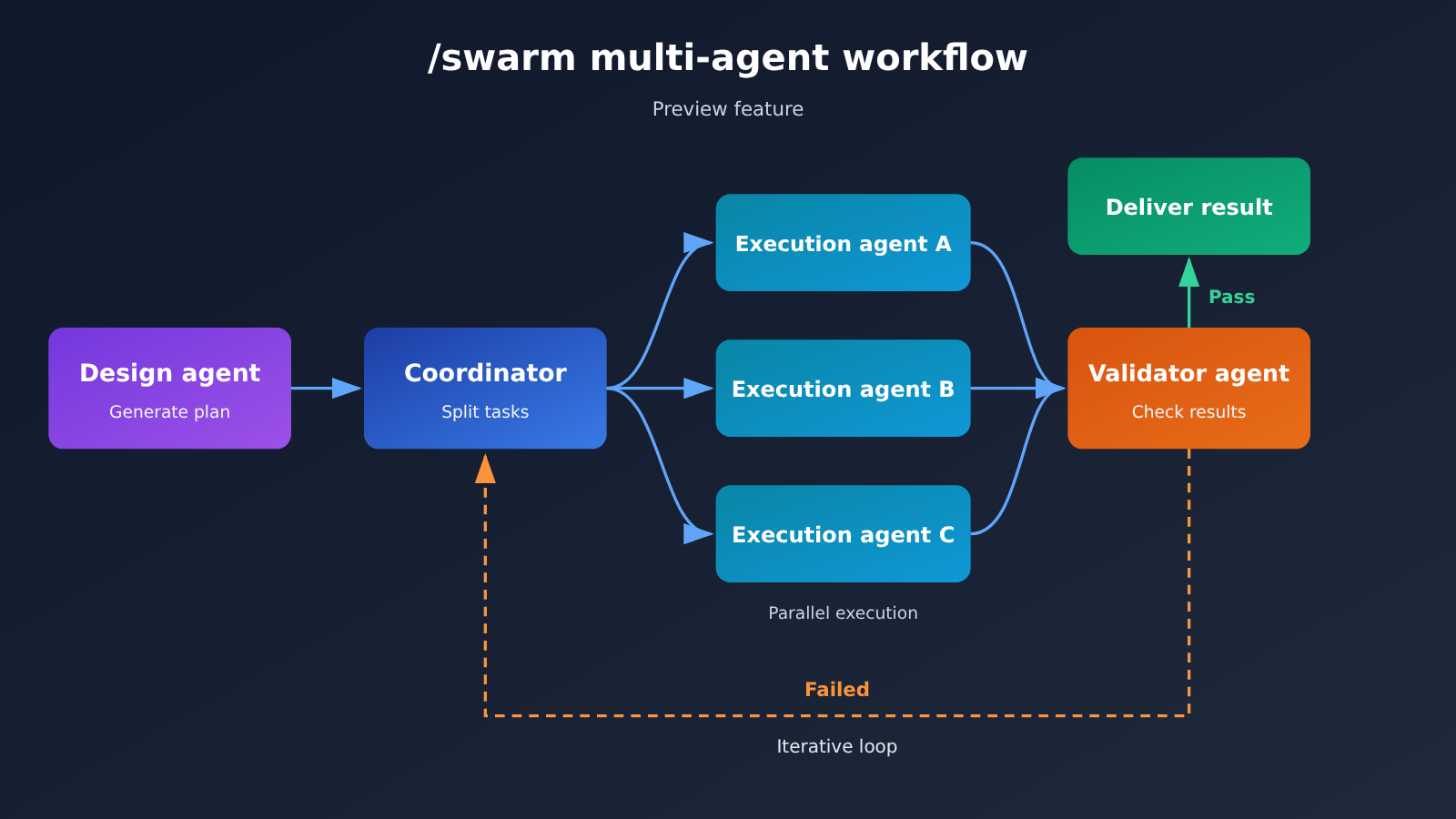
Google also introduced the /swarm preview feature in Antigravity. According to the announcement, it organizes several types of agents: design, coordination, execution, and verification. These roles map to solution design, task distribution, hands-on implementation, and results checking.
/swarm is currently a preview feature. The announcement doesn’t provide enough information to say it’s broadly available, nor that it has reached the reliability bar of a stable release.
Official Gemini 4 Carbon Case Study: Seven PDFs and 206 Views
Google showcased a 3D reconstruction case for an office building. The input materials included seven planning PDFs containing 206 engineering drawing views. Over ten overnight iterations, the system produced a 3D reconstruction of the office building.
The numbers in this case are quite specific, but it’s a vendor showcase. The announcement doesn’t reveal how much human inspection, correction, or filtering went into it, and you can’t conclude that any similar project could be completed unattended.
Gemini 4 Carbon: Analysis and Assessment
The following is an analysis based on the facts above—not an official statement. Anything that touches on future trends is a prediction.
Why Gemini 4 Carbon’s drawing comprehension goes beyond OCR
OCR solves the problem of “reading the text on a drawing,” but the real challenge with engineering drawings is spatial relationships. The same beam might be just a line in a plan view, show its height in a section view, and indicate connection details in a detail drawing. The model needs to align these views to recognize that they’re describing the same component.
In the case with seven PDFs and 206 views, the genuinely hard part is cross-referencing. Dimensions, grid numbers, legends, and scales all have to stay consistent—misread any one of them, and the 3D model can end up misaligned. So this case tests structured understanding across multiple source files, not just text recognition.
| Capability Level | Main Work | Role in 3D Reconstruction |
|---|---|---|
| Text recognition | Reading annotations, numbers, and descriptive text | Provides basic information but can’t complete reconstruction on its own |
| Single-image understanding | Identifying lines, components, and scale relationships | Can reconstruct the structure within a single view |
| Cross-view alignment | Matching the same component across multiple views | Determines whether the 3D model is self-consistent |
| Cross-file consistency | Handling version and interface relationships among multiple PDFs | Determines whether the whole project can be assembled |
Parallel Agents Must Share Size and Interface Constraints
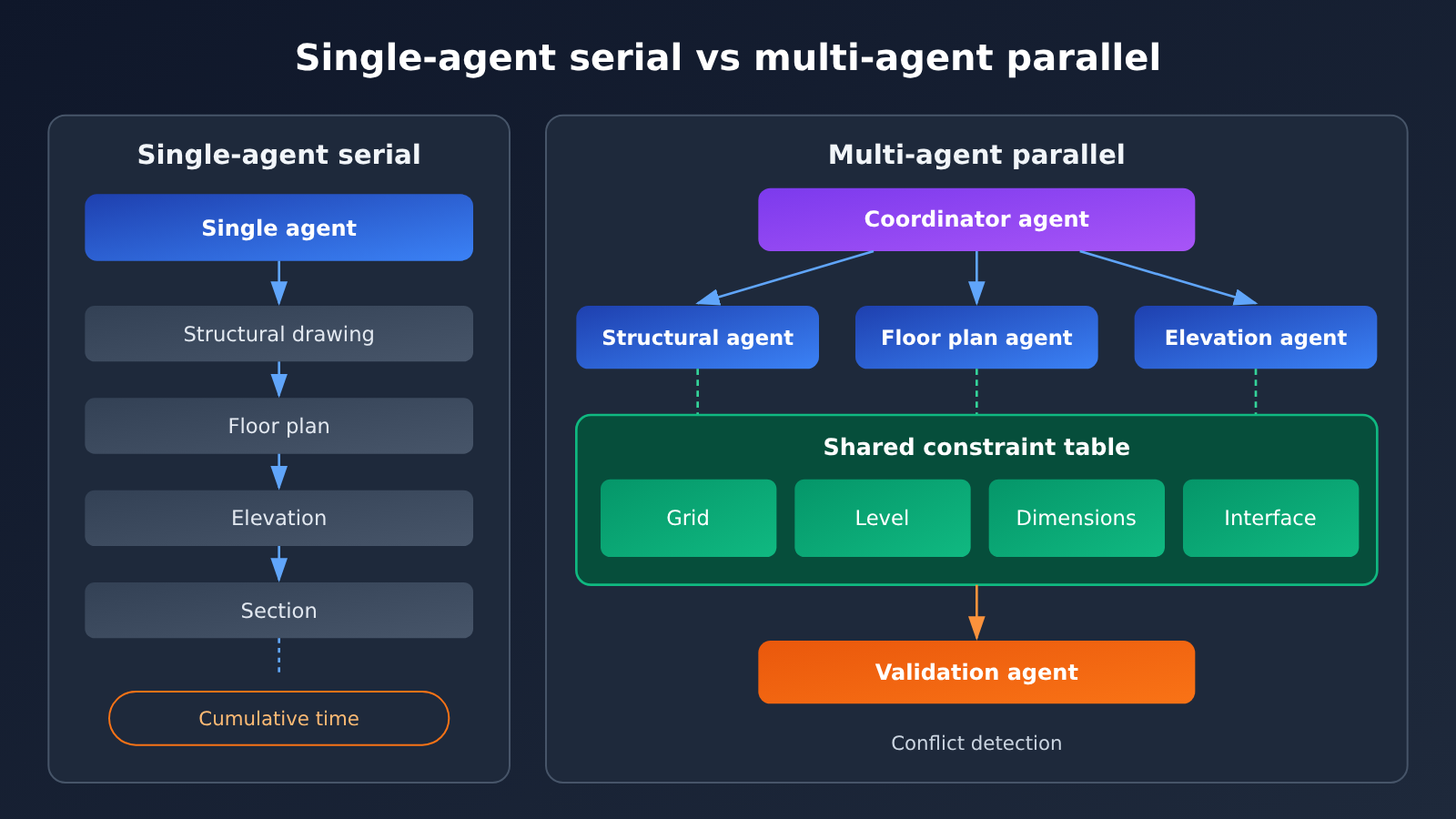
Multi-agent parallelism can shorten the time spent, but it also brings new risks. If one execution agent handles the structure and another handles the facade, and they each have slightly different understandings of floor height, conflicts will pop up when everything is finally assembled. So agents can’t just be handed tasks—they also need to share a set of constraints.
In architecture scenarios, that set of constraints usually includes grids, elevations, component sizes, and interface locations. In software scenarios, the equivalents are interface definitions, data formats, and module boundaries. /swarm sets up coordinator agents and verification agents, which you can think of as splitting “division of labor” and “alignment” into two separate responsibilities. That said, how well it works in real projects still needs more public feedback after the preview phase.
Long Tasks Need Reliable Recovery Points
“Ten rounds of nighttime iteration” shows that this kind of task can’t be completed in a single call. The longer it runs, the more likely it is to hit interruptions, wrong conclusions, or context drift. If every error meant starting over from scratch, both cost and time would rise significantly.
Recovery points save verified intermediate states—for example, confirmed grids or floor models that have already passed inspection. Later iterations can pick up from there, and verification agents can also narrow issues down to the most recent round of changes. For teams planning to use Carbon for long-horizon tasks, this design matters just as much as the model’s capabilities themselves.
How Developers Should Interpret This Release
For developers, the safer approach is to first route work by task complexity. Hand simple Q&A, rewriting, and routine coding to Argon; consider Carbon for cross-file understanding, complex debugging, and multi-step research. This aligns with the official positioning and avoids unnecessary output costs on simple tasks.
| Task characteristics | Better fit | Rationale |
|---|---|---|
| Everyday Q&A, writing, simple coding | Argon | Official guidance says most daily work still fits Argon |
| Multi-step code changes and debugging | Carbon | Matches the official core positioning |
| Multi-step reasoning in scientific research | Carbon | Explicitly mentioned in the announcement |
| Cross-understanding of multiple complex files | Carbon, with human verification | The case demonstrates potential, but it’s still a vendor showcase |
| Multi-agent long-horizon projects | Carbon + /swarm preview, trial with caution | /swarm isn’t broadly available yet and isn’t a stable release |
On pricing, the 2/10 USD figures are the entry-level prices in the announcement—check the official page regularly to confirm. For rollout, it’s best to keep a human acceptance step for key outputs, especially for engineering, compliance, and security-related tasks.
Signals to Watch for After Gemini 4 Carbon
A few follow-up developments will shape how we judge Carbon:
- Whether /swarm leaves preview: Only a more stable, broader release would be suitable for real production workflows.
- Whether pricing shifts: The very phrase “entry-level price” implies there’s room for change later on.
- Whether third-party case studies show up: Blueprint comprehension and long-horizon iteration need more independent projects to validate them — you can’t go on vendor demos alone.
- How fast the Ultra entry point opens up: This will determine whether non-API users can get their hands on Carbon.
Turning a building from seven blueprints into a 3D model takes round after round of alignment, verification, and correction. Long-horizon agent projects are no different — what they need is a process you can inspect and resume from where it broke off, not a perfect result delivered in one shot.
“Rome wasn’t built in a day.” (English proverb: Rome wasn’t built in a day.)


