

Author’s note: Google Cloud’s model lifecycle page shows gemini-3.6-flash retiring on 2026-11-19 and gemini-3.7-flash retiring on 2027-01-28. Both list gemini-3.8-flash as the replacement. This post helps you work out which one you actually need to change.
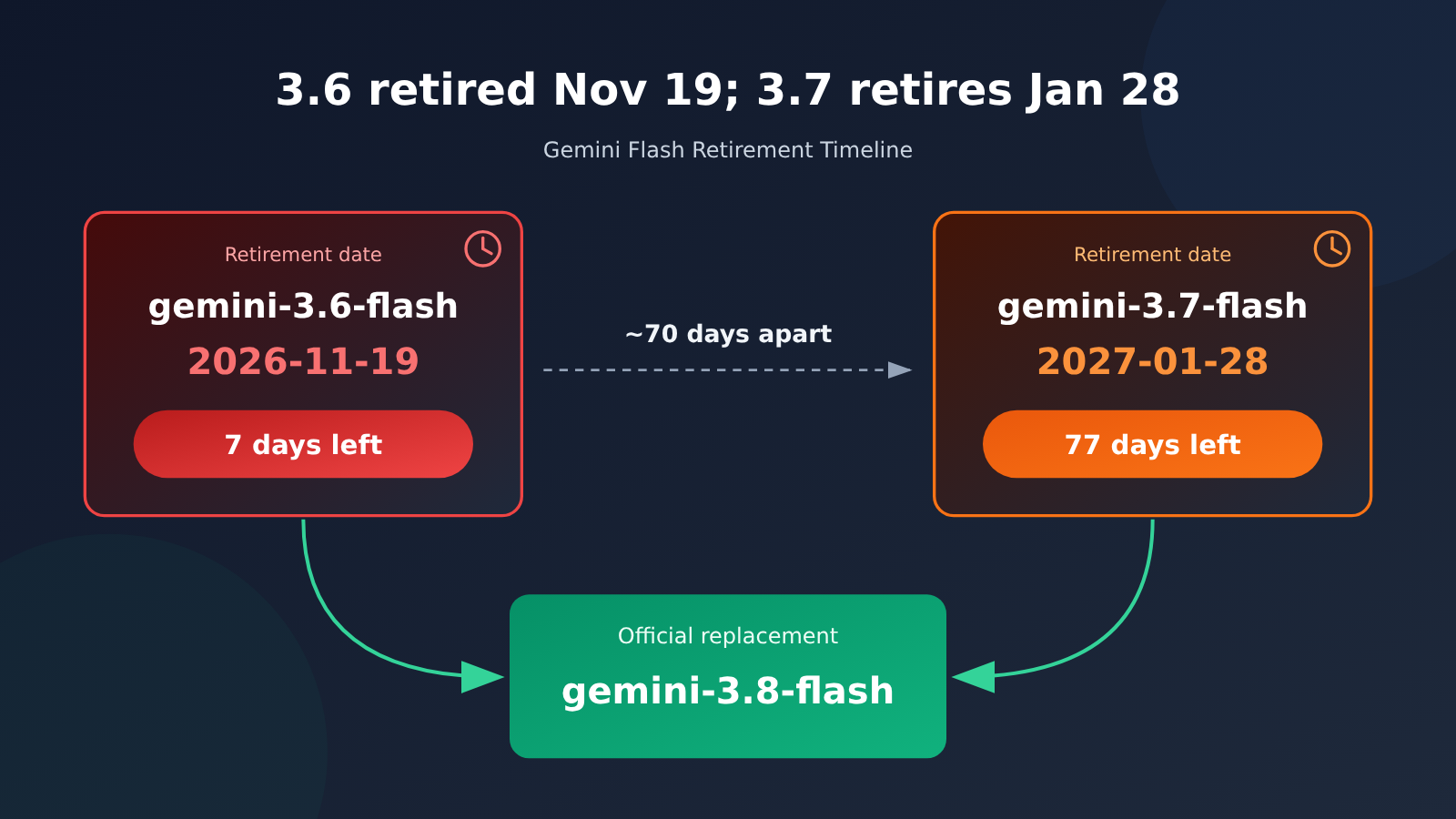
Lately a lot of developers have been hearing “Flash is being shut down.” The first instinct is to grep the codebase for every model name containing “flash,” only to find both 3.6 and 3.7 in use and no clear idea which to fix first. According to the Google Cloud Gemini Enterprise Agent Platform model lifecycle page, the model retiring on November 19 is gemini-3.6-flash, while gemini-3.7-flash retires on January 28, 2027. The official replacement for both is gemini-3.8-flash.
This isn’t a rumor. Both dates are published on Google Cloud’s model lifecycle page. This post does one thing: it untangles the 3.6 and 3.7 timelines so you only change the calls that really need fixing right now.
What you’ll get: In about 3 minutes, you’ll understand the gap between the gemini-3.6-flash and gemini-3.7-flash retirement dates, know what to change this week and what can wait until after the new year, and see how costs shift once you move to gemini-3.8-flash.
gemini-3.6-flash Retirement: Key Facts at a Glance
Let’s put the details that are easiest to mix up into a single table. One thing worth stressing: the retirement dates below come from Google Cloud, and they describe the model lifecycle on the Google Cloud platform. That doesn’t mean other platforms will take the same action on the same day.
| Item | Details |
|---|---|
| Source | Google Cloud Gemini Enterprise Agent Platform model lifecycle page |
| Model retiring on November 19 | gemini-3.6-flash (retirement date: 2026-11-19) |
| Model retiring later | gemini-3.7-flash (retirement date: 2027-01-28) |
| Official replacement | gemini-3.8-flash for both |
| Time until 3.6 retires (counting from 2026-11-12) | About 7 days |
| Time until 3.7 retires (counting from 2026-11-12) | About 77 days |
| Current APIYI price list (2026-11-12) | Still lists both gemini-3.6-flash and gemini-3.8-flash |
Why gemini-3.6-flash and gemini-3.7-flash Are Easy to Confuse
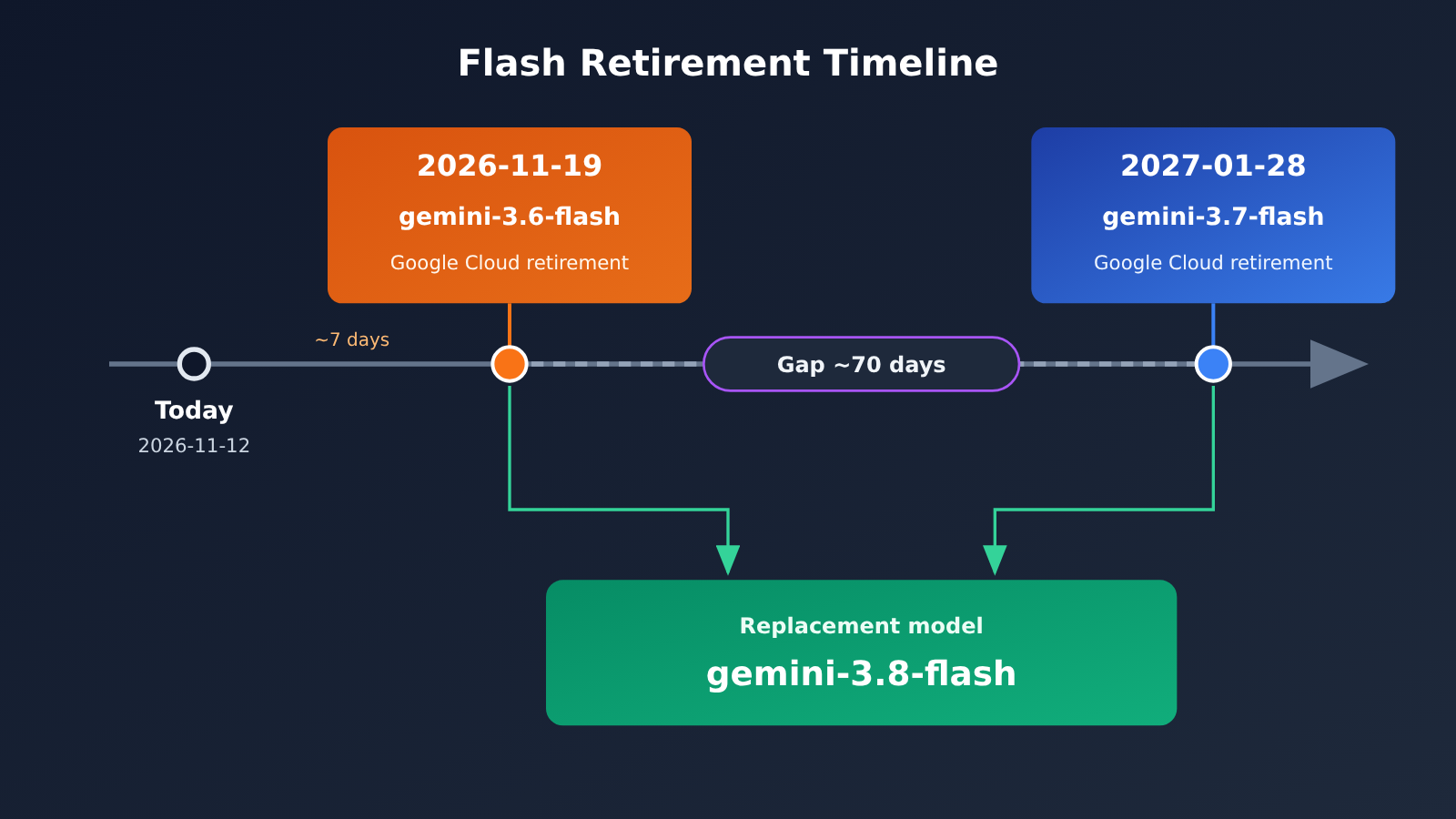
The two model names differ by a single digit, both belong to the Flash series, and they share the same replacement, gemini-3.8-flash. So a quick reminder like “Flash is being retired” is easy to read as the entire series going offline at once. In reality, the two retirement dates are about 70 days apart: November 19 to January 28 of the following year, with all of December sitting in between.
For developers, that 70-day gap matters a lot. If you treat 3.6 and 3.7 as retiring on the same day, you’ll be forced into double the migration and regression testing within a single week. Once you tell them apart, this week you only need to deal with calls to 3.6, and you can schedule 3.7 at a normal pace.
gemini-3.6-flash vs. gemini-3.7-flash Retirement Timeline
Once you look at the two models separately, the migration priorities are pretty clear. You can paste the comparison table below straight into your team’s migration board.
| Item | gemini-3.6-flash | gemini-3.7-flash |
|---|---|---|
| Google Cloud retirement date | 2026-11-19 | 2027-01-28 |
| Time remaining (as of 2026-11-12) | About 7 days | About 77 days |
| Official replacement | gemini-3.8-flash | gemini-3.8-flash |
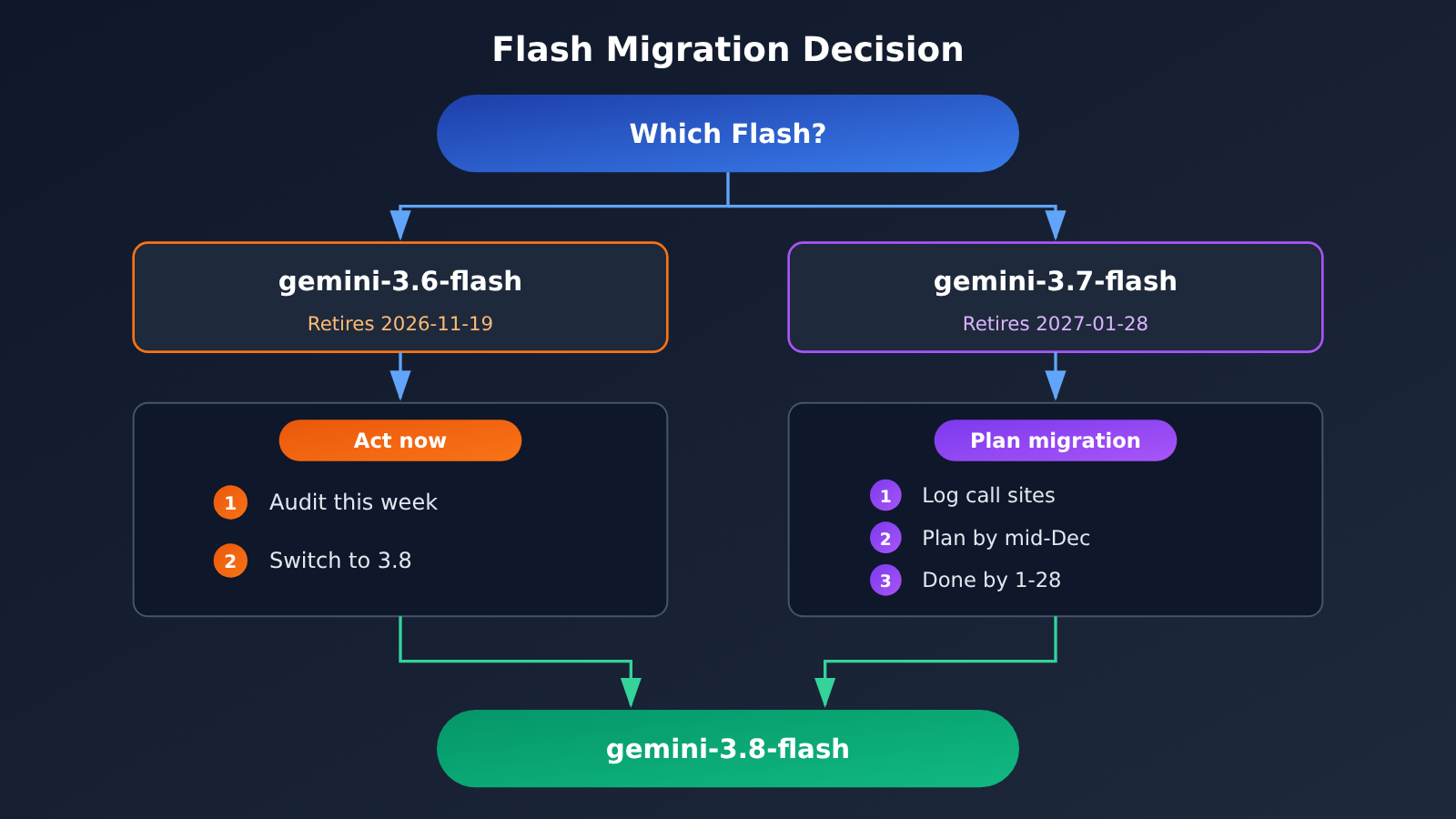
| Migration priority | High, handle this week | Medium, can go into a later iteration |
| Recommended action | Audit call sites and switch immediately | Log the call sites first, and leave time for regression testing |
How to Audit gemini-3.6-flash Call Sites
The key is to match the full model name exactly rather than doing a fuzzy search for “flash”. You can run grep -rn "gemini-3.6-flash" . in your code repository to list every call site. Then search separately through your config center, environment variables, and any model names stored in your database, since those places are easier to miss than the code itself.
While you’re searching, don’t casually change gemini-3.7-flash at the same time. That’s not to say 3.7 can’t be migrated early. But if you mix both batches of changes together and production behavior starts to fluctuate, it’s hard to tell which batch caused it.
Impact of the gemini-3.6-flash Retirement on Developers
If Your Project Still Calls gemini-3.6-flash
This group is under the most time pressure. If you call gemini-3.6-flash directly through Google Cloud, you need to switch before 2026-11-19. Otherwise, under the lifecycle rules, your requests may stop returning normally.
- Scope of changes: Usually just the
modelfield in your requests, changing fromgemini-3.6-flashtogemini-3.8-flash - Testing focus: Prompt output format, structured JSON responses, and long-text truncation behavior. We recommend preparing a fixed set of samples so you can compare results before and after
- Rollout approach: Start by routing a portion of your traffic to gemini-3.8-flash, watch it for a day or two, then switch over fully
If Your Project Uses gemini-3.7-flash
You don’t need to scramble to meet the November 19 deadline. With about 77 days left until 2027-01-28, you have enough time to run a full evaluation. The safer approach is to first catalog all your call sites, then reuse the same regression samples to migrate 3.7 once your 3.6 migration is stable.
One thing to keep in mind: the 3.7 retirement date falls after the new year, and many teams have code freezes or holiday schedules from late December through early January. Your actual development window is shorter than 77 days, so we suggest settling on a 3.7 migration plan by mid-December at the latest.
If Your Project Calls Models Through APIYI
Google Cloud’s retirement date is part of Google Cloud’s own lifecycle schedule. It doesn’t mean APIYI will remove the gemini-3.6-flash entry on November 19. As of 2026-11-12, the APIYI pricing page still lists both gemini-3.6-flash and gemini-3.8-flash. For any later changes, please refer to the official APIYI announcements and pricing page.
Even so, the replacement path is already clear. Since gemini-3.8-flash is the official replacement for both models, it’s more comfortable to start switching to it now than to deal with it at the last minute.
gemini-3.6-flash vs. gemini-3.8-flash Pricing
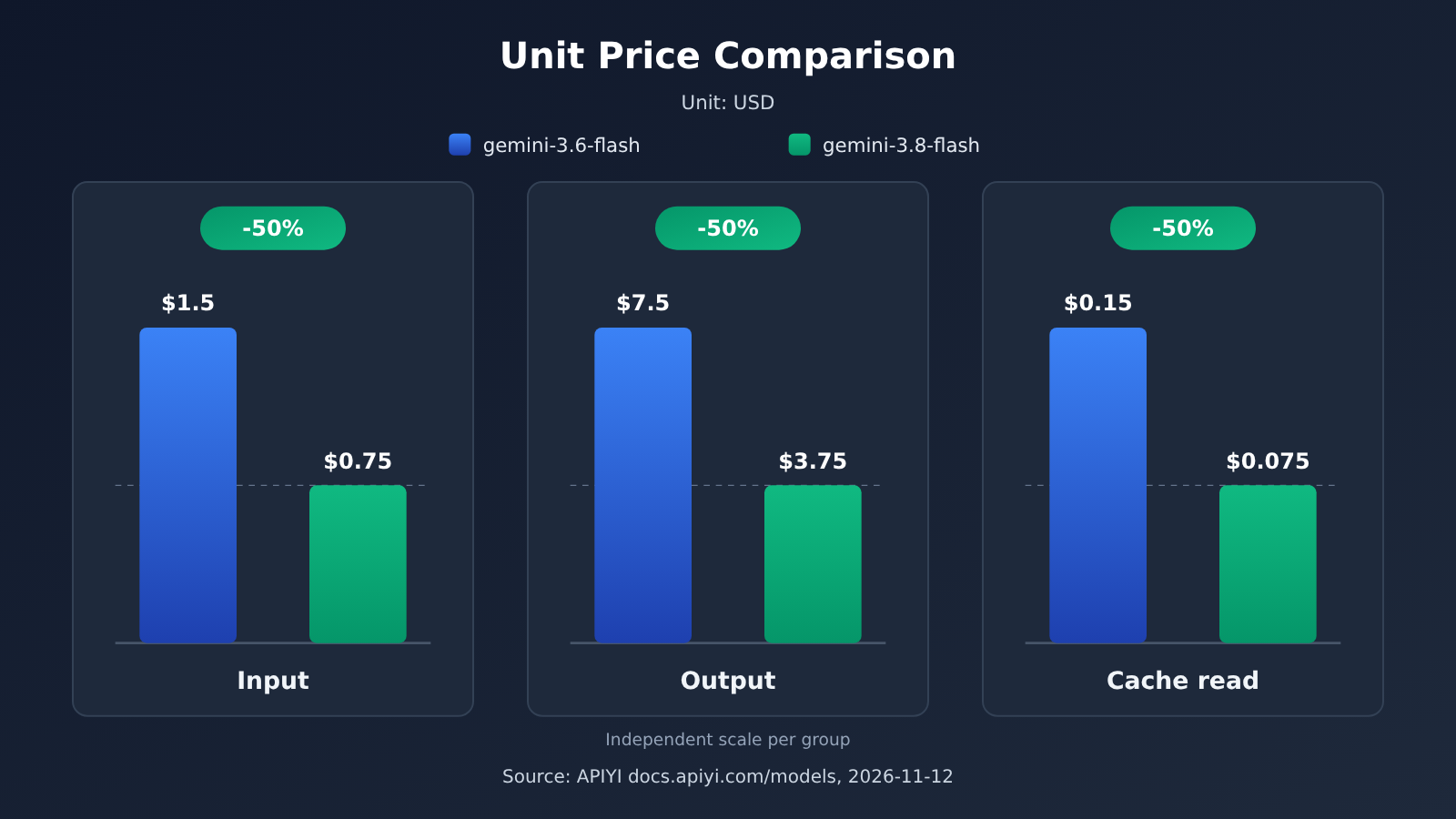
Migrating isn’t just a forced change. The price list shows a cost difference too. The prices below come from the APIYI model pricing page at docs.apiyi.com/models, with a data date of 2026-11-12. Pricing units follow what the pricing page states.
| Billing item | gemini-3.6-flash | gemini-3.8-flash | Change |
|---|---|---|---|
| Input | $1.5 | $0.75 | 50% lower |
| Output | $7.5 | $3.75 | 50% lower |
| Cache read | $0.15 | $0.075 | 50% lower |
| Available platform | Listed on the APIYI apiyi.com pricing page | Listed on the APIYI apiyi.com pricing page | — |
What Halving the gemini-3.8-flash Price Means
All three unit prices are exactly half of gemini-3.6-flash. If your token consumption stays about the same, moving the same traffic to gemini-3.8-flash should cut your model costs roughly in half. For output-heavy workloads like long summaries or batch copywriting, the drop in output price from $7.5 to $3.75 will be even more noticeable.
One caveat: different models may produce outputs of different lengths for the same prompt, so your actual bill also depends on real token consumption. During the gradual rollout, we recommend logging the average input and output token counts for both models, then estimating your real post-migration cost from those numbers.
💰 Cost tip: Before migrating, you can use the same API key on APIYI apiyi.com to call both gemini-3.6-flash and gemini-3.8-flash. Run the same batch of samples through each, compare output quality and token consumption, and then decide when to switch over fully.
How to Switch from gemini-3.6-flash to gemini-3.8-flash
If your project uses an OpenAI-compatible SDK, switching usually takes only a few configuration changes. The table below lists the key changes by setting, so you can just swap them in.
| Setting | Old Value | New Value |
|---|---|---|
base_url |
Your existing endpoint | https://api.apiyi.com/v1 |
api_key |
Your existing key | The key generated in the APIYI console |
model |
gemini-3.6-flash |
gemini-3.8-flash |
| Other parameters | messages, temperature, etc. |
Keep as-is, then fine-tune based on your regression results |
4 Steps to Migrate from gemini-3.6-flash
- Inventory your call sites: Run
grep -rn "gemini-3.6-flash" .and search your config center to list every service that uses 3.6. Track any 3.7 call sites separately. - Prepare regression samples: Pick representative requests from your production logs, covering typical use cases like short Q&A, structured output, and long-context prompts.
- Switch and roll out gradually: In the OpenAI SDK, set
base_url="https://api.apiyi.com/v1"and changemodeltogemini-3.8-flash. Start with a small slice of traffic and watch how it behaves. - Go full rollout and clean up: Once the output format and costs look right, switch all traffic over and remove any hardcoded references to
gemini-3.6-flashfrom your code.
Throughout the process, your request structure and message format stay in the OpenAI-compatible style, so there’s no need to rewrite any business logic. The part that really takes time is the regression samples in step 2. Do that well, and you can reuse them directly when you migrate your 3.7 call sites later.
🚀 Quick start: Sign up at APIYI (apiyi.com) to claim free test credits for new users. A single API key lets you call gemini-3.8-flash as well as OpenAI, Claude, and other major models, which makes side-by-side comparisons easy during the migration.
gemini-3.6-flash Retirement FAQ
Q1: Is it gemini-3.6-flash or gemini-3.7-flash that’s being shut down on November 19?
It’s gemini-3.6-flash. According to the Google Cloud model lifecycle page, gemini-3.6-flash retires on 2026-11-19, while gemini-3.7-flash retires on 2027-01-28. That’s a gap of about 70 days.
Q2: I only use gemini-3.7-flash. Do I need to change anything right now?
You don’t need to rush to finish before November 19 like the gemini-3.6-flash users do. That said, the replacement model is also gemini-3.8-flash, and the year-end holidays will squeeze your development time. We recommend inventorying your call sites first, settling on a migration plan by mid-December, and making sure the switch is done before 2027-01-28.
Q3: After November 19, can I still use gemini-3.6-flash on APIYI?
November 19 is Google Cloud’s retirement date. It isn’t a date on which APIYI has taken the model offline or confirmed its removal. As of 2026-11-12, the APIYI pricing page still lists gemini-3.6-flash. If anything changes later, please refer to the official announcements on APIYI (apiyi.com). Since the upstream replacement path is already clear, we suggest moving to gemini-3.8-flash sooner rather than later.
Q4: How do I quickly call gemini-3.8-flash through the API?
It’s straightforward:
1. Go to APIYI (apiyi.com), register an account, and get your API key
2. In an OpenAI-compatible SDK, set the base URL to `https://api.apiyi.com/v1`
3. Set the `model` parameter to `gemini-3.8-flash` and keep the rest of your parameters as they are
New users get a free test quota, so you can validate results against your regression samples before switching over fully.
Q5: What should I watch out for when moving from gemini-3.6-flash to gemini-3.8-flash?
Swapping the model name is simple, but output style, length, and formatting details can differ between versions. Focus your regression testing on structured output (such as JSON), fixed-format templates, and any downstream parsing logic that depends on specific wording. Also, a unit price that’s cut in half doesn’t necessarily mean your bill will be cut in half, because actual cost depends on real token consumption. It’s a good idea to record token usage for both models during the gradual rollout so you have real numbers to compare.
gemini-3.6-flash Deprecation: Key Takeaways
- November 19 is the cutoff for 3.6: Google Cloud retires gemini-3.6-flash on 2026-11-19
- 3.7 has a buffer: gemini-3.7-flash retires on 2027-01-28, about 70 days later
- Same replacement for both: the official replacement for 3.6 and 3.7 is gemini-3.8-flash
- Only touch 3.6 this week: search for the exact full model name so 3.6 changes don’t get mixed up with 3.7 changes
- Unit costs are cut in half: on the APIYI pricing page, 3.8’s input, output, and cache-read prices are all half of 3.6’s
- Keep platform dates separate: Google Cloud’s retirement date isn’t the same as the date APIYI takes a model offline, so follow the official announcements
- You can switch now: call gemini-3.8-flash directly through APIYI’s OpenAI-compatible endpoint
Summary
When it comes to the gemini-3.6-flash deprecation, there are three main points to remember:
- Keep the timelines straight: gemini-3.6-flash retires on November 19, while gemini-3.7-flash doesn’t retire until January 28, 2027.
- One replacement for both: the official replacement for both models is gemini-3.8-flash, so you only have one migration target.
- The scope is manageable: this week you only need to deal with 3.6 calls, which leaves a full regression-testing window for 3.7.
Rather than scrambling over news that “Flash is being retired,” start by listing every place that calls 3.6, run a fixed set of samples through regression testing, and then plan your 3.7 migration. Once you switch to gemini-3.8-flash, you’ll also pay half as much at current list prices, which is a nice bonus for the migration.
We recommend calling gemini-3.8-flash directly through APIYI at apiyi.com. With a single API key, you can compare the old and new models and roll out the switch gradually, so the migration goes at a more comfortable pace.
📚 References
- Google Cloud Gemini Enterprise Agent Platform model lifecycle page: Retirement dates and replacement models for gemini-3.6-flash and gemini-3.7-flash
- Link:
cloud.google.com(search for the model lifecycle page in the documentation) -
Note: All retirement dates and replacement relationships in this article are based on this page
-
APIYI model pricing page: Input, output, and cache-read prices for gemini-3.6-flash and gemini-3.8-flash
- Link:
docs.apiyi.com/models - Note: The pricing data in this article is as of 2026-11-12. Check the page for the latest actual prices
Author: APIYI Technical Team
Get in touch: If you run into model invocation issues during migration, reach out to us through the APIYI homepage. For more integration guides, check the documentation center.


