

Author’s note: This breaks down Tencent’s self-reported Hy4 flash blind-test table, clarifies exactly which table the claims “on par with Haiku” and “per-task cost about one-eighteenth as high” are based on, and separately checks Anthropic’s two official Claude Haiku 5.5 price tiers and APIYI’s model list.
On November 16, 2026, Tencent Hunyuan launched Hy4 flash. The official post calls it “the cheapest everyday productivity model” and makes an eye-catching claim: in a human blind test on everyday work, it’s on par with Claude Haiku 5.5 (high), while per-task cost is 18 times lower.
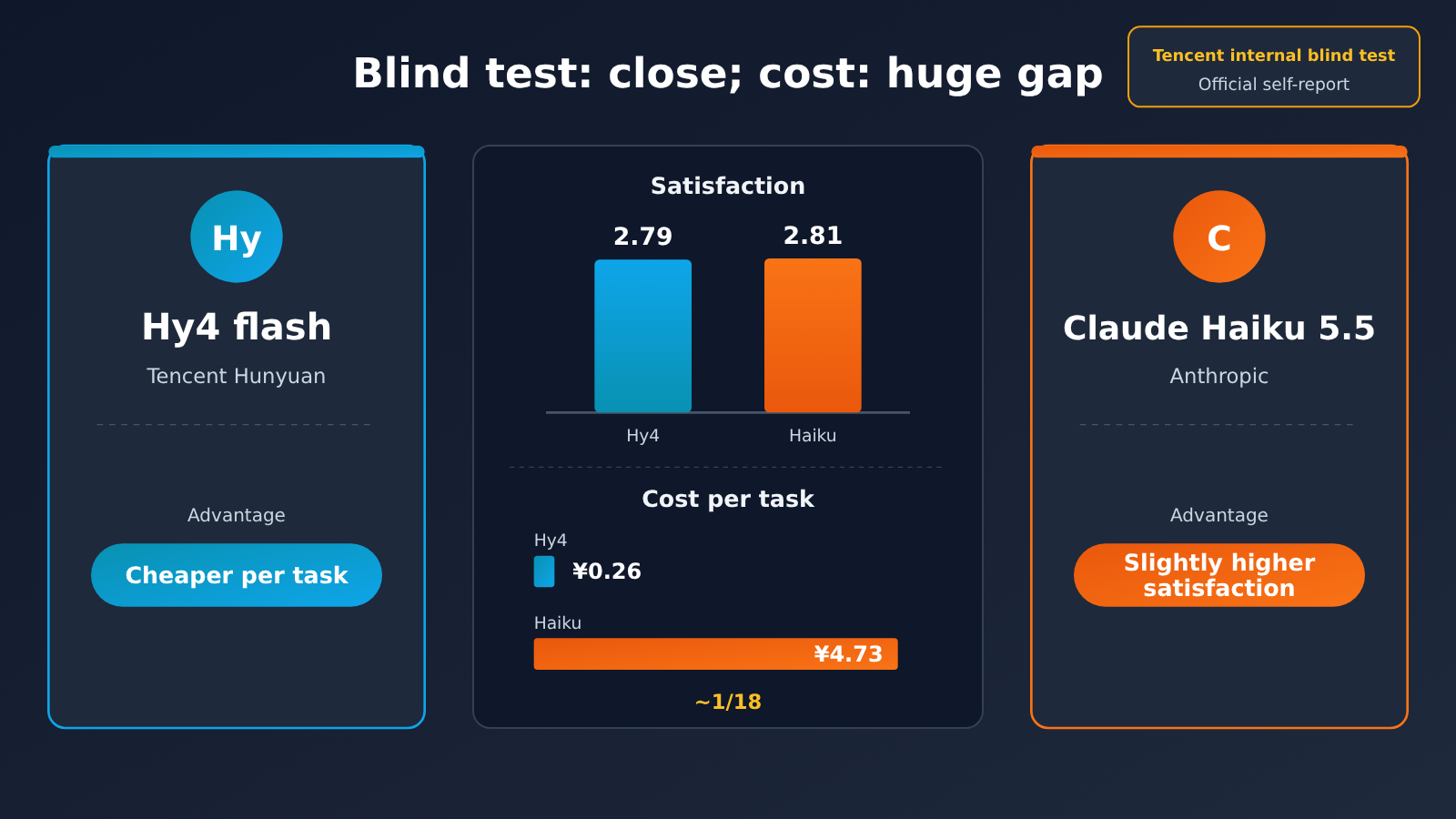
This isn’t a blanket “18 times cheaper” comparison. The 18× figure comes from just one column in one table: per-task cost in Tencent’s internal blind test, 4.73 yuan versus 0.26 yuan. This article treats each of these separately: that table, the WorkIndex and appendix on the research page, Anthropic’s two official price tiers for Claude Haiku 5.5, and APIYI’s model list. If you’re deciding between Haiku 5.5 and cheaper everyday models, by the end you’ll know how to use this number.
Core takeaway: Understand where the Hy4 flash vs. Claude Haiku 5.5 claim actually applies, and know which tasks are good candidates for switching models and which should stay on the existing one.
Hy4 flash vs. Claude Haiku 5.5: Which Table the 1/18 Figure Comes From
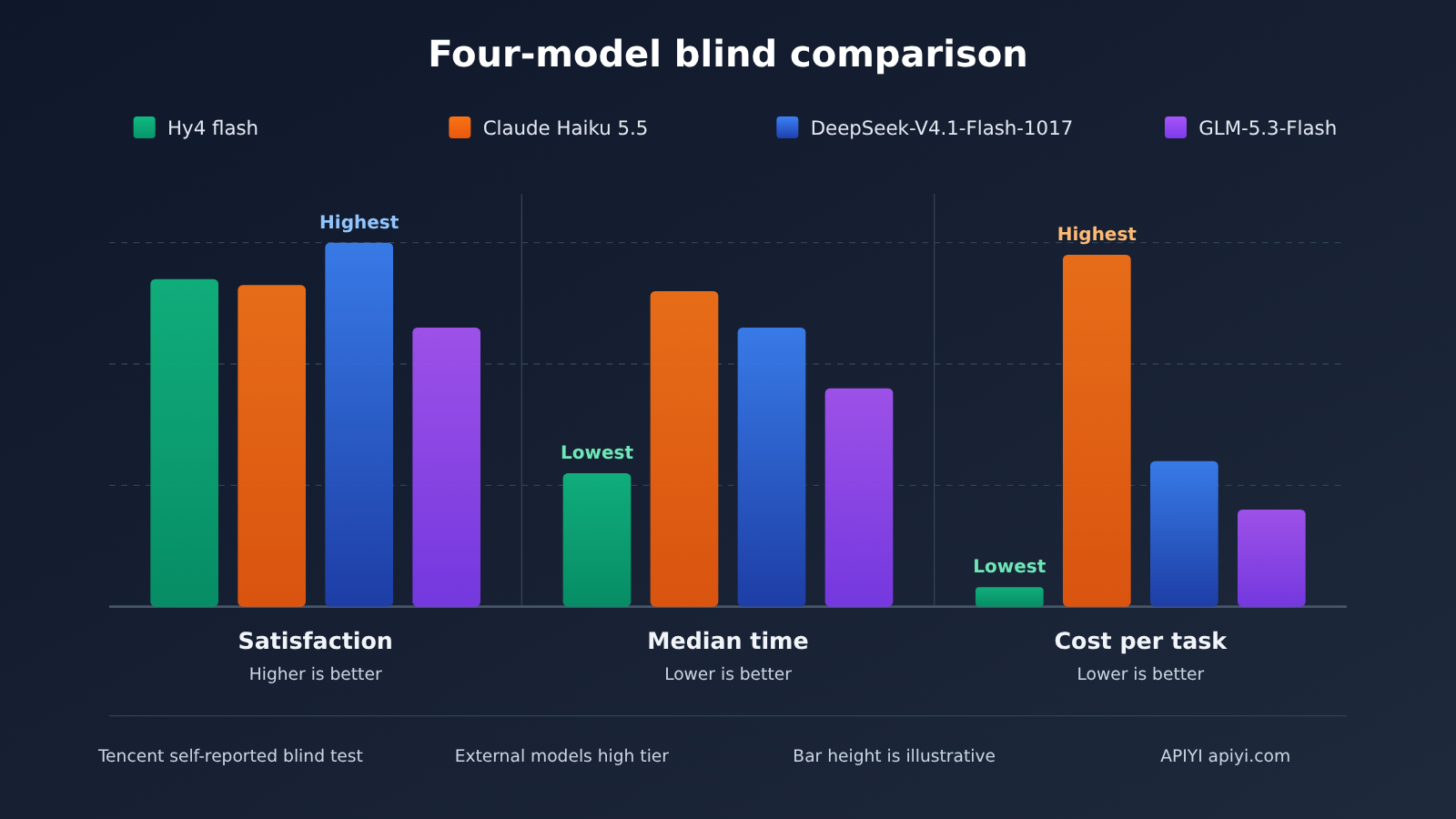
Start with the raw data. The table below comes from the body text and official graphic on the Hy4 flash research page, and it’s Tencent’s own self-reported internal blind test. The participants were 85 internal WorkBuddy users running 259 tasks across 27 categories. External models (DeepSeek, Claude Haiku, GLM) used the high tier; the Hy4 flash row doesn’t specify a tier.
| Model | Satisfaction (4-point scale) | Median end-to-end time | Cost per task (yuan) |
|---|---|---|---|
| DeepSeek-V4.1-Flash-1017 (high) | 3.09 | 10.3 minutes | 1.20 yuan |
| Hy4 flash | 2.79 | 6.7 minutes | 0.26 yuan |
| Claude-Haiku-5.5 (high) | 2.81 | 6.8 minutes | 4.73 yuan |
| GLM-5.3-Flash (high) | 2.53 | 7.6 minutes | 0.81 yuan |
4.73 divided by 0.26 is roughly 18.2, which is where the 18x in the post comes from. The comparison is against Haiku, not DeepSeek, and not Hy4. The highest satisfaction in the table is DeepSeek’s 3.09, and Hy4 flash sits 0.02 points below Haiku. The research page’s wording is close to, so you can’t write it up as “beats Haiku.”
Why Hy4 flash’s per-unit price gap is nowhere near 18x
Compare list prices per million tokens and the gap is much smaller. The research page quotes Hy4 flash at $0.070 input and $0.281 output. Claude Haiku 5.5’s official price for up to 100K tokens is $0.10 input and $0.50 output. On input alone, Hy4 flash is about 70% of Haiku; on output alone, about 56%.
So the 18x is the result of “how much it cost to finish one task in total,” not a multiple of the per-token price. The research page notes that reinforcement learning cut average end-to-end output tokens by 50%. But the blind test table itself doesn’t break down the cost components, so you can’t claim the 18x comes entirely from any single factor. The safer reading is: on this batch of everyday tasks inside Tencent, run with this configuration, task cost differs by about 18x. Swap in your own tasks, prompt lengths, or thinking tier, and you’ll need to rerun the numbers.
Hy4 flash vs. Claude Haiku 5.5: Core Differences
The table below puts the published specs of the two models side by side. Hy4 flash’s specs come from its research page, and Haiku 5.5’s come from Anthropic’s official model page.
| Comparison dimension | Hy4 flash | Claude Haiku 5.5 | Notes |
|---|---|---|---|
| Parameter count | 224B total parameters (including 64B Engram parameters), 12B activated per token | Not publicly disclosed | Only one side is comparable |
| Context | 1M tokens | 1M, max output 128K | Even |
| Modality | Native multimodal | Text and image input, text output | Different emphasis |
| Thinking | Research page doesn’t specify a default level | Adaptive thinking is on by default, with a default effort of medium | The blind test used high for Haiku |
| List price (USD per million tokens) | Cache 0.003, input 0.070, output 0.281 | Under 100K: cache read 0.01, input 0.10, output 0.50 | Hy4 flash has a lower unit price |
| Decoding speed | Research page claims over 150 tokens/s | Not covered by the sources in this article | — |
| Model ID | Not given on the research page; refer to what the TokenHub console shows | claude-haiku-5-5 |
— |
| Available platforms | Tencent Cloud TokenHub and others; not yet listed on APIYI | Anthropic official, APIYI apiyi.com | See the pricing section below |
One detail that’s easy to overlook: Haiku 5.5’s default effort is medium, while the blind test used high. If you call Haiku with default parameters in your own project, the speed and cost you measure won’t match the Haiku row in the blind test table. To check results against the blind test conclusions, you’ll need to at least align the effort level.
WorkIndex and the Appendix: Haiku Isn’t in This Table
The research page also has its own in-house benchmark, WorkIndex, covering 8 internal sets: slide generation, slide editing, human-AI collaborative slide writing, Markdown co-writing, document editing, spreadsheet repair, audio/video processing, and visual understanding. According to the research page, Hy4 flash’s average cost per task on WorkIndex is 1/13 of Hy4 preview, 1/20 of Hy4, and 1/8 of DeepSeek-V4.1-Flash-1017 (Max tier, peak pricing). These three ratios apply only to WorkIndex—you can’t use them to replace the RMB figures in the blind test table.
The appendix summary table compares 7 models in total, and Claude Haiku 5.5 isn’t one of them. So there’s no such thing as “Haiku’s Terminal-Bench score,” and this article won’t make one up. The appendix is there to show the capability ceiling gap between Hy4 flash and Hy4. The following data comes from the research page’s appendix; each cell is “score / cost per task (RMB),” with costs calculated by Tencent based on each vendor’s official API pricing at 1 USD = 7.2 RMB:
| Item (research page appendix) | Hy4 flash | Hy4 | DeepSeek-V4.1-Flash-1017 |
|---|---|---|---|
| PPTCoEditBench | 74.0 / 0.105 | 78.9 / 1.714 | 76.8 / 0.459 |
| MdCoEditBench | 56.9 / 0.057 | 57.7 / 0.899 | 29.2 / 0.194 |
| AutomationBench v1.0.6 | 52.2 / 0.038 | 56.2 / 0.908 | 54.3 / 0.620 |
| Terminal-Bench 4.0 | 19.2 / 0.558 | 44.4 / 12.014 | 40.0 / 3.882 |
| ProgramBench (almost solved) | 16.0 / 0.561 | 30.0 / 30.281 | 29.0 / 9.214 |
The pattern is pretty clear. On document-type and co-writing tasks, Hy4 flash’s scores are close to Hy4’s, yet its cost is an order of magnitude lower. But when it comes to long-horizon engineering tasks like Terminal-Bench and ProgramBench, its score is less than half of Hy4’s. The RMB prices in the DeepSeek column are calculated by Tencent at a fixed peak price—they don’t represent what you’d actually be billed on any platform. Nor are these final leaderboard rankings from any public benchmark.
The research page also includes a few testimonials from the product teams. For example, WorkBuddy says that compared with Hy4, average task time drops by 70% and cost is about 1/15, with a slight decline in long-horizon coding ability. That 1/15 is WorkBuddy’s own estimate—it’s not the same number as WorkIndex’s 1/20.
How do Hy4 flash and Claude Haiku 5.5 prices compare?
You have to look at pricing in two separate sets: Anthropic’s official list prices and APIYI’s model table. The two use different bases, so you can’t merge them into one sentence.
Claude Haiku 5.5 official pricing has two tiers
| Billing item (USD per million tokens) | Prompt ≤ 100K tokens | Prompt > 100K tokens |
|---|---|---|
| Input | 0.10 | 0.50 |
| Output | 0.50 | 2.50 |
| 5-minute cache write | 0.125 | 0.625 |
| 1-hour cache write | 0.20 | 1 |
| Cache read | 0.01 | 0.05 |
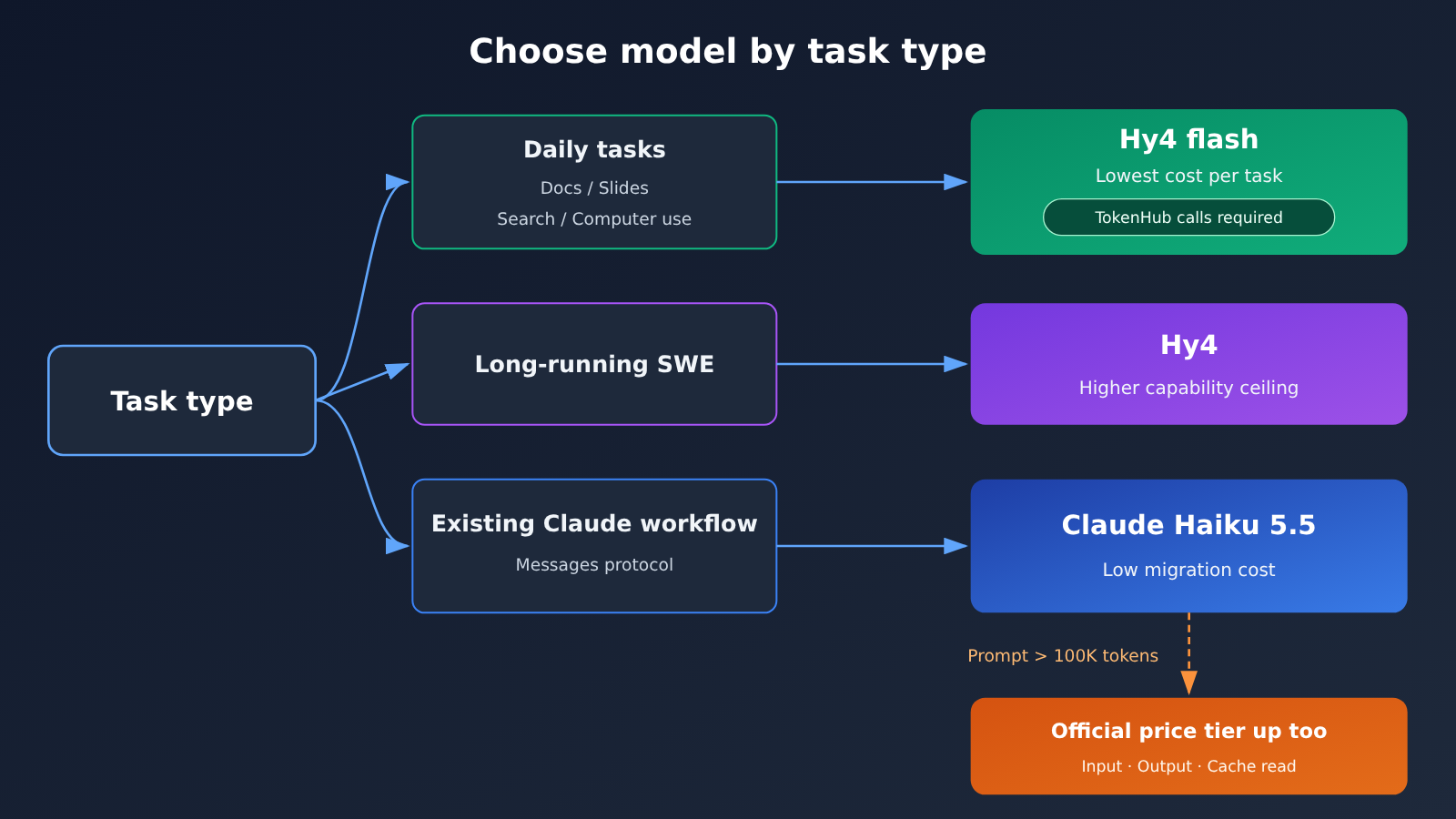
Under the official rules, as soon as the prompt exceeds 100K tokens, input, output, and cache read all jump to the higher tier together — and the whole request is billed at the higher rate, not just the portion that exceeds the limit. When calculating prompt length, both cache reads and cache writes count. So for long-document Q&A and similar scenarios, the effective unit price can be 5x the left column of the table.
Haiku and related models in APIYI’s model table
When I checked APIYI’s (apiyi.com) model list and pricing API on 2026-11-16, claude-haiku-5-5 and claude-haiku-5-5-thinking were listed in the master table at: input 0.10, output 0.50, cache read 0.01 USD per million tokens. The master table’s footnote only spells out the input tier: 0.10 up to 100K tokens, 0.50 above that. The footnote does not give the second output tier. When the prompt exceeds 100K tokens, the pricing API shows InputRatio as 0.25 and CompletionRatio still at 5. For actual billing in long-prompt scenarios, go by APIYI’s model list and your invoice — don’t just plug in the official 2.50.
| APIYI model | Input / output / cache read (USD per million tokens) | Endpoints | Notes |
|---|---|---|---|
claude-haiku-5-5 |
0.10 / 0.50 / 0.01 | chat, messages | Master table price; footnote only lists the input tier |
hy4 |
0.85 / 2.55 / 0.045 | chat | This is Hy4, not Hy4 flash; the research page lists 0.834 / 2.501 / 0.042 separately |
deepseek-v4.1-flash |
0.30 / 1.20 / 0.006 | chat, messages | Matches DeepSeek’s official peak pricing, not the off-peak pricing |
glm-5.3-flash |
0.15 / 0.50 / 0.03 | OpenAI Chat Completions only | Doesn’t support Messages or Responses |
DeepSeek also has a few standalone channels, such as deepseek-v4-1-flash-260910 (0.15 / 0.60 / 0.003) and deepseek-v4-1-flash-economy-261017 (0.24 / 0.96 / 0.006). These are separately priced models in their own right; they don’t represent the pricing of the entire V4.1 Flash family.
Hy4 flash isn’t listed yet — we’ll get that model up as soon as we can; models and prices are subject to the platform’s model list. For now, Hy4 flash can only be called through channels like Tencent Cloud TokenHub, and the research page doesn’t give an API model ID, so before you call it, go by the name shown in the TokenHub console. The research page also mentions that as of 2026-11-30, you can use it for free inside WorkBuddy, and TokenHub’s API is 50% off; that’s a limited-time window price that reverts to list price when it expires.
💰 Price-comparison tip: For models already listed on APIYI, you can use the same key you applied for at apiyi.com, send requests to
https://api.apiyi.com/v1, put Haiku, DeepSeek, and GLM through the same set of tasks, and then work out the per-task cost from your own invoice.
Hy4 flash vs. Claude Haiku 5.5: Which One Should You Use?
When Hy4 flash is the better fit
- High-frequency everyday tasks: The research page recommends it for deep search, document processing, building slide decks, simple front-end demos, and computer use.
- Cost-sensitive batch pipelines: In blind tests it had the lowest per-task cost and the shortest median completion time.
- Latency-sensitive interactions: The research page reports decoding speeds above 150 tokens/s.
When to stick with Claude Haiku 5.5
- You already have a Claude workflow: For projects that rely on the Anthropic Messages protocol or the Claude Code grouping, migration costs are lower.
- You need to call through an aggregator right now: Haiku is already listed on APIYI and supports both the chat and messages endpoints.
- High-frequency calls with short prompts: When prompts stay under 100,000 tokens, Haiku’s unit price is already low, and in blind tests its satisfaction score was close to Hy4 flash.
Two reference points
If satisfaction is what you care about most, the highest score in the blind tests went to DeepSeek-V4.1-Flash-1017 — at the cost of the longest runtime. For long-horizon software engineering tasks, the research page recommends sticking with Hy4 because its capability ceiling is higher. The Terminal-Bench gap of 19.2 vs. 44.4 in the appendix supports this too.
Hy4 flash vs. Claude Haiku 5.5: Decision Recommendations
Don’t make a decision based on a single 18x figure. Walk through the steps below in order, and you’ll end up with a much more reliable conclusion:
- Confirm the task type: Only lean on the blind-test results if your work is everyday stuff like documents, slides, or search. For long-horizon coding, go straight to the appendix.
- Match the thinking level: The Haiku runs in the blind test used the high setting, so don’t compare against the default medium setting when you reproduce it.
- Check prompt length: Once you go over 100K tokens, Haiku’s official pricing jumps to a higher tier across the board. Check the APIYI summary table and the footnotes separately, since they may define the pricing basis differently.
- Check the API protocol:
glm-5.3-flashonly supports Chat Completions, while Haiku anddeepseek-v4.1-flashsupport both the chat and messages endpoints. - Run the numbers with your own tasks: The blind test was scored by 85 internal users, and your workload mix may be different.
💡 Recommendation: After you look up the exact model ID on docs.apiyi.com, use an API key from apiyi.com to connect Haiku and other available models to the same OpenAI-compatible endpoint:
https://api.apiyi.com/v1. Tracking satisfaction, latency, and cost on the same set of real tasks will be far more useful than citing anyone else’s table.
FAQ
Q1: Between Hy4 flash and Claude Haiku 5.5, which has a higher satisfaction score?
According to Tencent’s self-reported blind test, Haiku 5.5 scores 2.81 and Hy4 flash scores 2.79, a difference of 0.02 points. The research page describes them as “close.” The highest satisfaction score in the table is DeepSeek-V4.1-Flash-1017 at 3.09.
Q2: Does “18x cheaper” mean every call is 18x cheaper?
No. The 18x figure comes only from the blind-test per-task cost of 4.73 yuan vs. 0.26 yuan. Based on list token prices, Hy4 flash’s input cost is about 70% of Haiku’s, and its output cost is about 56%—nowhere near 18x.
Q3: How does Hy4 flash’s Terminal-Bench score in the appendix compare with Haiku?
They can’t be compared. Haiku 5.5 isn’t in the appendix’s master table. To compare the two side by side, you can only use the blind-test table. The appendix is better suited for comparing Hy4 flash, Hy4, DeepSeek, and other models.
Q4: When will Hy4 flash be available on APIYI?
As of 2026-11-16, Hy4 flash is not yet listed on APIYI; the platform currently only has `hy4`. For specific availability, keep an eye on the model list at apiyi.com. Until then, you can invoke it through Tencent Cloud TokenHub.
Q5: How do I call Claude Haiku 5.5 on APIYI?
After getting a key at apiyi.com, set base_url to `https://api.apiyi.com/v1` and model to `claude-haiku-5-5`; if you need the thinking version, use `claude-haiku-5-5-thinking`. Both the chat and messages endpoints work.
Q6: What should I watch out for when calling Haiku with long prompts?
According to Anthropic’s official rules, once a prompt exceeds 100,000 tokens, input, output, and cache reads for the entire request move to a higher pricing tier. The APIYI summary table footnote only spells out the input tiers; for the second output tier, refer to the platform’s model list and your actual bill.
Q7: Have Hy4 flash’s weights been open-sourced?
The research page says open-sourcing is planned, and the page doesn’t state that the weights have been released. OpenRouter’s launch is also marked “coming soon.”
Hy4 flash vs Claude Haiku 5.5: Key Takeaways
- Close in blind tests, not better: Satisfaction scores are 2.79 vs 2.81, based on an internal blind test self-reported by Tencent.
- The 18x figure has only one source: The blind test’s per-task cost was 4.73 yuan vs 0.26 yuan. That doesn’t mean an across-the-board price cut.
- Configurations need to align: In the blind test, Haiku ran at the high setting, while its default effort is medium.
- No Haiku in the appendix: Don’t infer or fill in Haiku’s score from the appendix.
- Choose Hy4 for long-horizon engineering: On Terminal-Bench, Hy4 flash scores 19.2 and Hy4 scores 44.4.
- Haiku’s long-prompt pricing moves up a tier as a whole: Under official pricing, once you pass 100,000 tokens, input, output, and cache reads all go up together.
- Look at pricing in two separate sets: Check official list prices and the APIYI model table separately. Hy4 flash isn’t listed on APIYI yet.
Summary
The comparison between Hy4 flash and Claude Haiku 5.5 boils down to three sentences:
- Quality: In Tencent’s internal blind tests on everyday tasks, the two are close in satisfaction, and Hy4 flash has a slightly shorter median time.
- Cost: The roughly 1/18 figure is task-level cost; the per-token price gap is far smaller than that multiple.
- Boundary: Keep using Hy4 for long-horizon software engineering; for long-prompt scenarios, work out Haiku’s tiered pricing rules first.
For everyday documents, slides, and search tasks, it’s worth putting Hy4 flash on the shortlist. For the already-listed Haiku, DeepSeek, and GLM, you can start by running a round of your own tasks on APIYI (apiyi.com) and calculating the per-task cost.
📚 References
- Hy4 flash research page: specs, blind tests, WorkIndex, appendix, and channel info
- Link:
hy.tencent.ai/research/hy4-flash - Note: the blind tests, WorkIndex, and product testimonials are all officially self-reported
- Link:
- Tencent Hunyuan official post: the original wording on the 18x task cost and list price
- Link:
x.com/TencentHunyuan/status/2122217770314301469 - Note: published 2026-11-16
- Link:
- Claude Haiku 5.5 official model page: model ID, context window, and the two pricing tiers
- Link:
platform.claude.com/docs/en/models/haiku-5-5/overview - Note: this is the authoritative source for the 100k token tier-upgrade rule
- Link:
- DeepSeek official pricing page: peak and off-peak pricing tiers
- Link:
api-docs.deepseek.com/quick_start/pricing - Note: used to check which tier the APIYI model IDs map to
- Link:
Author: APIYI Technical Team
Technical inquiries: For model IDs and pricing, refer to the model list at docs.apiyi.com — you’re welcome to reach us through the APIYI homepage.


