

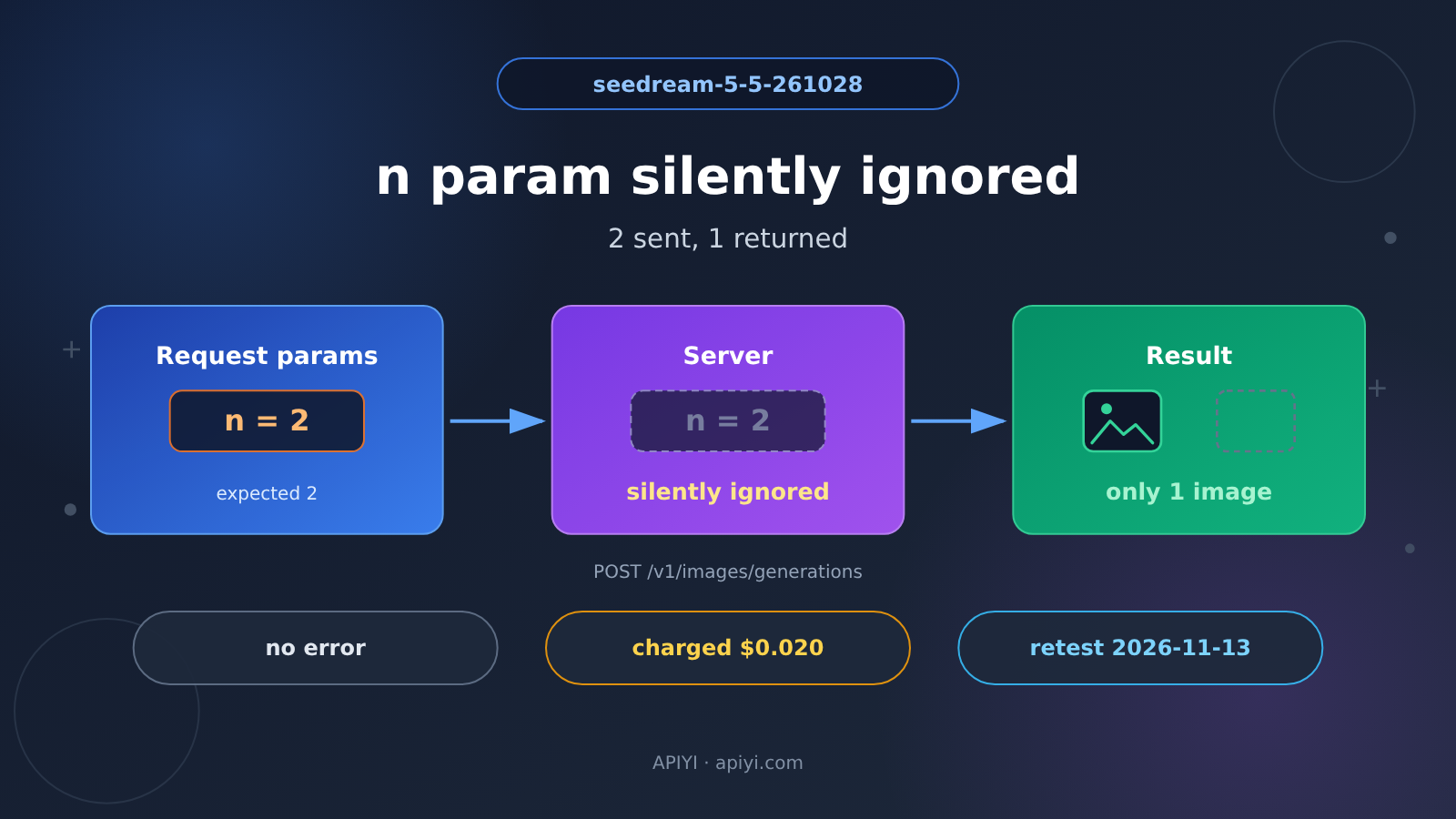
Author’s note: A documentation re-test on 2026-11-13 confirmed that seedream-5-5-261028’s n parameter is silently ignored: pass 2 and you still get only 1 image, get charged $0.020, and see no errors. This article explains what that means and the right way to generate multiple images.
If you’re using seedream-5-5-261028 for batch image generation and you habitually set n to 2 in your requests, expecting to get two images back from a single call, then this update is worth a look first: the 2026-11-13 documentation re-test confirms that n is silently ignored — pass 2 and you still get just 1 image. The request doesn’t error out or raise a warning, the response contains only one image, and the bill is generated as usual.
A lot of people assume that n on an image generation endpoint controls the number of images returned, the way it does on text endpoints. With seedream-5-5-261028, that expectation quietly falls apart. This isn’t a rumor or a one-off guess — the re-test table spells it out in the 1K tier row where n is set to 2: still one image returned, $0.020 charged, no error at any point. It’s a silent ignore, not a 400.
The key takeaway: in 3 minutes you’ll understand how the n parameter behaves on seedream-5-5-261028, what that means for multi-image workflows, and the correct way to get multiple images in a single request on APIYI (apiyi.com).
seedream-5-5-261028 Core Information at a Glance
Here’s a quick summary of the key details from this verification for easy reference:
| Item | Details |
|---|---|
| Verification date | 2026-11-13 |
| Model ID | seedream-5-5-261028 |
| Key behavior | The n parameter is silently ignored; passing 2 still returns only 1 image |
| Retest tier | 1K, n set to 2 |
| Actual charge | $0.020, consistent with the single-image output price |
| Error message | None; this is a silent ignore, not a 400 |
| Request endpoint | /v1/images/generations |
| Base URL | https://api.apiyi.com/v1 |
| Available groups | Default, SVIP |
| Reference pricing | 1K/1.5K output $0.020, input image $0.008 |
The word “silent” deserves special emphasis. Everything at the API layer looks fine: the request succeeds, the response is normal, and there’s no error code. The only thing wrong is the number of images returned. This kind of issue is far more insidious than an outright 400 because it won’t trigger any retry or alerting logic. It only gradually surfaces in downstream business operations, and by the time you notice it, you’ve usually already checked network and timeout issues.
Documentation Retest: seedream-5-5-261028 Returns Only 1 Image When n Is 2
The retest record itself is brief, but it contains a lot of signal. The request was sent to /v1/images/generations with model set to seedream-5-5-261028, tier 1K, and n set to 2. The server completed generation normally, but the returned data contained only 1 image. The charge was $0.020, with no warnings or error messages. From the caller’s perspective, the whole thing was a completely “successful” request.
| Retest item | Recorded content |
|---|---|
| Request parameters | model is seedream-5-5-261028, tier 1K, n is 2 |
| Returned result | Still 1 image |
| Charged amount | $0.020 |
| Error message | None |
| Behavior classification | n is silently ignored, not a 400 |
Looking at this record alongside the release notes also yields an additional conclusion: the same release notes mention that sequential_image_generation returns a 400. In other words, the server handles unsupported fields in two ways—some are rejected outright with a 400, while others, like n, are silently swallowed. The former at least interrupts the flow and forces you to fix it. The latter just quietly cuts the image count in half. The latter is the one to watch out for.
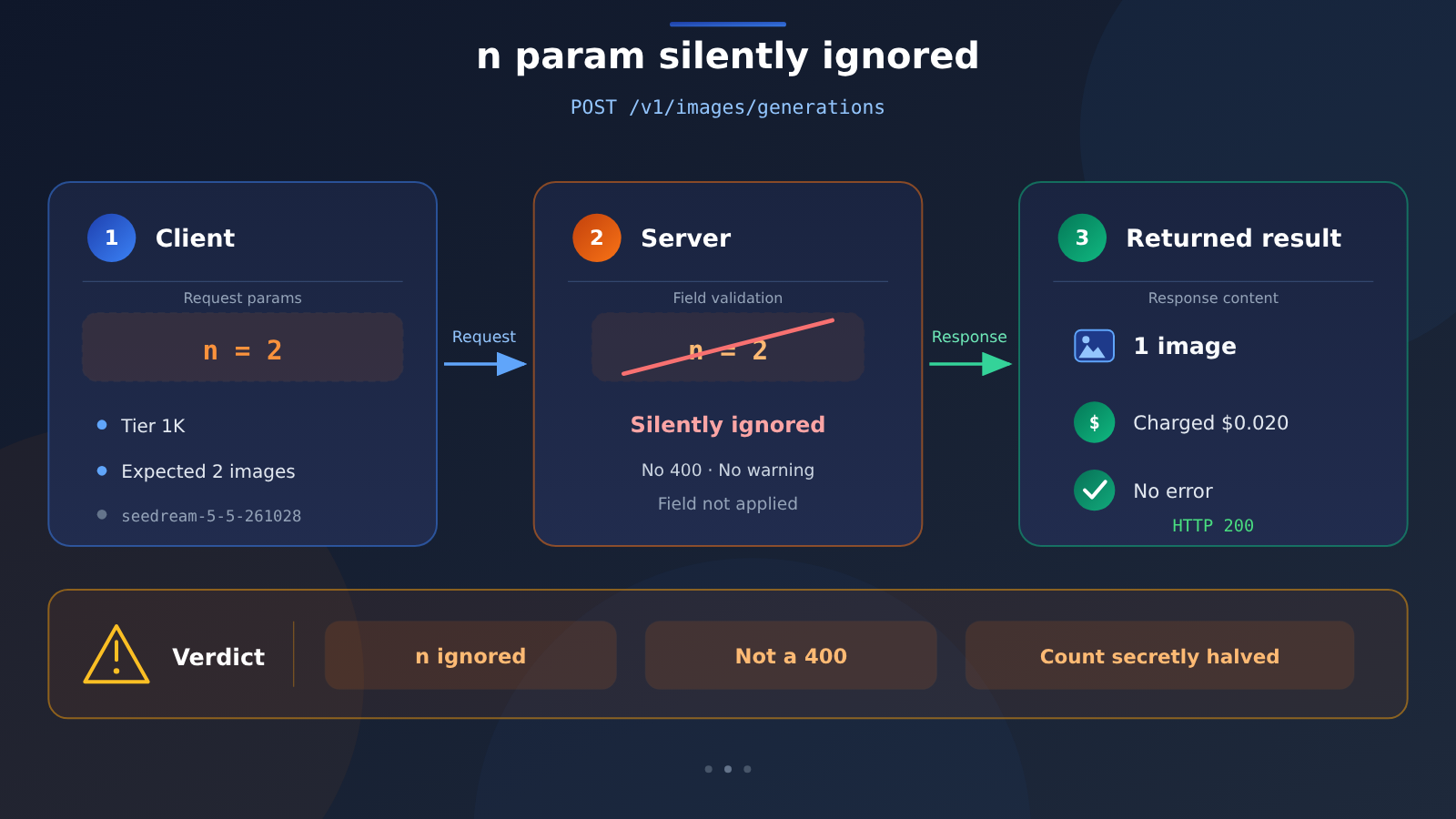
Diagram note: The flow above is based on the documentation retest record and release notes. API behavior is subject to the platform documentation.
Impact Analysis of Silent Ignoring in seedream-5-5-261028
Impact on Developers
The most immediate consequence is a “silent failure.” Your script runs to completion, the logs show nothing out of the ordinary, and no one looks into it until someone notices the asset count doesn’t add up. Even then, it’s easy to head down the wrong path: since nothing threw an error, the first suspects tend to be the network, timeouts, or a typo in the parameters—so you end up taking the long way around. Pipelines that split, name, and ingest assets by a fixed image count will also fall out of alignment when the returned array is shorter than expected.
- Silent failures are hard to spot: no errors, no alerts—count problems only surface downstream.
- Troubleshooting goes off course: you’ll likely suspect the network or timeouts first and overlook that the parameter itself never took effect.
- Pipeline misalignment: split and ingest logic designed around a fixed image count will hit short-length returns.
Impact on Business Operations
Multi-image scenarios need a redesigned invocation approach. For workloads that request several images at once—batch illustrations, visual concept comparisons—don’t pin your hopes on n. Moving to an application-layer loop is the more reliable route, and capacity planning should be recalculated on a “one image per request” basis.
Costs, at least, aren’t a concern—you won’t be overcharged. In our retest, passing n as 2 was billed at only $0.020, matching a single image as actually returned by the server, so there’s no “pass 2, pay for 2” situation. But if your schedule was planned around 2 images per call, real capacity is effectively cut in half—that’s where the hidden cost lies.
Troubleshooting Checklist
| Symptom | Likely Cause | What to Do |
|---|---|---|
Passing n as 2 returns only 1 image |
n is silently ignored |
Switch to multiple requests in a loop |
| Script shows no errors but assets are missing | Return count isn’t validated | Check the returned array length after each call |
| Multi-image schedule capacity halved | Planning assumed 2 images per call | Recalculate on 1 image per call |
How to Work Around the n Limit: The Right Way to Get Multiple Images from seedream-5-5-261028
Since n can’t be trusted, multi-image needs have to be solved at the application layer. The idea is simple: rewrite “one request for N images” as “N requests, one image each.” Here’s how:
- Register an account with APIYI (apiyi.com) and get an API key. Use
https://api.apiyi.com/v1as thebase_urlfor your requests. - Send each request to
/v1/images/generationswithmodelset toseedream-5-5-261028. Don’t rely onnas the count parameter. - Loop as many times as you need images in your business code, choosing serial or concurrent execution depending on the scenario.
- After each response, verify the returned array length is 1; if it isn’t, fall into your retry logic.
- Billing accumulates per image: $0.020 per output image at 1K/1.5K, and $0.008 per input image — so just multiply your budget by the number of images.
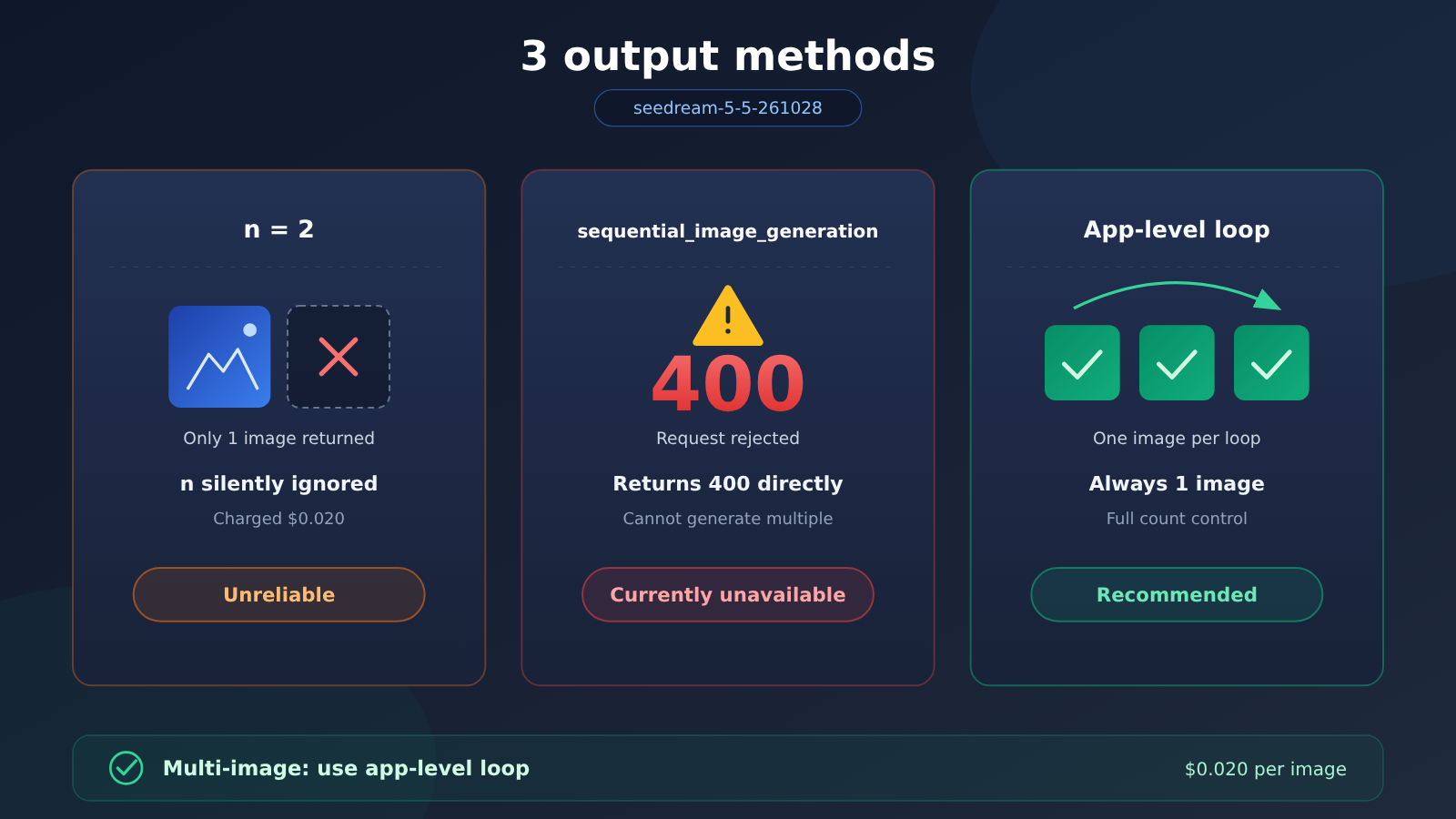
| Approach | Actual behavior | Verdict |
|---|---|---|
| Passing n=2 | Silently ignored, still returns 1 image, billed $0.020 | Not reliable |
| sequential_image_generation | Returns 400 | Currently unavailable; can’t be used for multiple images |
| Application-layer looping | Returns a stable 1 image per call, with full control over quantity | Recommended approach |
🚀 Quick start: We recommend grabbing a free trial quota directly through APIYI apiyi.com, then validating the returned image count and billing of this looping approach in your own use case before wiring it into production.
FAQ: Common Questions About the n Parameter in seedream-5-5-261028
Q1: Does the `n` parameter work in seedream-5-5-261028 now?
No. A documentation retest on 2026-11-13 confirmed that `n` is silently ignored: passing `2` still returns only 1 image, the request doesn’t error, and you’re charged $0.020. For now, don’t build multi-image logic around `n`.
Q2: If I pass `n` as 2, will I be charged more?
No. The retest charge was $0.020, the same as a single 1K output. Billing is based on the actual number of images returned, so there’s no “pass 2 and get charged for 2” scenario.
Q3: Is the 400 error caused by `n`?
No. `n` being ignored happens silently and won’t trigger a 400. The 400 mentioned in the launch notes comes from the `sequential_image_generation` field. These are different behaviors, so you’ll want to check them separately when troubleshooting.
Q4: What should I do if I want to generate multiple images at once?
Call `/v1/images/generations` in a loop at the application layer; each call reliably returns 1 image. Using APIYI’s unified interface makes it easier to control concurrency, retries, and per-image billing.
Q5: How is seedream-5-5-261028 billed?
1K/1.5K output costs $0.020 per image, and input images cost $0.008 each. Check the pricing page for specifics. New users can get free test credits on the APIYI platform—validate at a small scale first, then scale up.
seedream-5-5-261028 Key Takeaways
- Behavior confirmed:
nis silently ignored — pass 2 and you still get just 1 image back, with no error at any point. - Billing stays consistent: You’re charged $0.020, the same as a single output, so there’s no overcharge.
- Silent failure: No error doesn’t mean the parameter took effect — you have to explicitly verify the number of images returned.
- Multi-image approach: Loop calls to
/v1/images/generationsin your app layer, reliably getting 1 image each time. - Pricing at a glance: 1K/1.5K output costs $0.020; input image costs $0.008.
Conclusion: Stop Counting on n in seedream-5-5-261028
Here are the key points confirmed by this round of documentation retesting:
nis silently ignored: Pass 2 and you still only get 1 image, with no error — the textbook case of a silent failure.- Billing isn’t inflated: $0.020 matches the single-image price. The issue is your expectation of quantity, not the invoice.
- Multiple images come from loops: Drop
nfrom your design and use repeated app-layer calls to produce multiple images.
If you’re doing batch image generation or comparing visual concepts, check your calling code soon for any logic that depends on n — otherwise your image count may quietly shrink. The fastest way to validate the loop approach is through APIYI (apiyi.com), which offers free credits and a unified interface.
📚 References
- seedream-5-5 Pricing Page: Model billing details
- Link:
docs.apiyi.com/api-capabilities/seedream-image/seedream-5-5-pricing.md -
Notes: Basis for the pricing of 1K/1.5K output and input images
-
seedream-5-5 Launch Update: Release notes and re-test records
- Link:
docs.apiyi.com/live/2026-11/seedream-5-5-launch.md - Notes: Source for the documentation re-test results and for sequential_image_generation returning 400
Author: APIYI Technical Team
Technical inquiries: Feel free to reach out to us through the apiyi.com homepage. For more resources, visit the docs.apiyi.com documentation center.


