

Author’s note: This article compares Claude Fable 5.2 and GPT-6 Astra based on official specs, short-context pricing, the surcharge for 272K long-context use, cache-read pricing, and benchmark results published by Anthropic. It also explains which model you can call directly as of 2026-11-10.
When deciding how to allocate your budget between Claude Fable 5.2 and GPT-6 Astra, you usually need to answer three questions first: Which is more capable? Which costs more? And which can you call today? Here’s the short version: In the comparison table in Anthropic’s announcement, GPT-6 Astra doesn’t score higher than Claude Fable 5.2 in any category. Astra also costs more at standard short-context rates. But Astra is available to order today, while Fable 5.2 isn’t available yet.
This isn’t a hedged “each has its strengths” comparison. The article draws on just two types of sources: specs and pricing on the companies’ official model and pricing pages, and the benchmark results Anthropic published on 2026-11-09. Where official sources don’t provide a figure, this article says “unknown.” Prices and availability were checked on 2026-11-10 Beijing time.
Key takeaway: By the end, you’ll be able to decide which model offers better value for your tasks, context length, and cache hit rate.
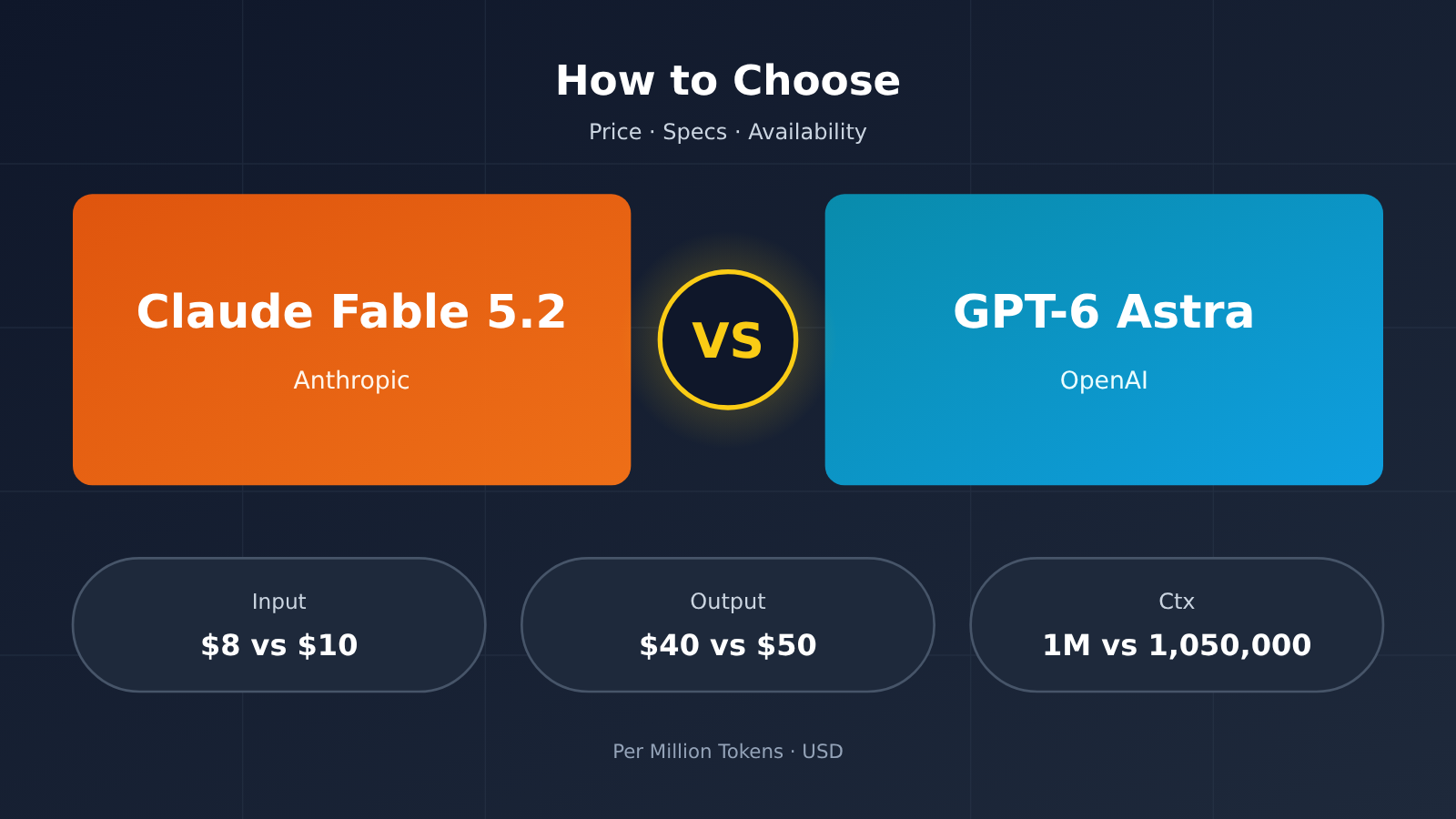
Key Differences Between Claude Fable 5.2 and GPT-6 Astra
First, what is Claude Fable 5.2? Anthropic released Claude Fable 5.2 and Claude Mythos 5.2 on 2026-11-09. The announcement stated that they’re the same underlying model. Fable has stronger cybersecurity and biosafety safeguards, so it’s available to all users. Mythos is only available to organizations that pass verification for life sciences or cybersecurity programs; it isn’t a more powerful model.
GPT-6 Astra is OpenAI’s model for “the hardest work,” and its model ID is gpt-6-astra. It’s a separate model from GPT-6 Cyber. All comparisons below are specifically about Astra.
| Comparison | Claude Fable 5.2 | GPT-6 Astra | Takeaway |
|---|---|---|---|
| Standard pricing for short contexts | $8 input / $40 output | $10 input / $50 output | Fable is cheaper |
| Cached reads | $0.20 | $1 | Fable is much cheaper |
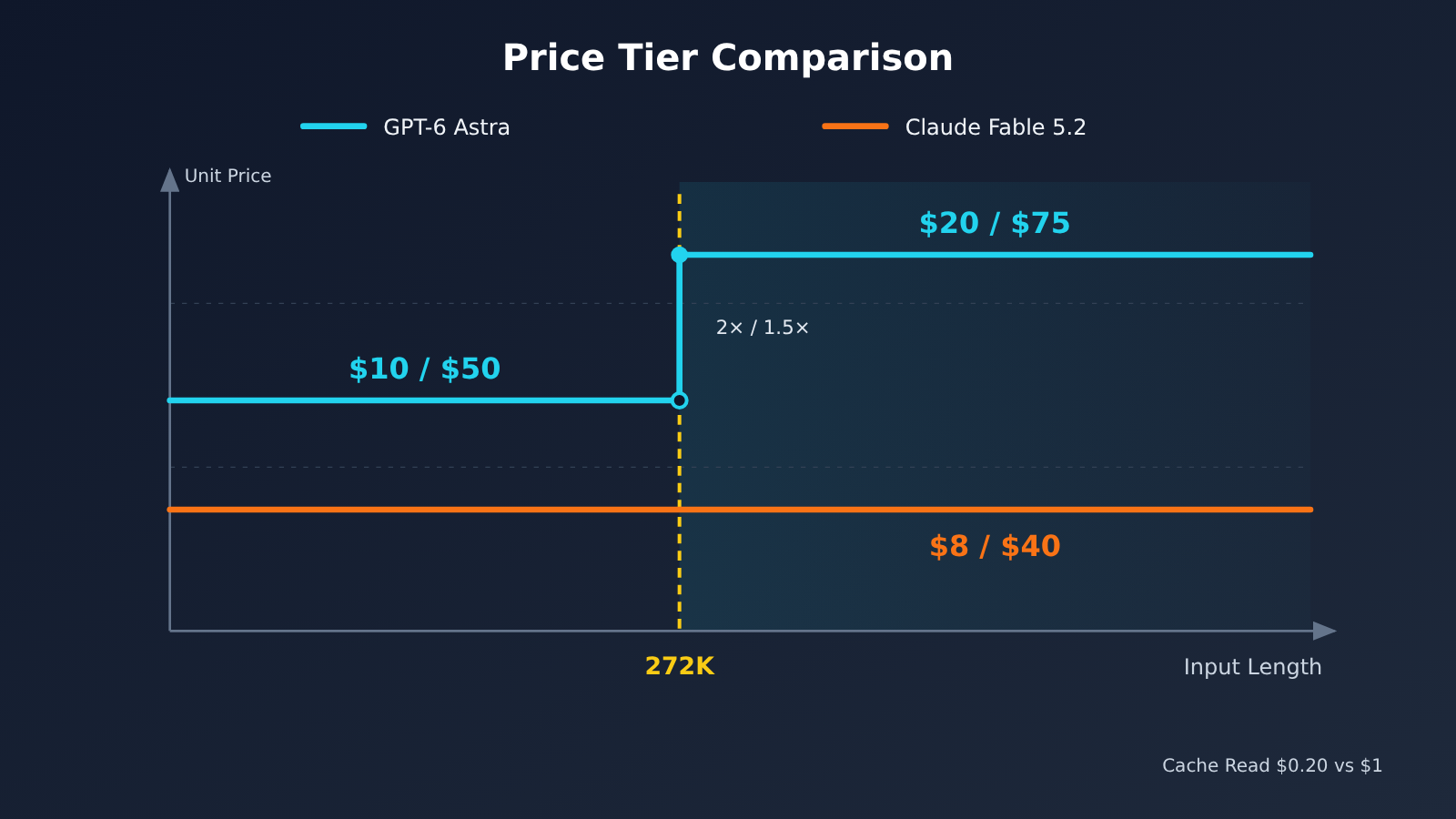
| Long-context surcharge | Published pricing has no 272K threshold | Above 272K input tokens, input and cached input are charged at 2×, and output at 1.5× | Fable’s price advantage is greater with long prompts |
| Anthropic comparison table results | Higher on every metric listed in the same column | Doesn’t score higher than Fable 5.2 on any metric | Fable leads, though the gap isn’t large on some metrics |
| Available to use through APIYI today? | Not yet listed among the models | Already listed among the models | You can use Astra now |
Claude Fable 5.2 vs. GPT-6 Astra: Specs Compared
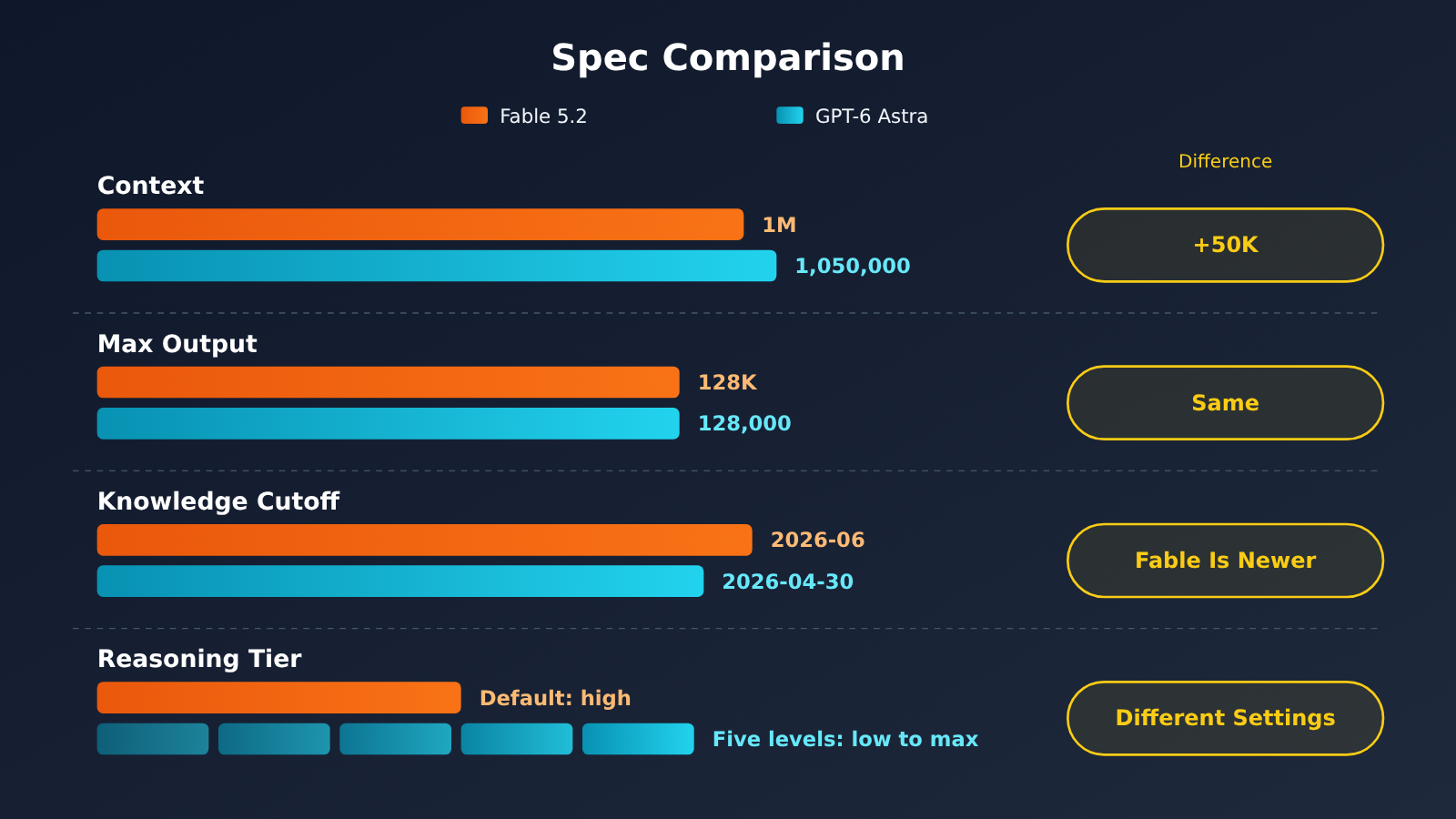
Both models accept text and images as input and return text. They each have a context window of around one million tokens. The differences that matter for integration are in the details: Astra lists a maximum input of 922,000 tokens, while Fable only specifies a 1M-token context window. Fable’s knowledge cutoff is about two months later than Astra’s.
| Specification | Claude Fable 5.2 | GPT-6 Astra |
|---|---|---|
| Model ID | claude-fable-5-2 (anthropic.claude-fable-5-2 on Bedrock) |
gpt-6-astra |
| Context window | 1M tokens | 1,050,000 tokens |
| Maximum input | Not listed separately by the provider | 922,000 tokens |
| Maximum output | 128K (synchronous Messages API) | 128,000 tokens |
| Knowledge cutoff | June 2026 | 2026-04-30 |
| Reasoning effort | Adaptive thinking is always on; Claude API defaults to high effort | reasoning.effort supports low, medium, high, xhigh, and max |
| Input / output modalities | Text and images / text | Text and images / text |
Fable 5.2 has a few integration limitations to check before migrating:
- Thinking can’t be turned off: Adaptive thinking is always on. To reduce the amount of thinking, you can only adjust the effort. At medium effort or higher, adding “don’t think” to the prompt has no effect.
- Sampling parameters cause errors: Requests that include
temperature,top_p, ortop_kreturn a 400 error. - Tool calls can’t be forced: Setting
tool_choicetoanyortoolreturns a 400 error. - Data retention: By default, data must be retained for 30 days. Zero data retention isn’t available unless Anthropic explicitly authorizes it.
- How refusals are returned: A refusal still returns HTTP status code 200, with
stop_reasonset torefusal. These requests also count against your rate limits.
If your existing code relies on tuning temperature or forcing tool calls, switching to Fable 5.2 will require code changes. Be sure to factor that work into the migration cost.
Claude Fable 5.2 vs. GPT-6 Astra: How Pricing Works
This section compares official standard pricing for short contexts only. All prices are in US dollars per million tokens. Lower prices from third-party resellers aren’t included.
| Pricing item | Claude Fable 5.2 | GPT-6 Astra |
|---|---|---|
| Standard input | $8 | $10 |
| Standard output | $40 | $50 |
| Cache reads | $0.20 | $1 |
| Cache writes | 5 minutes: $10; 1 hour: $16 | $12.5 |
| Input above 272K | No such threshold in the published price list | Input $20, output $75 (official pricing rules) |
| Batch | Half-price batch pricing: input $4, output $20 | Not covered in the reference materials |
| Fast mode | Input $16, output $80 | Not covered in the reference materials |
Short contexts: Fable is 20% cheaper across the board
For contexts under 272K, Fable 5.2’s input and output rates are both 20% lower than Astra’s. For example, consider a request with 100K input tokens and 10K output tokens. At the official rates, Astra costs about $1.50 ($1.00 for input plus $0.50 for output), while Fable costs about $1.20 ($0.80 for input plus $0.40 for output).
The gap is much larger for cache reads. Fable charges 0.025 times its standard input rate for cache reads, or $0.20. Astra charges $1 for cached input—five times Fable’s rate. If your application repeatedly includes a long system prompt or codebase context, for example with 200K tokens served from cache per request, Fable would cost about $0.04 and Astra about $0.20 at the official rates.
Long contexts: Astra’s 272K threshold
Astra’s pricing rules state that when a request has more than 272K input tokens, the entire request’s input and cache are charged at 2× the standard rate, while output is charged at 1.5×. That works out to $20 for input and $75 for output. The official cache rates are given as multipliers; applying those multipliers gives an estimated $2 for cached input and $25 for cache writes. Fable’s published price list has no 272K threshold, so this article doesn’t assume an additional long-context charge.
Consider another example: a request with 400K input tokens and 20K output tokens. Applying Astra’s multipliers, it costs about $9.50 ($8 for input plus $1.50 for output). At Fable’s official standard rates, it costs about $4.00 ($3.20 for input plus $0.80 for output). The longer the prompt, the wider the price gap.
Claude Fable 5.2 vs. GPT-6 Astra Benchmark Comparison
All scores in this section come from Anthropic’s announcement, published on 2026-11-09. These are comparisons reported in Anthropic’s announcement, not a leaderboard published by OpenAI. Unless otherwise noted, the scores use the highest effort setting available for each model at the time—not the default setting. Fable 5.2’s scores were achieved with safeguards enabled.
| Benchmark | Fable 5.2 | GPT-6 Astra | Gap |
|---|---|---|---|
| FrontierSWE v2 | 69.9% | 65.5% | Small |
| Chartography (no tools) | 73.4% | 71.0% | Small |
| FrontierCode 2.0 | 49.1% (Xhigh) | 42.8% | Large |
| RoboDojo Sim | 64.9% | 29.8% | Very large |
| AutomationBench | 51.4% | 41.4% | Gemini 4 Carbon leads at 53.9% |
| OSWorld 2.1 (offline set, partial) | 89.3% | 79.5% | Large |
| Terminal-Bench-Science 0.1 | 74.6% | 68.1% | Moderate |
| Humanity’s Last Exam (with tools) | 74.2% | 57.2% | Large |
Two benchmarks with small gaps
Fable leads on both FrontierSWE, with 69.9% versus 65.5%, and Chartography, with 73.4% versus 71.0%, but the gaps are small. If your work is mainly routine software fixes or chart interpretation, these two results alone aren’t enough to justify deciding that you must switch models. On Chartography, Gemini 4 Carbon scores 72.5%, putting all three models close together.
Two benchmarks with large gaps
FrontierCode 2.0 measures whether changes can be merged by maintainers of open-source repositories. Fable 5.2 scores 49.1% at the Xhigh setting, compared with Astra’s 42.8%. The announcement also notes that Fable 5.2 scores about 45.3% at the High setting—still above Astra’s best score—with roughly comparable per-task costs. RoboDojo Sim tests how well a model can control a simulated two-armed robot using camera images. Fable 5.2 scores 64.9%, compared with Astra’s 29.8%, making this the largest gap between them. Note that the 64.9% comes from Anthropic’s internal testing, not a position on a public leaderboard.
Benchmarks that don’t show Astra being outperformed across the board
On AutomationBench, Fable 5.2 scores 51.4% and Astra scores 41.4%. But Gemini 4 Carbon has the highest score on this benchmark, at 53.9%. So this result shows that Fable leads Astra, but it doesn’t mean Fable has a clear overall advantage in automation.
The announcement’s cybersecurity comparison, CyScenarioBench, is against GPT-6 Cyber, not Astra. Anthropic also reports scores for Mythos 5.2, so this benchmark isn’t included here. Astra’s entry for WANDR is blank, and we haven’t filled in a score.
Which Models Are Available on APIYI Right Now?
As of 2026-11-10, we checked both the full model list at docs.apiyi.com and the public pricing API. The pricing API returned 283 model IDs, but neither claude-fable-5-2 nor any Mythos models appeared in the results. We’ll add this model as soon as possible. The platform’s model list is the source of truth for model IDs and pricing. Until it’s available, this article won’t quote a price for it on APIYI or estimate one by applying a group multiplier to the official price.
| Model ID | Listed price (input / output / cached read) | Endpoint | Status |
|---|---|---|---|
gpt-6-astra |
$10 / $50 / $1 | responses (primary), chat | Available |
claude-opus-5-5, claude-opus-5-5-thinking |
$4 / $20 / $0.2 | chat, messages | Available |
claude-fable-5-1, claude-fable-5-1-thinking |
$10 / $50 / $0.25 | chat, messages | Available |
claude-fable-5-2 |
Not available | Not available | Not yet available |
A few things to know about using gpt-6-astra on APIYI:
- How to connect: APIYI provides an OpenAI-compatible API. Set
base_urltohttps://api.apiyi.com/v1and the model name togpt-6-astra. Its primary endpoint is responses, and chat is also supported. - Long-input pricing: A footnote in the model list says that inputs from 0 to 272,000 tokens cost $10 per million tokens, while inputs from 272,001 to 1,050,000 tokens cost $20 per million.
- Long-context output pricing: The model list doesn’t specify the output price for this tier. Check your console bill for the actual price.
- Actual charges: The dollar amounts in the model list are listed prices. Actual charges also depend on the token group multiplier, so check your bill for the final amount.
If you need a Claude model now, you can use claude-opus-5-5 or claude-fable-5-1 to get your workflow up and running, then switch models once Fable 5.2 is available. Anthropic’s launch announcement also recommends starting with Opus 5.5 for most coding and knowledge-work tasks, then moving up to Fable for more demanding tasks. New users can use the free testing credits at APIYI apiyi.com to try out their prompts.
Scenario Recommendations: Claude Fable 5.2 vs. GPT-6 Astra
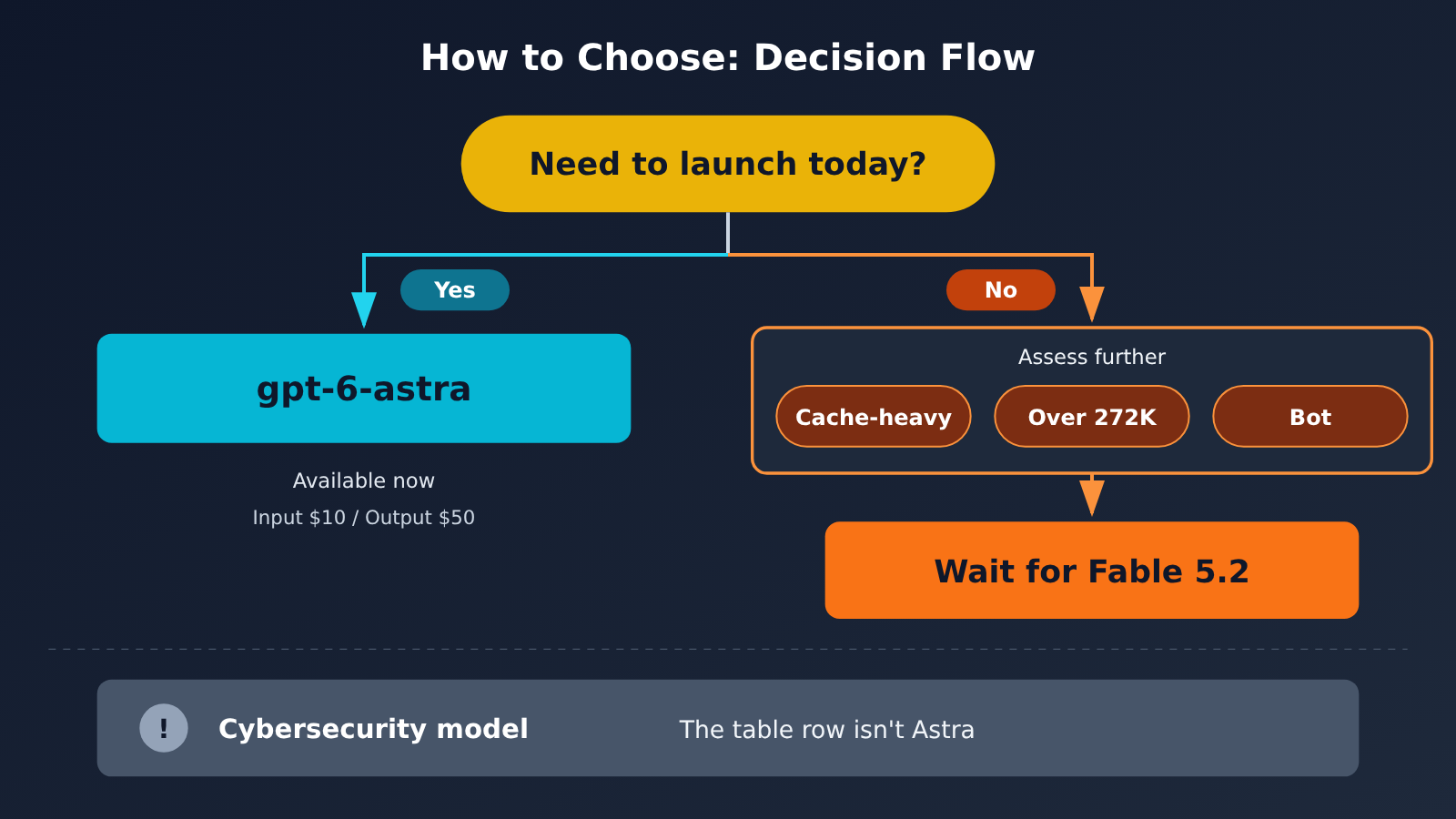
When to Choose GPT-6 Astra
- You need to launch today: Place your order through APIYI and start testing
gpt-6-astranow. - You need finer-grained reasoning levels: Astra offers five settings for
reasoning.effort, making it easier to tune costs precisely. - Your tasks focus on routine software fixes or chart interpretation: According to Anthropic’s comparison table, the two models are fairly close on these tasks.
When to Choose Claude Fable 5.2
- You have a high cache hit rate: Cached reads cost $0.20 versus $1, so long-running agent applications see the biggest savings.
- Your prompts often exceed 272K tokens: Fable doesn’t have Astra’s price threshold for long contexts at 272K.
- You work on robotics simulation or long-horizon coding: These are the two areas where the gap is largest: RoboDojo and FrontierCode.
- You rely on Claude’s tool ecosystem: For example, Claude Code and fast mode.
Recommendations: When to Switch—and When Not To
💡 Recommendation: If you need a model now, start with
gpt-6-astraon APIYI at apiyi.com. According to the comparison table, pricing is $10 per million input tokens, $50 per million output tokens, and $1 per million cached-read tokens. Input tokens cost $20 per million when your prompt exceeds 272,000 tokens. If you need Claude’s tools, lower cached-read costs, or strong performance in robotics simulation and long-horizon coding, wait forclaude-fable-5-2to become available. We’ll launch it as soon as possible; check the model list on apiyi.com for the current model name and pricing.
There are two cases where you shouldn’t switch models based solely on this comparison table. First, your task may not be covered by any of the listed benchmarks—for example, domain-specific question answering or long-form writing in Chinese. The score differences in the table may not apply directly, so you should compare the models using your own samples. Second, you may need a model specifically designed for cybersecurity. The model in that row of the table is GPT-6 Cyber, not Astra. Fable 5.2 also has enhanced cybersecurity safeguards, and requests it blocks are answered by Opus 4.8 instead.
Frequently Asked Questions
Q1: What’s the difference between Claude Fable 5.2 and Claude Mythos 5.2?
They’re the same underlying model and have the same pricing. Fable has stronger cybersecurity and biosafety guardrails and is available to all users. Mythos is only available to organizations that pass the verification program.
Q2: Are GPT-6 Astra and GPT-6 Cyber the same model?
No. The cybersecurity row in the launch announcement compares against GPT-6 Cyber. You shouldn’t attribute that row’s score to Astra.
Q3: Were these results published by OpenAI?
No. All the results come from Anthropic’s launch announcement on 2026-11-09 and are comparisons conducted by Anthropic. The external evaluators mentioned in the announcement didn’t review the blog post.
Q4: What’s the batch pricing for Fable 5.2?
The official policy is to apply a 50% discount to both batch API input and output. At half price, Fable 5.2’s batch pricing is $4 for input and $20 for output. The reference materials don’t cover Astra’s batch pricing, so we don’t know what it is.
Q5: Can Fable 5.2 handle 300K output?
Fable 5.2 isn’t listed in the official lineup, so this article uses the 128K limit of the synchronized Messages API.
Q6: What are the known limitations of Fable 5.2?
The main limitations are: thinking can’t be turned off; requests with sampling parameters or forced tool use return a 400 error; and data is retained for 30 days by default. Capabilities directly related to AI R&D, such as accelerator kernel optimization and improving Large Language Model architectures, are intentionally limited to around the level of Opus 5.5.
Claude Fable 5.2 vs. GPT-6 Astra: Key Takeaways
- Results: In Anthropic’s comparison table, Astra doesn’t outperform Fable 5.2 on any benchmark.
- Narrower gaps: FrontierSWE, 69.9% vs. 65.5%; Chartography, 73.4% vs. 71.0%.
- Wider gaps: FrontierCode, 49.1% vs. 42.8%; RoboDojo, 64.9% vs. 29.8%.
- Short-context pricing: Fable is 20% cheaper than Astra for both input and output.
- Caching and long context: Cached reads cost $0.20 vs. $1. Once Astra’s input exceeds 272K, input is billed at 2× and output at 1.5× the standard rate.
- Availability: As of 2026-11-10, only
gpt-6-astrais available for direct use.
Summary
- Capabilities: Based on Anthropic’s published comparison, Fable 5.2 leads across the board, with the biggest gaps in robotics simulation and long-horizon coding.
- Cost: Fable is cheaper for short contexts, cached reads, and long prompts.
- Timing: Astra is available to use today, while Fable 5.2 isn’t available yet.
If your business can’t wait, launch with Astra for now, while making sure to use prompt caching and keep context lengths under 272K. If cost or robotics and long-horizon coding tasks are key priorities, consider building your workflow with Opus 5.5 or Fable 5.1 first, then switching models for comparison once Fable 5.2 is available.
Author: APIYI Technical Team
Technical discussion: Contact us from the APIYI homepage at apiyi.com. For more resources, visit the documentation center at docs.apiyi.com.


