

In a nutshell: This article looks at an official announcement that explicitly raised rate limits, current Claude API billing rules, and real status-page incidents to assess what Anthropic’s power equipment deal means for developers. The takeaway: Long-term upstream investment is worth watching, but lower prices, higher limits, and faster Claude API performance each require their own evidence.
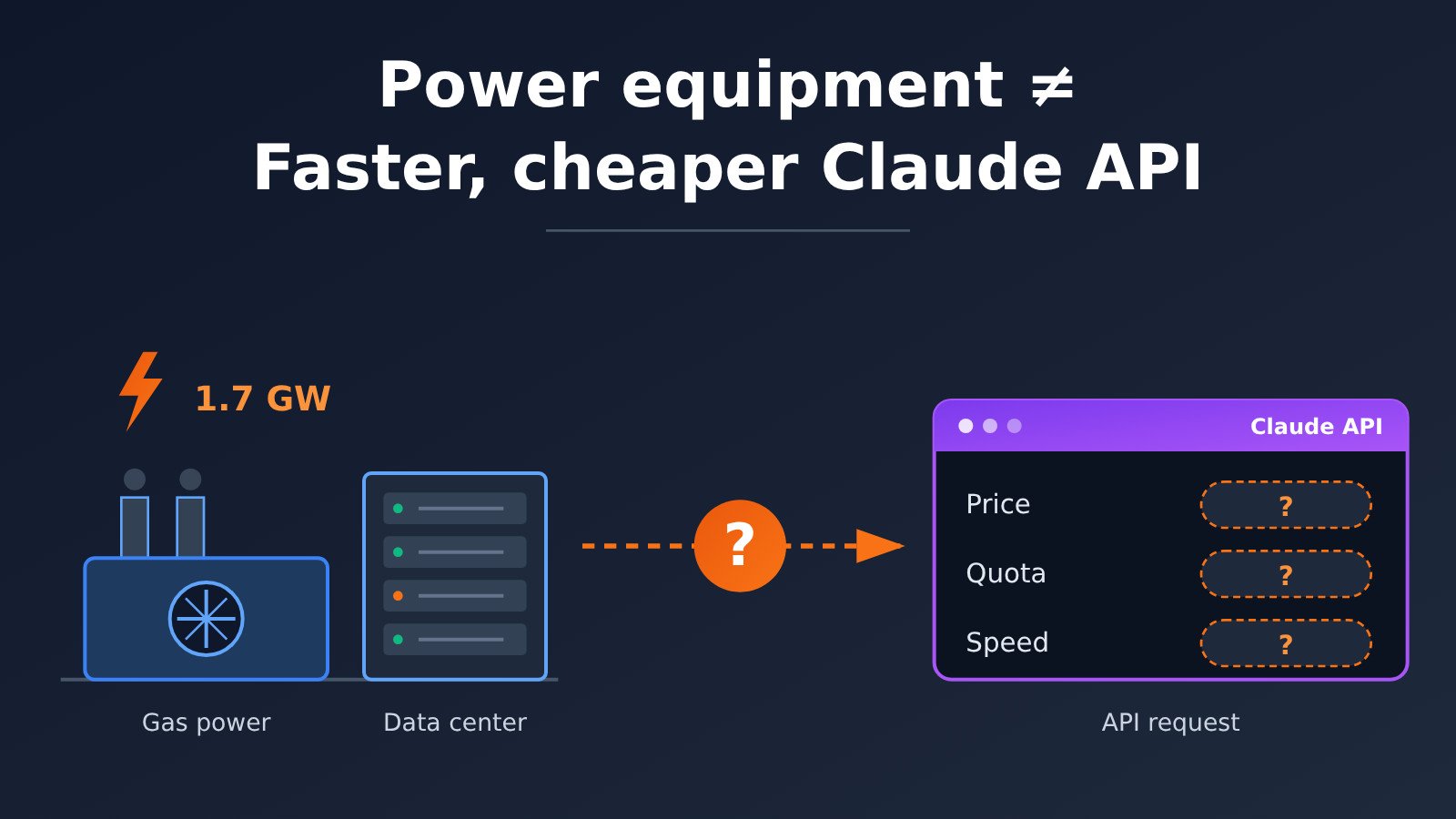
Table of contents
- How far is power equipment procurement from affecting the Claude API experience?
- What kind of capacity announcement clearly affects Claude API users?
- Lower prices, higher limits, and faster performance are three different things
- 3.1 Check billing rules and invoices for pricing
- 3.2 Check account rules and error messages for limits
- 3.3 Check incidents and measure performance on the same task
- What to check when accessing the Claude API through APIYI
- What developers can conclude now
What to know before reading
- token: A unit used to measure the text a model processes and generates. Tokens don’t correspond one-to-one with Chinese characters.
- MTok: One million tokens, a common unit for API pricing.
- RPM / ITPM / OTPM: The limits for requests per minute, input tokens per minute, and output tokens per minute, respectively.
- 429: May indicate a request limit or a specific spending limit. Check the response content to determine which.
- 529: An error code the official API uses to indicate temporary overload.
- Time to first token: The wait between sending a request and receiving the first output.
- API gateway: A service between an application and an upstream model API that receives, forwards, and manages requests.
How Far Is a Power Equipment Purchase from the Claude API Experience?
According to a November 8 Reuters report citing the Financial Times, Anthropic reached a deal in late September with OnePWR Solutions of San Antonio, Texas. The deal involved a purchase commitment for 1.7 GW of heavy-duty gas generators, valued at approximately $3.4 billion. It also included the engineering and construction capacity needed to install them. Anthropic didn’t acquire OnePWR or take on its employees.
This isn’t an announcement that power capacity is coming online—it’s an equipment deal disclosed by the media. Reuters said it couldn’t immediately independently verify the report, and neither company responded to requests for comment at the time. A page from transaction adviser Piper Sandler lists a $3.4 billion sale of a OnePWR power generation platform completed in September 2026, but identifies the buyer only as “a frontier AI lab.” It doesn’t name Anthropic or mention the 1.7 GW figure.
- Reuters report (published by CNA):
channelnewsasia.com/business/anthropic-secures-34-billion-generator-deal-ai-data-centers-ft-reports-6534256 - Piper Sandler transaction disclosure:
pipersandler.com/investment-banking-transactions/onepwr-solutions-20260901
Claude API Deal: Key Facts at a Glance
| Item | What’s Public | What’s Undisclosed or Unconfirmed |
|---|---|---|
| Deal timing | Media reports say the deal was reached in late September and disclosed on November 8 | Exact signing date |
| Deal subject | OnePWR Solutions’ gas-powered generation equipment and engineering capabilities | Equipment models and number of generating units |
| Value and capacity | Approximately $3.4 billion and 1.7 GW, according to reports | Breakdown of equipment and engineering costs, payment schedule |
| Corroboration | A transaction adviser disclosed a deal of similar size but didn’t name the buyer | Multiple outlets citing the same source don’t constitute independent confirmation |
| Deployment | None disclosed | Installation location, delivery and commissioning dates, fuel arrangements |
| Impact on the Claude API | No announcement | Whether pricing, quotas, or latency will change as a result |
So, while the deal has been described as “locking in 1.7 GW of power for Claude data centers,” it’s more accurate to say it secured generation equipment and construction resources—not a stable supply of electricity that’s already being delivered. GW is a unit of power: 1.7 GW describes the equipment’s power capacity under specific conditions. It’s neither annual electricity generation nor a measure of GPU or TPU computing power.
The Steps Between Equipment Delivery and the Claude API Experience
At least five steps separate a generator set from any change developers might notice in the Claude API. Each comes with its own uncertainties. This article doesn’t estimate when the equipment will enter service or convert generating capacity into token throughput.
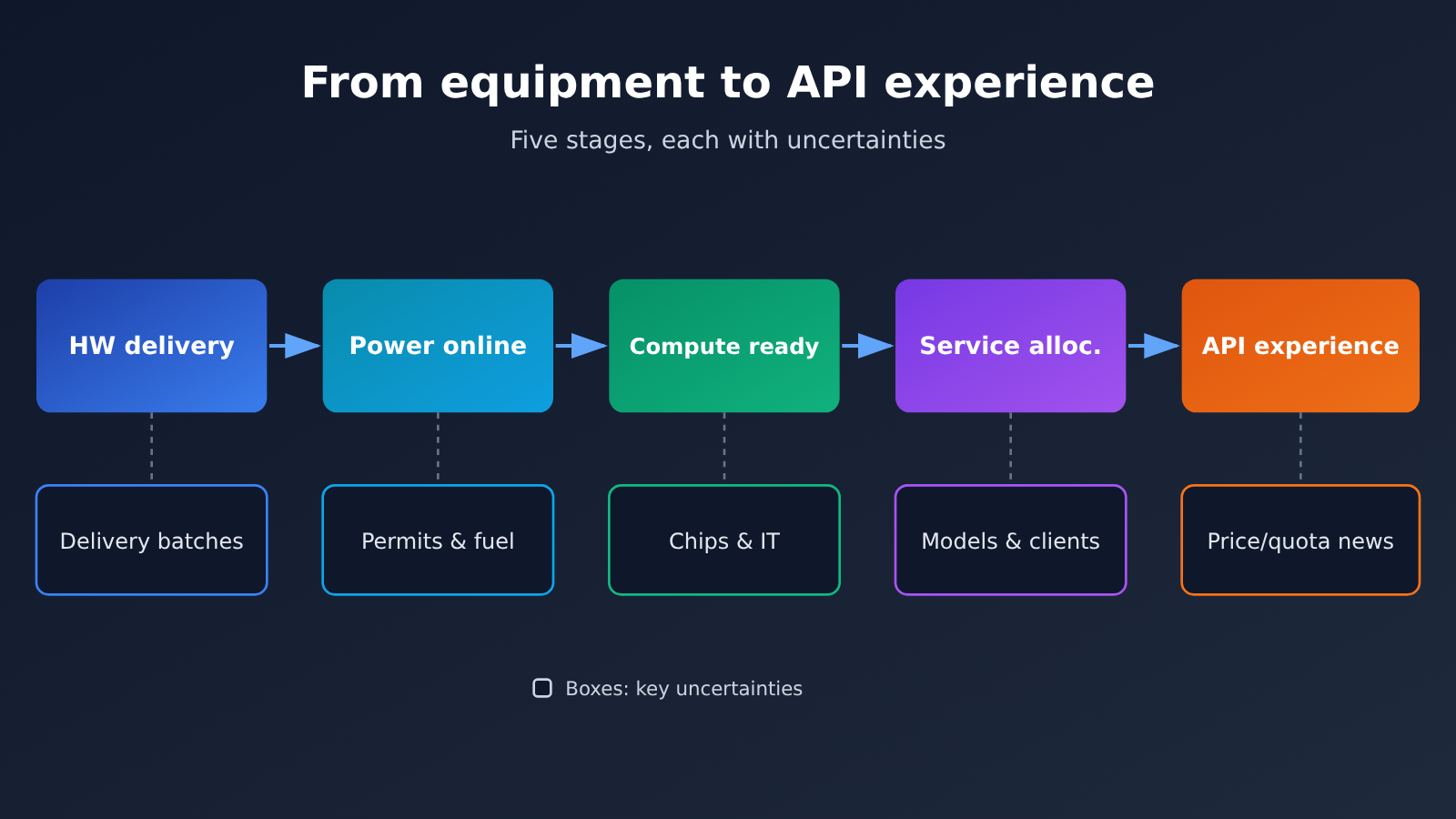
| Stage | What needs to happen | Current public information |
|---|---|---|
| Equipment delivery | Units arrive in batches and are installed on-site | Delivery batches and locations haven’t been disclosed |
| Power generation begins | Permits, fuel supply, redundancy, and energy storage are in place | Not disclosed |
| Computing resources ready | Chips, servers, cooling, and network connections are in place | Not disclosed |
| Service allocation | Compute is allocated among models, products, and customers | Not disclosed |
| API policies and experience | Actual changes to pricing, quotas, latency, and stability | No related announcements or real-world test results |
The broader industry context reinforces this point. In a report published on April 16, 2026, the IEA noted that supply chains for gas turbines, transformers, advanced chips, and IT components are tightening. A large number of project applications is also putting pressure on planning approvals and grid connections. The IEA observed that US developers are pursuing on-site natural gas generation projects, but many are still at an early stage. To provide reliable on-site gas-fired power for critical and variable loads, generating facilities may need 30% to 70% more capacity than actual demand. That’s a finding from industry research and can’t be applied directly to this equipment to estimate the compute available to Claude.
- IEA report executive summary:
iea.org/reports/key-questions-on-energy-and-ai/executive-summary - IEA press release:
iea.org/news/data-centre-electricity-use-surged-in-2025-even-with-tightening-bottlenecks-driving-a-scramble-for-solutions
What Kind of Capacity Announcement Clearly Affects Claude API Users?
The most reliable way to tell whether an upstream capacity expansion will affect Claude API users is to look for an explicit product-level statement from the company. One such example came on May 6, 2026: Anthropic announced a computing resources partnership with SpaceX, saying it could add more than 300 MW of capacity that month. In the same announcement, it raised some Claude Code limits effective immediately, removed some peak-hour restrictions for Pro and Max, and increased Opus API limits.
What makes that announcement useful is that it connects “more computing capacity” with “product changes users can actually see” and specifies when those changes take effect. By contrast, the gas equipment deal has so far only been reported by the media, with no product announcement about pricing or limits.
Two caveats are worth noting. First, the May example doesn’t prove this equipment deal will lead to the same changes. Second, the account policies in the May announcement were measures announced at the time, not necessarily the limits in effect in November. For your actual limits, check your account console and the official limits documentation.
- Anthropic SpaceX partnership and limits announcement:
anthropic.com/news/higher-limits-spacex
Cheaper, More Usable, and Faster Are Three Different Things for the Claude API
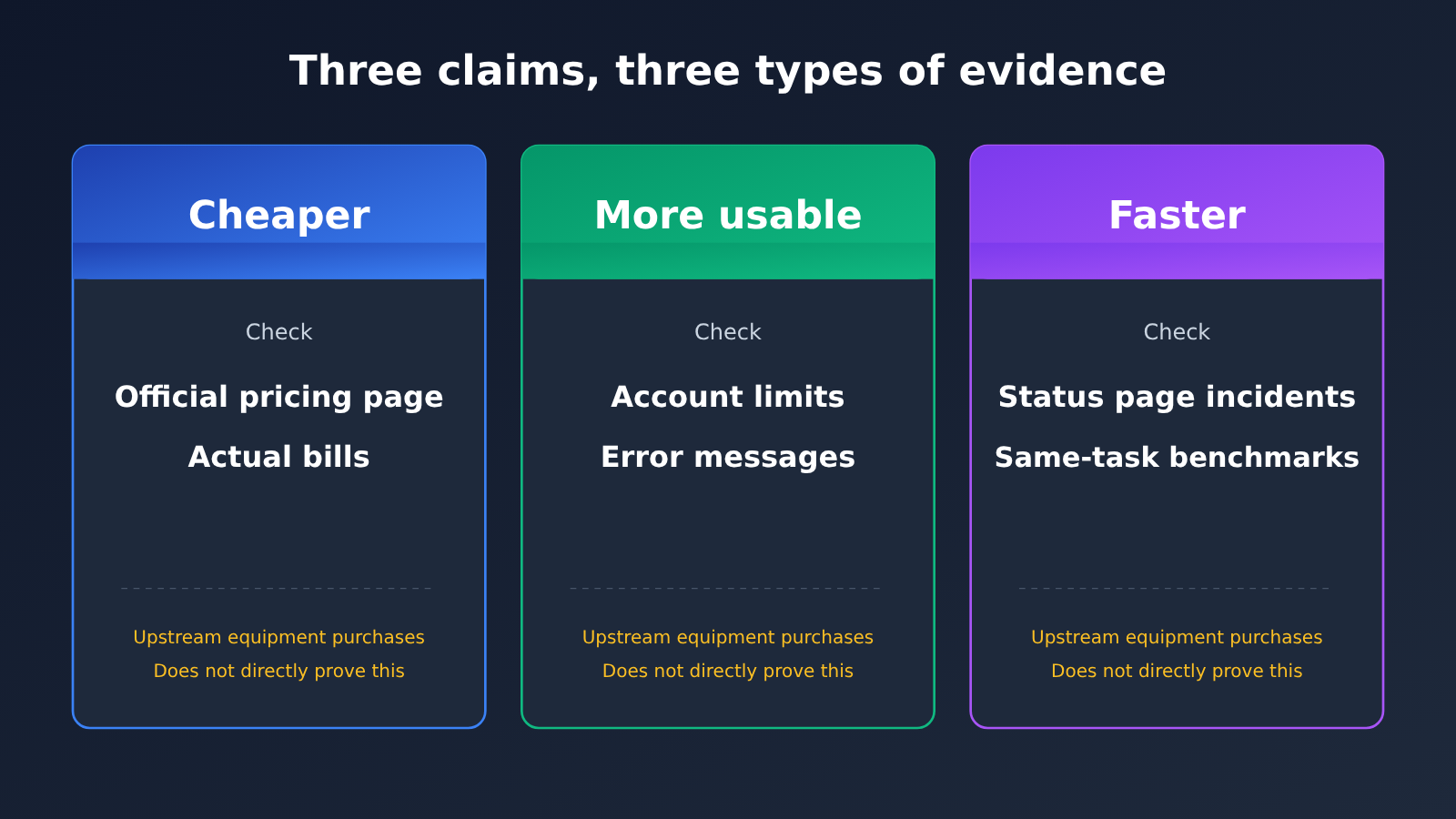
The claim that “expansion will make the Claude API faster and cheaper” actually combines three separate questions: Will unit prices drop? Will account usage limits increase? Will responses be faster in practice? Each depends on different mechanisms and requires different evidence.
Claude API Pricing: Check the Billing Rules and Your Bill
The table below is a snapshot of base token prices taken from Claude’s official pricing page on November 9, 2026 (Beijing time). It includes only standard input and output prices—not special charges for caching, batch processing, fast mode, tool calls, or taxes. The official pricing page is a dynamic document with no single publication date, so these prices shouldn’t be interpreted as new prices resulting from this hardware transaction.
| Model | Input (USD / million tokens) | Output (USD / million tokens) | Where to verify |
|---|---|---|---|
| Claude Opus 5.5 | 4 | 20 | Official pricing page; APIYI’s public registry also lists 4/20 |
| Claude Sonnet 5.5 | 2 | 10 | Official pricing page |
Here’s a simple budget calculation: suppose an Opus 5.5 request contains 10,000 input tokens billed at the base rate and 2,000 output tokens. The cost would be 10,000 ÷ 1,000,000 × 4 + 2,000 ÷ 1,000,000 × 20 = $0.08. With the same token counts, Sonnet 5.5 would cost about $0.04 using the same formula. This is just an arithmetic example under the stated assumptions, not a quote or bill for an actual request.
This article doesn’t compare prices before and after the transaction because the available sources contain no announcement of a price change. To check whether the Claude API has become cheaper, compare historical snapshots of the official pricing page with the actual charges on your bill.
- Claude official pricing documentation:
platform.claude.com/docs/en/about-claude/pricing
Claude API Quotas: Check Account Rules and Error Messages
Anthropic controls requests using metrics such as RPM, ITPM, and OTPM, with limits based on account tier. These are account-level rules—not measures of Anthropic’s total computing capacity. A limit is a ceiling, not guaranteed throughput.
| What You See | Possible Meaning | What to Do |
|---|---|---|
429 with a retry-after header |
An RPM, ITPM, or OTPM rate limit was triggered | Wait for the indicated time, then retry |
429 without a retry-after header |
The account tier’s monthly spending limit may have been reached | Check your allowance and billing period; continued retries won’t restore your allowance |
| 529 | The official API is temporarily overloaded | Retry with backoff and check the status page |
| An error returned through a third-party gateway | The error may come from the gateway or the upstream provider | Identify the source before deciding how to respond |
- Claude’s official rate limit documentation:
platform.claude.com/docs/en/api/rate-limits
Claude API Experience: Look at Incidents and Like-for-Like Measurements
The official status page records a real incident: Fable 5.1 performance was affected on November 8 from 08:18 to 08:32 UTC (16:18 to 16:32 Beijing time), impacting services including the Claude API. A resolution notice was posted at 08:54 UTC (16:54 Beijing time). When reviewing incidents like this, pay attention to the specific model, the affected period, and the resolution status. This was a performance incident lasting about 14 minutes, not ongoing instability across the entire platform.
Similarly, the official error documentation defines 529 as a temporary overload. The error code alone can’t prove that a particular campus is short of power, nor can it diagnose power supply issues. Nothing in the available information links this incident to an equipment transaction.
As for whether one option is “faster,” the answer has to come from measurements using the same model, task, and parameters—for example, time to first token, output speed, and success rate. This article didn’t run those tests, so it doesn’t present any performance comparisons.
- Claude’s official error documentation:
platform.claude.com/docs/en/api/errors - Fable 5.1 performance incident record:
status.claude.com/incidents/kw2lxj1th04c
What to Check When Accessing the Claude API Through APIYI
Many developers in China call the Claude API through an aggregator, which adds another layer of information to check. According to APIYI’s Claude documentation (docs.apiyi.com/api-capabilities/claude), the platform provides both the native Anthropic endpoint /v1/messages and the OpenAI-compatible endpoint /v1/chat/completions. The documentation also says it uses both AWS and the official API, with pay-as-you-go billing. That’s the platform’s own description, not an independent test conducted for this article; having two channels doesn’t eliminate upstream outages or bypass upstream capacity constraints.
On billing, APIYI’s pricing page (docs.apiyi.com/pricing) says the base prices for most overseas models match their official prices, and that account top-ups use a fixed 1:7 conversion rate with bonus credit. That’s a platform billing rule, not a live foreign exchange rate. Your actual cost also depends on the group you select and any current promotions, so check your account bill for the final amount.
For model availability, the public registry (docs.apiyi.com/model-registry.json), generated at 09:30 Beijing time on November 9 (01:30 UTC), lists claude-opus-5-5 with base input/output prices of $4/$20 per million tokens and both messages and chat endpoints. This confirms the public listing, but it doesn’t replace a live call using your API key. Also, the documentation home page already lists the 5.5 series, while the “latest version” examples on the Claude page still show 4.8/4.6/4.5. Rather than reuse version numbers from older examples, check which models are currently available to your account.
The following code calls the GET /v1/models endpoint to quickly check which Claude models your account can see:
import openai

client = openai.OpenAI(
    api_key="YOUR_API_KEY",
    base_url="https://api.apiyi.com/v1"  # APIYI unified endpoint
)

for m in client.models.list().data:
    if "claude" in m.id:
        print(m.id)
🎯 Recommended check: The registry and documentation reflect public listing information. Before going live, use your own API key to call the target model on APIYI apiyi.com, then check the console bill to confirm that the model name, endpoint, and actual charges match your expectations.
What Developers Can Conclude About the Claude API Today
Back to the question in the title: Will Anthropic’s purchase of power-generation equipment make the Claude API faster and cheaper? For now, the answer is: It’s a long-term investment in supply worth watching, but it hasn’t translated into any verifiable changes in pricing, quotas, or performance. Rather than waiting for those effects to trickle through, add these four types of evidence to your regular tracking.
| What to check | What to look at | What counts as a change |
|---|---|---|
| Pricing | Official pricing page snapshots and your actual bills | A price change is announced and reflected in your charges |
| Quotas | Account tier, RPM/ITPM/OTPM, and 429 response details | An official quota increase is announced, or console limits actually rise |
| Service incidents | Affected models, time periods, and resolution status on the status page | The frequency of incidents for the same model changes in a measurable way |
| Experience | Time to first token, output speed, and success rate for a fixed task | Long-term data shows a difference with the same model and parameters |
The fourth item is the easiest to overlook and the one that depends most on your own testing. Here’s a minimal template for recording time to first token. Run it regularly with a fixed prompt to build a comparable dataset (this test wasn’t run for this article, so no results are provided):
View the time-to-first-token tracking template
import time, json, openai

client = openai.OpenAI(
    api_key="YOUR_API_KEY",
    base_url="https://api.apiyi.com/v1"
)

PROMPT = "用三句话解释什么是API网关。"  # Fixed task; don't change it arbitrarily

def measure(model: str) -> dict:
    start = time.time()
    first_token_at, chunks = None, 0
    try:
        stream = client.chat.completions.create(
            model=model,
            messages=[{"role": "user", "content": PROMPT}],
            max_tokens=200,
            temperature=0,
            stream=True,
        )
        for chunk in stream:
            if chunk.choices and chunk.choices[0].delta.content:
                if first_token_at is None:
                    first_token_at = time.time()
                chunks += 1
        ok = True
    except Exception as e:
        ok, chunks = False, str(e)
    return {
        "model": model,
        "ts": time.strftime("%Y-%m-%d %H:%M:%S"),
        "ttft_s": round(first_token_at - start, 3) if first_token_at else None,
        "total_s": round(time.time() - start, 3),
        "ok": ok,
        "chunks": chunks,
    }

print(json.dumps(measure("claude-opus-5-5"), ensure_ascii=False))
💡 Tracking tip: Append each result to a log and compare the weekly median for the same model, rather than focusing on individual runs. To compare multiple models, you can use APIYI at apiyi.com to run the same template with one key, switching only the model name.
Frequently Asked Questions
Q1: Has Anthropic’s power generation equipment deal been confirmed?
So far, it’s a media report. Reuters relayed the FT’s reporting and said it couldn’t immediately verify it independently. An adviser on the deal disclosed a transaction of a similar size but didn’t name the buyer. It should therefore be described as “reportedly” a deal, and understood as a commitment to purchase equipment—not evidence that the power supply is already operational.
Q2: How does this differ from the SpaceX compute partnership announced in May?
The May announcement disclosed a compute partnership and specified limit changes effective immediately, providing evidence of product-level changes. This deal includes no details about pricing or limits, so the two shouldn’t be treated as equivalent. The May limits shouldn’t be assumed to be current, either.
Q3: What are the current Claude API prices?
According to the official base rates as of November 9, 2026, Opus 5.5 costs $4 per million input tokens and $20 per million output tokens; Sonnet 5.5 costs $2 per million input tokens and $10 per million output tokens. These rates exclude special pricing for caching, batch processing, and similar features. When using APIYI at apiyi.com, actual costs also depend on top-up terms, groups, and promotions. Check your bill for the final amount.
Q4: Do 429 or 529 errors mean the upstream provider is short on power?
No. A 429 error is usually related to account limits or spending caps, while a 529 signals temporary overload. Neither can diagnose the state of the power supply. If you’re connecting through a gateway, you should first determine whether the error came from the gateway or the upstream provider.
Q5: How can I find out which Claude models I can use?
Call `GET /v1/models` to list the models visible to your account, then send an actual request using your target model name. On APIYI at apiyi.com, `claude-opus-5-5` is listed in the registry, but you should still verify access with an actual request using your API key.
Claude API and Power Generation Equipment Deal: Key Takeaways
- The deal: The reported $3.4 billion deal for 1.7 GW of gas-fired equipment is a purchase commitment, not operational power capacity.
- The steps in between: Equipment delivery, commissioning, compute readiness, and service allocation haven’t been disclosed, so there’s no basis for estimating a timeline.
- Product evidence: Only an announcement that explicitly describes limit changes, like the one in May, establishes a change for users.
- Pricing: Check snapshots of the official pricing page and your bills for current prices. There’s no evidence of a “post-deal price cut.”
- Quotas: RPM, ITPM, and OTPM are ceilings, not guarantees. For 429 errors, distinguish between rate limits and spending limits.
- Experience: Performance conclusions require long-term measurements using the same model, task, and parameters.
- Access checks: When calling through an aggregation platform, check the endpoint, billing rules, registry, and live invocation results separately.
Summary
Anthropic’s reported purchase of power generation equipment shows that AI companies are investing more deeply in the power supply chain. But several layers of engineering and product decisions stand between that investment and the day-to-day Claude API experience:
- Cheaper: Look for an official pricing announcement and check your own bills. There’s no evidence of a price cut yet.
- More usable: Check account limit documentation and actual 429 responses. May’s limit increase can’t be assumed to apply now.
- Faster: Check status page incidents and long-term measurements on fixed tasks. No confirmed link has been established between any single incident and power supply.
The long-term investment is worth tracking, but price cuts, higher limits, and faster performance each require their own evidence. Start recording four types of data today: pricing, quotas, incidents, and latency. If you need to compare multiple models, you can use the unified interface at APIYI apiyi.com to measure them on the same tasks.
📚 References
- Reuters Report (Published by CNA): Deal value, capacity, and verification status
- Link:
channelnewsasia.com/business/anthropic-secures-34-billion-generator-deal-ai-data-centers-ft-reports-6534256 -
Note: The core deal details were reported by the FT; Reuters did not independently verify them.
-
Piper Sandler Transaction Disclosure: Sale of the OnePWR power generation platform
- Link:
pipersandler.com/investment-banking-transactions/onepwr-solutions-20260901 -
Note: The buyer’s name and capacity figures were not disclosed.
-
Anthropic SpaceX Partnership and Limits Announcement: An example of compute expansion and product changes announced together
- Link:
anthropic.com/news/higher-limits-spacex -
Note: Published on May 6, 2026; the limits described reflect the policy in effect at the time.
-
Official Claude Pricing, Rate Limits, and Error Documentation: Current billing and quota rules
- Link:
platform.claude.com/docs/en/about-claude/pricing - Link:
platform.claude.com/docs/en/api/rate-limits - Link:
platform.claude.com/docs/en/api/errors -
Note: These documents change over time; this article uses the content accessed on November 9, 2026.
-
Claude Status Page Incident Record: Fable 5.1 performance incident
- Link:
status.claude.com/incidents/kw2lxj1th04c -
Note: No causal connection to the equipment deal has been established.
-
IEA 2026 Report on Energy and AI: Background on data center electricity use and infrastructure bottlenecks
- Link:
iea.org/reports/key-questions-on-energy-and-ai/executive-summary - Note: These are industry-wide figures, including projections, and do not represent Anthropic’s own circumstances.
Relevant APIYI platform documentation is cited in the appropriate places in Section 4.
Author: APIYI Technical Team
Technical discussions: Contact us through the APIYI website homepage. For more integration resources, visit the docs.apiyi.com documentation center.


