

Author’s note: Claude Duet entered research preview on October 21, 2026. This article explores what the product looks like, how it works, its action boundaries and limitations, and offers a checklist for proactive Agent products.
The core shift in Claude Duet can be summed up in one sentence: from “you ask, it answers” to “it moves things forward on its own”. Rather than waiting for you to open a chat window, it keeps working on its own cloud computer. It proactively brings things that need your attention to you, and pauses for your approval before sending messages, making payments, or signing documents.
It’s important to be clear: this is still a research preview, not a full release. For now, it’s available only to Pro, Max, and Ultra subscribers in the US, with access rolling out in waves through a waitlist. Features and eligibility requirements may change. This isn’t just another reskinned chatbot, but you shouldn’t treat it as a mature, fully autonomous assistant either. We’ll look at what it is, how it works, its action boundaries, memory and tools, limitations, and product lessons, before wrapping up with a proactive Agent checklist.
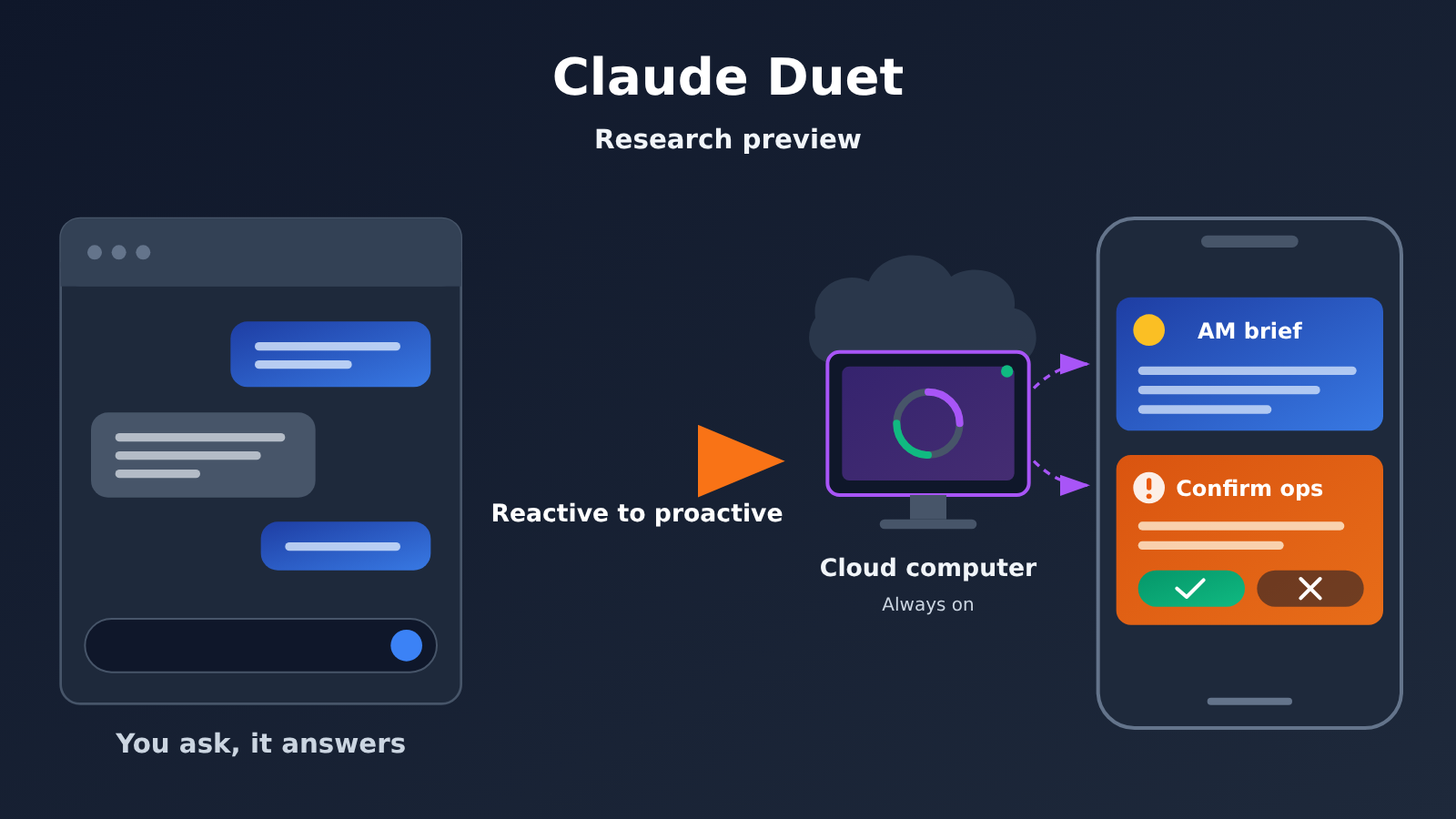
Claude Duet at a Glance: What It Is
Claude Duet is a standalone app from Anthropic, not a new button in the claude.ai chat interface. It’s available through iOS, Android, and claude.ai. Using it feels much like messaging someone: you can type or use your voice.
It runs exclusively on Claude Opus 5.5, with no option to switch models. According to Anthropic, it decides for itself how much “effort” a task needs. That’s quite different from how we’re used to specifying a model and adjusting reasoning effort manually in the API.
| Item | Details |
|---|---|
| Availability | Research preview opened October 21, 2026 |
| Product format | Standalone app available on iOS, Android, and claude.ai |
| Underlying model | Fixed to Claude Opus 5.5; no model selection |
| Eligibility | US Pro / Max / Ultra subscribers, with waitlist access rolling out in waves |
| Not yet available | Team and Enterprise plans; Anthropic says support is planned |
| Pricing | Included in subscriptions during the research preview; shares the same usage limits as Claude |
| Interaction | Type or use your voice, much like sending a message |
How Claude Duet Differs From a Typical Chatbot
A typical chatbot is conversation-driven: you send a message, it replies, and when you close the page, the work stops. Claude Duet is goal-driven: you hand it a task, and it keeps working in the background, checking in when there’s progress or it needs your decision.
That difference affects every aspect of the product, from its runtime environment and notifications to permissions and pricing. Here’s a quick comparison.
| Dimension | Traditional chat assistant | Claude Duet (proactive Agent) |
|---|---|---|
| Trigger | User asks a question | Agent proactively brings up things that need attention |
| Runtime environment | Within a session; stops when the page closes | Runs on its own cloud computer and continues after the app closes |
| Time span | A single exchange or session | Runs continuously, checking and following up periodically |
| External actions | Usually only outputs text | Can send messages, make payments, and sign documents, but requires confirmation first |
| Model selection | User can choose | Fixed to Opus 5.5; the Agent decides how much effort to use |
How Claude Duet Works: Continuous Operation on a Cloud Computer
The key to understanding Claude Duet is that it has its own cloud computer. Tasks don’t depend on the app running on your phone. Even if you close the app, Duet keeps working in the cloud. That’s what makes it possible for Duet to “keep working after you leave.”
With that foundation, Anthropic describes several ways Duet can take initiative:
- Morning briefings: Get a daily summary of things that need your attention, instead of having to ask about each one.
- Periodic checks of connected accounts: Review the accounts you’ve authorized on a schedule and identify items that need attention.
- Follow-ups on unanswered threads: If a conversation has gone quiet for a while, Duet can remind you or prepare a follow-up.
- Completing assigned tasks: Carry your tasks through to completion, checking back with you when it needs confirmation.
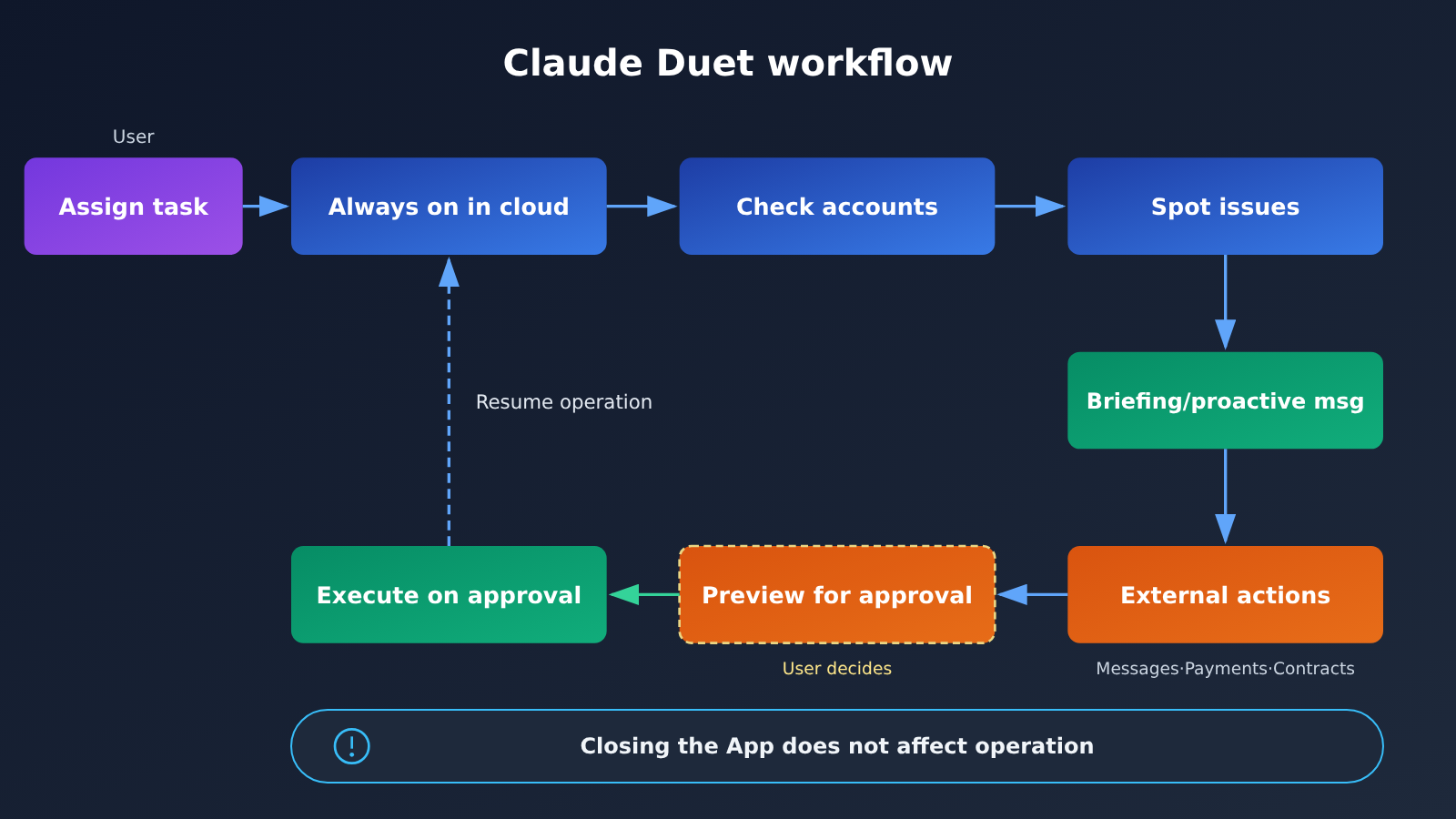
What Claude Duet’s “Periodic Checks” Mean
“Periodic checks” sound convenient, but they’re essentially polling, not real-time monitoring. Anthropic also explicitly warns that urgent matters may come up between checks. In other words, Claude Duet is good at making sure things don’t get forgotten, not responding to emergencies the instant they happen.
For product designers, that’s an honest trade-off. Continuous real-time monitoring means higher computing costs and more interruptions. Periodic checks combined with proactive notifications strike a balance between cost, interruptions, and timeliness. If your use case is extremely time-sensitive, you shouldn’t rely on Duet as your only alert channel.
Claude Duet’s Action Boundaries and Memory Tools
The biggest concern with a proactive agent is whether it’ll do things behind your back. Claude Duet addresses this with confirmation checkpoints before key actions and extra restrictions on sensitive information.
How Claude Duet Confirms Actions
When Claude Duet is ready to send a message, make a payment, or sign a document, it first shows you what it’s about to do and waits for your confirmation. This separates autonomous execution from final authorization: the agent prepares and moves things forward, while you make the final call.
For sensitive content such as health information and personal finances, it’ll only send it when you explicitly instruct it to. That’s a stricter safeguard than ordinary confirmation: sensitive information stays private by default, and you have to proactively ask for it to be sent.
That said, the official announcement also acknowledges that safety mechanisms in the research preview may occasionally miss things or raise false alarms. A miss means something that should have been blocked gets through; a false alarm means something is blocked when it shouldn’t be. Confirmation checkpoints are an important safeguard, but they aren’t foolproof. You should still review the action preview carefully before confirming.
Claude Duet Memory, Skills, and Apps
Claude Duet builds on Claude’s existing memory, skills, and apps. That means the preferences you’ve established, skills you’ve configured, and apps you’ve connected in Claude can carry over to Duet. You don’t have to teach it everything from scratch.
From a product perspective, that’s a smart move. The value of a proactive agent depends heavily on context: it needs to know who you are, what matters to you, and what it can handle on its own. Reusing the existing memory and tool ecosystem can significantly reduce the cold-start problem and help Duet complement the main Claude product rather than feel disconnected from it.
Claude Duet’s Limitations: What to Know During the Research Preview
Understanding the limitations is more useful than just listing features. This table puts Claude Duet’s current capabilities alongside their constraints, so you can quickly decide whether it meets your expectations.
| Capability | Current behavior | Limitation |
|---|---|---|
| Proactive updates | Morning briefings and reminders about things that need attention | May misjudge how urgent something is |
| Continuous operation | Runs on a cloud computer after you close the app | Checks periodically, so urgent matters may arise between checks |
| External actions | Sends messages, makes payments, and signs documents | Requires confirmation first; safeguards occasionally miss things or raise false alarms |
| Browser operations | Runs in its own cloud computer | You can’t watch or take over its browser |
| Model capabilities | Uses Opus 5.5 and decides how much effort to apply |
You can’t choose a model or manually adjust the effort level |
| Availability | US Pro / Max / Ultra | US only; waitlist access rolls out in waves; not available for Team/Enterprise |
| Pricing | Included in the subscription | Shares usage limits with Claude, so heavy use can eat into your allowance |
A Few Claude Duet Limitations That Are Easy to Overlook
You can’t watch or take over the browser. Many desktop agents let you watch them work in real time and take over with a click when needed. Duet can’t do that right now. You can only see what it’s doing through confirmation requests and the results it produces, so visibility into the process is limited.
Shared usage limits are also worth keeping in mind. Duet doesn’t cost extra during the research preview, but it uses the same allowance as your everyday Claude usage. An agent that runs continuously and checks things periodically consumes that allowance differently from an occasional chat, so heavy users should keep an eye on their usage.
Also, Anthropic hasn’t published large-scale performance data. That means there are no reliable numbers yet for questions like “How much time does it save?” or “How accurate are its judgments?” We won’t speculate here.
What Claude Duet Teaches Us About Agent Product Design
Whether or not you use Claude Duet, it gives teams building agents a useful reference point. Duet’s design choices shouldn’t be treated as the standard for every agent product, but they highlight several questions that apply broadly.
Four Pillars of Proactive Agents: Permissions, Confirmation, Observability, and Cost
- Permissions: Users must explicitly grant access to accounts and actions, and they should be able to revoke that access at any time. Duet’s approach of sending sensitive information only when explicitly instructed is one example of the principle of least privilege.
- Confirmation: Confirming actions before they happen is key to trust. The confirmation screen should clearly show what the agent is about to do, rather than asking a vague “Continue?”
- Observability: Users should be able to check task status and execution logs. Duet doesn’t let users watch the browser, which is a useful reminder: when the process isn’t visible, logs and auditing need to be especially robust.
- Cost: A continuously running agent has a different cost structure from a chat product. Subscription allowances and API costs should be tracked separately; otherwise, it’s hard to determine an agent’s true unit economics.
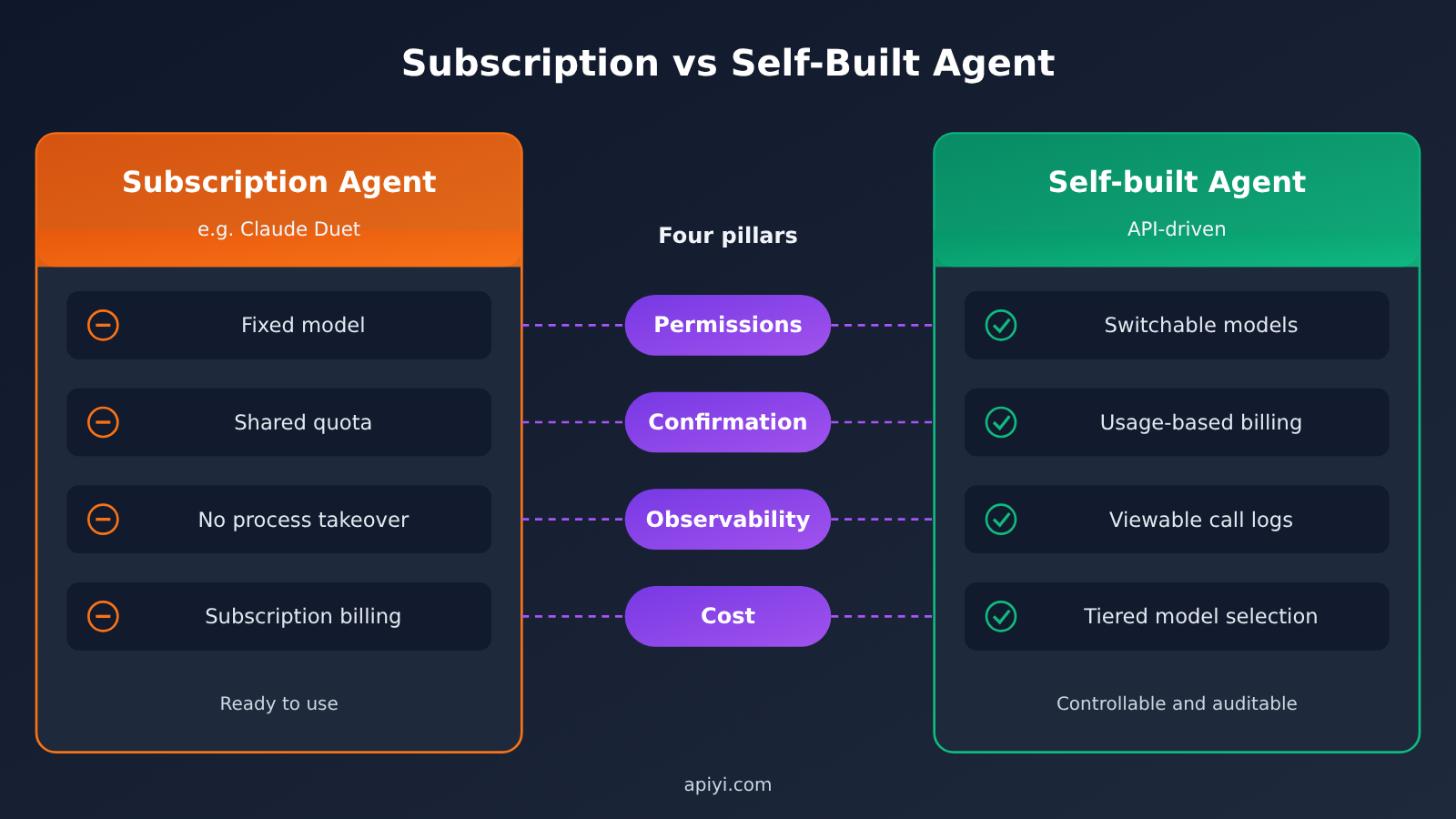
Diagram note: For self-built agents, you can view model invocation usage and logs by model and time in the APIYI apiyi.com console, making it easier to track them separately from subscription allowances.
Building Your Own Proactive Agent: How to Choose Backend Models
Duet uses Opus 5.5 exclusively, which saves everyday users from having to choose a model. But if you’re building a proactive Agent into your own product, the situation is different. Polling for updates, generating briefings, drafting replies, and making complex decisions all require different levels of model capability. Using the most powerful model for everything can get expensive, while relying entirely on lightweight models can lead to errors.
A better approach is to choose models by task tier and retain the ability to switch between them, so the entire Agent isn’t locked into one provider. The reference material makes this point explicitly: the model backend should be switchable.
For implementation, APIYI apiyi.com provides unified access to mainstream models from Claude, OpenAI, Gemini, and others using a single key, with support for both OpenAI and Claude native formats. Point the SDK’s base_url to https://api.apiyi.com/v1, and you can assign different models to different subtasks within the same codebase. For the availability and pricing of specific Opus model IDs (such as claude-opus-5-5), check the current console listings and documentation.
🎯 Technical tip: When prototyping a proactive Agent, use the same key through APIYI apiyi.com to compare how a few models perform on subtasks like “assessing urgency” and “drafting replies” before deciding on a tiering strategy. Console usage data and logs can serve as your first layer of Agent observability.
| Cost factor | Subscription-based Agent (Duet research preview) | Self-built Agent (pay-as-you-go API) |
|---|---|---|
| Billing | Included in the subscription, with shared usage limits | Billed by usage |
| Model selection | Fixed; no choice | Models can be tiered by subtask |
| Usage visibility | Mainly through quota consumption | Detailed usage by model and time |
| Available platforms | Official Claude App | APIYI apiyi.com, official provider APIs |
| Best for | Heavy individual users who want to try it directly | Development teams that need control and auditability |
Claude Duet FAQ
Q1: Is Claude Duet generally available? Who can use it now?
Not yet. `Claude Duet` launched as a **research preview** on October 21, 2026, available only to Pro, Max, and Ultra subscribers in the US. Access is rolling out in waves through a waitlist. Team and Enterprise plans aren’t supported yet, though the company says it plans to add support later. Features and eligibility rules may change during the preview.
Q2: Will Claude Duet send messages or make payments without my permission?
According to the official documentation, it shows you what it plans to do and waits for confirmation before sending messages, making payments, or signing documents. Sensitive information, such as health or personal financial details, is sent only when you explicitly instruct it to do so. However, safety mechanisms can occasionally miss issues or flag harmless actions during the research preview, so you should still check the details carefully before confirming.
Q3: I want to build a similar proactive Agent into my product. How should I connect the backend models?
Consider using a unified interface that supports multiple models, selecting models by subtask and retaining the ability to switch between them. APIYI apiyi.com lets you access Claude, OpenAI, Gemini, and other models with a single API key. It supports both OpenAI and Claude native formats and offers new users free testing credits, making it useful for comparing prototypes. Check the console for current models and pricing.
Q4: How do I audit costs and behavior for an Agent I build myself?
At a minimum, record three types of data: task status, usage for each model invocation, and confirmation records for external actions. For model invocations, you can view usage by model, billing, and logs in the APIYI apiyi.com console. You’ll still need to store business-level action audit records in your own system. Combining the two gives you a complete picture.
Claude Duet Key Takeaways and Proactive Agent Checklist
- A shift in interaction:
Claude Duetmoves beyond answering questions to proactively moving work forward and reaching out to you. - How it runs: It has its own cloud computer and keeps working after you close the app.
- Proactive behavior: Morning briefings, regular checks of connected accounts, and follow-ups on unanswered threads.
- Action boundaries: It shows you what it plans to do and waits for confirmation before sending messages, making payments, or signing documents.
- Main limitations: US only, waitlist access in waves, fixed to
Opus 5.5, and unable to take over your browser. - Design lessons: Permissions, confirmation, observability, and cost are the four pillars of a proactive agent.
- Getting started: If you’re building your own agent, APIYI at apiyi.com lets you compare multiple models with one key and track usage logs.
Product managers and developers can use the checklist below when designing proactive agents. The questions reflect Duet’s design choices and known limitations; the right column suggests minimum requirements.
| Checklist item | Question to answer | Suggested minimum requirement |
|---|---|---|
| Trigger mechanism | When should the agent reach out to the user? | Set clear briefing times and check intervals, and tell users how current the information will be |
| Permissions | Which accounts can it connect to, and what actions can it take? | Require explicit authorization, allow revocation at any time, and don’t send sensitive data externally by default |
| Action confirmation | Which actions require human confirmation? | Always show a preview before sending messages, making payments, or signing documents |
| Misjudgment fallback | What happens if it misjudges urgency? | Provide a user feedback option, and don’t rely on a single channel for critical alerts |
| Process visibility | Can users see what the agent is doing? | Provide execution logs at a minimum; support watching or taking over when possible |
| Task status | Can users check and stop tasks in progress? | Provide a task list, status updates, and one-click pause |
| Model backend | Is it locked to a single model? | Choose models by subtask and retain the ability to switch |
| Cost accounting | Are subscription allowances and API costs tracked separately? | Track usage and billing by model and task |
| Preview disclosure | Do users know the product is still experimental? | Clearly label its preview status and known limitations |
Claude Duet Summary: The Direction and Limits of Proactive Agents
The significance of Claude Duet isn’t any single feature. It’s that it puts a complete vision of a “proactive agent” on display: a standalone app, its own cloud computer, continuous operation, proactive briefings, confirmation before taking action, and reusable memory and tools. Together, these features offer a fairly clear product blueprint.
Its limitations are just as clear. It’s US-only, waitlist access rolls out in waves, Team and Enterprise aren’t supported, and you can’t choose the model. It may misjudge urgency, periodic checks leave gaps between runs, and it can’t take over your browser. There’s also the uncertainty that comes with a research preview. If you’re considering it, these limitations deserve more attention than the feature list.
For agent developers and product managers, the key takeaways are four pillars: permissions, confirmation, observability, and cost. If you’re ready to build your own proactive agent, consider using APIYI apiyi.com to quickly compare multiple backend models with one key, then use the console’s usage data and logs to manage both costs and behavior.
References
- Official Claude Duet product page: Research preview announcement, product design, and availability
- Access:
claude.ai - Note: Check the official page for the latest access dates, subscription plans, and waitlist rules
- Claude Help Center articles on Duet: Action confirmation, handling of sensitive information, and known limitations
- Note: Content may change during the research preview; refer to the latest version
- APIYI documentation center: Multi-model integration, console usage data, and logs
- Link:
docs.apiyi.com - Note: Check the console and documentation for the latest model list, pricing, and availability
Author: APIYI Technical Team
Technical discussions: Visit the APIYI apiyi.com homepage to contact us and share your experience with selecting backend models and managing usage for agents.


