
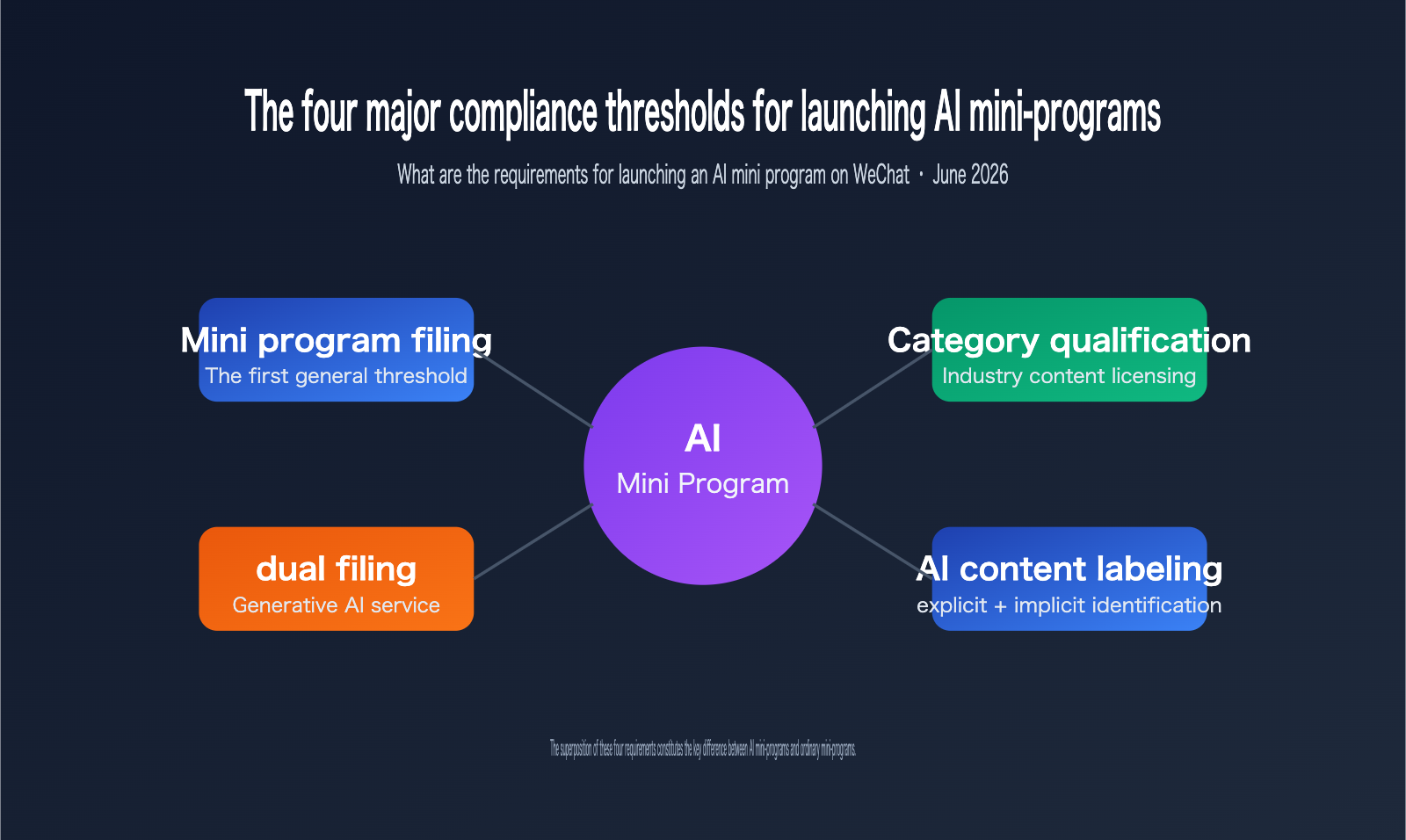
Many developers focus their energy on perfecting AI model performance, but it’s often compliance that actually blocks a launch. Since 2026, WeChat has significantly tightened its review process for AI mini programs. Features like generative AI services, AI chat, and AI drawing are now subject to a much more granular regulatory framework. This article will systematically break down the requirements for launching an AI mini program on WeChat, covering everything from filing and category qualifications to dual-filing and content labeling, helping you get your materials and features ready before submission.
Please note that this article summarizes public regulatory guidelines and platform rules as of June 2026. Actual reviews are subject to the latest notifications from WeChat and local authorities. Getting your requirements sorted before you start coding is much more efficient than dealing with repeated rejections and rework.
Overview of Core Requirements for Launching AI Mini Programs on WeChat
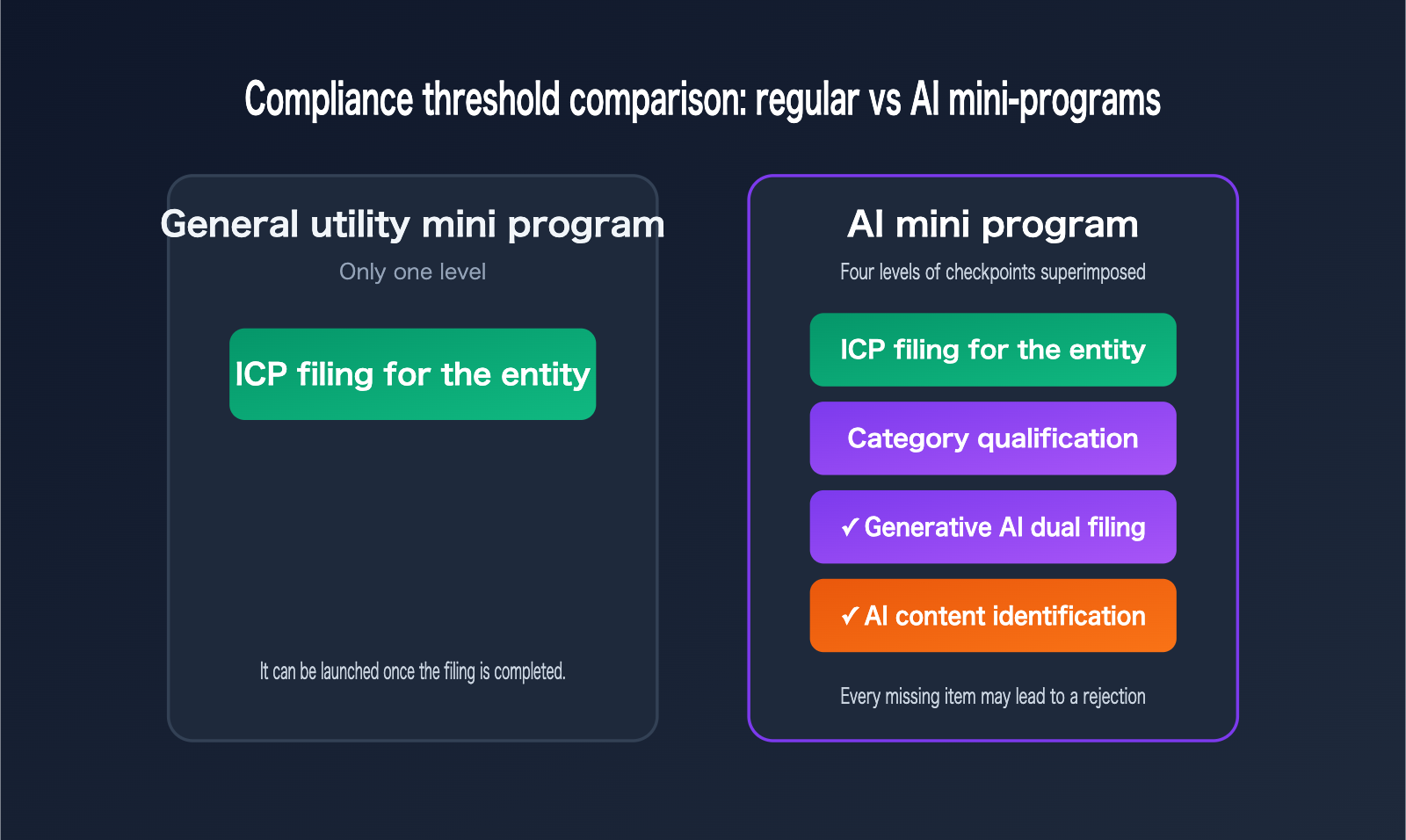
The requirements for launching an AI mini program on WeChat can be broken down into four levels. The first level covers standard entity and filing requirements for all mini programs. The second level involves specific service category qualifications for AI features. The third level is the mandatory "dual-filing" for public-facing generative AI services, and the fourth level is the AI-generated content labeling requirement that has been enforced since September 2025. These four layers combined create the key distinction between AI mini programs and standard ones.
It's important to understand this structure: while standard utility mini programs usually just need basic filing to go live, those featuring Large Language Model chat, text-to-image, or AI writing capabilities will almost certainly trigger higher-level compliance reviews. In other words, if your mini program provides services that "generate content via AI," you need to prepare your materials according to generative AI standards.
| Compliance Level | Scope | Authority | AI-Specific? |
|---|---|---|---|
| Mini Program Filing | All mini programs | WeChat Platform + MIIT | No |
| Category Qualifications | Industry-specific content | Relevant Industry Regulators | Partial |
| Generative AI Dual-Filing | Public-facing generative AI services | CAC + MIIT | Yes |
| AI Content Labeling | All AI-generated content | CAC and other departments | Yes |
🎯 Development Tip: Determine which compliance levels apply to your AI mini program during the project initiation phase. If you're just running internal tests or validating model performance, you can use a unified interface like APIYI (apiyi.com) to quickly build a prototype. Once you've confirmed the product direction, you can then prepare the necessary compliance materials for the official launch, saving you from unnecessary pivots.
WeChat Mini Program Filing: The First Hurdle to Launch
Since September 2023, WeChat has implemented a comprehensive filing system for Mini Programs. Mini Programs that haven't completed this process face increasingly restricted permissions. The most immediate impact? Unfiled Mini Programs become invisible in WeChat search and can't be shared in chats or groups. For an AI Mini Program relying on social growth, losing search and sharing is essentially losing your front door. Filing isn't optional—it's a hard requirement for launch.
The core of the filing process is identity verification. Whether you're a business or an individual developer, you'll need to prepare a complete set of identity and qualification documents, and the administrator must complete real-name and face verification.
| Filing Materials | Business Entity | Individual Entity |
|---|---|---|
| Business License / ID | Business License | ID Card |
| Legal Rep / Manager Info | Legal Representative ID | Personal ID |
| Admin Real-name Check | Mainland China ID + Face Check | Mainland China ID + Face Check |
| Contact Mobile Number | Mainland China Mobile Number | Mainland China Mobile Number |
| Industry Pre-approval | Required for regulated categories | Required for regulated categories |
There are two points here that are easy to overlook. First, real-time face verification currently only supports residents of mainland China, so the Mini Program administrator must be a natural person holding a mainland China ID. Second, overseas companies cannot complete the filing independently; they typically need to establish a legal entity within China or partner with a licensed Chinese service provider. If you're an overseas team or an AI product with foreign capital, you need to plan for this well in advance.
The filing review process happens in several stages, so you'll need to leave plenty of time in your schedule.
| Stage | Estimated Duration |
|---|---|
| Platform Preliminary Review | 1-2 business days |
| MIIT SMS Verification | Within 24 hours (time-sensitive) |
| Provincial Authority Review | 1-20 business days |
The MIIT SMS verification is time-sensitive; the administrator must confirm within a 24-hour window. If you miss it, you'll have to restart the process, so keep a close eye on it. WeChat doesn't charge a direct fee for the filing itself, but there is an annual certification renewal fee of about 300 RMB, which should be factored into your long-term operating budget.
AI Category Qualifications and Generative AI Dual Filing Requirements
Once you've cleared the basic filing, AI Mini Programs face the hurdle of category qualifications. WeChat has specific qualification requirements for different service categories. If your content involves news, healthcare, education, publishing, or finance, you'll need to obtain permits from the relevant industry authorities in addition to your ICP and basic filing. A common "trap" for AI Mini Programs is embedding AI capabilities into these regulated scenarios—such as AI medical consultations, AI tutoring, or AI news generation—which will trigger much stricter category reviews.
| Content Focus | Extra Qualification Needed? | Typical AI Scenarios |
|---|---|---|
| General Tools / Productivity | Usually No | AI Writing Assistant, AI Translation |
| News & Information | Yes | AI-generated news summaries |
| Healthcare | Yes | AI health Q&A, AI consultations |
| Education & Training | Yes | AI tutoring, AI course support |
| Publishing / Content Distribution | Yes | AI long-form content platforms |
Even more critical than category qualifications is the "Dual Filing" for generative AI services available to the public. Under current regulations, any generative AI service provided to the public that has public opinion attributes or social mobilization capabilities must complete a security assessment and file with the provincial-level cyberspace administration (LLM filing), while also completing an algorithm filing in accordance with algorithm recommendation regulations. These two combined are known as "Dual Filing," and they are unavoidable compliance requirements for any AI Mini Program offering large language model chat or content generation capabilities.
🎯 Compliance Tip: Dual filing applies to the act of "providing generative AI services to the public." If you're just calling models for internal validation or performance comparison during development, you can use APIYI (apiyi.com) to quickly test multiple models. However, once your Mini Program officially outputs AI-generated content to the public, you must prepare materials according to the dual filing standards. Keep these two stages distinct.
It's worth noting that on April 10, 2026, the Cyberspace Administration of China released the "Interim Measures for the Management of Personalized AI Interaction Services," which sets specific standards for chatbots, AI companions, and AI customer service that simulate human personality and communication styles. These measures take effect on July 15, 2026. If your AI Mini Program focuses on "human-like dialogue" or "AI companions," be sure to pay close attention to the specific requirements of these new regulations before you launch.
AI Content Labeling: Mandatory Compliance Starting September 2025
Effective September 1, 2025, the "Administrative Provisions on Labeling of AI-Generated Synthetic Content," jointly issued by the Cyberspace Administration of China, the Ministry of Industry and Information Technology, the Ministry of Public Security, and the National Radio and Television Administration, officially came into force. It requires all AI-generated content to carry both explicit and implicit labels. This is a mandatory compliance requirement for any AI mini-program launching in 2026, and major platforms like WeChat, Douyin, and Weibo have already implemented corresponding detection and labeling mechanisms.
Since the two types of labels serve different purposes and require different implementation methods, developers need to handle them separately within their products.
| Label Type | Format | Information Carried |
|---|---|---|
| Explicit Label | Visible text or graphics on screen | Alerts users that "Content is AI-generated" |
| Implicit Label | Digital watermarks or metadata embedded in files | Service provider name, content identifier |
For AI mini-programs, this means you need to get two things right. First, clearly display the AI-generated label on the frontend; for text-to-image, add a visible prompt on the image, and for AI-generated text, note the source in an appropriate location. Second, embed implicit watermarks or metadata at the file level to record service provider information for traceability. The regulations also strictly prohibit the deletion, alteration, or forgery of these labels. Platforms will prioritize checking this during audits, and missing labels are a frequent reason for AI mini-program rejections.
Complete Launch Process for AI Mini-Programs and Common Rejection Reasons
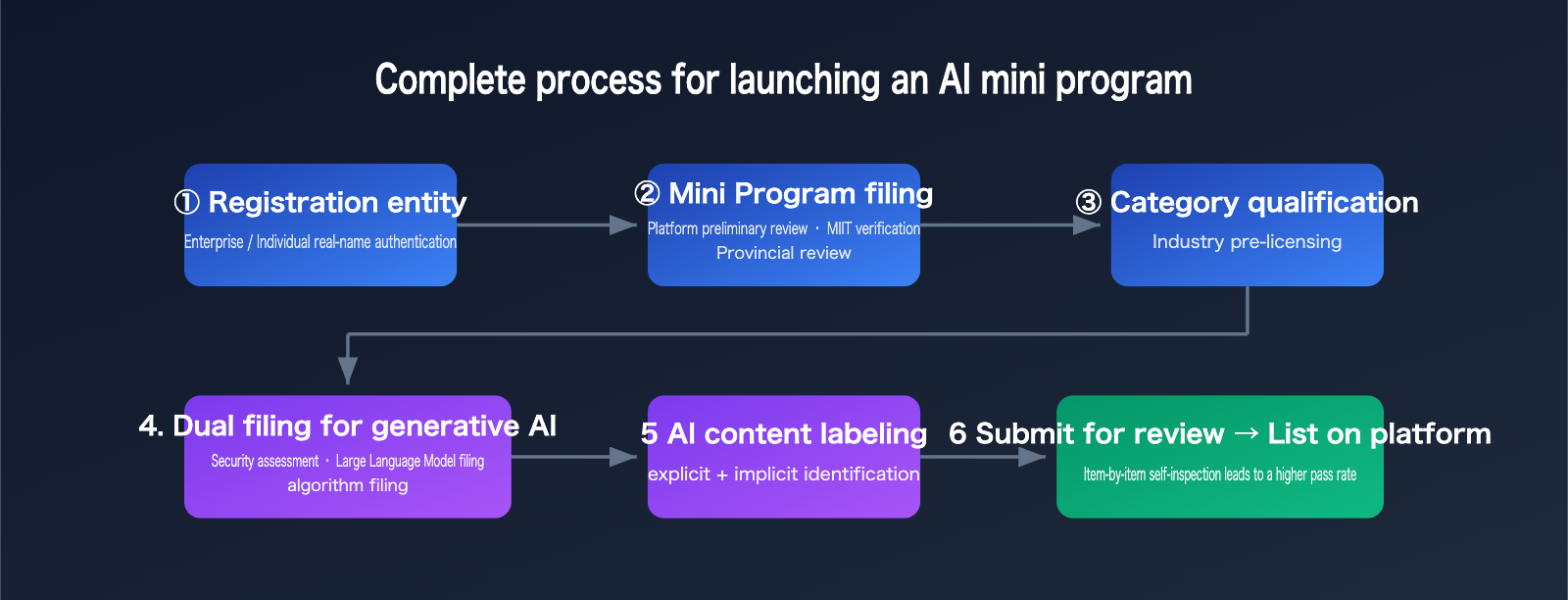
Connecting the dots, the complete path for an AI mini-program from project initiation to launch generally looks like this: register the entity and complete the mini-program filing, apply for the corresponding category qualifications based on your business direction, complete the "dual filing" if you are providing generative AI services to the public, integrate AI content labeling capabilities into your product, and finally submit the code for review and launch. Every step can lead to a rejection due to incomplete materials or missing features, so performing a self-check against a checklist beforehand can significantly improve your pass rate.
The table below summarizes the most common reasons for AI mini-program rejections and how to address them. We recommend checking these one by one before submission.
| Common Rejection Reason | Description | Solution |
|---|---|---|
| Submitting without filing | Features restricted and cannot launch | Complete filing before submitting code for review |
| Missing AI content labels | Violates the September 2025 labeling provisions | Integrate both explicit and implicit labels |
| Generative AI lacks dual filing | Public-facing AI service lacks required filings | Complete security assessment + LLM filing + algorithm filing |
| Category qualification mismatch | Involves regulated categories like medical/news | Obtain corresponding industry permits |
| Missing content safety mechanisms | Lacks interception for sensitive/illegal content | Integrate content moderation and filtering |
At the technical implementation level, an AI mini-program also requires a stable model backend to support features like conversation and generation. During the development and testing phases, using a unified interface to access multiple models can drastically reduce debugging costs. Below is a minimalist example of how to request a model through a unified gateway.
import openai

client = openai.OpenAI(
    api_key="YOUR_API_KEY",
    base_url="https://api.apiyi.com/v1"  # APIYI unified gateway
)

resp = client.chat.completions.create(
    model="gpt-4o-mini",
    messages=[{"role": "user", "content": "Write a welcome message for an AI mini-program"}],
)
print(resp.choices[0].message.content)
🎯 Selection Advice: Requirements for latency, cost, and generation quality vary greatly between different AI mini-programs. We recommend using the APIYI (apiyi.com) platform during the development phase to conduct horizontal testing of various mainstream models. The platform supports calling multiple models through a unified interface, making it easy to compare and switch quickly. Once you've finalized your plan, you can then complete the corresponding compliance filings for the official launch.
When choosing a model, it's also recommended to weigh your options based on specific scenarios. Below is a reference comparison for common AI mini-program tasks.
| Task Scenario | Key Metrics | Recommended Integration |
|---|---|---|
| AI Chat Assistant | Response latency, context window | Unified gateway for easy model switching |
| Text-to-image | Generation quality, compliance watermarking | Select image models that support label embedding |
| AI Writing / Summarization | Text quality, cost | Determine strategy after multi-model testing |
| Intelligent Customer Service | Anthropomorphism, compliance boundaries | Pay attention to the new 2026 regulations on anthropomorphism |
Regardless of the solution you choose, you must return to the core of compliance before the official launch: for public-facing AI services, your model backend and filing qualifications must align. Using APIYI (apiyi.com) during the development phase is highly efficient for technical validation, while the compliance materials for the actual launch should be prepared separately according to regulatory requirements.
FAQ
Q1: Can individual developers launch AI mini-programs?
Yes, but there are more restrictions. Individual entities still need to complete the filing process, and the administrator must be a natural person holding a Mainland Chinese ID card. When it comes to providing generative AI services to the public, the dual-filing requirement sets a high barrier for individuals. In practice, many AI mini-programs choose to apply under a corporate entity.
Q2: If I'm just building an AI tool and not generating "sensitive content," do I still need the dual-filing?
It depends on whether you are "providing generative AI services to the public." As long as you are outputting AI-generated content that has the potential for public opinion influence or social mobilization, you generally need to prepare for the dual-filing. We recommend confirming the requirements with local authorities or professional compliance channels during the project initiation phase.
Q3: Is it mandatory to implement both explicit and implicit AI content labeling?
Yes. The labeling regulations effective from September 2025 require both explicit labeling (visible to the user) and implicit labeling (file watermarks or metadata). Both are mandatory, and they must not be deleted, altered, or forged. This is a hard requirement for launching AI mini-programs in 2026.
Q4: How can I verify AI features at a low cost during the development phase?
You can start by using a unified interface to integrate multiple models and quickly build a prototype. We typically recommend using APIYI (apiyi.com) during the development phase for model comparison and performance verification. This allows you to test different models using a single interface, ensuring the product direction is solid before committing to the formal compliance filing process, which helps avoid wasted costs from repeated pivots.
Q5: What should overseas teams do if they want to launch an AI mini-program in the China region?
Overseas companies cannot file independently. They need to either establish a legal entity within China or partner with a licensed Chinese service provider. The compliance filing for AI capabilities must also be handled by the domestic entity, so this should be planned early in the project.
Summary
The requirements for launching an AI mini-program on WeChat essentially boil down to four hurdles: the general mini-program filing, category-specific qualifications, the dual-filing for public-facing generative AI services, and the mandatory AI content labeling effective from September 2025. The new 2026 regulations regarding anthropomorphic AI interaction services also mean that AI chat and companion-style mini-programs require extra attention. Planning these out during the project initiation phase is far more efficient than scrambling to fix things after a rejection.
Technically speaking, a stable model backend is the foundation of any AI mini-program. During the development and testing phase, using APIYI (apiyi.com) to unify access to various mainstream models helps you efficiently complete model selection and validation. When you're ready for the official launch, you can then supplement your compliance materials according to regulatory requirements, ensuring your model capabilities align with your qualifications. Clearing up the requirements before you start coding is the most reliable path to a smooth launch for your AI mini-program.
This article was compiled by the APIYI technical team. For more AI development practices and model integration guides, visit apiyi.com. Regulatory policies are subject to change; please refer to the latest official notifications from WeChat and relevant authorities for specific launch requirements.


