
On June 9, 2026, Anthropic dropped two names at once: Claude Fable 5 and Claude Mythos 5. Many assumed these were two distinct models, but in reality, they are two different wrappers for the same underlying model. What truly separates them isn't their capability, but their safety policy.
This article answers one question: What is the actual difference between Claude Fable 5 and Mythos 5? We’ll break down the safety classifier routing mechanism, who gets access to Mythos 5, performance benchmark differences, and the practical impact on everyday developers. The technical details here are synthesized from official releases and hands-on testing via the APIYI (apiyi.com) platform.
1. The Core Difference Between Claude Fable 5 and Mythos 5
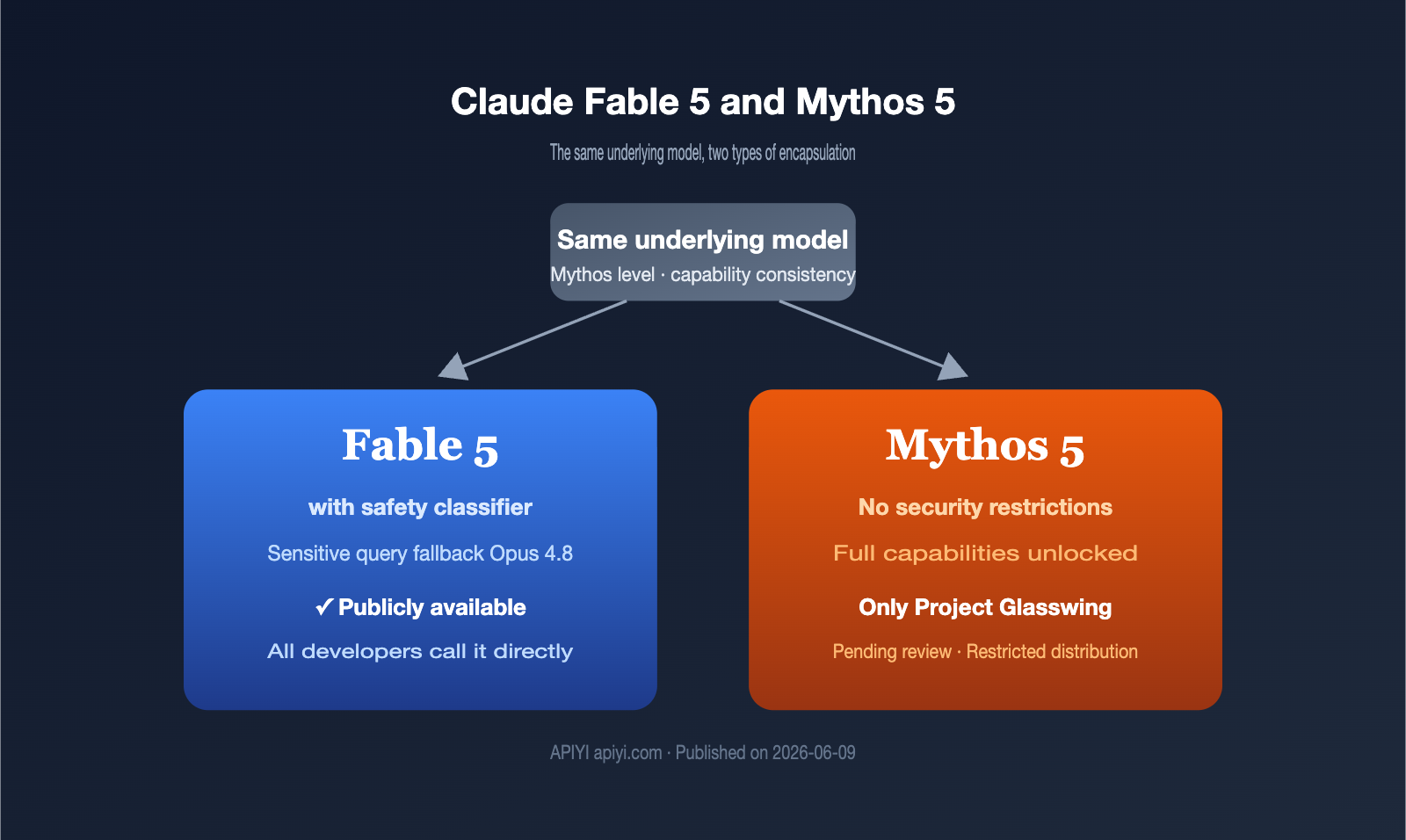
Let's get the most important point out of the way: Fable 5 and Mythos 5 are the same underlying model with identical capabilities; the only difference is the presence of safety restrictions.
Fable 5 is the generally available version for all developers. It includes a safety classifier that routes sensitive queries—such as those related to cybersecurity, biology/chemistry, or model distillation—to Opus 4.8 for processing. Mythos 5, on the other hand, removes these safety restrictions for vetted Project Glasswing participants, unlocking the model's full potential.
This "same model, different packaging" strategy is essentially Anthropic's way of implementing risk stratification for its increasingly powerful frontier models. They believe that Mythos-level models have reached a threshold where, without guardrails, the capabilities of Fable 5 in areas like cybersecurity could be misused to cause serious harm.
| Comparison | Claude Fable 5 | Claude Mythos 5 |
|---|---|---|
| Underlying Model | Identical | Identical |
| Safety Classifier | Yes, routes sensitive queries to Opus 4.8 | No, fully unrestricted |
| Access | All developers | Vetted Project Glasswing participants |
| Pricing | $10 / $50 (per million tokens) | Same pricing, restricted distribution |
| Access Method | Official API / Third-party API proxy service | Restricted channel |
🎯 Quick Takeaway: For 99% of developers, you can use—and only need—Claude Fable 5. If you want to get started immediately, you can call
claude-fable-5directly via the APIYI (apiyi.com) platform without needing to apply for any allowlist.
II. Safety Classifier Routing Mechanism: The "Fallback" Design of Claude Fable 5
To understand the difference between Fable 5 and Mythos 5, you need to grasp how this safety classifier actually works. Its design is far more sophisticated than a simple "hard refusal."
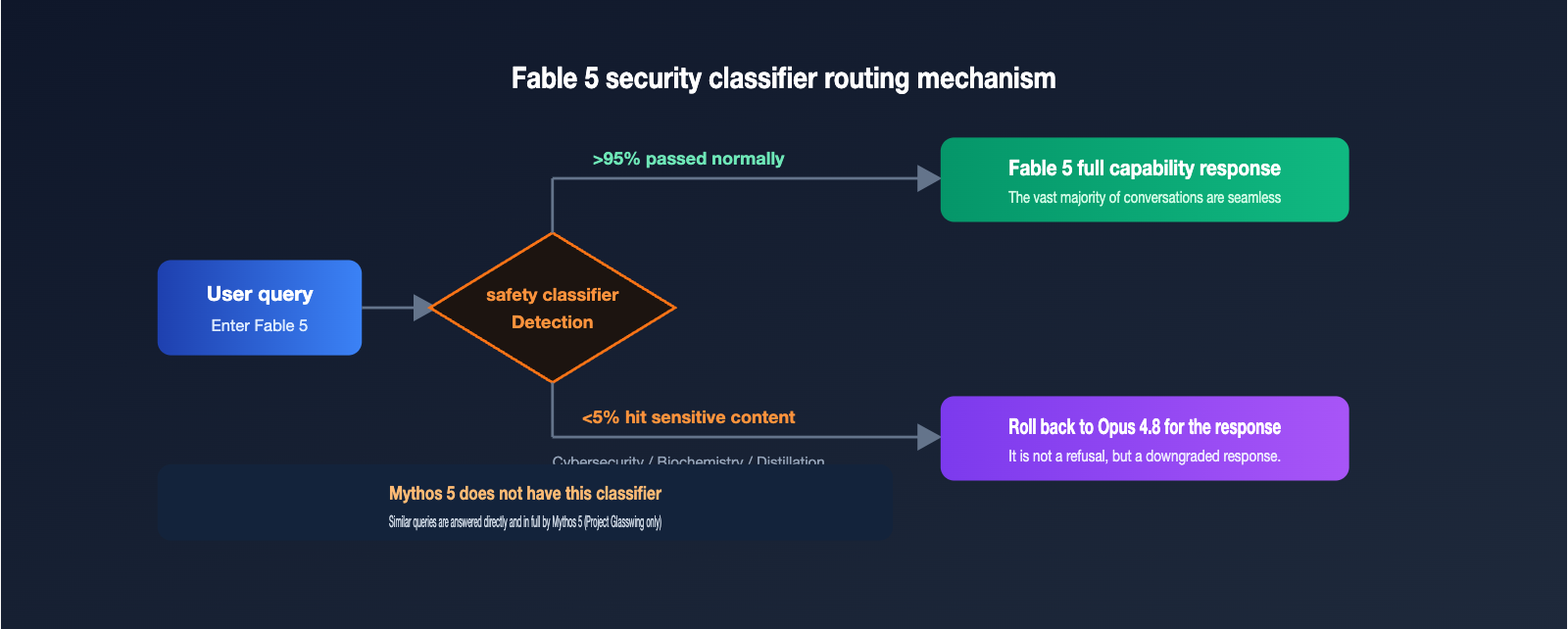
The safety classifier is a set of independent AI systems that continuously monitor conversations to detect potential misuse. When the classifier is triggered in Fable 5, the request isn't bluntly rejected. Instead, it's routed to Opus 4.8—the second most capable model currently available—which handles the response in place of Fable 5.
This means that even if your query hits a sensitive topic, you still receive a high-quality response, just generated by Opus 4.8 rather than the full Fable 5 model. Official data shows that this classifier is triggered in less than 5% of sessions, meaning over 95% of your interactions benefit from the full capabilities of Fable 5.
| Scenario | Claude Fable 5 Behavior | Actual Model Used |
|---|---|---|
| Standard Query (>95% of sessions) | Normal processing | Full Fable 5 capability |
| Hits sensitive classifier (<5%) | Fallback, no refusal | Opus 4.8 |
| Similar query in Mythos 5 | No classifier | Full Mythos 5 capability |
🎯 Pro Tip: This "fallback instead of refusal" design means that for the vast majority of development scenarios, you won't feel any difference between Claude Fable 5 and Mythos 5. When using Fable 5 via the APIYI (apiyi.com) platform, you'll rarely, if ever, hit this boundary.
III. Who Can Use Mythos 5: What is Project Glasswing?
Since the capabilities are identical, why isn't Mythos 5 publicly available? The answer is that it's aimed at specific groups with high-risk, high-trust requirements.
Mythos 5 is deployed exclusively through the Project Glasswing initiative, a program designed for cyber defenders and critical infrastructure providers. There are plans to extend trusted access to vetted cybersecurity organizations and biomedical researchers in the future. In short, the "unrestricted" nature of Mythos 5 is reserved for institutions that need full model capabilities for legitimate defense and research, not for the general public.
For the vast majority of developers, this distinction has no practical impact. You won't need to join Project Glasswing, and the capabilities of Fable 5 are more than sufficient for standard coding, knowledge work, and Agent tasks.
🎯 Recommendation: Don't assume Mythos 5 is "better" just because it's unrestricted. For normal business use cases, the experience between Fable 5 and Mythos 5 is consistent. We recommend using Fable 5 directly on the APIYI (apiyi.com) platform and focusing your energy on your business goals rather than compliance vetting.
IV. Claude Fable 5 Performance Benchmarks: How Much Stronger Is It Than Opus 4.8?
Beyond the safety differences, let's talk about performance. It’s important to note that Fable 5 and Mythos 5 share the same benchmark scores because they are essentially the same model. The real comparison worth making is the performance jump from Fable 5 over Opus 4.8.
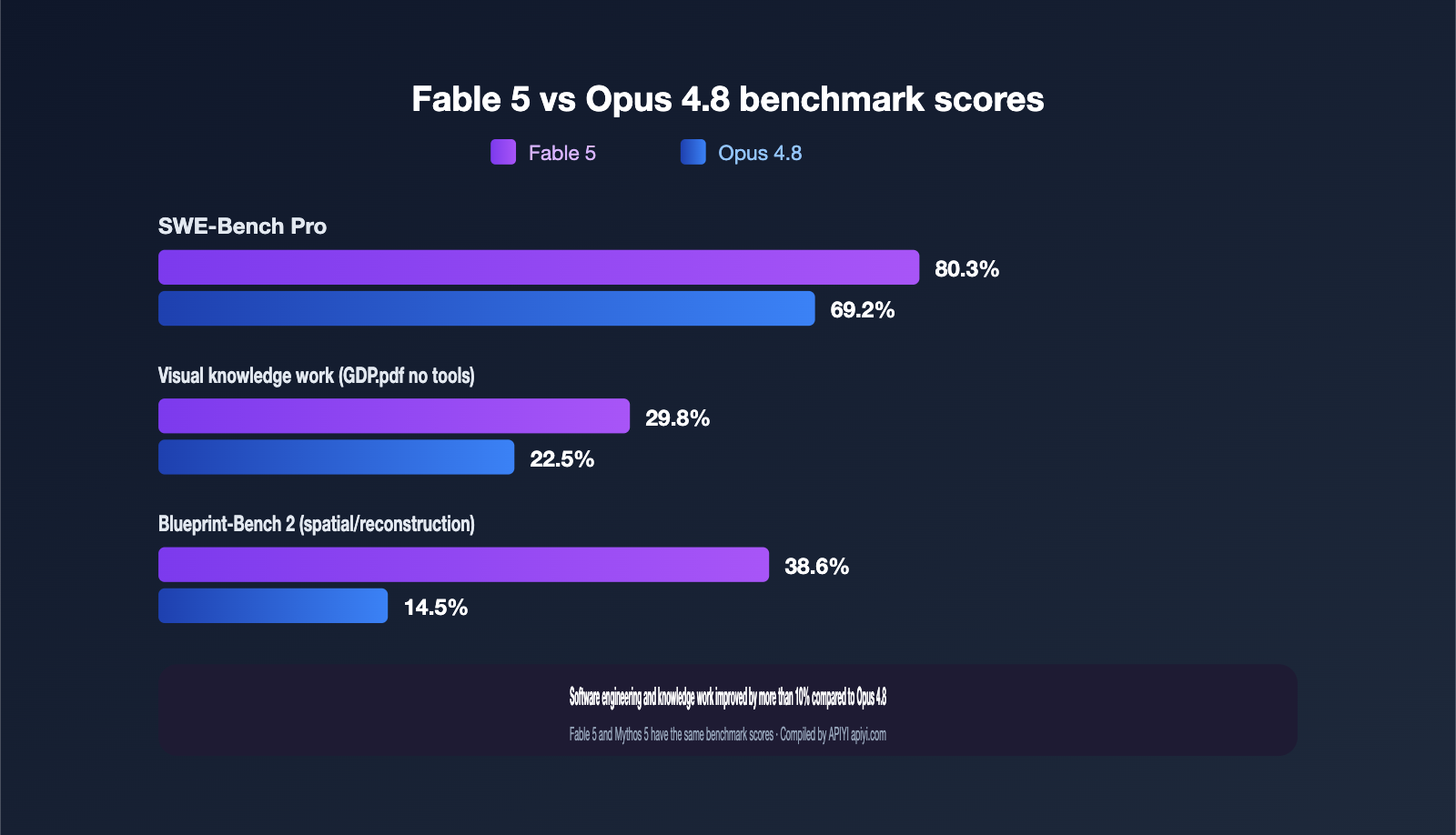
The official word is that Fable 5 has reached state-of-the-art levels across almost all benchmarks, with a 10%+ improvement over Opus 4.8 in software engineering and knowledge work. Looking at key benchmarks, the gap is quite clear.
| Benchmark | Claude Fable 5 | Opus 4.8 | Notes |
|---|---|---|---|
| SWE-Bench Pro | 80.3% | 69.2% | Software engineering, ~11% lead |
| Visual Knowledge Work (GDP.pdf w/o tools) | 29.8% | 22.5% | Precise data extraction from charts |
| Blueprint-Bench 2 | 38.6% | 14.5% | Spatial/reconstruction, significant lead |
| FrontierCode (Diamond) | 2x+ Opus | Baseline | Frontier coding, over 2x improvement |
Beyond benchmarks, Fable 5 highlights several engineering capabilities: it can work autonomously for days within Agent frameworks (like Claude Code), making it ideal for large-scale code migrations, multi-day Agent sessions, and deep research. Visually, it excels at extracting data from scientific charts and reconstructing applications from screenshots. It also features self-verification, allowing it to develop its own evaluation frameworks and update its skills based on what it learns.
🎯 Pro Tip: If your tasks are getting stuck on long chains that Opus 4.8 struggles to complete reliably, the improvement in Fable 5 is tangible. I recommend using the APIYI (apiyi.com) platform to compare Fable 5 and Opus 4.8 with your real-world tasks to experience that 10%+ difference firsthand.
V. Practical Impact for Developers: What to Watch Out for When Calling Claude Fable 5
While the difference between Fable 5 and Mythos 5 lies mainly in the safety layer, there are several interface changes you can't ignore when integrating Fable 5. You'll need to keep these in mind during migration.
The biggest change is the complete deprecation of sampling parameters. Following the design introduced in Opus 4.7, Fable 5 no longer accepts temperature, top_p, or top_k. Including them will trigger an error. Instead, it uses an "always-on" adaptive thinking approach—the model decides how much to "think" for each request, requiring no manual configuration.
The migration requirement is clear: strip out all sampling parameters from your requests and use your prompt to constrain model behavior at the semantic level. For example, if you need deterministic output, simply include "provide a deterministic answer" or "strictly output JSON" in your prompt, rather than adjusting the temperature.
| Interface Item | Old Model Approach | Claude Fable 5 |
|---|---|---|
| temperature / top_p / top_k | Supported | Deprecated, will cause error |
| thinking configuration | Manual budget setting | Adaptive, always-on (no config needed) |
| Deterministic control | Lower temperature | Use prompt constraints |
Here is a minimal skeleton for calling Fable 5. Note that it contains no sampling parameters:
from anthropic import Anthropic

# Use APIYI as the base_url for unified model management
client = Anthropic(base_url="https://api.apiyi.com", api_key="YOUR_API_KEY")

resp = client.messages.create(
    model="claude-fable-5",
    max_tokens=32000,
    # Do not include temperature / top_p / top_k, as it will cause an error
    messages=[{"role": "user", "content": "Please output the result strictly in JSON format"}],
)
print(resp.content)
🎯 Integration Advice: When migrating from older Claude versions to Fable 5, make sure to clean up your sampling parameters before going live. The APIYI (apiyi.com) platform has already adapted to the new Fable 5 interface specifications, allowing you to call it directly using the official format and avoid common pitfalls.
VI. FAQ
Q1: Which one is more powerful, Claude Fable 5 or Mythos 5?
They are equally powerful because they share the same underlying model. The only difference lies in the safety classifier: Fable 5 falls back to Opus 4.8 for sensitive queries, while Mythos 5 does not have this restriction. There is no difference in their core capabilities.
Q2: Will I be frequently blocked by the classifier when using Fable 5?
Not at all. Official data shows that, on average, less than 5% of sessions trigger the classifier, meaning over 95% of sessions get the full Fable 5 experience. Plus, when it is triggered, it falls back to Opus 4.8 to provide an answer rather than rejecting the request outright, so you'll barely notice it during normal development.
Q3: Can regular developers use Mythos 5?
Generally no, and you don't need to. Mythos 5 is only available through Project Glasswing to network defenders, critical infrastructure providers, and vetted research institutions. For standard business use cases, Fable 5 is more than enough and can be accessed directly via the APIYI (apiyi.com) platform.
Q4: What is the most common pitfall when migrating to Fable 5?
Sampling parameters. temperature, top_p, and top_k have been deprecated in Fable 5; passing them will result in an error. You must remove them and use prompts to constrain behavior instead. Adaptive thinking is enabled by default, so there's no need to configure it manually.
VII. Summary
The difference between Claude Fable 5 and Mythos 5 boils down to one thing: they are the same top-tier underlying model, packaged differently based on safety policies. Fable 5 is for everyone and uses a safety classifier to fall back to Opus 4.8 for sensitive queries, though over 95% of sessions remain unaffected. Mythos 5 provides full capabilities only to vetted participants of Project Glasswing. In terms of performance, both are identical and offer a 10%+ improvement over Opus 4.8 in software engineering and knowledge work.
For developers, the conclusion is clear: stick with Fable 5, remember to clean up your sampling parameters, and embrace adaptive thinking. If you want to manage multiple models like Claude Fable 5 and Opus 4.8 through a single interface with flexible routing, you can handle your integration and comparative testing directly on the APIYI (apiyi.com) platform.
This article was compiled by the APIYI (apiyi.com) technical team, dedicated to tracking the latest intelligence and best practices for the Claude 5 series and other mainstream Large Language Models.


