
Lately, many security engineers have been asking: what exactly is the ChatGPT Cyber portal found at chatgpt.com/cyber? Why can it provide help with binary reverse engineering and exploit analysis—tasks that the standard version of ChatGPT often refuses to answer? Is this exclusive to enterprise users, or is there still an opportunity for individual developers?
This article is for those new to ChatGPT Cyber. We’ll break down its positioning, capability boundaries, and application process into six key points. We’ll also provide some alternatives for when you haven't passed the verification yet, helping you decide if this path is right for you and how to keep your security research moving while you wait.
What is ChatGPT Cyber: The Core Definition of OpenAI's Trusted Access for Cyber
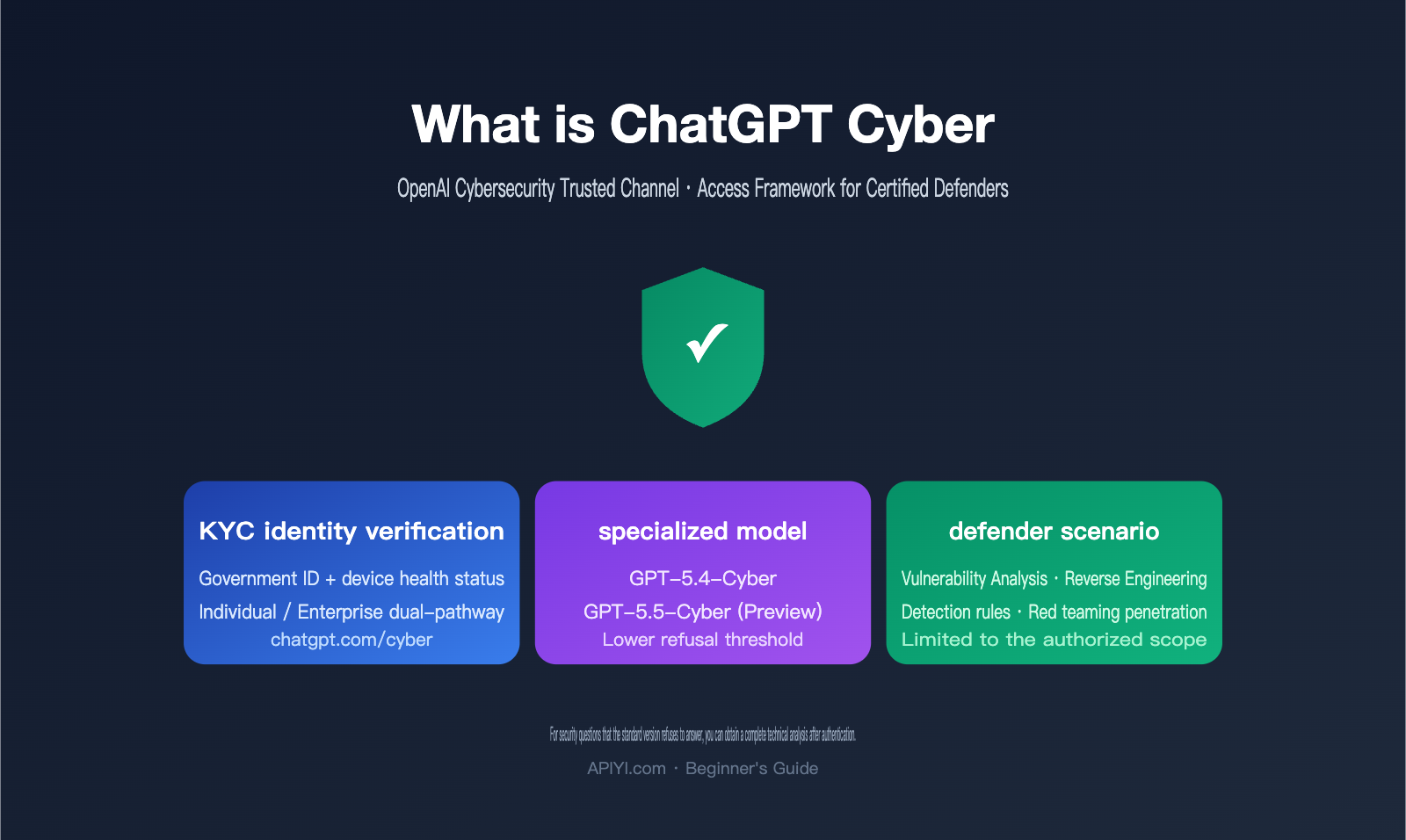
ChatGPT Cyber is the portal for the "Trusted Access for Cyber" project launched by OpenAI in 2026, accessible via chatgpt.com/cyber. It isn't a standalone product; rather, it’s an identity-verified access framework designed to open up "dual-use" cybersecurity requests—which are typically blocked by standard ChatGPT safety classifiers—to vetted, compliant defenders.
In short: for the same question regarding exploit details, binary disassembly, or malware feature extraction, standard ChatGPT might return a "cannot answer for safety reasons" refusal. However, an account verified through ChatGPT Cyber can receive a full technical analysis. This difference isn't about model capability, but rather the threshold of the safety classifier.
The table below compares ChatGPT Cyber with standard ChatGPT across several key dimensions to help you build a foundational understanding:
| Comparison Dimension | Standard ChatGPT | ChatGPT Cyber |
|---|---|---|
| Access Portal | chatgpt.com | chatgpt.com/cyber |
| Identity Verification | Email/Phone Number | Government ID + KYC + Device Health |
| Model Base | Public models (e.g., GPT-5.5) | GPT-5.5 + GPT-5.4-Cyber / GPT-5.5-Cyber |
| Safety Refusal Threshold | High (Anti-abuse) | Low (Defender-friendly) |
| Target Audience | All users | Vetted security researchers and defense teams |
| Typical Use Cases | General chat, coding, summaries | Exploit analysis, malware research, red teaming |
We recommend that security teams compile a list of real-world samples that are currently being rejected by standard ChatGPT before evaluating ChatGPT Cyber. This will help you determine if the benefits of verification justify the effort of the application process. If you only encounter refusals occasionally, you might want to use an API proxy service like APIYI (apiyi.com) to compare how different models respond to the same questions before deciding whether to apply for full certification.
Why OpenAI Created ChatGPT Cyber: The Dual-Use Dilemma and Security Balance
To understand the design of ChatGPT Cyber, you first have to grasp the inherent "dual-use" nature of the cybersecurity field. A piece of code that identifies an SQL injection vulnerability serves as a roadmap for patches for the Blue Team, as penetration material for the Red Team, and as a free attack tool for malicious actors. When a Large Language Model faces such requests, choosing to either "reject everything" or "allow everything" creates serious problems—the former prevents legitimate defenders from doing their jobs, while the latter turns the model into a free assistant for attackers.
OpenAI’s solution is to shift the problem from "indistinguishable intent" to "verifiable identity" through authentication. As long as you can prove you are a security professional employed by a legitimate organization and agree to the corresponding terms of use, the classifier will relax its restrictions on relevant topics. This approach actually has precedents in the traditional security industry; for example, certain vulnerability databases and cyber range platforms are only accessible to verified practitioners.
It’s important for developers to understand this design intent: ChatGPT Cyber is not a "cracked version of ChatGPT," nor is it an "unfiltered model." It remains bound by OpenAI's usage policies and will still reject requests to directly attack real-world targets, produce production-grade weaponized code, or bypass authorization to access actual systems. It simply re-opens content that has "more research value than attack utility" to verified defenders.
6 Typical Use Cases for ChatGPT Cyber
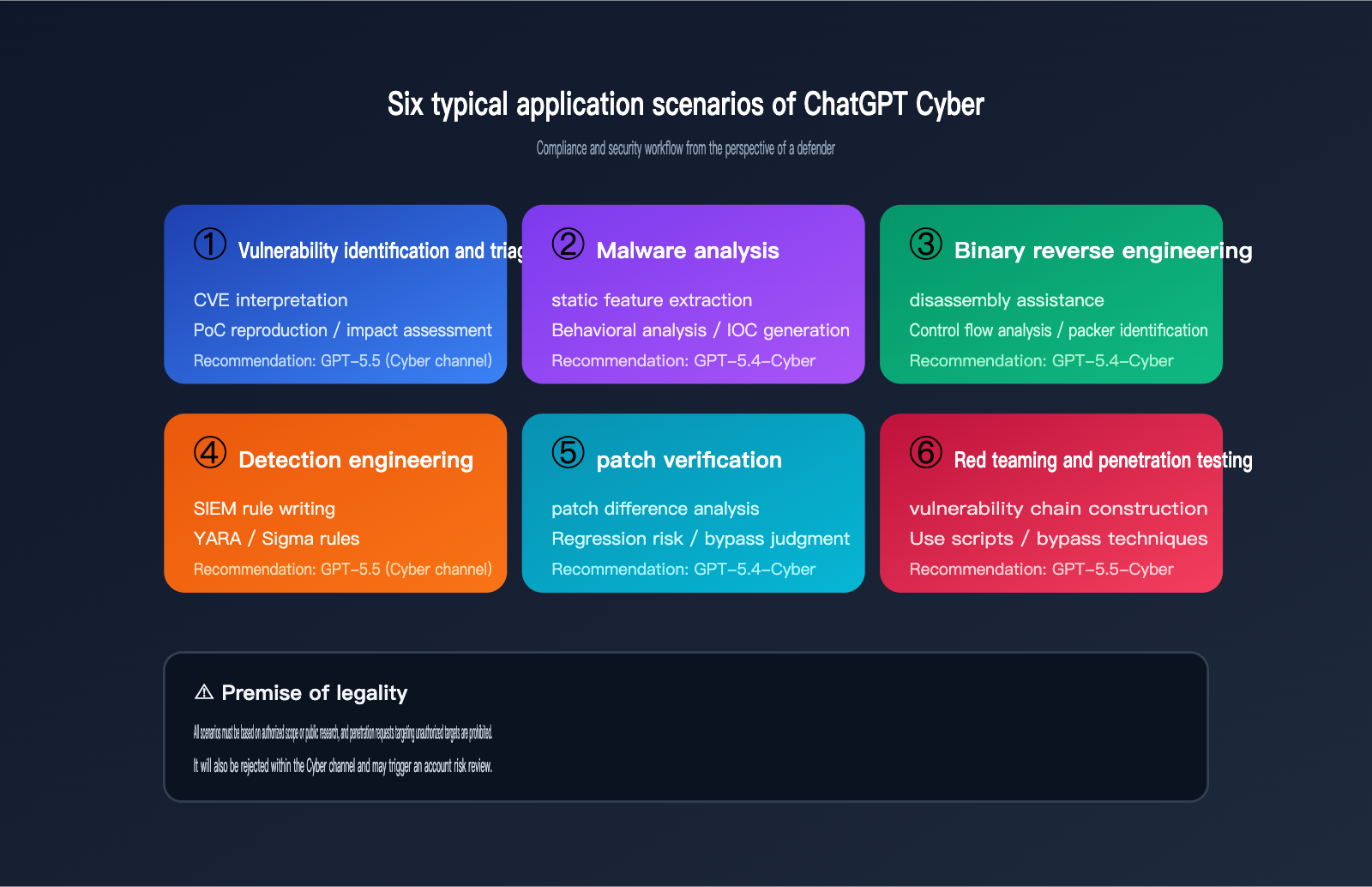
Knowing what ChatGPT Cyber can actually do is far more valuable than just remembering its name. Based on the partnership cases released by OpenAI and the GPT-5.5-Cyber model card, it currently covers 6 typical scenarios, all centered around a "defender's perspective":
| Use Case | Typical Task | Recommended Model |
|---|---|---|
| Vulnerability Identification & Triage | CVE analysis, PoC reproduction, impact assessment | GPT-5.5 (Cyber channel) |
| Malware Analysis | Static feature extraction, behavioral analysis, IOC generation | GPT-5.4-Cyber |
| Binary Reverse Engineering | Disassembly assistance, control flow analysis, packer identification | GPT-5.4-Cyber |
| Detection Engineering | SIEM rules, YARA rules, Sigma rule writing | GPT-5.5 (Cyber channel) |
| Patch Validation | Patch diffing, regression risk assessment, patch bypass judgment | GPT-5.4-Cyber |
| Red Teaming & Penetration Testing | Vulnerability chain construction, exploit script writing, bypass research | GPT-5.5-Cyber |
A special reminder for newcomers: the legality of the scenarios above assumes you have explicit authorization for the target system or are operating within the scope of public research. Even within the ChatGPT Cyber channel, penetration requests against unauthorized targets will still be rejected and may trigger an account security review.
In our interviews with clients at APIYI (apiyi.com), we found that what security teams want most from ChatGPT Cyber isn't just "better model capabilities," but rather a solution to the "empty responses" they get when the model misinterprets professional topics as malicious intent. This specific pain point is exactly where the core value of the Cyber channel lies.
Core Differences Between GPT-5.4-Cyber and GPT-5.5-Cyber
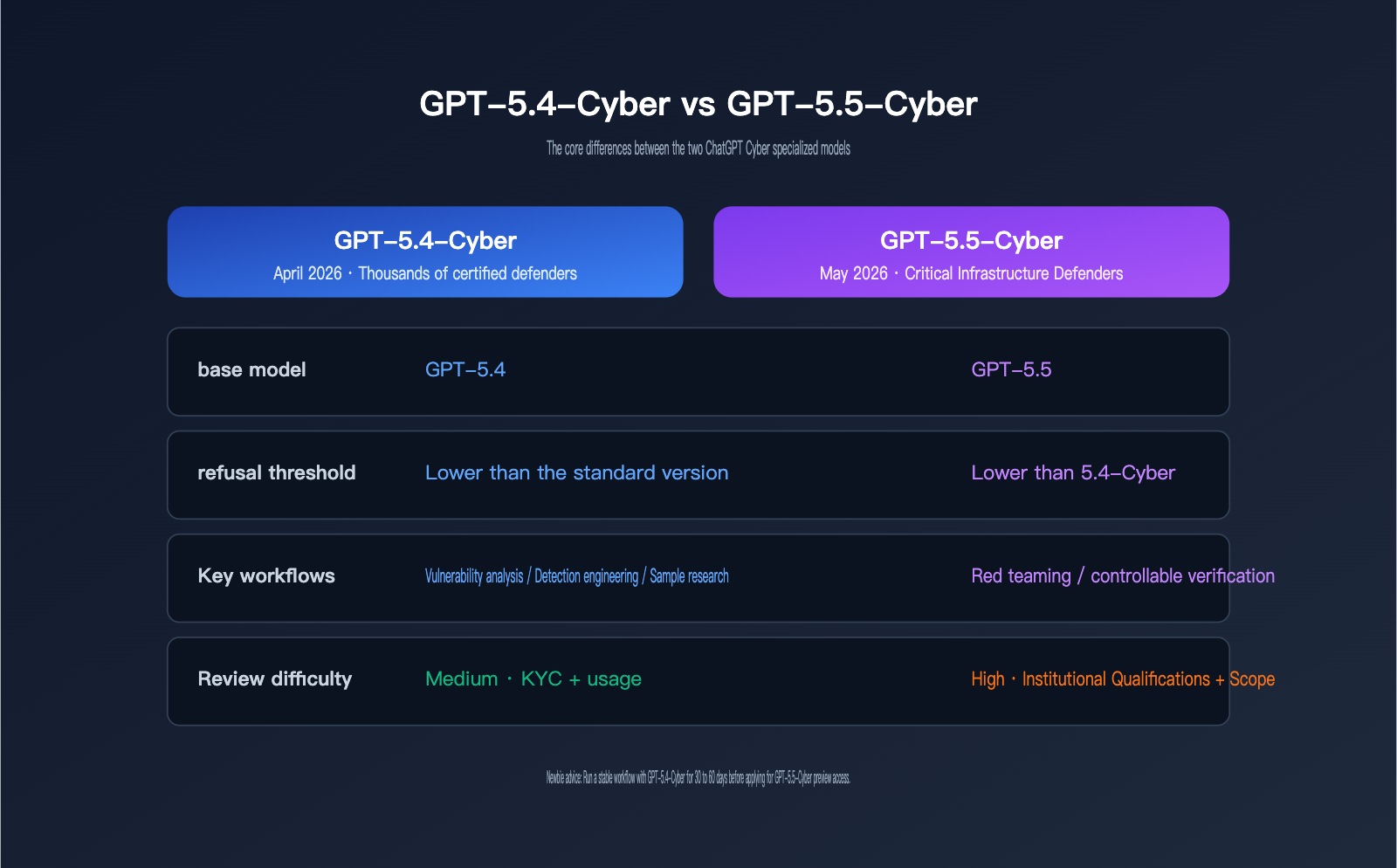
The ChatGPT Cyber channel currently offers two specialized models: GPT-5.4-Cyber and GPT-5.5-Cyber. These aren't just simple version increments; they represent distinct product positionings tailored to different approval levels and workflows. The most common point of confusion for newcomers is "which one should I use?" The table below breaks down the core differences:
| Comparison Item | GPT-5.4-Cyber | GPT-5.5-Cyber |
|---|---|---|
| Release Date | April 2026 | May 2026 (Limited Preview) |
| Base Model | GPT-5.4 | GPT-5.5 |
| Access Scope | Thousands of certified individual defenders + hundreds of teams | Critical infrastructure defenders, smaller scope |
| Refusal Threshold | Lower than the standard version | Lower than 5.4-Cyber |
| Key Workflows | Vulnerability analysis, detection engineering, malware research | High-risk red teaming, penetration testing, controlled validation |
| Approval Difficulty | Moderate (KYC + Purpose Statement) | High (Institutional credentials + explicit scope) |
| Account Control | Standard | Enhanced (Operation auditing + scope constraints) |
From a capability standpoint, GPT-5.5-Cyber isn't just a "more powerful GPT-5.4-Cyber." The core difference lies in the fact that it "allows for more actions," which comes with higher compliance costs. If you're primarily doing routine vulnerability research or writing detection rules, GPT-5.4-Cyber is usually sufficient. You should only apply for GPT-5.5-Cyber preview access if you genuinely need to perform red team operations or PoC weaponization validation within an authorized scope.
🎯 Selection Advice: For teams that have just passed Cyber certification, we recommend using GPT-5.4-Cyber for 30–60 days to stabilize your team's prompt templates and compliance review processes before considering an application for GPT-5.5-Cyber. If you can't use the OpenAI channel for the time being, you can also use APIYI (apiyi.com) to call standard GPT-5.5 and other equivalent models from different providers to get your workflow running before switching over.
How to Apply for ChatGPT Cyber: Certification Process and Checklist
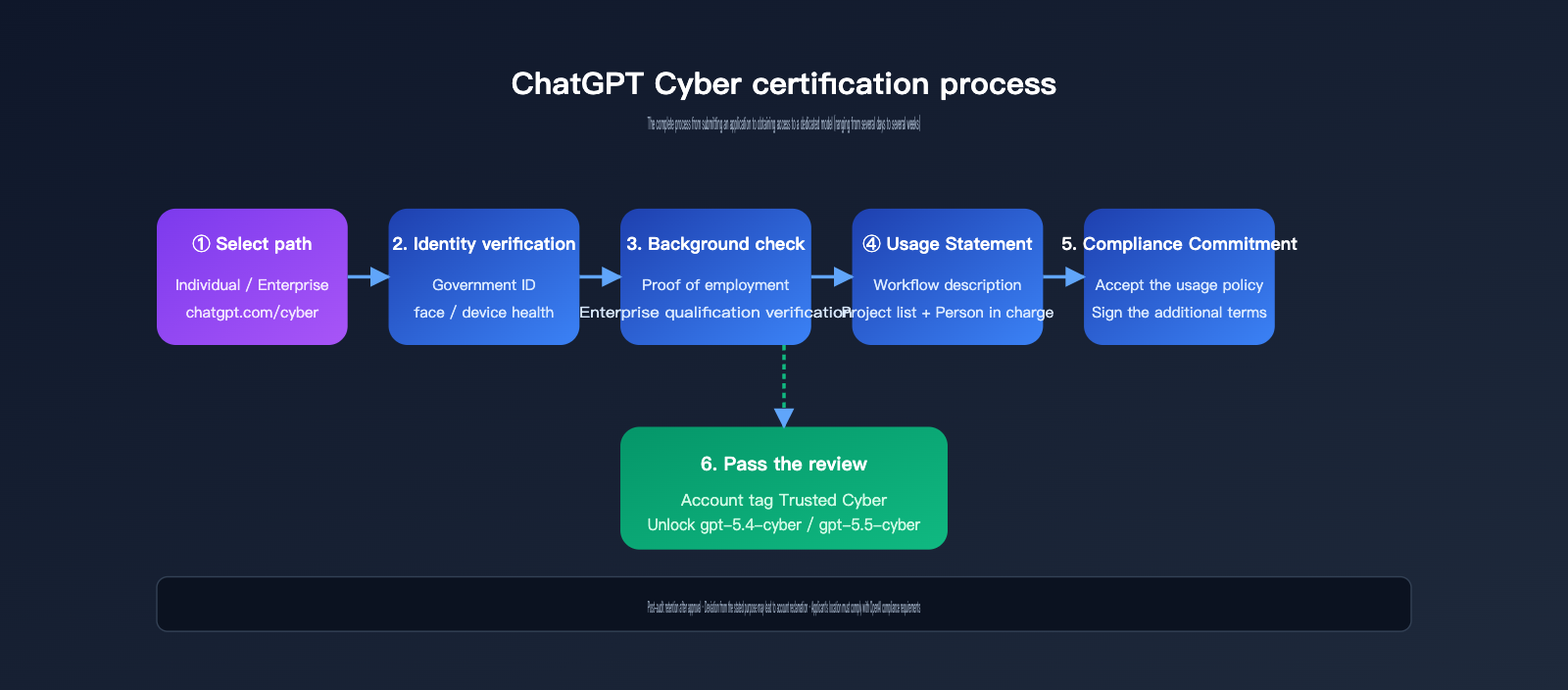
The application process for ChatGPT Cyber is split into two paths: individual and enterprise. Individual developers can submit directly via chatgpt.com/cyber, while enterprise teams need to contact OpenAI sales or a partner account manager to go through the Enterprise Trusted Access process. Both paths involve three steps: identity verification, organizational background check, and a statement of purpose.
The table below organizes the required materials into a checklist to help you confirm you have all the prerequisites before you get started:
| Material Category | Individual Path | Enterprise Path |
|---|---|---|
| Identity Documents | Government-issued valid ID (e.g., passport) | Legal representative ID + Business license |
| Professional Proof | Security-related employment proof or independent research status | Company business proof, security certifications |
| Purpose Statement | Written explanation of intended workflows | Specific project list and contact information |
| Device Health | Device integrity check | Endpoint management and device binding policies |
| Compliance Commitment | Acceptance of OpenAI usage policies | Signing of Enterprise Cyber addendum |
| Review Cycle | Typically several days to 1–2 weeks | Several weeks (depending on scale) |
Once approved, your account will be marked with a "Trusted Cyber" status at the system level. When you visit chatgpt.com/cyber, you will enter an exclusive interface, and specialized models like gpt-5.4-cyber (and gpt-5.5-cyber, if granted permission) will appear in the model selector. Note that even after certification, OpenAI reserves the right to perform content reviews and post-event audits on individual requests; excessive abuse or deviation from the stated purpose may lead to account revocation.
What to Do If You Haven't Passed Verification: 3 Alternatives for Independent Developers
The verification barrier for ChatGPT Cyber isn't exactly friendly to many independent researchers or early-stage security teams. If you haven't secured that "pass" yet but still need a Large Language Model to assist with security-related research, these three alternatives are worth evaluating:
| Alternative | Best For | Pros | Cons |
|---|---|---|---|
| Standard GPT-5.5 + Prompt Engineering | Research, low-sensitivity tasks | Quick to start, immediate access | Will refuse to answer hardcore security topics |
| Open-source Security Fine-tuned Models | Self-hosting, high compliance needs | Fully controllable, no audit risks | High maintenance, capabilities lag behind commercial models |
| Multi-model Aggregation Gateway | Rapid cross-vendor comparison | Test the same prompt across models | Still subject to the refusal policies of underlying models |
The third option is the most practical choice for most mid-sized teams. Through a multi-model aggregation gateway like APIYI (apiyi.com), you can simultaneously invoke mainstream models like GPT-5.5, Claude Opus, and Gemini. This allows you to perform a horizontal comparison of refusal policies and response quality for the same security query, helping you identify the best "working model" for your current task. For highly sensitive tasks that truly require the Cyber channel, you can proceed with OpenAI's separate verification process, ensuring your entire project doesn't get stuck waiting for approval.
# Example: Using APIYI to invoke standard GPT-5.5 for security research
from openai import OpenAI

client = OpenAI(
    api_key="YOUR_APIYI_KEY",
    base_url="https://api.apiyi.com/v1"
)

resp = client.chat.completions.create(
    model="gpt-5.5",
    messages=[
        {"role": "system", "content": "You are an authorized Blue Team detection engineer."},
        {"role": "user", "content": "Help me write a Sigma rule to detect suspicious PowerShell execution."}
    ]
)
print(resp.choices[0].message.content)
If the same prompt is refused by standard GPT-5.5, you can switch to a comparable model from another vendor with one click in the APIYI (apiyi.com) dashboard, saving you from endlessly "tweaking prompts" on a single model. This approach doesn't replace ChatGPT Cyber, but it keeps your daily work moving while you wait for your verification window.
FAQ: 5 Common Questions from ChatGPT Cyber Newcomers
Q1: Is ChatGPT Cyber a paid service?
ChatGPT Cyber itself is an access framework and doesn't charge extra fees, but you must already hold a ChatGPT Plus, Team, or Enterprise account. API invocations for GPT-5.4-Cyber and GPT-5.5-Cyber are billed based on the token pricing of the underlying model; please refer to the official OpenAI pricing page for details.
Q2: Can users in mainland China apply for ChatGPT Cyber?
OpenAI has compliance requirements regarding the applicant's location. As ChatGPT is not yet available in mainland China, users located in unsupported regions are highly unlikely to pass the review, even if they submit KYC documentation. In such cases, it is recommended to use a compliant aggregation gateway like APIYI (apiyi.com) to invoke public models like GPT-5.5 as an alternative.
Q3: Will I be monitored by OpenAI after passing verification?
There will be audit logs. OpenAI reserves the right to perform post-event audits on Cyber channel accounts, including request content, usage frequency, and associated devices. This isn't "monitoring your daily work," but rather a standard compliance logic used in the security industry to trace specific accounts if evidence of abuse arises.
Q4: Is GPT-5.5-Cyber more powerful than GPT-5.5?
It shouldn't be simply understood as "more powerful." The core difference of GPT-5.5-Cyber is that it is "more permissive regarding security topics," while its underlying reasoning and writing capabilities are essentially the same as GPT-5.5. If your tasks don't involve sensitive security topics, standard GPT-5.5 is sufficient and can be accessed directly via APIYI (apiyi.com).
Q5: Are ChatGPT Cyber and OpenAI's Codex Security Agent the same thing?
No. Codex Security is an internal security agent used by OpenAI to scan and fix code vulnerabilities—it's a product. ChatGPT Cyber is an access framework that is open for applications. Both belong to OpenAI's "security product matrix," but they serve completely different purposes.
Summary: Who is ChatGPT Cyber for, and how should you prepare?
Let's circle back to the original question: What exactly is ChatGPT Cyber? It’s an access framework designed by OpenAI to safely deliver dual-use cybersecurity capabilities to compliant defenders. It isn't a new model or a "jailbroken" version; the core innovation is its "identity-based refusal threshold adjustment" mechanism. For teams actively engaged in vulnerability research, detection engineering, or red teaming, it eliminates the frustration of being constantly blocked by the standard ChatGPT. However, for individual developers just starting out or those who haven't established a compliance foundation yet, the certification barrier might feel a bit steep in the short term.
Our recommendation? Spend 1–2 weeks auditing your team’s actual refusal samples and workflows before deciding whether to pursue full Cyber certification. During the waiting period for approval, you can use the multi-model aggregation capabilities of APIYI (apiyi.com) to run your daily security tasks. This allows you to refine your prompt templates and compliance review processes. Once your Cyber account is activated, you can switch over seamlessly, ensuring your projects don't grind to a halt while you wait for the approval process.
📌 Author: This article was compiled by the technical team at APIYI (apiyi.com). For more guides on compliant access and switching between OpenAI and Claude series models, please check out the APIYI Help Center.


