
Author's Note: This article breaks down the product positioning of the TapNow AI platform and the secret behind the stability of its Nano Banana Pro image generation. We’ll reveal the technical architecture of its API supply chain and show you how to access the same high-quality API services through the same provider.
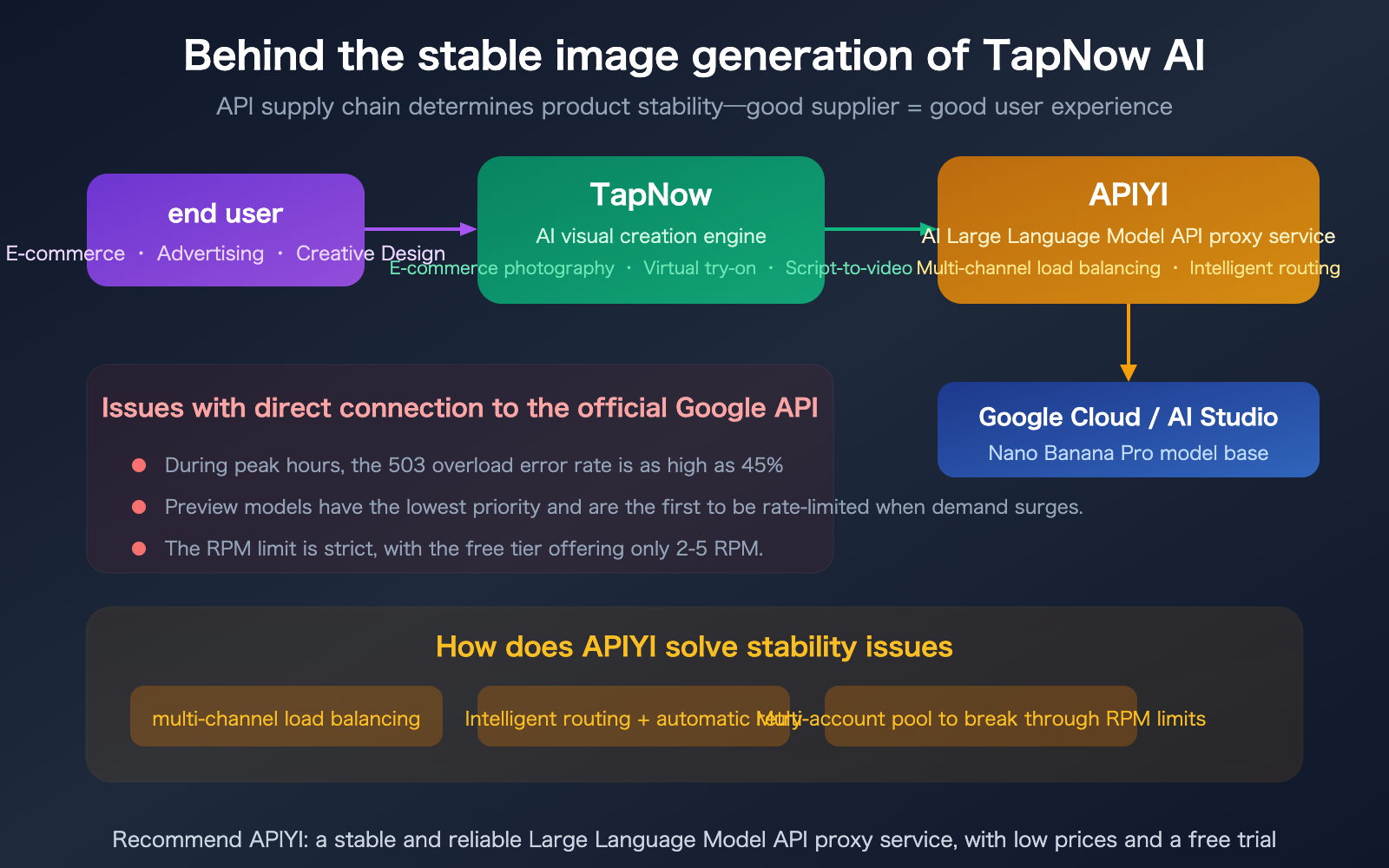
If you've used TapNow AI to generate images, you might have noticed something: its Gemini image model, specifically gemini-3-pro-image-preview (also known as Nano Banana Pro), offers image generation stability that far exceeds direct calls to the official Google API. During peak times, the official API can suffer from 503 overload error rates as high as 45%, yet TapNow remains smooth and responsive. This stability isn't magic—it's the result of an optimized API supply chain. According to industry insiders, the provider behind TapNow's Gemini image model is APIYI. This article explores TapNow's product positioning and explains why choosing the right API provider is the key to stability in image generation services.
Core Value: Understand the product architecture and API supply chain logic of TapNow AI, and learn how to directly integrate with the same provider to achieve the same level of stability for the Nano Banana Pro API.
What is TapNow AI?
Let's start by looking at how TapNow positions itself in the market.
Core Positioning of TapNow AI
TapNow is an AI visual creation engine designed for e-commerce and commercial creativity. It’s not just a simple image generation tool; it’s a comprehensive platform for producing visual content.
| Dimension | Description |
|---|---|
| Website | tapnow.ai |
| Core Positioning | AI visual creation engine for e-commerce and advertising |
| Target Audience | E-commerce teams, creative advertisers, brand marketers |
| Core Capabilities | AI product photography, virtual try-on, script-to-video, one-click ad creative |
| Tech Stack | Unified workbench for multiple models, integrating various AI models at the backend |
TapNow AI's Core Feature Matrix
| Feature | Description | Use Case |
|---|---|---|
| AI Product Photography | Upload product photos and have AI generate multi-angle, multi-scene displays | E-commerce main images, detail pages |
| Virtual Try-On | AI model try-on to quickly generate outfit previews | Fashion e-commerce |
| Script-to-Video | Input a text script to automatically generate cinematic short videos | Advertising, brand films |
| One-Click Ad Creative | Input brand assets and copy to automatically generate multi-size ad creatives | Feed advertising |
| Cinematic Lens Control | Simulate real cameras and lenses to control depth of field and angles | High-end creative |
| Lighting Adjustment | Adjust brightness and color temperature to simulate different lighting environments | Product photography |
The key feature of TapNow is that it integrates multiple AI models into a single, unified creative workbench. Users don't need to worry about whether the backend is using Nano Banana Pro or another model; they can simply focus on their creative and business needs.
Why is TapNow AI's Nano Banana Pro so stable?
This is the core question of this article: Since it's the same gemini-3-pro-image-preview (Nano Banana Pro), why is it so much more stable on TapNow than when calling the Google API directly?
Stability Issues with the Official Google API
As a preview model, Nano Banana Pro has always struggled with stability:
| Issue | Details |
|---|---|
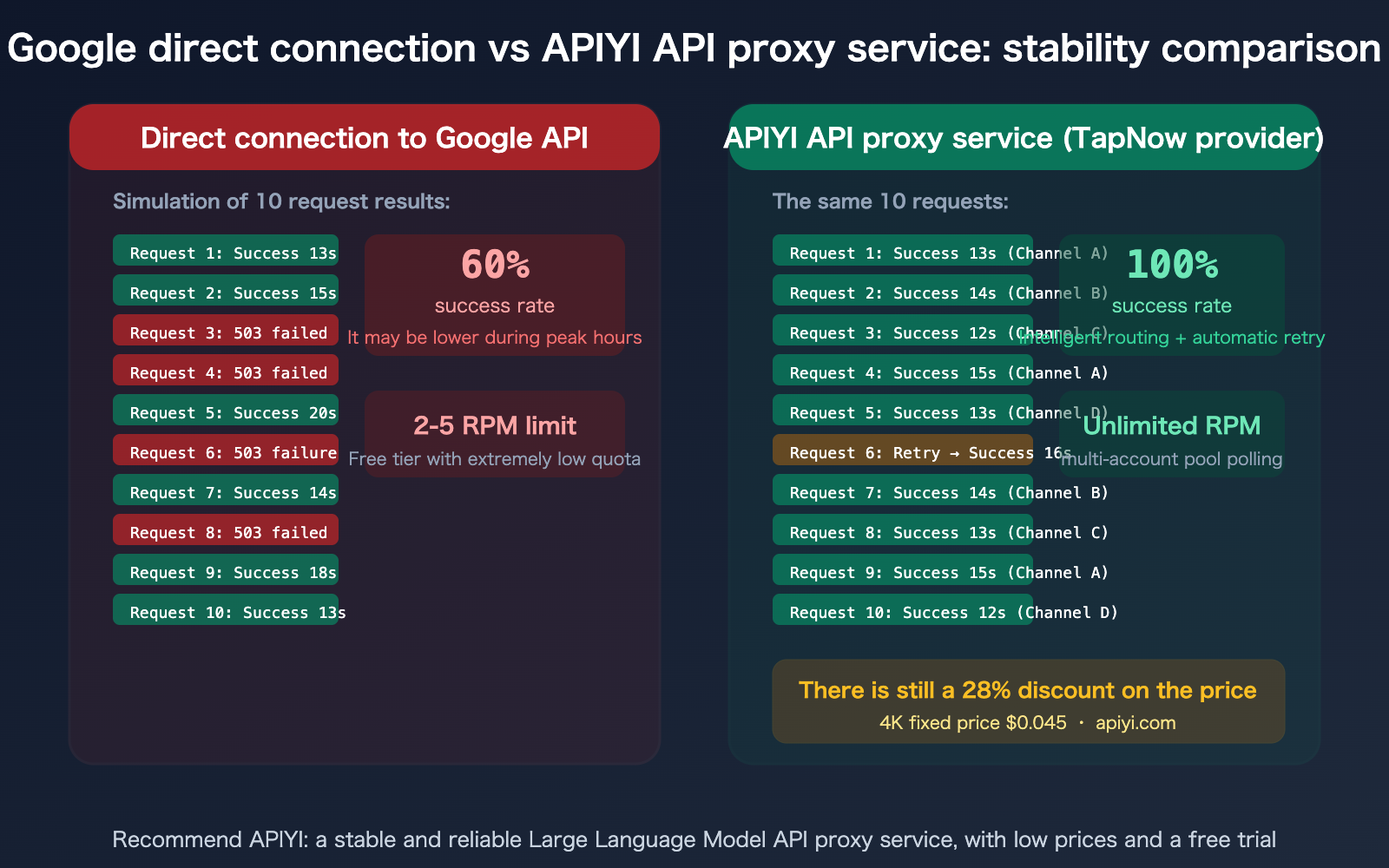
| 503 Overload Errors | Error rates as high as 45% during peak times |
| Lowest Priority | Preview models have the lowest priority in Google's resource allocation and are the first to be throttled when demand spikes |
| RPM Limits | 2-5 RPM for the free tier, only 150 RPM for Tier 1 |
| RPD Limits | 20-100 RPD for the free tier, about 1,000 RPD for Tier 1 |
| Unpredictability | Since it's a preview model, Google can adjust compute allocation at any time |
For a commercial platform like TapNow, having a 45% failure rate after a user clicks "Generate" is unacceptable—it would lead directly to user churn.
The Supply Chain Secret Behind TapNow's Stability
Industry insiders know that the API provider for TapNow's Gemini image models (especially Nano Banana Pro) is APIYI. As an AI Large Language Model API proxy service, APIYI solves these stability issues in the following ways:
Multi-Channel Load Balancing: APIYI doesn't just forward requests to a single Google endpoint. Instead, it maintains a pool of multiple Google Cloud accounts and API keys. When one channel is overloaded, it automatically switches to another available channel.
Smart Routing + Automatic Retries: Requests pass through smart routing to determine the optimal channel. If the initial request fails (503), it automatically retries across different channels, making the process transparent to the upstream caller (TapNow).
Breaking RPM Limits with Multi-Account Pools: A single Google account has strict RPM limits, but APIYI uses multi-account polling to multiply the effective RPM. TapNow's high-concurrency requests are distributed across multiple backend accounts, avoiding individual account throttling.
The Result: The user experience on TapNow is "click to generate, image ready in seconds." Users never notice the underlying 503 errors or throttling because APIYI handles these issues in the middle layer.
🎯 Key Insight: TapNow's stability isn't due to some secret proprietary technology, but because they chose the right API provider. APIYI's multi-channel load balancing and smart routing mechanism shield the instability of Google's preview models in the middle layer.
Developers can access the same stable Nano Banana Pro API directly via APIYI (apiyi.com) to achieve the same level of backend supply quality.
Directly Integrating APIYI's Nano Banana Pro
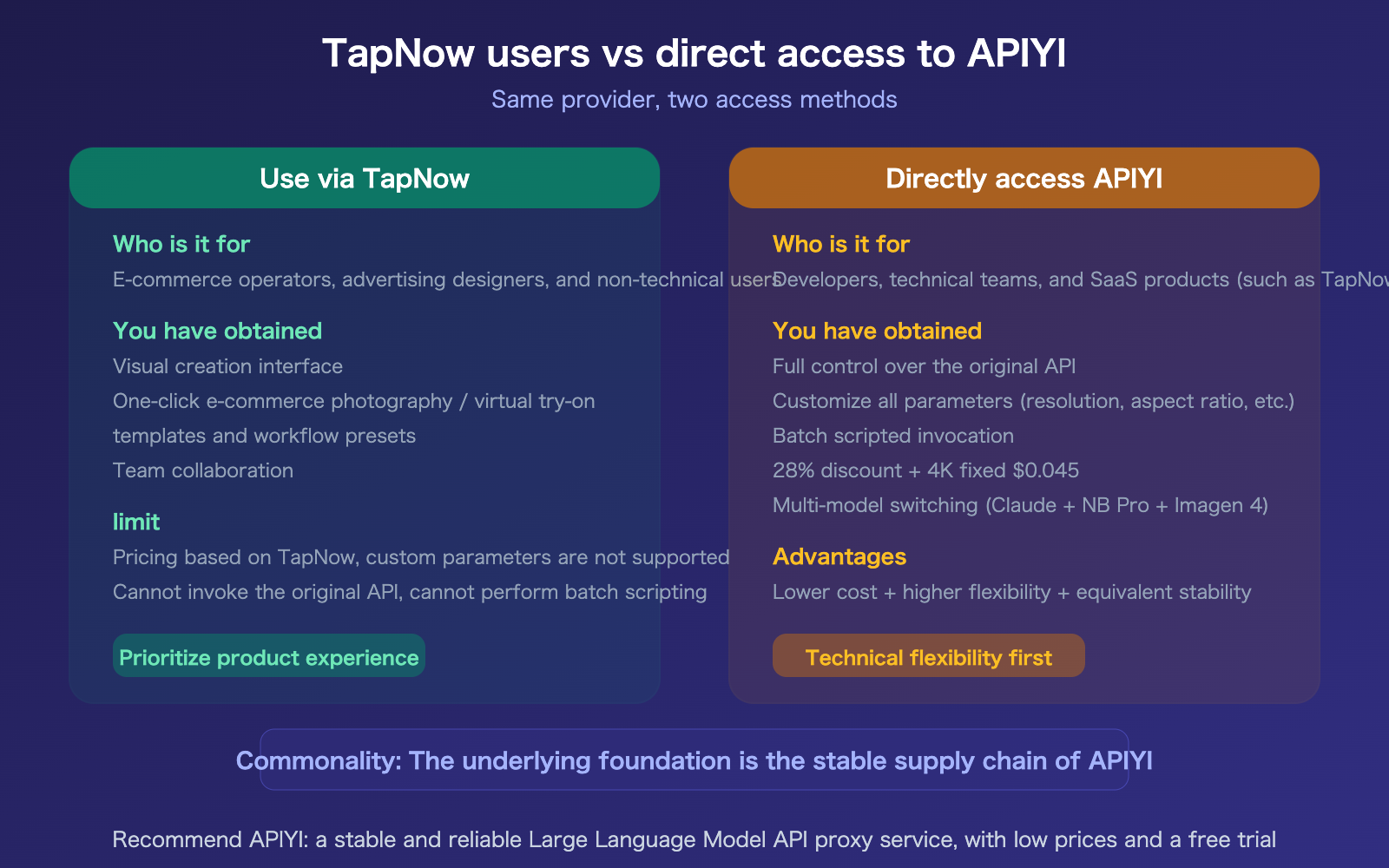
Since TapNow's stable image output relies on the supply from APIYI, developers can skip TapNow and integrate directly with APIYI. This allows you to get the same high-quality API service—with even more flexibility, as you have full control over the invocation parameters.
Advantages of Integrating APIYI Nano Banana Pro
| Advantage | Description |
|---|---|
| Stability | Multi-channel load balancing + intelligent routing + automatic retries, with a success rate approaching 100% |
| Pricing | 28% discount on tokens, fixed price of $0.045 for 4K (less than 30% of the official $0.24) |
| No RPM Limits | Multi-account pool polling to bypass official per-account RPM limits |
| Easy Integration | OpenAI-compatible format; integrate with just a single base_url |
| Full Model Coverage | Supports Nano Banana Pro, Nano Banana 2, Imagen 4, and more |
Minimalist Integration Code
import openai

client = openai.OpenAI(
    api_key="YOUR_API_KEY",
    base_url="https://vip.apiyi.com/v1"
)

# Nano Banana Pro (uses the same supply chain as TapNow)
response = client.chat.completions.create(
    model="gemini-3-pro-image-preview",
    messages=[
        {"role": "user", "content": "E-commerce main image of silver sneakers, white background, 45-degree angle, soft lighting"}
    ]
)
🎯 Direct Integration Tip: If you're building an e-commerce visual tool similar to TapNow or need a stable image generation API, integrating Nano Banana Pro directly via APIYI (apiyi.com) is the simplest solution. You get the same underlying quality as TapNow, but at a lower price and with much greater flexibility.
FAQ
Q1: Is APIYI confirmed as the provider for TapNow?
This is based on industry chatter, so we can't provide an official confirmation. However, from a technical standpoint, the stability of TapNow's Nano Banana Pro far exceeds that of Google's official API, which suggests they are using a multi-channel load balancing solution. APIYI is one of the few API proxy services on the market capable of providing this level of stability for Gemini image models. Regardless of the supply chain, developers can achieve equal or even better stability and pricing by using APIYI at apiyi.com.
Q2: Is there a difference in image quality between calling via APIYI and using TapNow?
No difference at all. All legitimate third-party channels ultimately route requests to the same underlying Google model infrastructure, so the image quality is identical. The only difference is that TapNow provides a visual interface and e-commerce-specific features (ideal for non-technical users), while APIYI provides raw API access and full control over parameters (ideal for developers and technical teams).
Q3: How do I integrate with APIYI if I want to build a product similar to TapNow?
It’s a simple three-step process: 1) Register an account at apiyi.com to get your API key; 2) Set base_url="https://vip.apiyi.com/v1" in your code; 3) Call the gemini-3-pro-image-preview model. APIYI uses an OpenAI-compatible format, so if your product is already integrated with OpenAI, switching to APIYI only requires changing one line of code. The platform also supports Claude, GPT, and Nano Banana 2 models, all accessible with a single key.
Q4: How does APIYI ensure stability? Is there an SLA?
APIYI ensures stability through a three-layer mechanism: 1) Multi-channel load balancing—we maintain multiple Google Cloud accounts and automatically distribute requests to the optimal channel; 2) Intelligent routing—we monitor the health of each channel in real-time to avoid overloaded nodes; 3) Automatic retries—if a request fails, it is automatically retried through a different channel, which is completely transparent to the user. You aren't charged for failed generations (SLA guarantee), ensuring you only pay for successful requests.
Summary
The supply chain insights behind TapNow AI's stable image generation:
- Product Stability = Supply Chain Quality: The reason TapNow's Nano Banana Pro is so stable isn't due to proprietary technology, but because they chose the right API provider. APIYI's multi-channel load balancing and intelligent routing effectively mitigate the 503 overload issues common with Google Preview models.
- Developers can access the same supply chain directly: By calling Nano Banana Pro directly via APIYI (apiyi.com), you get the same stability as TapNow but at a lower cost (28% discount + $0.045 fixed for 4K) and with greater flexibility (full API control).
- TapNow's success validates the supply solution: The fact that a commercial e-commerce platform relies on this supply chain for its core image generation capabilities is the best possible validation of APIYI's stability.
We recommend integrating the Nano Banana Pro API via APIYI (apiyi.com)—you'll get the same stable supply as TapNow, a 28% discount, no RPM limits, and free testing credits upon registration.
📚 References
-
TapNow AI Official Website: E-commerce AI visual creation engine
- Link:
tapnow.ai - Description: Learn about TapNow's product features and use cases.
- Link:
-
Nano Banana Pro Official Documentation: Gemini 3 Pro Image Preview model reference
- Link:
ai.google.dev/gemini-api/docs/models/gemini-3-pro-image-preview - Description: Includes model capabilities, parameter configurations, and official pricing.
- Link:
-
Gemini API Rate Limits: Official rate limits and quota documentation
- Link:
ai.google.dev/gemini-api/docs/rate-limits - Description: Details on RPM, RPD, and IPM limits for both free and paid tiers.
- Link:
-
APIYI Documentation Center: Nano Banana Pro stable integration guide
- Link:
docs.apiyi.com - Description: Includes integration tutorials, discounted pricing, and stability guarantees.
- Link:
Author: APIYI Technical Team
Technical Discussion: Feel free to join the discussion in the comments section. For more resources, visit the APIYI documentation center at docs.apiyi.com.


