

Author’s note: A roundup of Gemini 4 Carbon, Claude Fable 5.2, and Apple’s FastFrames from November 2026, to help you tell which ones you can call via API today and which are just papers and research weights.
The new AI models of November 2026 all landed within two weeks: Google opened Gemini 4 Carbon to paid developers on November 10, Anthropic released Claude Fable 5.2 on November 9, and Apple published the paper and weights for its video research project FastFrames on November 17. There are a lot of names, but for people who want to get hands-on right away, the real question is: which ones can you call via API today, and which are just papers and weights.
This is not a comprehensive ranking of “who’s No. 1.” This article only pulls together information that lines up across official announcements, self-reported paper claims, and platform model pages. It doesn’t draw hands-on testing conclusions, nor does it treat an official “best” capability claim as a number we’ve already measured.
Key takeaway: By the end of this article, you’ll have a comparison table. For text tasks, you can switch between Gemini 4 Carbon and Claude Fable 5.2 depending on your needs. On the video side, the first thing to understand is that FastFrames is research weights, not an API you can call.
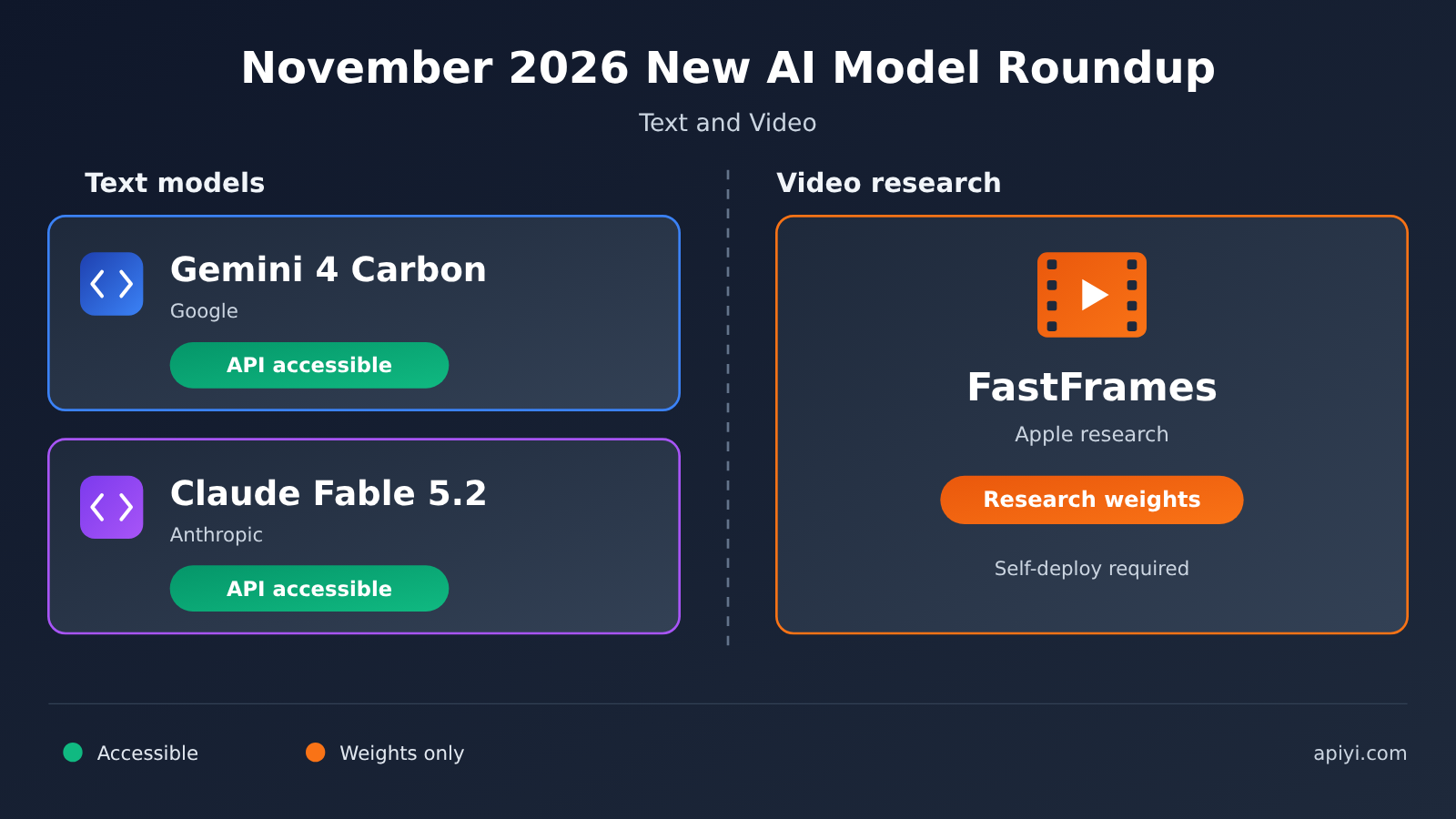
Quick Overview: Core Info on the New AI Models of November 2026
The table below answers the key questions first: what type each model is, who released it, and whether you can call it through an API today. All dates follow the official announcement or the paper’s version date.
| Model | Release by | Type | Key date | Can be called via API today? |
|---|---|---|---|---|
| Gemini 4 Carbon | Large Language Model (text) | October 28: given first to cyber-defense teams (Fairwind); November 10: opened to paid developers and enterprises | Yes, model ID gemini-4-carbon |
|
| Claude Fable 5.2 | Anthropic | Large Language Model (text) | Released November 9 | Yes, model ID claude-fable-5-2 |
| FastFrames | Apple Research | Video generation research | Paper v1 dated November 17 | Not an API — it’s a paper plus open weights |
Both text models are already listed in APIYI’s platform model catalog and can be called directly using the OpenAI-compatible format. For model names and pricing, refer to the model list on APIYI at apiyi.com; the pricing data in this article was verified on 2026-11-19.
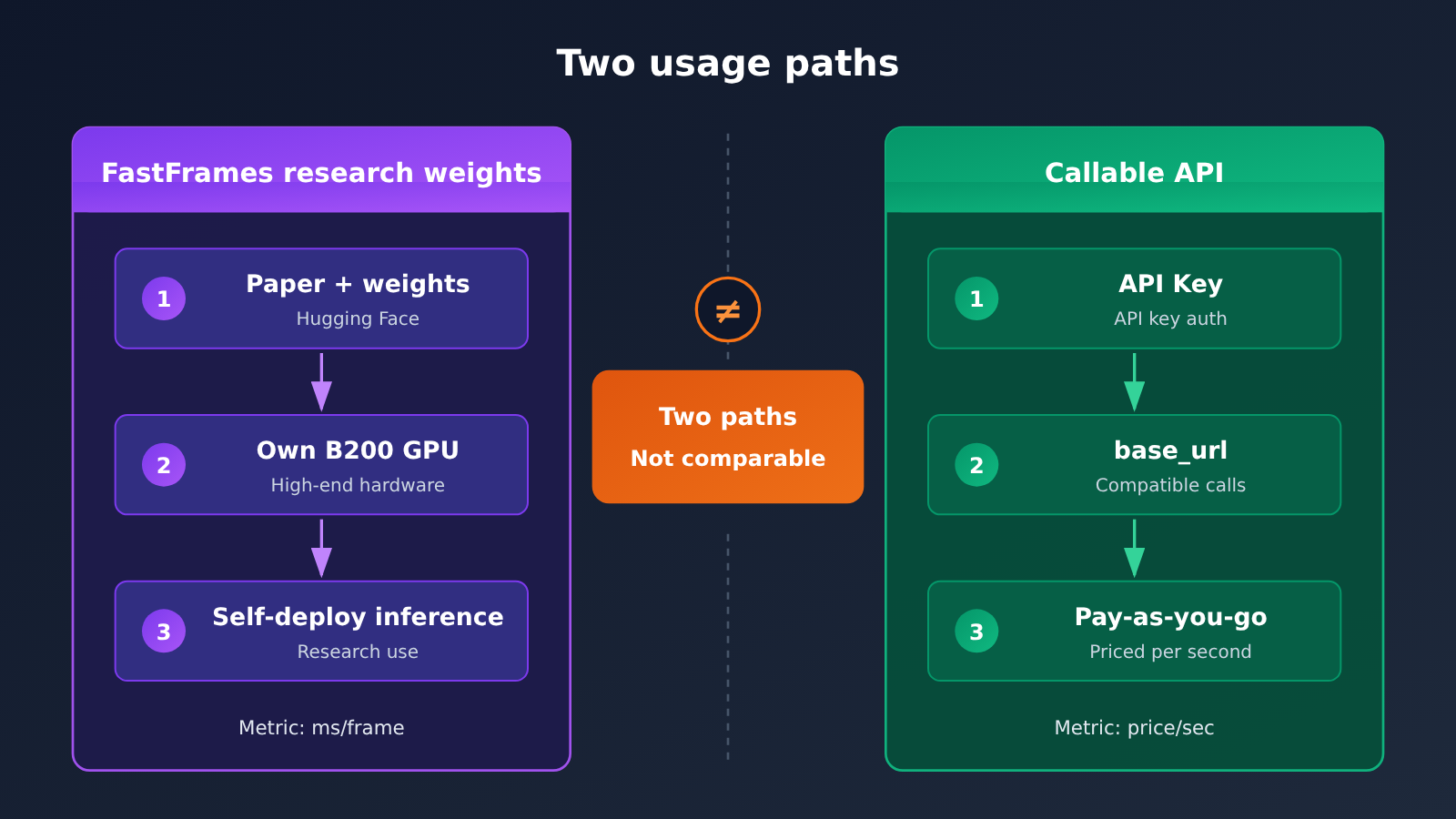
FastFrames is a different story entirely. It’s a paper plus a set of weight files on Hugging Face — to use it, you’ll need to set up your own GPUs and deploy inference. There’s no per-call pricing, and I’ll cover it separately below.
New Text Model in November 2026: Gemini 4 Carbon Overview
Gemini 4 Carbon has an unusual release cadence. Google first made it available to cybersecurity defenders on October 28, then opened it to paid developers and enterprises on November 10. The introductory price Google lists is the same as Gemini 4 Argon: $2 input and $10 output per million tokens.
Gemini 4 Carbon: Official Wording vs. APIYI Model Page
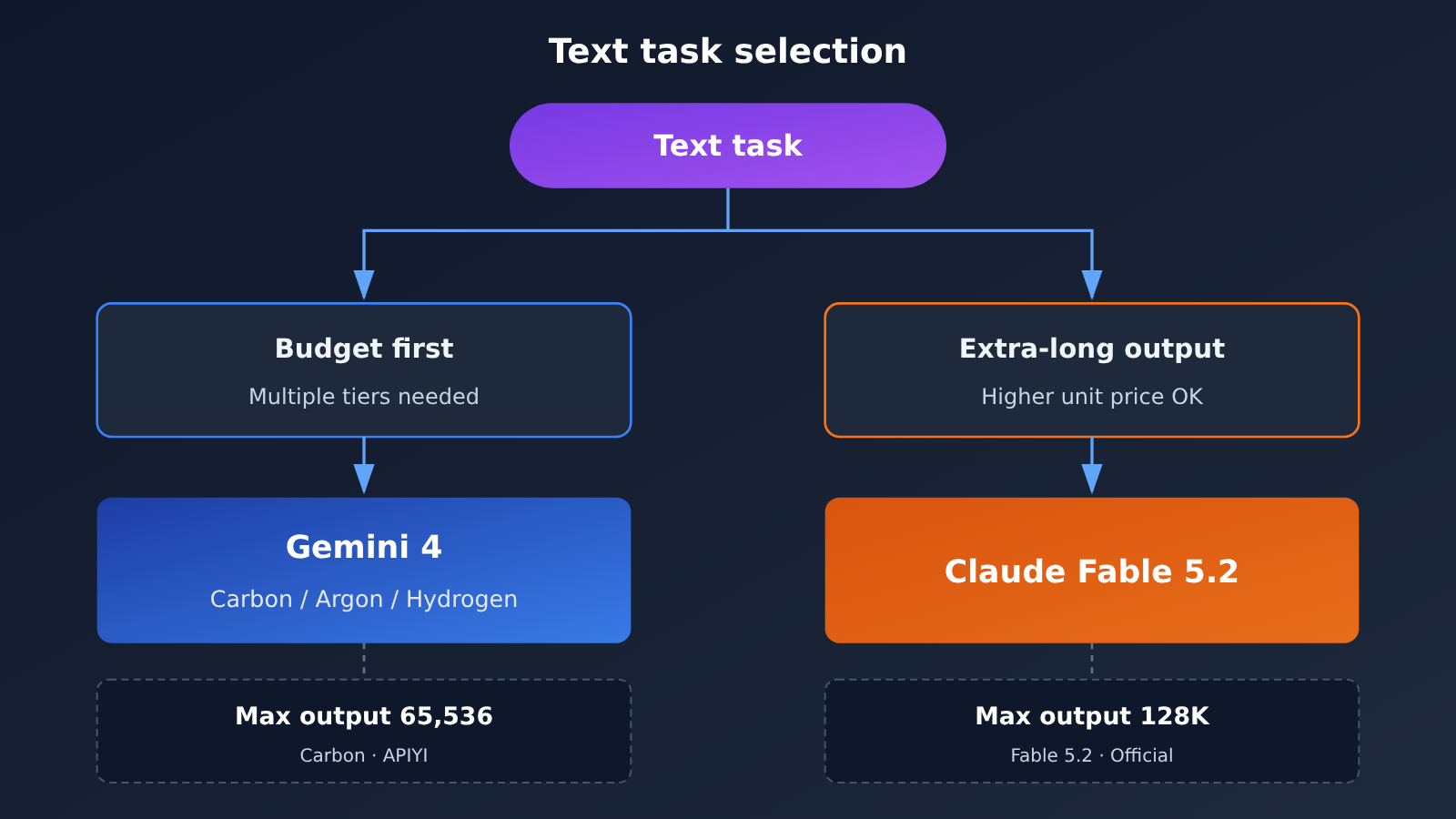
There are two different figures for Carbon’s maximum output, and they need to be viewed separately. Google AI Studio’s documentation page says a single response can exceed 64K, up to 1 million minus the input length. APIYI’s model page lists the maximum output as 65,536 tokens.
| Parameter | Google’s Official Wording | APIYI Model Page |
|---|---|---|
| Model ID | Gemini 4 Carbon | gemini-4-carbon |
| Launch date | Opened to paid developers on November 10 | 2026-11-11 |
| Context length | Around the 1 million scale | 1,048,576 tokens |
| Max output | Can exceed 64K, up to 1 million minus input | 65,536 tokens |
| Input price | $2 / million tokens | $2 / million tokens |
| Cache read | — | $0.1 / million tokens |
| Output price | $10 / million tokens | $10 / million tokens |
| Supported endpoints | — | Both chat and gemini |
The practical takeaway is simple: when calling gemini-4-carbon through APIYI, plan for a single-output cap of 65,536 tokens as listed on the model page. The official ultra-long output is a separate figure and applies to Google’s native environment, so don’t mix the two numbers. There’s also a line on the model page quoting the documentation: “long-context 199K tokens passed.” That’s a record from the documentation, not a test result from this article.
The Same Unit Price for Gemini 4 Carbon Doesn’t Mean the Same Cost per Task
Many people see that Carbon and Argon have the same unit price and assume they’ll cost the same to use. There’s an easy-to-miss detail here. Google’s documentation explicitly states that Carbon uses more tokens than Argon for verification. In other words, for the same question, Carbon may consume more output or reasoning tokens.
So the same unit price only means the per-million-token rate is the same; it doesn’t mean the bill for a single task will be the same. Google doesn’t specify how many more tokens, and this article won’t estimate a multiplier. If you’re cost-sensitive, the safer approach is to run your own real tasks a few times with each model and compare token consumption in the billing.
There’s also a cheaper option in the same family, gemini-4-hydrogen, listed in APIYI’s master table at $1.5 input, $0.075 cache read, and $7.5 output per million tokens. It’s a good fit for scenarios that don’t require deep verification and involve high call volume.
November 2026 Text Model Release: Claude Fable 5.2 Overview
Claude Fable 5.2 was released by Anthropic on November 9. The official documentation lists the model ID as claude-fable-5-2. Official specs: a 1 million token context window, a maximum output of 128,000 tokens, and pricing of $8 for input and $40 for output per million tokens.
Claude Fable 5.2 vs. Previous-Generation Pricing
APIYI’s master table lists both claude-fable-5-2 and claude-fable-5-2-thinking at the same price. The official documentation states that cache reads for Fable 5.2 cost 2.5% of the input price. 2.5% of $8 is exactly $0.20, which matches the platform’s master table.
| Model ID | Input (USD/million) | Cache Read (USD/million) | Output (USD/million) |
|---|---|---|---|
claude-fable-5-2 |
8 | 0.2 | 40 |
claude-fable-5-2-thinking |
8 | 0.2 | 40 |
claude-fable-5-1 (previous generation) |
10 | 0.25 | 50 |
As the table shows, all three unit prices for Fable 5.2 are lower than those for Fable 5.1. If your project is currently running on 5.1, moving to 5.2 directly lowers the per-unit price, at least on paper. We’d still recommend validating the actual performance differences with your own tasks.
Note that APIYI’s master table doesn’t provide a dedicated details page for Fable 5.2, so the context and maximum output figures here come from Anthropic’s official documentation. If you need very long outputs during model invocation, use the official documentation as your reference and explicitly set max_tokens in the request.
November 2026: Comparing Pricing and Invocation for the New AI Models
Placing the two new text models next to their neighboring siblings makes the price gaps much easier to see. All unit prices below are in USD per million tokens, pulled from the APIYI model master table on the same day.
| Model ID | Input | Cached read | Output | Available platforms |
|---|---|---|---|---|
gemini-4-carbon |
2 | 0.1 | 10 | APIYI apiyi.com, Google official |
gemini-4-argon |
2 | 0.1 | 10 | APIYI, Google official |
gemini-4-hydrogen |
1.5 | 0.075 | 7.5 | APIYI, Google official |
claude-fable-5-2 |
8 | 0.2 | 40 | APIYI, Anthropic official |
claude-fable-5-1 |
10 | 0.25 | 50 | APIYI, Anthropic official |
Let’s do the math with a hypothetical scenario: a task with 100K input tokens and 10K output tokens. Going by unit price, Carbon comes out to roughly 0.2 + 0.1 = 0.3 USD, while Fable 5.2 lands around 0.8 + 0.4 = 1.2 USD. This is just an arithmetic illustration based on list prices — Carbon’s actual cost may be higher because it tends to spend more tokens on verification. For real spending, always trust your bill.
On the invocation side, both models are accessible through APIYI’s OpenAI-compatible endpoint. Set base_url to https://api.apiyi.com/v1 for both, and switching models only means changing the model field. One API key lets you call gemini-4-carbon and claude-fable-5-2 at the same time, which makes A/B comparisons within a single codebase easy.
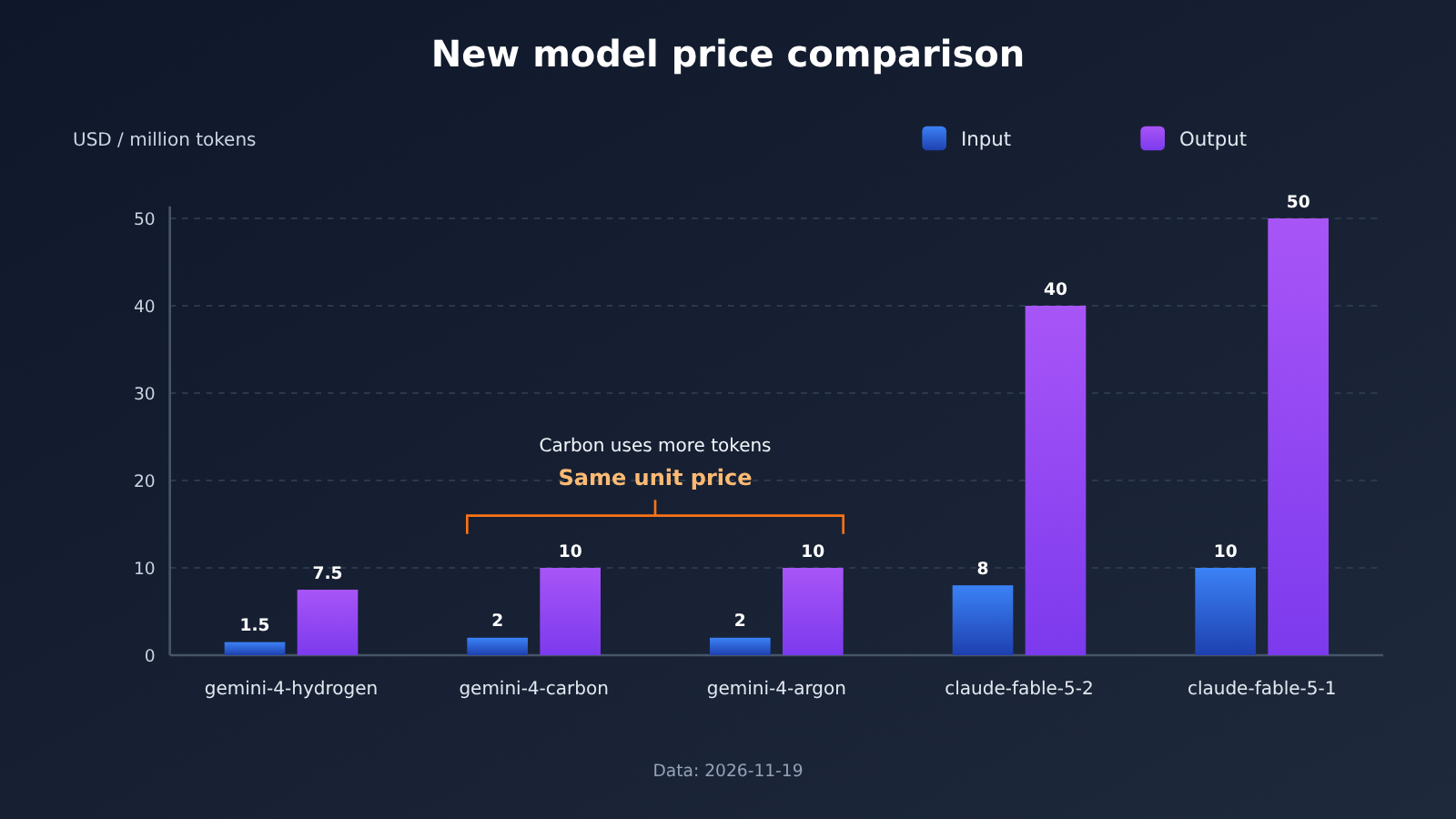
Chart notes: The unit prices in the figure come from the APIYI apiyi.com model master table dated 2026-11-19. The Carbon and Argon bars being the same height only means their unit prices match — the cost of a single task still depends on actual token consumption.
Quickly Calling Gemini 4 Carbon and Claude Fable 5.2 Through the API
Here’s the simplest way to do it — change a single model field and you can switch between the two new models:
import openai

client = openai.OpenAI(
    api_key="YOUR_API_KEY",
    base_url="https://api.apiyi.com/v1"
)

response = client.chat.completions.create(
    model="gemini-4-carbon",  # switch to "claude-fable-5-2" to change models
    messages=[{"role": "user", "content": "用三句话解释零信任架构"}]
)
print(response.choices[0].message.content)
View the full side-by-side calling code
import openai
from typing import Optional

client = openai.OpenAI(
    api_key="YOUR_API_KEY",
    base_url="https://api.apiyi.com/v1"
)

# Through APIYI, Carbon's max output is planned at 65,536 per the model page
MAX_OUTPUT = {
    "gemini-4-carbon": 65536,
    "claude-fable-5-2": 8192,  # adjust as needed; the official max output is 128K
}

def ask(model: str, prompt: str, system: Optional[str] = None) -> dict:
    messages = []
    if system:
        messages.append({"role": "system", "content": system})
    messages.append({"role": "user", "content": prompt})

    resp = client.chat.completions.create(
        model=model,
        messages=messages,
        max_tokens=min(MAX_OUTPUT.get(model, 4096), 8192),
    )
    return {
        "model": model,
        "text": resp.choices[0].message.content,
        "prompt_tokens": resp.usage.prompt_tokens,
        "completion_tokens": resp.usage.completion_tokens,
    }

if __name__ == "__main__":
    task = "审查下面这段代码的安全隐患,并给出修复建议:..."
    for m in ["gemini-4-carbon", "claude-fable-5-2"]:
        r = ask(m, task, system="你是资深安全工程师")
        print(m, r["prompt_tokens"], r["completion_tokens"])
        print(r["text"][:300], "\n---")
The full code prints the input and output tokens for every call — exactly what you need to check the point made earlier: “same unit price, different cost per call.” Run the same task a few times on each model and compare completion_tokens; that’s more reliable than just staring at the price list.
🚀 Quick start tip: Want to compare these two new models on your own tasks? Sign up at APIYI apiyi.com to grab free trial credits, run one round with each using the code above, then pick your primary model based on token consumption and output quality.
New Video Model for November 2026: FastFrames Is Research Weights
FastFrames comes from Apple’s research team. The paper is arXiv:2611.23226, with v1 dated 2026-11-17. The project also has a project page on GitHub Pages and has released two sets of weights—FastFrames-S and FastFrames-L—on Hugging Face.
Self-Reported Data from the FastFrames Paper
All the numbers below are self-reported by the paper. They’re not a final third-party benchmark leaderboard, and certainly not any API’s per-call price.
| Version | Parameters | Paper-reported hardware | Paper-reported speed | Resolution |
|---|---|---|---|---|
| FastFrames-S | 1.3 billion | Single B200 | About 36 ms per frame | 480p |
| FastFrames-L | 14 billion | 8 B200 GPUs | About 45 ms per frame | 480p |
This table shows where FastFrames sits: it demonstrates a research approach for fast frame-by-frame video generation on high-end GPUs. To reproduce those speeds, you’d need to get your own B200-class hardware and handle deployment yourself. It’s not the same as “just fill in an API key and call it.”
FastFrames is also just video research—it’s not a general-purpose model that handles both text and video. If your goal is to generate video in a product today, look at the video models already priced per second in the APIYI model catalog. Don’t compare the frame speed of research weights with the per-second pricing of an API.
Impact Analysis: New AI Models of November 2026
What It Means for Developers
- More text models to choose from, lower switching costs: Carbon and Fable 5.2 both support OpenAI-compatible calls, so you can compare them by changing a single model ID in the same codebase. That makes routing by task a better fit than betting everything on one model.
- Cost estimates should focus on token consumption, not just unit price: Carbon and Argon share the same per-unit pricing, but the official docs note that Carbon uses extra tokens for verification. Budget against your actual bill, not the sticker price.
- Confirm the output limit for your specific access channel: Carbon’s official long-output figure and the 65,536 listed on the platform’s model page are two different numbers. When writing code, set
max_tokensbased on the channel you’re actually calling. - For video, first separate research from production APIs: FastFrames is a good fit for teams with GPU resources who want to explore real-time video generation—not for building a production video API on day one.
What It Means for the Industry
- Rolling out to safety use cases first is becoming a launch strategy: Carbon goes to cyber defenders first, then opens up to paid developers. That suggests vendors are starting to release new models in stages, by use case.
- High-end model pricing is trending down: All three Fable 5.2 price points are lower than Fable 5.1. The pattern of price cuts with each iteration in the same tier continues.
- Video generation is chasing real-time performance: The FastFrames paper targets millisecond-level per-frame generation speed. Research focus is shifting from “can it generate” to “how fast can it generate.”
FAQ
Q1: Which new AI models can be called directly via API in November 2026?
For text, Gemini 4 Carbon (`gemini-4-carbon`) and Claude Fable 5.2 (`claude-fable-5-2`, `claude-fable-5-2-thinking`) can both be called directly. On the video side, FastFrames is a paper plus research weights—not a callable interface.
Q2: Gemini 4 Carbon and Gemini 4 Argon cost the same—which one should I pick?
Both models are priced at $2 per million tokens for input, $0.1 for cache reads, and $10 for output. But Google’s original documentation notes that Carbon uses more tokens than Argon for verification, so the cost per task may end up higher. I’d suggest running each model on a few real tasks, then comparing token consumption and output quality before deciding.
Q3: What’s the actual maximum output for Gemini 4 Carbon?
It depends on the channel. When calling through APIYI, plan around the 65,536 tokens listed on the model page. Google AI Studio’s official docs say a single response can exceed 64K, up to 1 million minus the input—that’s a separate standard from the official native environment.
Q4: Can FastFrames be used for video generation in a product?
FastFrames is an Apple research result, offering a paper and Hugging Face weights, and the speed reported in the paper depends on B200-class GPUs. If you want to generate video directly through an API, pick a per-second-priced video model from APIYI’s model master list instead of using research weights for price comparisons.
Q5: How do I quickly call Gemini 4 Carbon and Claude Fable 5.2?
I’d recommend testing them together through an API aggregation platform:
1. Visit APIYI at apiyi.com and register an account
2. Get an API key and the free trial quota for new users
3. Use the code from this article, set `base_url` to `https://api.apiyi.com/v1`, and set `model` to `gemini-4-carbon` and `claude-fable-5-2` respectively
One key lets you call both models at once, which makes comparing and switching easy.
Q6: What limitations should I watch out for with these new models?
Carbon’s unit price matches Argon, but actual token consumption may be higher, so you’ll need to verify costs through testing. Fable 5.2 costs four times as much as Carbon per unit, and spending grows noticeably in long-output scenarios. FastFrames’ speed figures are all self-reported in the paper and require your own high-end GPU—they shouldn’t be equated with API performance.
November 2026 New AI Models: Key Takeaways
- Two text models you can call: both
gemini-4-carbonandclaude-fable-5-2can already be invoked through the OpenAI-compatible API. - Carbon is priced the same as Argon: $2 per million input tokens and $10 per million output tokens for both — but the vendor says Carbon will use more tokens.
- Carbon’s output comes in two flavors: the platform plans around 65,536, while the official long-output figure is a separate claim.
- Fable 5.2 is cheaper than 5.1: $8 input, $0.2 cache read, $40 output — all three prices are lower than the previous generation.
- FastFrames is research weights: an Apple paper plus Hugging Face weights; the speed numbers are self-reported in the paper, not API pricing.
- How to get started: on APIYI, use the same key and just change the model ID to compare the two new text models.
Summary
The key takeaways for the November 2026 new AI models:
- Two new choices on the text side: Gemini 4 Carbon has a low unit price and multiple tiers within the same family, while Claude Fable 5.2 has a higher official output cap and lower unit prices than the previous generation.
- Cost depends on actual consumption: the same unit price doesn’t mean the same price per call — Carbon’s additional verification shows up in token usage.
- On the video side, know what you’re getting first: FastFrames is research weights, suited to research teams with GPU resources; for product integration, choose a video model billed by the second.
For developers who want to get moving right away, the most practical approach is to split by task: run the same set of real tasks through both Carbon and Fable 5.2, and let your bill and output quality decide — not any aggregate ranking. We recommend using APIYI (apiyi.com) with a single key to run this comparison quickly; refer to the platform’s model list for model availability and pricing.
📚 References
-
Google Official Blog — Gemini 4 Carbon Release Announcement: availability timing and the officially announced price
- Link:
blog.google/innovation-and-ai/models-and-research/gemini-models/gemini-4-carbon-now-available/ - Notes: includes the official statement that pricing matches Argon, plus verification of the extra token usage
- Link:
-
Google AI Studio — Gemini 4 Carbon Update Notes: the official line on long-form output
- Link:
aistudio.google.com/docs/whats-new-gemini-4-carbon - Notes: the official source text stating a single response can exceed 64K
- Link:
-
Anthropic Official Docs — Claude Fable 5.2 Overview: model ID, context, and pricing
- Link:
platform.claude.com/docs/en/models/fable-5-2/overview - Notes: the source for the 128K max output and the 2.5% cache read rate
- Link:
-
Apple Research — FastFrames Project Page: the paper and research write-up
- Link:
apple-aiml-research.github.io/ml-fastframes/ - Notes: paper arXiv:2611.23226, v1 dated 2026-11-17
- Link:
-
Hugging Face — FastFrames Weights: two versions, S and L
- Link:
huggingface.co/apple/FastFrames-S - Notes: download entry point for the research weights; you’ll need to deploy inference yourself
- Link:
Author: APIYI Technical Team
Technical Inquiries: Feel free to reach us through the APIYI website homepage. For model details and invocation documentation, visit the docs.apiyi.com documentation center.


