

Tencent Hunyuan released Hy4 flash on 2026-11-16. The research page and the official post, both published the same day, quoted a list price of $0.003 for cached input, $0.070 for input, and $0.281 for output per million tokens, and the Tencent Cloud TokenHub API throws in another 50% off through November 30.
This isn’t another benchmark breakdown — it’s a pricing note meant for budgeting and price comparisons. The article lists three separate price sets: the research page list price, the TokenHub 50%-off window, and what APIYI has listed today. It doesn’t stack them into a single calculation.
The core value: By the end, you’ll know exactly where each Hy4 flash price comes from and when it stops applying, and you’ll be able to line it up against models already on APIYI like deepseek-v4.1-flash, claude-haiku-5-5, and glm-5.3-flash to work out a monthly cost for each channel.
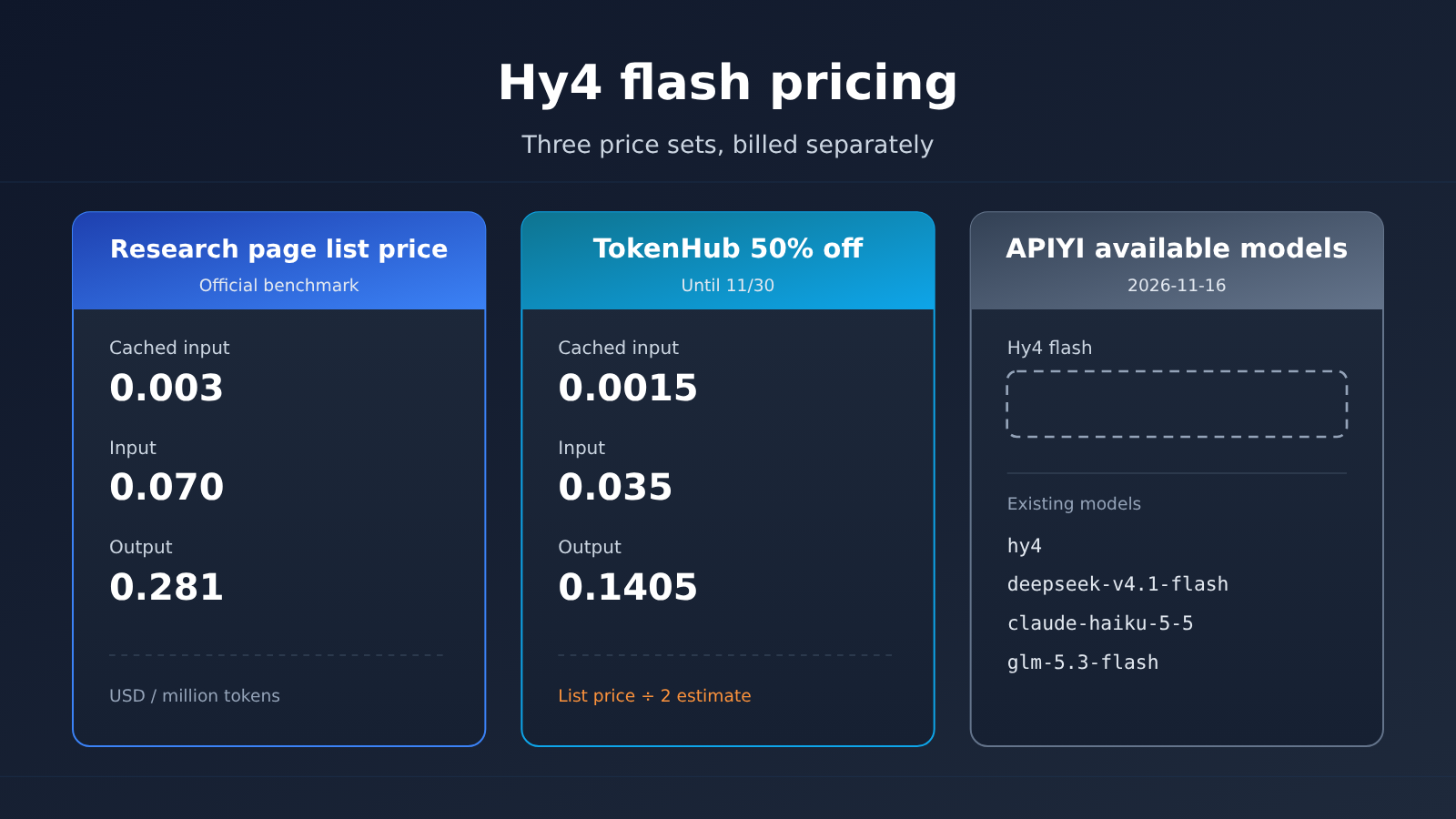
Hy4 flash Pricing Core Info at a Glance
Let’s start with one table of what was confirmed on launch day. Everything below comes from Tencent’s official research page, the official post, and APIYI’s public listing; all dates are 2026-11-16.
| Item | Details | Source |
|---|---|---|
| Launch date | 2026-11-16; official post timestamp 14:38 (UTC+8) | Tencent Hunyuan research page, official post |
| Specs | 224B total parameters, of which 64B are Engram parameters; 12B activated per token; natively multimodal, 1M-token context window | Research page |
| Three-tier list prices | Cached input 0.003 / input 0.070 / output 0.281 USD per million tokens | Research page price table |
| Window discount | 50% off the Tencent Cloud TokenHub API, through 2026-11-30 | Research page |
| Free channel | Free use inside WorkBuddy through 2026-11-30 (in-product, not the API) | Research page |
| API model ID | Not given on the research page; use the name shown in the TokenHub console | Research page |
| Weights | Planned for open source; the page doesn’t say they’ve been released | Research page |
| APIYI status | Hy4 flash isn’t listed yet; only hy4 is available |
APIYI model list and pricing endpoint |
How to read Hy4 flash’s three-tier list prices
The three tiers in the research page’s price table are cached input, standard input, and output—all in USD per million tokens. Hy4 flash is 0.003, 0.070, 0.281; Hy4 in the same table is 0.042, 0.834, 2.501. The input prices differ by roughly 12x, and the output prices by roughly 9x.
This is the research page list price—not TokenHub’s promotional window price, and not APIYI’s listed price. The official post says “API pricing (per 1M tokens)”, and the numbers match the research page, so you can cite them as Hy4 flash’s baseline price.
The Hy4 flash 50%-off window runs only through November 30
The research page states that through 2026-11-30, Tencent Cloud TokenHub’s API is 50% off. The research page doesn’t publish a separate post-discount price table, so the discounted numbers below are estimates: list price divided by 2—cached input about 0.0015, input 0.035, output about 0.1405 USD per million tokens.
Starting from launch day, this window is only about two weeks. When you’re building quarterly or annual budgets, model at list price and only count the 50% off for usage in late November; after November 30, it’s back to list price.
WorkBuddy being free doesn’t mean the Hy4 flash API is free
The research page also mentions that through November 30, you can use Hy4 flash for free in WorkBuddy. That’s an in-product benefit and doesn’t involve API call billing. When you integrate the API into your own app, billing goes through TokenHub—during the window it’s 50% off, not free.
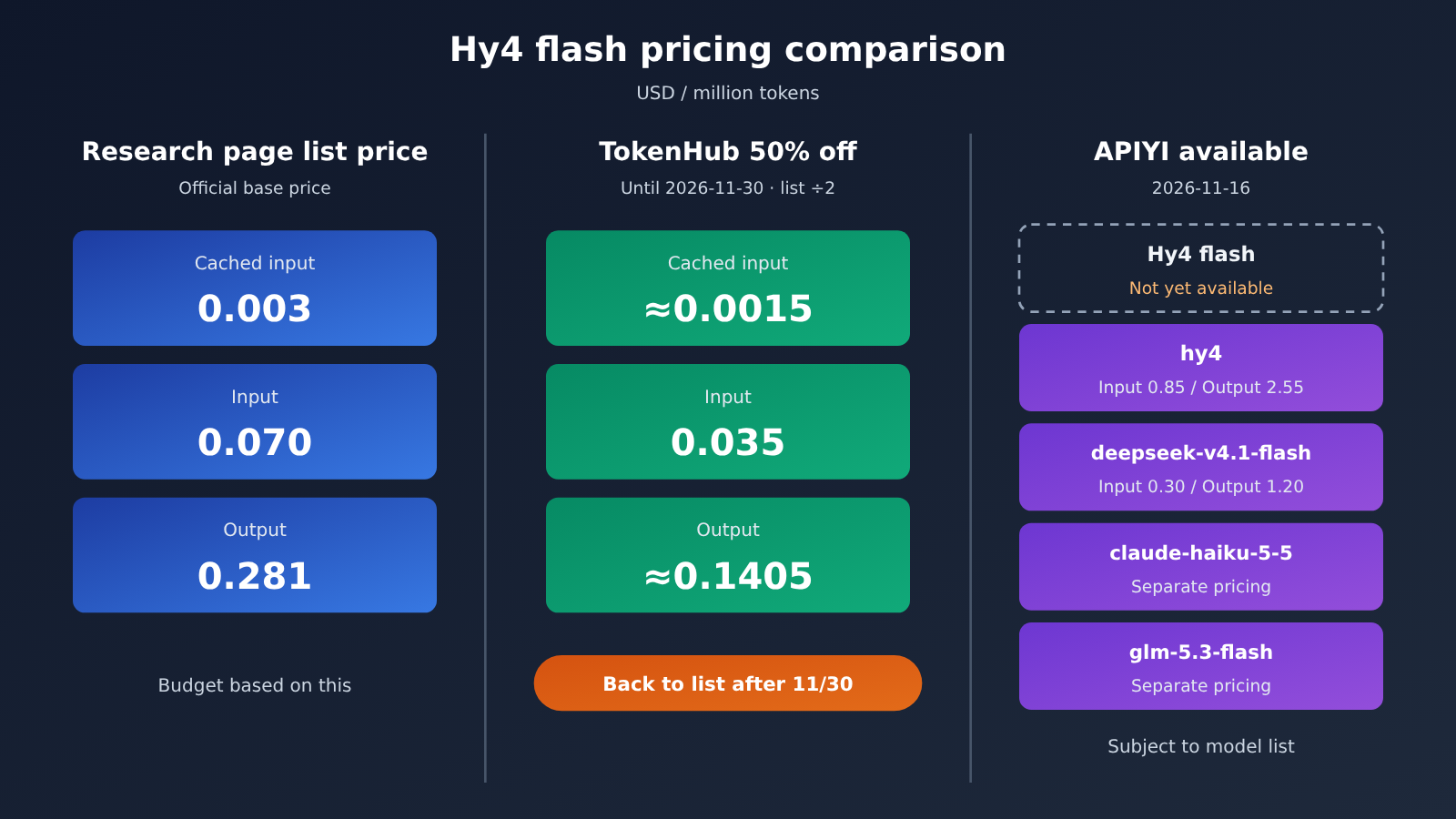
Hy4 flash availability on APIYI
On 2026-11-16, we checked both docs.apiyi.com/models and api.apiyi.com/api/pricing. Neither listed Hy4 flash, nor any flash version of Hunyuan—only one Hunyuan model, hy4.
Hy4 flash isn’t listed yet. We’ll get it listed as soon as possible; model names and pricing are subject to the platform’s model list. Until it’s listed, the APIYI column in the table below will have to stay blank rather than borrow some other number.
| Price tier | Research page list price (USD per million tokens) | TokenHub window (through 11/30, estimated as list price ÷ 2) | APIYI 2026-11-16 |
|---|---|---|---|
| Cached input | 0.003 | about 0.0015 | Not listed yet, N/A |
| Input | 0.070 | 0.035 | Not listed yet, N/A |
| Output | 0.281 | about 0.1405 | Not listed yet, N/A |
Don’t mistake APIYI’s hy4 for Hy4 flash
On APIYI, hy4 is priced at 0.85 for input, 2.55 for output, and 0.045 for cache reads per million tokens. Its groups are Default and SVIP, and its endpoint is chat. The research page lists Hy4 at 0.834, 2.501, and 0.042. The two sets of prices come from different sources; keep each as-is and don’t substitute one for the other.
More importantly, hy4 is the full Hy4, not Hy4 flash. If you budgeted based on Hy4 flash’s per-token price, switching straight to hy4 will make input and output costs an order of magnitude higher.
For models already listed on APIYI, you can call them directly with an apiyi.com key: in an OpenAI-compatible SDK, set base_url to https://api.apiyi.com/v1 and put the model name from the list in model. Once Hy4 flash is listed, its model name will likewise follow the list.
Hy4 flash vs. the models already listed: every channel gets its own price
The three models used for comparison on the research page all have listings on APIYI, but the same model often comes in several channels, each with its own pricing and supported protocols. When you’re comparing prices, go channel by channel — you can’t use one channel’s price to represent the whole family.
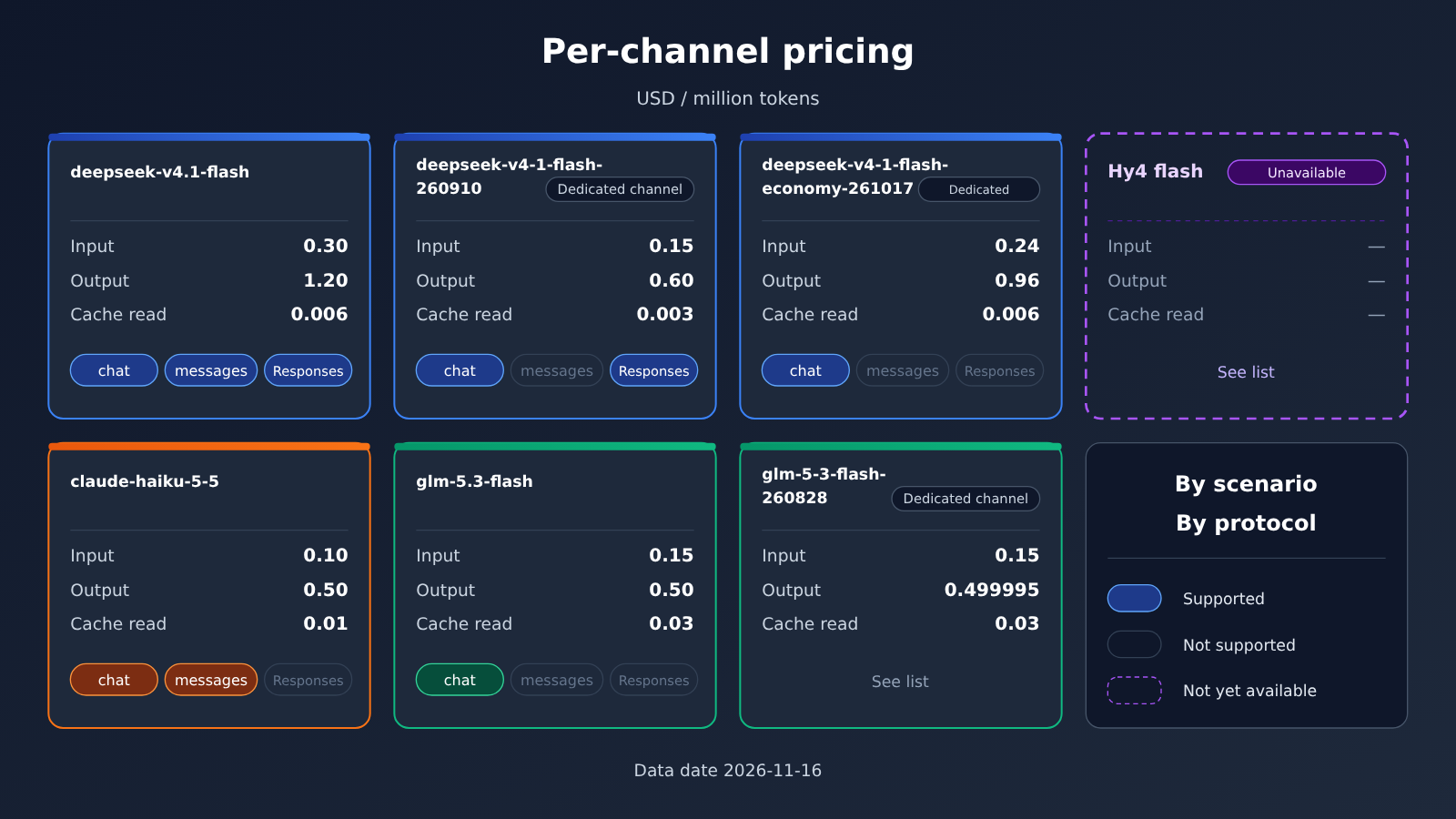
| APIYI model (channel) | Input | Output | Cache read | Group / endpoint |
|---|---|---|---|---|
deepseek-v4.1-flash |
0.30 | 1.20 | 0.006 | ClaudeCode, CodexResponses, Default, SVIP; chat, messages |
deepseek-v4.1-flash-1017 |
0.30 | 1.20 | 0.006 | ClaudeCode, Default, SVIP (no CodexResponses) |
deepseek-flash |
0.30 | 1.20 | 0.006 | ClaudeCode, Default, SVIP |
deepseek-v4-1-flash-260910 |
0.15 | 0.60 | 0.003 | CodexResponses, Default, SVIP (standalone channel) |
deepseek-v4-1-flash-economy-261017 |
0.24 | 0.96 | 0.006 | Default, SVIP (standalone channel) |
claude-haiku-5-5 / -thinking |
0.10 | 0.50 | 0.01 | ClaudeCode, Claude_Enterprise, Default, SVIP; chat, messages |
glm-5.3-flash |
0.15 | 0.50 | 0.03 | CodexResponses, Default, SVIP; Chat Completions only |
glm-5-3-flash-260828 |
0.15 | 0.499995 | 0.03 | Standalone channel |
All prices above are in USD per million tokens, with data as of 2026-11-16. Before you compare prices or protocols, it’s worth confirming the channel name in the model list on apiyi.com, then deciding which endpoint to send your request to.
DeepSeek V4.1 Flash: Official Peak/Off-Peak Pricing vs APIYI Channel Pricing
DeepSeek’s official model invocation name is deepseek-flash, and the current version is DeepSeek-V4.1-Flash-1017; the old name deepseek-v4-flash is now served by 1017. Official pricing comes in two tiers, peak and idle: during peak hours, cache hits cost 0.006, input 0.30, and output 1.20; during idle hours, those rates are exactly halved. Peak hours are Monday through Friday, UTC 01:00–04:00 and 06:00–10:00, excluding Chinese statutory holidays.
APIYI’s three channels — deepseek-v4.1-flash, -1017, and deepseek-flash — are priced identically and line up with the official peak price. deepseek-v4-1-flash-260910 and deepseek-v4-1-flash-economy-261017 are two separate channels, priced at 0.15/0.60/0.003 and 0.24/0.96/0.006 respectively; don’t treat either of them as the uniform price for the whole V4.1 Flash series.
Claude Haiku 5.5: Keep the Official Two Tiers and the APIYI Summary Table Separate
claude-haiku-5-5 was released on 2026-10-07, with a 1M context window and 128K max output. Official pricing is split into two tiers based on prompt length; prompt length includes cache reads and cache writes, and once it goes over 100K tokens, the entire request is billed at the higher rate.
| Tier | Input | Output | 5-minute cache write | 1-hour cache write | Cache read |
|---|---|---|---|---|---|
| Official: prompt ≤ 100K tokens | 0.10 | 0.50 | 0.125 | 0.20 | 0.01 |
| Official: prompt > 100K tokens | 0.50 | 2.50 | 0.625 | 1 | 0.05 |
| APIYI summary table | 0.10 | 0.50 | — | — | 0.01 |
The footnote on the APIYI summary table only covers the two input tiers: 0.10 for up to 100K tokens and 0.50 above that. It doesn’t spell out the second output tier. The pricing API shows an InputRatio of 0.25 once the prompt exceeds 100K tokens, while CompletionRatio stays at 5. For long-prompt scenarios, go by the platform’s listing and your actual bill — don’t assume on your own that APIYI’s output price is necessarily 2.50, or that it’s always 0.50.
GLM-5.3-Flash: Chat Completions Only
On APIYI, the model page for glm-5.3-flash lives at docs.apiyi.com/models/glm-5-3-flash, and it lists input at 0.15, cached reads at 0.03, and output at 0.50. The docs spell out 320B total parameters with 18B active, a 1,000,000 context window, 128,000 max output, and support for text, image, and video inputs. Thinking is enabled by default, and the APIYI launch date is 2026-09-08.
It only works with the OpenAI Chat Completions endpoint — Anthropic Messages and Responses are both unsupported. glm-5-3-flash-260828 is a separate channel with output listed at 0.499995; it runs in parallel with glm-5.3-flash rather than representing two conflicting quotes for the same thing.
How to Calculate Hy4 flash’s Monthly Cost
Just add up the three token buckets by millions of tokens, with each bucket priced separately:
Monthly cost (USD) = millions of cache-hit tokens × cache price + millions of cache-miss input tokens × input price + millions of output tokens × output price
For the example below, assume monthly usage of 100 million cache-hit tokens, 200 million cache-miss input tokens, and 50 million output tokens. Plug each listed price into its bucket. This usage is just a demo baseline; all prices come from the sources cited above, with no extra discounts added.
| Price source | Calculation | Monthly cost (USD) |
|---|---|---|
| Hy4 flash research page list price | 100×0.003 + 200×0.070 + 50×0.281 | 28.35 |
| Hy4 flash TokenHub window (inferred as list price ÷ 2, through 11/30 only) | 28.35 ÷ 2 | about 14.18 |
APIYI hy4 (not Hy4 flash) |
100×0.045 + 200×0.85 + 50×2.55 | 302 |
APIYI deepseek-v4.1-flash |
100×0.006 + 200×0.30 + 50×1.20 | 120.6 |
APIYI deepseek-v4-1-flash-260910 |
100×0.003 + 200×0.15 + 50×0.60 | 60.3 |
APIYI claude-haiku-5-5 (each prompt ≤ 100K, excluding cache writes) |
100×0.01 + 200×0.10 + 50×0.50 | 46 |
APIYI glm-5.3-flash |
100×0.03 + 200×0.15 + 50×0.50 | 58 |
This table has an obvious flaw in its premise: it assumes different models use the same number of tokens to complete the same set of tasks. In reality, output length, reasoning tokens, and the number of tool-call rounds all vary by model. If you’re already running a comparison model on apiyi.com, I’d suggest pulling your actual usage for the three buckets from your bill and plugging it into the formula.
A low unit price doesn’t mean a low per-task cost for Hy4 flash
The blind test on the research page (Tencent’s own reported figures: 85 internal WorkBuddy users, 259 tasks, 27 categories) gives Hy4 flash a per-task cost of 0.26 yuan, versus 4.73 yuan for Claude-Haiku-5.5. Dividing the two gives about 18x, which is where the 18x in the official post comes from. In the same table, Hy4 flash has a satisfaction score of 2.79, 0.02 points below Haiku. The research page describes it as close to Haiku; DeepSeek had the highest satisfaction score at 3.09.
The research page also gives a set of WorkIndex figures (internal eval set, as stated on the research page): Hy4 flash’s average per-task cost is 1/20 that of Hy4 and 1/8 that of DeepSeek-V4.1-Flash-1017 (Max tier, peak pricing). The input unit-price ratio and the task-cost ratio are clearly different; the gap comes from token consumption. The research page mentions that reinforcement learning cut average end-to-end output tokens by 50%.
These multiples all depend on Tencent’s own task set and price assumptions. The RMB prices for DeepSeek and GLM in the appendix table are also fixed prices Tencent used when building its spreadsheet, and they won’t match your bill on any platform.
How Hy4 flash Pricing Affects Developers
For teams building budgets
- Build budgets on list prices: The 50% off window runs only through November 30. For long-term budgets, use 0.003 / 0.070 / 0.281 as your baseline.
- Output pricing carries a lot of weight: Hy4 flash output costs about 4x its input price, so for long-output tasks, cost is mostly driven by output.
- Get the model ID first: The research page doesn’t provide an API model ID. Before integrating, go by the TokenHub console, and don’t hard-code guessed names in your code.
For teams choosing a model
- Tier by task: The research page recommends Hy4 flash for everyday tasks (deep search, document processing, building slide decks, simple frontend demos, computer use), and Hy4 for long-horizon software engineering.
- The protocol determines the channel: If you need Anthropic Messages, GLM-5.3-Flash isn’t available. If you need the Responses group, choose the DeepSeek channel with CodexResponses.
- Vendor claims use a different basis: The WorkBuddy product team says its cost is about 1/15 of Hy4. That’s the product’s own estimate, not the same figure as the research page’s WorkIndex basis.
Frequently Asked Questions (FAQ)
Q1: What are Hy4 flash’s three official price tiers?
The research page lists $0.003 for cached input, $0.070 for input, and $0.281 for output per million tokens. The official post has the same numbers. This is the baseline price, and it doesn’t include any channel discounts.
Q2: How much does Hy4 flash cost after TokenHub’s 50% discount?
The research page doesn’t publish a separate discounted price. Dividing the list price by 2 gives about 0.0015 / 0.035 / 0.1405 USD per million tokens, but only through 2026-11-30. After that, it goes back to list price.
Q3: Can I call Hy4 flash through APIYI right now?
Not yet. As of 2026-11-16, APIYI only has `hy4`, not Hy4 flash. If you need a side-by-side test, you can start by using the same API key on apiyi.com to call the already-listed `deepseek-v4.1-flash`, `claude-haiku-5-5`, or `glm-5.3-flash`, then add the comparison once Hy4 flash is listed.
Q4: Can I use APIYI’s hy4 in place of Hy4 flash?
I wouldn’t recommend it as a substitute. `hy4` is the full version, and APIYI lists it at 0.85 / 2.55 / 0.045. At the same usage, the cost is much higher. It’s suited to complex workloads like long-horizon software engineering.
Q5: What known uncertainties are there around Hy4 flash pricing?
First, the API model ID isn’t published on the research page. Second, OpenRouter only says “coming soon.” Third, the weights are planned for open-source release. Fourth, the blind test, WorkIndex, and appendix figures are all self-reported by Tencent, and the research page doesn’t provide third-party verification.
Hy4 flash Pricing Key Takeaways
- Three list-price tiers: $0.003 for cache, $0.070 for input, and $0.281 for output per million tokens, sourced from the research page.
- The 50% discount is a limited window: TokenHub API’s 50% off runs only through November 30; the discounted figures are all calculated by halving the list price.
- Free isn’t the same as free API: being free inside WorkBuddy applies only to product usage — API calls are billed as usual.
- APIYI status: Hy4 flash isn’t listed yet;
hy4is a different model with a different price set. - Pricing by channel: DeepSeek, Haiku, and GLM each have multiple channels on APIYI, so prices and terms need to be checked one by one.
- Task cost comes down to tokens: a unit-price ratio isn’t the same as a per-task cost ratio — budgets need to be based on real usage.
Summary
The key to Hy4 flash pricing is keeping three sets of numbers separate:
- Research page list price: 0.003 / 0.070 / 0.281 — the baseline for long-term budgeting.
- TokenHub window: 50% off through 2026-11-30 — a temporary price that shouldn’t go into an annual budget.
- APIYI today: Hy4 flash isn’t listed yet, so leave the third column blank; the comparable models that are listed are priced per channel individually.
If you want to do a comparison right now, you can start by running your own business’s real three-tier usage on an already-listed flash-class model at apiyi.com, then plug Hy4 flash’s list price into the same formula. Once it’s listed, replace the third column with the actual listed price from the platform’s model list.
📚 References
-
Tencent Hunyuan Hy4 flash research page: specifications, pricing table, blind test, WorkIndex, and appendix
- Link:
hy.tencent.ai/research/hy4-flash - Description: original source for list prices, the 50% off window, and channel information
- Link:
-
Tencent Hunyuan official post: release announcement and original API pricing wording
- Link:
x.com/TencentHunyuan/status/2122217770314301469 - Description: public statement on the 18x task cost claim and the three-tier pricing
- Link:
-
DeepSeek official pricing page: V4.1 Flash peak and off-peak pricing, plus time period definitions
- Link:
api-docs.deepseek.com/quick_start/pricing - Description: cross-check the peak and off-peak pricing tiers
- Link:
-
Claude Haiku 5.5 official documentation: model ID, context, and two-tier pricing
- Link:
platform.claude.com/docs/en/models/haiku-5-5/overview - Description: cross-check the 100K token tier rule
- Link:
Author: APIYI Technical Team
Technical inquiries: Feel free to contact us through the APIYI website homepage. Model names and pricing are available in the docs.apiyi.com documentation center.


