

Author’s note: Two things happen on November 30. Anthropic retires Sonnet 4.5, and Google’s introductory pricing for Gemini 4 Carbon ends. They come from different vendors and are handled differently, so this article covers them separately. All platform prices use the 2026-11-11 price list.
On November 30, you may get two reminders at once: Sonnet 4.5 retirement and the end of Gemini 4 Carbon’s official introductory pricing. The short version is that these are two separate decisions by two separate vendors, and the dates just happen to match. The retirement is part of Anthropic’s model lifecycle schedule, while the end of the introductory price is Google’s pricing cadence. There’s no connection between them.
This isn’t a coordinated change from a single vendor, and it isn’t news that anything is “already offline” or “already more expensive.” As of 2026-11-11, both models can still be found in the APIYI apiyi.com model catalog. All platform prices in this article are based on that day’s price list.
What you’ll get from this article: In 3 minutes, you’ll know what each event affects, what to do before November 30, and which numbers are official vendor prices and which are platform prices.
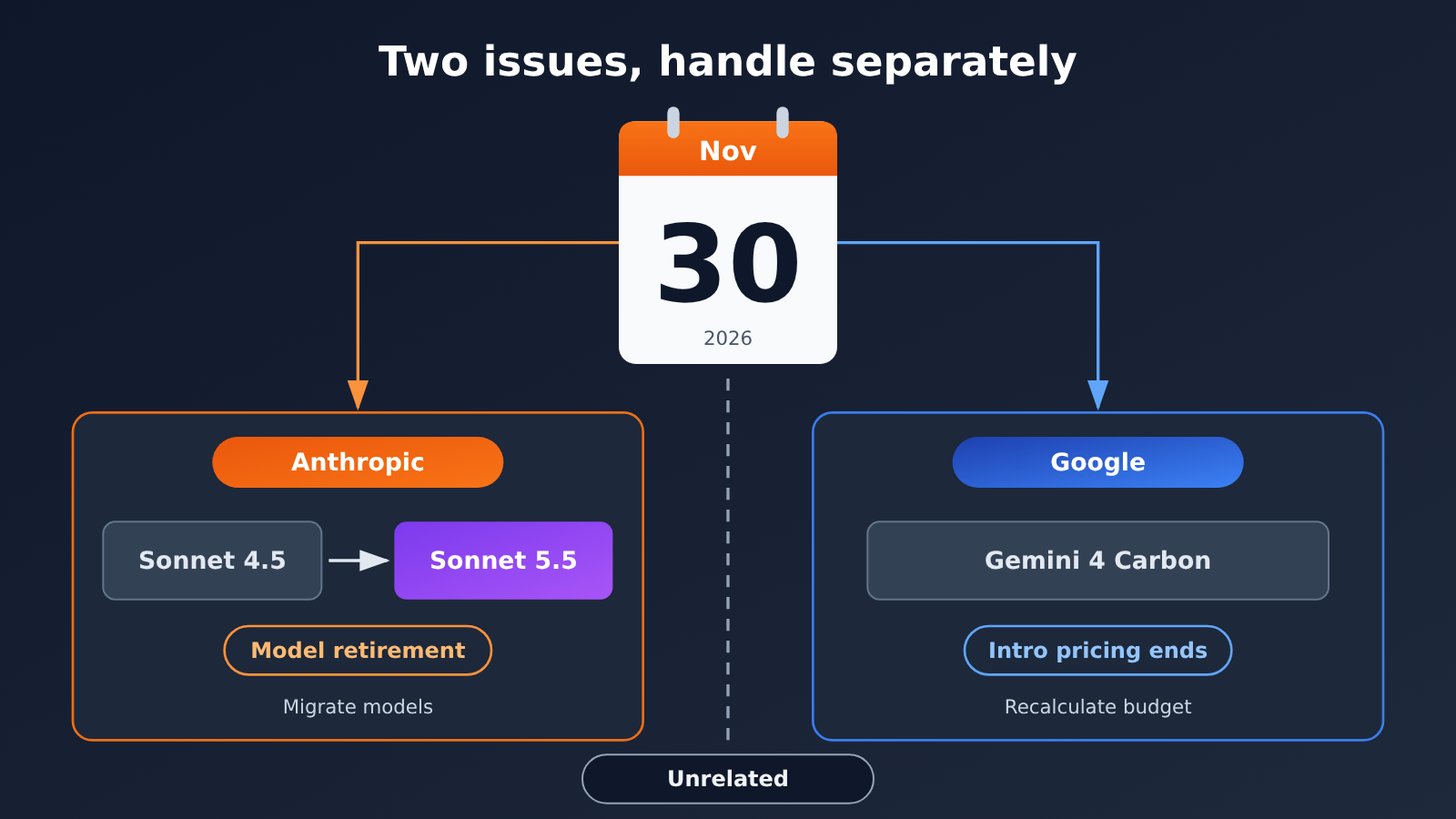
Quick Overview: Sonnet 4.5 Retirement and the Carbon Promotion Ending on November 30
Both events land on the same date, but they come from different sources, they’re different kinds of change, and they call for different actions from you. This table puts them side by side for a quick comparison:
| Item | Sonnet 4.5 Retirement | Gemini 4 Carbon Promotion Ending |
|---|---|---|
| Date | November 30 | Intro period ends 2026-11-30 |
| Decided by | Anthropic | |
| Type of event | Model retirement | Official introductory pricing expires |
| Source | Chinese article already published by APIYI; Anthropic’s retirement notice is the final authority | Footnote in the Google blog post published 2026-11-10 |
| Main action | Migrate from claude-sonnet-4-5 to Sonnet 5.5 | Recalculate your budget |
| Platform status on 2026-11-11 | The master list shows the dated ID claude-sonnet-4-5-20250929 | gemini-4-carbon is still billed at that day’s listed price |
Why You Should Treat the Sonnet 4.5 Retirement and Carbon Promotion Ending Separately
If you lump the two events together, there are two common mistakes. One is assuming a platform is doing a “across-the-board price adjustment” on November 30, and raising your Claude and Gemini budgets together. The other is assuming Carbon will be taken offline along with Sonnet 4.5, and changing a Gemini workload that’s running fine. Both assumptions are wrong.
The right approach is to split this into two tracks. The Sonnet 4.5 track is about whether the model can still be called, so the core action is migration. The Carbon track is about the official price of the same model changing, so the core action is running the numbers, with no code changes involved. Each track can have its own owner, schedule, and acceptance criteria.
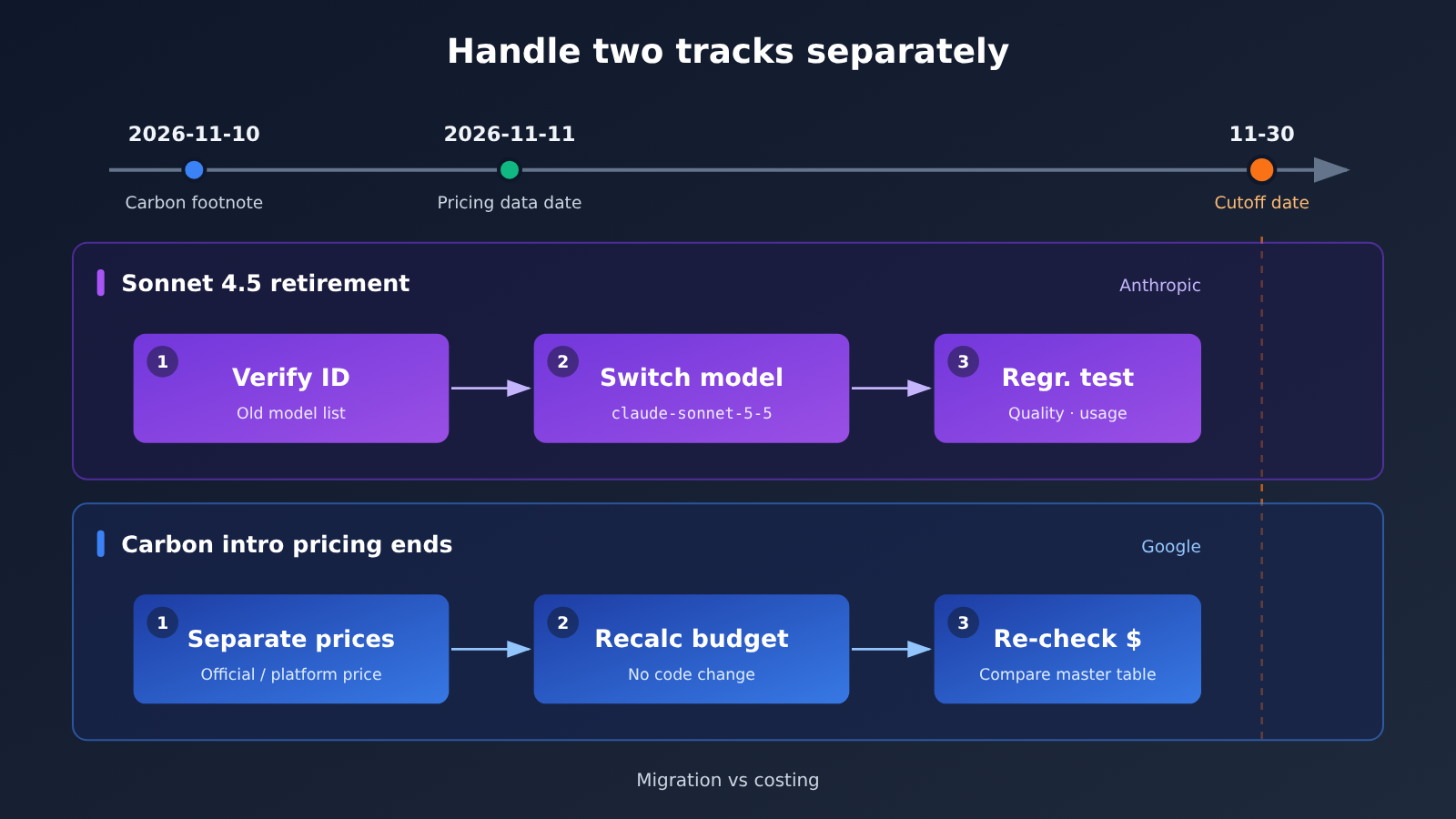
Sonnet 4.5 Retirement: Anthropic’s Model Lifecycle Schedule
The Sonnet 4.5 retirement is a normal replacement of an older model by Anthropic. APIYI’s earlier Chinese post gave the date as November 30, with the migration path going from claude-sonnet-4-5 to Sonnet 5.5. This article uses the same date. If your business is strict about timing, please double-check against Anthropic’s official retirement notice and APIYI’s latest pricing.
One more thing: as of 2026-11-11, the retirement hasn’t happened yet, so we can’t say Sonnet 4.5 has “already been taken offline.” There are still 19 days until November 30, which is enough time for one round of migration and regression testing.
Price Comparison: Moving from Sonnet 4.5 to Sonnet 5.5
For most teams, this migration is good news on price. The table below is taken from the APIYI model master list, with a data date of 2026-11-11. Pricing units follow what the master list specifies:
| Model ID | Input | Output | Cache Read | Endpoints | Data Date |
|---|---|---|---|---|---|
| claude-sonnet-5-5 | $2 | $10 | $0.1 | chat, messages | 2026-11-11 |
| claude-sonnet-4-5-20250929 | $3 | $15 | $0.3 | See master list | 2026-11-11 |
Based on these two rows, Sonnet 5.5’s input and output prices are both about one-third lower than Sonnet 4.5’s, and the cache read price is only one-third of the original. If your workload relies on long system prompts or heavy context caching, the drop in cache read pricing will make the biggest difference on your bill. This is only a unit price comparison, though. Your actual cost after migrating also depends on the new model’s token consumption, so we recommend re-running the numbers with your own business samples.
Check Your Model ID Before the Sonnet 4.5 Retirement
The first step in migrating is to find out exactly which ID your code uses. In the 2026-11-11 master list, Sonnet 4.5 appears as a dated entry, and no undated claude-sonnet-4-5 entry was visible that day. This article doesn’t speculate on whether the undated form can still be invoked. It only describes which row the master list showed that day.
Here are the places we suggest checking:
- Hard-coded
claude-sonnet-4-5orclaude-sonnet-4-5-20250929in your business code - Model name fields in config centers, environment variables, and feature flags
- Evaluation scripts, batch jobs, scheduled tasks, and other code you rarely touch
- Model names configured separately in third-party tools (such as IDE plugins and agent frameworks)
Sonnet 4.5 Retirement Migration Steps
The migration itself isn’t complicated. The main thing is not to miss calls tucked away in corners. Here are the suggested steps:
- Search globally for the old IDs listed in the previous section and put together a list of call sites
- Change the target model everywhere to
claude-sonnet-5-5 - If you use the OpenAI-compatible approach, set
base_urltohttps://api.apiyi.com/v1; your API key stays the same - For workloads using the native Anthropic format, confirm the
messagesendpoint works; for workloads using the OpenAI format, use thechatendpoint - Run regression tests with fixed samples and compare output quality, format, and token usage
- After a gradual rollout, watch your bill and confirm the unit prices match the 2026-11-11 master list figures
🚀 Quick start: If you want to get Sonnet 5.5 running before November 30, sign up at APIYI (apiyi.com) and use the free trial credit for new users to verify it. The same API key can call both Claude and Gemini series models, so you don’t need to re-integrate any interfaces when migrating.
Carbon Promo Ending: Google’s Official Introductory Pricing Expires
Gemini 4 Carbon is a separate matter. According to a footnote in Google’s blog post published on 2026-11-10, the introductory period ends on 2026-11-30. After that, the official price will be $4 for input and $20 for output. This is a Google pricing change. It has nothing to do with Anthropic, and no model is being retired. Carbon itself will stay available.
It’s worth keeping in mind that Google’s official pricing and a platform’s price list are two different data sets. As of 2026-11-11, gemini-4-carbon on APIYI is still listed at $2 for input, $10 for output, and $0.1 for cache reads. This article won’t predict whether the platform will adjust after November 30, so check the price table at that time.
Carbon Price Comparison Before and After the Promo Ends
| Price Source | Data Date | Input | Output | Cache Read |
|---|---|---|---|---|
| Google official (after introductory period) | 2026-11-10 blog footnote | $4 | $20 | Not listed in footnote |
| APIYI gemini-4-carbon | 2026-11-11 | $2 | $10 | $0.1 |
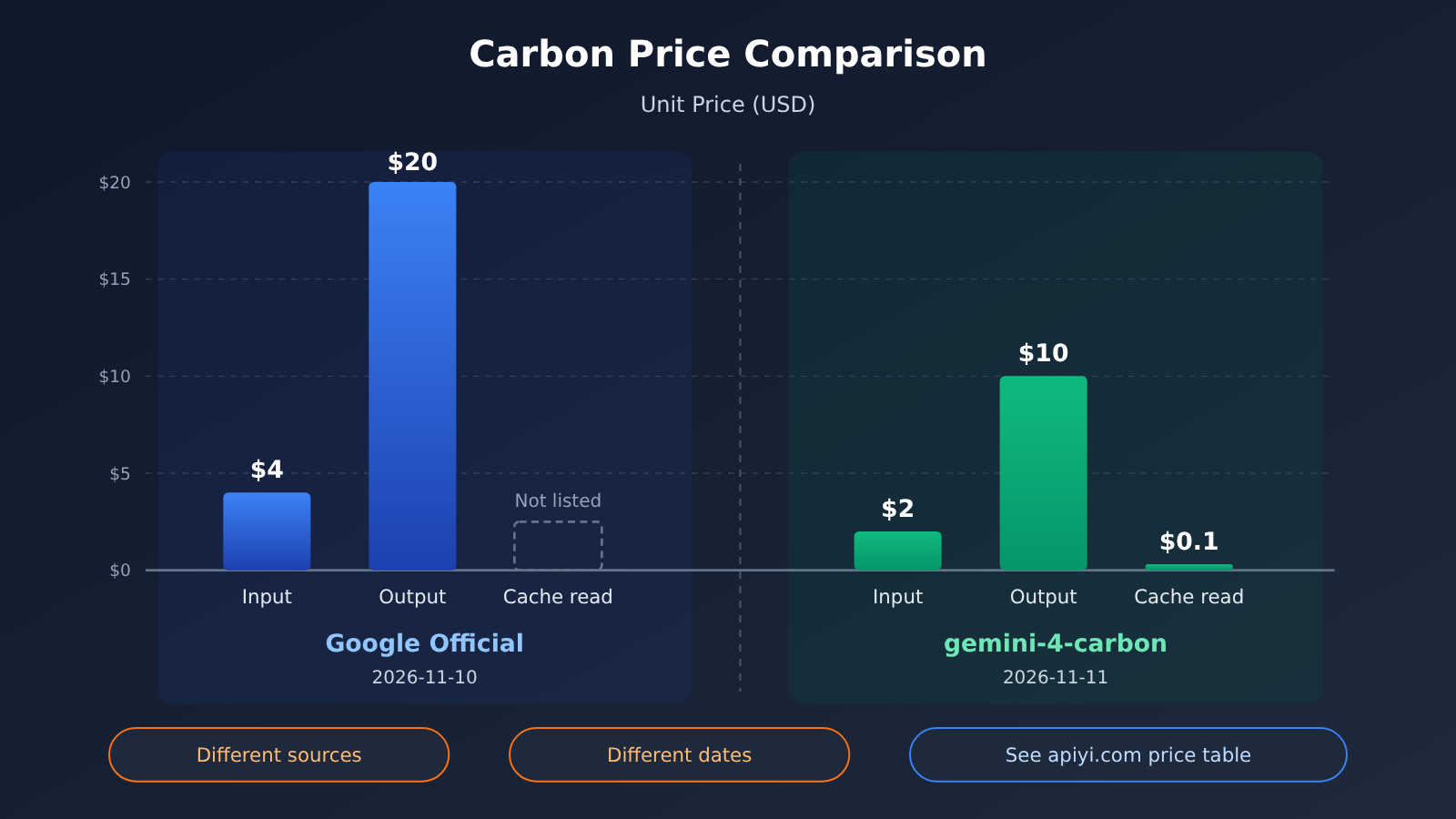
How to Budget for Carbon After the Promo Ends
Going by the table above, Google’s official input and output prices after the introductory period are exactly double the platform prices listed on 2026-11-11. But the two sets of numbers come from different sources and dates, so you can’t say “the platform will double its prices too,” and you can’t say “the platform has already raised prices” either.
A safer approach is to prepare two budgets. The first calculates your current bill using the platform prices from 2026-11-11. The second is a stress test using Google’s official post-introductory-period prices, to see whether your business can absorb them. If you connect directly to Google, the second budget is the price you’ll face after November 30. If you call the model through a platform, go by the prices that platform publishes at that time.
💰 Cost tip: If your project uses Carbon heavily, check the APIYI apiyi.com model price list once before and once after November 30, and record the data date in your budget sheet. That way you’re less likely to run into mismatched figures when you reconcile bills later.
Impact Analysis: What the November 30 Sonnet 4.5 Retirement and Carbon Promo Ending Mean for You
Impact on Developers
- The Sonnet 4.5 track needs code changes: Swap the old ID for
claude-sonnet-5-5. Eval scripts and scheduled jobs are easy to miss, so do a global search. - The Carbon track needs no code changes: The
gemini-4-carbonID isn’t affected by the end of the introductory pricing. Don’t change it just because the dates happen to match. - Regression testing applies only to Claude: The old and new Sonnet may differ in output style and token usage. Carbon doesn’t need a fresh regression pass just because of a price change.
- Make your config easy to switch: Put model names in config instead of hardcoding them. The next retirement will then take far less work.
Impact on Team Budgets
- Your Claude budget may go down: According to the 2025-11-11 master table, Sonnet 5.5’s input, output, and cache-read prices are all lower than Sonnet 4.5’s.
- Budget Gemini by source: For usage going directly through Google, re-estimate costs at the post-introductory-period price. For usage going through a platform, use that platform’s price list.
- Record the data date: Note the source and date in your price sheet so you don’t mix official prices with platform prices.
Troubleshooting Guide: Sonnet 4.5 Retirement vs. Carbon Price Change
If something looks off around November 30, use the table below to figure out which track it belongs to first, then check the right place:
| Symptom | Track | Likely Cause | What to Check First |
|---|---|---|---|
| Calls report that the model can’t be found or isn’t available | Sonnet 4.5 retirement | The ID in your code doesn’t match that day’s master table | Compare against the full model ID in the master table. The exact error text depends on what the platform actually returns. |
| Output format changed after migration | Sonnet 4.5 retirement | Behavioral differences between the old and new models | Compare Sonnet 4.5 and 5.5 using a fixed set of regression samples |
| Claude billing unit price doesn’t match expectations | Sonnet 4.5 retirement | Some traffic still goes through the old ID | Break down the bill by model ID and check against the unit prices in the APIYI apiyi.com master table |
| Carbon cost estimate is way off | Carbon promo ending | Google’s official prices were applied to a platform bill, or vice versa | Confirm the price source and the data date |
| Thinking Carbon was shut down | Carbon promo ending | The end of introductory pricing was mistaken for a retirement | Reread the footnote in Google’s blog post. It only concerns pricing. |
Action Checklist by Track Before November 30
| Timeline | Sonnet 4.5 Retirement Track | Carbon Promo Ending Track |
|---|---|---|
| Now through mid-November | Compile a list of calls using the old ID | Separate usage going directly through Google from usage going through a platform |
| Late November | Switch to claude-sonnet-5-5 and run regression tests | Stress-test your budget under both price sets |
| Around November 30 | Confirm no traffic remains on the old ID | Recheck the platform price list and update your budget sheet |
Frequently Asked Questions (FAQ)
Q1: Are the Sonnet 4.5 retirement and the end of the Carbon promotional pricing the same company’s decision?
No. The Sonnet 4.5 retirement is part of Anthropic’s model lifecycle schedule, while the end of Carbon’s introductory pricing is a Google pricing decision. They just happen to share the same date, November 30.
Q2: Can I still call Sonnet 4.5 right now?
As of 2026-11-11, the retirement date hasn’t arrived yet. The APIYI model master list still showed the dated `claude-sonnet-4-5-20250929` that day. We’d recommend migrating to `claude-sonnet-5-5` as soon as you can. For the exact retirement timing, go by Anthropic’s deprecation notice.
Q3: Will migrating to Sonnet 5.5 cost more?
Based on the 2026-11-11 master list, no. Sonnet 5.5 is $2 for input, $10 for output, and $0.1 for cache reads. The dated Sonnet 4.5 version is $3 for input, $15 for output, and $0.3 for cache reads. Your actual cost also depends on token usage, so we’d suggest running the numbers on your own workload samples.
Q4: Has Carbon’s price gone up on the platform yet?
No. On 2026-11-11, `gemini-4-carbon` on the platform was still $2 for input, $10 for output, and $0.1 for cache reads. The $4 input / $20 output pricing Google announced is what applies after the official introductory period ends. Whether the platform adjusts its prices afterward will depend on the price list at that time.
Q5: How can I handle both model lines through a single interface?
Sign up at APIYI (apiyi.com) to get an API key, then set `base_url` to `https://api.apiyi.com/v1` when using the OpenAI-compatible mode. For the Claude migration, you only need to change the model name. Carbon keeps using its existing ID, so both lines share the same integration code.
Q6: What’s still uncertain about these changes?
Three main things: the Sonnet 4.5 retirement date follows the previously published Chinese article, so defer to Anthropic’s notice; the undated `claude-sonnet-4-5` didn’t appear in the master list that day, so this article makes no claims about its status; and the platform hasn’t yet announced its Carbon pricing for after November 30.
Key Takeaways: Sonnet 4.5 Retirement and Carbon Promo Ending on November 30
- Two events, two vendors: Anthropic is retiring Sonnet 4.5, and Google is ending the Carbon introductory pricing. They just happen to land on the same date.
- The Sonnet line needs a migration: Swap every old ID for
claude-sonnet-5-5, and check your evals and scheduled jobs too. - The new Sonnet is cheaper: In the 2026-11-11 master price table, input, output, and cache read are all lower than Sonnet 4.5.
- The Carbon line is just a budgeting exercise: Once Google’s official introductory period ends, pricing becomes $4 input and $20 output. Nothing is being shut down.
- Platform pricing hasn’t changed: As of 2026-11-11,
gemini-4-carbonon the platform is still $2 input, $10 output, and $0.1 cache read. - Record the data date: Keep official pricing and platform pricing in separate records so they don’t get mixed up when you reconcile your bills.
Summary
If you handle the November 30 Sonnet 4.5 retirement and the Carbon promo ending separately, things get much clearer:
- Sonnet 4.5 retirement: This is an Anthropic model replacement. You’ll need to migrate to Sonnet 5.5, and according to the 2026-11-11 price list, all three unit prices go down.
- Carbon promo ending: This is a change to Google’s official pricing. You don’t need to touch your code, but you do need to redo your budget.
- Platform pricing follows the price list for the day: Both models appear in the 2026-11-11 master table, and platform pricing hasn’t changed.
I’d suggest putting the Sonnet migration and regression testing on this week’s schedule, and checking your Carbon budget once before and once after November 30. If you want to validate the new model first, you can use the free test credits on APIYI (apiyi.com) to run a round of tests before deciding whether to switch everything over.
📚 References
- APIYI Model Catalog: Source for the platform pricing and model IDs in this article. Data as of 2026-11-11.
- Link:
docs.apiyi.com/models -
Notes: Lists input, output, and cache-read prices for
claude-sonnet-5-5,claude-sonnet-4-5-20250929, andgemini-4-carbon -
Google Blog – Gemini 4 Carbon now available: Source for the Carbon introductory pricing period and the official pricing that follows
- Link:
blog.google/innovation-and-ai/models-and-research/gemini-models/gemini-4-carbon-now-available/ -
Notes: Published 2026-11-10. The footnote states the introductory period ends on 2026-11-30
-
Anthropic Model Deprecation Notice: The final authority on when Sonnet 4.5 retires
- Notes: This article uses the November 30 date from the Chinese article APIYI already published. If it differs from Anthropic’s official notice, go with Anthropic’s
Author: APIYI Technical Team
Get in touch: For questions about migration or pricing, reach out to us through the APIYI homepage. You can find model details and pricing in the documentation center.


