

Author’s note: Muse Ember shipped on November 9, but it still isn’t in APIYI’s model list. This article first sorts out what the official list price and the third-party leaderboard’s “cost per task” each actually mean, then explains whether your subtasks should run on Haiku 5.5 or GPT-6 Luna today.
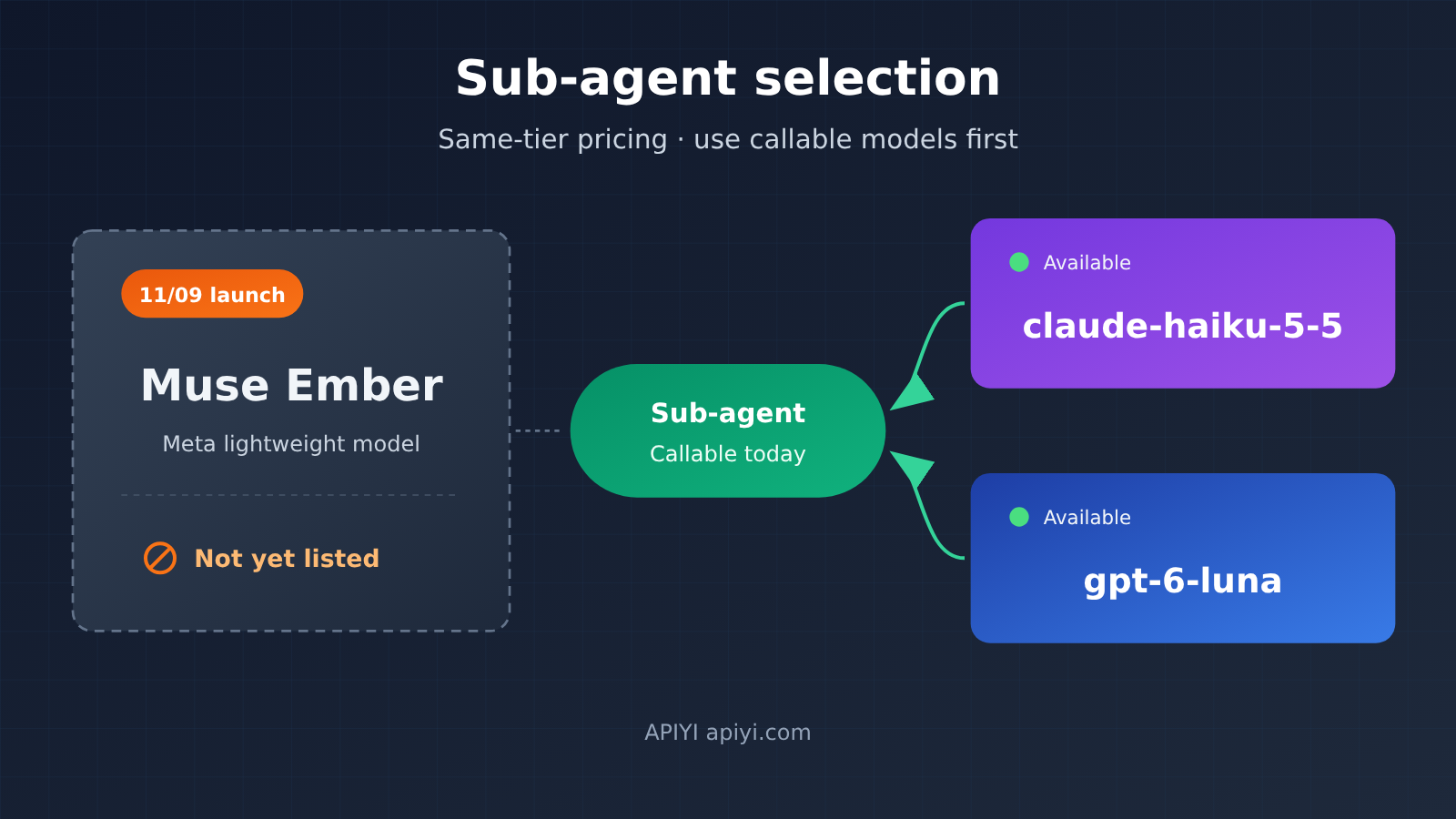
Meta released Muse Ember on November 9, 2026, positioned as the smallest model in the Muse family, built around tool calling, coding subtasks, routing, information extraction, and long-document processing. Plenty of developers doing multi-agent orchestration saw it and immediately wanted to plug it in as a sub-agent. As of 2026-11-10, APIYI apiyi.com’s model list still has no model whose name contains muse or ember — go look right now and you won’t find one.
This isn’t a “let’s wait until it’s listed” type of article. Two models in the same price bracket as Muse Ember that you can call today are claude-haiku-5-5 and gpt-6-luna, and sub-agents can switch over to those two IDs right away. One clarification up front: this article is about Muse Ember, the lightweight API model Meta released this time. It has nothing to do with Claude, and it’s not Meta’s personal agent product also named Muse.
The payoff: by the end, you’ll be able to tell apart what Muse Ember’s “official list price” refers to versus the “cost per task” numbers reported by third-party leaderboards, and you’ll know how to choose between Haiku 5.5 and GPT-6 Luna based on the type of subtask.
Muse Ember Key Facts at a Glance
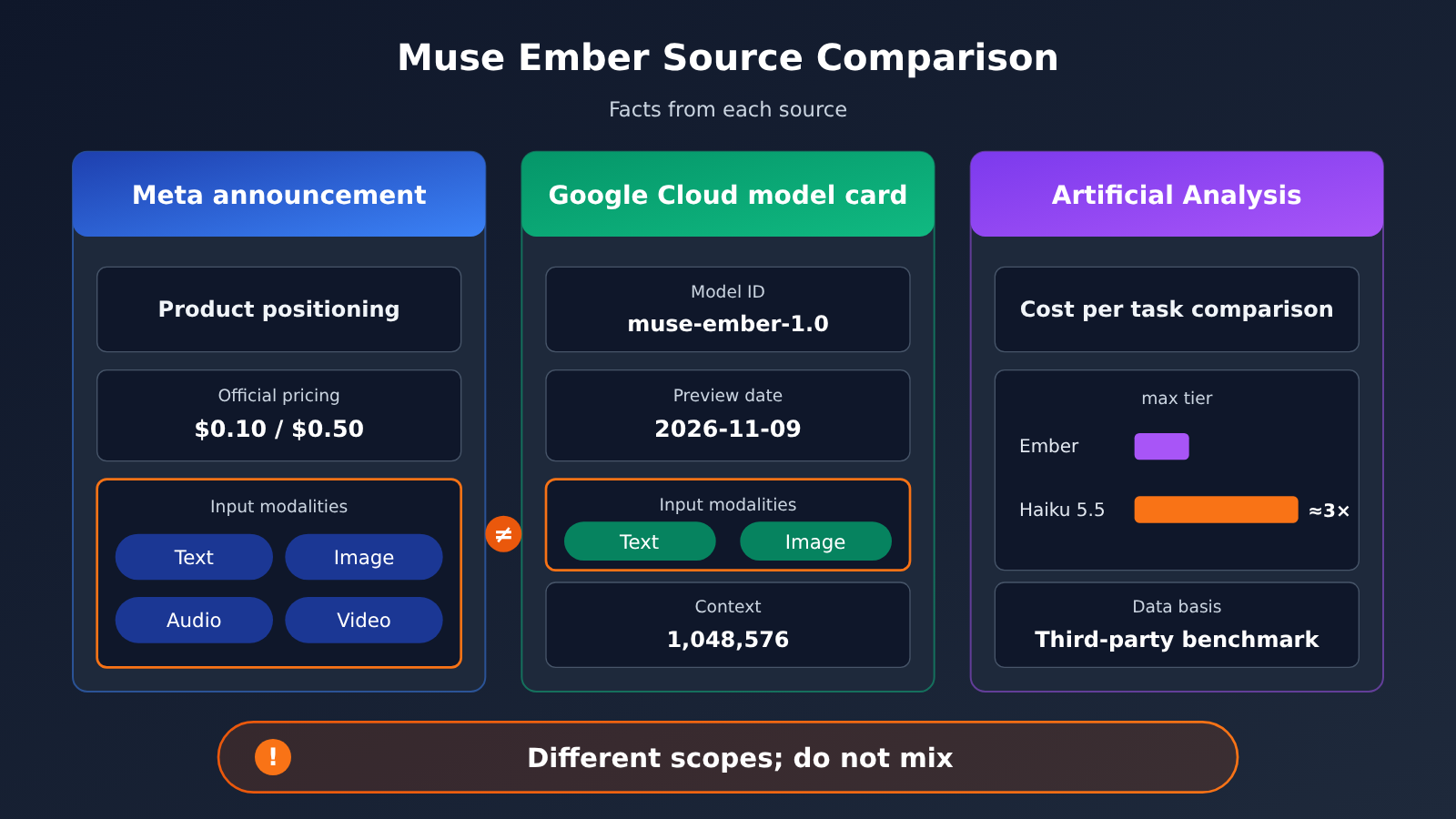
Let’s start by gathering the information that’s already public into a table. The facts come from Meta’s launch post, the Google Cloud model card, and an article from Artificial Analysis. Claims from different sources are listed separately rather than merged.
| Item | Details | Source |
|---|---|---|
| Release date | 2026-11-09 | Meta launch post, TechCrunch |
| Publisher | Meta | Meta launch post |
| Model positioning | The smallest model in the series, aimed at tool calling, coding subtasks, routing, extraction, and long documents | Meta launch post |
| Official API list price | $0.10 per million input tokens, $0.50 per million output tokens | Meta launch post |
| Model card ID | muse-ember-1.0, entered preview on 2026-11-09 |
Google Cloud model card |
| Context length | 1,048,576 tokens | Google Cloud model card |
| APIYI listing status | Not listed yet; model IDs and pricing are subject to the platform’s model list. We’ll launch it as soon as possible. | APIYI pricing API (2026-11-10) |
Muse Ember Input Modalities: Two Public Claims
There are currently two different claims about input modalities, so this can’t be summed up in a single sentence. Meta’s launch post says Muse Ember can understand text, images, audio, and video. The Google Cloud model card for muse-ember-1.0 lists only text and images as inputs.
The difference may come from different capabilities being available through different access channels, or it may be a temporary limitation of the preview stage. If your subtask needs to handle audio or video, it’s best to wait until the platform you actually integrate with provides clear modality documentation before designing around it—don’t plan production workflows based directly on the capabilities described in the launch post.
Muse Ember: list price vs. cost per task
This is the most commonly misread part of the launch, so it helps to look at it in two layers.
The first layer is list price. Meta’s published pricing for Muse Ember is $0.10 for input and $0.50 for output (per million tokens). Artificial Analysis also confirms that Ember’s input and output token list prices match those of Claude Haiku 5.5 and GPT-6 Luna. So on unit price, all three models sit in the same tier — Ember isn’t cheaper.
The second layer is cost per task. In its November 9 article, Artificial Analysis concluded that Ember’s average cost to complete a task is lower. There are two main reasons: cached input is cheaper, and it consumes fewer tokens to reach the same score. By AA’s reckoning, the cost per task for Haiku 5.5 (max tier) to reach the same score is about 3× that of Ember (max tier).
| Basis of comparison | Muse Ember | Claude Haiku 5.5 | GPT-6 Luna | Notes |
|---|---|---|---|---|
| Input list price (per million tokens) | $0.10 | $0.10 | $0.10 | Same for all three |
| Output list price (per million tokens) | $0.50 | $0.50 | $0.50 | Same for all three |
| Cached input | AA says it’s cheaper | Platform cache_ratio 0.1 | Platform cache_ratio 0.1 | Ember’s specific cache price is subject to the official figures |
| Cost per task (AA third-party leaderboard) | Baseline | About 3× Ember (max tier) | No specific multiple cited in this article | Evaluation methodology, not list price |
| Available platforms | Not listed yet | Listed on APIYI apiyi.com | Listed on APIYI | As of 2026-11-10 |
It’s worth stressing that “about 3×” is a cost-per-task comparison Artificial Analysis derived from its own evaluation task set. It’s third-party leaderboard data, not a difference in list price, and it isn’t something we ran ourselves. If you read it as “Ember’s unit price is a fraction of Haiku’s,” you’ll get your budget calculation wrong.
Whether this number holds up in your own business depends on two things: how high your cache hit rate is on your subtasks, and how closely your task distribution resembles AA’s evaluation set. If you’re routing with long system prompts and short tasks, caching will have a big impact; if it’s one-off extraction tasks where the input is different every time, the caching advantage is hard to realize.
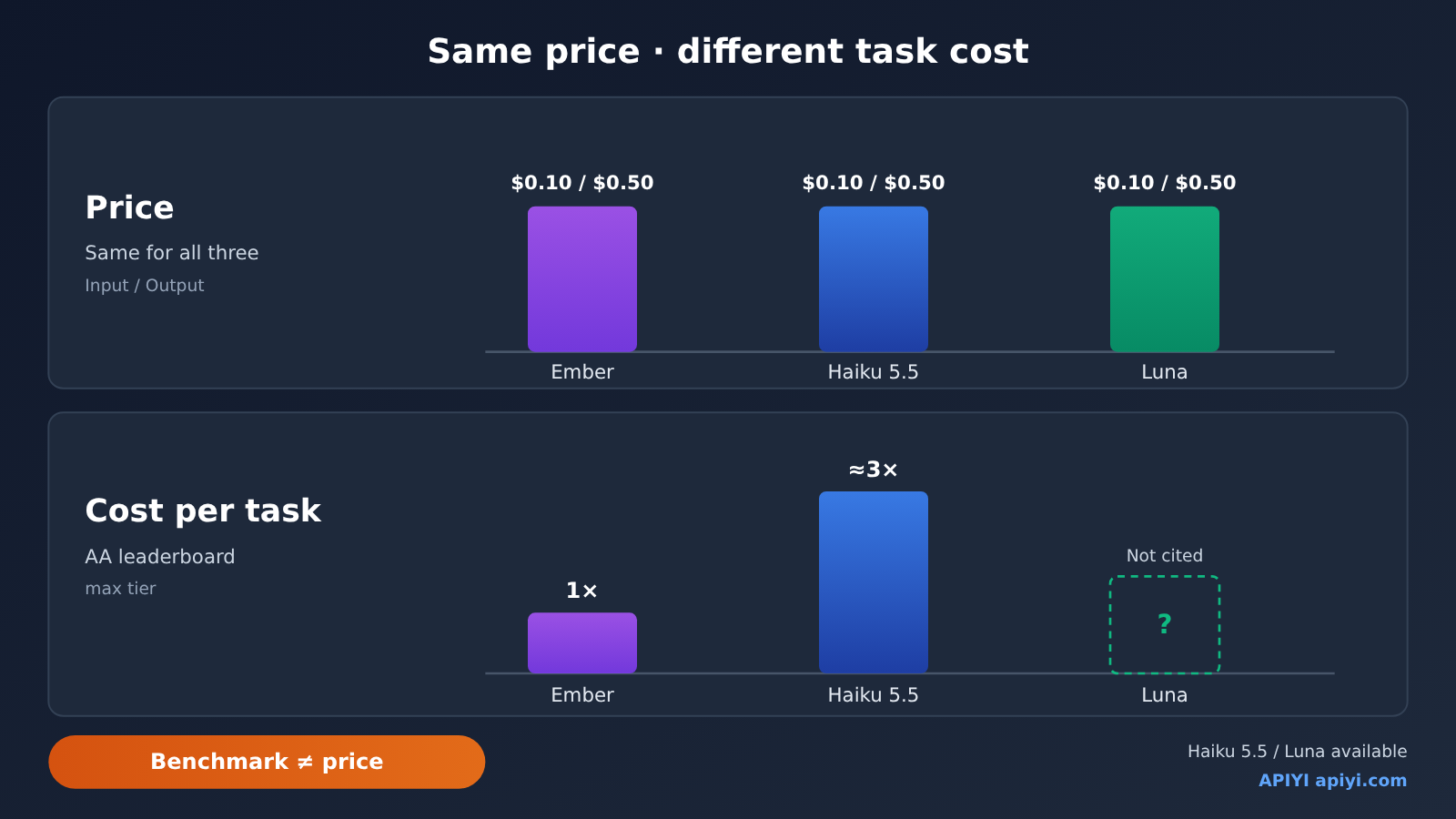
💡 A note on methodology: When budgeting, use list price for unit cost and your own logs to estimate usage. AA’s cost-per-task data can help you decide whether Ember is worth waiting for, but it isn’t a direct billing forecast.
When Muse Ember Isn’t Listed Yet: How Sub-Agents Should Choose Between Haiku 5.5 and GPT-6 Luna
Data from the APIYI pricing endpoint on 2026-11-10 shows that both claude-haiku-5-5 and gpt-6-luna are listed and can be called directly, and the pricing parameters registered on the platform are completely identical:
| Model ID | model_ratio | completion_ratio | Corresponding list price (input/output) | cache_ratio | Status |
|---|---|---|---|---|---|
claude-haiku-5-5 |
0.05 | 5 | $0.10 / $0.50 | 0.1 | Listed |
gpt-6-luna |
0.05 | 5 | $0.10 / $0.50 | 0.1 | Listed |
| Muse Ember | — | — | — | — | Not listed yet |
There’s no difference between the two models in list price or cache parameters, so when choosing between them you don’t need to compare prices — instead, look at the subtask type and how they work with the main Agent. The prices in the table are the list prices of the models themselves; actual charges are based on the platform account page. This article does not convert platform prices according to group multipliers.
How to Approach Model Selection for a Muse Ember Replacement
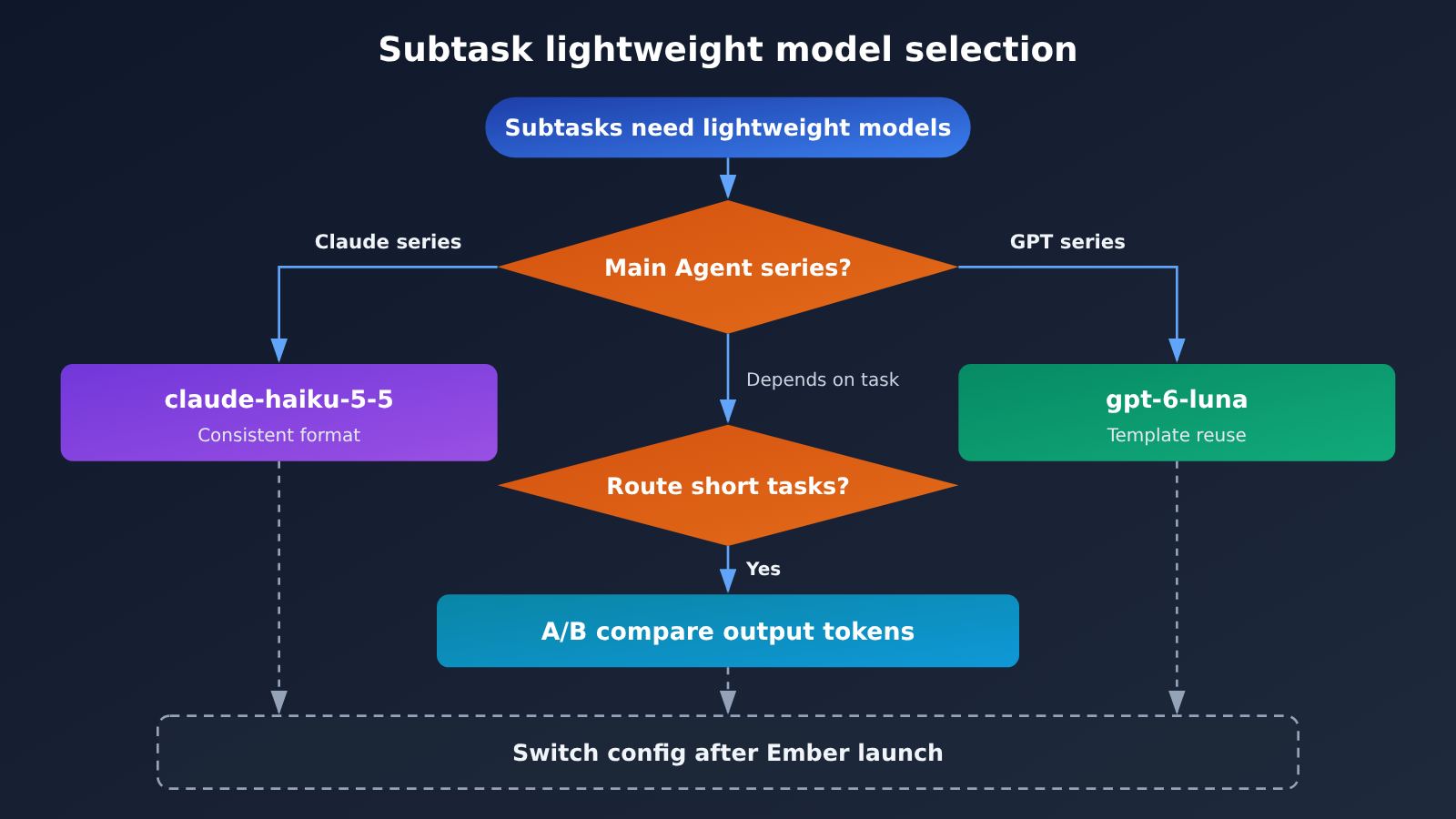
- The main Agent is in the Claude family: Prefer
claude-haiku-5-5for sub-agents. The tool-calling format and system prompt style stay consistent with the main model, so migration requires the fewest changes. - The main Agent is in the GPT family, or batch automation is the main focus: Prefer
gpt-6-lunafor sub-agents. The same set of prompt templates and structured-output conventions can be carried over directly. - Short tasks like routing or classification: Either works. It’s best to run the same batch of samples through both and compare accuracy and output token counts. When list prices are the same, whichever produces shorter output costs less in practice.
- Long-document extraction: First confirm that the actual document length falls within the model’s context window, then decide whether to chunk it. Don’t design your workflow around the 1,048,576 context from the Ember model card.
- Planning to switch to Ember later: Make the sub-agent’s model a configuration item in your code, so that when Ember is listed you can switch by changing a single line of configuration.
How to Call Both IDs Today
APIYI provides an OpenAI-compatible interface, so clients only need to change two things: base_url and model. Initialize the client as client = OpenAI(api_key="YOUR_API_KEY", base_url="https://api.apiyi.com/v1"), set model to claude-haiku-5-5 or gpt-6-luna when making calls, and keep the structure of messages and tools unchanged.
| Parameter | Recommended sub-agent usage | Description |
|---|---|---|
base_url |
https://api.apiyi.com/v1 |
OpenAI-compatible endpoint |
model |
claude-haiku-5-5 / gpt-6-luna |
Read from environment variables for easy switching later |
max_tokens |
Set an upper limit based on the task | Subtask outputs are usually short; setting a limit prevents wasted tokens |
tools |
Share the schema with the main Agent | Reduces the cost of switching models |
It’s a good idea to put the model ID in an environment variable, for example SUBAGENT_MODEL=gpt-6-luna. Once Muse Ember is listed in the list, you only need to change the value of this variable — no changes to business code required.
🚀 Quick start: Log in to APIYI apiyi.com now; you’ll see
claude-haiku-5-5andgpt-6-lunain the model list, and you can call each with the same API key. It’s a good way to start by running the same batch of subtask samples for comparison.
Impact analysis of the Muse Ember release
Impact on developers
- More choices for sub-agents: in the same price tier, there’s now a Meta option alongside Claude and GPT. In multi-agent architectures, it’s easier to implement the “strong main model, cheap sub-model” layering.
- Cost evaluation should focus on cost per task: all three are priced the same, and AA explicitly attributes the differences to caching and token efficiency. When choosing lightweight models going forward, unit price alone is becoming less useful—”how much does it cost to complete a task” matters more.
- Engineering needs to support model switching: there’s usually a lag between a new model’s release and its availability on various platforms. Make the sub-agent model a configuration option and keep tool schemas cross-model compatible, so you can switch over as soon as the new model is available.
Impact on the industry
- The lightweight tier is entering same-price competition: Haiku 5.5, GPT-6 Luna, and Muse Ember are listed at the same price, so competition shifts to cache pricing, output conciseness, and tool-call reliability.
- Third-party leaderboards matter more: when list prices are the same, developers rely more on cost-per-task data from third parties like Artificial Analysis. That’s also why citations need to clearly state the methodology and tier.
💰 Cost tip: Before Ember becomes available, start accumulating token logs for your subtasks with Haiku 5.5 and Luna. Once Ember is available, run the same batch of tasks and compare—you’ll see how much of AA’s conclusion actually holds up in your business.
FAQ
Q1: What is Muse Ember? Is it the same thing as Meta’s personal agent product Muse?
No, they’re different. Muse Ember is a lightweight API model Meta released on 2026-11-09, aimed at tool calling, coding subtasks, routing, extraction, and long documents. It isn’t the same as Meta’s personal agent product Muse, and it has nothing to do with Claude.
Q2: Is Muse Ember cheaper than Haiku 5.5?
At list price, no. All three charge $0.10 and $0.50 per million tokens for input and output. But Artificial Analysis’s third-party leaderboard shows Ember with a lower cost per task: reaching the same score costs roughly 3× more on Haiku 5.5 (max) than on Ember (max). That’s evaluation-benchmark data, not a difference in unit price.
Q3: When can I call Muse Ember on APIYI?
As of 2026-11-10, Muse Ember isn’t listed yet. Models and pricing follow the platform’s model list, and we’ll roll it out as soon as we can. You can search for `ember` in the model list on APIYI apiyi.com at any time to check whether it’s live.
Q4: Does Muse Ember support audio and video input?
There are two conflicting accounts right now. Meta’s launch post says it supports text, images, audio, and video; the Google Cloud model card for the `muse-ember-1.0` preview lists only text and images. Which modalities you can actually use depends on the documentation for the channel you’re connecting through.
Q5: For sub-agents, should I use claude-haiku-5-5 or gpt-6-luna right now?
Both have identical list prices and `cache_ratio` on APIYI, so you can pick based on which family your main agent belongs to — that keeps migration easy. If you’re unsure, run a batch of samples through both IDs on APIYI apiyi.com with the same key, then compare accuracy and output token counts before deciding.
Q6: I’m on Haiku 5.5 or Luna now — will switching to Ember later be a hassle?
Not if you haven’t hardcoded the model name. Put the model in an environment variable, keep your tool schemas portable across models, and once Ember is listed you can switch by changing one config value. After switching, rerun your regression samples to confirm the output format hasn’t changed.
Muse Ember Key Takeaways
- Release info: Meta released Muse Ember on November 9, positioned as the smallest model for subtasks
- Same list price: $0.10 input, $0.50 output — the same tier as Haiku 5.5 and GPT-6 Luna
- Cost per task: The third-party AA leaderboard shows Haiku 5.5 (max) costs roughly 3x per task compared to Ember
- Modality claims differ: The release post says four modalities, while the Google Cloud model card says text plus image
- Listing status: ember isn’t in APIYI’s model list yet — the list is the source of truth for models and pricing
- Today’s choice: For sub-agents, call
claude-haiku-5-5orgpt-6-lunaon APIYI apiyi.com first - Engineering prep: Make the model a config item — once Ember is listed, switching is a one-line config change
Summary
The key points after Muse Ember’s release come down to three things:
- Look at list price and cost per task separately: The unit price matches Haiku 5.5 and Luna; the “about 3x” figure is only the per-task cost comparison from the AA leaderboard.
- Trust the integration channel for capability descriptions: Input modalities are described differently in the release post and the model card, and the context length comes from the Google Cloud model card.
- Sub-agents don’t need to wait: Same-tier Haiku 5.5 and Luna are already callable — ship first and collect token logs while you’re at it.
Before Ember is listed, it’s worth getting your sub-agents running on Haiku 5.5 and Luna, and making the model a swappable config item. We recommend using a single key on APIYI apiyi.com to compare these two models, then once Ember shows up in the list, use the same batch of tasks to verify what AA concluded.
📚 References
- Meta Research – Muse Ember release post: model positioning, API pricing, and modality details
- Link:
research.meta.ai/blog/muse-ember -
Note: Official first-hand source; pricing follows this post
-
TechCrunch – Meta releases Muse Ember: release coverage
- Link:
techcrunch.com/2026/11/09/meta-releases-muse-ember-a-new-lightweight-model-for-agent-execution -
Note: Third-party reporting on release date and positioning
-
Artificial Analysis – Muse Ember review article: cost-per-task comparison
- Link:
artificialanalysis.ai/articles/meta-s-muse-ember-is-the-cheapest-model-scoring-36-on-the-intelligence-index -
Note: Third-party leaderboard methodology; be sure to note the tier when citing
-
Google Cloud – muse-ember-1.0 model card: preview status, input modalities, and context length
- Link:
docs.cloud.google.com/gemini-enterprise-agent-platform/models/partner-models/meta/muse-ember-1-0 - Note: Differs from Meta’s release post on modality claims; useful for cross-referencing
Author: APIYI Technical Team
Technical discussion: Feel free to reach out via the APIYI website homepage. For model listing updates, please refer to the platform’s model list.


