

Author’s note: this piece breaks GLM-5.5’s “3T rumor” into three layers — what was officially said, what research reports relayed, and what the community guessed — then holds it up against three yardsticks (launch timing, task type, and cost) to help you decide whether GLM-5.5 is worth delaying a project for.
First, let’s split the information about GLM-5.5 into three layers. What Zhipu actually said comes down to one sentence: when it released GLM-5.4, it noted that “the next model will be significantly larger in scale and will meet everyone soon” — no name, no parameter count, no date. What research reports relayed is a different matter: a JPMorgan report cited in the media says Zhipu management expects to ship a flagship with roughly 3 trillion parameters in Q4 this year, about 4x the size of the current base model. Yicai and Securities Daily turned that into the “GLM-5.5, December” framing, but the report itself can’t be independently verified. What the community guessed is looser still, with estimates spanning 2.5 trillion to 3.5 trillion parameters, mostly sourced from screenshots and translations circulating on X.
As of 2026-11-24, Z.ai has no model page, release notes, pricing line, or API model ID for GLM-5.5, and the zai-org organization on Hugging Face has no matching checkpoint. So this article won’t predict a GLM-5.5 launch date. It answers a more practical question instead: can the GLM-5.4 and GLM-5.3 you already have carry your projects from Q4 into early next year.
This isn’t a “just wait, it’ll be worth it” piece, nor a “don’t wait” one. The conclusions come task type by task type — we won’t crown a winner in the opening.
What you’ll walk away with: a waiting-cost table, an executable set of acceptance criteria, and a concrete way to get moving with GLM-5.3 on APIYI apiyi.com today.
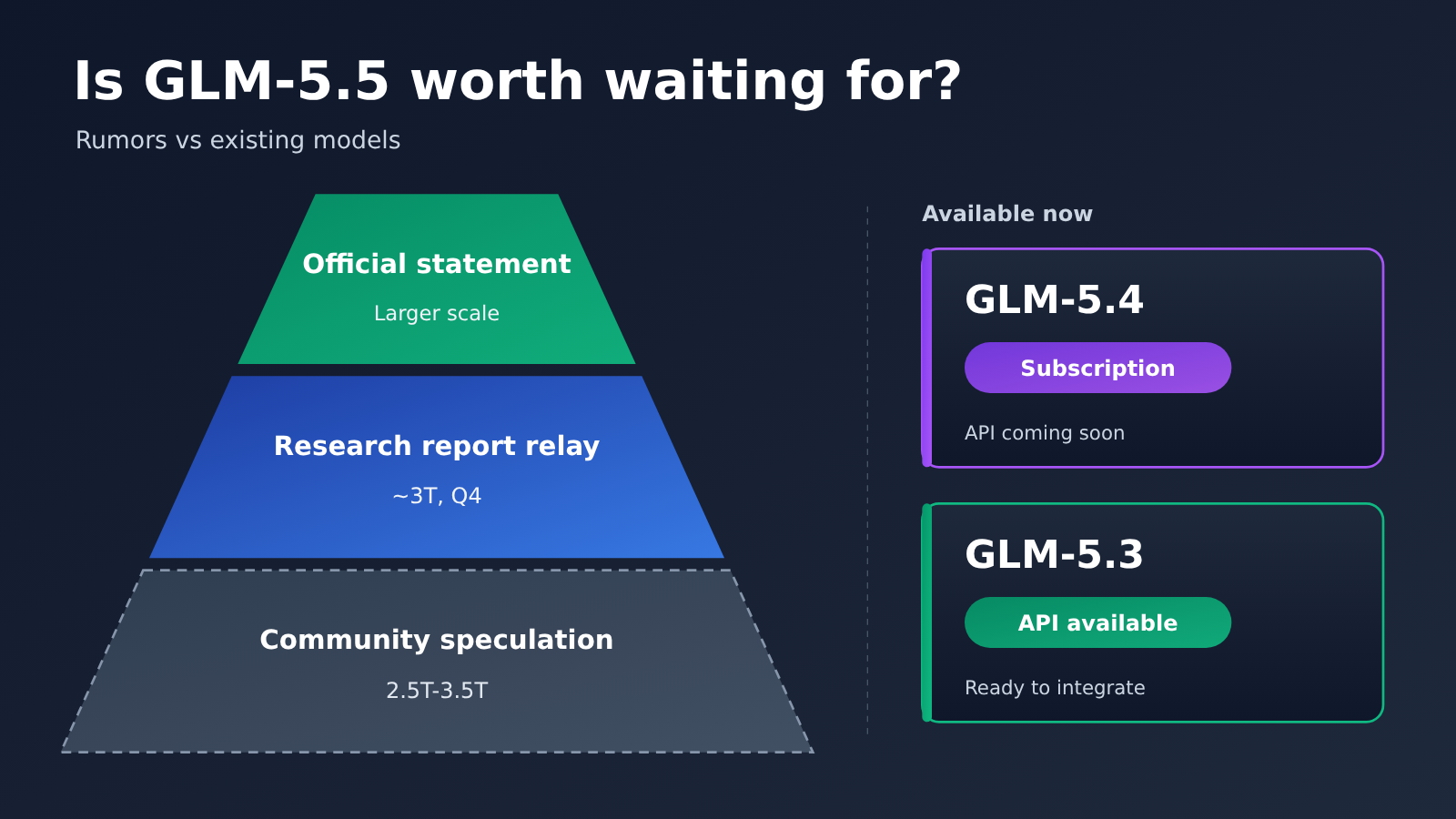
The credibility boundaries of the GLM-5.5 rumors: what official sources, research notes, and the community each actually said
The easiest thing to get wrong in a model-selection meeting is lumping three different sources into one sentence: “I heard a 3T model is coming out in December.” The table below labels the source tier for each piece of information, so you can cite it directly in your internal docs.
| Data point | Content | Source tier | Usable for scheduling? |
|---|---|---|---|
| Next model is larger | “The next model is significantly larger in scale; we’ll see it soon” | Official self-report (at the GLM-5.4 launch) | Only indicates direction, no timing |
| ~3 trillion parameters | Roughly 4x the current base (research-note base of ~745B) | Brokerage research note relaying management expectations | Cannot be independently verified |
| Time window | Research note says Q4 this year; media reports the market expects December | Research note relay + media summarization | Not an official date |
| ~700B-parameter validation model | Used as a validation platform for larger-scale training; performance already exceeds GLM-5.3 | Research note relay | Launch plan undecided |
| 2.5T–3.5T range | A guess at the parameter range | Community observation | Not recommended to cite |
| Model page, pricing, model ID | As of 2026-11-24, none of them exist | Official page verification | Currently “unknown” |
The two things most easily misread in the GLM-5.5 rumors
The first is the relationship between “3T” and “performance.” The parameter scale is just an expectation from a research note—it comes with no benchmark data, and certainly no API pricing. Even if a 3-trillion-parameter model ships on schedule, its inference cost, concurrency quota, and launch channels may all fail to match your project’s requirements.
The second is the gap between “we’ll see it soon” and “the API is available.” Judging by the GLM-5.4 cadence, the official rollout opens the subscription entry point first, and the API waits until the safety assessment is complete. If the next model follows the same process, your backend integration may not be able to use it on launch day. This is a reasonable inference, not an official commitment—make that clear when you put it in a schedule.
GLM-5.4 vs GLM-5.3: What You Can Actually Use Today
GLM-5.4 launched on 2026-11-23, making it Zhipu’s first flagship model built on the Loop Transformer architecture. According to the official blog, it made three changes at the 750B scale, looping the 28 layers of the GLM-5 base twice, and adding vision capabilities. Officially, its intelligence level is described as “equivalent to a 2T-3T parameter model” — that’s a self-reported claim, with no independent third-party leaderboard verification.
On availability: GLM-5.4 is open to all GLM Coding Plan users starting today, and it’s rolling out simultaneously in coding tools like ZCode, Trae, and Qoder. Coding Plan V2, V3, and team edition users get their GLM-5.4 quota boosted to 1.5x. But the API is marked as Coming Soon on the official page — it won’t open until security evaluation wraps up, and model weights are planned for open-sourcing after security hardening.
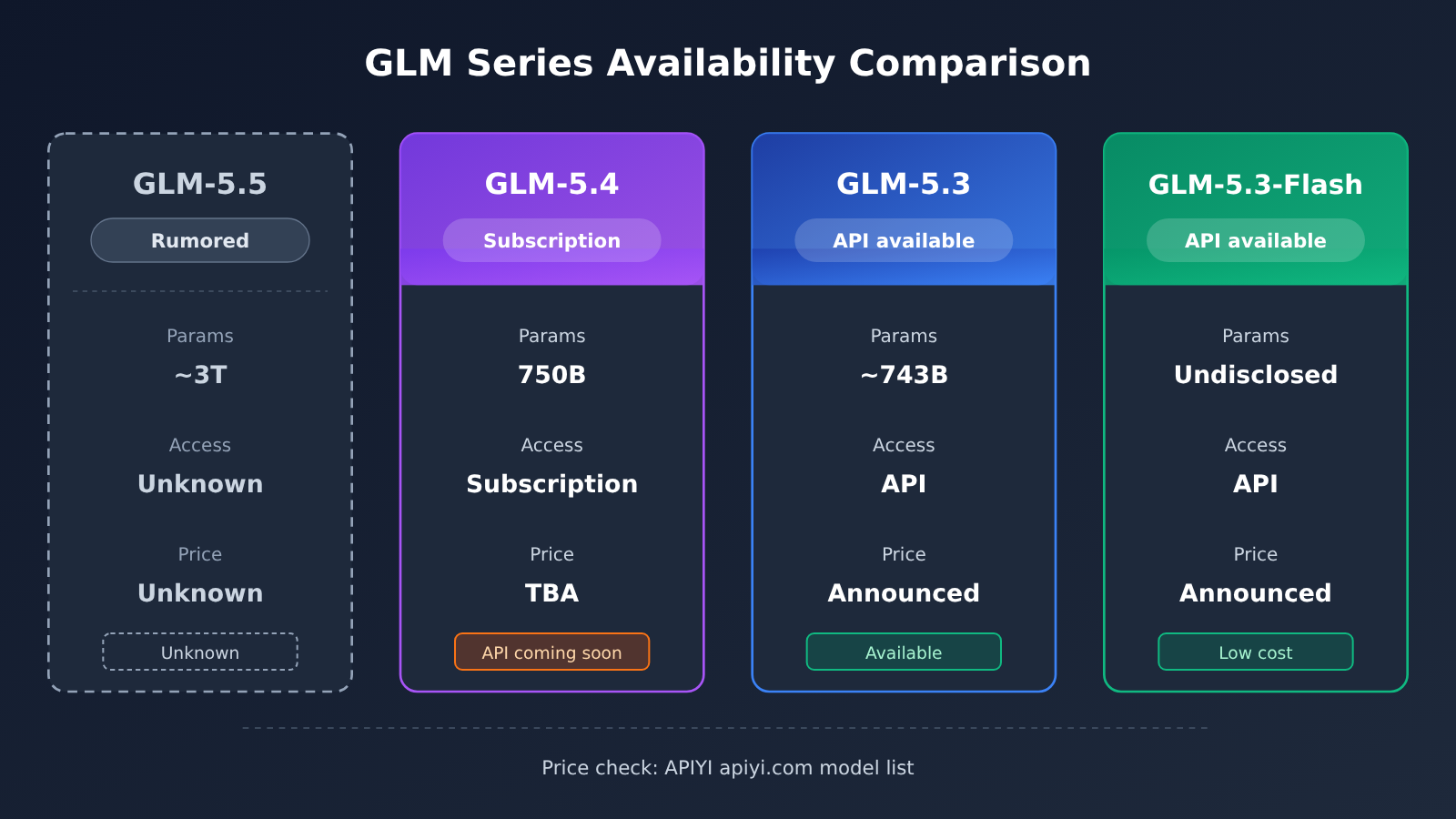
| Dimension | GLM-5.5 (rumored) | GLM-5.4 | GLM-5.3 | GLM-5.3-Flash |
|---|---|---|---|---|
| Parameter scale | ~3T (cited from a research report) | 750B, 28 layers looped twice (official) | ~743 billion, MoE (media reports) | Not disclosed in the materials |
| Architecture highlights | Unknown | Loop Transformer, added vision | MoE | Lightweight version |
| Official capability statement | None | Equivalent to a 2T-3T parameter model (official self-report) | — | — |
| Inference speed | Unknown | Up to 200 tokens/s off-peak, 70-80 tokens/s at peak (official self-report) | — | — |
| Subscription entry points | None | Coding Plan, ZCode, Trae, Qoder | — | — |
| API status | No model ID | Coming Soon | Callable | Callable |
| Available platforms | — | Official subscription channels | APIYI apiyi.com, official API | APIYI apiyi.com, official API |
The limitations GLM-5.4 officially admits
The official blog also spells out GLM-5.4’s weak spots: it tends to get stuck in overly long “marathon thinking” loops. On the flip side, average output length dropped 10-14% across most benchmarks, with some reasoning shifting from explicit output tokens into loop depth. For product leads, that means two things to verify: first, whether long tasks drag on or stall; second, whether billing actually goes down when output gets shorter — rather than just trusting the official averages.
The GLM-5.5 waiting-cost table: what waiting a month actually means
To decide whether to wait, you don’t need to guess which day GLM-5.5 ships. You only need to nail down three things: your launch date, your task type, and your cost constraints. The table below offers recommendations for the most common project shapes.
| Project shape | Cost of waiting a month | Recommended entry point today | When it’s worth re-evaluating |
|---|---|---|---|
| Team-internal coding efficiency (IDE plugins, code review assistance) | A month of productivity gains lost outright | GLM-5.4 subscription entry (Coding Plan, etc.) | When GLM-5.5 shows up in subscription channels with quota details |
| Already-launched backend services that need API calls | You can’t ship, or you keep running the old approach | GLM-5.3 API | When the GLM-5.4 API opens up and pricing is published |
| High-concurrency, cost-sensitive batch jobs (classification, extraction, summarization) | The model you’re waiting for will most likely be pricier—not worth it | GLM-5.3-Flash API | Basically no reason to wait for GLM-5.5 |
| Coding tasks that need visual input (screenshot-to-code, etc.) | GLM-5.3 doesn’t cover that capability | GLM-5.4 subscription entry to validate first | Migrate once the GLM-5.4 API opens |
| Exploratory projects launching mid-next-year | Almost no cost | GLM-5.3 to build the pipeline, and make the model ID a config item | Once official release notes and a price line exist |
The logic behind this table is simple: if a task has to go through the API, today you can only use GLM-5.3 or GLM-5.3-Flash; only coding tasks that can accept a subscription form qualify for GLM-5.4. GLM-5.5 doesn’t even have a model ID yet, so it has no business appearing in the schedule of any project with a firm launch date.
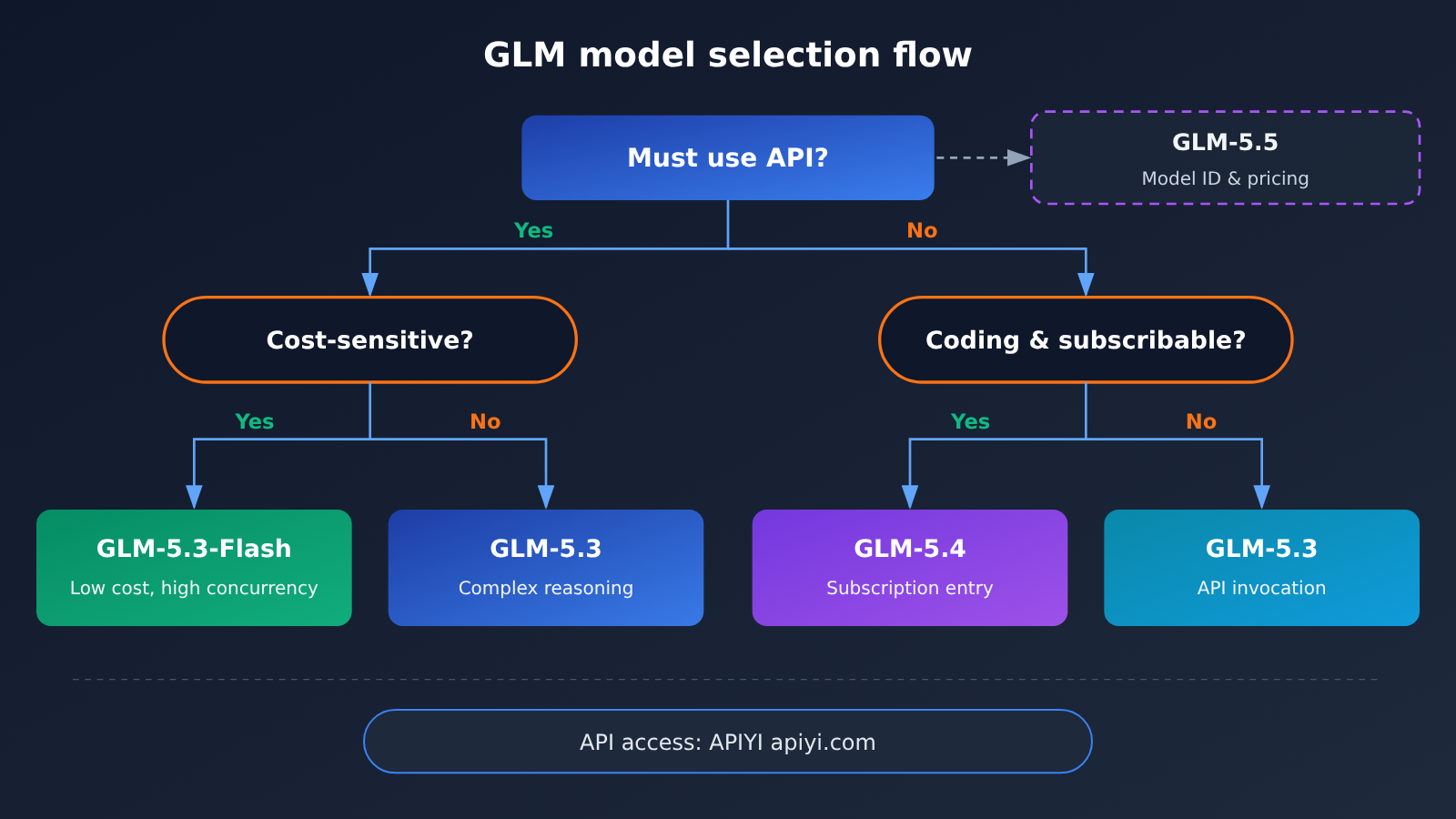
GLM-5.3 API Pricing and Access: Get the Pipeline Running First
If your project needs an API today and the GLM-5.3 series is the only option available, the next step is to nail down the pricing. The numbers below come from the APIYI model master table (data updated 2026-11-23 10:23 UTC+8, in USD per million tokens); actual prices are subject to the platform’s model list.
| Model ID | Input | Output | Cache Read | Best for |
|---|---|---|---|---|
glm-5.3 |
$1.4 | $4.396 | $0.259 | Complex reasoning, code generation, long-document analysis |
glm-5.3-flash |
$0.15 | $0.5 | $0.03 | High-concurrency classification, extraction, summarization, routing |
glm-5.2 |
$1.142 | $3.997 | $0.2284 | Baseline comparison for existing legacy projects |
One thing worth calling out: the APIYI model master table currently has neither glm-5.4 nor glm-5.5, which lines up with those models not yet being available in the official API. You can check the model list on APIYI apiyi.com anytime — once a model goes live, the same Key can switch to it directly.
GLM-5.3 Access Steps (OpenAI-Compatible Format)
APIYI uses an OpenAI-compatible interface, so existing code built on the OpenAI SDK only needs two parameter changes:
- Install the SDK:
pip install openai - When initializing the client, set
base_url = "https://api.apiyi.com/v1"and put the Key generated in the APIYI console intoapi_key - When calling, set the model parameter to
model = "glm-5.3"; for cost-sensitive scenarios, usemodel = "glm-5.3-flash" - Everything else follows the standard
client.chat.completions.create(...)pattern, and themessagesstructure stays the same - Manage the model name with an environment variable, e.g.
GLM_MODEL=glm-5.3, so that once the GLM-5.4 API opens up later you can migrate by changing a single line of config - For a quick command-line check, the request URL is
https://api.apiyi.com/v1/chat/completions, withAuthorization: Bearer YOUR_API_KEYin the request headers
🚀 Quick start: We recommend signing up at APIYI apiyi.com first and claiming the free trial credits for new users, then running both
glm-5.3andglm-5.3-flashagainst your real samples before picking your primary model. A single Key covers GLM, OpenAI, Claude, Gemini and other models, which makes side-by-side comparison easy.
GLM-5.4 vs GLM-5.3: Which One Should You Use?
When the GLM-5.4 subscription entry point makes sense
- Everyday coding help for teams: use it directly in ZCode, Trae, and Qoder without waiting on the API — and Coding Plan V2/V3 and the Team edition bump your quota by 1.5x
- Coding tasks that need visual understanding: like generating front-end code from a design screenshot — GLM-5.3 doesn’t handle this kind of input
- Evaluating a new architecture: before the GLM-5.4 API opens up, use the subscription entry point to build up quality judgments on real tasks, so you’re ready for migration later
When the GLM-5.3 API makes sense
- Backend services that are live or about to launch: today, it’s the only GLM-family API option available
- Workloads that need stable billing and quota management: pay-as-you-go, with transparent, publicly listed pricing
- Complex reasoning and long-document processing: before the GLM-5.4 API is available, GLM-5.3 is the workhorse model you can call in this family
When GLM-5.3-Flash makes sense
- High-concurrency batch processing: input pricing is about one tenth of GLM-5.3, making it a good fit for classifying and extracting text at scale
- A front layer for multi-model routing: let Flash gauge difficulty first, then hand the complex requests over to GLM-5.3
💡 Recommendation: mixing models within the same project is a common practice. With APIYI apiyi.com, a single API key lets you call
glm-5.3andglm-5.3-flashat the same time — convenient for tiered routing, and convenient for later comparisons when new models come along.
GLM-5.5 Decision Recommendations: An Actionable Acceptance Standard
Rather than waiting for rumors to become reality, write your acceptance criteria now. Whether you end up using GLM-5.3, GLM-5.4, or a future GLM-5.5, run them through the same standard—that way, when you migrate, you’ll have evidence to back up your decision.
Pre-launch model acceptance checklist:
- Task pass rate: Prepare 50–100 samples from real business workloads and set pass thresholds—for example, unit test pass rate for code tasks, or field accuracy for extraction tasks.
- Latency ceiling: Define your P95 latency requirement. GLM-5.4 officially reports 70–80 tokens/s at peak, but you’ll need to verify that yourself during your own traffic hours.
- Long-task stability: To address the “marathon thinking” issue that GLM-5.4 officially acknowledges, set a maximum elapsed time and maximum output length, and track the timeout rate.
- Per-task cost: Calculate based on actual input and output tokens, not just the sticker price. For models that produce shorter outputs, verify against the bill.
- Portability: Make the model ID a configuration item, keep prompts from depending on quirks of a specific model, and rerun the same sample set after switching.
Signals that trigger re-evaluating GLM-5.5 (meet any two before changing your schedule):
- An official GLM-5.5 model page or release notes appear on Z.ai.
- The official API model ID and pricing line item are published.
- Evaluation results appear on a third-party independent leaderboard—not official self-reported numbers or community screenshots.
- The corresponding model shows up in the model list of the platform you use.
🎯 Technical recommendation: Lock down the sample set above. Whenever a new model is listed, rerun it on APIYI apiyi.com with the same
base_url, and compare pass rate and cost. Whether a new model is worth switching to is a question your own data should answer—more reliable than any rumor.
Frequently Asked Questions (FAQ)
Q1: Is GLM-5.5 an officially confirmed model?
No. Officially, all that’s been said is that “the next model will be significantly larger in scale” — no name, parameter count, or date has been given. “GLM-5.5” and “roughly 3 trillion parameters” come from media retellings of a brokerage research report, and the report itself can’t be independently verified. As of 2026-11-24, there is no official model page, pricing, or model ID for GLM-5.5.
Q2: What’s the biggest difference between GLM-5.4 and GLM-5.3?
GLM-5.4 uses a Loop Transformer architecture that loops the base’s 28 layers twice, and it adds vision capabilities. Officially self-reported, its intelligence level is equivalent to a 2T–3T parameter model. GLM-5.3 is roughly a 743-billion-parameter MoE model. From a usage standpoint, the key difference is the entry point: GLM-5.4 is currently only available through subscription channels, while GLM-5.3 can be called directly via API.
Q3: When will the GLM-5.4 API open up?
Officially, it’s only been said that it will open after safety evaluation is complete — no date given, and the API is marked as Coming Soon in the official blog. Our suggestion: make the model name a configuration item, get things working end to end with GLM-5.3 first, and then switch over to validate once the API opens.
Q4: Is it worth delaying a project for GLM-5.5?
It depends on your launch timeline. Projects with a firm launch date that must go through the API shouldn’t wait — GLM-5.5 doesn’t even have a model ID, and even if it ships, the API may not open right away. Exploratory projects launching mid-next-year can build their pipeline with GLM-5.3 first, then evaluate once official release notes and pricing appear.
Q5: How do I quickly call GLM-5.3 via API?
Register at APIYI apiyi.com to get an API key and free test quota, then in the OpenAI SDK set `base_url` to `https://api.apiyi.com/v1` and `model` to `glm-5.3` or `glm-5.3-flash`. Your existing OpenAI-format code doesn’t need to be rewritten.
Q6: What limitations should I watch out for with GLM-5.4?
Officially, it’s acknowledged that it tends to get stuck in overly long “marathon thinking” loops, so long tasks need time and length caps set. Also, the API isn’t open yet, and open-sourcing the weights has to wait for security hardening to be completed — so it’s not suitable right now for scenarios requiring private deployment or backend integration. The officially self-reported 2T–3T intelligence level and inference speed haven’t been reviewed by any independent third-party leaderboard, so you’ll want to validate with your own samples.
Q7: Can GLM-5.3-Flash replace GLM-5.3?
For clearly structured tasks like classification, extraction, and summarization, it’s worth trying first — the price gap is nearly tenfold. For complex reasoning and code generation, we’d still recommend GLM-5.3. The safest approach is to compare the two on the same batch of samples using pass rate, then decide the routing ratio.
Key Takeaways for Choosing Between GLM-5.5 and GLM-5.4
- GLM-5.5 is still a rumor: the parameters and timing come from a research report’s paraphrase, and there’s no official date or model name
- GLM-5.4 is subscription-only: the Coding Plan and coding tools are available, but the API is pending a safety review
- Use GLM-5.3 for API needs: the GLM models you can actually call today are GLM-5.3 and Flash
- Cost-sensitive? Go with Flash: input pricing is roughly one-tenth that of GLM-5.3
- Write your acceptance criteria first: pass rate, latency, long-task stability, per-call cost, portability
- Wait for two signals before touching your schedule: official page, pricing line, third-party review, platform listing — any two of these
- A unified interface makes switching easy: compare multiple models with a single key on APIYI apiyi.com
Conclusion
Whether the rumored 3T GLM-5.5 is worth waiting for isn’t answered by a release date — it’s answered by the shape of your project:
- Separate the sources: officially, all they’ve said is “the next, bigger one.” The 3T figure and the timing window come from a research report’s paraphrase, and community ranges aren’t worth citing.
- Choose by entry point: for coding productivity you can start using the GLM-5.4 subscription today; tasks that have to go through the API can only use the GLM-5.3 series.
- Replace waiting with standards: fix a sample set and acceptance criteria, rerun them when a new model ships, and let the data decide whether to migrate.
For teams planning from Q4 into early next year, the safer path is to get the pipeline working with GLM-5.3 first and get the costs nailed down, while keeping model IDs configurable. We recommend claiming free credits on APIYI apiyi.com to validate glm-5.3 and glm-5.3-flash against your own business samples first — once a new model is listed, you only change one line of config to compare.
📚 References
-
Zhipu Official Blog: GLM-5.4 Release Article: Loop Transformer architecture, self-reported performance, and limitation notes
- Link:
z.ai/blog/glm-5.4 - Notes: First-hand source for GLM-5.4 architecture, inference speed, API status, and open-source plans
- Link:
-
Securities Daily 2026-11-23 Report: GLM-5.4 fully opened to Coding Plan
- Link:
zqrb.cn - Notes: Subscription entry, quota adjustments, official statements about the next model
- Link:
-
Yicai 2026-11-23 Report: GLM-5.5 parameter expectations relayed from research reports
- Link:
yicai.com - Notes: Approximately 3 trillion parameters, roughly 4× the existing base model per research report figures
- Link:
-
Z.ai Official Model Page: Verify GLM series models and release status
- Link:
z.ai - Notes: Used to confirm whether GLM-5.5 already has a model page and price row
- Link:
Author: APIYI Technical Team
Technical Exchange: Feel free to contact us on the APIYI official website homepage. For more integration materials, visit the docs.apiyi.com documentation center.


