

Yes — with conditions. According to Microsoft’s public materials, MAI Code 2 Flash does have a clearly named enterprise fine-tuning case: Woven by Toyota trained a customized Flash on its own historical MISRA fix data. That path, however, runs through the MAI Licensed Weights program announced on 2026-11-17. The program was initially launched via a Frontier Company partnership and requires contacting your Microsoft account team — it isn’t a self-service button you click inside Foundry. Standard GitHub Copilot and Foundry-hosted invocation only give you inference; they don’t distribute weights.
What you’ll take away from this article
- What the Licensed Weights announcement actually commits to, and which parts are just announcement wording.
- What conditions sit behind each of MAI Code 2 Flash’s three usage paths (hosted inference, the Foundry public training table, and authorized partnership).
- How the Woven by Toyota “44%” figure should be cited — and how it must not be rewritten.
- The samples, asset inventory, and evaluation design an enterprise needs before kicking off a project, plus runnable scripts for data splitting and metric computation.
Index: We start with a concept table and an at-a-glance impact summary to align terminology and identify who’s affected. The “Objective facts” section covers the announcement content, the three operational entry points, and the original wording of the Woven case in order. The “Analysis and judgment” section discusses what these facts mean for project planning, and provides an evaluation design with sample code. FAQ and references close it out.
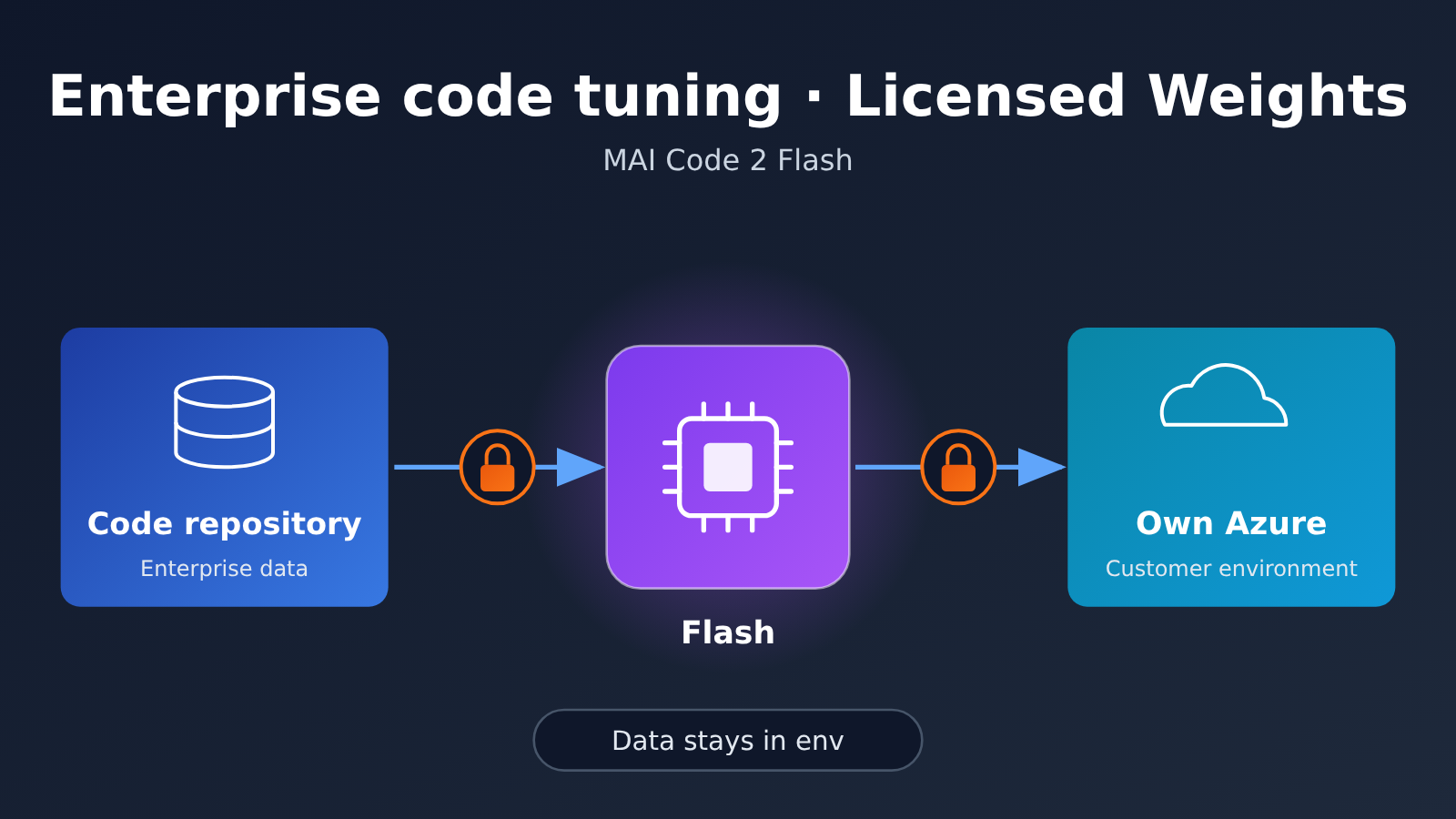
MAI Code 2 Flash Enterprise Fine-Tuning Concepts: To Know
| Concept | Brief explanation |
|---|---|
| MAI Code 2 Flash | A code model in Microsoft’s MAI series, released alongside MAI Code 2; the model card describes both as hosted services on Azure GPUs |
| MAI Licensed Weights | A program announced on 2026-11-17 that lets enterprises deploy and customize Microsoft AI models within their own Azure environments |
| Frontier Company collaboration | The initial rollout approach for Licensed Weights; interested enterprises need to contact their Microsoft account team |
| Microsoft Foundry | Microsoft’s model and AI application platform, where you can create hosted MAI Code 2 Flash deployments, currently labeled as a limited access preview |
| Responses API | An OpenAI-compatible interface shape; Flash deployments in Foundry are invoked through it |
| Managed reinforcement fine-tuning | Platform-hosted reinforcement-learning-style fine-tuning; during verification, the corresponding entry in Foundry’s public training table is the MAI-Code-1.1-Flash preview |
| MISRA | A C/C++ coding standard commonly used in automotive and other embedded domains to constrain safety-critical code |
| Holdout set | A set of samples that isn’t used for training and only serves evaluation, used to test how the model performs on new problems |
| Mergeable fix | A patch that can be merged straight into the codebase after compilation, checks, and human review |
MAI Code 2 Flash fine-tuning news: impact at a glance
| Audience | Actual impact |
|---|---|
| Enterprise platforms and engineering productivity teams | If you have stable, narrowly scoped code tasks and historical fix data, you can work with your customer team to evaluate the Licensed Weights program |
| Individual developers | Day-to-day use still runs through GitHub Copilot or Foundry-hosted inference; you can’t get the weights, and there’s no self-serve fine-tuning entry point for individuals |
| Security and compliance leads | The announcement promises that enterprises retain their data and adaptation outputs, but specific permissions, regions, and retention rules are subject to the contract and implementation plan |
| Technical writers and evaluators | When citing 44%, you must include the denominator and evaluation scope, and distinguish training table entries for the old and new models |
The objective facts: what the Licensed Weights announcement confirms
Core commitments in the MAI Licensed Weights announcement
On 2026-11-17, Microsoft published the MAI Licensed Weights announcement, describing the program as deploying and customizing Microsoft AI models inside the customer’s own Azure environment. Enterprises can use their own proprietary business knowledge and data to customize the models, and they control how deployment is done, who can access it, and when upgrades happen.
On data ownership, the announcement states that the enterprise retains its data and the resulting adaptations, and that Microsoft will use them to train Microsoft models only with the enterprise’s explicit consent. Note that this is announcement-level language. For a specific project, the contracting entity, access permissions, deployment region, and data retention requirements still need to be verified against the documents applicable to that engagement and the actual deployment configuration.
Three operational entry points for MAI Code 2 Flash
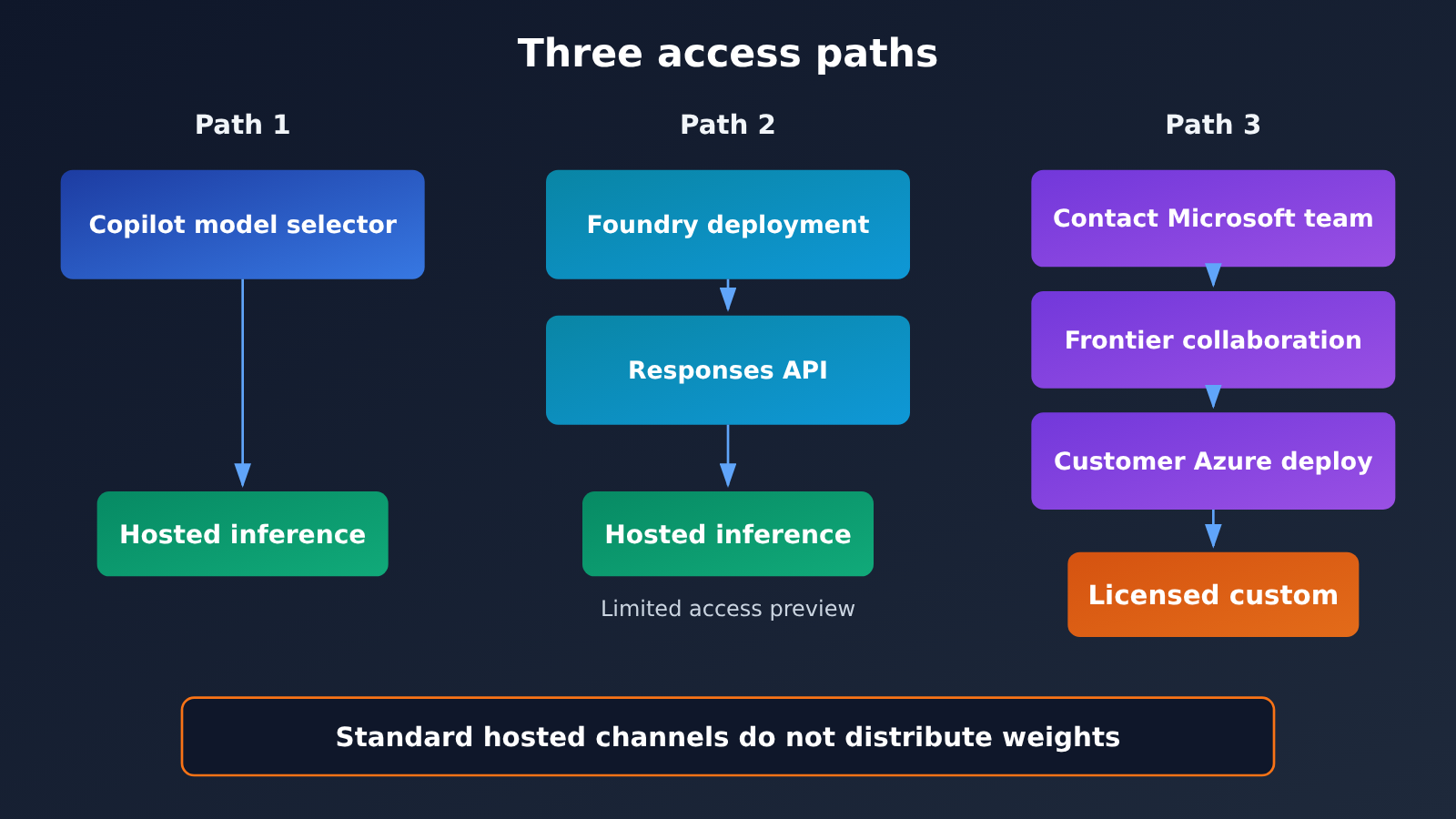
The Get started section of the announcement is clear: initially, the program is introduced through the Frontier Company collaboration, and interested enterprises should contact their Microsoft account team. The Custom Models page gives the same guidance to contact the account team and also shows the Foundry entry point. These page entry points are for learning about the product; as for which trainable model versions, project eligibility, and usage conditions apply, you need to verify them at the relevant level.
The standard product channel is another route. On page 4 of the original model card, MAI Code 2 and MAI Code 2 Flash are described as managed services on Microsoft Azure GPUs, and the standard hosted channel does not distribute model weights. In GitHub Copilot, you can use these two models from the model selector in supported clients. In Foundry, you can create a MAI Code 2 Flash deployment and invoke it through the OpenAI-compatible Responses API. The Ignite release notes published the same day mark Flash as a limited-access preview in Foundry.
MAI-Code-1.1-Flash in the Foundry Public Training Table
Foundry also has a public training capability table where you can cross-check model IDs, training methods, and deployment options. At the time of this verification, the table listed hosted reinforcement fine-tuning for the preview version of MAI-Code-1.1-Flash, along with the corresponding deployment restrictions.
This row carries 1.1, which means it belongs to the previous generation. The positive evidence that MAI Code 2 Flash can be fine-tuned comes from an enterprise case explicitly named by Microsoft. The project’s access scope comes from the Licensed Weights announcement. The training parameters for the older model only apply to the corresponding row in the table and can’t be directly applied to Code 2 Flash.
| Path | Entry point | What it can do | Weights | Status and conditions |
|---|---|---|---|---|
| GitHub Copilot | Model selector in supported clients | Hosted inference | Not distributed | Subject to client support |
| Foundry hosted deployment | Create a MAI Code 2 Flash deployment | Responses API inference | Not distributed | Limited access preview |
| Foundry public training table | Fine-tuning capability table | Hosted reinforcement fine-tuning | Restricted by table entry | At verification, it listed MAI-Code-1.1-Flash |
| Licensed Weights | Microsoft account team | Customer Azure deployment and customization | Per licensing agreement | Initially through Frontier Company partnership |
There’s one term here that’s easy to mix up: “deployment.” Creating a deployment in Foundry means choosing a hosted service for your own application to run inference. The “customer Azure deployment” in the announcement refers to authorized customization and deployment within the partnership scope. Both uses can be valid at the same time, but they mean different things.
Woven by Toyota’s MISRA Fix Case: The Original Framing
Woven by Toyota’s autonomous-driving software follows MISRA, the automotive embedded coding standard. According to notes in materials Microsoft published, the team trained MAI Code 2 Flash on the team’s historical MISRA fix records. The comparison target was a frontier model the team had originally used in production.
Microsoft’s result: among the cases where the original model needed manual rework, the custom Flash produced a mergeable fix on the first try in 44% of them, at less than one-tenth the cost of the original approach. This material is vendor disclosure, with named quotes from partner representatives; Microsoft did not disclose the actual sample size.
| Framing item | What Microsoft disclosed | Must not be rewritten as |
|---|---|---|
| Model | Custom MAI Code 2 Flash | Other MAI models or generic Flash |
| Training data | Woven’s historical MISRA fixes | Arbitrary enterprise code |
| Denominator | Cases where the original model needed manual rework | All defects or the entire batch of tasks |
| 44% | Share that produced a mergeable fix on the first try | Overall fix rate or reduction in incident rate |
| Cost | Less than one-tenth of the original approach | Production quote or generic price |
| Sample size | Not disclosed | Any specific number |
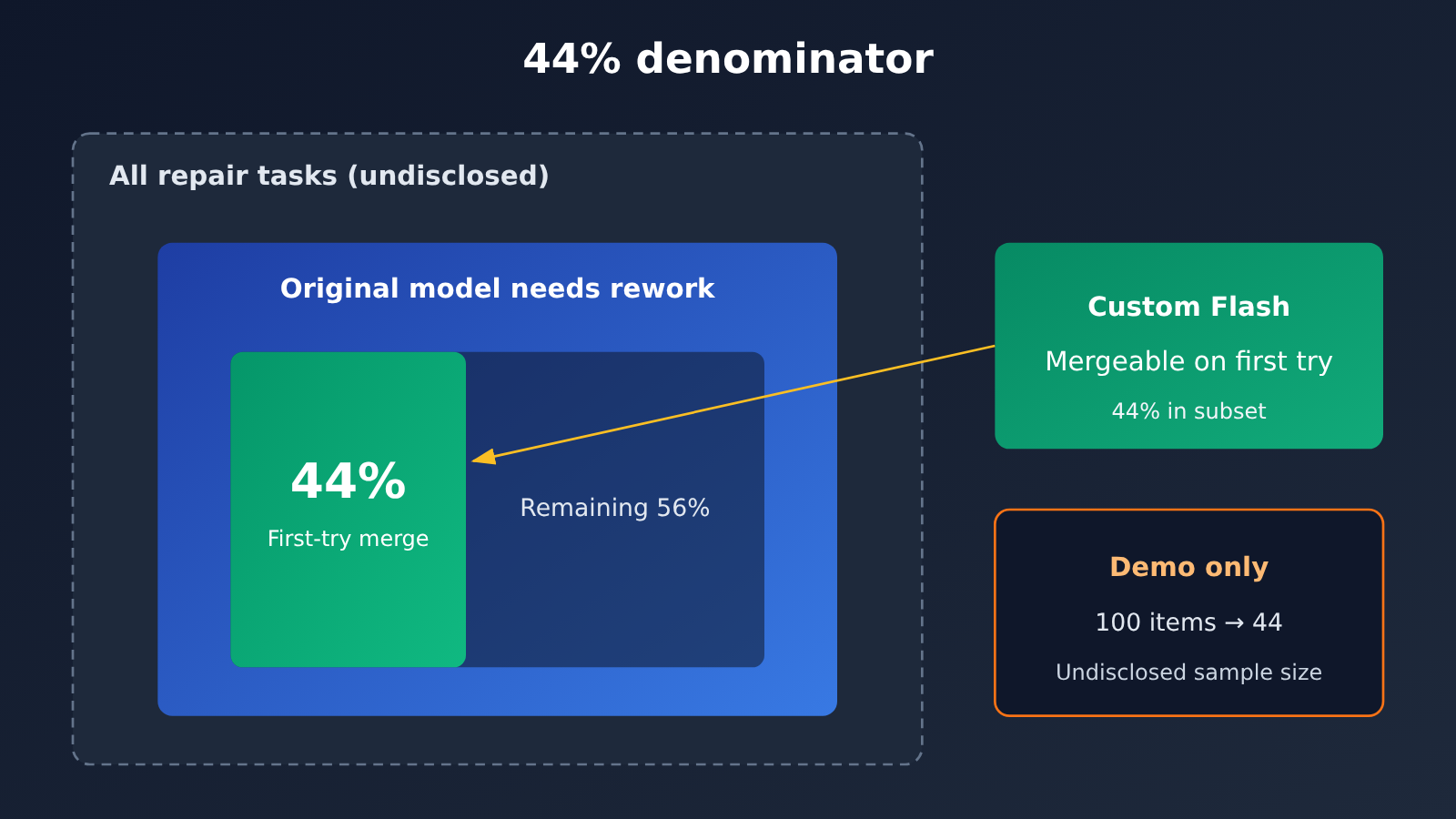
Here’s a purely mathematical example: suppose there are 100 cases where the original model needed manual rework, and 44 of them get a mergeable fix directly from the custom Flash. Then 44% of this group became merge candidates. The 100 here only illustrates the ratio; Microsoft has not disclosed the real sample size.
Analysis: How to Implement Enterprise Fine-Tuning for MAI Code 2 Flash
The announcement confirms that fine-tuning MAI Code 2 Flash is feasible, but provides no self-serve entry point
Putting the facts together, the conclusion breaks into three layers. First, the question of whether Code 2 Flash can be customized with enterprise code already has a named case study behind it — it’s not speculation. Second, the only viable route in is a Licensed Weights partnership, and the initial barrier is a Frontier Company relationship. Third, at the time of verification, the Foundry public training table did not list a self-serve fine-tuning row for Code 2 Flash.
So an enterprise’s first step isn’t writing training scripts — it’s figuring out which need it actually has: just calling ready-made inference, first evaluating the hosted version’s performance against historical samples, or genuinely needing customization and private deployment. For many teams, the first or second option is enough.
Why Tasks Like MISRA Suit Enterprise Code Fine-Tuning (Inference)
The following is an inference based on the case, not training-engineering details disclosed by Microsoft. The value of MISRA fixes lies in the fact that inputs and outputs can form stable pairs: rule numbers, change scope, historical merged patches, rerunnable checks, and review conclusions. What matters more than the code itself is the team’s standard for “how to decide whether a fix can be merged.”
What can be transferred to other enterprises is usually a similar narrow task, such as common fixes triggered by internal compilation rules or handling fixed-format security alerts. The broader the task and the more acceptance relies on subjective judgment, the harder it is to measure the return on customization.
Asset Checklist and Communication Items Before an Enterprise Project Kickoff
When contacting the customer team, it’s recommended to clarify the following. These are suggestions for discussion and don’t represent Microsoft’s fixed process:
- Exact model name: Write the full name MAI Code 2 Flash to avoid confusion with version 1.1.
- Task and acceptance: A narrow task, paired with a business goal and a manual acceptance method.
- Environment: Azure tenant, subscription, hosted environment, and whether training is completed inside the customer’s environment.
- Permissions and lifecycle: Who can access it, how upgrades are approved, and how to roll back.
- Asset ownership: Retention, export, and copy permissions for training data, weights, or adaptation outputs, subject to commercial terms and the implementation plan.
| Asset | Questions to confirm | Example owner |
|---|---|---|
| Company code | Source, code license, whether it contains sensitive values | R&D lead |
| Training data | Whether explicitly authorized, whether deduplicated | Data lead |
| Review records | Whether review conclusions can be used as labels | Quality lead |
| Generated outputs | Storage location and retention period | Platform lead |
| Adaptation outputs | Ownership, export, and deletion process | Legal and procurement |
| Base weights | Scope of authorization, whether they can be downloaded or redistributed | Legal and procurement |
MAI Code 2 Flash Evaluation Set Splitting Example Code
Training and holdout sets must be strictly isolated. Otherwise, the same fix can end up on both sides, which inflates the evaluation results. The script below deduplicates by code family, then splits by time, and only processes sample metadata that the enterprise has explicitly authorized.
import hashlib
import json

def fingerprint(sample):
    # Deduplicate by rule ID + normalized patch content to keep the same fix out of both sets
    key = sample["rule_id"] + "\n" + sample["patch"].strip()
    return hashlib.sha256(key.encode("utf-8")).hexdigest()

def split_by_time(samples, cutoff="2026-06-01"):
    seen, train, holdout = set(), [], []
    for s in sorted(samples, key=lambda x: x["merged_at"]):
        fp = fingerprint(s)
        if fp in seen:
            continue
        seen.add(fp)
        (train if s["merged_at"] < cutoff else holdout).append(s)
    return train, holdout

samples = [json.loads(l) for l in open("authorized_fixes.jsonl", encoding="utf-8")]
train, holdout = split_by_time(samples)
print(len(train), len(holdout))
View the full implementation: dual-denominator metric calculation
from dataclasses import dataclass
from typing import List

@dataclass
class EvalResult:
    sample_id: str
    baseline_needed_rework: bool   # Whether the existing workflow needs manual rework
    candidate_mergeable: bool      # Whether the custom solution is mergeable on the first attempt
    build_passed: bool
    static_check_passed: bool
    cost: float                    # Inference + retries + human review + training-hosting amortization

def report(results: List[EvalResult]) -> dict:
    total = len(results)
    hard = [r for r in results if r.baseline_needed_rework]
    mergeable = [r for r in results if r.candidate_mergeable]

    def rate(part, whole):
        return round(len(part) / len(whole), 4) if whole else None

    return {
        # Denominator 1: the full holdout set
        "overall_mergeable_rate": rate(mergeable, results),
        "build_pass_rate": rate([r for r in results if r.build_passed], results),
        "static_check_pass_rate": rate(
            [r for r in results if r.static_check_passed], results),
        # Denominator 2: the hard subset requiring rework in the existing workflow
        "hard_subset_size": len(hard),
        "hard_subset_mergeable_rate": rate(
            [r for r in hard if r.candidate_mergeable], hard),
        # Total cost per qualifying patch
        "cost_per_mergeable_patch": round(
            sum(r.cost for r in results) / len(mergeable), 2) if mergeable else None,
        "total_samples": total,
    }

if __name__ == "__main__":
    demo = [
        EvalResult("a1", True, True, True, True, 0.8),
        EvalResult("a2", True, False, True, False, 1.1),
        EvalResult("a3", False, True, True, True, 0.5),
    ]
    print(report(demo))
The two denominators must be reported separately. Success rates on the hard subset often look impressive, but they don’t represent the overall batch. Woven’s 44% figure uses the hard-subset denominator. Important changes and samples that are hard to validate automatically should always be left for human review.
Start with the Hosted Version for a Baseline Evaluation
If you don’t have cooperation eligibility yet, you can first run a baseline round on a held-out set using a Foundry hosted deployment — as long as you’ve already obtained limited-access preview eligibility and your code samples are allowed to be sent to the hosted service. Both the endpoint and the deployment name should follow what’s shown on the Foundry deployment page. The example below only reads from environment variables and doesn’t assume any address up front.
import os
from openai import OpenAI

client = OpenAI(
    api_key=os.environ["FOUNDRY_API_KEY"],
    base_url=os.environ["FOUNDRY_ENDPOINT"],  # Use the endpoint shown on the Foundry deployment page
)

resp = client.responses.create(
    model=os.environ["FOUNDRY_DEPLOYMENT_NAME"],  # The name of the MAI Code 2 Flash deployment you created
    input="以下 C 代码违反 MISRA 规则,请给出最小修复补丁:\n<已授权的代码片段>",
)
print(resp.output_text)
The baseline results help you decide whether the hosted version is already good enough on the hard subset, or whether the gap is large enough to justify pushing for a custom project. This step also surfaces problems in the sample format, the checking toolchain, and the review process early on.
Delivery Evidence to Retain During the Cooperation Phase
Once you’ve been granted cooperation eligibility, it’s a good idea to capture the training environment, inference deployment, and post-launch access management in a single project record. For each phase, note the owner, the Azure resource involved, how it runs, what data is accessible, the access approval, and the deletion process. The actual placement of data in the customer environment should be based on the project files and resource configuration.
This record maps directly to the two control commitments in the announcement — “who can access” and “when to escalate.” As launch approaches, keep a separate release identifier for the original base model, the customized version, and each rollback, so that any round of evaluation results can be traced back to a specific version.
Changes Worth Watching (Speculative)
The following are areas to monitor, not confirmed facts: whether Licensed Weights will expand from Frontier Company partnerships to more enterprises; whether the Foundry public training table will add a Code 2 Flash row; and when Flash’s limited-access preview will move to general availability. Until the official pages are updated, project proposals should note the verification date.
MAI Code 2 Flash Enterprise Fine-Tuning FAQ
Q1: Can MAI Code 2 Flash be fine-tuned with enterprise code?
Yes, but the path is a Licensed Weights enterprise partnership. Microsoft has publicly documented the case of Woven by Toyota training a custom Flash version using historical MISRA fixes. Initially, you’ll need to go through a Frontier Company partnership and contact the Microsoft account team.
Q2: Does creating a MAI Code 2 Flash deployment in Foundry mean I get the weights?
No. The model card states that standard hosted channels don’t distribute weights. A Foundry deployment means choosing a hosted service, running inference through the Responses API, and it’s currently a limited-access preview.
Q3: Can the hosted reinforcement fine-tuning in the Foundry training table be used directly for Code 2 Flash?
Not directly. At the time of verification, the table listed the `MAI-Code-1.1-Flash` preview, and its parameters and deployment constraints apply only to that row.
Q4: Can Woven by Toyota’s 44% be described as a “44% fix rate”?
No. The denominator is the cases where the original model required manual rework, and 44% is the share of those cases in which the custom Flash produced a mergeable fix on its first attempt. Microsoft hasn’t disclosed the sample size, and this figure doesn’t represent an overall fix rate or a cost quote.
Q5: Who owns the enterprise data and fine-tuning results?
Per the announcement, the data and adaptation results are retained by the enterprise, and Microsoft will only use them for training with explicit consent. The specific rights to retention, export, and deletion are governed by the contract and implementation plan.
Q6: Can the custom version be deployed on-premises or in another cloud?
Public materials only mention the customer’s own Azure environment. Rights for deployment in external regions, on-premises deployment, downloading, and redistribution must be confirmed under the specific agreement and can’t be inferred directly from the announcement.
Q7: What can teams without partnership eligibility do right now?
You can organize authorized samples, split out hold-out sets by time and code family, and run baseline evaluations using Copilot or the Foundry hosted version. Once the partnership channel is confirmed, these materials can be used directly in project discussions.
References
- Microsoft MAI Licensed Weights announcement: program description, Get started, and Woven evaluation notes
- Link:
microsoft.ai/news/introducing-mai-licensed-weights/
- Link:
- Microsoft AI Custom Models page: customer team contact guidance and quotes from Woven leadership
- Link:
microsoft.ai/models/custom-models/
- Link:
- MAI Code 2 and MAI Code 2 Flash model cards: hosted service and scope of use notes on page 4
- Link:
microsoft.ai/pdf/MAI-Code-2-And-MAI-Code-2-Flash-Model-Card.pdf
- Link:
- Microsoft Ignite 2026 announcement: Flash’s limited-access preview status in Foundry
- Link:
microsoft.ai/news/microsoft-ignite-2026/
- Link:
- Foundry fine-tuning overview and supported models table: model IDs, training methods, and deployment restrictions
- Link:
learn.microsoft.com/en-us/azure/foundry/fine-tuning/overview
- Link:
Public information verification date: 2026-11-25 (Beijing time). Project contracting, permissions, regions, and retention requirements are subject to the actual collaboration documents and deployment configuration.


